SUBSCRIBE TO OUR FREE NEWSLETTER
Daily news & progressive opinion—funded by the people, not the corporations—delivered straight to your inbox.
5
#000000
#FFFFFF
To donate by check, phone, or other method, see our More Ways to Give page.
Daily news & progressive opinion—funded by the people, not the corporations—delivered straight to your inbox.
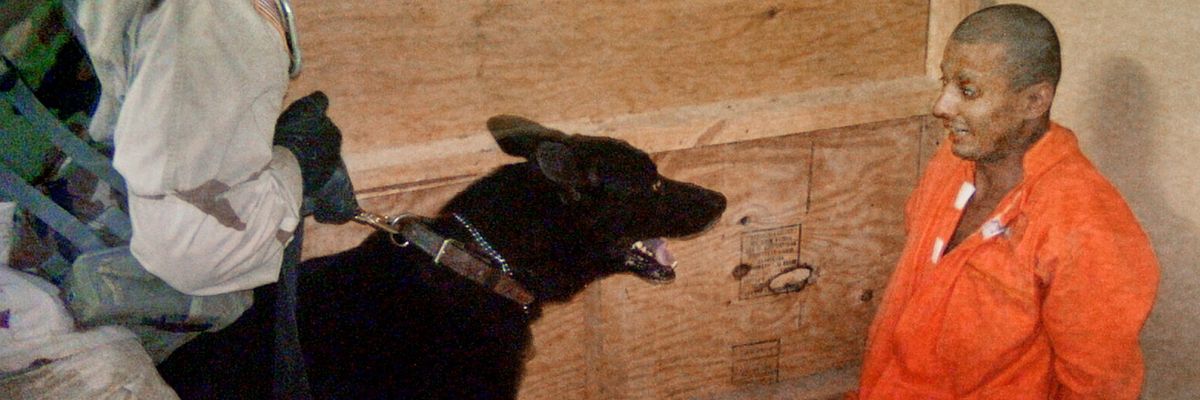
U.S. Army Sgt. Michael Smith uses a dog to torture a terrified Iraqi detainee at Abu Ghraib prison near Baghdad.
In a landmark verdict cheered by human rights defenders around the world, a federal jury in Virginia found a U.S. military contractor liable for the torture of three prisoners at the notorious Abu Ghraib prison during the invasion and occupation of Iraq in the early 2000s.
The jury ordered CACI Premier Technology to pay each of the three Iraqi plaintiffs $3 million in compensatory damages and $11 million in punitive damages, for a total of $42 million. It is the first time that a civilian contractor has been found legally responsible for abusing Abu Ghraib detainees.
The lawsuit against CACI—filed in 2008 by the Center for Constitutional Rights (CCR) on behalf of Suhail Al Shimari, Asa'ad Al Zuba'e, and Salah Al-Ejaili—alleged that company officials conspired with U.S. military personnel in subjecting the plaintiffs to torture and other crimes.
As CCR noted Tuesday:
The plaintiffs brought their case under the Alien Tort Statute, a 1789 federal law that allows foreign nationals to seek redress in U.S. courts for certain violations of international law. This historic outcome follows 16 years of litigation, more than 20 attempts by CACI to have the case dismissed, and a previous trial in which the jury was unable to reach a verdict. Never before this case had survivors of U.S. post-9/11 torture testified in a U.S. courtroom. It also featured testimony from U.S. generals, CACI employees, and former [military police officers] involved in the torture.
"Today is a big day for me and for justice," said Al-Ejaili. "I've waited a long time for this day."
"This victory isn't only for the three plaintiffs in this case against a corporation," he added. "This victory is a shining light for everyone who has been oppressed and a strong warning to any company or contractor practicing different forms of torture and abuse."
CCR legal director Baher Azmy said that "our clients have fought bravely for 16 years in search of justice for the horrors they endured at Abu Ghraib, against all of the challenges this massive private military contractor threw in their way over the years to avoid basic accountability for its role in this shameful episode in American history."
"We are awed by our clients' courage and by the power of their testimony in court, and we are grateful that this jury knew enough to credit their story over the deflections of CACI," Azmy added. "We thank the jury for affording our clients the measure of justice they came to a United States court to seek."
Like Guantánamo Bay, Abu Ghraib became a byword for U.S. torture during the Bush administration as it waged a worldwide war on terrorism following the September 11, 2001 attacks. The prison's worldwide notoriety stems from the leak and publication in 2004 of photos showing U.S. troops torturing and abusing Abu Ghraib detainees, both living and dead, often with smiles on their faces.
A 2004 investigation by U.S. Army Lt. Gen. Anthony Jones and Maj. Gen. George Fay found that CACI employees participated in and encouraged the torture of Abu Ghraib prisoners.
Investigators found that employees of CACI and Titan Corporation (now L3 Technologies) tortured Abu Ghraib detainees and encouraged U.S. troops to do likewise. Dozens of Abu Ghraib detainees died in U.S. custody, some of them as a result of being tortured to death. Abu Ghraib prisoners endured torture ranging from rape and being attacked with dogs to being forced to eat pork and renounce Islam.
A separate U.S. Army report concluded that most Abu Ghraib prisoners were innocent, with the Red Cross estimating that between 70-90% of inmates there were wrongfully detained. These include women who were held as bargaining chips to induce suspected militants to surrender.
Eleven low-ranking U.S. soldiers were convicted and jailed for their roles in Abu Ghraib torture. Brig. Gen. Janis Karpinski, the prison's commanding officer, was demoted. No other high-ranking military officer faced accountability for the abuse. Senior Bush administration officials—who had authorized many of the "enhanced interrogation techniques" used at prisons including Abu Ghraib and Guantánamo Bay—lied about their knowledge of the torture. None of them were ever held accountable.
Dear Common Dreams reader, It’s been nearly 30 years since I co-founded Common Dreams with my late wife, Lina Newhouser. We had the radical notion that journalism should serve the public good, not corporate profits. It was clear to us from the outset what it would take to build such a project. No paid advertisements. No corporate sponsors. No millionaire publisher telling us what to think or do. Many people said we wouldn't last a year, but we proved those doubters wrong. Together with a tremendous team of journalists and dedicated staff, we built an independent media outlet free from the constraints of profits and corporate control. Our mission has always been simple: To inform. To inspire. To ignite change for the common good. Building Common Dreams was not easy. Our survival was never guaranteed. When you take on the most powerful forces—Wall Street greed, fossil fuel industry destruction, Big Tech lobbyists, and uber-rich oligarchs who have spent billions upon billions rigging the economy and democracy in their favor—the only bulwark you have is supporters who believe in your work. But here’s the urgent message from me today. It's never been this bad out there. And it's never been this hard to keep us going. At the very moment Common Dreams is most needed, the threats we face are intensifying. We need your support now more than ever. We don't accept corporate advertising and never will. We don't have a paywall because we don't think people should be blocked from critical news based on their ability to pay. Everything we do is funded by the donations of readers like you. When everyone does the little they can afford, we are strong. But if that support retreats or dries up, so do we. Will you donate now to make sure Common Dreams not only survives but thrives? —Craig Brown, Co-founder |
In a landmark verdict cheered by human rights defenders around the world, a federal jury in Virginia found a U.S. military contractor liable for the torture of three prisoners at the notorious Abu Ghraib prison during the invasion and occupation of Iraq in the early 2000s.
The jury ordered CACI Premier Technology to pay each of the three Iraqi plaintiffs $3 million in compensatory damages and $11 million in punitive damages, for a total of $42 million. It is the first time that a civilian contractor has been found legally responsible for abusing Abu Ghraib detainees.
The lawsuit against CACI—filed in 2008 by the Center for Constitutional Rights (CCR) on behalf of Suhail Al Shimari, Asa'ad Al Zuba'e, and Salah Al-Ejaili—alleged that company officials conspired with U.S. military personnel in subjecting the plaintiffs to torture and other crimes.
As CCR noted Tuesday:
The plaintiffs brought their case under the Alien Tort Statute, a 1789 federal law that allows foreign nationals to seek redress in U.S. courts for certain violations of international law. This historic outcome follows 16 years of litigation, more than 20 attempts by CACI to have the case dismissed, and a previous trial in which the jury was unable to reach a verdict. Never before this case had survivors of U.S. post-9/11 torture testified in a U.S. courtroom. It also featured testimony from U.S. generals, CACI employees, and former [military police officers] involved in the torture.
"Today is a big day for me and for justice," said Al-Ejaili. "I've waited a long time for this day."
"This victory isn't only for the three plaintiffs in this case against a corporation," he added. "This victory is a shining light for everyone who has been oppressed and a strong warning to any company or contractor practicing different forms of torture and abuse."
CCR legal director Baher Azmy said that "our clients have fought bravely for 16 years in search of justice for the horrors they endured at Abu Ghraib, against all of the challenges this massive private military contractor threw in their way over the years to avoid basic accountability for its role in this shameful episode in American history."
"We are awed by our clients' courage and by the power of their testimony in court, and we are grateful that this jury knew enough to credit their story over the deflections of CACI," Azmy added. "We thank the jury for affording our clients the measure of justice they came to a United States court to seek."
Like Guantánamo Bay, Abu Ghraib became a byword for U.S. torture during the Bush administration as it waged a worldwide war on terrorism following the September 11, 2001 attacks. The prison's worldwide notoriety stems from the leak and publication in 2004 of photos showing U.S. troops torturing and abusing Abu Ghraib detainees, both living and dead, often with smiles on their faces.
A 2004 investigation by U.S. Army Lt. Gen. Anthony Jones and Maj. Gen. George Fay found that CACI employees participated in and encouraged the torture of Abu Ghraib prisoners.
Investigators found that employees of CACI and Titan Corporation (now L3 Technologies) tortured Abu Ghraib detainees and encouraged U.S. troops to do likewise. Dozens of Abu Ghraib detainees died in U.S. custody, some of them as a result of being tortured to death. Abu Ghraib prisoners endured torture ranging from rape and being attacked with dogs to being forced to eat pork and renounce Islam.
A separate U.S. Army report concluded that most Abu Ghraib prisoners were innocent, with the Red Cross estimating that between 70-90% of inmates there were wrongfully detained. These include women who were held as bargaining chips to induce suspected militants to surrender.
Eleven low-ranking U.S. soldiers were convicted and jailed for their roles in Abu Ghraib torture. Brig. Gen. Janis Karpinski, the prison's commanding officer, was demoted. No other high-ranking military officer faced accountability for the abuse. Senior Bush administration officials—who had authorized many of the "enhanced interrogation techniques" used at prisons including Abu Ghraib and Guantánamo Bay—lied about their knowledge of the torture. None of them were ever held accountable.
In a landmark verdict cheered by human rights defenders around the world, a federal jury in Virginia found a U.S. military contractor liable for the torture of three prisoners at the notorious Abu Ghraib prison during the invasion and occupation of Iraq in the early 2000s.
The jury ordered CACI Premier Technology to pay each of the three Iraqi plaintiffs $3 million in compensatory damages and $11 million in punitive damages, for a total of $42 million. It is the first time that a civilian contractor has been found legally responsible for abusing Abu Ghraib detainees.
The lawsuit against CACI—filed in 2008 by the Center for Constitutional Rights (CCR) on behalf of Suhail Al Shimari, Asa'ad Al Zuba'e, and Salah Al-Ejaili—alleged that company officials conspired with U.S. military personnel in subjecting the plaintiffs to torture and other crimes.
As CCR noted Tuesday:
The plaintiffs brought their case under the Alien Tort Statute, a 1789 federal law that allows foreign nationals to seek redress in U.S. courts for certain violations of international law. This historic outcome follows 16 years of litigation, more than 20 attempts by CACI to have the case dismissed, and a previous trial in which the jury was unable to reach a verdict. Never before this case had survivors of U.S. post-9/11 torture testified in a U.S. courtroom. It also featured testimony from U.S. generals, CACI employees, and former [military police officers] involved in the torture.
"Today is a big day for me and for justice," said Al-Ejaili. "I've waited a long time for this day."
"This victory isn't only for the three plaintiffs in this case against a corporation," he added. "This victory is a shining light for everyone who has been oppressed and a strong warning to any company or contractor practicing different forms of torture and abuse."
CCR legal director Baher Azmy said that "our clients have fought bravely for 16 years in search of justice for the horrors they endured at Abu Ghraib, against all of the challenges this massive private military contractor threw in their way over the years to avoid basic accountability for its role in this shameful episode in American history."
"We are awed by our clients' courage and by the power of their testimony in court, and we are grateful that this jury knew enough to credit their story over the deflections of CACI," Azmy added. "We thank the jury for affording our clients the measure of justice they came to a United States court to seek."
Like Guantánamo Bay, Abu Ghraib became a byword for U.S. torture during the Bush administration as it waged a worldwide war on terrorism following the September 11, 2001 attacks. The prison's worldwide notoriety stems from the leak and publication in 2004 of photos showing U.S. troops torturing and abusing Abu Ghraib detainees, both living and dead, often with smiles on their faces.
A 2004 investigation by U.S. Army Lt. Gen. Anthony Jones and Maj. Gen. George Fay found that CACI employees participated in and encouraged the torture of Abu Ghraib prisoners.
Investigators found that employees of CACI and Titan Corporation (now L3 Technologies) tortured Abu Ghraib detainees and encouraged U.S. troops to do likewise. Dozens of Abu Ghraib detainees died in U.S. custody, some of them as a result of being tortured to death. Abu Ghraib prisoners endured torture ranging from rape and being attacked with dogs to being forced to eat pork and renounce Islam.
A separate U.S. Army report concluded that most Abu Ghraib prisoners were innocent, with the Red Cross estimating that between 70-90% of inmates there were wrongfully detained. These include women who were held as bargaining chips to induce suspected militants to surrender.
Eleven low-ranking U.S. soldiers were convicted and jailed for their roles in Abu Ghraib torture. Brig. Gen. Janis Karpinski, the prison's commanding officer, was demoted. No other high-ranking military officer faced accountability for the abuse. Senior Bush administration officials—who had authorized many of the "enhanced interrogation techniques" used at prisons including Abu Ghraib and Guantánamo Bay—lied about their knowledge of the torture. None of them were ever held accountable.