

SUBSCRIBE TO OUR FREE NEWSLETTER
Daily news & progressive opinion—funded by the people, not the corporations—delivered straight to your inbox.
5
#000000
#FFFFFF
To donate by check, phone, or other method, see our More Ways to Give page.
Daily news & progressive opinion—funded by the people, not the corporations—delivered straight to your inbox.

AI data centers have been added to the limited menu for economic development in marginalized US communities, but people in those communities have good reason to oppose them.
One word—plastics. That was the golden grail that Dustin Hoffman learned about from some well-wisher in the movie The Graduate. I remember watching the film as a farm kid and thinking about the updated version I was being told by my guidance counselors—one word: computers. We are now in the midst of the “Fourth Industrial Revolution” and the latest mantra is: artificial intelligence. Such free advice, though, could really be a costly warning in disguise.
Granted, there is a lot of poverty in the “richest” nation on Earth, and marginalized US communities often have few choices for economic (mal) development. It becomes a twisted game of pick your own poison: supermax prison, toxic waste dump, ethanol facility, tar sands pipeline… Now, AI data centers have been added to the limited menu. Someone recently shared a map of looming AI data centers across the world. It reminded me of how a tumor spreads and Edward Abbey’s quote that “growth for the sake of growth is the ideology of the cancer cell.”
The fact that Big Data has targeted Rural America for its latest mastitis should be no surprise. We have lots of available land to grab, thanks to the legacy of settler colonialism and family-farm foreclosure. Back in August I remember driving past Beaver Dam, Wisconsin and watching bulldozers flattening over 800 acres along Hwy 151 and my first hunch was: data center. Sure enough, the secretive $1 billion deal with Meta was finally revealed in a November press release. Just north of Madison in the town of DeForest, Blackstone subsidiary QTS Realty Trust is aiming to build another $12 billion data center on close to 1,600 acres. And if we need to free up more land for AI, we quaint rural folks could just abandon growing real Xmas trees and force people to buy plastic ones instead, as one Fox News “expert” suggested over the holidays. Former President Joe Biden visited Mt. Pleasant, Wisconsin in May 2024 to promote Microsoft’s new $3.3 billion 300+ acre AI campus on the former site of flat screen maker, Foxconn, that welcomed President Donald Trump for its groundbreaking back in 2018. Foxconn abandoned that $10 billion project and its 13,000 job promise, after getting millions in state subsidies and local tax deferrals.
The Microsoft AI complex in Mt. Pleasant will also require over 8 million gallons of water per year from Lake Michigan. We still have some clean water, though that may not last long thanks to agrochemical monocultures, CAFO manure dumping, and PFAS-laden sludge spreading. And AI certainly is thirsty—the Alliance for the Great Lakes noted in its August 2025 report that a hyperscale AI data center needs up to 365 million gallons of water to keep itself cool—that is as much water as is needed by 12,000 people! A recent investigative report by Bloomberg News found that over two-thirds of the AI data centers built since 2022 are in parts of the country already facing water stress. And it is really hard to drink data.
But is all the AI hype just another bubble about to burst? Rural communities (and public taxpayers) have been offered many “amazing” schemes in the past that ended up being just a “bait and switch”—another hollow promise.
In the Midwest we also have potential access to vast electricity (fracked natural gas, wind and solar farms, methane digesters), and relatively under-stressed high voltage grids (unlike California or Texas), though the loss of “cheaper” imported Canadian hydropower with the latest trade war could be a serious challenge. In 2023 the US had over a $2 billion electricity trade deficit vis-a-vis Canada. According to a recent Clean Wisconsin report, just two of our proposed AI data centers will require 3.9 gigawatts—1.5 times the current power demand of all 4.3 million homes in the state.
But, no worry, there are dilapidated US nuclear reactors with massive waste dumps that could be put back online such as Palisades in Michigan, despite opposition from environmental activists and family farmers. The Trump administration also just announced a $1 billion low-interest loan to reanimate Three Mile Island in Pennsylvania for the sake of AI. Until all that happens, though, regular ratepayers can expect a huge hike in their energy bills as Big Data has the market clout to siphon off what it needs first, especially as it colludes with utility monopolies. Many people in Wisconsin are already paying for $1+ billion in stranded assets—mostly defunct coal plants, as well as nuclear waste storage facilities—while utility investors continue to receive guaranteed dividends of 9-10%.
But is all the AI hype just another bubble about to burst? Rural communities (and public taxpayers) have been offered many “amazing” schemes in the past that ended up being just a “bait and switch”—another hollow promise. If we subsidize a massive data center, will the projected “market” for increasing algorithms actually come? Many within the AI industry don’t think so, and are now invoking the lessons we should have learned from the Enron scandal decades ago or the even worse sequel in the subprime mortgage-fueled financial meltdown. Corporate cheerleaders can be quite clever when it comes to inflating prices (and stocks) for goods and services that may not even exist, while hiding their massive debt obligations in a whole cascading series of shadowy shell subsidiaries and dishonest accounting shenanigans.
Many industry insiders are ringing alarm bells. "These models are being hyped up, and we're investing more than we should," said Daron Acemoglu, who won the 2024 Nobel Economics Prize, quoted in a recent NPR story about the current AI boom or bubble. OpenAI says it will spend $1.4 trillion on data centers over the next eight years, while Amazon, Google, Meta, and Microsoft are going to throw in another $400 billion. Meanwhile, just 3% of people who use AI now pay for it, and many are frantically trying to figure out how to turn off AI mode on their internet searches and to reject AI eavesdropping on their Zoom calls. Where is the real revenue going to come from to pay for all this AI speculation? The same NPR story notes that such a flood of leveraged capital is equal to every iPhone user on Earth forking over $250 to “enjoy” the benefits of AI—and “that’s not going to happen,” adds Paul Kedrosky, a venture capitalist who is now a research fellow at MIT's Institute for the Digital Economy. Morgan Stanley estimates AI companies will shell out $3 trillion by 2028 for this data center buildout—but less than 50% of that money will come from them. Hmmm...
Special purpose vehicle (SPV) may sound like a fancy name for a retrofitted tractor, but that is how Big Data is creating a Potemkin Village to hide their Ponzi Scheme. Here is one example from Richland Parish, Louisiana where Meta is now building its Hyperion Data Center—a massive $27 billion project. A Wall Street outfit, Blue Owl, borrows $27 billion, using Meta’s future rent payments for a data center to back up its loan. Meta’s 20% “mortgage” on the facility gives them 100% control of the purported data crunching from the facility. This debt never shows up on Meta’s books and remains hidden from carefree investors and shallow analysts, but, like other synthetic financial instruments such as the now infamous mortgage backed security (MBS), the reality only comes home to roost when the house of cards collapses and Meta has to eventually pay off Blue Owl.
In the meantime, as the Louisiana Illuminator reports, the residents of Richland Parish (where 25% live below the poverty level) are bearing the brunt of all the real costs of having an AI factory farm. Dozens of crashes involving construction vehicles; damage to local roads; and massive future energy demands (three times that required for the entire city of New Orleans), which will entail new natural gas power plants to be built (subsidized by existing ratepayers even as fossil fuel-induced climate change floods the Louisiana delta). Beyond the initial building flurry, AI data centers are ultimately job poor. It just doesn’t take that many people to tend computers once they are built. As Meta’s VP, Brad Smith, admitted, the 250,000 square foot Hyperion data center may need 1,500 workers to build but barely 50 to operate. Beyond all the ballyhoo, the main reason a particular community is chosen to “host” one seems to be based upon the bought duplicity of elected officials and the excessive generosity of local taxpayers. Not a good cost-benefit analysis—unless you are Big Data.
And then there are the questionable kickback schemes between the suppliers of the technology and those owning the data centers. If you are maker of computer chips, would you not be tempted to fork over capital to a major buyer of your own products to ensure future demand? Nvidia just announced a $100 billion stake in OpenAI to help bankroll the data centers. In turn OpenAI signed a $300 billion deal with Oracle to actually build the AI data centers that will require Nvidia’s graphics processing units (GPUs). OpenAI also signed a separate $6+ billion deal with former BitCoin miner, CoreWeave, which rents out internet cloud access (using Nvidia’s chips once again). This type of incestuous circular financing should raise eyebrows to anyone who studies business ethics—and perhaps remind others of how a toilet operates.
What is all this AI doing? Promoters will point to many innovations—faster screening for cancer cells, closer connection to far-flung relatives, precision application of fertilizers and pesticides, elimination of drudgery in the workplace through automation. A bright future indeed—or perhaps not?
The real issue is whether or not AI data centers are economically viable, socially appropriate, environmentally sustainable, and actually serve the public interest.
In August 2025, ProPublica reported that the Food and Drug Administration (FDA) had lost 20% of its staff devoted to food safety thanks to DOGE cuts. Inspection of food import facilities is now at a historic low even as our dependence on the rest of the world to feed us grows. But not to worry, the FDA announced in May that AI was coming to the rescue thanks to a large language model (LLM)—dubbed Elsa—that would be deployed alongside what’s left of its human staff to expedite their oversight work. Hopefully, Elsa knows melamine when it sees it. AI chatbots are also growing in popularity and available 24-7 to “talk or advise” people on all sorts of pressing issues—how to win more friends, how to cheat on this exam, how to make up fake legal opinions, even encouraging a teenager to commit suicide and suggesting to someone else that they murder their own parents.
But there is an even dirtier AI underbelly. Some have dubbed these AI slop, AI smut, and AI stazi—three 21st-century horsemen of the digital apocalypse. What is this all about? Well, a lot of these accelerating AI algorithms are actually devoted to selling “products” that many people do not want and would find objectionable, as well as providing “services” that undermine our basic freedoms. Slop (Merriam Webster’s word of 2025) is used to describe when AI generates internet content that is only meant to make money through advertising. Right now there are thousands of wannabe internet “creatives” all over the globe, watching “how-to videos” to manufacture AI social media to grab the eyeballs of US consumers. That cute puppy video you see on Instagram or that shocking “news” story you read on Facebook is not by accident—the goal is to monetize clicks per thousand (cost per mille, or CPM) where advertisers pay for how much their ad is viewed online. This is also why online content is often overly long (where is the actual recipe in this cooking blog?), since that increases ad scrolling. The average US consumer is now subject to between 6,000 and 10,000 ads per day—70% of which are online. For more on AI slop, visit: https://www.visibrain.com/blog/ai-slop-social-media.
An even worse virtual commodity is AI smut—literally algorithms creating pornography. This perverted version of AI scraps the internet for images (high school yearbooks, red carpet fashion shows, popular music concerts, street cam footage, etc.) and then uses “face swap” programs to create personalized hardcore rubbish. There is little if any accountability for this theft of public images and violation of personal privacy—at best those involved are “shamed” into taking down their AI sites after being exposed due to fears of liability and prosecution for child abuse. But that has hardly stopped this seedy AI subsector. Can you imagine your face or image being put into such a lucrative sexploitative scenario without your permission? At this point, there are hardly any internet police walking the beat in the virtual AI world. We don’t even have the right to be forgotten on the internet.
Which brings us to AI stazi—the updated version of the Cold War-era East German secret police. University of Wisconsin Madison just announced the creation of a College of Computing and Artificial Intelligence (CAI), in part thanks to a $140 million donation from Cisco. Few Bucky Badger fans know that 30 years ago they were used as guinea pigs while cheering at Camp Randall Stadium to help create facial recognition technology through a UW-Madison grant from the Department of Defense Applied Research Agency (DARPA). Visitors to the UW campus today will no doubt “enjoy” the automated license plate readers (ALRPs) owned by Flock Safety. According to an August 2025 Wisconsin Examiner expose, there are hundreds of Flock cameras across the state in use by law enforcement agencies, including Wisconsin county sheriff departments with active 287(g) cooperation agreements with Immigration and Customs Enforcement. No warrant is needed for law enforcement agencies to browse the national Flock database. In fact, agents have used Flock to track peaceful protesters, spy on spouses, or just stalk people they don’t like. To see where Flock cameras are near you, visit: www.deflock.me. Of course, Flock Security has outsourced its AI programming to cheaper (and more secure?) Filipino contractors. Similar AI spying networks such as Pegasus have been widely exposed and have become “bread and butter” for authoritarian regimes from Israel to Saudi Arabia. China and Russia have their own versions (Skynet, SORM, etc.). Thanks to the cozy relationship between Trump and Peter Thiel, the US-based AI mercenary outfit, Palantir, is now being redeployed for domestic surveillance—first revealed by Edward Snowden back in 2017.
The latest executive bluster from Trump is that states’ rights are out the window when it comes to regulating AI data centers—such federal preemption of local democratic control is part of the larger neoliberal “race to the bottom” forced-trade agenda. But the cat is already out of the bag as dozens of communities have successfully blocked AI data center projects and others are poised to do the same based upon their winning strategies. Better yet, this is a bipartisan grassroots organizing issue!
What is the best way to keep out an AI factory farm? No non-disclosure agreements (NDAs)! These are massive development schemes that could not exist without the approval and support of elected officials, so any agreement should not be secret. They can hardly claim to be providing a public good if they are not subject to transparency and oversight. No sweetheart deals! Big Data is among the wealthiest sectors of our current economy and does not need or deserve subsidies, discounted electric rates, tax increment financing, property tax holidays, or other incentives. It is a classic move of crony capitalism to privatize the benefits and socialize the costs. No regulatory loopholes! Given their huge demands for land, water, and energy, Big Data should not be allowed to cut legal corners and needs to follow all the rules of any other normal enterprise—full liability coverage, no special economic zones, consideration of cumulative impacts, protections for ratepayers, no unregulated toxic pollution or illegal water transfer in violation of the Clean Water Act or the Great Lakes Compact, etc. How much water your data center demands is hardly a “trade secret.”
And most important, don’t let Big Data boosters belittle your legitimate concerns as “neo-Luddite!” Everyone uses technology—even the Amish. The real issue is whether or not AI data centers are economically viable, socially appropriate, environmentally sustainable, and actually serve the public interest. People have good reasons to be wary and oppose them on all those fronts.
For more info, checkout: Big Tech Unchecked: A Toolkit for Community Action
As well as the North Star Data Center Policy Toolkit

"The court saw that Elon Musk and his unqualified lackeys present a grave danger to Social Security and have illegally accessed the data of millions of Americans," said one union leader.
Defenders of the Social Security Administration celebrated a federal judge's Thursday order blocking U.S. President Donald Trump and Elon Musk's Department of Government Efficiency from access to millions of Americans' SSA records.
"The DOGE team is essentially engaged in a fishing expedition at SSA, in search of a fraud epidemic, based on little more than suspicion. It has launched a search for the proverbial needle in the haystack, without any concrete knowledge that the needle is actually in the haystack," wrote Maryland-based U.S. District Judge Ellen Hollander, who issued a temporary restraining order.
In her 137-page opinion, Hollander explained that "to facilitate the expedition, SSA provided members of the SSA DOGE team with unbridled access to the personal and private data of millions of Americans, including but not limited to Social Security numbers, medical records, mental health records, hospitalization records, drivers' license numbers, bank and credit card information, tax information, income history, work history, birth and marriage certificates, and home and work addresses."
"Yet, defendants, with so-called experts on the DOGE team, never identified or articulated even a single reason for which the DOGE team needs unlimited access to SSA's entire record systems, thereby exposing personal, confidential, sensitive, and private information that millions of Americans entrusted to their government," noted the appointee of former President Barack Obama.
"Indeed, the government has not even attempted to explain why a more tailored, measured, titrated approach is not suitable to the task. Instead, the government simply repeats its incantation of a need to modernize the system and uncover fraud. Its method of doing so is tantamount to hitting a fly with a sledgehammer," asserted the judge, concluding that "plaintiffs are likely to succeed on their claim that such action is arbitrary and capricious," and violates the Privacy Act and the Administrative Procedure Act.
The plaintiffs in this case are three advocacy and labor groups—the American Federation of State, County, and Municipal Employees (AFSCME), Alliance for Retired Americans, and the American Federation of Teachers (AFT)—represented by Democracy Forward. In addition to DOGE, they sued the SSA and its acting commissioner, Leland Dudek, over the "data grab."
"This is a major win for working people and retirees across the country," AFSCME president Lee Saunders said of the Thursday order. "The court saw that Elon Musk and his unqualified lackeys present a grave danger to Social Security and have illegally accessed the data of millions of Americans. This decision will not only force them to delete any data they have currently saved, but it will also block them from further sharing, accessing, or disclosing our Social Security information."
AFT president Randi Weingarten also welcomed the development, saying that "no one filed for Social Security believing their personal assets would be appropriated by a billionaire who attacks Social Security as a 'Ponzi scheme.' Americans must be allowed to retire with dignity and grace without having to worry about Elon Musk jeopardizing their savings."
Skye Perryman, president and CEO of Democracy Forward—which is involved with multiple court battles challenging the Trump administration's sweeping assault on the federal government—pledged Thursday that "our team will continue its legal efforts to ensure that this data remains protected and that those responsible are held accountable."
Judges who have ruled against Trump and Musk's agenda have faced threats of violence and impeachment.
While the Musk-led entity's attempt to gut the federal government has sparked various legal fights, "this ruling is the first time a federal court has explicitly mandated that Musk and DOGE delete unlawfully obtained data," according to Democracy Forward.
Critics of the administration's attempt to "sabotage" the SSA—which includes cutting phone services, laying off workers, shutting down offices, and stealing seniors' earned benefits—warn that Trump and Musk are pushing for privatization.
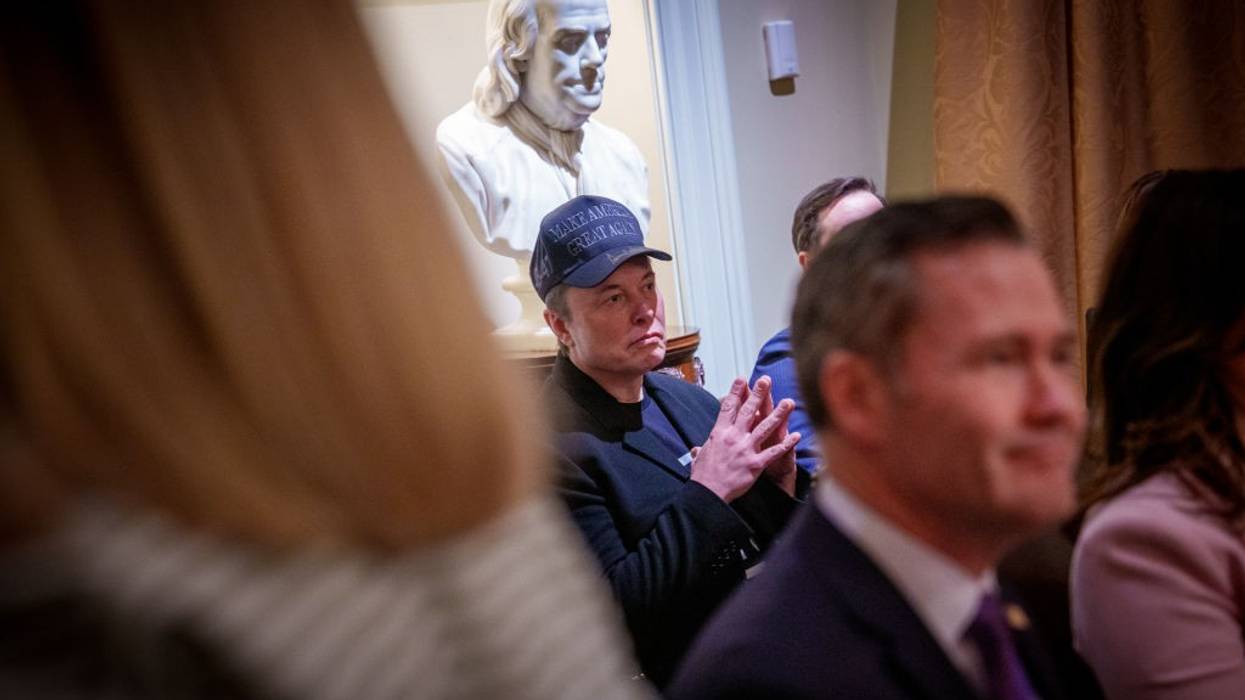
"Why do you lie so much about Social Security? To get people to lose faith in the system, and then you can give it over to Wall Street," said Sen. Bernie Sanders.
U.S. Sen. Bernie Sanders warned late Monday that billionaire Elon Musk's new call for up to $700 billion in cuts to mandatory federal spending is an alarming step in the direction of Social Security privatization, a longstanding—and deeply unpopular—goal of right-wing politicians and corporate-funded think tanks.
Musk, who is spearheading a large-scale assault on federal agencies and workers, told Fox Business host Larry Kudlow on Monday that "waste and fraud" in "entitlement spending"—a category that includes Social Security, Medicare, and Medicaid—is "the big one to eliminate," estimating that up to $700 billion could be cut from such programs.
It's not clear where Musk, who has lied repeatedly about Social Security in recent weeks, got the $700 billion figure. As Rolling Stone's Andrew Perez noted, "There is no expert on the planet who thinks there is $700 billion worth of annual fraud in America's safety net programs."
"Musk at one point in the interview cited a Government Accountability Office report which estimated that the government may lose between $233 billion and $521 billion annually to fraud, but that report covered the whole of the federal government—not just those programs," Perez wrote.
A 2024 report from the Social Security Administration's inspector general found that of the $8.6 trillion in Social Security benefits paid out between 2015 and 2022, roughly $71.8 billion was dispensed improperly—0.84% of the total.
"I think this is a prelude not only to cutting benefits, but to privatizing Social Security itself. I think that's in the back of their mind."
Musk also baselessly claimed that mandatory federal spending on programs such as Social Security, Medicare, and Medicaid is a "mechanism by which the Democrats attract and retain illegal immigrants, by essentially paying them to come here and then turning them into voters." (In reality, undocumented immigrants pay taxes that help finance Social Security and Medicare but cannot receive benefits from the programs.)
Sanders (I-Vt.) couldn't hide his disgust when he was asked during a CNN appearance to respond to Musk's remarks.
"Well, he has called Social Security a Ponzi scheme. They have already laid off 2,500 employees of the Social Security Administration," said Sanders. "If you ask me, I think this is a prelude not only to cutting benefits, but to privatizing Social Security itself. I think that's in the back of their mind."
"Why do you lie so much about Social Security? Why do you make it look like it's a broken, dysfunctional system?" Sanders asked. "The reason is to get people to lose faith in the system, and then you can give it over to Wall Street. That's my view."
Musk's latest attack on Social Security, a remarkably efficient program that has never missed a payment, came as his Department of Government Efficiency, or DOGE, has effectively taken over the Social Security Administration (SSA) and is pushing for massive cuts to the agency's staff and budget based on egregious lies.
"Appearing to misread a chart, for example, Musk said on social media in February that DOGE had identified payments to 'tens of millions' of deceased Americans—an incorrect assertion repeated by White House Press Secretary Karoline Leavitt," The Washington Post reported last week.
Everett Kelley, president of the American Federation of Government Employees—a union engaged in a legal fight against the Trump administration's purge of the federal workforce—wrote Monday that Musk's latest comments show that he "doesn't just want to cut the SSA workforce."
"He wants to eliminate Social Security entirely," Kelley added.
Joel Payne, chief communications officer at MoveOn Civic Action, said in a statement Tuesday that "Elon Musk and the Trump-led Republican Party are promising exactly what they have been trying to do for years: gut Social Security."
" Republicans want to illegally fire tens of thousands of workers responsible for making sure American seniors get their Social Security and then let Musk take his chainsaw to our benefits," said Payne. "We won't let them do it. Elon Musk, Donald Trump, and Republicans need to keep their hands off our Social Security."
The progressive advocacy group Social Security Works sounded a similarly defiant note.
"Elon Musk is a conman and a criminal, born with an emerald mine instead of a moral compass," the group wrote on social media. "Of course he wants to destroy Social Security, because he can't get his tiny greedy fingers on it any other way. HELL NO!"

"Local news blocked," one employee said. "So if there was a local shooting or something, I wouldn't be able to see."
The Trump administration's sweeping attacks on journalism and federal workers continued Thursday with an announcement that Social Security Administration employees can no longer access "general news" websites on government devices.
The Washington Post noted the email in an update to its Thursday reporting that earlier this week, acting SSA Commissioner Leland Dudek told top staff that members of President Donald Trump's Department of Government Efficiency (DOGE), headed by billionaire Elon Musk, are leading efforts to shrink the agency—which critics slam as a push toward privatization.
"DOGE people are learning and they will make mistakes, but we have to let them see what is going on at SSA," Dudek said, according to notes from the meeting. "I am relying on longtime career people to inform my work, but I am receiving decisions that are made without my input. I have to effectuate those decisions."
The newspaper reported that "on Thursday morning—three hours after the publication of this story—an all-staff email went out to SSA employees informing them that they would be prevented 'effective today' from accessing certain websites on their government devices, including 'online shopping,' ' general news,' and 'sports.'"
The email—a screenshot of which was posted on the Musk-owned social media site X by independent journalist Justin Glawe, author of the newsletter American Doom—states that "these additional restrictions will help reduce risk and better protect the sensitive information entrusted to us in our many systems."
An SSA spokesperson said in a statement that "employees should be focused on mission-critical work and serving the American people," but they "may request an exception if they have a business need for job-specific duties."
As Glawe pointed out: "To all the people saying BUT YOU SHOULDN'T READ NEWS AT WORK—they are government employees, so reading news and staying informed is part of their job. They're not working at a car dealership."
While SSA messaging frames the policy as an effort to promote safety and efficiency, and the email did not include a list of blocked websites, Wired revealed that some outlets "at the forefront of the reporting" on DOGE have been banned:
Wired has confirmed with two sources inside the SSA that Wired.com is no longer accessible today, though it was accessible previously.
The sources also confirmed that the websites of The Washington Post, The New York Times, and MSNBC were inaccessible. However, the sources were able to access other news websites including Politico and Axios.
"Local news blocked," says one source at SSA, who was granted anonymity over fears of retribution. "So if there was a local shooting or something, I wouldn't be able to see."
It's unclear who has implemented the block list or what criteria were used to populate it, but it appears not to be based on ideological grounds, as Fox News and Breitbart are also blocked.
The policy change comes amid a flurry of reporting on Musk calling Social Security "the biggest Ponzi scheme of all time" during a recent podcast interview with Joe Rogan as well as efforts to shrink the agency and shut down multiple offices nationwide.
Over 150 House Democratswrote in a Tuesday letter to Dudek that "Social Security helps approximately 70 million beneficiaries—including seniors, people with disabilities, children, and their families—put food on the table, pay the rent, heat their homes, cover medical bills, and more... Shuttering field offices and gutting SSA staffing has nothing to do with 'governmental efficiency.'"
Other federal agencies are also under assault by DOGE and its billionaire leader—who is facing new limits from the president. Citing two officials, Politico reported that during a Thursday Cabinet meeting attended by Musk, "Trump told top members of his administration that Musk was empowered to make recommendations to the departments but not to issue unilateral decisions on staffing and policy."
While working to gut the federal government, the Trump administration has also taken aim at journalism. Amid a spat with The Associated Press over its refusal to use Trump's preferred name for the Gulf of Mexico, White House Press Secretary Karoline Leavitt announced last week that the administration will now decide which outlets get to participate in the presidential press pool.
That came a week after the Post reported that the U.S. State Department told embassies and consulates to cancel "all non-mission critical contracts/purchase orders for media subscriptions (publications, periodicals, and newspaper subscriptions) that are not academic or professional journals."
According to the newspaper, a memo "directed procurement teams at embassies and consulates to prioritize the termination of contracts with six news organizations in particular: The Economist, The New York Times, Politico, Bloomberg News, The Associated Press, and Reuters."
Similarly, as Rolling Stone detailed Thursday: "In the first weeks of the Trump administration, DOGE canceled subscriptions to services like Politico Pro, which many agencies rely on to stay abreast of legislation moving through Congress. DOGE also incorrectly identified a contract with a wing of Thomson Reuters as going toward news subscriptions. In fact, the contract—signed by the Defense Department under the first Trump administration—was with Thomson Reuters Special Services and dealt with preventing cyber threats."
The Republican president has a long record of attacking news outlets and individual reporters—from his frequent declarations of "fake news" to
reportedly inquiring about how he could jail journalists if he returned to the White House.
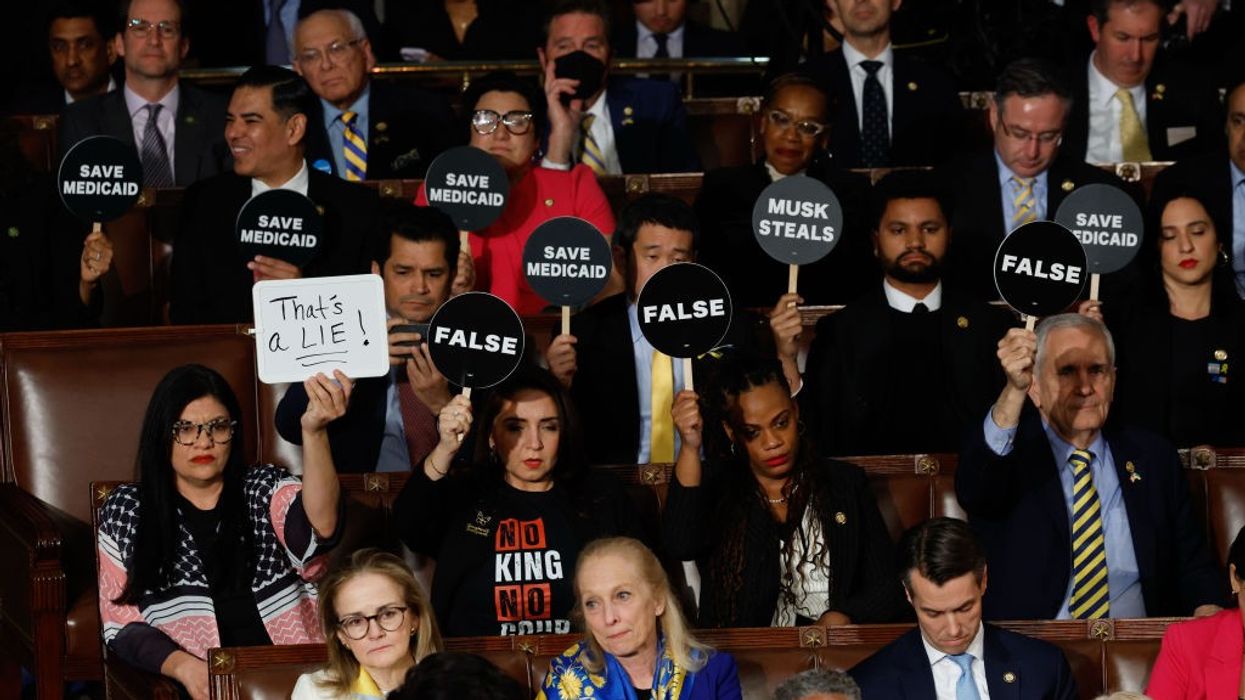
"Social Security has survived wars, pandemics, and recessions," said one advocate. "But unless there is a rapid course correction, it may not survive Donald Trump and Elon Musk."
After boasting about gutting climate initiatives, terminating thousands of federal workers, and withdrawing the U.S. from the World Health Organization at the start of his address to a joint session of Congress Tuesday night, President Donald Trump rattled off a series of now-familiar falsehoods about Social Security that advocates say are aimed at justifying deep cuts to the program.
"Believe it or not, government databases list 4.7 million Social Security members from people aged 100 to 109 years old. It lists 3.6 million people from ages 110 to 119. I don't know any of them," Trump said, regurgitating the lie—also peddled by Elon Musk—that Social Security benefits are being paid out on a large scale to people who have been dead for years.
"I know some people who are rather elderly but not quite that elderly," said Trump as he continued to list numbers, at one point declaring that a person in Social Security Administration (SSA) databases is "listed at 360 years of age."
SSA, which Trump and Musk are in the process of eviscerating and possibly privatizing, automatically halts payments by age 115. Even Trump's handpicked acting SSA commissioner has refuted the claim that Social Security benefits are being paid out to tens of millions of dead people.
The president's remarks were seen as part of a broader effort, spearheaded by Musk, to create the appearance of rampant waste and fraud to make the case for cutting Social Security, which lifts more people above the poverty line in the U.S. than any other program.
"Tonight's speech by President Trump should be highly alarming to the 70 million Americans on Social Security and to anyone who is earning benefits by paying into the program. His speech was full of lies," said Max Richtman, president and CEO of the National Committee to Preserve Social Security and Medicare.
"Just because someone may be in SSA's database, doesn't mean that they are receiving benefits unless they are alive and eligible—something Elon Musk and his DOGE minions should have learned before propagating these claims," Richtman added. "Trump and Musk's claims of 'fraud' in the Social Security program would be laughable if they weren't so harmful, and have already been widely discredited."
Robert Weissman, co-president of Public Citizen, also weighed in, calling Trump's Social Security lies "the prelude to vicious cuts."
"They want to cut Social Security and Medicaid. This is their core agenda. Reverse Roosevelt. They are no longer even hiding it."
SSA data shows that just 0.1% of Social Security recipients are over the age of 100. A report published last year by SSA's inspector general, whom Trump recently fired, found that of the $8.6 trillion in Social Security benefits paid out between 2015 and 2022, just 0.84% of the payments were deemed improper.
"Social Security has vanishingly low rates of fraud, far less than private-sector retirement programs," Alex Lawson, executive director of the progressive advocacy group Social Security Works, said in a statement late Tuesday. "Lying about it is a convenient way to justify cutting off benefits to people deemed enemies or undeserving under the guise of 'fraud.'"
"Social Security has survived wars, pandemics, and recessions," said Lawson. "But unless there is a rapid course correction, it may not survive Donald Trump and Elon Musk."
Democratic lawmakers also sharply condemned Trump's comments on Social Security, which came days after Musk falsely characterized the program as a Ponzi scheme.
"Trump is making up stats about Social Security so he has an excuse to cut your benefits," said Rep. Pramila Jayapal (D-Wash.).
Rep. Ro Khanna (D-Calif.) noted that "all you hear is Republican laughter" as Trump spouted lies about Social Security.
"They want to cut Social Security and Medicaid," Khanna wrote on social media. "This is their core agenda. Reverse Roosevelt. They are no longer even hiding it."

Dismantling the most prominent social welfare program of the last century is undoubtedly an extremist undertaking and Musk is employing Trumpism as a discourse to help make that happen. Whether he succeeds is dependent in no small part on our ability to call out and resist his verbal jujitsu.
In an interview with podcaster Joe Rogan, the world’s richest person Elon Musk late last week called Social Security “the biggest Ponzi scheme of all time.” It was yet another “pot calling the kettle black” moment in the run-on sentence called Trumpism.
I say run-on sentence because it is important to highlight Trumpism as featuring a nefarious discourse self-consciously deployed by Donald Trump and his acolytes to normalize their extremism. Trumpism as a discourse obfuscates so as to legitimate what has become its extremist threat to the existing political system, the rule of law and U.S. Constitution. It is a distinctive way of speaking that facilitates highly questionable action. We see this repeatedly in the Trump era.
Trumpism as a discourse most prominently features three verbal maneuvers: gaslighting, coopting, and boomeranging. All three are intertwined in the disingenuous effort to overturn our liberal democracy and further the move toward a more illiberal autocratic political system, where Trump and his followers get to claim they are saving us from the failures of the current political system. Gaslighting is where you deflect a criticism by saying that the problem is something other than what the critic alleged, thereby insulating yourself from that criticism. For instance, the January 6th attack on the Capitol was actually an inside job perpetrated by the FBI. Coopting is where you adopt the language of your critics so that you are the one with the just cause and they are the one who is deserving of condemnation. The January 6th attack on the Capitol was an instance of Trump supporters standing up for democracy, not trying to undermine it. Boomeranging is where you send criticism directed at you right back at your critics. In this case, the claim is that the critics of the January 6th insurrection are actually the ones who are threatening democracy. These are all lies, aided by disinformation, consciously deployed to pollute public discourse and open the door to allowing Trump and is supporters to overthrow the existing constitutional order.
Why toss the Ponzi scheme boomerang now? Perhaps either because you do not know how Social Security works, or you don’t care because you are so keen to legitimate your extremist actions of illegally decimating the cornerstone of the U.S. welfare state.
With Trump’s second term as president beginning, the discourse of Trumpism has now become commonplace in American politics. It had worked effectively to help Trump regain the presidency. He now is abusing the powers of that office to among other things unleash Musk as a temporary advisor to the president to illegally and unconstitutionally begin without congressional authorization dismantling the federal bureaucracy and the programs its implements.
Musk has been recruited by Trump to take on the role of special advisor for allegedly seeking to root out waste, fraud and abuse from the federal bureaucracy, even as Musk’s private companies continue to profit in the millions of dollars from contracts from that bureaucracy. For some reason, Musk’s own contracts have been exempted from his investigations, but Social Security has not. Dismantling the most prominent social welfare program of the last century is undoubtedly an extremist undertaking and Musk is employing Trumpism as a discourse to help make that happen. Whether he succeeds is dependent in no small part on our ability to call out and resist his verbal jujitsu.
Dismantling Social Security would be very significant, for it not only provides major benefits to over 70 million retirees and persons receiving disability and survivor benefits (about one in five Americans). The program was enacted by Congress during the Great Depression with the Economic Security Act of 1935 (which quickly came to be known as the Social Security Act). It has become the cornerstone of the American welfare state, limited as it is compared to its counterparts in the rest of the developed world. It is nonetheless the most effective anti-poverty program in the history of the country, basically reducing the poverty rate among the elderly by half once its benefits started getting adjusted annually in 1972 to keep up with inflation. It has long been considered the “third rail” of American politics for any politician who tries to tamper with it usually ends up getting repudiated, just as President George Bush did when he tried to privatize it after winning re-election in 2004. Now Trump is going down that road but using the discourse of Trumpism to legitimate undermining this bedrock foundation of the U.S. welfare state.
Calling Social Security the “biggest Ponzi scheme in American history” is pure Trumpism. It is a boomerang. Many people have pointed out the Ponzi-scheme nature of Musk’s own preferred cryptocurrency Dogecoin. Dogecoin was the source for Musk calling his anti-federal government initiative “DOGE” (Department of Government Efficiency). Musk’s response was like him saying “no Dogecoin is not a Ponzi scheme, but Social Security is,” thereby redirecting the criticism of Dogecoin (and all cryptocurrencies) toward the government’s largest and most effective social welfare program. Cryptocurrencies, like Dogecoin, but also even more prominently Bitcoin, have been, for the last decade or so, very popular, especially with people who want to be free of having to rely on government-backed currency like the dollar. Cryptocurrencies have an anti-government elan that attracts all kinds of people, including libertarians and even anarchists. Calling Social Security the biggest Ponzi scheme in history is an anti-government boomerang perpetuated in the name of speculators who want to be free of government regulation.
Strictly speaking, a Ponzi scheme is where those who initially invest in some initiative reap profits from those who subsequently invest, and those subsequent investors will gain only if there are further investors. People are lied to in that there is no actual productive activity that is being invested in, contrary to what they were told. There is only a system of forwarding investments forward to the people who came before you. Once no new investors appear, the flow of profit stops and people are left with no returns on their investment. The largest Ponzi scheme ever was conducted by Bernard Madoff who for decades told people he successfully invested their money in stocks and other investments but actually just forwarded new investments to his clients until the flow of money stopped and he was revealed in 2008 to have defrauded people of tens of billions of dollars.
Actually, neither Social Security nor cryptocurrency is necessarily a Ponzi scheme. Crypto investors are not usually lied to that there is some supposed productive enterprise they are investing in, and Social Security recipients are told that will receive government guaranteed benefits regardless of how their contributions are invested or not. In both cases though, current contributions are used to pay out benefits to people who paid in previously.
In an attempt to make Social Security seem all-American, individualistic and capitalistic, it was originally sold to the American public as a “social insurance” program making it seem like it was no different than private insurance where people pay in to finance their own benefit. This sleight of hand was called the “insurance myth,” for people were never really financing their own benefit but contributing to a collective funding of the program overall. Social insurance is simply not the same as private insurance. It is more a collective than individual effort.
Yet, what is important here regarding the boomerang is that Social Security is in fact superior to cryptocurrencies just because it provides government backed, guaranteed benefits. The anti-government posture of cryptocurrencies, including Musk’s preferred Dogecoin, makes them vulnerable to being seen as way riskier than Social Security. Musk’s boomerang fails, Dogecoin is more like a Ponzi scheme than any government guaranteed benefit.
It is true that Social Security periodically needs tweaking by Congress to ensure that contributions keep up with what is needed to pay out to retirees and others. But that has consistently been done for almost a century. Why toss the Ponzi scheme boomerang now? Perhaps either because you do not know how Social Security works, or you don’t care because you are so keen to legitimate your extremist actions of illegally decimating the cornerstone of the U.S. welfare state. Is it because Musk as an adult immigrant never bothered to learn American public policy while in college or later, or because Musk just wants to destroy the government in the name of his libertarian fantasy? In any case, his Ponzi-scheme boomerang might to some degree work with segments of the public. For that reason alone, we need to highlight this particularly pernicious instance of Trumpism as a dangerous discourse.
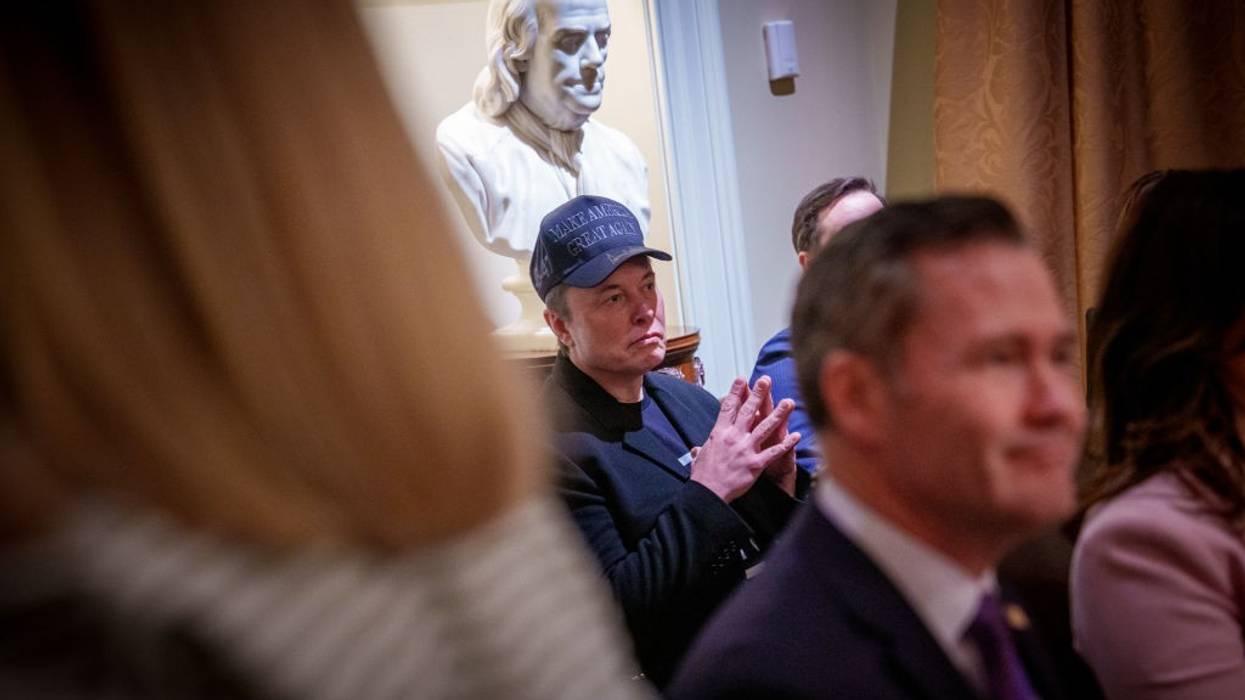
"No matter how many billions he gets in tax cuts and government contracts, it will never be enough for him," said Rep. Alexandria Ocasio-Cortez. "Now he's going after the elderly, the disabled, and orphaned children."
Progressive lawmakers and advocates hit back on Sunday after Elon Musk parroted the long-debunked right-wing claim that Social Security is a Ponzi scheme, the billionaire's latest false attack on the nation's most effective anti-poverty program.
Musk made the comments during an appearance on the "Joe Rogan Experience" podcast over the weekend, and the episode has already racked up nearly 8 million views as of this writing.
"Social Security is the biggest Ponzi scheme of all time," Musk said. "If you look at the future obligations of Social Security, it far exceeds the tax revenue."
The advocacy group Social Security Works noted in response that Social Security—which is 90% funded for the next quarter-century—"hasn't missed a payment in 89 years" and accused Musk of "defaming" the program as part of an effort to "cut benefits and otherwise destroy Social Security."
BREAKING: Elon Musk called Social Security "the biggest Ponzi scheme of all time" in an interview with Joe Rogan. pic.twitter.com/gCrDPLM15u
— More Perfect Union (@MorePerfectUS) March 1, 2025
Musk's comments came as the Trump administration, with the assistance of the billionaire Tesla CEO's lieutenants, is working to gut the already-understaffed Social Security Administration, an effort that could result in benefit delays and disruptions.
"This guy is a leech on the public," Rep. Alexandria Ocasio-Cortez (D-N.Y.) wrote on social media after a clip of Musk's remarks on Rogan's podcast circulated. "No matter how many billions he gets in tax cuts and government contracts, it will never be enough for him."
"Now he's going after the elderly, the disabled, and orphaned children so he can pocket it in tax cuts for himself," Ocasio-Cortez added. "It's disgusting."
Rep. Greg Casar (D-Texas), chair of the Congressional Progressive Caucus, wrote that "a guy who makes $8 million a day off the government thinks seniors getting $65 a day they worked their whole lives to earn is a 'Ponzi scheme.'"
"Protect Social Security," Casar wrote. "Fire Elon Musk."
Sen. Bernie Sanders (I-Vt.) also weighed in on Musk's comments during an appearance on NBC's "Meet the Press" Sunday morning, calling the billionaire's attack on Social Security "totally outrageous."
"That's a hell of a Ponzi scheme when for the last 80 years, Social Security has paid out every nickel owed to every eligible American. Quite a Ponzi scheme," said Sanders, who called on lawmakers to support his proposal to expand Social Security benefits by lifting the cap on income subject to payroll taxes.
"You lift that cap, we can extend the solvency of Social Security for 75 years," the Vermont senator said. "And you can raise benefits."
Last week, as Common Dreams reported, Sanders attempted to pass his Social Security expansion bill through the Senate via unanimous consent, but Sen. Mike Crapo (R-Idaho) objected, blocking the legislation.
A previous version of this story improperly identified "Meet the Press" as an MSNBC show.