

SUBSCRIBE TO OUR FREE NEWSLETTER
Daily news & progressive opinion—funded by the people, not the corporations—delivered straight to your inbox.
5
#000000
#FFFFFF
To donate by check, phone, or other method, see our More Ways to Give page.
Daily news & progressive opinion—funded by the people, not the corporations—delivered straight to your inbox.
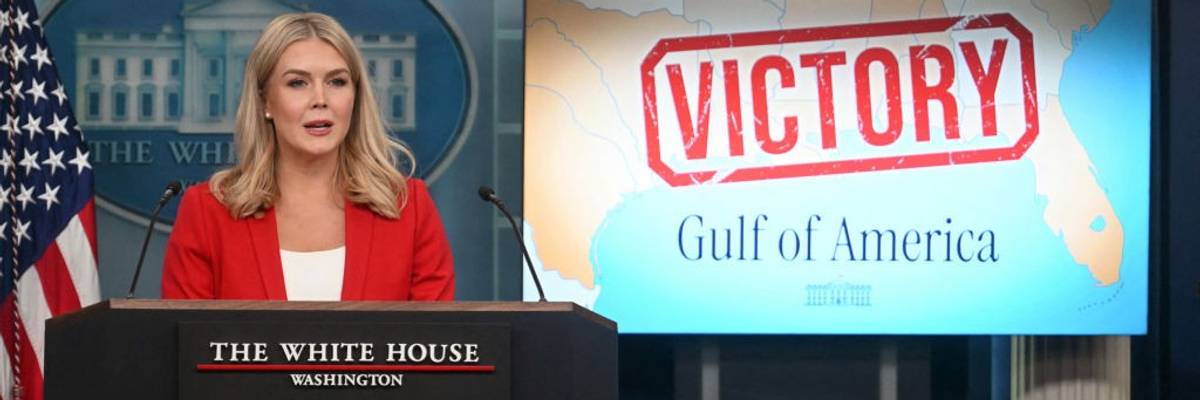
White House Press Secretary Karoline Leavitt speaks in the Brady Briefing Room of the White House in Washington, D.C. on February 25, 2025.
"This move tears at the independence of a free press in the United States," said the head of the White House Correspondents' Association. "In a free country, leaders must not be able to choose their own press corps."
As part of U.S. President Donald Trump's long-running war with the news media, White House Press Secretary Karoline Leavitt announced Tuesday that the administration will now decide which outlets get to participate in the presidential press pool.
The widely condemned announcement came just a day after U.S. District Judge Trevor N. McFadden, a Trump appointee, declined to lift the White House's ban on Associated Press reporters attending press briefings and Air Force One flights because the outlet refuses to call the Gulf of Mexico the "Gulf of America" in line with the president's January executive order.
The White House Correspondents' Association (WHCA) has managed the press pool since the 1950s. While the group has faced its share of criticism, journalists and others also weren't buying Leavitt's attempt to frame the Trump takeover of the responsibility as an effort to include reporters previously denied the significant access to the president that pool members have.
"This move tears at the independence of a free press in the United States. It suggests the government will choose the journalists who cover the president. In a free country, leaders must not be able to choose their own press corps," WHCA president Eugene Daniels said in a Tuesday statement.
As Daniels detailed:
For generations, the working journalists elected to lead the White House Correspondents' Association board have consistently expanded the WHCA's membership and its pool rotations to facilitate the inclusion of new and emerging outlets.
Since its founding in 1914, the WHCA has sought to ensure that the reporters, photographers, producers, and technicians who actually do the work—365 days of every year—decide amongst themselves how these rotations are operated, so as to ensure consistent professional standards and fairness in access on behalf of all readers, viewers and listeners.
To be clear, the White House did not give the WHCA board a heads-up or have any discussions about today's announcements. But the WHCA will never stop advocating for comprehensive access, full transparency, and the right of the American public to read, listen to and watch reports from the White House, delivered without fear or favor.
His remarks followed reporting that the WHCA was trying to quietly resolve the dispute with the AP. CNN chief media analyst Brian Stelter said on social media last week: "So why aren't more reporters and media outlets speaking out more vehemently to help the AP? In part, I'm told, it's because the WH Correspondents' Association is trying to work out a solution behind the scenes."
The WHCA did file a motion on Sunday seeking to submit an amicus brief in the AP case before McFadden. The document states that "the government should never interfere with the operation of an independent press, nor should it demand that reporters adopt the government's messaging, framing, and, indeed, ideological worldview. Such conduct is wholly at odds with the Constitution and cannot be permitted to persist."
boy i'll tell you, it does not seem like the white house correspondents' association read this well at all
[image or embed]
— Alex Kirshner ( @alexkirshner.com) February 25, 2025 at 1:56 PM
Daniels was far from alone in blasting the Trump administration's decision on Tuesday. The AP reported that the Reporters Committee for Freedom of the Press called it "a drastic change in how the public obtains information about its government."
Bruce D. Brown, the group's president, said that "the White House press pool exists to serve the public, not the presidency."
The Committee to Protect Journalists said on social media that it "is alarmed by the White House's decision to pick who can be part of the press pool. Given the White House's decision to ban the AP from pool activities in retaliation for an editorial choice, it is concerning that the administration will now exert yet more control over which outlets are able to access the president and events he attends."
Jenna Leventoff, senior policy counsel at the ACLU, said that "the president does not get to handpick his news coverage, and he cannot condition access to the White House on an outlet's speech alone. The First Amendment protects the rights of outlets to make their own editorial decisions, but this decision opens the door for government punishment of outlets that don't comply with the White House's editorial demands. This is not just about silencing reporters but about dodging accountability and keeping the American people in the dark about important news that impacts each and every one of them."
Some journalists pointed to Russian President Vladimir Putin. Susan Glasser, a staff writer at The New Yorker, warned that the Trump White House is "on the way to establishing its own version of a Kremlin press pool, approved media only."
Glasser co-authored the book Kremlin Rising with her husband, New York Times chief White House correspondent Peter Baker. He said Tuesday that "having served as a Moscow correspondent in the early days of Putin's reign, this reminds me of how the Kremlin took over its own press pool and made sure that only compliant journalists were given access."
"The message is clear," Baker continued. "Given that the White House has already kicked one news organization out of the pool because of coverage it does not like, it is making certain everyone else knows that the rest of us can be barred too if the president does not like our questions or stories."
MSNBC host Symone Sanders Townsend—who served as chief spokesperson for former Vice President Kamala Harris—suggested that "the reporters should refuse to comply and should continue the precedent of deciding the pool themselves."
"Do I wish I could have picked the reporters in the press pool who were covering the VP when I worked at the White House? Some days… yes," she said. "But that is not how this works."
This article has been updated with comment from the ACLU.
Dear Common Dreams reader, It’s been nearly 30 years since I co-founded Common Dreams with my late wife, Lina Newhouser. We had the radical notion that journalism should serve the public good, not corporate profits. It was clear to us from the outset what it would take to build such a project. No paid advertisements. No corporate sponsors. No millionaire publisher telling us what to think or do. Many people said we wouldn't last a year, but we proved those doubters wrong. Together with a tremendous team of journalists and dedicated staff, we built an independent media outlet free from the constraints of profits and corporate control. Our mission has always been simple: To inform. To inspire. To ignite change for the common good. Building Common Dreams was not easy. Our survival was never guaranteed. When you take on the most powerful forces—Wall Street greed, fossil fuel industry destruction, Big Tech lobbyists, and uber-rich oligarchs who have spent billions upon billions rigging the economy and democracy in their favor—the only bulwark you have is supporters who believe in your work. But here’s the urgent message from me today. It's never been this bad out there. And it's never been this hard to keep us going. At the very moment Common Dreams is most needed, the threats we face are intensifying. We need your support now more than ever. We don't accept corporate advertising and never will. We don't have a paywall because we don't think people should be blocked from critical news based on their ability to pay. Everything we do is funded by the donations of readers like you. When everyone does the little they can afford, we are strong. But if that support retreats or dries up, so do we. Will you donate now to make sure Common Dreams not only survives but thrives? —Craig Brown, Co-founder |
As part of U.S. President Donald Trump's long-running war with the news media, White House Press Secretary Karoline Leavitt announced Tuesday that the administration will now decide which outlets get to participate in the presidential press pool.
The widely condemned announcement came just a day after U.S. District Judge Trevor N. McFadden, a Trump appointee, declined to lift the White House's ban on Associated Press reporters attending press briefings and Air Force One flights because the outlet refuses to call the Gulf of Mexico the "Gulf of America" in line with the president's January executive order.
The White House Correspondents' Association (WHCA) has managed the press pool since the 1950s. While the group has faced its share of criticism, journalists and others also weren't buying Leavitt's attempt to frame the Trump takeover of the responsibility as an effort to include reporters previously denied the significant access to the president that pool members have.
"This move tears at the independence of a free press in the United States. It suggests the government will choose the journalists who cover the president. In a free country, leaders must not be able to choose their own press corps," WHCA president Eugene Daniels said in a Tuesday statement.
As Daniels detailed:
For generations, the working journalists elected to lead the White House Correspondents' Association board have consistently expanded the WHCA's membership and its pool rotations to facilitate the inclusion of new and emerging outlets.
Since its founding in 1914, the WHCA has sought to ensure that the reporters, photographers, producers, and technicians who actually do the work—365 days of every year—decide amongst themselves how these rotations are operated, so as to ensure consistent professional standards and fairness in access on behalf of all readers, viewers and listeners.
To be clear, the White House did not give the WHCA board a heads-up or have any discussions about today's announcements. But the WHCA will never stop advocating for comprehensive access, full transparency, and the right of the American public to read, listen to and watch reports from the White House, delivered without fear or favor.
His remarks followed reporting that the WHCA was trying to quietly resolve the dispute with the AP. CNN chief media analyst Brian Stelter said on social media last week: "So why aren't more reporters and media outlets speaking out more vehemently to help the AP? In part, I'm told, it's because the WH Correspondents' Association is trying to work out a solution behind the scenes."
The WHCA did file a motion on Sunday seeking to submit an amicus brief in the AP case before McFadden. The document states that "the government should never interfere with the operation of an independent press, nor should it demand that reporters adopt the government's messaging, framing, and, indeed, ideological worldview. Such conduct is wholly at odds with the Constitution and cannot be permitted to persist."
boy i'll tell you, it does not seem like the white house correspondents' association read this well at all
[image or embed]
— Alex Kirshner ( @alexkirshner.com) February 25, 2025 at 1:56 PM
Daniels was far from alone in blasting the Trump administration's decision on Tuesday. The AP reported that the Reporters Committee for Freedom of the Press called it "a drastic change in how the public obtains information about its government."
Bruce D. Brown, the group's president, said that "the White House press pool exists to serve the public, not the presidency."
The Committee to Protect Journalists said on social media that it "is alarmed by the White House's decision to pick who can be part of the press pool. Given the White House's decision to ban the AP from pool activities in retaliation for an editorial choice, it is concerning that the administration will now exert yet more control over which outlets are able to access the president and events he attends."
Jenna Leventoff, senior policy counsel at the ACLU, said that "the president does not get to handpick his news coverage, and he cannot condition access to the White House on an outlet's speech alone. The First Amendment protects the rights of outlets to make their own editorial decisions, but this decision opens the door for government punishment of outlets that don't comply with the White House's editorial demands. This is not just about silencing reporters but about dodging accountability and keeping the American people in the dark about important news that impacts each and every one of them."
Some journalists pointed to Russian President Vladimir Putin. Susan Glasser, a staff writer at The New Yorker, warned that the Trump White House is "on the way to establishing its own version of a Kremlin press pool, approved media only."
Glasser co-authored the book Kremlin Rising with her husband, New York Times chief White House correspondent Peter Baker. He said Tuesday that "having served as a Moscow correspondent in the early days of Putin's reign, this reminds me of how the Kremlin took over its own press pool and made sure that only compliant journalists were given access."
"The message is clear," Baker continued. "Given that the White House has already kicked one news organization out of the pool because of coverage it does not like, it is making certain everyone else knows that the rest of us can be barred too if the president does not like our questions or stories."
MSNBC host Symone Sanders Townsend—who served as chief spokesperson for former Vice President Kamala Harris—suggested that "the reporters should refuse to comply and should continue the precedent of deciding the pool themselves."
"Do I wish I could have picked the reporters in the press pool who were covering the VP when I worked at the White House? Some days… yes," she said. "But that is not how this works."
This article has been updated with comment from the ACLU.
As part of U.S. President Donald Trump's long-running war with the news media, White House Press Secretary Karoline Leavitt announced Tuesday that the administration will now decide which outlets get to participate in the presidential press pool.
The widely condemned announcement came just a day after U.S. District Judge Trevor N. McFadden, a Trump appointee, declined to lift the White House's ban on Associated Press reporters attending press briefings and Air Force One flights because the outlet refuses to call the Gulf of Mexico the "Gulf of America" in line with the president's January executive order.
The White House Correspondents' Association (WHCA) has managed the press pool since the 1950s. While the group has faced its share of criticism, journalists and others also weren't buying Leavitt's attempt to frame the Trump takeover of the responsibility as an effort to include reporters previously denied the significant access to the president that pool members have.
"This move tears at the independence of a free press in the United States. It suggests the government will choose the journalists who cover the president. In a free country, leaders must not be able to choose their own press corps," WHCA president Eugene Daniels said in a Tuesday statement.
As Daniels detailed:
For generations, the working journalists elected to lead the White House Correspondents' Association board have consistently expanded the WHCA's membership and its pool rotations to facilitate the inclusion of new and emerging outlets.
Since its founding in 1914, the WHCA has sought to ensure that the reporters, photographers, producers, and technicians who actually do the work—365 days of every year—decide amongst themselves how these rotations are operated, so as to ensure consistent professional standards and fairness in access on behalf of all readers, viewers and listeners.
To be clear, the White House did not give the WHCA board a heads-up or have any discussions about today's announcements. But the WHCA will never stop advocating for comprehensive access, full transparency, and the right of the American public to read, listen to and watch reports from the White House, delivered without fear or favor.
His remarks followed reporting that the WHCA was trying to quietly resolve the dispute with the AP. CNN chief media analyst Brian Stelter said on social media last week: "So why aren't more reporters and media outlets speaking out more vehemently to help the AP? In part, I'm told, it's because the WH Correspondents' Association is trying to work out a solution behind the scenes."
The WHCA did file a motion on Sunday seeking to submit an amicus brief in the AP case before McFadden. The document states that "the government should never interfere with the operation of an independent press, nor should it demand that reporters adopt the government's messaging, framing, and, indeed, ideological worldview. Such conduct is wholly at odds with the Constitution and cannot be permitted to persist."
boy i'll tell you, it does not seem like the white house correspondents' association read this well at all
[image or embed]
— Alex Kirshner ( @alexkirshner.com) February 25, 2025 at 1:56 PM
Daniels was far from alone in blasting the Trump administration's decision on Tuesday. The AP reported that the Reporters Committee for Freedom of the Press called it "a drastic change in how the public obtains information about its government."
Bruce D. Brown, the group's president, said that "the White House press pool exists to serve the public, not the presidency."
The Committee to Protect Journalists said on social media that it "is alarmed by the White House's decision to pick who can be part of the press pool. Given the White House's decision to ban the AP from pool activities in retaliation for an editorial choice, it is concerning that the administration will now exert yet more control over which outlets are able to access the president and events he attends."
Jenna Leventoff, senior policy counsel at the ACLU, said that "the president does not get to handpick his news coverage, and he cannot condition access to the White House on an outlet's speech alone. The First Amendment protects the rights of outlets to make their own editorial decisions, but this decision opens the door for government punishment of outlets that don't comply with the White House's editorial demands. This is not just about silencing reporters but about dodging accountability and keeping the American people in the dark about important news that impacts each and every one of them."
Some journalists pointed to Russian President Vladimir Putin. Susan Glasser, a staff writer at The New Yorker, warned that the Trump White House is "on the way to establishing its own version of a Kremlin press pool, approved media only."
Glasser co-authored the book Kremlin Rising with her husband, New York Times chief White House correspondent Peter Baker. He said Tuesday that "having served as a Moscow correspondent in the early days of Putin's reign, this reminds me of how the Kremlin took over its own press pool and made sure that only compliant journalists were given access."
"The message is clear," Baker continued. "Given that the White House has already kicked one news organization out of the pool because of coverage it does not like, it is making certain everyone else knows that the rest of us can be barred too if the president does not like our questions or stories."
MSNBC host Symone Sanders Townsend—who served as chief spokesperson for former Vice President Kamala Harris—suggested that "the reporters should refuse to comply and should continue the precedent of deciding the pool themselves."
"Do I wish I could have picked the reporters in the press pool who were covering the VP when I worked at the White House? Some days… yes," she said. "But that is not how this works."
This article has been updated with comment from the ACLU.

