
SUBSCRIBE TO OUR FREE NEWSLETTER
Daily news & progressive opinion—funded by the people, not the corporations—delivered straight to your inbox.
5
#000000
#FFFFFF
To donate by check, phone, or other method, see our More Ways to Give page.


Daily news & progressive opinion—funded by the people, not the corporations—delivered straight to your inbox.
"The victory of freeing Leonard Peltier is a symbol of our collective strength—and our resistance will never stop," vowed one Indigenous organizer.
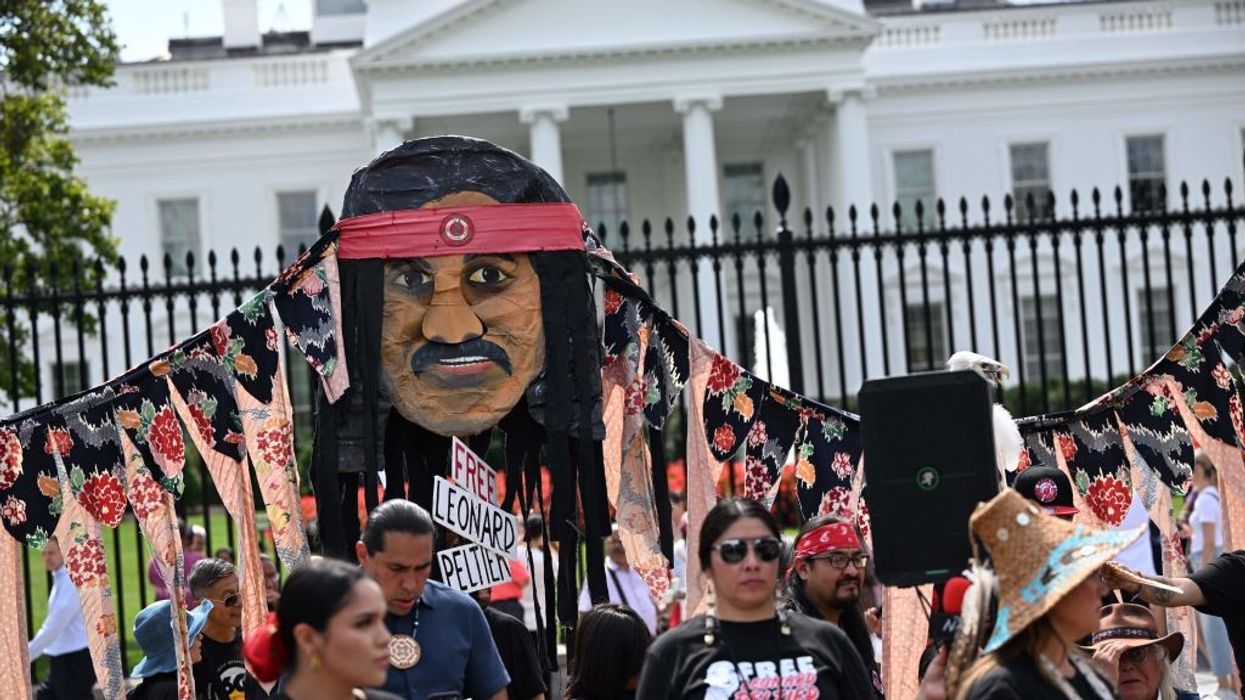
Just minutes before leaving office, Joe Biden on Monday commuted the life prison sentence of Leonard Peltier, the elderly American Indian Movement activist who supporters say was framed for the murder of two federal agents during a 1975 reservation shootout.
"It's finally over, I'm going home," Peltier, who is 80 years old, said in a statement released by the Indigenous-led activist group NDN Collective. "I want to show the world I'm a good person with a good heart. I want to help the people, just like my grandmother taught me."
While not the full pardon for which he and his defenders have long fought, the outgoing Democratic president's commutation will allow Peltier—who has been imprisoned for nearly a half-century—to "spend his remaining days in home confinement," according to Biden's statement, which was no longer posted on the White House website after Republican President Donald Trump took office Monday afternoon.
🚨BREAKING🚨 Leonard Peltier Granted Executive Clemency After 50 years of unjust incarceration and the tireless efforts of intergenerational grassroots organizing and advocacy, our elder and relative Leonard Peltier has been granted executive clemency.
[image or embed]
— NDN Collective ( @ndncollective.bsky.social) January 20, 2025 at 9:02 AM
"Tribal Nations, Nobel Peace laureates, former law enforcement officials (including the former U.S. attorney whose office oversaw Mr. Peltier's prosecution and appeal), dozens of lawmakers, and human rights organizations strongly support granting Mr. Peltier clemency, citing his advanced age, illnesses, his close ties to and leadership in the Native American community, and the substantial length of time he has already spent in prison," Biden explained.
Biden Interior Secretary Deb Haaland, the first Indigenous cabinet secretary in U.S. history, said in a statement: "I am beyond words about the commutation of Leonard Peltier. His release from prison signifies a measure of justice that has long evaded so many Native Americans for so many decades. I am grateful that Leonard can now go home to his family. I applaud President Biden for this action and understanding what this means to Indian Country."
Congressman Raúl Grijalva (D-Ariz.), who last month led 34 U.S. lawmakers in a letter urging clemency for Peltier, said in a statement that "for too long, Mr. Peltier has been denied both justice and the pursuit of a full, healthy life at the hands of the U.S. government, but today, he is finally able to go home."
"President Biden's decision is not just the right, merciful, and decent one—it is a testament to Mr. Peltier's resilience and the unwavering support of the countless global leaders, Indigenous voices, civil rights and legal experts, and so many others who have advocated so tirelessly for his release," Grijalva added. "While there is still much work to be done to fix the system that allowed this wrong and so many others against Indian Country, especially as we face the coming years, let us today celebrate Mr. Peltier's return home."
NDN Collective founder and CEO Nick Tilsen said Monday that "Leonard Peltier's freedom today is the result of 50 years of intergenerational resistance, organizing, and advocacy."
"Leonard Peltier's liberation is our liberation—we will honor him by bringing him back to his homelands to live out the rest of his days surrounded by loved ones, healing, and reconnecting with his land and culture," Tilsen continued.
"Let Leonard's freedom be a reminder that the entire so-called United States is built on the stolen lands of Indigenous people—and that Indigenous people have successfully resisted every attempt to oppress, silence, and colonize us," Tilsen added. "The victory of freeing Leonard Peltier is a symbol of our collective strength—and our resistance will never stop."
Amnesty International USA executive director Paul O'Brien said that "President Biden was right to commute the life sentence of Indigenous elder and activist Leonard Peltier given the serious human rights concerns about the fairness of his trial."
While Peltier admits to having participated in the June 26, 1975 gunfight at the Oglala Sioux Reservation at Pine Ridge, South Dakota, he denies killing Federal Bureau of Investigation agents Jack Coler and Ronald Williams.
As HuffPost senior political reporter Jennifer Bendery recapped Monday:
There was never evidence that Peltier committed a crime, and the U.S. government never did figure out who shot those agents. But federal officials needed someone to take the fall. The FBI had just lost two agents, and Peltier's co-defendants were all acquitted based on self-defense. So, Peltier became their guy.
His trial was rife with misconduct. The FBI threatened and coerced witnesses into lying. Federal prosecutors hid evidence that exonerated Peltier. A juror acknowledged on the second day of the trial that she had "prejudice against Indians," but she was kept on anyway.
The government's case fell apart after these revelations, so it simply revised its charges against Peltier to "aiding and abetting" whoever did kill the agents—based entirely on the fact that he was one of dozens of people present when the shootout took place. Peltier was convicted and sentenced to two consecutive life terms.
American Indian Movement (AIM) activist Joe Stuntz Killsright was also killed at Pine Ridge when a U.S. Bureau of Indian Affairs agent sniper shot him in the head after Coler and Williams were killed. Stuntz' death has never been investigated.
Some Indigenous activists welcomed Peltier's commutation while also remembering Annie Mae Pictou Aquash, an Mi'kmaq activist who was kidnapped and murdered at Pine Ridge in December 1975 by her fellow AIM members. Some of Aquash's defenders believe her killing to be an assassination ordered by AIM leaders who feared she was an FBI informant.
Before leaving office, Biden issued a flurry of eleventh-hour preemptive pardons meant to protect numerous relatives and government officials whom Trump and his allies have threatened with politically motivated legal action.
However, the outgoing president dashed the hopes of figures including Steven Donziger, Charles Littlejohn, and descendants of Ethel Rosenberg, who were
seeking last-minute pardons or commutations.
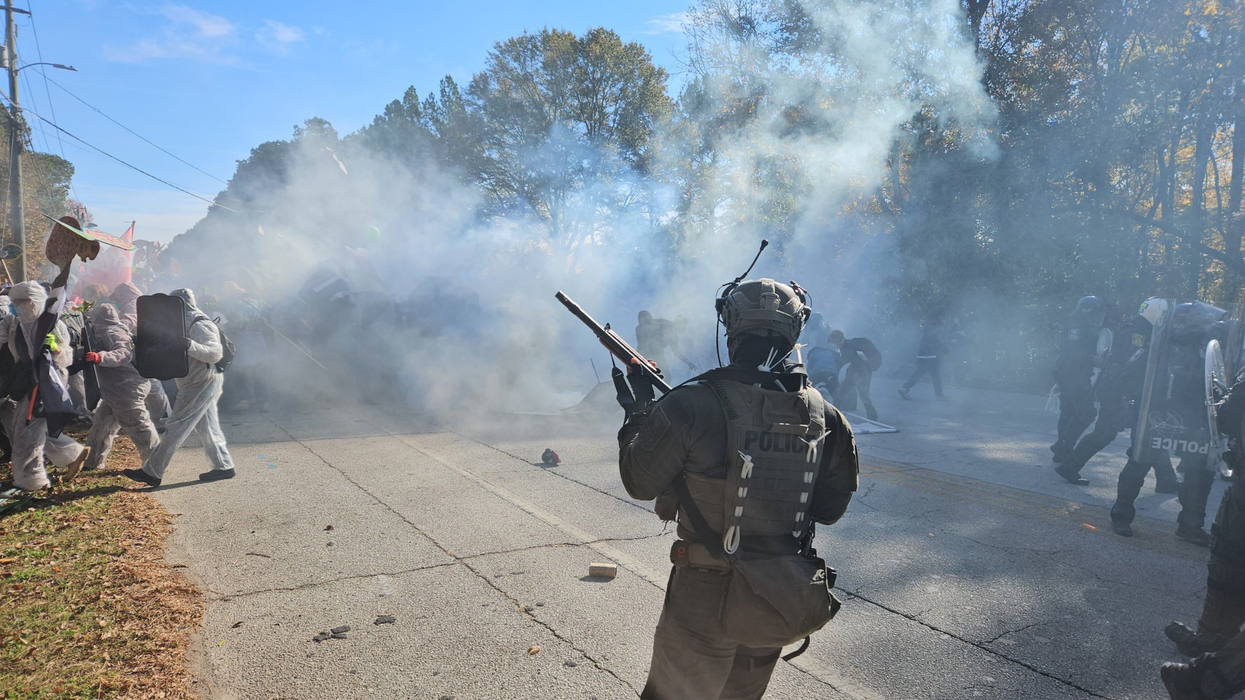
"This is the type of 'training' they will get if Cop City is built," said one activist group.
Militarized state and local police on Monday attacked a peaceful protest against the construction of the so-called "Cop City" training center outside Atlanta, Georgia with "less-lethal" weapons including tear gas, pepper balls, and flash-bang grenades, journalists and activists there said.
Hundreds of #StopCopCity activists marched from a park toward the Weelaunee Forest in suburban DeKalb County early Monday morning. Some carried large and elaborate puppets, others had saplings to plant in woodlands bulldozed during construction, and a few carried banners reading "Block Cop City" and "Viva Tortuguita"—a reference to forest defender Manuel Esteban Paez Terán, aka "Tortuguita," who was fatally shot 57 times with live ammunition by police during a January raid on a protest camp.
A marching band and members of the Wanbli Ska Society—a South Dakota-based Indigenous advocacy group—hyped up the activists, who then started their two-mile march toward the Cop City construction site.
Journalists and protesters said police blocked the road about half a mile from the march's planned destination.
"The police have effectively separated the press at the front of the march from the rest of the march," the group Defend the Atlanta Forest wrote on social media. "Police are preventing them from rejoining the march and threatening to tow their cars."
NDN Collective, an Indigenous advocacy group, posted video of police pushing reporters away from the march, calling the area a "crime scene" and threatening to arrest journalists.
Backed by menacing SWAT vehicles, including one labeled "The Beast," police attacked the nonviolent marchers, some of whom attempted to push through the line of armored officers.
Many of the activists chanted: "Don't panic, stay tight, we gonna be alright!"
Some protesters lobbed tear gas canisters back at the officers.
"Protestors and police both retreated because neither group was wearing gas masks," Defend the Atlanta Forest reported. Neither were the police dogs, whose only protection appeared to be goggles and noise-reducing ear coverings.
The activists regrouped and continued their march. Eight activists reportedly made it to the construction site and locked themselves to equipment there.
Responding to the police action, Mary Hooks, field secretary for the Movement for Black Lives, said in a statement: "We just witnessed overt violations of our civil rights on a road named after the U.S. Constitution. Atlanta claims itself to be a civil rights hub, but it erases its own legacy when protests arise that confront the power of politicians and police. The police's violence against protestors today affirms our belief that Cop City must never be built."
Prior to the march, activists gathered in a local park, where speakers included community organizer Kamau Franklin and Tortuguita's parents.
"Now is not a time for cowardice. You are either with the oppressed or with the oppressors," Franklin told the crowd. "You cannot stand in the middle. You cannot be [on] both sides. You cannot close your eyes to the terror of policing that happens in this country and in this world. And you cannot deny and cannot be silent on the capitalist economics and the system that controls all of our people across the world."
"You're either with the colonialist or the colonized," he added. "So today when you march and demonstrate and conduct acts of civil disobedience… you are doing it with the oppressed people."
Cop City—which is funded by the private Atlanta Police Foundation and backed by major corporations including Amazon, Home Depot, Wells Fargo, JPMorgan Chase, and UPS—is being built on land stolen from the Muscogee people, many of whom were forced westward during the genocidal Trail of Tears period in the late 1830s.
Since Terán's killing, more than 40 Stop Cop City campaigners have been criminally charged as domestic terrorists, while over 60 activists have also been indicted under the state's Racketeer Influenced and Corrupt Organizations (RICO) Act—some for simply handing out fliers.
On Monday, Belkis Terán, Tortuguita's mother, said that "we are here to protect nature."
"To fight the police, we must be happy. And to be happy we must be strong," she added. "This is one step. We will continue."
Echoing Terán, Joel Paez, Tortuguita's father, told the crowd: "We are going to continue defending the forest. We are going to continue defending the legacy of Tortuguita. We are family. You are my family."
"As I watch millions of people join the #StopWillow movement, these staggering numbers send a clear message that today's youth expect President Biden and Secretary Haaland to step up," said one activist.
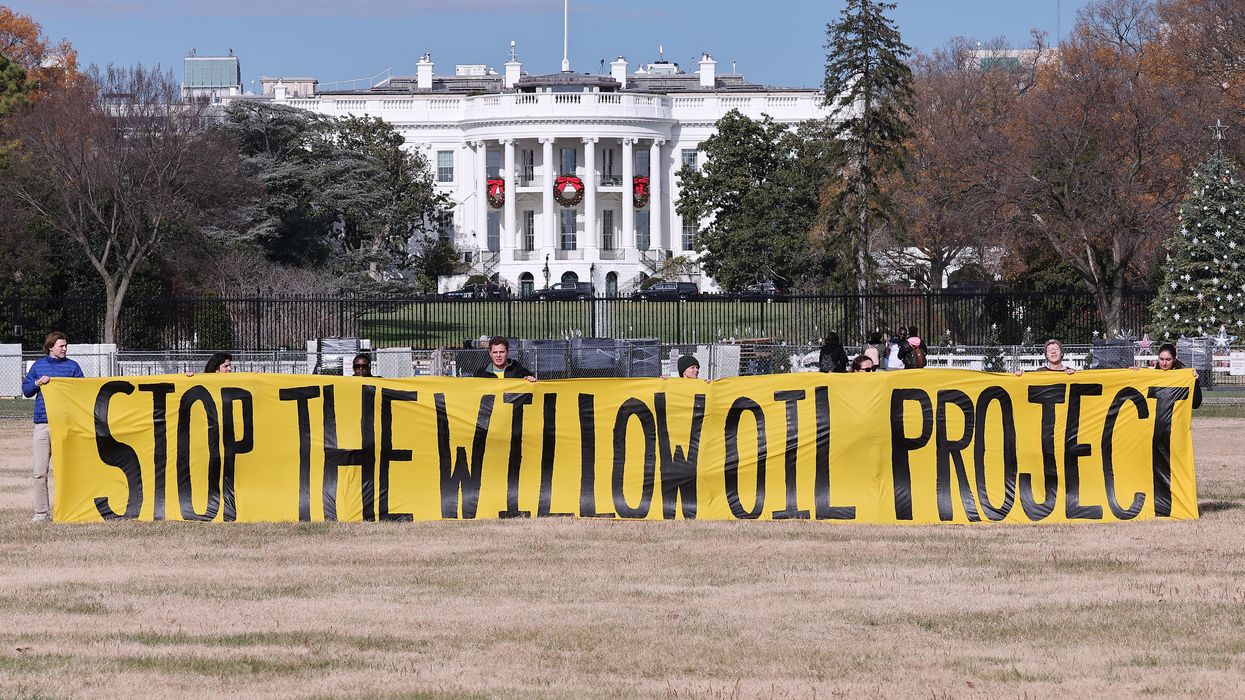
From climate campaigners on TikTok to former Vice President Al Gore, people who care about the planet across the United States are pressuring the Biden administration to block ConocoPhillips' multibillion-dollar Willow oil project in Alaska.
The U.S. Department of Interior's Bureau of Land Management (BLM) published a notice of availability regarding its final supplemental environmental impact statement for the proposed Willow Master Development Plan in the Federal Register on February 6. It said that a final decision for the project would come no earlier than 30 days from then.
Leading up to the BLM's decision—which ConocoPhillips chairman and CEO Ryan Lance expects this week—opponents have stressed scientists' warnings about the need to keep fossil fuels in the ground if humanity has any chance of preventing catastrophic global heating and meeting the Paris climate agreement's 1.5°C target for this century.
Announced by the Houston-based company in 2017, the 30-year development in the National Petroleum Reserve would produce up to 180,0000 barrels of oil a day at its peak and release over 9.2 metric tons of planet-heating carbon dioxide annually.
"We don't need to prop up the fossil fuel industry with new, multiyear projects that are a recipe for climate chaos."
"Some Native Alaskan Iñupiaq have also raised serious concerns about the project's local environmental impacts, including disturbance to local wildlife, disruption to traditional hunting practices, and a decline in air quality," BBC News noted Friday.
Gore, a longtime environmentalist, acknowledged both local and global concerns on Friday in comments to The Guardian.
"The proposed expansion of oil and gas drilling in Alaska is recklessly irresponsible," he said. "The pollution it would generate will not only put Alaska Native and other local communities at risk, it is incompatible with the ambition we need to achieve a net-zero future."
"We don't need to prop up the fossil fuel industry with new, multiyear projects that are a recipe for climate chaos," Gore continued. "Instead, we must end the expansion of oil, gas, and coal and embrace the abundant climate solutions at our fingertips."
Climate advocacy groups have been sending President Joe Biden and U.S. Interior Secretary Deb Haaland that same message.
After the White House released its budget blueprint on Thursday, Varshini Prakash, executive director of the youth-led Sunrise Movement, said that the "proposed budget—especially its investments in clean energy, jobs, and an end to oil and gas subsidies—is the kind of thing young people in this country want to see ahead of 2024."
"But President Biden has the power to act on climate and issues important to our generation without having to go through a Republican House," Prakash added. "He can reject the Willow Project, which goes against his own agenda to stop the climate crisis, and can do everything in his executive authority, like declaring a climate emergency and invoking the Defense Production Act, to jump-start our transition to clean energy."
Though Willow is backed by Alaska's three-member congressional delegation, Republican Gov. Mike Dunleavy, and the state Legislature, opponents of the project have taken social media by storm with the hashtag #StopWillow.
"I have never seen so many videos, so many comments, mentions about a climate topic on social media," 26-year-old Alaina Wood, a scientist and climate activist with more than 353,500 followers on the video platform TikTok, told The Washington Post Tuesday.
Elise Joshi, a 20-year-old University of California, Berkeley student and acting executive director of the nonprofit Gen-Z for Change, posted one of the earliest TikTok videos about the project, which now has over 300,000 views. She emphasized that "this is not environmentalist groups."
"This is young people as a whole, as a voter base, taking action," Joshi explained to the Post. "With Willow, this is one of the biggest actions we've ever seen on TikTok go forward. It has shown that we are willing to fight."
A Change.org petition urging Biden to stop Willow—now signed by more than 3 million people and promoted by groups including the Indigenous-led NDN Collective—declares that "there must come a point where human health, food security, environmental justice, and a functioning ecosystem come before corporate profit."
Pointing to the growing support for the petition, Alex Haraus, a 25-year-old TikTok creator whose Willow videos have millions of views, told CNN, "If that doesn't emphasize the fact that it's everyday Americans pushing back, I don't know what does."
"This is not an environmental movement, it's much larger than that," Haraus added. "It's the American public that can vote."
Hazel Thayer, another climate activist who has posted TikTok videos with #StopWillow, told The Associated Press Wednesday that the proposed Big Oil project is "just so blatantly bad for the planet."
"With all of the progress that the U.S. government has made on climate change, it now feels like they're turning their backs by allowing Willow to go through," Thayer said. "I think a lot of young people are feeling a little bit betrayed by that."
Quannah Chasinghorse—a Han Gwich'in and Sicangu/Oglala Lakota land protector, climate justice activist, and fashion model from Eagle Village, Alaska and the tribes of South Dakota—wrote Friday in a CNN opinion piece opposing the project that "I've been inspired by the chorus of voices who have joined me."
"To date, #StopWillow (and related) videos from a diverse array of young creators have around 300 million direct views on TikTok alone," Chasinghorse noted. "In a matter of just a few days, #StopWillow catapulted to the top of social media conversations."
"As I watch millions of people join the #StopWillow movement, these staggering numbers send a clear message that today's youth expect President Biden and Secretary Haaland to step up," she added. "It reflects a game-changing trend that astute leaders should not ignore: They must deliver the climate leadership they promised by taking bold action to stop the Willow climate disaster before it's too late."
Even if the Biden administration gives Willow the green light, that approval is expected to be met with legal challenges.
"I think that litigation is very likely," Earthjustice senior attorney Jeremy Lieb told The Guardian. “We and our clients don't see any acceptable version of this project."
"We're not the subjugated and disenfranchised people that we were," said one Ponca elder who took part in the 1973 revolt. "Wounded Knee was an important beginning of that."
As many Native Americans on Monday marked the 50th anniversary of the militant occupation of Wounded Knee, South Dakota, participants in the 1973 uprising and other activists linked the deadly revolt to modern-day Indigenous resistance, from Standing Rock to the #LandBack movement.
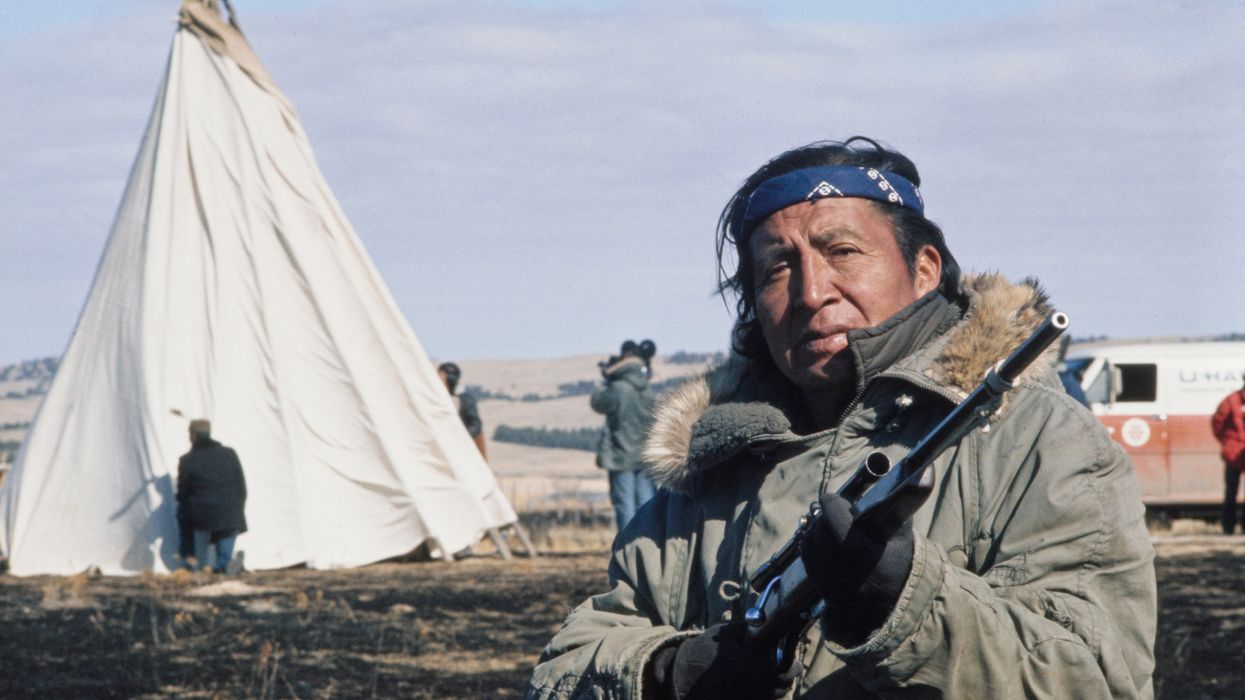
On February 27, 1973 around 300 Oglala Lakota and members of the American Indian Movement (AIM), seething from centuries of injustices ranging from genocide to leniency for whites who committed crimes against Indians, occupied the hamlet of Wounded Knee on the Pine Ridge Reservation for more than two months. The uprising occurred during a period of increased Native American militancy and the rise of AIM, which first drew international attention in 1969 with the 19-month occupation of Alcatraz Island in San Francisco Bay.
"The Native people of this land after Wounded Knee, they had like a surge of new pride in being Native people," Dwain Camp, an 85-year-old Ponca elder who took part in the 1973 revolt, told The Associated Press.
"Anything that goes on, anything we do, even today with the #LandBack issue, all of that is just a continuation."
Camp said the occupation drove previously "unimaginable" changes, including the Indian Self-Determination and Education Assistance Act, the Indian Child Welfare Act, the American Indian Religious Freedom Act, and the Indian Gaming Regulatory Act.
"After we left Wounded Knee, it became paramount that protecting Mother Earth was our foremost issue," he explained. "Since that period of time, we've learned that we've got to teach our kids our true history."
Camp said the spirit of Wounded Knee lives on in Indigenous resistance today.
"We're not the subjugated and disenfranchised people that we were," he said. "Wounded Knee was an important beginning of that. And because we're a resilient people, it's something we take a lot of pride in."
Some of the participants in the 1973 uprising had been raised by grandparents who remembered or even survived the 1890 massacre of more than 200 Lakota Lakota men, women, and children by U.S. troops at Wounded Knee.
"That's how close we are to our history," Madonna Thunder Hawk, an 83-year-old elder in the Oohenumpa band of the Cheyenne River Sioux Tribe who was a frontline participant in the 1973 occupation, told Indian Country Today. "So anything that goes on, anything we do, even today with the #LandBack issue, all of that is just a continuation. It's nothing new."
Nick Tilsen, an Oglala Lakota who played a prominent role in the 2016-17 protests against the Dakota Access Pipeline at Standing Rock, North Dakota and who founded the NDN Collective, told Indian Country Today that "for me, it's important to acknowledge the generation before us—to acknowledge their risk."
"It's important for us to honor them," said Tilsen, whose parents met at the Wounded Knee occupation. "It's important for us to thank them."
Akim Reinhardt, an associate professor of history at Townson State University in Baltimore, told Indian Country Today that the AIM protests "helped establish a sense of the permanence of Red Power in much the way that Black Power had for African-Americans, a permanent legacy."
"It was the cultural legacy that racism isn't okay and people don't need to be quiet and accept it anymore," he added. "That it's okay to be proud of who you are."
Indian Country Today reports:
The occupation began on the night of Feb. 27, 1973, when a group of warriors led by Oklahoma AIM leader Carter Camp, Ponca, moved into the small town of Wounded Knee. They took over the trading post and established a base of operations along with AIM leaders Russell Means, Oglala Lakota; Dennis Banks, Ojibwe; and Clyde Bellecourt, White Earth Nation.
Within days, hundreds of activists had joined them for what became a 71-day standoff with the U.S. government and other law enforcement.
Black activist Ray Robinson, who had been working with the Oglala Sioux Civil Rights Organization, went missing during the standoff. In 2014, the FBI confirmed that Robinson died at Wounded Knee, but his body was never recovered.
AIM remains active today. Its members have participated in the fights against the Dakota Access, Keystone XL, and Line 3 pipelines, as well as in the effort to free Leonard Peltier, a former AIM leader who has been imprisoned for over 45 years after a dubious conviction for murdering two FBI agents during a separate 1975 shootout on the Pine Ridge Reservation.
Kevin McKiernan, then a rookie reporter for NPR who was smuggled into Wounded Knee after the Nixon administration banned journalists from covering the standoff, said in an interview with NPR that the #LandBack movement—spearheaded in the U.S. by NDN Collective—is a leading example of the occupation's legacy.
"And I think that there is a collective or a movement like that on every reservation with every tribe," McKiernan said. "They're going to get back, to buy back, to get donated—just do it by inches."
"That's what's going on in every inch of Indian country today," he added.
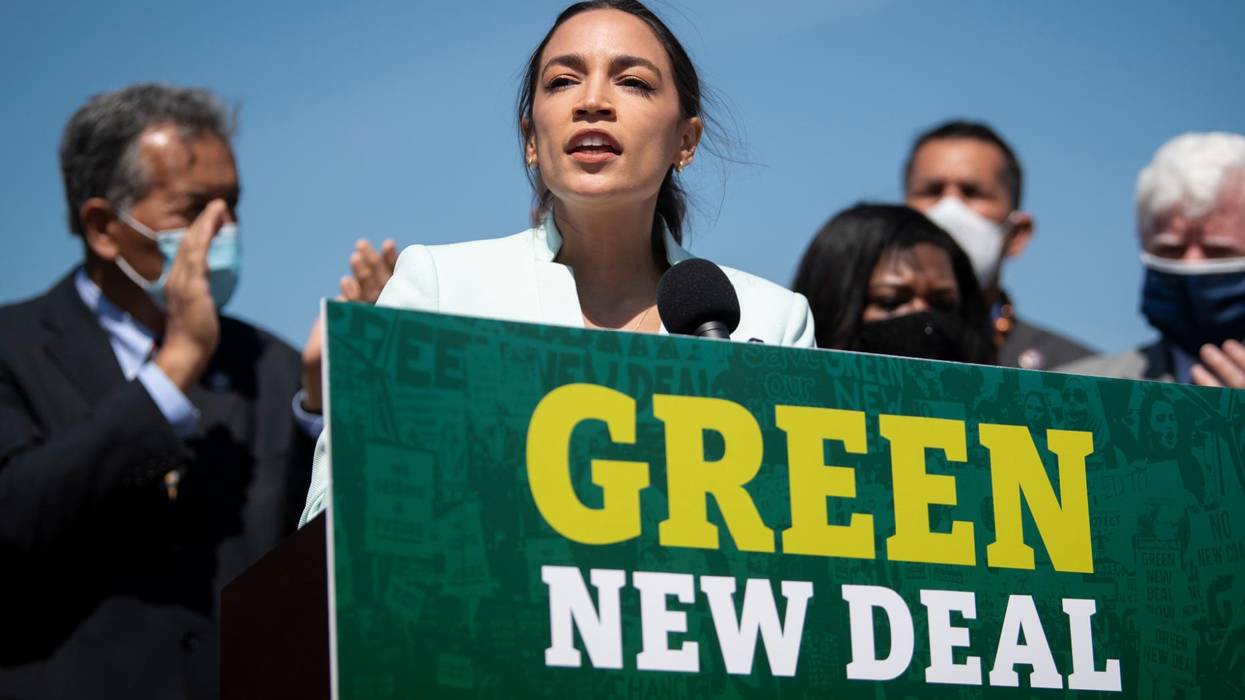
As part of what they are calling "Green New Deal Week," Rep. Alexandria Ocasio-Cortez and Sen. Ed Markey on Tuesday led the reintroduction of their landmark resolution envisioning a 10-year mobilization that would employ millions of people with well-paying, union jobs repairing U.S. infrastructure, while reducing pollution and tackling the country's intersecting climate, economic, health, and racial justice crises.
"On the eve of Biden's climate summit, this is the bold, transformative climate action we need."
--Natalie Mebane, 350.org
"The Green New Deal isn't just a resolution, it is a revolution," said Markey (D-Mass.), who first unveiled the measure with Ocasio-Cortez (D-N.Y.) in February 2019. "In the past two years, the Green New Deal has become the DNA of climate action, and the principles of jobs, justice, and climate action are now widely represented in legislation and state and local actions across the country."
"We can transform our economy and our democracy for all Americans by addressing the generational challenge of climate change," Markey said. "We have the technology to do it. We have the economic imperative. We have the moral obligation. We just need the political will."
The Green New Deal Resolution of 2021 (pdf), partly inspired by Franklin D. Roosevelt's 20th century New Deal programs, declares that "it is the duty of the federal government... to achieve the greenhouse gas and toxic emissions reductions needed to stay under 1.5 degrees Celsius of warming, through a fair and just transition for all communities and workers," referencing the more ambitious target of the 2015 Paris climate agreement.
The resolution calls for building resiliency against climate-related disasters; repairing and upgrading U.S. infrastructure; shifting to 100% renewable energy; prioritizing energy efficiency for new and existing buildings; spurring growth in clean manufacturing; promoting sustainable agriculture practices; and overhauling the country's transportation systems.
It also emphasizes the necessity of mitigating and managing the long-term adverse health, economic, and other effects of pollution and the climate emergency; restoring natural ecosystems; cleaning up hazardous waste sites; and "promoting the international exchange of technology, expertise, products, funding, and services, with the aim of making the United States the international leader on climate action."
The lead sponsors held an event on Capitol Hill to unveil the resolution, which has gained over a dozen new co-sponsors and is endorsed by over two dozen advocacy groups, including 350.org, Climate Justice Alliance, Future Coalition, Green New Deal Network, Greenpeace USA, Indivisible, Justice Democrats, National Domestic Workers Alliance, NDN Collective, Sierra Club, Sunrise Movement, United We Dream, and Working Families Party.
Two years after the first resolution, "we are still facing the ticking time bomb of the climate crisis, but now alongside the highest levels of joblessness since the Great Depression," noted Sunrise Movement executive director Varshini Prakash. "We are in a civilization-altering moment in our history and it's time for America's political leaders to muster the courage and moral clarity to pass the Green New Deal, launching America's biggest job creation program in a century while combating climate change."
"At a crucial moment like this," she added, "politicians have a choice to make: they can heed the call demanded by science and justice to build back better through a Green New Deal, or they can cower to the fossil fuel industry and force us down a path of destruction, towards the fires that burned our homes to rubble and the floods that took our family and friends with them."
350.org policy director Natalie Mebane pointed out the reintroduction comes just before President Joe Biden's Leaders Summit on Climate, which kicks off Thursday.
"Today, our movement presented a vision for our future: one that staves off the worst of the climate crisis and centers communities in a just transition to a regenerative, people-centered economy," Mebane said. "On the eve of Biden's climate summit, this is the bold, transformative climate action we need. We are calling on Congress and the Biden administration to implement the Green New Deal, ensure a just recovery from the racial, health, climate, and economic crises, and #BuildBackFossilFree."
Applauding the resolution "for its vision, intention, and scope," the Indigenous Environmental Network (IEN) said in a statement that "as Indigenous peoples and tribal nations living on the frontline of climate chaos, our communities already experience the direct impacts of climate change--and the various policies that legislate our sovereignty, our lands, and our bodies."
"We know we need bold solutions that meet the scale of our intersecting problems," IEN said. "While it is true their resolution helps shift the national conversation around addressing the climate crisis, they are also helping to shift the national conversation away from the notion that consultation equals consent and toward the codified practice of free, prior, and informed consent with tribal nations and communities. We are encouraged to see congressional leaders take charge to help Indigenous communities and tribal nations protect their homelands, rights, sacred sites, waters, air, and bodies from further destruction."
As Ocasio-Cortez detailed in a statement, "The Green New Deal has three core components: jobs, justice, and climate." She continued:
The dozens of bills that have sprung from this resolution since we introduced it two years ago all contain: 1) a commitment to creating good-paying union jobs; 2) prioritizing frontline and vulnerable communities disproportionately affected by climate change--including communities of color, Indigenous land, deindustrialized communities, and fossil fuel hubs; and 3) reducing greenhouse gas emissions from human sources by 40 to 60% within 10 years and net-zero global emissions by 2050, in line with the Intergovernmental Panel on Climate Change's finding that global temperatures must not increase more than 1.5 degrees Celsius above pre-industrialized levels in order to avoid the most severe impacts of climate change.
In a tweet, the congresswoman highlighted the other measures that have been or will be put forth this week--including the Green New Deal for Cities Act of 2021, which she introduced with Rep. Cori Bush (D-Mo.) on Monday. As Common Dreams reported, that bill is a $1 trillion plan to "tackle the environmental injustices that are making us and our children sick, costing us our homes, and destroying our planet."
Along with reintroducing the original resolution on Tuesday, Ocasio-Cortez and Markey joined with Sen. Bernie Sanders (I-Vt.) and others to introduce the Civilian Climate Corps for Jobs and Justice Act.
The bill would establish a Civilian Climate Corps (CCC) administered by the Corporation for National and Community Service within AmeriCorps. Markey's office framed the proposal as a modern version of a New Deal-era program also known as CCC. The updates include "ensuring that all Americans who want to participate may do so, regardless of race, age, or gender; broadening the range of eligible projects; providing 21st century health and education benefits; deepening partnerships with unions; and preserving tribal sovereignty."
Sanders, who's also a co-sponsor of the initial resolution and the Green New Deal for Public Housing, said in a statement that "the existential threat of climate change is our greatest challenge, but also our greatest opportunity to protect our natural heritage and build a just future for the generations to come."
"In the tradition of FDR's New Deal Civilian Conservation Corps--one of the most successful programs of the era that ensured jobs for millions of working people in maintaining our precious interior and conserving our wilderness--the Civilian Climate Corps for Jobs and Justice Act will create more than a million good-paying jobs, help us protect our natural resources, and move us forward in the fight against climate change," he added. "I am proud to work with my colleagues to see the CCC of our time renewed for the challenges ahead."