
SUBSCRIBE TO OUR FREE NEWSLETTER
Daily news & progressive opinion—funded by the people, not the corporations—delivered straight to your inbox.
5
#000000
#FFFFFF
To donate by check, phone, or other method, see our More Ways to Give page.


Daily news & progressive opinion—funded by the people, not the corporations—delivered straight to your inbox.
"It was these Democrats' responsibility to stand up against this administration, and they voted to stand down instead," said one campaigner.
Dozens of Democrats in the Republican-controlled US House of Representatives helped the GOP send a key spying bill to the Senate on Wednesday, earning sharp condemnation from the diverse movement that has called for privacy reforms.
The House voted 235-191 in favor of the bill released last week by Speaker Mike Johnson (R-La.), who has been trying for months to get an extension of Section 702 of the Foreign Intelligence Surveillance Act (FISA) to President Donald Trump's desk.
FISA's Section 702 allows the US government to surveil electronic communications of noncitizens located outside the United States to acquire foreign intelligence information, without a warrant. However, Americans' data is also swept up, and civil society, along with some lawmakers from both major parties, has demanded reforms to prevent further abuse by federal agencies.
In the lead-up to the vote, progressives such as Rep. Ilhan Omar (D-Minn.) warned that "this bill has no meaningful reforms to stop warrantless surveillance, directly undermining the Fourth Amendment" to the US Constitution, which is supposed to protect Americans against unreasonable searches and seizures.
Another "Squad" member, Rep. Rashida Tlaib (D-Mich.), took to the House floor to blast Section 702 as "a dangerous mass surveillance tool" that "has been used to spy on Black Lives Matter protesters, members of Congress, journalists, and more."
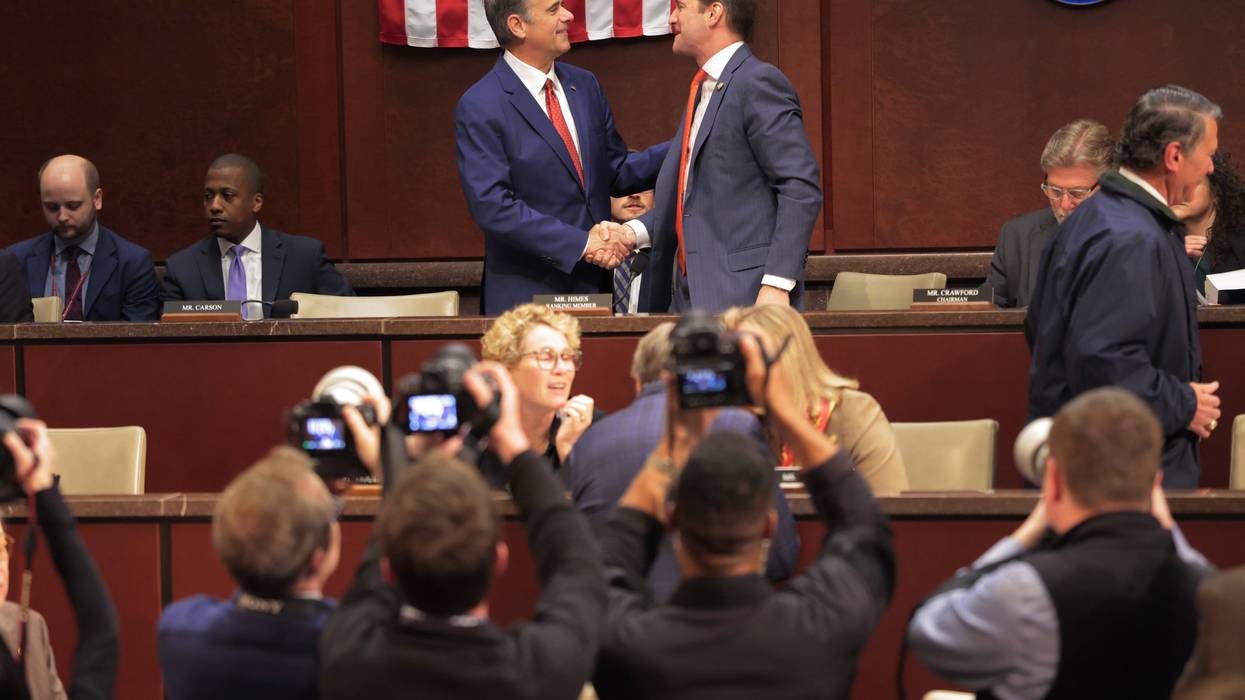
However, 42 Democrats—including House Permanent Select Committee on Intelligence Ranking Member Jim Himes (Conn.)—still joined most House Republicans in advancing the legislation.
In addition to Himes, the Democrats who voted for the bill are Pete Aguilar (Calif.), Ami Bera (Calif.), Sanford Bishop (Ga.), Nikki Budzinski (Ill.), Janelle Bynum (Ore.), Ed Case (Hawaii), Kathy Castor (Fla.), Gil Cisneros (Calif.), Herb Conaway (NJ), Henry Cuellar (Texas), Don Davis (NC), Lois Frankel (Fla.), Laura Gillen (NY), Jared Golden (Maine), Vicente Gonzalez (Texas), Josh Gottheimer (NJ), Josh Harder (Calif.), Chrissy Houlahan (Pa.), Steny Hoyer (Md.), Greg Landsman (Ohio), Susie Lee (Nev.), Kristen McDonald Rivet (Mich.), Jared Moskowitz (Fla.), Frank Mrvan (Ind.), Donald Norcross (NJ), Marie Gluesenkamp Perez (Wash.), Scott Peters (Calif.), Mike Quigley (Ill.), Josh Riley (NY), Brad Schneider (Ill.), Kim Schrier (Wash.), Terri Sewell (Ala.), Eric Sorensen (Ill.), Darren Soto (Fla.), Marilyn Strickland (Wash.), Tom Suozzi (NY), Derek Tran (Calif.), Gabe Vasquez (NM), Marc Veasey (Texas), Debbie Wasserman Schultz (Fla.), and George Whitesides (Calif.).
"It's incredibly disappointing the House approved this measure," said Jake Laperruque, deputy director of the Center for Democracy and Technology's Security and Surveillance Project, in a statement. "This bill is empty calories through and through. It contains no warrant for querying Americans' messages, and no meaningful reforms of any kind. The razor-thin procedural vote this afternoon makes clear that there's an appetite for reform, but House leadership took meaningful reforms off the menu."
"There is nothing in this bill that would have prevented the abuses of FISA 702 we've already seen—snooping on lawmakers, protesters, and campaign donors—and there is nothing that would stop even worse abuses in the future. A vote for this bill was a vote to give the FBI and other intelligence agencies a three-year blank check for surveillance abuse."
Hajar Hammado, senior policy adviser at Demand Progress—which helped convene over 100 artificial intelligence, civil rights, and other progressive groups pressuring Congress to include privacy protections in any renewal bill for the spying power—took aim at the House Democrats who supported the legislation.
"The 42 Democratic votes to advance Speaker Johnson and Donald Trump's surveillance agenda are dangerous and shameful," she declared.
"These Democrats defied their constituents and common sense to undercut meaningful privacy reforms in the House and instead voted to hand over sweeping spy powers to the Trump administration," she stressed. "This means continuing warrantless backdoor searches and allowing an increasing number of federal agencies to exploit the data broker loophole to supercharge AI and fuel mass domestic surveillance."
Hammado said that "their vote today has major consequences, as even 22 Republicans put principles over politics and voted against renewing FISA without warrant protections. It was these Democrats' responsibility to stand up against this administration and they voted to stand down instead."
While stressing that "no administration should have these powers," Free Press Action advocacy director Jenna Ruddock directed attention at "the champions for a clean extension of Section 702 in the Trump administration in particular," including the president's homeland security adviser, Stephen Miller.
"Stephen Miller has advocated against reforms to Section 702, claiming it is critical to his and Trump’s homeland security agenda, even as members of the administration refer to political opponents as 'enemies within,'" she noted. "Today, 42 Democrats joined 192 Republicans to co-sign Donald Trump and Stephen Miller's domestic surveillance agenda, jeopardizing the civil rights and liberties of every person in the United States."
Zeteo News reporter Prem Thakker pointed out that House "Democratic leadership did not whip their members, enabling them to vote with Republicans and give Trump the surveillance powers."
While calling out the House Democrats who backed the bill, campaigners also set their sights on the Senate, where Punchbowl News reporter Anthony Adragna predicted that "it's DOA," or dead on arrival. Republicans have a slim majority in the chamber and, due to its rules, need at least some Democratic support to pass most bills, including this one.
A key issue is the central bank digital currency ban included in the House bill. Senate Majority Leader John Thune (R-SD) told reporters on Wednesday that he may try to pass a 45-day extension instead. After a recent short-term extension, the spying authority is set to expire Thursday night.
"Now the fight moves to the Senate, where privacy champions in both parties are gearing up to try and stop this reckless giveaway to the surveillance state," Hammado said. She urged members of the upper chamber to join "bipartisan reformers" like Sens. Dick Durbin (D-Ill.), Mike Lee (R-Utah), Rand Paul (R-Ky.), and Ron Wyden (D-Ore.) "in voting against any FISA measure that lacks real reforms like a warrant requirement to close the backdoor search and data broker loopholes."
Laperruque similarly said that "we hope senators will stand strong and reject this dangerous proposal."
Ruddock highlighted that "there is bipartisan legislation already introduced in both the House and Senate that would make desperately needed reforms to government surveillance powers."
"The Senate should reject the fake reforms in the current House bill and demand a vote on real reforms to Section 702, including a warrant requirement, and closing the data broker loophole," she said. "Our constitutional rights depend on it."
This article has been updated to include the names of the Democrats who voted for the bill.
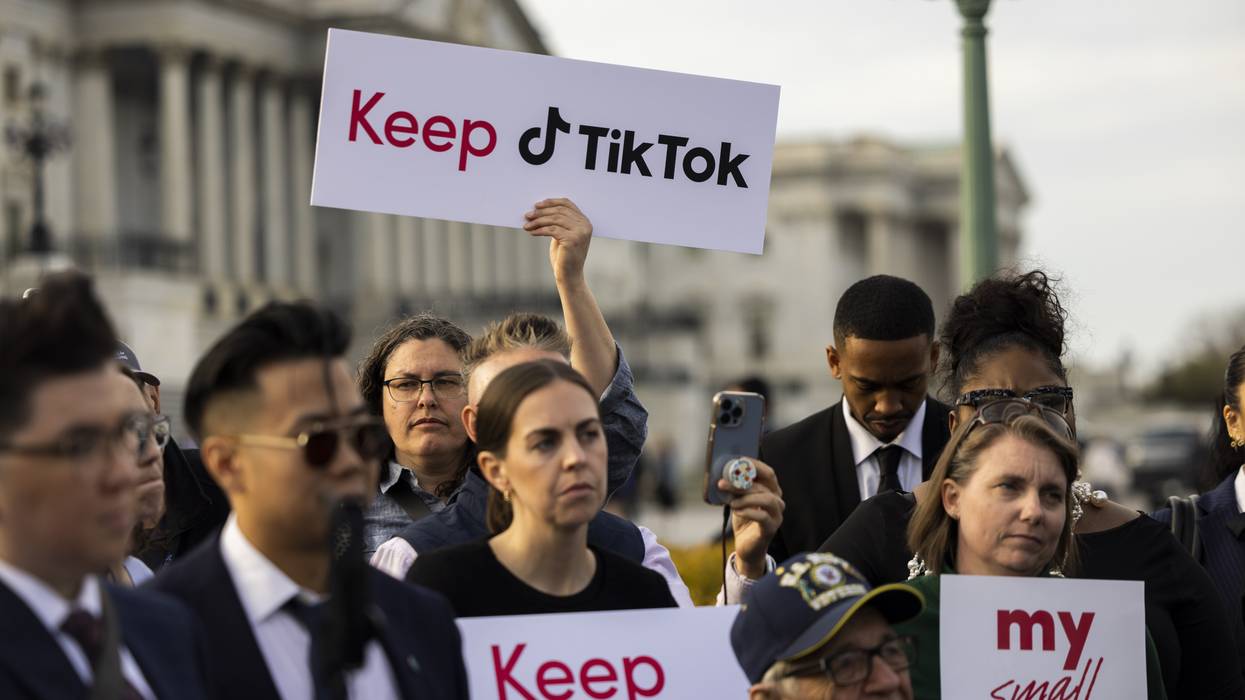
"Banning this social media platform would trample on the constitutional rights of over 170 million Americans."
Update (December 28):
On Friday evening, President-elect Donald Trump filed a brief with the Supreme Court that took no position on whether a ban on TikTok would violate First Amendment rights. Instead, he wrote that he has "consummate deal-making expertise," and as president would be able to "negotiate a resolution to save the platform while addressing the national security concerns expressed by the government."
Trump touted his understanding of social media, noting that he has 14.7 million followers on TikTok. He also said the timing of the impending ban—one day before he takes office–interferes with his "ability to manage the United States’ foreign policy and to pursue a resolution" that will preserve the app in the United States and protect national security.
Earlier:
Ahead of the U.S. Supreme Court's scheduled hearing on social media company TikTok's appeal regarding a ban on the popular platform, three bipartisan lawmakers were among the First Amendment advocates who filed amicus briefs in support of the app on Friday.
Sens. Ed Markey (D-Mass.) and Rand Paul (R-Ky.) were joined by Rep. Ro Khanna (D-Calif.) in asking the court to grant TikTok an emergency injunction to block the Protecting Americans from Foreign Adversary Controlled Applications Act from banning the app on January 19 unless the platform's Chinese parent company sells its stake by then.
The law and its ban on TikTok would "deprive millions of Americans of their First Amendment rights," said the lawmakers.
"The TikTok ban does not survive First Amendment scrutiny," Markey, Paul, and Khanna added. "Its principal justification—preventing covert content manipulation by the Chinese government—reflects a desire to control the content on the TikTok platform and in any event could be achieved through a less restrictive alternative."
The law was signed by President Joe Biden in April over the objections of First Amendment advocates, and a federal appeals court upheld the ban earlier this month. The Supreme Court then agreed to hear TikTok's challenge.
The ACLU, the Center for Democracy & Technology (CDT), and the Freedom of the Press Foundation were among several civil liberties groups that also filed a amicus brief on Friday, arguing that the government has not presented sufficient evidence that the app, which is used by 170 million Americans, causes "ongoing or imminent harm."
Patrick Toomey, deputy director of the ACLU's National Security Project, said the government's attempt to ban Americans from using TikTok, which some creators use to share commentary on geopolitical events as well as weighing in on pop culture and creating humorous videos, is "extraordinary and unprecedented."
"This social media platform has allowed people around the world to tell their own stories in key moments of social upheaval, war, and natural disaster while reaching immense global audiences," Toomey said.
TikTok, he said, is "a unique forum for expression online—and the connections and community that so many have built there cannot be easily replaced. TikTok creators can't simply transfer their audiences and followers to another app, and TikTok users can't simply reassemble the many voices they've discovered on the platform."
At CDT, Free Expression Project director Kate Ruane said the groups' amicus brief "makes clear that national security interests do not diminish protections afforded by the First Amendment and that courts must impose the same rigorous standards to laws that restrict speech."
"It further argues that the D.C. Circuit misapplied strict scrutiny when it failed to significantly examine the government's vague and nonspecific national security justifications for enacting the statute," said Ruane. "In light of the law's sweeping ban on free expression, the coalition's brief argues that the court should block implementation of the Protecting Americans from Foreign Adversary Controlled Applications Act."
The SAFE Act "would make critical reforms to stop persistent abuse" and is "meticulously designed to account for operational needs," said one advocate.
Just weeks away from the expiration of a U.S. government surveillance power with a history of abuse, a bipartisan group of senators unveiled a reauthorization bill welcomed by rights groups who have long demanded reforms.
Congress and U.S. President Joe Biden last year temporarily extended Section 702 of the Foreign Intelligence Surveillance Act (FISA), which permits warrantless surveillance targeting noncitizens located outside the United States, to allow for ongoing discussions of possible changes opposed by the intelligence community and its allies on Capitol Hill.
"There is little doubt that Section 702 is a valuable national security tool. However, while only foreigners overseas may be targeted, the program sweeps in massive amounts of Americans' communications, which may be searched without a warrant," Senate Majority Whip Dick Durbin (D-Ill.) noted Thursday.
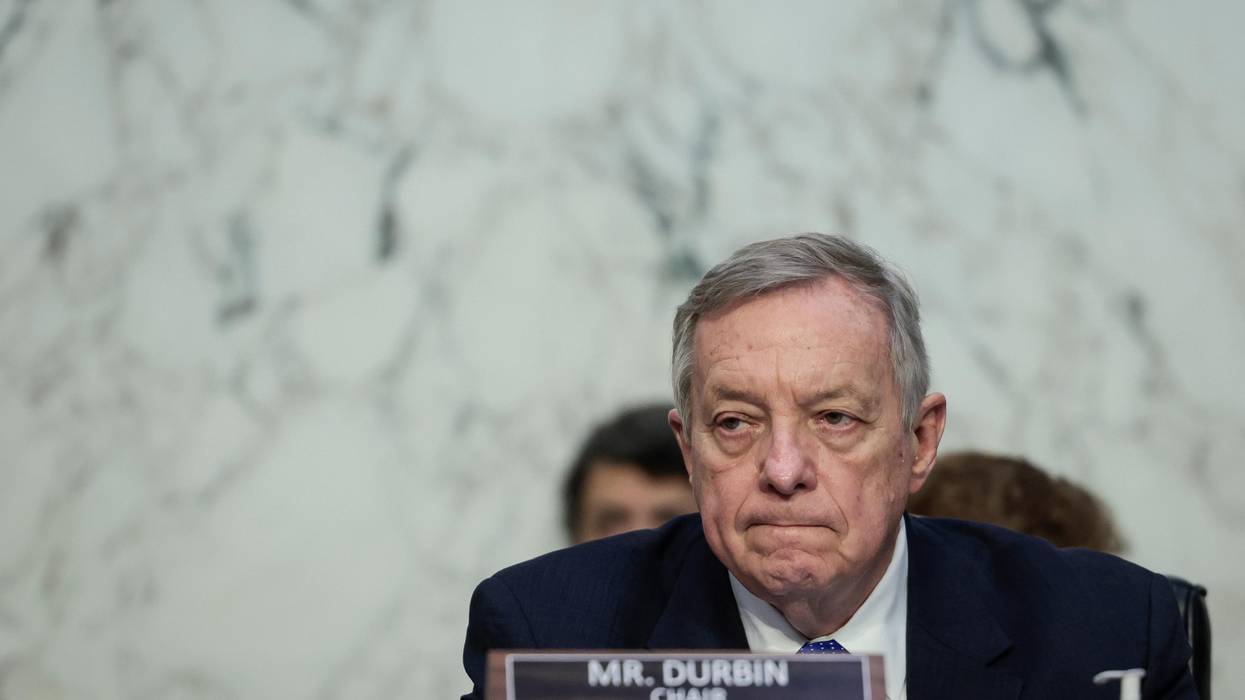
Durbin, who also chairs the Senate Judiciary Committee, and Sen. Mike Lee (R-Utah) are leading the Security and Freedom Enhancement (SAFE) Act with support from 11 other senators who have backed reform efforts in response to rampant abuse, particularly by the Federal Bureau of Investigation (FBI).
"The documented abuses under FISA should provoke outrage from anyone who values the Fourth Amendment rights of American citizens," said Lee. "From warrantless searches targeting journalists, political commentators, and campaign donors to monitoring sitting members of Congress, these actions reveal a blatant disregard for individual liberties."
After noting that "even after implementing compliance measures, the FBI still conducted more than 200,000 warrantless searches of Americans' communications in just one year—more than 500 warrantless searches per day," Durbin framed the SAFE Act as "a sensible, bipartisan path forward on reauthorizing Section 702 with meaningful reforms."
With the April 19 sunset of Section 702 of the Foreign Intelligence Surveillance Act approaching, I'm announcing a bipartisan compromise bill that protects Americans from foreign threats and from warrantless government surveillance. WATCH: https://t.co/3ELLO7O7YN
— Senator Dick Durbin (@SenatorDurbin) March 14, 2024
Specifically, the bill would require agencies to "obtain a FISA Title I order or a warrant before accessing the contents of Americans' communications collected under Section 702—but not before running queries," the sponsors explained. It also includes additional layers of internal supervision for queries involving Americans and would close the data broker loophole, among other provisions.
"Sen. Durbin and Lee have carefully crafted a bipartisan compromise bill," said ACLU senior policy counsel Kia Hamadanchy. "While this legislation does not include every reform civil liberties groups have been pushing for, it does include meaningful changes that will rein in the government's warrantless surveillance of Americans and help ensure that our privacy is protected. The Senate should take up this bill immediately."
Demand Progress policy director Sean Vitka agreed. While also noting that it doesn't have everything rights advocates wanted, he said that "the SAFE Act is a major development in the ongoing fight to rein in warrantless government surveillance of people in the United States."
"We commend Sen. Durbin and Lee for their leadership," Vitka added, stressing that "an overwhelming number of Americans from across the political spectrum want Congress to seize this once-in-a-generation moment and get this done."
Jeramie Scott, senior counsel and director of the Electronic Privacy Information Center's Project on Surveillance Oversight, similarly praised the pair for crafting the bill, which he said "takes a pragmatic, measured approach to reform that draws upon a wide range of proposals" to offer "a clear path forward to reauthorizing Section 702 while ensuring that our rights are protected."
Jake Laperruque, deputy director of the Center for Democracy & Technology's Security and Surveillance Project, also celebrated that the bill "would make critical reforms to stop persistent abuse" and is "meticulously designed to account for operational needs."
"We're just a few weeks away from the expiration of FISA 702—it's time for congressional leadership to stop stalling and allow a vote on these critical reforms," Laperruque declared.
The SAFE Act comes just days after Wired revealed that U.S. House Permanent Select Committee on Intelligence Chair Mike Turner (R-Ohio) privately tried using peaceful protests at the home of Senate Majority Leader Chuck Schumer (D-N.Y.) as proof of the need to block long-demanded reforms to Section 702.
Turner notably already faced calls to resign after he announced that his panel had provided members of Congress with "information concerning a serious national security threat," which news outlets reported was that Russia has made progress on a space-based nuclear weapon to target U.S. satellites.
Amid that controversy—which was widely seen as a ploy to force the reauthorization without reforms—House Speaker Mike Johnson (R-La.) abruptly delayed action on Section 702 in February. However, the Republican leader told Politico on Thursday that "the current plan is to run FISA as a standalone the week after Easter."