
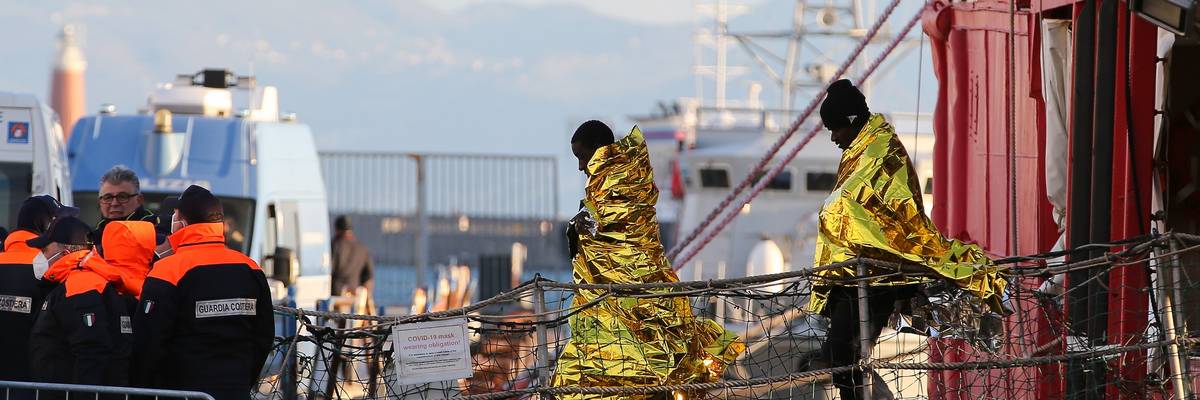
Migrants disembark in Naples, Italy from the Sea-Eye 4 rescue ship after being saved from a shipwreck in the Mediterranean sea on February 6, 2023.
UN Agency Says EU States 'Must Respond' as Migrant Deaths Soar in Mediterranean
"Saving lives at sea is a legal obligation for states," said the U.N.'s top migration official.
The United Nations migration agency said Wednesday that the first three months of 2023 were the deadliest quarter in six years for people attempting to cross the Mediterranean Sea to reach the European Union, with at least 411 migrants dying on the central route through the sea.
Antonio Vitorino, director general of the International Organization for Migration (IOM), said the "persisting humanitarian crisis in the central Mediterranean" has become "intolerable" as state-led search-and-rescue (SAR) efforts have been significantly delayed—in some cases by right-wing anti-migration policies.
"With more than 20,000 deaths recorded on this route since 2014, I fear that these deaths have been normalized," said Vitorino. "States must respond. Delays and gaps in state-led SAR are costing human lives."
The agency said delays in government-led rescues in the Mediterranean were a factor in at least six incidents that led to the deaths of at least 127 people. At least 73 migrants died in another incident in which no attempt at SAR was made by an E.U. government.
"Guided by the spirit of responsibility-sharing and solidarity, we call on states to work together and work to reduce loss of life along migration routes."
In addition to governments' unwillingness to ensure the safe arrival of the tens of thousands of people who attempt the journey from northern Africa to the E.U. each month—including a record number of migrants in the first three months of 2023—right-wing anti-immigration policies have delayed humanitarian organizations from rescuing migrants.
As Common Dreams reported in February, the government of Italian Prime Minister Giorgia Meloni introduced a new law requiring humanitarian rescue shops to request access to Italy's ports, proceed to the country "without delay" after conducting a rescue, and dock in ports in the northern part of the country, far from where rescues take place.
The international charity Medicins Sans Frontiers said earlier this year that following the statute would force the group to leave many refugees stranded in the Mediterranean.
"Saving lives at sea is a legal obligation for states," said Vitorino. "We need to see proactive state-led coordination in search-and-rescue efforts. Guided by the spirit of responsibility-sharing and solidarity, we call on states to work together and work to reduce loss of life along migration routes."
The IOM demanded that E.U. members take more action to rescue migrants in the Mediterranean a day after Meloni's government declared a state of emergency in Italy stemming from so-called "migration congestion."
The government plans to spend $5.42 million to build "new structures, suitable both for sheltering as well as the processing and repatriation of migrants who don't have the requisites to stay."
Alissa Pavia, North Africa associate director for the Atlantic Council, warned the state of emergency, which is scheduled to last for six months, will make it "easier for Meloni to reject and send back migrants because of [the] alleged emergency."
"For YEARS Italian NGOs in the south have been pleading the government to help deal with the inhuman conditions in the centers," said Pavia. "Yet nothing was done."
Instead of declaring a "highly unethical" state of emergency and striving to keep migrants out of Italy, she added, the government should "strengthen asylum and refugee systems" and address integration challenges to normalize the presence of refugees and migrants in the country.
We are at a crossroads
This country and this world are at a monumental crossroads. In a few short weeks, US voters will have an opportunity to beat back the forces of fascism and confront the billionaires who are rigging the economy, our media system, and our democracy, making it increasingly impossible for ordinary people to get by. We’re not just talking about the election. We’re talking about what must be done once these fascist elements are vanquished from power. We need a bolder set of solutions than what either major party has so far been willing to offer and a working-class movement ready to fight like hell for it. Trump didn't emerge from nowhere. The conditions that fueled MAGA authoritarianism were created by decades of radical neoliberal economic policies and a corrupt political system dominated by corporate interests. They slashed taxes on the super-rich, promising that the benefits would trickle down. They said giveaways to the corporate titans would make life more affordable for the rest of us. It was all bullshit. And when a bitter, betrayed populace searches for someone to blame, right-wing demagogues have little trouble finding scapegoats. People know when they're being lied to, but you won't hear any of this from the corporate media. Only independent journalism—powered and funded by people who believe in building a better world—can deliver truly trustworthy daily news. Our Fall Campaign is underway, and we need your help. To power our newsroom through the rest of the year, we need to raise $125,000 by midnight on October 31. So if you share our vision, please contribute whatever you can to sustain our work. |
The United Nations migration agency said Wednesday that the first three months of 2023 were the deadliest quarter in six years for people attempting to cross the Mediterranean Sea to reach the European Union, with at least 411 migrants dying on the central route through the sea.
Antonio Vitorino, director general of the International Organization for Migration (IOM), said the "persisting humanitarian crisis in the central Mediterranean" has become "intolerable" as state-led search-and-rescue (SAR) efforts have been significantly delayed—in some cases by right-wing anti-migration policies.
"With more than 20,000 deaths recorded on this route since 2014, I fear that these deaths have been normalized," said Vitorino. "States must respond. Delays and gaps in state-led SAR are costing human lives."
The agency said delays in government-led rescues in the Mediterranean were a factor in at least six incidents that led to the deaths of at least 127 people. At least 73 migrants died in another incident in which no attempt at SAR was made by an E.U. government.
"Guided by the spirit of responsibility-sharing and solidarity, we call on states to work together and work to reduce loss of life along migration routes."
In addition to governments' unwillingness to ensure the safe arrival of the tens of thousands of people who attempt the journey from northern Africa to the E.U. each month—including a record number of migrants in the first three months of 2023—right-wing anti-immigration policies have delayed humanitarian organizations from rescuing migrants.
As Common Dreams reported in February, the government of Italian Prime Minister Giorgia Meloni introduced a new law requiring humanitarian rescue shops to request access to Italy's ports, proceed to the country "without delay" after conducting a rescue, and dock in ports in the northern part of the country, far from where rescues take place.
The international charity Medicins Sans Frontiers said earlier this year that following the statute would force the group to leave many refugees stranded in the Mediterranean.
"Saving lives at sea is a legal obligation for states," said Vitorino. "We need to see proactive state-led coordination in search-and-rescue efforts. Guided by the spirit of responsibility-sharing and solidarity, we call on states to work together and work to reduce loss of life along migration routes."
The IOM demanded that E.U. members take more action to rescue migrants in the Mediterranean a day after Meloni's government declared a state of emergency in Italy stemming from so-called "migration congestion."
The government plans to spend $5.42 million to build "new structures, suitable both for sheltering as well as the processing and repatriation of migrants who don't have the requisites to stay."
Alissa Pavia, North Africa associate director for the Atlantic Council, warned the state of emergency, which is scheduled to last for six months, will make it "easier for Meloni to reject and send back migrants because of [the] alleged emergency."
"For YEARS Italian NGOs in the south have been pleading the government to help deal with the inhuman conditions in the centers," said Pavia. "Yet nothing was done."
Instead of declaring a "highly unethical" state of emergency and striving to keep migrants out of Italy, she added, the government should "strengthen asylum and refugee systems" and address integration challenges to normalize the presence of refugees and migrants in the country.
- 'The Inhumanity Defies Words': Italy Seizes Banksy-Funded Migrant Rescue Ship as Dozens Drown ›
- EU Deliberately Causes Needless Suffering for Refugees in the Mediterranean ›
- Refugees 'Will Pay the Real Price,' Says Charity After Italy Detains Rescue Ship ›
- Opinion | How the EU Weaponizes Time Against Refugees | Common Dreams ›
- At Least 289 Children Have Drowned Trying to Reach Europe This Year: UNICEF ›
- Opinion | The Unremarkable Deaths of Migrants Crossing the Sahara | Common Dreams ›
- 'Unacceptable Tragedy': 10,000+ Migrants Died Trying to Reach Spain This Year | Common Dreams ›
The United Nations migration agency said Wednesday that the first three months of 2023 were the deadliest quarter in six years for people attempting to cross the Mediterranean Sea to reach the European Union, with at least 411 migrants dying on the central route through the sea.
Antonio Vitorino, director general of the International Organization for Migration (IOM), said the "persisting humanitarian crisis in the central Mediterranean" has become "intolerable" as state-led search-and-rescue (SAR) efforts have been significantly delayed—in some cases by right-wing anti-migration policies.
"With more than 20,000 deaths recorded on this route since 2014, I fear that these deaths have been normalized," said Vitorino. "States must respond. Delays and gaps in state-led SAR are costing human lives."
The agency said delays in government-led rescues in the Mediterranean were a factor in at least six incidents that led to the deaths of at least 127 people. At least 73 migrants died in another incident in which no attempt at SAR was made by an E.U. government.
"Guided by the spirit of responsibility-sharing and solidarity, we call on states to work together and work to reduce loss of life along migration routes."
In addition to governments' unwillingness to ensure the safe arrival of the tens of thousands of people who attempt the journey from northern Africa to the E.U. each month—including a record number of migrants in the first three months of 2023—right-wing anti-immigration policies have delayed humanitarian organizations from rescuing migrants.
As Common Dreams reported in February, the government of Italian Prime Minister Giorgia Meloni introduced a new law requiring humanitarian rescue shops to request access to Italy's ports, proceed to the country "without delay" after conducting a rescue, and dock in ports in the northern part of the country, far from where rescues take place.
The international charity Medicins Sans Frontiers said earlier this year that following the statute would force the group to leave many refugees stranded in the Mediterranean.
"Saving lives at sea is a legal obligation for states," said Vitorino. "We need to see proactive state-led coordination in search-and-rescue efforts. Guided by the spirit of responsibility-sharing and solidarity, we call on states to work together and work to reduce loss of life along migration routes."
The IOM demanded that E.U. members take more action to rescue migrants in the Mediterranean a day after Meloni's government declared a state of emergency in Italy stemming from so-called "migration congestion."
The government plans to spend $5.42 million to build "new structures, suitable both for sheltering as well as the processing and repatriation of migrants who don't have the requisites to stay."
Alissa Pavia, North Africa associate director for the Atlantic Council, warned the state of emergency, which is scheduled to last for six months, will make it "easier for Meloni to reject and send back migrants because of [the] alleged emergency."
"For YEARS Italian NGOs in the south have been pleading the government to help deal with the inhuman conditions in the centers," said Pavia. "Yet nothing was done."
Instead of declaring a "highly unethical" state of emergency and striving to keep migrants out of Italy, she added, the government should "strengthen asylum and refugee systems" and address integration challenges to normalize the presence of refugees and migrants in the country.
- 'The Inhumanity Defies Words': Italy Seizes Banksy-Funded Migrant Rescue Ship as Dozens Drown ›
- EU Deliberately Causes Needless Suffering for Refugees in the Mediterranean ›
- Refugees 'Will Pay the Real Price,' Says Charity After Italy Detains Rescue Ship ›
- Opinion | How the EU Weaponizes Time Against Refugees | Common Dreams ›
- At Least 289 Children Have Drowned Trying to Reach Europe This Year: UNICEF ›
- Opinion | The Unremarkable Deaths of Migrants Crossing the Sahara | Common Dreams ›
- 'Unacceptable Tragedy': 10,000+ Migrants Died Trying to Reach Spain This Year | Common Dreams ›