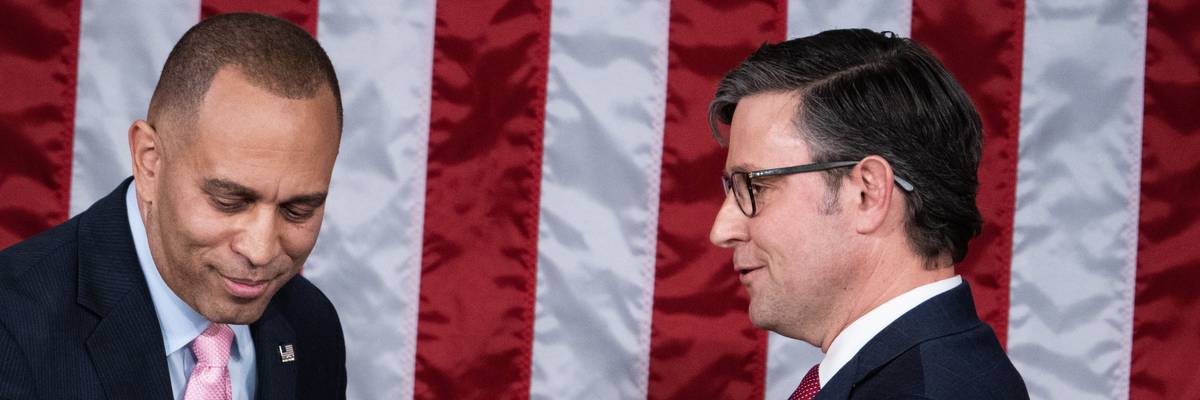
House Speaker Mike Johnson (R-La.) greets House Minority Leader Hakeem Jeffries (D-N.Y.) on the House floor on October 25, 2023.
ACLU, Snowden Slam Bipartisan Extension of 'Unconstitutional' Spying Law
"It's incredibly disheartening that Congress decided to extend an easily abused law with zero of the reforms needed to protect all of our privacy," said the ACLU's senior policy counsel.
The ACLU and National Security Agency whistleblower Edward Snowden were among those condemning House and Senate lawmakers on Thursday for approving an extension of a law that the federal government has used to spy on the communications of Americans without a warrant.
The extension of Section 702 of the Foreign Intelligence Surveillance Act (FISA) was crammed into the 3,000-page National Defense Authorization Act, an $886 billion piece of legislation that approves funding for the Pentagon for the coming fiscal year.
Just hours after the Senate narrowly defeated a last-ditch motion to strip out the Section 702 extension and approved the NDAA in a bipartisan 87-13 vote, the House passed the legislation in a similarly resounding fashion on Thursday, with 163 Democrats and 147 Republicans supporting the bill.
Just 45 Democrats voted no after the Congressional Progressive Caucus leadership urged the bloc's 100-plus members to oppose the measure, citing the proposed four-month extension of Section 702 and excessive military spending.
The NDAA now heads to the desk of President Joe Biden, who is expected to sign it. The White House has publicly urged Congress to reauthorize Section 702, which ostensibly allows federal authorities to surveil only the communications of non-U.S. citizens located outside the country.
In practice, however, the program has been used to spy on the communications of American activists, journalists, members of Congress, and others without a warrant. Government records show that the FBI abused Section 702 more than 278,000 times between 2020 and early 2021.
Kia Hamadanchy, the ACLU's senior policy counsel, said in a Thursday statement following the House vote that "it's incredibly disheartening that Congress decided to extend an easily abused law with zero of the reforms needed to protect all of our privacy."
"As long as Section 702 is being used by the government to spy on Americans without a warrant," Hamadanchy added, "we will continue to fight this unconstitutional law and work with Congress to strengthen our Fourth Amendment protections against government surveillance."
Snowden, a former NSA contractor who helped expose the agency's mass surveillance apparatus, wrote on social media that "Congress has voted to pass the NDAA—in which they deceitfully concealed an extension of the warrantless spying program ('Section 702') universally opposed by the public."
https://t.co/D1cqGYIvDC
— Edward Snowden (@Snowden) December 14, 2023
Elizabeth Goitein, co-director of the Liberty and National Security Program at the Brennan Center for Justice, criticized lawmakers for caving to "abject fearmongering by the administration and surveillance hawks" who claimed the reauthorization of Section 702 was urgently needed to protect national security.
Goitein noted that the four-month extension of Section 702 will likely become a 16-month extension as the Biden administration is expected to use the four months to ask the FISA Court for a one-year extension. The spying authority was set to expire at the end of the year.
"The fight continues," Goitein wrote on social media. "We can't sit back and wait for 16 months; we must demand that Congress reform Section 702 *now* to end the abuses and rein in warrantless surveillance of Americans."
We are at a crossroads
This country and this world are at a monumental crossroads. In a few short weeks, US voters will have an opportunity to beat back the forces of fascism and confront the billionaires who are rigging the economy, our media system, and our democracy, making it increasingly impossible for ordinary people to get by. We’re not just talking about the election. We’re talking about what must be done once these fascist elements are vanquished from power. We need a bolder set of solutions than what either major party has so far been willing to offer and a working-class movement ready to fight like hell for it. Trump didn't emerge from nowhere. The conditions that fueled MAGA authoritarianism were created by decades of radical neoliberal economic policies and a corrupt political system dominated by corporate interests. They slashed taxes on the super-rich, promising that the benefits would trickle down. They said giveaways to the corporate titans would make life more affordable for the rest of us. It was all bullshit. And when a bitter, betrayed populace searches for someone to blame, right-wing demagogues have little trouble finding scapegoats. People know when they're being lied to, but you won't hear any of this from the corporate media. Only independent journalism—powered and funded by people who believe in building a better world—can deliver truly trustworthy daily news. Our Fall Campaign is underway, and we need your help. To power our newsroom through the rest of the year, we need to raise $125,000 by midnight on October 31. So if you share our vision, please contribute whatever you can to sustain our work. |
The ACLU and National Security Agency whistleblower Edward Snowden were among those condemning House and Senate lawmakers on Thursday for approving an extension of a law that the federal government has used to spy on the communications of Americans without a warrant.
The extension of Section 702 of the Foreign Intelligence Surveillance Act (FISA) was crammed into the 3,000-page National Defense Authorization Act, an $886 billion piece of legislation that approves funding for the Pentagon for the coming fiscal year.
Just hours after the Senate narrowly defeated a last-ditch motion to strip out the Section 702 extension and approved the NDAA in a bipartisan 87-13 vote, the House passed the legislation in a similarly resounding fashion on Thursday, with 163 Democrats and 147 Republicans supporting the bill.
Just 45 Democrats voted no after the Congressional Progressive Caucus leadership urged the bloc's 100-plus members to oppose the measure, citing the proposed four-month extension of Section 702 and excessive military spending.
The NDAA now heads to the desk of President Joe Biden, who is expected to sign it. The White House has publicly urged Congress to reauthorize Section 702, which ostensibly allows federal authorities to surveil only the communications of non-U.S. citizens located outside the country.
In practice, however, the program has been used to spy on the communications of American activists, journalists, members of Congress, and others without a warrant. Government records show that the FBI abused Section 702 more than 278,000 times between 2020 and early 2021.
Kia Hamadanchy, the ACLU's senior policy counsel, said in a Thursday statement following the House vote that "it's incredibly disheartening that Congress decided to extend an easily abused law with zero of the reforms needed to protect all of our privacy."
"As long as Section 702 is being used by the government to spy on Americans without a warrant," Hamadanchy added, "we will continue to fight this unconstitutional law and work with Congress to strengthen our Fourth Amendment protections against government surveillance."
Snowden, a former NSA contractor who helped expose the agency's mass surveillance apparatus, wrote on social media that "Congress has voted to pass the NDAA—in which they deceitfully concealed an extension of the warrantless spying program ('Section 702') universally opposed by the public."
https://t.co/D1cqGYIvDC
— Edward Snowden (@Snowden) December 14, 2023
Elizabeth Goitein, co-director of the Liberty and National Security Program at the Brennan Center for Justice, criticized lawmakers for caving to "abject fearmongering by the administration and surveillance hawks" who claimed the reauthorization of Section 702 was urgently needed to protect national security.
Goitein noted that the four-month extension of Section 702 will likely become a 16-month extension as the Biden administration is expected to use the four months to ask the FISA Court for a one-year extension. The spying authority was set to expire at the end of the year.
"The fight continues," Goitein wrote on social media. "We can't sit back and wait for 16 months; we must demand that Congress reform Section 702 *now* to end the abuses and rein in warrantless surveillance of Americans."
The ACLU and National Security Agency whistleblower Edward Snowden were among those condemning House and Senate lawmakers on Thursday for approving an extension of a law that the federal government has used to spy on the communications of Americans without a warrant.
The extension of Section 702 of the Foreign Intelligence Surveillance Act (FISA) was crammed into the 3,000-page National Defense Authorization Act, an $886 billion piece of legislation that approves funding for the Pentagon for the coming fiscal year.
Just hours after the Senate narrowly defeated a last-ditch motion to strip out the Section 702 extension and approved the NDAA in a bipartisan 87-13 vote, the House passed the legislation in a similarly resounding fashion on Thursday, with 163 Democrats and 147 Republicans supporting the bill.
Just 45 Democrats voted no after the Congressional Progressive Caucus leadership urged the bloc's 100-plus members to oppose the measure, citing the proposed four-month extension of Section 702 and excessive military spending.
The NDAA now heads to the desk of President Joe Biden, who is expected to sign it. The White House has publicly urged Congress to reauthorize Section 702, which ostensibly allows federal authorities to surveil only the communications of non-U.S. citizens located outside the country.
In practice, however, the program has been used to spy on the communications of American activists, journalists, members of Congress, and others without a warrant. Government records show that the FBI abused Section 702 more than 278,000 times between 2020 and early 2021.
Kia Hamadanchy, the ACLU's senior policy counsel, said in a Thursday statement following the House vote that "it's incredibly disheartening that Congress decided to extend an easily abused law with zero of the reforms needed to protect all of our privacy."
"As long as Section 702 is being used by the government to spy on Americans without a warrant," Hamadanchy added, "we will continue to fight this unconstitutional law and work with Congress to strengthen our Fourth Amendment protections against government surveillance."
Snowden, a former NSA contractor who helped expose the agency's mass surveillance apparatus, wrote on social media that "Congress has voted to pass the NDAA—in which they deceitfully concealed an extension of the warrantless spying program ('Section 702') universally opposed by the public."
https://t.co/D1cqGYIvDC
— Edward Snowden (@Snowden) December 14, 2023
Elizabeth Goitein, co-director of the Liberty and National Security Program at the Brennan Center for Justice, criticized lawmakers for caving to "abject fearmongering by the administration and surveillance hawks" who claimed the reauthorization of Section 702 was urgently needed to protect national security.
Goitein noted that the four-month extension of Section 702 will likely become a 16-month extension as the Biden administration is expected to use the four months to ask the FISA Court for a one-year extension. The spying authority was set to expire at the end of the year.
"The fight continues," Goitein wrote on social media. "We can't sit back and wait for 16 months; we must demand that Congress reform Section 702 *now* to end the abuses and rein in warrantless surveillance of Americans."