SUBSCRIBE TO OUR FREE NEWSLETTER
Daily news & progressive opinion—funded by the people, not the corporations—delivered straight to your inbox.
5
#000000
#FFFFFF
To donate by check, phone, or other method, see our More Ways to Give page.
Daily news & progressive opinion—funded by the people, not the corporations—delivered straight to your inbox.
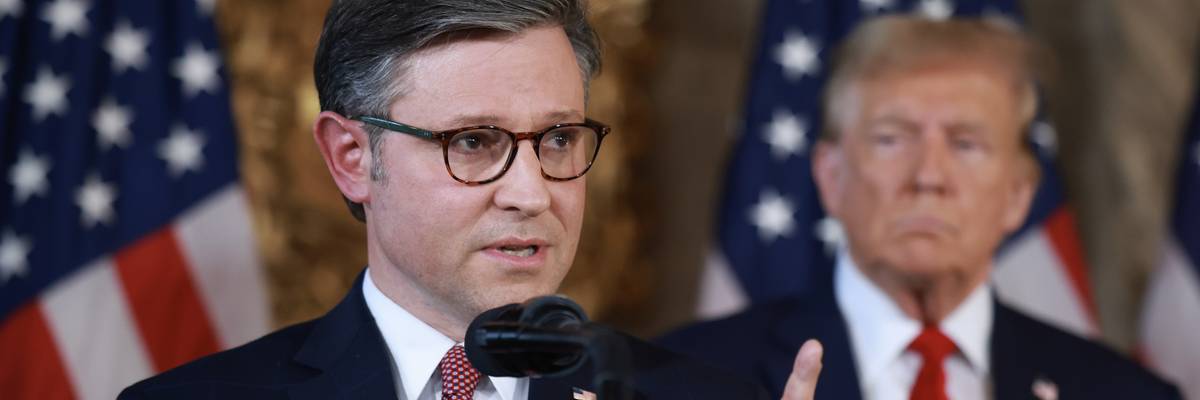
Republican presidential candidate former President Donald Trump listens as Speaker of the House Mike Johnson (R-LA) speaks during a press conference at Mr. Trump's Mar-a-Lago estate on April 12, 2024, in Palm Beach, Florida.
The president and GOP House speaker wanted a 5-year extension of a despised domestic spying bill. Instead, they got just two weeks. "Now, they will have to fight in daylight tomorrow!" said one Democratic lawmaker
A dramatic series of votes in the US House of Representatives resulted in a dead-of-night extension of what critics describe as a "deceitful proposal" to continue a controversial domestic spying program, known as Section 702, that allows federal agencies to spy on the communications of Americans without a warrant.
While US President Donald Trump and his allies on the issue have pushed aggressively for a longer agreement to continue the controversial provision of the Foreign Intelligence Surveillance Act, or FISA, most of the Democratic caucus and a band of renegade, more libertarian-leaning Republicans have resisted.
In the 228-197 final vote, a total of four Democrats—Reps. Jared Golden of Maine, Josh Gottheimer of New Jersey, Marie Gluesenkamp Perez of Washington, and Thomas R. Suozzi of New York—joined with all but 25 Republicans who voted to pass a 10-day extension. Twenty GOP members voted against it, while five did not vote.
Ahead of the votes—including on separate versions asking for a 5-year and then 18-month extensions of Section 702—opponents of any clean extension, including Rep. Ro Khanna (D-Calif.), said anyone opposed to warrantless spying on Americans must vote no.
"They have called us back at midnight to cast a secret vote to reauthorize FISA while America sleeps," said Khanna in a late-night social media post. "A yes vote gives Trump more power to surveil Americans. Every Democrat must vote no. Everyone who loves the constitution must vote no."
They have called us back at midnight to cast a secret vote to reauthorize FISA while America sleeps. A yes vote gives Trump more power to surveil Americans.
Every Democrat must vote no. Everyone who loves the constitution must vote no. pic.twitter.com/kJGQm5EWW3
— Ro Khanna (@RoKhanna) April 17, 2026
The bloc of 20 Republicans who voted against the shorter extension also refused to budge on the push, despite heavy lobbying from the Trump White House and pressure from House Speaker Mike Johnson, for the 18-month and 5-year versions.
The holdouts on both sides of the aisle, meanwhile, have been demanding privacy reforms to make sure the communications of US citizens are not swept up in the surveillance of noncitizens targeted abroad by the nation's spy agencies and law enforcement.
"Let me be clear," said Rep. Pramila Jayapal (D-Wash.) explaining her no vote in a statement. "There is no new warrant requirement in tonight's amendment to FISA reauthorization. It does absolutely nothing to fix the massive loopholes in 702 collection that allow the government to spy on Americans without a warrant. It does nothing to fix the data broker loophole. And it slaps a 5-year extension on this bill so that this White House can continue to spy on Americans and violate our privacy rights for an even longer time."
Speaker Johnson, she charged, "is trying to pass it in the middle of the night—like so many of other pieces of his agenda—because he knows it is not what the American people want. Don't be fooled: this bill simply continues to the spying and surveillance of the American people."
Outside critics of the clean extension effort have criticized Democratic lawmakers, including Reps. Gregory Meeks of New York and Jim Hines of Connecticut—the latter of whom was reportedly conferring with the Republican whip team on the floor of the House late Thursday night—with sabotaging efforts to get a bill with stronger protections.
Sean Vitka, executive director of Demand Progress, which has led a bipartisan coalition against a clean extension of the FISA provision, said serious questions must be asked about the role some Democrats are playing in the current fight to win significant reforms.
“Speaker Johnson’s failure to ram through an 18-month FISA extension creates time for Congress to vote on critical privacy protections, namely closing the backdoor search and data broker loopholes," Vitka said after the short-term extension was passed overnight. "This failure of Himes and House Republican leaders is a testament to the good-faith, bipartisan movement fighting tirelessly for Americans’ privacy rights. This is a major opportunity to protect Americans’ civil liberties, and the Republicans who withstood this pressure should be celebrated for putting privacy over party.
"Extraordinarily, four Democrats chose to back Speaker Johnson over Leader Jeffries on this critical privacy vote," Vitka added. "Given that top Intelligence Democrat Jim Himes was caught speaking with Speaker Johnson before the vote, reporters should be asking whether he engineered these defections in an effort to sabotage the mere chance for the House to enact key, broadly bipartisan civil liberties protections. It would be unconscionable for someone with a critical oversight role like Himes to do so."
For his part, Khanna said the battle for meaningful reforms to the FISA law continues.
"We just defeated Johnson's efforts to sneak through a 5-year FISA authorization tonight," said Khanna. "Now, they will have to fight in daylight tomorrow!"
Vitka said that from now until the end of the month, when the short-term extension expires, lawmakers "fighting against privacy reform to face reality: the American people don’t want FISA to continue as-is and are watching like hawks."
"If you want to renew FISA," he added, "you must come to the table and agree to real privacy reforms that stop the government from bypassing the courts to collect private information on Americans.”
Dear Common Dreams reader, It’s been nearly 30 years since I co-founded Common Dreams with my late wife, Lina Newhouser. We had the radical notion that journalism should serve the public good, not corporate profits. It was clear to us from the outset what it would take to build such a project. No paid advertisements. No corporate sponsors. No millionaire publisher telling us what to think or do. Many people said we wouldn't last a year, but we proved those doubters wrong. Together with a tremendous team of journalists and dedicated staff, we built an independent media outlet free from the constraints of profits and corporate control. Our mission has always been simple: To inform. To inspire. To ignite change for the common good. Building Common Dreams was not easy. Our survival was never guaranteed. When you take on the most powerful forces—Wall Street greed, fossil fuel industry destruction, Big Tech lobbyists, and uber-rich oligarchs who have spent billions upon billions rigging the economy and democracy in their favor—the only bulwark you have is supporters who believe in your work. But here’s the urgent message from me today. It's never been this bad out there. And it's never been this hard to keep us going. At the very moment Common Dreams is most needed, the threats we face are intensifying. We need your support now more than ever. We don't accept corporate advertising and never will. We don't have a paywall because we don't think people should be blocked from critical news based on their ability to pay. Everything we do is funded by the donations of readers like you. When everyone does the little they can afford, we are strong. But if that support retreats or dries up, so do we. Will you donate now to make sure Common Dreams not only survives but thrives? —Craig Brown, Co-founder |
A dramatic series of votes in the US House of Representatives resulted in a dead-of-night extension of what critics describe as a "deceitful proposal" to continue a controversial domestic spying program, known as Section 702, that allows federal agencies to spy on the communications of Americans without a warrant.
While US President Donald Trump and his allies on the issue have pushed aggressively for a longer agreement to continue the controversial provision of the Foreign Intelligence Surveillance Act, or FISA, most of the Democratic caucus and a band of renegade, more libertarian-leaning Republicans have resisted.
In the 228-197 final vote, a total of four Democrats—Reps. Jared Golden of Maine, Josh Gottheimer of New Jersey, Marie Gluesenkamp Perez of Washington, and Thomas R. Suozzi of New York—joined with all but 25 Republicans who voted to pass a 10-day extension. Twenty GOP members voted against it, while five did not vote.
Ahead of the votes—including on separate versions asking for a 5-year and then 18-month extensions of Section 702—opponents of any clean extension, including Rep. Ro Khanna (D-Calif.), said anyone opposed to warrantless spying on Americans must vote no.
"They have called us back at midnight to cast a secret vote to reauthorize FISA while America sleeps," said Khanna in a late-night social media post. "A yes vote gives Trump more power to surveil Americans. Every Democrat must vote no. Everyone who loves the constitution must vote no."
They have called us back at midnight to cast a secret vote to reauthorize FISA while America sleeps. A yes vote gives Trump more power to surveil Americans.
Every Democrat must vote no. Everyone who loves the constitution must vote no. pic.twitter.com/kJGQm5EWW3
— Ro Khanna (@RoKhanna) April 17, 2026
The bloc of 20 Republicans who voted against the shorter extension also refused to budge on the push, despite heavy lobbying from the Trump White House and pressure from House Speaker Mike Johnson, for the 18-month and 5-year versions.
The holdouts on both sides of the aisle, meanwhile, have been demanding privacy reforms to make sure the communications of US citizens are not swept up in the surveillance of noncitizens targeted abroad by the nation's spy agencies and law enforcement.
"Let me be clear," said Rep. Pramila Jayapal (D-Wash.) explaining her no vote in a statement. "There is no new warrant requirement in tonight's amendment to FISA reauthorization. It does absolutely nothing to fix the massive loopholes in 702 collection that allow the government to spy on Americans without a warrant. It does nothing to fix the data broker loophole. And it slaps a 5-year extension on this bill so that this White House can continue to spy on Americans and violate our privacy rights for an even longer time."
Speaker Johnson, she charged, "is trying to pass it in the middle of the night—like so many of other pieces of his agenda—because he knows it is not what the American people want. Don't be fooled: this bill simply continues to the spying and surveillance of the American people."
Outside critics of the clean extension effort have criticized Democratic lawmakers, including Reps. Gregory Meeks of New York and Jim Hines of Connecticut—the latter of whom was reportedly conferring with the Republican whip team on the floor of the House late Thursday night—with sabotaging efforts to get a bill with stronger protections.
Sean Vitka, executive director of Demand Progress, which has led a bipartisan coalition against a clean extension of the FISA provision, said serious questions must be asked about the role some Democrats are playing in the current fight to win significant reforms.
“Speaker Johnson’s failure to ram through an 18-month FISA extension creates time for Congress to vote on critical privacy protections, namely closing the backdoor search and data broker loopholes," Vitka said after the short-term extension was passed overnight. "This failure of Himes and House Republican leaders is a testament to the good-faith, bipartisan movement fighting tirelessly for Americans’ privacy rights. This is a major opportunity to protect Americans’ civil liberties, and the Republicans who withstood this pressure should be celebrated for putting privacy over party.
"Extraordinarily, four Democrats chose to back Speaker Johnson over Leader Jeffries on this critical privacy vote," Vitka added. "Given that top Intelligence Democrat Jim Himes was caught speaking with Speaker Johnson before the vote, reporters should be asking whether he engineered these defections in an effort to sabotage the mere chance for the House to enact key, broadly bipartisan civil liberties protections. It would be unconscionable for someone with a critical oversight role like Himes to do so."
For his part, Khanna said the battle for meaningful reforms to the FISA law continues.
"We just defeated Johnson's efforts to sneak through a 5-year FISA authorization tonight," said Khanna. "Now, they will have to fight in daylight tomorrow!"
Vitka said that from now until the end of the month, when the short-term extension expires, lawmakers "fighting against privacy reform to face reality: the American people don’t want FISA to continue as-is and are watching like hawks."
"If you want to renew FISA," he added, "you must come to the table and agree to real privacy reforms that stop the government from bypassing the courts to collect private information on Americans.”
A dramatic series of votes in the US House of Representatives resulted in a dead-of-night extension of what critics describe as a "deceitful proposal" to continue a controversial domestic spying program, known as Section 702, that allows federal agencies to spy on the communications of Americans without a warrant.
While US President Donald Trump and his allies on the issue have pushed aggressively for a longer agreement to continue the controversial provision of the Foreign Intelligence Surveillance Act, or FISA, most of the Democratic caucus and a band of renegade, more libertarian-leaning Republicans have resisted.
In the 228-197 final vote, a total of four Democrats—Reps. Jared Golden of Maine, Josh Gottheimer of New Jersey, Marie Gluesenkamp Perez of Washington, and Thomas R. Suozzi of New York—joined with all but 25 Republicans who voted to pass a 10-day extension. Twenty GOP members voted against it, while five did not vote.
Ahead of the votes—including on separate versions asking for a 5-year and then 18-month extensions of Section 702—opponents of any clean extension, including Rep. Ro Khanna (D-Calif.), said anyone opposed to warrantless spying on Americans must vote no.
"They have called us back at midnight to cast a secret vote to reauthorize FISA while America sleeps," said Khanna in a late-night social media post. "A yes vote gives Trump more power to surveil Americans. Every Democrat must vote no. Everyone who loves the constitution must vote no."
They have called us back at midnight to cast a secret vote to reauthorize FISA while America sleeps. A yes vote gives Trump more power to surveil Americans.
Every Democrat must vote no. Everyone who loves the constitution must vote no. pic.twitter.com/kJGQm5EWW3
— Ro Khanna (@RoKhanna) April 17, 2026
The bloc of 20 Republicans who voted against the shorter extension also refused to budge on the push, despite heavy lobbying from the Trump White House and pressure from House Speaker Mike Johnson, for the 18-month and 5-year versions.
The holdouts on both sides of the aisle, meanwhile, have been demanding privacy reforms to make sure the communications of US citizens are not swept up in the surveillance of noncitizens targeted abroad by the nation's spy agencies and law enforcement.
"Let me be clear," said Rep. Pramila Jayapal (D-Wash.) explaining her no vote in a statement. "There is no new warrant requirement in tonight's amendment to FISA reauthorization. It does absolutely nothing to fix the massive loopholes in 702 collection that allow the government to spy on Americans without a warrant. It does nothing to fix the data broker loophole. And it slaps a 5-year extension on this bill so that this White House can continue to spy on Americans and violate our privacy rights for an even longer time."
Speaker Johnson, she charged, "is trying to pass it in the middle of the night—like so many of other pieces of his agenda—because he knows it is not what the American people want. Don't be fooled: this bill simply continues to the spying and surveillance of the American people."
Outside critics of the clean extension effort have criticized Democratic lawmakers, including Reps. Gregory Meeks of New York and Jim Hines of Connecticut—the latter of whom was reportedly conferring with the Republican whip team on the floor of the House late Thursday night—with sabotaging efforts to get a bill with stronger protections.
Sean Vitka, executive director of Demand Progress, which has led a bipartisan coalition against a clean extension of the FISA provision, said serious questions must be asked about the role some Democrats are playing in the current fight to win significant reforms.
“Speaker Johnson’s failure to ram through an 18-month FISA extension creates time for Congress to vote on critical privacy protections, namely closing the backdoor search and data broker loopholes," Vitka said after the short-term extension was passed overnight. "This failure of Himes and House Republican leaders is a testament to the good-faith, bipartisan movement fighting tirelessly for Americans’ privacy rights. This is a major opportunity to protect Americans’ civil liberties, and the Republicans who withstood this pressure should be celebrated for putting privacy over party.
"Extraordinarily, four Democrats chose to back Speaker Johnson over Leader Jeffries on this critical privacy vote," Vitka added. "Given that top Intelligence Democrat Jim Himes was caught speaking with Speaker Johnson before the vote, reporters should be asking whether he engineered these defections in an effort to sabotage the mere chance for the House to enact key, broadly bipartisan civil liberties protections. It would be unconscionable for someone with a critical oversight role like Himes to do so."
For his part, Khanna said the battle for meaningful reforms to the FISA law continues.
"We just defeated Johnson's efforts to sneak through a 5-year FISA authorization tonight," said Khanna. "Now, they will have to fight in daylight tomorrow!"
Vitka said that from now until the end of the month, when the short-term extension expires, lawmakers "fighting against privacy reform to face reality: the American people don’t want FISA to continue as-is and are watching like hawks."
"If you want to renew FISA," he added, "you must come to the table and agree to real privacy reforms that stop the government from bypassing the courts to collect private information on Americans.”