SUBSCRIBE TO OUR FREE NEWSLETTER
Daily news & progressive opinion—funded by the people, not the corporations—delivered straight to your inbox.
5
#000000
#FFFFFF
To donate by check, phone, or other method, see our More Ways to Give page.
Daily news & progressive opinion—funded by the people, not the corporations—delivered straight to your inbox.
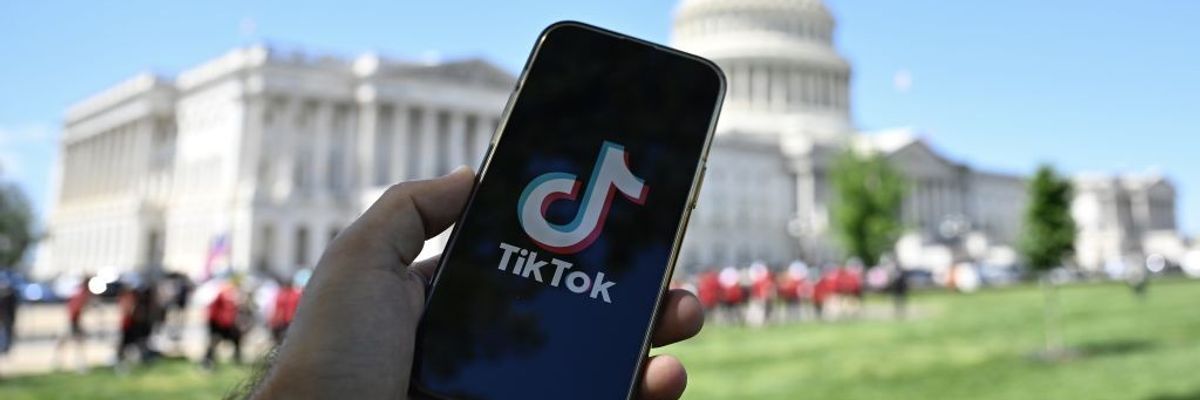
The TikTok logo is displayed on a smartphone in Washington, D.C. on April 20, 2024.
"This is a deeply misguided ruling that reads important First Amendment precedents too narrowly and gives the government sweeping power to restrict Americans' access to information, ideas, and media from abroad."
First Amendment advocates on Friday criticized a U.S. appellate court for upholding a law that would ban TikTok in the United States if its Chinese parent company does not swiftly sell the social media platform used by an estimated 170 million Americans.
Signed by President Joe Biden in April, the law gives ByteDance until January 19 to divest from TikTok. Three judges from the U.S. Court of Appeals for the District of Columbia Circuit found that the parts of the law considered by the panel "do not contravene the First Amendment" nor other parts of the Constitution of the United States.
"The First Amendment exists to protect free speech in the United States. Here the government acted solely to protect that freedom from a foreign adversary nation and to limit that adversary's ability to gather data on people in the United States," Judge Douglas Ginsburg wrote in an opinion the company is expected to appeal to the U.S. Supreme Court.
Responding to the decision on social media Friday, Ashley Gorski, senior staff attorney with the ACLU's National Security Project, said that "the D.C. Circuit's decision today to uphold the TikTok ban is enormously disappointing. If allowed to stand, it would give the government far too much power to restrict Americans' speech online."
Jameel Jaffer, who was on a friend-of-the-court brief as director of the Knight First Amendment Institute at Columbia University, issued a similar warning after the ruling was released.
"This is a deeply misguided ruling that reads important First Amendment precedents too narrowly and gives the government sweeping power to restrict Americans' access to information, ideas, and media from abroad," he said. "I hope the D.C. Circuit's ruling won't be the last word—and I doubt it will be."
Kate Ruane, director of the Center for Democracy & Technology's Free Expression Project, also looked ahead to the next court fight.
"The D.C. Circuit decision upholding the TikTok ban will immeasurably harm the free expression of hundreds of millions of TikTok users in the U.S. and globally who use the app to create, to share information, to get their news, and promote their businesses," she said in a statement. "We hope the next phase of review of this misguided and overbroad law will be a chance to right this wrong and prevent it from going into effect."
In addition to arguing the law is unconstitutional, attorneys for TikTok and ByteDance "have claimed it's impossible to divest the platform commercially and technologically,"
The Associated Press reported. "They also say any sale of TikTok without the coveted algorithm—the platform's secret sauce that Chinese authorities would likely block under any divesture plan—would turn the U.S. version of TikTok into an island disconnected from other global content."
U.S. President-elect Donald Trump, who is set to take office one day after the law's divestment deadline, previously supported banning the platform, but during the latest campaign, he pledged to try to "save TikTok." According to The Washington Post:
Trump is expected to try to halt the TikTok ban, people familiar with his views on the matter told The Washington Post in early November, speaking on the condition of anonymity to discuss private conversations.
Alan Rozenshtein, a former national security adviser to the Justice Department, said Trump could take any of three actions to help TikTok fend off the ban: persuading Congress to repeal the law, directing his new attorney general not to enforce it, and declaring that ByteDance has satisfied the statute by performing a "qualified divestiture" of TikTok.
Although the president-elect hasn't yet weighed in on the new court decision, on Thursday he shared on his Truth Social platform a post-election overview of how his campaign performed on TikTok.
While Trump may move to preserve TikTok in the United States, civil rights attorney and Harvard Law School Cyberlaw Clinic instructor Alejandra Caraballo noted that the court decision's "terrible precedent" is also a concern as he returns to office.
"This will be a test of the U.S.'s ability to shut down access to websites they dislike," Caraballo stressed. "Really bad to do with Trump in office! We could enter a new era of government censorship."
Dear Common Dreams reader, It’s been nearly 30 years since I co-founded Common Dreams with my late wife, Lina Newhouser. We had the radical notion that journalism should serve the public good, not corporate profits. It was clear to us from the outset what it would take to build such a project. No paid advertisements. No corporate sponsors. No millionaire publisher telling us what to think or do. Many people said we wouldn't last a year, but we proved those doubters wrong. Together with a tremendous team of journalists and dedicated staff, we built an independent media outlet free from the constraints of profits and corporate control. Our mission has always been simple: To inform. To inspire. To ignite change for the common good. Building Common Dreams was not easy. Our survival was never guaranteed. When you take on the most powerful forces—Wall Street greed, fossil fuel industry destruction, Big Tech lobbyists, and uber-rich oligarchs who have spent billions upon billions rigging the economy and democracy in their favor—the only bulwark you have is supporters who believe in your work. But here’s the urgent message from me today. It's never been this bad out there. And it's never been this hard to keep us going. At the very moment Common Dreams is most needed, the threats we face are intensifying. We need your support now more than ever. We don't accept corporate advertising and never will. We don't have a paywall because we don't think people should be blocked from critical news based on their ability to pay. Everything we do is funded by the donations of readers like you. When everyone does the little they can afford, we are strong. But if that support retreats or dries up, so do we. Will you donate now to make sure Common Dreams not only survives but thrives? —Craig Brown, Co-founder |
First Amendment advocates on Friday criticized a U.S. appellate court for upholding a law that would ban TikTok in the United States if its Chinese parent company does not swiftly sell the social media platform used by an estimated 170 million Americans.
Signed by President Joe Biden in April, the law gives ByteDance until January 19 to divest from TikTok. Three judges from the U.S. Court of Appeals for the District of Columbia Circuit found that the parts of the law considered by the panel "do not contravene the First Amendment" nor other parts of the Constitution of the United States.
"The First Amendment exists to protect free speech in the United States. Here the government acted solely to protect that freedom from a foreign adversary nation and to limit that adversary's ability to gather data on people in the United States," Judge Douglas Ginsburg wrote in an opinion the company is expected to appeal to the U.S. Supreme Court.
Responding to the decision on social media Friday, Ashley Gorski, senior staff attorney with the ACLU's National Security Project, said that "the D.C. Circuit's decision today to uphold the TikTok ban is enormously disappointing. If allowed to stand, it would give the government far too much power to restrict Americans' speech online."
Jameel Jaffer, who was on a friend-of-the-court brief as director of the Knight First Amendment Institute at Columbia University, issued a similar warning after the ruling was released.
"This is a deeply misguided ruling that reads important First Amendment precedents too narrowly and gives the government sweeping power to restrict Americans' access to information, ideas, and media from abroad," he said. "I hope the D.C. Circuit's ruling won't be the last word—and I doubt it will be."
Kate Ruane, director of the Center for Democracy & Technology's Free Expression Project, also looked ahead to the next court fight.
"The D.C. Circuit decision upholding the TikTok ban will immeasurably harm the free expression of hundreds of millions of TikTok users in the U.S. and globally who use the app to create, to share information, to get their news, and promote their businesses," she said in a statement. "We hope the next phase of review of this misguided and overbroad law will be a chance to right this wrong and prevent it from going into effect."
In addition to arguing the law is unconstitutional, attorneys for TikTok and ByteDance "have claimed it's impossible to divest the platform commercially and technologically,"
The Associated Press reported. "They also say any sale of TikTok without the coveted algorithm—the platform's secret sauce that Chinese authorities would likely block under any divesture plan—would turn the U.S. version of TikTok into an island disconnected from other global content."
U.S. President-elect Donald Trump, who is set to take office one day after the law's divestment deadline, previously supported banning the platform, but during the latest campaign, he pledged to try to "save TikTok." According to The Washington Post:
Trump is expected to try to halt the TikTok ban, people familiar with his views on the matter told The Washington Post in early November, speaking on the condition of anonymity to discuss private conversations.
Alan Rozenshtein, a former national security adviser to the Justice Department, said Trump could take any of three actions to help TikTok fend off the ban: persuading Congress to repeal the law, directing his new attorney general not to enforce it, and declaring that ByteDance has satisfied the statute by performing a "qualified divestiture" of TikTok.
Although the president-elect hasn't yet weighed in on the new court decision, on Thursday he shared on his Truth Social platform a post-election overview of how his campaign performed on TikTok.
While Trump may move to preserve TikTok in the United States, civil rights attorney and Harvard Law School Cyberlaw Clinic instructor Alejandra Caraballo noted that the court decision's "terrible precedent" is also a concern as he returns to office.
"This will be a test of the U.S.'s ability to shut down access to websites they dislike," Caraballo stressed. "Really bad to do with Trump in office! We could enter a new era of government censorship."
First Amendment advocates on Friday criticized a U.S. appellate court for upholding a law that would ban TikTok in the United States if its Chinese parent company does not swiftly sell the social media platform used by an estimated 170 million Americans.
Signed by President Joe Biden in April, the law gives ByteDance until January 19 to divest from TikTok. Three judges from the U.S. Court of Appeals for the District of Columbia Circuit found that the parts of the law considered by the panel "do not contravene the First Amendment" nor other parts of the Constitution of the United States.
"The First Amendment exists to protect free speech in the United States. Here the government acted solely to protect that freedom from a foreign adversary nation and to limit that adversary's ability to gather data on people in the United States," Judge Douglas Ginsburg wrote in an opinion the company is expected to appeal to the U.S. Supreme Court.
Responding to the decision on social media Friday, Ashley Gorski, senior staff attorney with the ACLU's National Security Project, said that "the D.C. Circuit's decision today to uphold the TikTok ban is enormously disappointing. If allowed to stand, it would give the government far too much power to restrict Americans' speech online."
Jameel Jaffer, who was on a friend-of-the-court brief as director of the Knight First Amendment Institute at Columbia University, issued a similar warning after the ruling was released.
"This is a deeply misguided ruling that reads important First Amendment precedents too narrowly and gives the government sweeping power to restrict Americans' access to information, ideas, and media from abroad," he said. "I hope the D.C. Circuit's ruling won't be the last word—and I doubt it will be."
Kate Ruane, director of the Center for Democracy & Technology's Free Expression Project, also looked ahead to the next court fight.
"The D.C. Circuit decision upholding the TikTok ban will immeasurably harm the free expression of hundreds of millions of TikTok users in the U.S. and globally who use the app to create, to share information, to get their news, and promote their businesses," she said in a statement. "We hope the next phase of review of this misguided and overbroad law will be a chance to right this wrong and prevent it from going into effect."
In addition to arguing the law is unconstitutional, attorneys for TikTok and ByteDance "have claimed it's impossible to divest the platform commercially and technologically,"
The Associated Press reported. "They also say any sale of TikTok without the coveted algorithm—the platform's secret sauce that Chinese authorities would likely block under any divesture plan—would turn the U.S. version of TikTok into an island disconnected from other global content."
U.S. President-elect Donald Trump, who is set to take office one day after the law's divestment deadline, previously supported banning the platform, but during the latest campaign, he pledged to try to "save TikTok." According to The Washington Post:
Trump is expected to try to halt the TikTok ban, people familiar with his views on the matter told The Washington Post in early November, speaking on the condition of anonymity to discuss private conversations.
Alan Rozenshtein, a former national security adviser to the Justice Department, said Trump could take any of three actions to help TikTok fend off the ban: persuading Congress to repeal the law, directing his new attorney general not to enforce it, and declaring that ByteDance has satisfied the statute by performing a "qualified divestiture" of TikTok.
Although the president-elect hasn't yet weighed in on the new court decision, on Thursday he shared on his Truth Social platform a post-election overview of how his campaign performed on TikTok.
While Trump may move to preserve TikTok in the United States, civil rights attorney and Harvard Law School Cyberlaw Clinic instructor Alejandra Caraballo noted that the court decision's "terrible precedent" is also a concern as he returns to office.
"This will be a test of the U.S.'s ability to shut down access to websites they dislike," Caraballo stressed. "Really bad to do with Trump in office! We could enter a new era of government censorship."