SUBSCRIBE TO OUR FREE NEWSLETTER
Daily news & progressive opinion—funded by the people, not the corporations—delivered straight to your inbox.
5
#000000
#FFFFFF
To donate by check, phone, or other method, see our More Ways to Give page.


Daily news & progressive opinion—funded by the people, not the corporations—delivered straight to your inbox.

Erin Jensen, Friends of the Earth Action, (202) 222-0722, ejensen@foe.org
Garrett Blad, Sunrise Movement, (513) 808-6395, garrettblad@gmail.com
In response to the DNC's recent decision to reverse a ban on contributions from fossil fuel corporate PACs, youth leaders and activists are gathering today in Chicago to deliver over 100,000 petition signatures and a
In response to the DNC's recent decision to reverse a ban on contributions from fossil fuel corporate PACs, youth leaders and activists are gathering today in Chicago to deliver over 100,000 petition signatures and a letter signed by over 20 groups condemning the move.
In June of this year, the DNC unanimously voted to refuse all donations from fossil fuel corporate PACs. Two weeks ago, the Executive Committee of the DNC abruptly reversed course, shamelessly disregarding the growing progressive movement that has taken decisive action on this issue. Almost 1,000 candidates for local, state and national office have already refused to accept fossil fuel corporate money. As the DNC meets in Chicago this week for its Summer Gathering, the groups are demanding that the ban be immediately restored.
"I'm very disappointed in the DNC for reneging on their efforts to stop climate change and fight back against the corrupting influence of fossil fuel CEOs on our democracy," said Jeremy Ornstein, a 17-year-old Sunrise Movement volunteer and recent President of the High School Democrats Association of America. "If the Democrats want to restore the trust of young voters and unite workers and environmentalists, they'll restore the ban and back a Green New Deal that'll guarantee every American a job fighting climate change and building a fossil-free economy."
"The DNC has no business taking fossil fuel PAC money," said Brant Olson, Program Director at ClimateTruth.org. "Fossil fuel companies spend millions every year to influence our elections and block action on climate change. Tom Perez should follow the lead of more than 1,000 candidates nationwide that have already pledged to reject fossil fuel money and prioritize the health of our communities."
"You cannot fight for climate solutions if you take money from climate deniers," said Lukas Ross, Senior Policy Analyst for Friends of the Earth Action. "Chairman Perez's sudden about-face is a sad indication that corporate dollars matter more to the DNC than showing true progressive leadership. This is how elections are lost."
"It's deeply disappointing to see the DNC resist the growing momentum within the party for bold climate action," said May Boeve, Executive Director of 350 Action. "This political u-turn is bizarrely out of touch with the hundreds of candidates and elected officials committing to sever financial ties with Big Oil. It's past time for Democratic leadership to step up and put their constituents ahead of fossil fuel interests. We need support for policies that move us toward a 100% renewable energy economy and lift up community-led solutions to climate change now."
Friends of the Earth fights for a more healthy and just world. Together we speak truth to power and expose those who endanger the health of people and the planet for corporate profit. We organize to build long-term political power and campaign to change the rules of our economic and political systems that create injustice and destroy nature.
(202) 783-7400"It should be a no-brainer: Our tax dollars should not fund a genocide," said Democratic Rep. Ilhan Omar, who supports an amendment to cut off $3.3 billion in military aid to Israel.
Israeli Prime Minister Benjamin Netanyahu on Tuesday compared US aid to "welfare" and said he wants it to end, remarks that came as top Democrats in the US House of Representatives expressed opposition to an amendment that would cut off $3.3 billion in American military assistance to Israel.
"I want to stop American aid," Netanyahu said during a televised event in Israel on Tuesday, saying he wants the US aid phaseout to begin this year. "We can finance ourselves."
In recent weeks, amid growing US public backlash against continued military aid to Israel as its military commits atrocities in Gaza and throughout the Middle East, Netanyahu has signaled a desire to "shift the framework" of the US-Israeli relationship "from aid to partnership," as the prime minister put it in a June 1 letter to US Rep. Marlin Stutzman (R-Ind.).
"Israel deeply appreciates the financial component of the military aid the United States has generously provided us over the years," Netanyahu wrote in the letter. "The time has now arrived for us to move from aid recipient to partner."
Netanyahu's stated vision aligns with legislative text included in annual US defense policy legislation, which would deepen integration of the American and Israeli militaries. Earlier this week, the Republican-controlled House Rules Committee refused to allow a floor vote on an amendment by Reps. Thomas Massie (R-Ky.) and Ro Khanna (D-Calif.) that proposed stripping the integration measure from the bill, which is currently moving through Congress.
But the rules panel is allowing a full House vote on a separate Massie-led amendment that would prevent any US State Department or national security appropriations from being "obligated or expended for Israel" in the coming fiscal year. The amendment would specifically cut off the $3.3 billion in assistance Israel is slated to receive via the Foreign Military Financing Program in 2027.
Massie's proposal has spotlighted a consequential rift in the House Democratic caucus, even as an overwhelming majority of Democratic voters support ending US aid to the Israeli government.
Prominent progressives—including Reps. Greg Casar (D-Texas), Alexandria Ocasio-Cortez (D-NY), and Ilhan Omar (D-Minn.)—have said they plan to vote yes on the amendment, which could come to a vote next week.
"It should be a no-brainer: Our tax dollars should not fund a genocide," Omar, the deputy chair of the Congressional Progressive Caucus, said Tuesday. "We cannot continue to be complicit in Israel’s crimes against humanity."
But top Democrats, including the ranking members of key committees, are opposed to the Massie amendment, which is unlikely to get through the Republican-controlled House. Few Republicans are expected to support Massie's proposal.
"I don't want Israel to be without what they need," Rep. Gregory Meeks (D-NY), the top Democrat on the House Foreign Affairs Committee, told Jewish Insider earlier this week, following a closed-door House Democratic caucus meeting.
Rep. Adam Smith (D-Wash.), the top Democrat on the House Armed Services Committee, said he is "against" the Massie proposal because it would cut off "all aid for Israel."
"I don’t think there’s support for it," Smith added, "but we’ll see."
House Minority Leader Hakeem Jeffries (D-NY), who is staunchly pro-Israel and a recipient of AIPAC campaign cash, has not publicly taken a position on the Massie amendment.
The Hill reported that the House Democratic leadership told caucus members during Tuesday's private meeting to "vote according to their conscience" on the amendment, as some members expressed concerns about the proposal's broad scope and the process by which it is being brought to a vote.
Casar, the chair of the Congressional Progressive Caucus, acknowledged earlier this week that—if passed—the amendment "may cut off both military weapons (~$3.3 billion) and some diplomatic funding (~$50 million)."
“While I would prefer to vote on an amendment that stripped just military funding,” Casar wrote on social media, “I think opposing the billions in military funding is what’s most important here.”
Speaking to MS NOW earlier this week, Casar said that "it's really important for members to recognize that, while a relatively very small amount of diplomatic funding could be implicated on the amendment... virtually all of the money is military financing that the Israeli military has used to buy fighter planes and attack helicopters."
“You’re going to see a growing number of Democrats come out against sending more money for weapons for Netanyahu’s military,” Casar predicted. “In the past, it was just a very, very small number. You could count on maybe one or two hands how many members of Congress would vote against sending the Israeli military money for more weapons.”
"NPR’s reporting that Justice Alito is retiring was early. But it wasn’t wrong."
Following a series of major US Supreme Court decisions, NPR retracted an erroneous report on Tuesday that conservative Justice Samuel Alito was planning to retire.
But while that report turned out to be false, a progressive legal action group is warning that it pointed to something potentially very real: That President Donald Trump could try to push aging right-wing justices like 76-year-old Alito, as well as 78-year-old Justice Clarence Thomas, to retire early so he can replace them with young judges who can cement a right-wing majority for decades.
"NPR’s reporting that Justice Alito is retiring was early. But it wasn’t wrong," said Josh Orton, the president of Demand Justice, and Ezra Levin, the co-executive director of Indivisible, in a statement on Wednesday. "We know that Donald Trump will do whatever he can to hold onto power, and we are prepared for him trying to force Alito, Thomas, or both off the bench this year, while Republicans still control the Senate and can ram through a replacement."
It's not an unfounded fear. It's something Trump has discussed openly.
In April, the president told Fox Business interviewer Maria Bartiromo that he was "prepared" to appoint as many as three justices before his term is up—perhaps alluding to the possibility that the liberal 72-year-old Justice Sonia Sotomayor could die before the next president is inaugurated or that the 71-year-old conservative Chief Justice John Roberts could retire.
"In theory, it's two—you just read the statistics—it could be two, could be three, could be one," Trump said. "I don't know. I'm prepared to do it."
He called Alito—who authored major decisions to gut abortion rights, allow religious businesses to deny contraceptive coverage to employees, and kneecap public sector unions—"one of the great justices of all time," but added, "It’d be nice to say, now I have somebody for 40 years.”
He also invoked the late Justice Ruth Bader Ginsburg, whom he said “really hurt herself within the Democrat Party" by refusing to retire when Barack Obama was president. After Ginsburg's death in 2020, Trump replaced her with Justice Amy Coney Barrett, who expanded the court's conservative majority to 6-3.
Trump was asked about possible Supreme Court vacancies again in an interview with Breitbart News on Wednesday after NPR jumped the gun on Alito's retirement. The president suggested he was torn.
“Well I think you know, if you listen to people, there are three potential vacancies for various reasons, so I’m certainly prepared,” he said. “There are a lot of great people out there who would like to have that position.”
While he praised Alito, describing himself as the justice's "single biggest fan," he reiterated that putting “a young conservative judge on the bench for 40 years” is a “very important thing." He said that the idea of replacing either Alito or Thomas was a "mixed blessing."
Rumblings of a concerted push for both Alito and Thomas to pack up can be traced back to 2024, when The Washington Post reported that Trump adviser Mike Davis was championing the idea in conservative legal circles.
But neither man has indicated plans to retire at this moment. And if Thomas, who has sat on the bench since 1991, were to retire before the next Congress is sworn in, he'd be stopping less than two years shy of eclipsing William O. Douglas to become the longest-serving Supreme Court justice.
Demand Justice, however, is betting on long-term political power winning the day. The group said it has invested $3 million "to prepare for a 2026 Supreme Court fight."
This will include pressuring Republican senators to reject Trump's pick—particularly those like Sens. Mitch McConnell (Ky.) and Thom Tillis (NC) who are retiring at the end of this term, Sens. John Cornyn (Texas) and Bill Cassidy (La.) who lost their primaries, and Sens. Susan Collins (Maine) and Lisa Murkowski (Alaska), who have (at least rhetorically) broken with Trump more frequently than their GOP colleagues.
Orton and Levin said that "Trump will choose his nominee for one reason: loyalty." They said he'd likely pick somebody who'd validate even his most lawless actions even more than the current justices do—including supporting his efforts to overturn an election result, which the court rejected in 2020.
"We’ll be ready to expose them," Orton and Levin said. "And we’ll be ready to fight."
"The Republican tax law has proven to be a callous bill that punishes working families to reward billionaires," said one critic.
As Republicans rammed their so-called One Big Beautiful Bill through Congress last year on the way to President Donald Trump's desk, opponents of the legislation sounded the alarm over the pain it would inflict upon working families for the benefit of the wealthiest Americans. One year in, those warnings have borne out—and experts say the worst is yet to come.
The GOP budget reconciliation package that Trump signed into law last July 4 ushered in the biggest cuts to Medicaid and the Supplemental Nutritional Assistance Program (SNAP) in the programs’ histories in order to fund trillions of dollars in tax reductions that disproportionately benefit the wealthiest Americans.
Senate Democrats said Wednesday that "Republicans stole from the working class to give to the rich," highlighting how "millions of families are going hungry and how the law's cuts "are endangering lives."
“When Republicans passed their ‘Big, Ugly Bill,’ they chose the wealthy elite over working Americans,” US Senate Minority Leader Chuck Schumer (D-NY) said Wednesday in a statement marking the law's looming anniversary. “It wasn’t beautiful; it was a betrayal."
"Republicans gutted healthcare, SNAP, and low-cost clean energy to benefit billionaires and big corporations," he added. "Now, Americans are dealing with a cost-of-living crisis, and they have Donald Trump and Republicans to thank for it. While Trump says, ‘I love the inflation’ and affordable housing is ‘a big yawn’ between rounds of golf, Democrats are fighting tooth and nail to lower costs, expand housing, and make life more affordable.”
The law's Medicaid eligibility restrictions and paperwork requirements are expected to dramatically increase the number of uninsured Americans. The advocacy group Protect Our Care estimates that, since the passage of the GOP legislation, 3.8 million people have lost coverage they previously had under Medicaid and the Children’s Health Insurance Program. Combined with the loss of Affordable Care Act (ACA) subsidies that Trump and congressional Republicans let expire late last year, approximately 8 million more people are now uninsured.
Health insurance premiums have more than doubled for nearly 22 million families, with further increases expected in 2027.
Since enactment of the Republican law, more than 1,000 hospitals, clinics, and nursing homes have been forced to either close or face the prospect of closure, with rural healthcare services hit particularly hard.
“A mind-boggling number of Americans have found themselves joining the ranks of the uninsured. And this is just the beginning," Protect Our Care president Brad Woodhouse said on Tuesday. "As working families continue to get squeezed left and right by GOP-driven healthcare cost hikes and bureaucratic red tape, millions more Americans will lose the care they rely on to stay alive and healthy."
Meanwhile, more than 3.5 million people have lost food assistance, including 770,000 children, due at least in part to the law's SNAP cuts. According to a Center on Budget and Policy Priorities analysis of SNAP caseload data, enrollment in the crucial food aid program plummeted by 4 million between the OBBBA's enactment and March 2026. The result has been what the New York Federal Reserve Bank in late May called a “remarkable increase in food insecurity, particularly among lower-educated and lower-income households and households with young children."
Lindsay Owens, executive director of the progressive economic advocacy group Groundwork Collaborative, said Wednesday that “President Trump promised to lower costs. Instead, his signature legislative achievement has left Americans to foot the bill for tax cuts for his wealthy friends and donors."
"Millions have lost healthcare coverage and food assistance, hundreds of nursing homes and clinics have shuttered, and the prices for basics like groceries continue to climb," Owens added. "One year later, the Republican tax law has proven to be a callous bill that punishes working families to reward billionaires.”
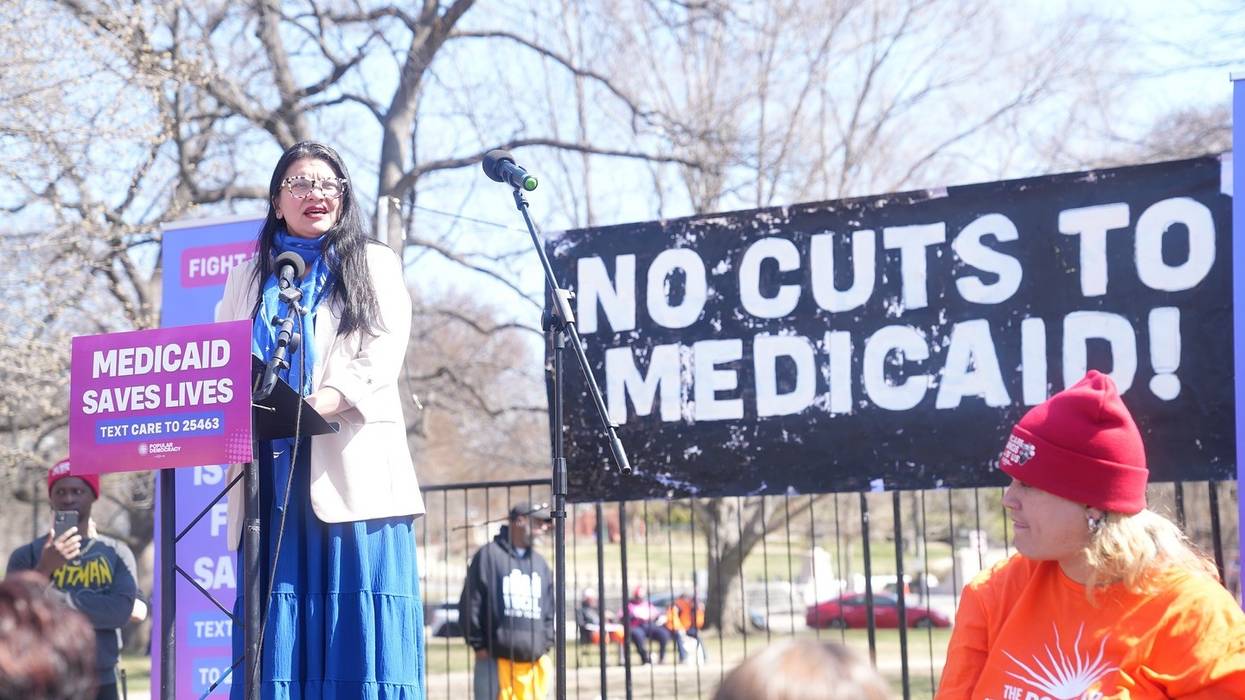
There is much more pain to come. The research organization RAND estimates that impending Medicaid cuts under the OBBBA will result in 7.6 million fewer program enrollees by 2034. Overall, roughly 15 million people are projected to lose health coverage and become uninsured by 2034 due to Medicaid and ACA marketplace cuts in the OBBBA, according to estimates from the nonpartisan Congressional Budget Office.
"We weren’t being hysterical. We knew this would happen," Congresswoman Sara Jacobs (D-Calif.) said this week. "When Republicans passed the Big Ugly Bill and cut funding for healthcare, they literally signed away millions of Americans’ ability to afford health insurance. And now it’s happening."
On Tuesday, the Washington Center for Equitable Growth published an analysis examining the OBBBA's impacts on the overall economy. The research nonprofit noted that the legislation "makes enormous cuts to critical income supports on which Americans depend to survive," while at the same time "is a windfall for corporations and wealthy households, making it the most regressive tax and budget law in at least 40 years."
As Common Dreams reported, the OBBBA is expected to give the wealthiest 1% of Americans $1 trillion in tax cuts while adding $4.6 trillion to the federal deficit over the next decade.
"Even so, its tax cuts were not paid for," the Washington Center said of the law. "By increasing the federal budget deficit, the law not only limits the nation’s ability to invest in future needs but also drives up interest rates on mortgages, car loans, and business loans."
"Thus far, implementation guidance from the Trump administration has been faster and harsher than anticipated, with looming consequences for state budgets—which will necessitate further cuts to state initiatives that support families and that lead to longer-term state economic growth," the center added.
The American Federation of State, County, and Municipal Employees (AFSCME)—a union representing 1.3 million public sector workers and retirees—said Monday that the year of harm wrought by the OBBBA "is only the beginning."
"Some of the law’s cuts hit immediately, while extreme changes and cuts to Medicaid, for example, won’t happen until after November this year. But working families are already feeling its impact," the union said.
"You feel it when you ask yourself whether the energy bill gets paid or the rent does—because you can’t always do both," AFSCME continued. "You feel it when you watch your health insurance premiums climb while your neighborhood clinic cuts its hours."
"For AFSCME members, you feel it at work too—when you talk to families and have to break it to them that new policies mean they will lose food assistance, Medicaid, and other life-sustaining support," the union said. "You feel it when low pay drives high turnover, so you’re forced to work mandatory overtime. And you feel it when states, cities, and towns say they don’t have the resources to compensate you fairly for your work or invest in our schools, hospitals, and roads."
AFSCME asserted that the Republican law and its harms should sound "a nationwide call to action for working families to get organized and demand more."
"The labor movement is how working people have always asserted that we are not spectators in our own lives," the union added. "That we have a voice, a vote, and the power to drive change."