

SUBSCRIBE TO OUR FREE NEWSLETTER
Daily news & progressive opinion—funded by the people, not the corporations—delivered straight to your inbox.
5
#000000
#FFFFFF
To donate by check, phone, or other method, see our More Ways to Give page.
Daily news & progressive opinion—funded by the people, not the corporations—delivered straight to your inbox.

Charles Idelson, 510-273-2246 or 415-559-8991 (cell)
National Nurses United today condemned the latest attack by Hillary Clinton on Sen. Bernie Sanders' proposal for healthcare for all, noting massive problems with cost and access to needed medical care remain for millions of Americans even with implementation of the Affordable Care Act (ACA).
NNU also accused the Clinton campaign of deliberately distorting Sanders' call for Medicare for all by claiming it would "turn over" healthcare to state governors.
"It is Bernie Sanders who, in contrast to the Clinton campaign, clearly understands that our profit-focused healthcare system continues to abandon millions of Americans to crushing medical debt, discrimination based on race, gender or ability to pay, and an inability to buy expensive insurance due to the still high cost," said NNU Co-President Jean Ross.
"It is Bernie Sanders who has clearly said that healthcare is a human right, and stands for everyone to be guaranteed healthcare, as does much of the rest of the world, by expanding Medicare, one of the most successful reforms in U.S. history, to cover all Americans," Ross said.
"Surely Hillary Clinton knows that Medicare and Medicaid are national programs, and that they would be funded as national programs. To claim that expanding Medicare to all would hand it over to state governors is a crude, inflammatory distortion, and shows an indifference to all those people who continue to be harmed by a broken system," Ross said.
"Hillary Clinton's failure to provide her own plan to cover everyone and solve the ongoing healthcare crisis faced by so many while attacking Bernie Sanders for proposing a comprehensive solution is disgraceful," said Ross.
"We would expect a little more sympathy from a major candidate for President to people struggling with getting the care they and their families need."
Ross pointed to a recent New York Times/Kaiser Family Foundation survey, which found that 20 percent of people under 65 who have health insurance continue to face significant problems with medical bills, despite the ACA.
"We found that that medical bills don't just keep people from filling prescriptions and scheduling doctors' visits. They can also prompt deep financial and personal sacrifices, affecting their housing, employment, credit and daily lives," wrote Times reporter Margot Sanger-Katz January 5.
The Times report found that 63 percent of those burdened by medical bills said they had "used up all or most of their savings," 42 percent had to take on another job or work more hours, 11 percent had to move or take in roommates, and 11 percent had to turn to charity due to those bills.
While the ACA has helped many people who have faced discrimination by the insurance industry, other recent reports have noted that many people, especially those with lower incomes, are choosing to pay the financial penalty rather than purchase insurance plans that remain costly even under the ACA exchanges, or have such high out-of-pocket costs that people with insurance still skip needed care.
"The recent studies also note that the ongoing crisis in healthcare costs and medical debt is most pronounced for low and middle income people," Ross continued, "a reminder of the direct link between access to healthcare and massive income inequality."
"That is a major reason why Bernie Sanders has linked the need for healthcare for all to his signature issue of the income gap. And it's a major reason why he was endorsed by NNU and nurses across the country continue to campaign for Bernie," Ross said.
"Today, 29 million people remain uninsured. Tens of millions more remain under insured, facing bankruptcy or the choice of getting the care they need or paying for food or housing for their families."
"Nurses will never stop campaigning for Medicare for all, the only systemic cure for our inhumane, dysfunctional healthcare system," Ross said.
National Nurses United, with close to 185,000 members in every state, is the largest union and professional association of registered nurses in US history.
(240) 235-2000
“In state after state and race after race, Big Tech has failed to deliver—and everyday Americans have won,” said Mitch Jones, deputy director of Food and Water Action.
The results of both ballot initiatives and legislative elections Tuesday night underscored what numerous polls have shown for months: Despite President Donald Trump's insistence to the contrary, Americans don't want data centers in their communities and are demanding that Big Tech, including artificial intelligence companies, be reined in.
Dozens of cities and towns across the country—including in Ohio, which has been pushed as a hub for the expansion of energy-sucking, water-guzzling data centers—resoundingly voting for moratoriums on their construction, blocking proposed projects like a $2 billion data center Amazon had planned for Sunbury, Ohio.
In all, communities across the US passed 43 out of 44 initiatives that proposed banning or pausing construction on data centers or infrastructure of a certain size.
Sunbury, a small city of less than 9,000 residents, mobilized to pass a ban on data centers larger than 25 megawatts, with more than 78% of voters supporting the moratorium.
The ban "gives us more of a say in the outcome of what happens in our community,” Trey Dockendorf, who helped organize the campaign, told WCMH. Amazon had planned to begin construction in 2028 and property tax breaks for the massive facility could have spanned more than 30 years.
"People do not want data centers where they can ruin neighborhoods, ruin communities, or put people at risk," Larry Thode, who lives near the proposed site for the Amazon project, told 10TV.
Wide margins were reported in elections across the country and in towns across Ohio, where 21 initiatives appeared on ballots.
More than 82% of voters in Granville approved a ban on all data center construction in the village, along with 76% of voters in Hubbard and 77% of people in Urbana.
Farm Action president Angela Huffman recounted how her community of Upper Sandusky also rallied around a proposed moratorium, which was backed by more than 76% of residents.
After Smartland Energy proposed a $900 million center in the town last year, residents "filled public meetings, challenged the proposed approval process, and pressed city officials for answers," wrote Huffman, eventually pushing Smartland to withdraw its zoning request.
She continued:
Local residents worked with attorneys at Conserve Ohio, who drafted the charter amendment that ultimately became Ordinance 85-14.
The amendment would prohibit construction of data centers with an electrical demand or peak load exceeding 25 megawatts.
To place it on the November ballot, we needed to collect signatures from registered city voters.
We were initially told that 155 valid signatures would be sufficient. We collected well beyond that number, knowing some signatures would be rejected during verification.
On August 3, we submitted petitions containing 301 signatures. Of those, 192 were accepted.
We then learned that the city’s charter required 212 valid signatures. That left us 20 valid signatures short.
With just hours remaining before the filing deadline, we headed back out to collect signatures, determined not to let months of work fall short.
On August 5, we submitted another 50 signatures. Election officials accepted 37. Our final total was 229 valid signatures, just 17 more than required.
We had qualified for the November ballot.
Ohioans also elected Democrat Amy Acton to be governor, after a campaign in which Acton supported a statewide moratorium on data centers, and unseated Republican Sen. Jon Husted, whom Democratic Sen.-elect Sherrod Brown derided as "the face of data centers," pointing to his support for tech giants' investment in Ohio when he served as lieutenant governor.
Maine was home to the second-highest number of data center-related ballot initiatives, and voters overwhelmingly supported measures banning construction for 180 days or, in the case of North Berwick, indefinitely for data centers larger than 25,000 square feet.
“Let’s not destroy our nice Maine environment to help produce this thing, and have water droughts and everybody surrounded by really loud noise," Kayley Buzzell of Sabattus told The Maine Monitor. The town voted 66-33% in favor of a moratorium on data centers of 10,000 sq ft or 20 megawatts or more, until May 2027.
Other victorious Democratic gubernatorial candidates who pledged to fight the unregulated growth of data centers, which Trump has aggressively pushed as AI giants poured tens of millions of dollars into the midterm elections, include Govs.-elect Keisha Lance Bottoms in Georgia and Gina Hinojosa in Texas. Hinojosa consistently called for an immediate moratorium on data center development, and Lance Bottoms advocated for a temporary statewide pause and accountability to stop companies from driving up residents' electricity costs.
And in South Carolina, Sen.-elect Annie Andrews (D) labeled her opponent, Republican Sen. Darline Graham, "Data Center Darline" as a super political action committee aligned with the industry spent $1.5 million on advertising for Graham.
The victories of citizen-led ballot initiatives and vocally anti-AI candidates against well-funded allies of Big Tech served as a "clear rebuke of the unchecked AI data center build-out," said Food and Water Action.
“Voters across the country have emphatically rejected the push for AI data centers. In state after state and race after race, Big Tech has failed to deliver—and everyday Americans have won,” said Mitch Jones, deputy director of the group. “Not only in Washington, but in state capitols and village halls across the country, newly elected leaders are poised to stand up to the unregulated, reckless build-out of hyperscale data centers wherever they are proposed."
“Congressional Democrats now have a mandate to stand up to Big Tech," said Jones. "They must start by rejecting the pro-polluter 'permitting reform' bill before them in the lame duck Congress. And a desperately needed moratorium on new data center construction must be enacted, so lawmakers and community leaders have the time to determine if—not how—this out-of-control industry can ever be safely regulated.”

"They are going to need to plant new forests for all of the subpoenas we’ll be printing," said Sen. Ed Markey.
After Democrats took back both chambers of the US Congress Tuesday, Rep. Robert Garcia, the incoming Democratic chair of the House Oversight Committee, had two words for President Donald Trump and his family: “Lawyer up.”
With solid majorities in the House and Senate, Democrats will have much greater power to conduct hearings, demand documents, and summon witnesses to testify under oath beginning in January.
“They are going to need to plant new forests for all of the subpoenas we’ll be printing,” said Sen. Ed Markey (D-Mass.).
Democrats are expected to aggressively probe the depths of what Garcia (D-Calif.) called “an unprecedented amount of corruption” by the “Trump crime family.”
Trump has added billions of dollars to his personal wealth during his second term. Garcia said Democrats plan to examine Trump’s cryptocurrency empire and whether foreign governments and businesses have used it to purchase political favors.
He said Democrats intend to investigate Donald Trump Jr.’s personal investments and his involvement with companies that have received government contracts. The business dealings of Trump’s son-in-law Jared Kushner, who has been accused of using foreign diplomacy to line his own pockets, will also be investigated.
Responding to voter concerns about the cost of living, which fueled Democratic wins across the map on Tuesday, Garcia said “any CEO that has been ripping off the American public” should prepare to face scrutiny, particularly those whose companies have engaged in price gouging, abused government contracts, or financially benefited from their relationships with Trump.
Punchbowl News noted several powerful executives and officials who could be under the gun:
Expect the tech executives closest to [Trump], including SpaceX’s Elon Musk, Meta’s Mark Zuckerberg, and Nvidia’s Jensen Huang, to be early targets for House Oversight, [the House Energy and Commerce Committee], and [the Senate Commerce, Science, and Transportation Committee]. Democrats will also want to grill OpenAI’s Sam Altman and Anthropic’s Dario Amodei about their [artificial intelligence] products.
“Anyone who has been in bed with the Trumps” is going to have “no choice but to respond to our questions,” Garcia said of businesses alleged to have gotten favorable treatment due to their relationship with the president’s family.
The US Department of Justice (DOJ) will also face scrutiny over its handling of the investigation into the late sex criminal Jeffrey Epstein. A report last month by Democrats on the House Judiciary Committee said the DOJ “appears to be covering up” evidence of Trump’s relationship with the billionaire predator and laid out accounts involving 11 women who connect Trump to Epstein’s alleged sex trafficking operation—five of them have accused the president of sexual assault in Epstein’s presence.
Garcia said Tuesday that in contrast to the closed-door hearings conducted under Republican control, he plans to hold “real public hearings” that “center the survivors” of Epstein’s abuse.
Abuses by US Immigration and Customs Enforcement (ICE) and the US Department of Homeland Security (DHS) will also be examined.
At least 62 people have died in ICE custody since Trump returned to office, while federal immigration agents have opened fire on people in at least 32 incidents, killing nine and injuring 15, including US citizens and immigrants who appeared to pose no threat. Agents have also been documented committing widespread civil rights violations, using excessive force, and engaging in racial profiling.
“Oversight Democrats have documented hundreds of incidents of abuse and misconduct by DHS immigration enforcement agents, and every single one of them deserves a full investigation,” Garcia said in April in a statement with Rep. Summer Lee (D-Pa.).
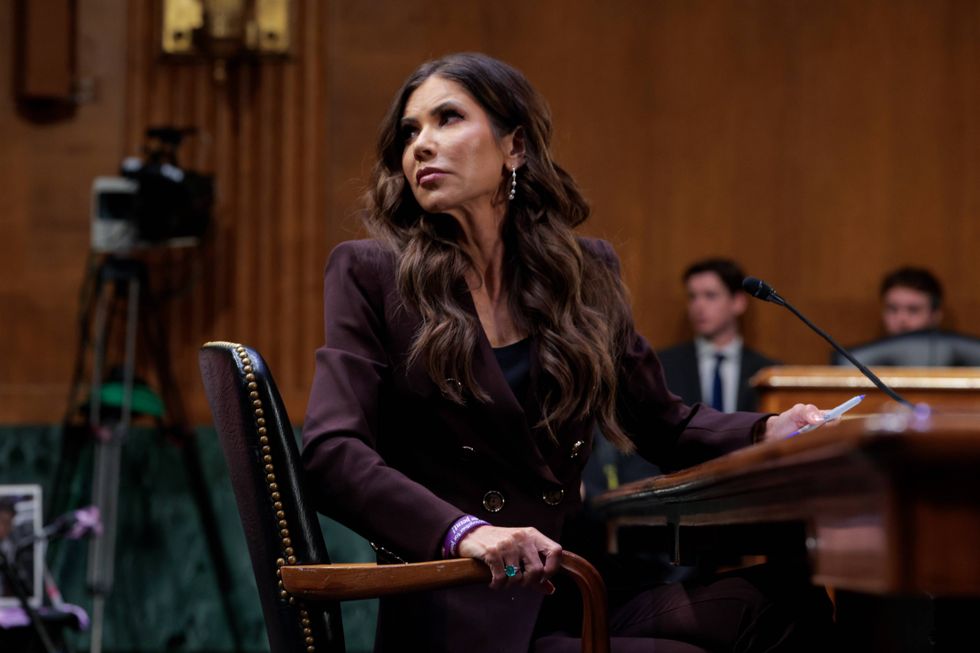 Then-US Secretary of Homeland Security Kristi Noem testified before the Senate Judiciary Committee in the Dirksen Senate Office Building on March 3, 2026, in Washington, DC. (Photo by Chip Somodevilla/Getty Images)
Garcia has stressed that "it can't just be the agents" who face accountability, but anyone “involved in the abuses of ICE."
“The agents are taking direction in some cases from others, and policy is being written to encourage that level of activity and that level of elimination of due process,” he said, adding that he wants “accountability at all levels, and that starts at the top.”
Garcia signaled that top DHS officials, including former Secretary Kristi Noem and her top aide Corey Lewandowski, could face scrutiny over a $220 million taxpayer-funded advertising campaign featuring Noem and allegations that she and Lewandowski used their positions for personal gain. The DOJ was reported in October to have opened a criminal investigation into Lewandowski over whether he personally profited from his government role.
Garcia will likely oversee only a fraction of the inquiries into Trump and his allies’ conduct launched by a Democratic Congress.
Rep. Adam Smith (D-Wash.), the incoming chair of the House Armed Services Committee, is expected to dig into Trump’s decision to launch an unauthorized aggressive war against Iran, as well as its financial cost, attacks on civilians, and the administration’s shifting justifications for the now eight-month-old conflict.
He also said he would examine the legality of Trump's unauthorized strikes on boats in the Caribbean and eastern Pacific, which have killed at least 243 people and have been described as illegal extrajudicial assassinations by human rights groups. He also called for more transparency surrounding the Trump administration's regime change operation and commandeering of oil in Venezuela, and its crippling blockade and threats to invade Cuba.
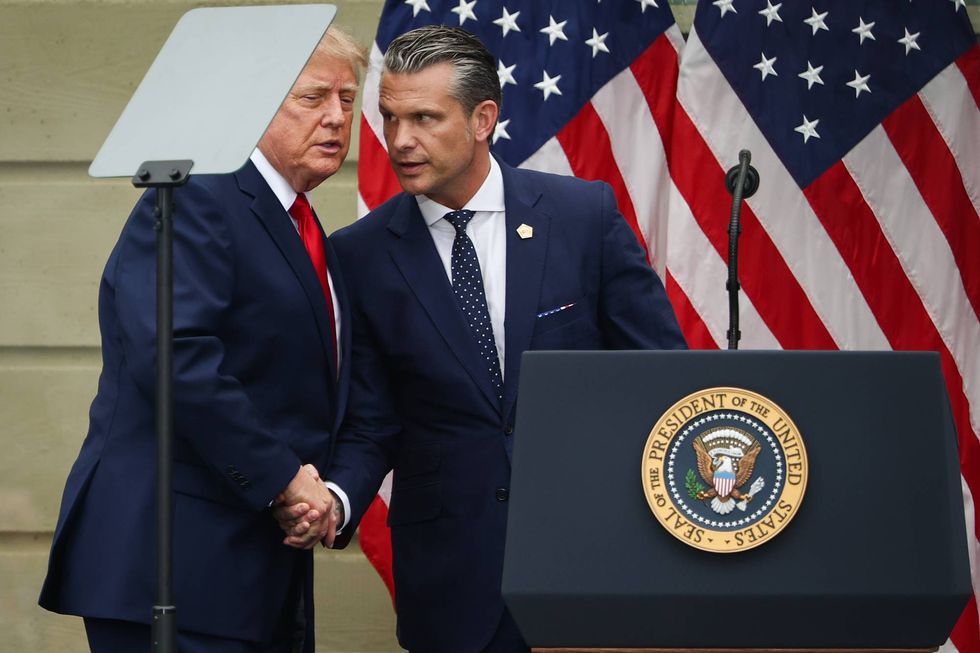 President Donald Trump shakes hands with Secretary of Defense Pete Hegseth during a ceremony marking the 25th anniversary of the September 11, 2001, terrorist attacks at the Pentagon in Arlington, Virginia, on September 11, 2026. (Photo by Finn Gomez/Getty Images)
Smith, who has served in Congress for nearly three decades, described Defense Secretary Pete Hegseth as less transparent than anyone who previously held the position.
"Since I became ranking member, I have had the cellphone number of every single secretary of defense," he told The Washington Post earlier this week. "Hegseth does not speak to me."
He has said, "There are Republicans who would support impeaching Hegseth who might not support doing it to Trump."
But that doesn't mean Trump is safe. Rep. Jamie Raskin (D-Md.), the incoming chair of the House Judiciary Committee, said Tuesday that he would not rule out pursuing a third impeachment of Trump, though he cautioned that Democrats would have to weigh it against their other priorities.
Raskin, who managed Trump’s historic second impeachment, called it "one of the people's major instruments of constitutional self-defense against a president who continues to act like a king or an emperor."

"We showed that in a battle between the money and the many, the many really can win."
It wasn't just a Democratic tsunami that swept the United States in Tuesday's midterm elections—it was also an "economic populist wave" that drowned out billionaire cash.
In states across the country, voters propelled to victory candidates who explicitly cast their campaigns as part of a movement to topple a corporate-dominated economic and political order that has allowed those at the top to accumulate unimaginable wealth—and pump massive sums of cash into elections—while the working class falls further behind, their paychecks swallowed by rising gas, grocery, housing, and healthcare prices.
"If you're watching this after getting home from a shift or sitting at the table wondering how you're going to pay your next bill, I want you to hear something very clearly: You are sending somebody to Washington who knows exactly what that feels like," Troy Jackson, a fifth-generation logger from northern Maine, said after defeating 30-year Republican incumbent Sen. Susan Collins and the billionaires financing her campaign.
Jackson's focus on the nation's affordability crisis and his support for bold solutions such as Medicare for All resembled Abdul El-Sayed's approach in the critical battleground state of Michigan, where he defeated former Rep. Mike Rogers with an unwavering focus on the costs of necessities—even as his opponents sought to smear him with bigoted attacks on his name and faith.
"Rather than try to unite us to contend with the crisis of gas or groceries, the opposition decided to try to divide us," said El-Sayed in his victory speech, mocking AIPAC and other billionaire-backed groups that spend millions against him. "We showed that in a battle between the money and the many, the many really can win."
Nationwide, the top 20 donors in the 2026 midterms—a list dominated by Elon Musk and other tech billionaires—spent around $2 billion trying to influence the midterm contests.
In Texas, where Musk spent most heavily, Democratic Sen.-elect James Talarico and Gov.-elect Gina Hinojosa explicitly framed their campaigns in populist terms, with Talarico describing the fundamental struggle in the US as "not left versus right," but "top versus bottom."
Those messages helped Democrats end the GOP's three-decade stranglehold on Texas politics.
"We must get big money out of our politics so no billionaire or trillionaire can buy our elections," said Talarico. "We must unrig this economic system that only benefits the top 1%."
Hinojosa, who described her politics as "economic populism" in an interview shortly before Tuesday's elections, said after defeating Elon Musk-backed incumbent Gov. Greg Abbott that the contest was about whether Texas belongs "to the working families who pay their taxes and do every everything right" or "the wealthy and well-connected who play by different rules."
"Does Texas belong to the people who rise before the sun, who work two jobs, who build our homes, who keep our hospitals running, who put everything they've got into small businesses and big dreams?" Hinojosa asked. "Or does it belong to the people who write the biggest check to politicians in Austin. Tonight, Texas, we answered—and we did not whisper."
GINA HINOJOSA and the rise of real economic populism!!!!"the one fight in this country is about economic power..." "if i were to describe a label to describe myself it would be economic populism" The new Texas Governor is calling on the farmers alliance history to describe the need to take on tech giants who are crushing peopls.
— Zephyr Teachout (@ZephyrTeachout) November 4, 2026
Lower-profile congressional races also saw underdog progressives succeed in the face of massive opposition spending. Will Lawrence, a cofounder of the Sunrise Movement, was on track to defeat incumbent Republican Rep. Tom Barrett in Michigan's 7th Congressional District—the most expensive US House race in the country.
Lawrence, who faced around $27 million in opposition spending as he campaigned on Medicare for All and a federal moratorium on new data center construction, said as results poured in Tuesday night that "we're on the verge of beating an incumbent Republican propped up by corporate money and Trump-aligned super PACs."
Even in races that progressives didn't win, the potency of their messaging and vision was clear.
Angie Nixon, a democratic socialist who campaigned on Medicare for All, universal childcare, and a billionaire wealth tax, came close to defeating billionaire-backed Republican Sen. Ashley Moody in Florida, despite receiving no support from the national Democratic Party.
"We may not have won this election, but that outcome will not stop us from getting up," Nixon said Tuesday night. "From getting up tomorrow to continue the fight to deliver what everyday hardworking Floridians need and deserve. They need a government that works for them and not the greedy corporations. I'm going to wake up tomorrow and keep fighting."
Sulma Arias, president of the advocacy group People’s Action Power, said in a statement Wednesday that "we still need to count every vote, but it’s clear that community organizing that took on greedy corporations resulted in working class people getting the goods."
"Voters are sick of being bullied by MAGA and the billionaires–and they’re tired of weak resistance by corporate-backed politicians. We backed candidates who would stand up for working class people, and voters responded by turning out for them in record numbers.”
Shaunna Thomas, cofounder of the Guardrails Alliance, which supports robust artificial intelligence regulations, wrote on social media that "econ populism won last night, full stop."
"The unholy alliance between Big Tech and Republicans created the conditions. Voters showed what happens when you pick the wrong side," Thomas wrote. "Dems have a mandate—be the party that finally made corps play by the rules and change the system."
Top Democrats have signaled that they plan to focus on affordability with the party's new majority, but their ability to enact legislation will be limited by President Donald Trump's veto power. Progressives are calling on Democrats to accomplish as much as possible while also pursuing an ambitious agenda to set the stage for 2028, when the party can take back the presidency.
"This newly empowered Democratic majority must put their rhetoric into action," said Lindsay Owens, president and CEO of Groundwork Action. "If the majority simply works to undo Trump's damage and goes back to business as usual, it will face the same electoral backlash that swept the Republican majority from power. Corporations have been picking our pockets for years. And only Congress has the power to put a stop to it."
"Democrats must bring the CEOs of Big Oil, Big Pharma, insurance giants, and AI companies before Congress and make them answer for the prices Americans are paying and the profits executives are pocketing," Owens added. "Voters have handed Democrats a mandate to take on corporate greed, bring down costs, and make billionaires and big corporations pay their fair share. Now Democrats must use it."

"The more states that follow this innovative approach, the more we can make Citizens United irrelevant."
Voters in Montana on Tuesday delivered a major blow to big moneyed interests by overwhelmingly passing a ballot initiative barring corporate cash from political campaigns in the state.
With 87% of votes counted as of Wednesday morning, Montana Constitutional Initiative 194 has received support from more than 65% of voters, with just 35% registering opposition.
The initiative prohibits what it describes as "artificial persons"—which includes corporations, nonprofits, trusts, partnerships, and trade associations—from giving money to political campaigns.
Supporters of the initiative have billed it as a way to strike a blow against the Supreme Court's 2010 ruling in Citizens United v. Federal Election Commission, which opened the door to unlimited campaign spending in US politics.
“A yes vote on I-194 means that only real people—not corporations, unions, trade associations, nonprofits, or groups with anonymous donors—are allowed to spend money in Montana elections,” the Yes on Initiative 194 campaign explained on its website. "It’s time to kick the oligarchs out of Big Sky country."
The initiative's overwhelming victory drew praise from Tom Moore, senior fellow at the Center for American Progress, who congratulated the people of Montana for taking "a historic step toward ending the scourge of corporate and dark money in politics."
Moore noted that the initiative passed by Montana is similar to a law passed in Hawaii earlier this year that classified corporations as "artificial persons" who do not have a constitutional right to make political donations.
Both states, Moore said, are "setting a bold example for other states to follow suit, sending a powerful message that we don’t have to give corporations unlimited power."
"The more states that follow this innovative approach," he added, "the more we can make Citizens United irrelevant."
Stacy Mitchell, co-executive director at the Institute for Local Self-Reliance, hailed the initiative's passage as a win for democratic governance.
"We've largely forgotten that states define what corporations can do," Mitchell wrote in a social media post. "Yesterday, Montana voters overwhelmingly stripped corporations of the power to spend money influencing elections. Hawaii did the same in May. Both face court fights. Our nascent citizen muscle is coming to life."
Adam Bojak, a Democrat who on Tuesday won an election in New York State Assembly District 149, said he'd like to see the Empire State follow the trail blazed by Montana and Hawaii.
"Congratulations to the people of Montana!" Bojak wrote. "I can't wait to bring this legislation to New York in next year's session."

"Tonight, we sent a crystal-clear message to the people at the top: We will not be conquered," said senator-elect James Talarico.
Elon Musk, the world's richest man, spent nearly half a billion dollars on the 2026 midterm elections, with much of the money going to Republicans in Texas—where Democrats had not won a statewide election in more than three decades.
That changed on Tuesday when Democratic US Senate candidate James Talarico defeated the state's corrupt Republican attorney general, Ken Paxton, despite Musk's last-minute "rescue mission"—which took the form of a $160 million donation, a minuscule fraction of the Tesla CEO's net worth but a massive infusion of cash into a critical race. Republicans also lost the state's gubernatorial contest, with Democratic candidate Gina Hinojosa prevailing over incumbent GOP Gov. Greg Abbott, who received millions of dollars from Musk.
Musk, who lives in Texas and has moved his businesses there, tried to brush off Democrats' stunning wins, writing on the social media platform he owns: "Guess my election-interfering space lasers didn’t work this time."
Neither Talarico nor Hinojosa—who were just part of the "blue tsunami of epic proportions" that swept through Texas on Tuesday—mentioned Musk by name in their victory speeches, though the senator-elect accused Musk on the campaign trail of "trying to buy the race." But both decried the campaign finance system that has let Musk and other billionaires convert their obscene wealth into political power.
"The billionaires who own the social media algorithms, who own the cable news networks, who own the politicians fighting on our screens—they want us at each other's throats," said Talarico. "They want us looking left and right at each other, instead of looking up at them."
"Our unity is a threat to their wealth and power," he added. "Tonight, we sent a crystal-clear message to the people at the top: We will not be conquered."
In her victory remarks, Hinojosa said the contest against Abbott posed a fundamental question to Texas voters: Does the state belong to working families, or "the people who write the biggest check"?
"Tonight, Texas, we answered," said the Democratic governor-elect. "And we did not whisper. We answered loud enough for every billionaire, every lobbyist, and every corrupt politician in Austin to hear. Texas belongs to us."
Across the country, according to a CNBC analysis of federal filings, "Musk’s America PAC spent nearly $87 million across 44 federal races."
"By Wednesday morning, Republicans it backed had lost 29 contests and won just three, with 12 still uncalled. More than $80 million—or 93% of its spending—went toward races Republicans lost," the outlet reported. "The outcome leaves Musk with fewer allies in a Democratic-controlled Congress that could investigate his federal contracts, his past leadership of Trump’s Department of Government Efficiency, and his companies’ ties to Washington."

"I just want to thank you, everybody who knocked a door, made a call, sent a dollar, posted a story, and, most importantly, gave us your stake in democracy."
Abdul El-Sayed added to the Democratic Party's historic midterm rout of President Donald Trump's GOP on Wednesday by prevailing over former Rep. Mike Rogers in Michigan's US Senate race, overcoming torrents of bigoted abuse from Republicans, a last-minute betrayal by his former primary opponent, and tens of millions of dollars in outside spending–including from an AIPAC-linked super PAC.
"Michigan, we did it," El-Sayed declared in his victory speech, to thunderous applause from supporters gathered in Detroit. "This movement for money out of politics, money in your pocket, and Medicare for All—I just want to thank you, everybody who knocked a door, made a call, sent a dollar, posted a story, and, most importantly, gave us your stake in democracy."
El-Sayed, who will become the nation's first Muslim senator, cast his win as a rebuke of a right-wing opposition that "decided to try to divide us" by attacking his name and religious faith, launching what he described as "one of the ugliest campaigns we've seen in our lifetimes" to distract from the key issues facing American families, including the spiraling cost-of-living crisis.
"We all know that my name and my faith aren't the reason you can't afford your gas," said the senator-elect. "Not the reason you can't afford your groceries. Not the reason you can't see a doctor."
To his Republican opponent, El-Sayed said: "Mike, enjoy your retirement. I know you got a house in Florida and two yachts. See, you chose hate, and Michigan chose hope."
Watch El-Sayed's victory speech in full:
With El-Sayed's win, Democrats have secured 54 US Senate seats starting in January, along with the party's control of the US House of Representatives, where Democrats are on track to have their largest majority since 2008.
As of 5:00 am ET Wednesday morning, two US Senate races had yet to be called and were razor-close: Alaska and Mississippi.
Joining El-Sayed in representing Michigan in the US Congress will be progressive activist and Sunrise Movement cofounder Will Lawrence, who was projected to defeat Republican incumbent Tom Barrett despite being heavily outspent.
“Democrats won tonight because they ran on economic populism, not milquetoast, status quo politics," said Aru Shiney-Ajay, the Sunrise Movement's executive director. "That’s why $30 million in corporate spending against Lawrence, the most expensive House race in US history, wasn’t enough to defeat him. Young people knocked on tens of thousands of doors and made hundreds of thousands of dials to elect him because they want a new Democratic Party."

"We will fight to lower the cost of groceries and gas, expand access to healthcare, make housing and childcare more affordable, stand up for workers, end Republicans' costly war with Iran and their reckless tariffs, put a check on Trump’s corruption, and invest in communities across America."
Some key US Senate races haven't yet been called, but as of late Tuesday, Democrats have flipped enough seats to secure majorities in both chambers of Congress—a clear rejection of President Donald Trump's Republican Party by voters across the country.
The decisive wins in the US Senate, according to various decision desks, were by Josh Turek in Iowa, Roy Cooper in North Carolina, Annie Andrews in South Carolina, Adam Hamilton in Kansas, Troy Jackson in Maine, Sherrod Brown in Ohio, and James Talarico in Texas.
So far, Democrats have not lost any Senate seats they currently hold. As of press time, Democrats are projected to control enough seats to not need support from Sen. John Fetterman (D-Pa.), who continues to buck his party on issues including war.
Watching the calls come in one after another, MS NOW anchor Chris Hayes said the results were not just "an eke out" win with an "11,000-vote margin or a 20,000-vote margin" in the races that Democrats are winning. "This is a total shellacking," he said, specifically referring to the Senate and governor races in Texas, but also in the context of the other races called.
Texas, Hayes said, "has been run as a one-party state for a generation—for 30 years," and now "Talarico might win that state by seven, eight, or nine points when all is said and done. It's not close. They're getting their clocks cleaned."
From the Lone Star State, Talarico declared that "we just took back Texas," and "we just sent a message to every billionaire megadonor... In this state, in this country, power belongs to the people."
Earlier in the night, after decision desks determined that Democrats had won enough seats to control the House of Representatives, Congressional Progressive Caucus Chair Greg Casar (D-Texas) said that "working people came together to change the course of American history. From coast to coast, Americans are demanding a country that works for all of us, not just corrupt politicians and billionaires."
After his party picked up the necessary number of seats to also control the Senate, Casar said, "Abolish the filibuster."
Sen. Ron Wyden (D-Ore.), who's expected to chair the Senate Finance Committee, identified another priority: "Subpoenas."
Sen. Ed Markey (D-Mass.) similarly said that "they are going to need to plant new forests for all of the subpoenas we'll be printing."
The looming majorities give Democrats critical opportunities not only to thwart Trump's legislative agenda for the latter half of his second term, but also to exercise oversight of him and his administration—and could even lead to a historic third impeachment of the president.
As Trump often does, he took to his Truth Social platform late Tuesday. The president—who faces historically low approval ratings as his policies, including an illegal war on Iran, fuel a nationwide affordability crisis—wrote that "I wasn't on the Ballot and if I was, we would have won IN A LANDSLIDE!"
While there have been serious fears that Trump would not accept a Democratic tsunami, given his refusal to concede after losing in 2020, The New York Times spoke with him by phone shortly before 10:30 pm Eastern Time. Despite his hallmark hostility toward elected Democrats, he said: "We'll, you know, look forward to working with them... We'll probably work something out."
Meanwhile, the Democratic National Committee chair, Ken Martin, pledged the kind of accountability Democrats campaigned on when his party officially reclaims both chambers.
"Thanks to Democrats going on offense throughout the country, we have held Republicans accountable for their harmful policies, elected real champions for working families, and flipped control of the US Senate," Martin said. "Congratulations to our incredible candidates, our hardworking state Democratic parties, and all of the organizers who put in the work to protect our incumbents, flip seats from red to blue, and put Republicans on defense while expanding the map."
"With Democrats back in the Senate majority," he added, "we will fight to lower the cost of groceries and gas, expand access to healthcare, make housing and childcare more affordable, stand up for workers, end Republicans' costly war with Iran and their reckless tariffs, put a check on Trump’s corruption, and invest in communities across America."
Senate Minority Leader Chuck Schumer (D-NY), who may return to the chamber's top leadership role, said that "against all odds, we Democrats have won the Senate. And we have five words for the American people: Relief is on the way."
While campaigning, he said, "we focused on American families, and their pain, and their needs. They're suffering. They're not having a good life. And they're worried about the future for themselves and their children. And we focused on what they needed and what they wanted and what they asked for. We listened to them. And they talked about costs above all, chaos, and corruption."
"Republicans made a choice and followed Trump over the cliff. And some of the time he talked about extraneous things that were ridiculous, but much of the time he implemented things that raised their costs: on electricity, on healthcare, on goods," he added. "There is now a generational remake of the Senate map that is going to change America now and on into the future. Americans voted for change, and now Democrats must deliver."
This article has been updated with comment from Senate Minority Leader Chuck Schumer (D-NY).

"A Democratic senator? From South Carolina? It's not just possible—it's now reality," said one reporter.
In a stunning midterm upset that boosted Democrats' chances of controlling the US Senate, pediatrician Annie Andrews defeated Republican incumbent Darline Graham in South Carolina, flipping a seat long held by her late brother, consummate warmonger Lindsey Graham.
For the first time since 1998, voters elected a Democrat to the Senate in a state that Trump won by 18 points in 2024. It's also the first time that the Palmetto State has elected a woman senator.
"South Carolina, you have shown the nation—in an era of partisan divides, of vitriol and name-calling, in a politics dominated by billionaires, special interests, and insiders in Washington—that we will not bow down," Andrews said Tuesday night. "We will not back down. And we will chart our own course."
Andrews, 45, campaigned on expanding healthcare access, tackling the worsening affordability crisis, and fighting corruption. She defeated Graham, who was appointed to fill the vacancy left by her brother's death in July before winning the Republican nomination for a full six-year upper chamber term.
"A Democratic senator? From South Carolina? It's not just possible—it's now reality," said Slate political reporter Ben Jacobs after major media outlets projected Andrews' victory.
Former National Nurses United communications chief Charles Idelson posted on social media, "Trump's handpicked candidate gets bounced, oh well."
The contest in the deeply red state became unexpectedly competitive as Graham struggled to establish herself as a credible successor to her brother. During her primary campaign, she acknowledged that she was "not that informed on national security," an admission Andrews successfully seized upon.
"South Carolina, if your surgeon said that appendectomies aren't really his thing, would you still hand him a scalpel? No," Andrews said last month. "So why would we hand Darline Graham a full term in the US Senate?"
Some observers argued that Darline Graham's lack of foreign policy acumen was actually less dangerous than her brother's inveterate warmongering. As American Prospect executive editor David Dayen remarked following Lindsey Graham's death, the late senator “never met a war he didn’t want to send your kids to.”
Former US Transportation Secretary Pete Buttigieg hailed Andrews' triumph, posting on social media, "There is no such thing as a permanently red state!"
"Dr. Annie Andrews' victory tonight proves that Democrats across the country can win anywhere when we show up and put the hard work in," he added. "Congratulations, Annie!"

"Working people came together to change the course of American history. From coast to coast, Americans are demanding a country that works for all of us, not just corrupt politicians and billionaires."
After nearly two years of President Donald Trump back in the White House and a Republican-controlled Congress, US voters on Tuesday supported enough Democrats to flip the House of Representatives, according to projections by CNN, Decision Desk HQ, NBC News, and more.
While Trump bullied GOP-dominated state legislatures into rigging congressional maps for Republicans in the lead-up to the midterms, Democrats campaigned against the president's corruption and damaging agenda, from his costly tariffs and illegal Iran War to his deadly weaponization of US Immigration and Customs Enforcement (ICE).
"America is alive and well!" House Minority Leader Hakeem Jeffries (D-NY), who is likely to be the next speaker, declared on social media Tuesday night. "We have crushed the Republican gerrymander all across the land."
Just over a month ago, Jeffries laid out some of how Democrats were preparing for possible control of the chamber, and pledged that "if folks have been stealing from the American people, shortchanging the American people, or screwing over the American people... we are going to hold the crooks accountable."
Jeffries signaled at the time that a historic third impeachment of Trump—who has been cashing in on the presidency to the tune of billions of dollars as well as enriching his wealthy allies since he was sworn in earlier last year—is on the table.
Rep. Robert Garcia (D-Calif.), who is set to chair the House Committee on Oversight and Government Reform, had a concise message for the president: "Lawyer up."
Congressional Progressive Caucus Chair Greg Casar (D-Texas) said Tuesday that "tonight working people came together to change the course of American history. From coast to coast, Americans are demanding a country that works for all of us, not just corrupt politicians and billionaires."
"Tonight we celebrate an incredible victory. Tomorrow the real work starts," he continued. "Now is the time to deliver on the big change people are demanding. End the war. Stop ICE's reign of terror. Root out corruption from politicians and big corporations. Raise wages. Stop price gouging. Get money out of politics. Strengthen unions."
"This is a mandate to deliver big change. No complacency," he stressed. "Tonight is the beginning of the end of the Trump era. Tomorrow we begin building the better world that comes next."
Key seats flipped by Democrats on Tuesday, according to projections, include Jamie Ager in North Carolina's 11th District, Zach Dembo in Kentucky's 6th District, Don Leonard in Ohio's 15th District, and Manny Rutinel in Colorado's 8th District.
In New Jersey, Democrats Zachary Mullock and Rebecca Bennett won the 2nd and 7th districts, respectively. There have also been at least three flips in Pennsylvania: Bob Brooks in the 7th District, Paige Cognetti in the 8th, and Janelle Stelson in the 10th.
Fox News congressional correspondent Bill Melugin said that GOP congressional sources responding to the results told him that "this is f**ked" and a "bloodbath across the board."
Former US Attorney General Eric Holder, who now chairs the National Democratic Redistricting Committee, said in a statement that "the Trump plot to steal enough seats to keep control of Congress—the will of the people be damned—was systematically dismantled, and, given the opportunity, voters instead chose to elect a new Democratic majority."
"Once again, American democracy has been defended. Let this be a lesson: never capitulate, never acquiesce to those who would use power for improper purposes; fight," he continued. "The MAGA gerrymandering scheme didn't just fail all on its own—we destroyed it together."
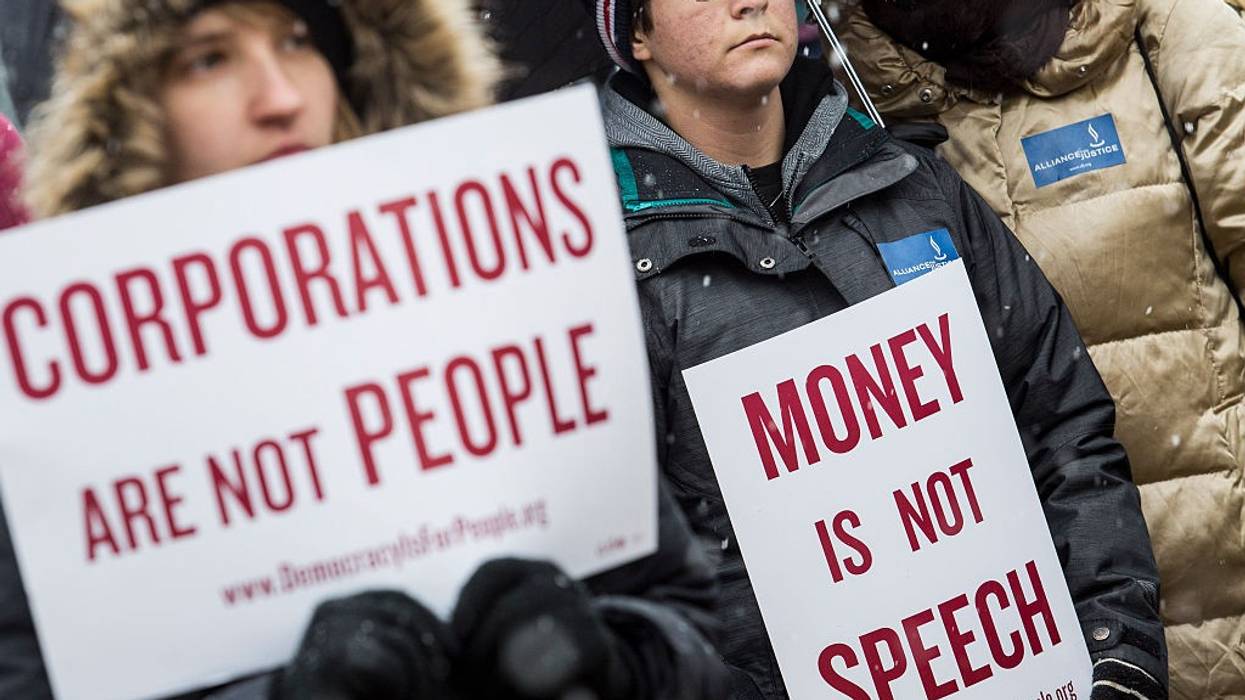
Initiative 194 "is not going to stop Elon Musk from writing a big fat check," explained one backer, but it would prevent "laundering the money through a dark money group."
Montanans are voting Tuesday on a potentially groundbreaking ballot initiative that could become a model for how to overturn Citizens United v. Federal Election Commission—the 2010 US Supreme Court decision that ushered in the era of unlimited money in politics—without the near-impossible necessity of a constitutional amendment.
Citizens United established that the government cannot restrict independent political expenditures by corporations, labor unions, and other outside groups on the basis of their corporate or union identity. Simply put, the decision affirmed corporate personhood and, essentially, that money is speech that cannot be restricted.
Since then, super political action committees have proliferated, and corporate spending has exploded from just $12.8 million during the 2010 election cycle to $737 million during the current one.
Initiative 194, also known as the Montana Plan, would prohibit corporations, nonprofits, trade associations, and other artificial entities from spending money to influence elections and ballot measures in the state. Rather than attempting to restrict corporations' constitutional rights as affirmed by Citizens United, states could simply not give corporations the legal power to spend on politics.
"A yes vote on I-194 means that only real people—not corporations, unions, trade associations, nonprofits, or groups with anonymous donors—are allowed to spend money in Montana elections," the Yes on Initiative 194 campaign said on its website.
"It's time to kick the oligarchs out of Big Sky country," the campaign added.
The proposal's backers argue that legal entities should not have the same rights as natural persons.
"Each state creates and defines its corporations. It need not permit its creations to consume it," Tom Moore, a senior fellow at the Center for American Progress (CAP), explained in September, arguing that corporations are legal creations, not natural persons, and that states retain broad authority to determine what powers they exercise.
"When the state creates a corporation, it is starting from nothing and deciding what to give the corporation, and no case has ever held that they have to give local spending power to a corporation," Moore told Fortune on Tuesday. "It's not regulation; it's redefinition."
Moore stressed that Initiative 194 "is not going to stop Elon Musk from writing a big fat check to some election in Montana."
"What it will stop them from doing is laundering the money through a dark money group," he added.
Montana's former commissioner of Political Practices, Jeff Mangan—who spearheaded Initiative 194—was equally blunt.
"The Montana Plan simply removes the ability for corporations to spend in our politics," he told Montana PBS. "By removing the corporation's ability to spend in our politics, we end dark money. Simple as that."
Initiative 194 has attracted support from Montanans concerned about the growing influence of wealthy donors and anonymous political spending.
"Most people I talk to when they hear about the prospect of getting dark money out of elections are in favor of it," state resident Nathan Kommers told Montana PBS. "I think that it makes sense to almost everybody."
Shannon Stober, who lives in the Bozeman area, said: "I think what I've observed over the past 15 years is the ways in which money and politics has completely created a decline in civic engagement and participation. A lot of people have just decided that their participation doesn't matter and they don't feel like there's a way out."
Opponents, including the Montana Chamber of Commerce, argue that Initiative 194 violates the First Amendment by restricting organizations' political speech. If passed, the measure will surely face legal challenges.
However, former Republican Montana Gov. Marc Racicot, who supports Initiative 194, said the effort is worthwhile regardless of the ultimate outcome.
"You can't just sit back and curse the darkness," he told Montana PBS. "You have to try and do something about it."