SUBSCRIBE TO OUR FREE NEWSLETTER
Daily news & progressive opinion—funded by the people, not the corporations—delivered straight to your inbox.
5
#000000
#FFFFFF
To donate by check, phone, or other method, see our More Ways to Give page.
Daily news & progressive opinion—funded by the people, not the corporations—delivered straight to your inbox.
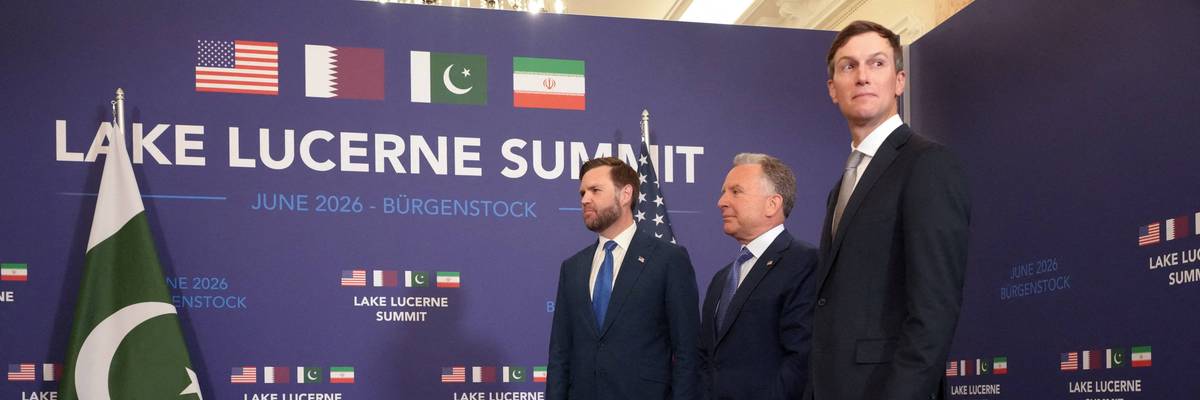
US Vice President JD Vance waits alongside special envoys Steve Witkoff and Jared Kushner to meet with Pakistani Prime Minister Shehbaz Sharif at a resort near Lake Lucerne in Switzerland, on June 21, 2026.
Drop Site reported that Iran warned Vice President JD Vance that "the pair were more interested in exploiting insider knowledge of the negotiations to profit in financial markets than they were in reaching a deal."
Iranian officials reportedly warned US Vice President JD Vance late last month that two officials leading the Trump administration's diplomatic efforts in the Middle East—special envoys Steve Witkoff and Jared Kushner—were trying to profit from their proximity to critical negotiations rather than working to secure a lasting peace agreement.
According to Drop Site, which cited an unnamed Iranian official, "Iran conveyed to Vance that the pair were more interested in exploiting insider knowledge of the negotiations to profit in financial markets than they were in reaching a deal." The Iranian side also "expressed concern about repeated leaks from Kushner to Israeli Prime Minister Benjamin Netanyahu."
Iranians estimated that people with inside information have raked in $9 billion in profits stemming from financial market moves related to the US-Israeli war on Iran, which sparked significant volatility in energy and equity prices.
On several occasions during the war, massive trading volumes have closely preceded major conflict-related announcements by US President Donald Trump. (Kushner is Trump's son-in-law, and Witkoff is a close personal friend of the president.)
Mohammad Bagher Ghalibaf, speaker of the Iranian Parliament and the country's top negotiator, accused the Trump administration in March of peddling "fake news" to "manipulate the financial and oil markets and escape the quagmire in which the US and Israel are trapped."
According to Drop Site, Iranians "conveyed through intermediaries" that $4.5 billion of profits allegedly accumulated through market manipulation should be "allocated to the Iranian side."
“The exchanged texts will ultimately become part of the historical record," said the unnamed Iranian official.
The Trump administration denied that Vance received messages from the Iranian side related to Kushner and Witkoff, and accused Drop Site journalists of being "so filled with hate for America and devoid of respect for themselves that they have become full-throated propagandists for the Iranian regime."
Concerns that Kushner and Witkoff's personal and familial financial interests could influence their approach to diplomatic talks are hardly new.
"The public has no reason to trust Jared Kushner’s integrity as a government official to put their interests above his financial benefit," Donald Sherman, president of Citizens for Responsibility and Ethics in Washington, said after Trump formally named Kushner a special peace envoy in February.
Less than a month later, The New York Times reported that Kushner was trying to raise at least $5 billion in funding for his private equity firm, Affinity Partners, from Middle East governments. Saudi Arabia's Public Investment Fund is the largest investor in Affinity.
Witkoff, a real estate investor, has also faced scrutiny for potentially massive conflicts of interest.
Rep. Greg Stanton (D-Ariz.) noted during a House hearing last month that Witkoff "co-founded the cryptocurrency venture firm World Liberty Financial, alongside President Trump and President Trump’s children."
Stanton continued:
Days before Trump’s second inauguration, a firm controlled by a member of the royal family of the United Arab Emirates, Sheikh Tahnoon, bought a 49% stake in the company. That was a $500 million investment. $31 million of that went straight to the Witkoff family.
Witkoff was still a financial stakeholder in World Liberty as he was simultaneously leading high-level US government negotiations in his role as special envoy. One of those negotiations was over the export of America’s most advanced AI chips to the UAE, negotiations personally attended by Sheikh Tahnoon.
Drop Site's reporting came as the Trump administration on Wednesday expanded its aerial assault on Iran, hitting targets in the northern part of the country as the prospect of a negotiated resolution appeared increasingly remote. Recent US strikes have killed more than 30 people and wounded hundreds of others, according to Iranian officials.
Iran said it retaliated with strikes on US military installations in the region, including in Kuwait and Bahrain.
Dear Common Dreams reader, It’s been nearly 30 years since I co-founded Common Dreams with my late wife, Lina Newhouser. We had the radical notion that journalism should serve the public good, not corporate profits. It was clear to us from the outset what it would take to build such a project. No paid advertisements. No corporate sponsors. No millionaire publisher telling us what to think or do. Many people said we wouldn't last a year, but we proved those doubters wrong. Together with a tremendous team of journalists and dedicated staff, we built an independent media outlet free from the constraints of profits and corporate control. Our mission has always been simple: To inform. To inspire. To ignite change for the common good. Building Common Dreams was not easy. Our survival was never guaranteed. When you take on the most powerful forces—Wall Street greed, fossil fuel industry destruction, Big Tech lobbyists, and uber-rich oligarchs who have spent billions upon billions rigging the economy and democracy in their favor—the only bulwark you have is supporters who believe in your work. But here’s the urgent message from me today. It's never been this bad out there. And it's never been this hard to keep us going. At the very moment Common Dreams is most needed, the threats we face are intensifying. We need your support now more than ever. We don't accept corporate advertising and never will. We don't have a paywall because we don't think people should be blocked from critical news based on their ability to pay. Everything we do is funded by the donations of readers like you. When everyone does the little they can afford, we are strong. But if that support retreats or dries up, so do we. Will you donate now to make sure Common Dreams not only survives but thrives? —Craig Brown, Co-founder |
Iranian officials reportedly warned US Vice President JD Vance late last month that two officials leading the Trump administration's diplomatic efforts in the Middle East—special envoys Steve Witkoff and Jared Kushner—were trying to profit from their proximity to critical negotiations rather than working to secure a lasting peace agreement.
According to Drop Site, which cited an unnamed Iranian official, "Iran conveyed to Vance that the pair were more interested in exploiting insider knowledge of the negotiations to profit in financial markets than they were in reaching a deal." The Iranian side also "expressed concern about repeated leaks from Kushner to Israeli Prime Minister Benjamin Netanyahu."
Iranians estimated that people with inside information have raked in $9 billion in profits stemming from financial market moves related to the US-Israeli war on Iran, which sparked significant volatility in energy and equity prices.
On several occasions during the war, massive trading volumes have closely preceded major conflict-related announcements by US President Donald Trump. (Kushner is Trump's son-in-law, and Witkoff is a close personal friend of the president.)
Mohammad Bagher Ghalibaf, speaker of the Iranian Parliament and the country's top negotiator, accused the Trump administration in March of peddling "fake news" to "manipulate the financial and oil markets and escape the quagmire in which the US and Israel are trapped."
According to Drop Site, Iranians "conveyed through intermediaries" that $4.5 billion of profits allegedly accumulated through market manipulation should be "allocated to the Iranian side."
“The exchanged texts will ultimately become part of the historical record," said the unnamed Iranian official.
The Trump administration denied that Vance received messages from the Iranian side related to Kushner and Witkoff, and accused Drop Site journalists of being "so filled with hate for America and devoid of respect for themselves that they have become full-throated propagandists for the Iranian regime."
Concerns that Kushner and Witkoff's personal and familial financial interests could influence their approach to diplomatic talks are hardly new.
"The public has no reason to trust Jared Kushner’s integrity as a government official to put their interests above his financial benefit," Donald Sherman, president of Citizens for Responsibility and Ethics in Washington, said after Trump formally named Kushner a special peace envoy in February.
Less than a month later, The New York Times reported that Kushner was trying to raise at least $5 billion in funding for his private equity firm, Affinity Partners, from Middle East governments. Saudi Arabia's Public Investment Fund is the largest investor in Affinity.
Witkoff, a real estate investor, has also faced scrutiny for potentially massive conflicts of interest.
Rep. Greg Stanton (D-Ariz.) noted during a House hearing last month that Witkoff "co-founded the cryptocurrency venture firm World Liberty Financial, alongside President Trump and President Trump’s children."
Stanton continued:
Days before Trump’s second inauguration, a firm controlled by a member of the royal family of the United Arab Emirates, Sheikh Tahnoon, bought a 49% stake in the company. That was a $500 million investment. $31 million of that went straight to the Witkoff family.
Witkoff was still a financial stakeholder in World Liberty as he was simultaneously leading high-level US government negotiations in his role as special envoy. One of those negotiations was over the export of America’s most advanced AI chips to the UAE, negotiations personally attended by Sheikh Tahnoon.
Drop Site's reporting came as the Trump administration on Wednesday expanded its aerial assault on Iran, hitting targets in the northern part of the country as the prospect of a negotiated resolution appeared increasingly remote. Recent US strikes have killed more than 30 people and wounded hundreds of others, according to Iranian officials.
Iran said it retaliated with strikes on US military installations in the region, including in Kuwait and Bahrain.
Iranian officials reportedly warned US Vice President JD Vance late last month that two officials leading the Trump administration's diplomatic efforts in the Middle East—special envoys Steve Witkoff and Jared Kushner—were trying to profit from their proximity to critical negotiations rather than working to secure a lasting peace agreement.
According to Drop Site, which cited an unnamed Iranian official, "Iran conveyed to Vance that the pair were more interested in exploiting insider knowledge of the negotiations to profit in financial markets than they were in reaching a deal." The Iranian side also "expressed concern about repeated leaks from Kushner to Israeli Prime Minister Benjamin Netanyahu."
Iranians estimated that people with inside information have raked in $9 billion in profits stemming from financial market moves related to the US-Israeli war on Iran, which sparked significant volatility in energy and equity prices.
On several occasions during the war, massive trading volumes have closely preceded major conflict-related announcements by US President Donald Trump. (Kushner is Trump's son-in-law, and Witkoff is a close personal friend of the president.)
Mohammad Bagher Ghalibaf, speaker of the Iranian Parliament and the country's top negotiator, accused the Trump administration in March of peddling "fake news" to "manipulate the financial and oil markets and escape the quagmire in which the US and Israel are trapped."
According to Drop Site, Iranians "conveyed through intermediaries" that $4.5 billion of profits allegedly accumulated through market manipulation should be "allocated to the Iranian side."
“The exchanged texts will ultimately become part of the historical record," said the unnamed Iranian official.
The Trump administration denied that Vance received messages from the Iranian side related to Kushner and Witkoff, and accused Drop Site journalists of being "so filled with hate for America and devoid of respect for themselves that they have become full-throated propagandists for the Iranian regime."
Concerns that Kushner and Witkoff's personal and familial financial interests could influence their approach to diplomatic talks are hardly new.
"The public has no reason to trust Jared Kushner’s integrity as a government official to put their interests above his financial benefit," Donald Sherman, president of Citizens for Responsibility and Ethics in Washington, said after Trump formally named Kushner a special peace envoy in February.
Less than a month later, The New York Times reported that Kushner was trying to raise at least $5 billion in funding for his private equity firm, Affinity Partners, from Middle East governments. Saudi Arabia's Public Investment Fund is the largest investor in Affinity.
Witkoff, a real estate investor, has also faced scrutiny for potentially massive conflicts of interest.
Rep. Greg Stanton (D-Ariz.) noted during a House hearing last month that Witkoff "co-founded the cryptocurrency venture firm World Liberty Financial, alongside President Trump and President Trump’s children."
Stanton continued:
Days before Trump’s second inauguration, a firm controlled by a member of the royal family of the United Arab Emirates, Sheikh Tahnoon, bought a 49% stake in the company. That was a $500 million investment. $31 million of that went straight to the Witkoff family.
Witkoff was still a financial stakeholder in World Liberty as he was simultaneously leading high-level US government negotiations in his role as special envoy. One of those negotiations was over the export of America’s most advanced AI chips to the UAE, negotiations personally attended by Sheikh Tahnoon.
Drop Site's reporting came as the Trump administration on Wednesday expanded its aerial assault on Iran, hitting targets in the northern part of the country as the prospect of a negotiated resolution appeared increasingly remote. Recent US strikes have killed more than 30 people and wounded hundreds of others, according to Iranian officials.
Iran said it retaliated with strikes on US military installations in the region, including in Kuwait and Bahrain.