5
#000000
#FFFFFF
To donate by check, phone, or other method, see our More Ways to Give page.
Daily news & progressive opinion—funded by the people, not the corporations—delivered straight to your inbox.
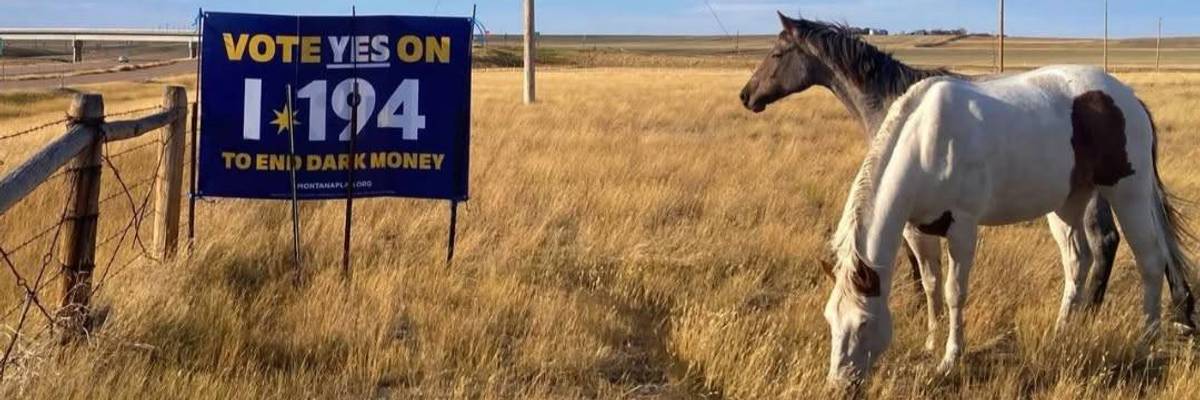
A sign urging Montana voters to support Constitutional Initiative 194 was pictured on October 26, 2026.
"The more states that follow this innovative approach, the more we can make Citizens United irrelevant."
Voters in Montana on Tuesday delivered a major blow to big moneyed interests by overwhelmingly passing a ballot initiative barring corporate cash from political campaigns in the state.
With 87% of votes counted as of Wednesday morning, Montana Constitutional Initiative 194 has received support from more than 65% of voters, with just 35% registering opposition.
The initiative prohibits what it describes as "artificial persons"—which includes corporations, nonprofits, trusts, partnerships, and trade associations—from giving money to political campaigns.
Supporters of the initiative have billed it as a way to strike a blow against the Supreme Court's 2010 ruling in Citizens United v. Federal Election Commission, which opened the door to unlimited campaign spending in US politics.
“A yes vote on I-194 means that only real people—not corporations, unions, trade associations, nonprofits, or groups with anonymous donors—are allowed to spend money in Montana elections,” the Yes on Initiative 194 campaign explained on its website. "It’s time to kick the oligarchs out of Big Sky country."
The initiative's overwhelming victory drew praise from Tom Moore, senior fellow at the Center for American Progress, who congratulated the people of Montana for taking "a historic step toward ending the scourge of corporate and dark money in politics."
Moore noted that the initiative passed by Montana is similar to a law passed in Hawaii earlier this year that classified corporations as "artificial persons" who do not have a constitutional right to make political donations.
Both states, Moore said, are "setting a bold example for other states to follow suit, sending a powerful message that we don’t have to give corporations unlimited power."
"The more states that follow this innovative approach," he added, "the more we can make Citizens United irrelevant."
Stacy Mitchell, co-executive director at the Institute for Local Self-Reliance, hailed the initiative's passage as a win for democratic governance.
"We've largely forgotten that states define what corporations can do," Mitchell wrote in a social media post. "Yesterday, Montana voters overwhelmingly stripped corporations of the power to spend money influencing elections. Hawaii did the same in May. Both face court fights. Our nascent citizen muscle is coming to life."
Adam Bojak, a Democrat who on Tuesday won an election in New York State Assembly District 149, said he'd like to see the Empire State follow the trail blazed by Montana and Hawaii.
"Congratulations to the people of Montana!" Bojak wrote. "I can't wait to bring this legislation to New York in next year's session."
This country and this world are at a monumental crossroads. US voters have an opportunity to beat back the forces of fascism and confront the billionaires who are rigging the economy, our media system, and our democracy, making it increasingly impossible for ordinary people to get by. We’re not just talking about the election. We’re talking about what must be done once these fascist elements are vanquished from power. We need a bolder set of solutions than what either major party has so far been willing to offer and a working-class movement ready to fight like hell for it. Trump didn't emerge from nowhere. The conditions that fueled MAGA authoritarianism were created by decades of radical neoliberal economic policies and a corrupt political system dominated by corporate interests. They slashed taxes on the super-rich, promising that the benefits would trickle down. They said giveaways to the corporate titans would make life more affordable for the rest of us. It was all bullshit. And when a bitter, betrayed populace searches for someone to blame, right-wing demagogues have little trouble finding scapegoats. People know when they're being lied to, but you won't hear any of this from the corporate media. Only independent journalism—powered and funded by people who believe in building a better world—can deliver truly trustworthy daily news. If you share our vision, please contribute whatever you can to sustain our work. |
Voters in Montana on Tuesday delivered a major blow to big moneyed interests by overwhelmingly passing a ballot initiative barring corporate cash from political campaigns in the state.
With 87% of votes counted as of Wednesday morning, Montana Constitutional Initiative 194 has received support from more than 65% of voters, with just 35% registering opposition.
The initiative prohibits what it describes as "artificial persons"—which includes corporations, nonprofits, trusts, partnerships, and trade associations—from giving money to political campaigns.
Supporters of the initiative have billed it as a way to strike a blow against the Supreme Court's 2010 ruling in Citizens United v. Federal Election Commission, which opened the door to unlimited campaign spending in US politics.
“A yes vote on I-194 means that only real people—not corporations, unions, trade associations, nonprofits, or groups with anonymous donors—are allowed to spend money in Montana elections,” the Yes on Initiative 194 campaign explained on its website. "It’s time to kick the oligarchs out of Big Sky country."
The initiative's overwhelming victory drew praise from Tom Moore, senior fellow at the Center for American Progress, who congratulated the people of Montana for taking "a historic step toward ending the scourge of corporate and dark money in politics."
Moore noted that the initiative passed by Montana is similar to a law passed in Hawaii earlier this year that classified corporations as "artificial persons" who do not have a constitutional right to make political donations.
Both states, Moore said, are "setting a bold example for other states to follow suit, sending a powerful message that we don’t have to give corporations unlimited power."
"The more states that follow this innovative approach," he added, "the more we can make Citizens United irrelevant."
Stacy Mitchell, co-executive director at the Institute for Local Self-Reliance, hailed the initiative's passage as a win for democratic governance.
"We've largely forgotten that states define what corporations can do," Mitchell wrote in a social media post. "Yesterday, Montana voters overwhelmingly stripped corporations of the power to spend money influencing elections. Hawaii did the same in May. Both face court fights. Our nascent citizen muscle is coming to life."
Adam Bojak, a Democrat who on Tuesday won an election in New York State Assembly District 149, said he'd like to see the Empire State follow the trail blazed by Montana and Hawaii.
"Congratulations to the people of Montana!" Bojak wrote. "I can't wait to bring this legislation to New York in next year's session."