SUBSCRIBE TO OUR FREE NEWSLETTER
Daily news & progressive opinion—funded by the people, not the corporations—delivered straight to your inbox.
5
#000000
#FFFFFF
To donate by check, phone, or other method, see our More Ways to Give page.
Daily news & progressive opinion—funded by the people, not the corporations—delivered straight to your inbox.
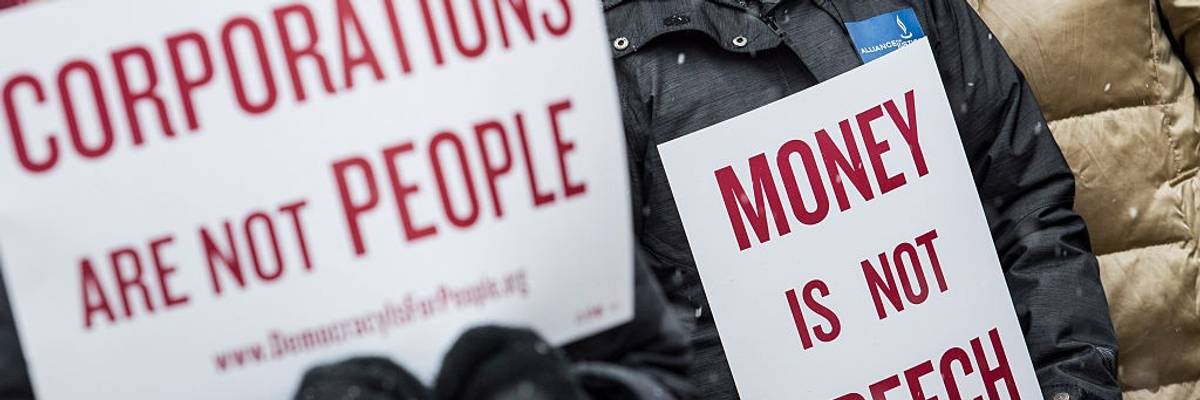
Attendees hold signs as they listen to speakers during a rally calling for an end to corporate money on January 21, 2015 in Washington, DC.
"The far-right Supreme Court hijacked the Constitution to let corporations spend in our elections. But we are not powerless. We can fight back," said US Rep. Greg Casar.
The state of Hawaii has passed a law that poses a direct challenge to the infamous 2010 Citizens United Supreme Court ruling, which opened the door to unlimited corporate spending in US elections.
Democratic Hawaii Gov. Josh Green on Thursday signed into law a bill that takes aim at the court's ruling that corporations are effectively people with full free speech rights who can face no limits on what they can contribute to political organizations.
As explained by More Perfect Union, the law, which is set to take effect next July, classifies corporations as "artificial persons" who do not have a constitutional right to make political donations.
"The bill could limit the influence of super PACs," noted More Perfect Union, "and be a model to challenge the influence of money in politics."
Democratic Hawaii state Sen. Jarrett Keohokalole, a supporter of the law, said on Thursday he was proud that Hawaii has become "the first state in the nation" to take direct action challenging Citizens United.
"As elected leaders, we do not serve artificial entities," Keohokalole said. "We serve the people."
“We do not serve artificial entities. We serve the people.” @SenatorJarrett on Hawaii making history by getting dark and corporate money out of politics. #CitizensUnited pic.twitter.com/Se6HQyvRu8
— American Progress (@amprog) May 14, 2026
US Rep. Greg Casar (D-Texas), chair of the Congressional Progressive Caucus, hailed the law as "big news" that should inspire opponents of limitless corporate political spending across the US.
"The far-right Supreme Court hijacked the Constitution to let corporations spend in our elections," said Casar. "But we are not powerless. We can fight back."
The new law passed despite opposition from Hawaii Attorney General Anne Lopez, who argued that defending it in court could be difficult and expensive.
The law's passage earned praise from campaign finance watchdogs who have long called for overturning Citizens United and reestablishing guardrails for corporate cash in US democracy.
Michael Beckel, who directs the Money in Politics project for the advocacy group Issue One, said the Hawaii law is a "model for the country" that other states should rush to emulate.
"This measure... is among the most innovative and impactful ideas to curb corporate and dark money spending in campaigns since the Supreme Court’s disastrous Citizens United ruling in 2010," Beckel said. "Those looking to bring more transparency and accountability to elections should embrace this powerful proposal and follow Hawaii’s lead."
End Citizens United, the nonprofit campaign finance reform organization dedicated to overturning the 2010 Supreme Court ruling, also pushed other states to look at Hawaii's law as a roadmap for their own legislation.
"Hawaii has provided a blueprint for how to prevent super PACs from spending dark money by passing state law," the group said in a social media post. "Let this win be a testament to the ability states have to put power back in the hands of everyday people by neutralizing the effects of the Citizens United ruling."
Tom Moore, senior fellow at the Center for American Progress, praised the Hawaii law in an interview with The Associated Press, calling it "a brave and bold step to get corporate and dark money out of America’s politics" that "will send a powerful message that will be heard loud and clear across the Pacific and across the mainland."
Dear Common Dreams reader, It’s been nearly 30 years since I co-founded Common Dreams with my late wife, Lina Newhouser. We had the radical notion that journalism should serve the public good, not corporate profits. It was clear to us from the outset what it would take to build such a project. No paid advertisements. No corporate sponsors. No millionaire publisher telling us what to think or do. Many people said we wouldn't last a year, but we proved those doubters wrong. Together with a tremendous team of journalists and dedicated staff, we built an independent media outlet free from the constraints of profits and corporate control. Our mission has always been simple: To inform. To inspire. To ignite change for the common good. Building Common Dreams was not easy. Our survival was never guaranteed. When you take on the most powerful forces—Wall Street greed, fossil fuel industry destruction, Big Tech lobbyists, and uber-rich oligarchs who have spent billions upon billions rigging the economy and democracy in their favor—the only bulwark you have is supporters who believe in your work. But here’s the urgent message from me today. It's never been this bad out there. And it's never been this hard to keep us going. At the very moment Common Dreams is most needed, the threats we face are intensifying. We need your support now more than ever. We don't accept corporate advertising and never will. We don't have a paywall because we don't think people should be blocked from critical news based on their ability to pay. Everything we do is funded by the donations of readers like you. When everyone does the little they can afford, we are strong. But if that support retreats or dries up, so do we. Will you donate now to make sure Common Dreams not only survives but thrives? —Craig Brown, Co-founder |
The state of Hawaii has passed a law that poses a direct challenge to the infamous 2010 Citizens United Supreme Court ruling, which opened the door to unlimited corporate spending in US elections.
Democratic Hawaii Gov. Josh Green on Thursday signed into law a bill that takes aim at the court's ruling that corporations are effectively people with full free speech rights who can face no limits on what they can contribute to political organizations.
As explained by More Perfect Union, the law, which is set to take effect next July, classifies corporations as "artificial persons" who do not have a constitutional right to make political donations.
"The bill could limit the influence of super PACs," noted More Perfect Union, "and be a model to challenge the influence of money in politics."
Democratic Hawaii state Sen. Jarrett Keohokalole, a supporter of the law, said on Thursday he was proud that Hawaii has become "the first state in the nation" to take direct action challenging Citizens United.
"As elected leaders, we do not serve artificial entities," Keohokalole said. "We serve the people."
“We do not serve artificial entities. We serve the people.” @SenatorJarrett on Hawaii making history by getting dark and corporate money out of politics. #CitizensUnited pic.twitter.com/Se6HQyvRu8
— American Progress (@amprog) May 14, 2026
US Rep. Greg Casar (D-Texas), chair of the Congressional Progressive Caucus, hailed the law as "big news" that should inspire opponents of limitless corporate political spending across the US.
"The far-right Supreme Court hijacked the Constitution to let corporations spend in our elections," said Casar. "But we are not powerless. We can fight back."
The new law passed despite opposition from Hawaii Attorney General Anne Lopez, who argued that defending it in court could be difficult and expensive.
The law's passage earned praise from campaign finance watchdogs who have long called for overturning Citizens United and reestablishing guardrails for corporate cash in US democracy.
Michael Beckel, who directs the Money in Politics project for the advocacy group Issue One, said the Hawaii law is a "model for the country" that other states should rush to emulate.
"This measure... is among the most innovative and impactful ideas to curb corporate and dark money spending in campaigns since the Supreme Court’s disastrous Citizens United ruling in 2010," Beckel said. "Those looking to bring more transparency and accountability to elections should embrace this powerful proposal and follow Hawaii’s lead."
End Citizens United, the nonprofit campaign finance reform organization dedicated to overturning the 2010 Supreme Court ruling, also pushed other states to look at Hawaii's law as a roadmap for their own legislation.
"Hawaii has provided a blueprint for how to prevent super PACs from spending dark money by passing state law," the group said in a social media post. "Let this win be a testament to the ability states have to put power back in the hands of everyday people by neutralizing the effects of the Citizens United ruling."
Tom Moore, senior fellow at the Center for American Progress, praised the Hawaii law in an interview with The Associated Press, calling it "a brave and bold step to get corporate and dark money out of America’s politics" that "will send a powerful message that will be heard loud and clear across the Pacific and across the mainland."
The state of Hawaii has passed a law that poses a direct challenge to the infamous 2010 Citizens United Supreme Court ruling, which opened the door to unlimited corporate spending in US elections.
Democratic Hawaii Gov. Josh Green on Thursday signed into law a bill that takes aim at the court's ruling that corporations are effectively people with full free speech rights who can face no limits on what they can contribute to political organizations.
As explained by More Perfect Union, the law, which is set to take effect next July, classifies corporations as "artificial persons" who do not have a constitutional right to make political donations.
"The bill could limit the influence of super PACs," noted More Perfect Union, "and be a model to challenge the influence of money in politics."
Democratic Hawaii state Sen. Jarrett Keohokalole, a supporter of the law, said on Thursday he was proud that Hawaii has become "the first state in the nation" to take direct action challenging Citizens United.
"As elected leaders, we do not serve artificial entities," Keohokalole said. "We serve the people."
“We do not serve artificial entities. We serve the people.” @SenatorJarrett on Hawaii making history by getting dark and corporate money out of politics. #CitizensUnited pic.twitter.com/Se6HQyvRu8
— American Progress (@amprog) May 14, 2026
US Rep. Greg Casar (D-Texas), chair of the Congressional Progressive Caucus, hailed the law as "big news" that should inspire opponents of limitless corporate political spending across the US.
"The far-right Supreme Court hijacked the Constitution to let corporations spend in our elections," said Casar. "But we are not powerless. We can fight back."
The new law passed despite opposition from Hawaii Attorney General Anne Lopez, who argued that defending it in court could be difficult and expensive.
The law's passage earned praise from campaign finance watchdogs who have long called for overturning Citizens United and reestablishing guardrails for corporate cash in US democracy.
Michael Beckel, who directs the Money in Politics project for the advocacy group Issue One, said the Hawaii law is a "model for the country" that other states should rush to emulate.
"This measure... is among the most innovative and impactful ideas to curb corporate and dark money spending in campaigns since the Supreme Court’s disastrous Citizens United ruling in 2010," Beckel said. "Those looking to bring more transparency and accountability to elections should embrace this powerful proposal and follow Hawaii’s lead."
End Citizens United, the nonprofit campaign finance reform organization dedicated to overturning the 2010 Supreme Court ruling, also pushed other states to look at Hawaii's law as a roadmap for their own legislation.
"Hawaii has provided a blueprint for how to prevent super PACs from spending dark money by passing state law," the group said in a social media post. "Let this win be a testament to the ability states have to put power back in the hands of everyday people by neutralizing the effects of the Citizens United ruling."
Tom Moore, senior fellow at the Center for American Progress, praised the Hawaii law in an interview with The Associated Press, calling it "a brave and bold step to get corporate and dark money out of America’s politics" that "will send a powerful message that will be heard loud and clear across the Pacific and across the mainland."