

SUBSCRIBE TO OUR FREE NEWSLETTER
Daily news & progressive opinion—funded by the people, not the corporations—delivered straight to your inbox.
5
#000000
#FFFFFF
To donate by check, phone, or other method, see our More Ways to Give page.
Daily news & progressive opinion—funded by the people, not the corporations—delivered straight to your inbox.
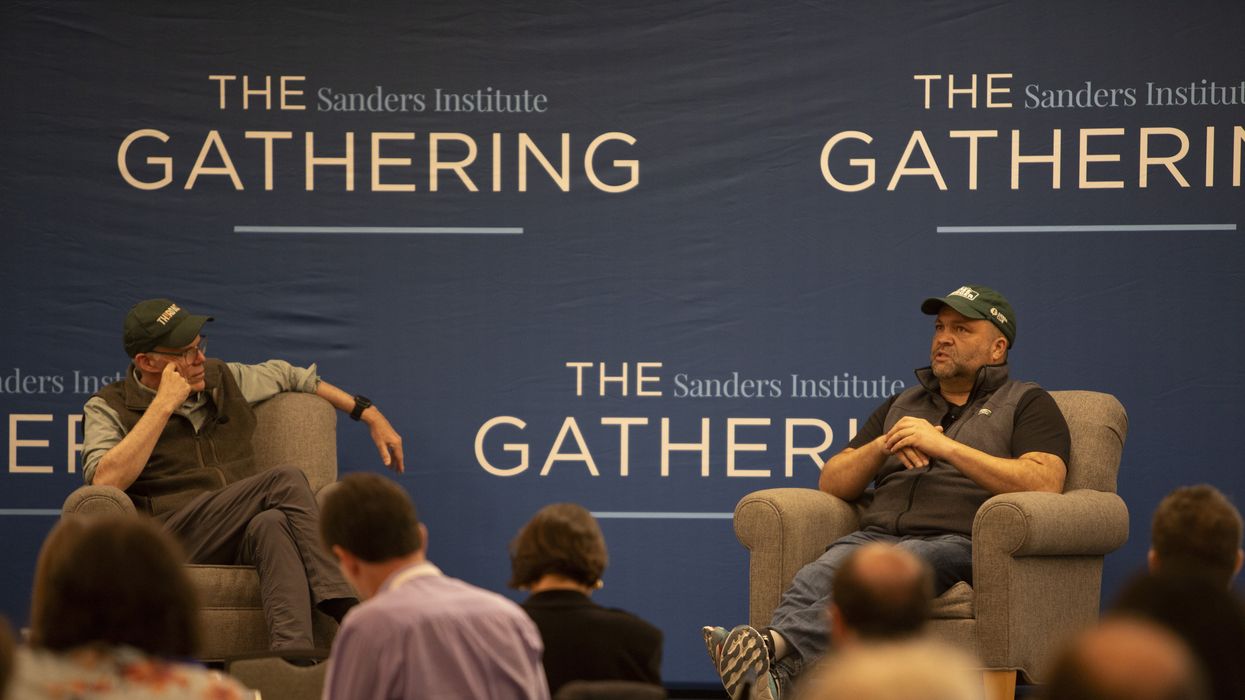
"We have an opportunity for 18 months to organize, to take out the oil and gas industry," said one environmental leader during a Sanders Institute event in Vermont.
"Now is the time to go for the jugular. Now is the time to kill the fossil fuel industry, because we don't have another chance at survival after this."
That's what Jamie Minden, senior director of global organizing for the youth-led group Zero Hour, told the audience Saturday during The Sanders Institute Gathering, in Burlington, Vermont. The three-day event featured panel discussions on various topics and a few screenings, including the trailer for The Welcome Table, Josh Fox's forthcoming documentary about climate refugees.
"In order to win, we need to go on the offensive," said Minden, "because defense has not been working."
Playing offense against the incredibly powerful and well-funded fossil fuel industry requires growing the movement and seizing political opportunities to implement lifesaving policies, according to experts and organizers who participated in a series of panels focused on the climate crisis.
One of those opportunities that campaigners are already gearing up for is the January 2026 expiration of tax cuts signed into law in December 2017 by then-President Donald Trump, the presumptive Republican nominee for the November election.
Speaking alongside Minden on the livestreamed panel, Friends of the Earth (FOE) president Erich Pica described the looming fight as a "Tax Super Bowl" that will take place shortly before the next president is sworn in. The climate movement is organizing aggressively to show just how much U.S. consumers and taxpayers are being ripped off by the greed of the fossil fuel giants that enjoy massive federal subsidies and enormous tax breaks despite the "eye-popping" profits they post year after year.
. @Erichpica: The Tax Super Bowl [will be] in January 2025. All the Trump Tax Cuts that were passed in 2017, particularly the ones that impact individuals, are up for reauthorization...We have an opportunity for 18 months to organize to take out the oil and gas industry. pic.twitter.com/VbaeHzuTIi
— Sanders Institute (@TheSandersInst) June 1, 2024
"We know that there will be a tax bill that, if it is not passed, will end up increasing taxes on all individual Americans. And so we have an opportunity for 18 months to organize, to take out the oil and gas industry," Pica said.
Trump in April made a reported quid pro quo offer to fossil fuel executives: Pour just $1 billion into his current campaign, and he will repeal climate policies implemented under Democratic President Joe Biden, who is seeking reelection.
Pica pointed out that Big Oil—which has benefited from federal tax breaks since the Revenue Act of 1913—could profit handsomely by taking Trump up on his offer, if the Republican returns to the White House. In an analysis published last month, FOE Action found that the industry fueling the climate emergency could see an estimated $110 billion in tax breaks alone if Republicans get their way.
Throughout the weekend, multiple panelists highlighted the End Polluter Welfare Act recently reintroduced by Rep. Ilhan Omar (D-Minn.) and Sen. Bernie Sanders (I-Vt.)—whose wife Jane O'Meara Sanders and son Dave Driscoll co-founded the Sanders Institute. The legislation aims to close tax loopholes and end corporate handouts to the fossil fuel industry, and the sponsors estimate it would save American taxpayers up to $170 billion over a decade.
. @JosephGeev: Our democracy is on the line. But so too is the fate of our planet…Donald Trump is pitching a deal to big oil executives to give me a billion dollars in campaign contributions and I'm gonna make sure the US government keeps the fossil fuel industry in operation. pic.twitter.com/5N6NJ2Asud
— Sanders Institute (@TheSandersInst) June 1, 2024
The bill's reintroduction last month was "an important step," said Joseph Geevarghese, executive director of Our Revolution, an organization that grew out of the senator's 2016 presidential campaign. "The thing is, we need a movement and a strategic opportunity to be able to get that policy over the finish line."
Some panelists argued that the moment is now, but the movement must expand beyond what Rev. Lennox Yearwood, president and CEO of the Hip Hop Caucus, said is, "at this time, a siloed, segregated, progressive climate movement."
Americans are not only "dying because of the climate crisis" but also paying fossil fuel companies "to kill us," Yearwood told the audience. "Their business plan literally means a death sentence for our communities."
"The issue on taxation," he explained, "allows us to once again broaden our movement, allows us to go to Republicans, go to Democrats, to go to Independents, and go across this country... and say simply: 'Your tax dollars are going to go to those who are rich and are killing our communities. Do you want that?'"
. @RevYearwood: The fossil fuel industry is evil. I mean evil. We have never as humans dealt with anything as global, as destructive, and as suicidal as this industry. pic.twitter.com/45LDPm6psg
— Sanders Institute (@TheSandersInst) June 1, 2024
Another way to grow the movement is to include communities—especially those historically represented in politics by Big Oil beneficiaries—in the global green transition.
On the Gathering's opening night, which was also livestreamed, Sierra Club executive director Ben Jealous, also a Sanders Institute fellow, spoke about recently visiting a plant where workers make solar panels in the district of far-right Congresswoman Majorie Taylor Greene (R-Ga.), a major Trump ally.
While touring the Hanwha Qcells solar facility in Dalton, Jealous asked about a wall of drawings and paintings. He learned that they were created for Earth Day last year by children of the employees, who were asked to portray "how they see their parents working at this factory."
"In maybe the most, arguably the most conservative congressional district in America," workers' children "portrayed their parents as heroes saving the planet," he said. "The kids in that district get that we need solar panels, get that we got to work together to save this planet. There's reason to be hopeful."
. @BenJealous: The seeds to overcoming the division in America lies in the factories we are building for renewables, for batteries, for semiconductors. pic.twitter.com/yxNQv4GlJo
— Sanders Institute (@TheSandersInst) June 1, 2024
The plant's South Korean company has been able to grow because of the Inflation Reduction Act (IRA) that congressional Democrats passed and Biden signed in 2022. While members of the climate movement have long framed the law as a flawed but still historic package in terms of tackling the planetary emergency, with the general election mere months away, speakers at the Gathering stressed the need to showcase such progress to voters nationwide.
"We really do have to take those moments when something happens and claim it. And partly that means in this election being willing to say how important that IRA was," said panelist and Sanders Institute fellow Bill McKibben, who founded Third Act, which organizes elders for climate advocacy.
"Was it perfect? Not even close… but it was in some other sense, remarkable," he continued. "We've got to actually talk about that enough that people understand it. And truthfully, we don't… Certainly, the Democratic Party does not a good job of talking about those things in those ways."
Also pointing to the Georgia solar plant, McKibben added that "one of the things that's really brilliant about the IRA is that the bulk of the money is going to red state America to do this work, which is not something that we're used to anymore in our country... people being willing to do anything other than support their own supporters. And it's a remarkable possibility for a kind of political healing going forward."
McKibben: At the exact same moment that the planet is physically starting to disintegrate in precisely the way scientists 30 years ago told us it would, as if kind of scripted by Hollywood, we're also seeing the sudden spike in the only antidote we have at scale to deal with this pic.twitter.com/FaUQv6BdTk
— Sanders Institute (@TheSandersInst) June 1, 2024
No matter the outcomes of the upcoming U.S. congressional and presidential elections, climate campaigners are committed to the fight against fossil fuels. As Pica put it, "I think we have to wage the fight regardless."
"The oil and gas industry has been operating with impunity for over a hundred years," the FOE leader said. "They're crushing our politics, they're polluting the climate, and they're getting away with it."
"We discovered during the Inflation Reduction Act fight, when there was a real effort to repeal the oil and gas subsidies, that they expended a lot of political capital to keep those subsidies in place," he noted. "The fact that we can wage a campaign that forces the oil and gas industry to expend political capital to maintain their largesse from the federal government, regardless of if we win or we lose, is a winning strategy for us."
"'Cause that means they're not trying to repeal the stuff in the Inflation Reduction Act. That means that they're not trying to work on reducing… their corporate taxes," he explained. Like Minden, Pica wants the climate movement to make the fossil fuel industry finally play defense.
The End Polluter Welfare Act "is the organizing vehicle," Pica said. "We've gotta get support behind it. We've gotta get members of Congress on it. We've gotta get community activists out there in the streets."
Jamie Minden: I am 21 years old and I've never lived a year of my life without experiencing extreme climate disaster first hand…We have an entire generation of young people growing up this way. This is not only our future. This is our present. @ThisIsZeroHour pic.twitter.com/ULZYFRya0Z
— Sanders Institute (@TheSandersInst) June 1, 2024
The organizers battling Big Oil underscored the urgency, emphasizing that not only are the Trump tax cuts set to expire soon, but also communities across the country and around the world are already enduring the effects of a hotter planet—including rising sea levels, more destructive storms, extreme temperatures, devastating floods, and raging wildfires.
"A hundred years from now really matters. But also what's going on today and in the next five years really matters," said Minden. "I think within the next five years… our world's gonna be pretty unrecognizable in many ways."
The 21-year-old climate campaigner told the Gathering's audience—full of academics, advocates, policymakers, and more—that "whether you're here working in healthcare or income inequality or labor, the reality is that this issue is about to become a part of your work, if it's not already."
"I know we all have our own fights. I know everyone here is working on things that are really, really important. But if we don't all go out on this fight, if we don't all go out on climate, we're gonna get taken out," she warned. "It's a matter of survival."
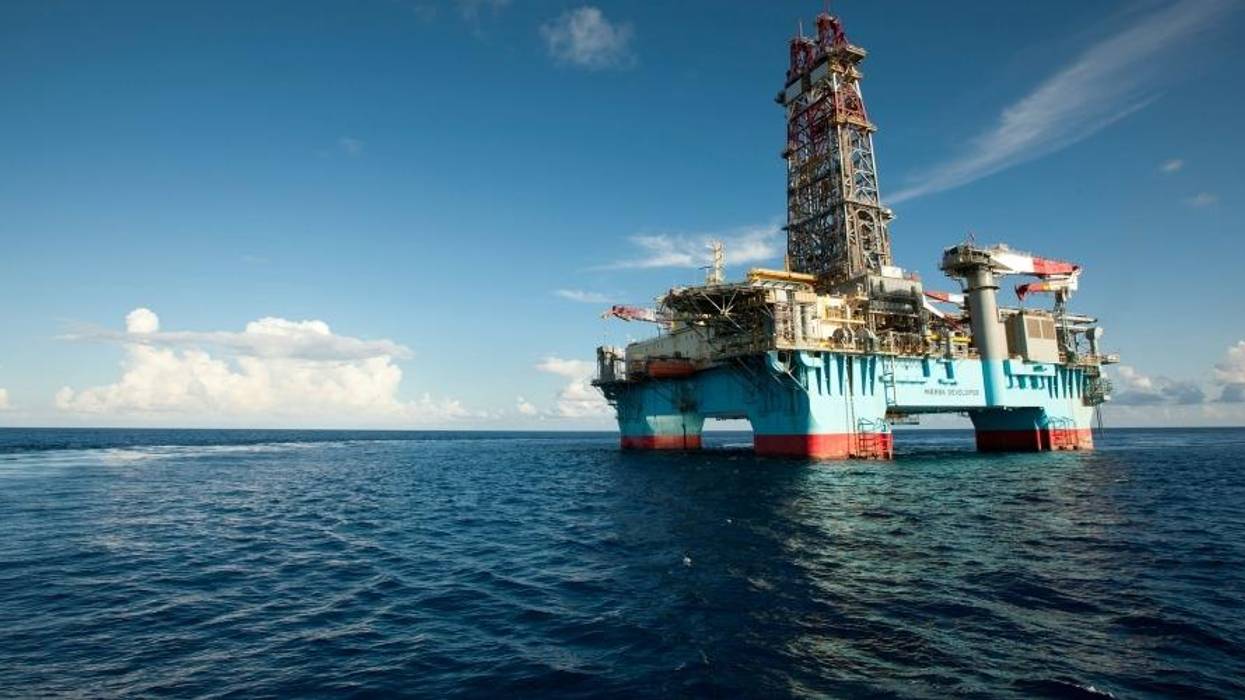
Even with oil spill prevention measures, said one advocate, "offshore drilling simply will never be safe."
Environmental advocates on Tuesday said the Biden administration's decision to reinstate offshore drilling safety rules would help undo damage caused by former Republican President Donald Trump's repeal of the regulations, but were clear that the rules would not change the fact that fossil fuel extraction is imperiling ecosystems and the planet.
U.S. Interior Secretary Deb Haaland announced that the rules have once again been finalized and will go into effect in October, governing the use of safety equipment on offshore oil rigs.
The rules were originally put in place by the Obama administration after BP's 2010 Deepwater Horizon disaster, which sent four million barrels of oil into the Gulf of Mexico and killed 11 people, an estimated one million seabirds, and up to five million fish.
The oil and gas industry strongly supported Trump's repeal of the rules, which Kristen Monsell, a senior attorney at the Center for Biological Diversity, said at the time would "make dirty offshore drilling even more dangerous" by making oil spills more likely.
But Jackie Savitz, chief policy officer for the ocean conservation group Oceana, said new safety regulations for drilling operations are no replacement for halting offshore drilling altogether.
"Offshore drilling simply will never be safe," she said. "When there is a spill like Deepwater Horizon, it's too late, our options are severely limited, so prevention is the only solution and this is a good step in that direction."
The reinstated rules are "a big step in getting us back on track" to ensuring there's no repeat of disasters like Deepwater Horizon, Savitz said, but "there is no way we can do enough to prevent an oil spill."
"It is an inherently risky business and it's not a matter of if, but when we will have another one," she added. "So a big part of prevention has to be to stop selling new leases."
The newly reinstated rules will require:
Ahead of the announcement, Zero Hour founder and executive director Zanagee Artis and Taproot Earth national policy director Kendall Dix wrote an op-ed in the Miami Herald, calling on U.S. President Joe Biden to "move the country off of its addiction to fossil fuels by barring new leasing on public lands and waters," as he promised to when he campaigned for the presidency in 2020.
With the Interior Department considering a five-year oil and gas leasing program that would allow the fossil fuel industry to conduct extraction operations in even more areas of the nation's oceans—a proposal expected to be finalized this fall as the revived safety regulations go into effect—"the risk of environmental disaster from offshore drilling is not a question of if disaster will strike, but when," wrote Artis and Dix.
They pointed out that in addition to the International Energy Agency's call for an immediate end to fossil fuel extraction in order to achieve net zero carbon emissions by 2050 and the United Nations' warning that oil and gas drilling are "incompatible with human survival," offshore operations are simply not necessary "to meet the nation's energy needs."
"An analysis by industry experts found that, even without a single new lease offering, oil production in the United States will remain steady into 2035, at which point the nation's transition to renewable energy will be approaching maturity," Artis and Dix wrote.
"We don't need to sell off more of our ocean to Big Oil," they added. "Every oil spill began with an offshore lease sale."
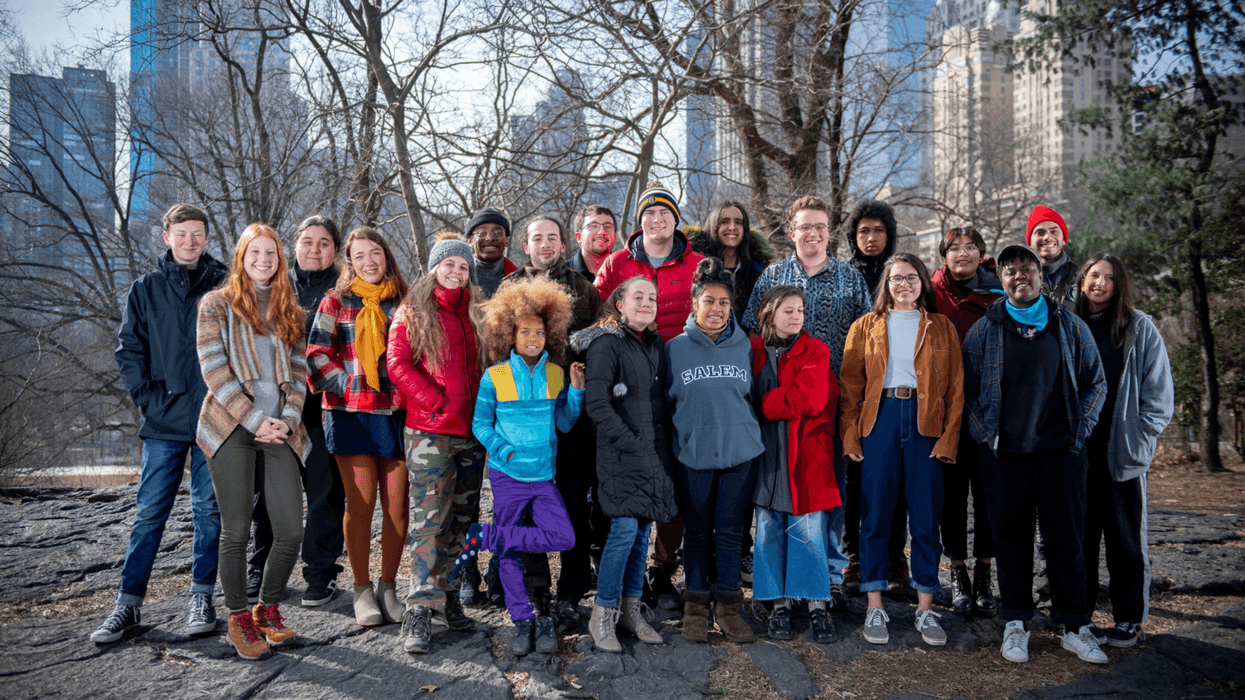
"Young Americans have the right to be heard by our nation's courts, the branch of our government that has a duty to protect our constitutional right to a livable planet."
Representing a coalition of more than 255 climate justice and other progressive groups as well as more than 50,000 supporters, campaigners on Wednesday digitally delivered a petition demanding the U.S. Department of Justice end its efforts to block a lawsuit filed eight years ago by 21 youth plaintiffs over the harm done to children across the country by the government's continued support for fossil fuels.
The People vs. Fossil Fuels coalition—including Food & Water Watch, Sunrise Movement, and 350.org—delivered the petition to the DOJ and Attorney General Merrick Garland, with coalition steering committee member John Beard saying the young plaintiffs in Juliana v. United States "have the right to be heard by their nation's courts."
"Justice deferred, regardless of age, is justice DENIED," said Beard. "End the DOJ's campaign to deny these youth access to justice."
The case was originally filed in 2015, with the plaintiffs arguing that the U.S. government has not done enough to protect communities from the climate crisis and that its continued support for planet-heating fossil fuel extraction is putting the lives of millions of children in danger.
Since the lawsuit was originally filed, the petition delivered on Wednesday points out, "young people like these 21 young Americans have suffered from increasingly severe climate harms" as their day in court has been "delayed again and again by tactics employed by the Department of Justice to impede or dismiss their case."
"Justice deferred, regardless of age, is justice DENIED. End the DOJ's campaign to deny these youth access to justice."
Since the plaintiffs—now ranging in age from 15 to 26—filed their lawsuit, the U.S. has faced climate-related disasters including a deadly heatwave in the Pacific Northwest, a number of severe hurricanes, and a drought across the western part of the country.
"Young people fear when the next devastating flood, wildfire, drought, heatwave, or other climate disaster will be," said Zanagee Artis, founder and executive director of Zero Hour, who co-delivered the petition with Beard. "It's long past time for the Department of Justice to end its opposition to the Juliana plaintiffs and youth climate justice. Young Americans have the right to be heard by our nation's courts, the branch of our government that has a duty to protect our constitutional right to a livable planet."
The campaigners delivered the petition three weeks after Judge Ann Aiken of the U.S. District Court for the District of Oregon ruled that the plaintiffs can amend their complaint and the case can proceed to trial. In 2018 U.S. the Supreme Court halted to case from going to trial days before it was to commence.
"It is a foundational doctrine that when government conduct catastrophically harms American citizens, the judiciary is constitutionally required to perform its independent role and determine whether the challenged conduct, not exclusively committed to any branch by the Constitution, is unconstitutional," said Aiken in her ruling earlier this month.
Now, "evidence that indisputably proves the federal government's knowing perpetuation of the climate crisis will come to light, in open court, and Judge Aiken will rule whether the U.S. energy system violates the youth's constitutional rights," People vs. Fossil Fuels said Wednesday.
The coalition called on the DOJ to refrain from using an "extreme legal tool" known as a petition for writ of mandamus to delay the case. The Trump administration used the maneuver six times to block legal actions, but the tool is "only intended to be used as an 'extraordinary remedy,'" according to Our Children's Trust, the public interest law firm that represents the plaintiffs in Juliana.
"Tell Attorney General Garland today to end the extreme legacy of the Trump DOJ by not filing an unprecedented SEVENTH petition for writ of mandamus in this case in an attempt to once again delay this trial," said Children's Trust this month, calling the legal tool an "abuse of process."
The petition was delivered on the same day that another case regarding children and fossil fuel energy wrapped up in Montana. Sixteen plaintiffs ranging in age from 5 to 22—also represented by Our Children's Trust—are arguing in that case that the state's continued support for fossil fuel extraction has violated the children's constitutional rights.
People vs. Fossil Fuels urged supporters to write to the DOJ to call on Garland to end the Biden administration's opposition to the case.
"The U.S. District Court has just put the young plaintiffs' case back on a path to trial and the Department of Justice will soon respond," said the coalition. "They can choose to defend the case on its merits at trial—just as they would any other constitutional case—or continue the Trump administration strategy of seeking to block the youth's access to their own courts."
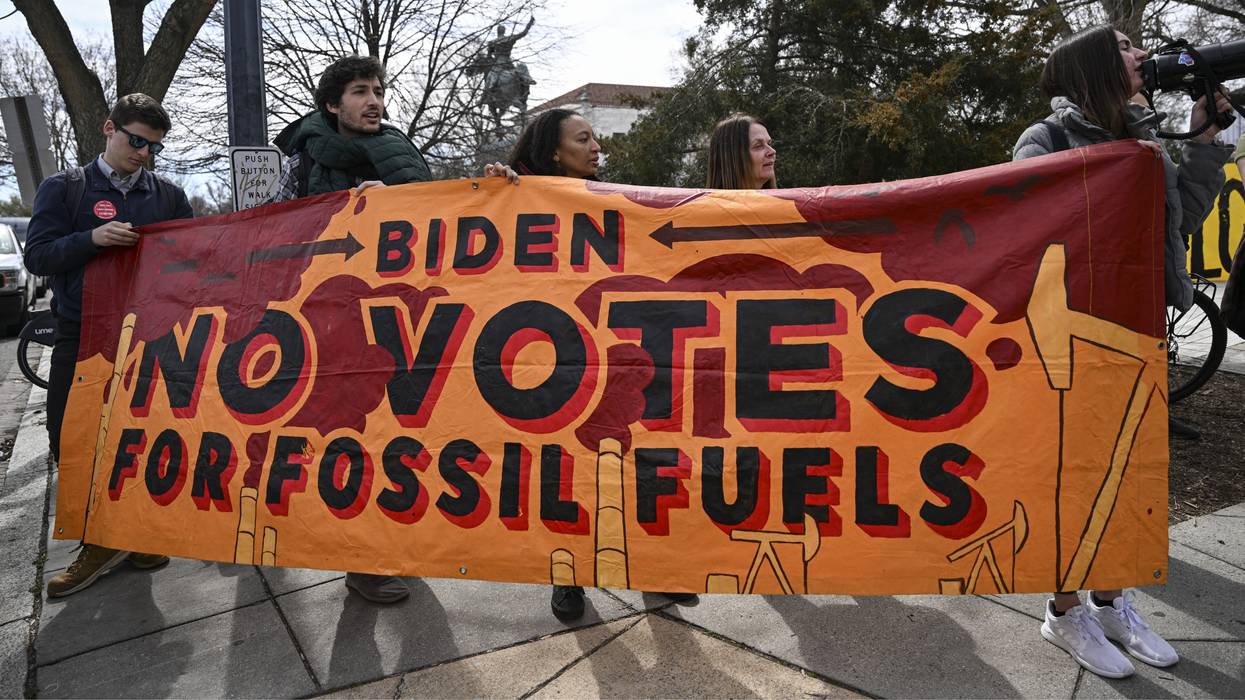
The administration's approval of the Willow oil project in Alaska communicates a disconnect from reality and a disregard for the people who elected him.
The sun was beating down and my ears were ringing. My hands gripped the megaphone as we chanted, "No more drilling, no more drilling, no more drilling on federal lands!" The words we chanted were President Joe Biden's verbatim, a broken promise made on the campaign trail in 2020. Just over a week after approving a massive oil drilling plan in the Arctic called the Willow project, President Biden hosted a conservation summit at the Department of the Interior. Youth climate justice organizers from Zero Hour protested alongside allied organizations outside the summit for hours, determined not to let Biden forget his broken promise. Administration officials and the president himself entered and left the building, pretending to ignore us and our demands, but we didn't quiet down. We don't plan to stop protesting the outrageous decision any time soon.
The conservation summit also came a day after the latest Intergovernmental Panel on Climate Change (IPCC) report was released, warning that this is our last chance for governments to stop fossil fuels to meet key planetary warming thresholds. The audacity of the Biden administration to host an environmental summit just after taking action that locks us into further dependence on fossil fuels is a striking example of just how out-of-touch the administration is. The week before the Willow project was approved, #StopWillow went viral online and a Change.org petition against the project gathered nearly 2.5 million signatures. In-person protests erupted in places from the White House to the Stephen Colbert show where Vice President Kamala Harris was a guest. And yet, the administration has continued to stand by its unconscionable decision.
I have been organizing and advocating for climate action since I was 15 years old, and politicians being deaf to public demands is nothing new to me. But as I stood outside the president's summit that day, it felt like a slap in the face.
I refuse to fall victim to climate doom, because the truth is we can still save our planet as we know it.
President Biden will never know what it's like to be a young person growing up in the middle of the climate crisis. Seeing news like the IPCC report back to back with government-sanctioned fossil fuel approval, it's no wonder many young people like me are disillusioned and riddled with climate anxiety and despair. Every day we are careening towards a dark and uncertain future, as we watch the waters rise around us and deadly disasters become regular occurrences. Words cannot describe how demoralizing it is to see our representatives side with fossil fuels again and again, stubbornly chaining us to a corrupt and antiquated industry that has no concern for the future of humanity.
I refuse to fall victim to climate doom, because the truth is we can still save our planet as we know it. The IPCC was clear about that too: If greenhouse gas emissions peak now, we have a chance to keep the planet under 1.5°C of warming. Scientists warn that at 1.5°C, we will see the most catastrophic effects of climate change. From coastal cities going underwater to widespread food scarcity from crop failures, humanity will face challenges we can't even fathom. I became a climate justice organizer because I was determined not to let our planet and futures be stolen from us by the fossil fuel industry. The only way we'll achieve a livable future is if our president carries that philosophy as well.
President Biden needs youth and climate justice organizers on his side too. I worked hard organizing youth to vote for Biden in 2020 even though I myself was too young to vote. I remember the relief and hope I felt when he won, promising to cut emissions by 50% by 2030. But Biden has not been the climate president he claims to be, and has taken actions that undermine his emission reduction goals. On top of the Willow project, the Biden administration approved 6,430 permits to drill for oil and gas on public lands in its first two years, a higher rate than the Trump administration.
There is no middle ground when it comes to fighting the climate crisis anymore: We either stop all new fossil fuels or we don't. Approving new fossil fuel projects at this point is absurd: We need to be actively shutting down current projects. President Biden's decision on the Willow project is the opposite of what conventional science dictates. It communicates a disconnect from reality and a disregard for the people who elected him. Time has run out for a both-sides approach: President Biden must choose one or the other, fossil fuels or our future. By approving the Willow project, it is clear which side he is on.
William Galston writes in the Wall Street Journal about a Republican senator's plans to force a confrontation on government disability benefits. Though Mr. Galston doesn't seem to see it this way, it sounds as if Sen. Orrin Hatch plans to hold benefits for disabled Americans hostage in order to force Social Security cuts on everyone.
Sen. Hatch, like many other Republicans, is raising alarms about the decreasing size of Social Security's disability trust fund. But, in a rare moment of candor, a "Senate staff member" indicated to Galston that "Sen. Hatch hopes to focus on the disability issue to catalyze a broader discussion."
In other words, Hatch wants to prevent a temporary reallocation of funds from other programs - which Democratic and Republican Congresses alike have done in the past - in order to force a "broader discussion" of across-the-board cut in benefits for Social Security, and perhaps privatization as well.
Right-wing wars of disinformation and demonization can be a wonder to behold, but the attacks on disabled recipients of Social Security benefits have been especially mean-spirited. Claims of "fraud" in the disability program are, simply put, counterfactual. There are other claims, too - that there's an epidemic in malingering that is exacerbated by overly generous benefits, that poor screening and lax rules allow able-bodied people to collect benefits, that there's a widespread "double dipping" problem, and that loopholes allow people to collect benefits while working.
"60 Minutes," which increasingly reflexively reflects the misguided and narrow worldview of the wealthy and powerful, even jumped in with an "expose" that repeated and amplified many of these misconceptions. (For more on "60 Minutes" and its corporate worldview, see here and here.)
Shawn Fremstad and Rebecca Vallas of the Center for American Progress (CAP) co-authored an article entitled "The Facts on Social Security Disability Insurance and Supplemental Security Income for Workers with Disabilities" which clears up many of these misconceptions. Vallas also joined us on The Zero Hour to further debunk these and other falsehoods about the SSDI and SSI programs.
Common Sense on Social Security Disability with Rebecca Vallas of CAPRebecca Vallas, Associate Director of the Poverty to Prosperity Program at the Center for American Progress, speaks with RJ ...
"For the vast majority of Disability Insurance beneficiaries -- about 71 percent -- half or more of their income comes from Disability Insurance," Fremstad and Vallas write. Conservatives claim that there has been an explosion in disability claims. But, as Fremstad and Vallas point out, "There has been little change over the past two decades in the share of nonelderly adults receiving Supplemental Security due to a disability."
There has been some increase in disability as the average age of working adults increase - but, as we discussed with Vallas, it's interesting to see conservatives complain about that (relatively minor) figure while simultaneously pushing to raise the retirement age even higher.
Far from being an easy program to game, Social Security disability coverage is, as Vallas says in our interview, "hard to get on and hard to live on." The screening process is stringent, and applicants often must wait a year or more as the result of congressional budget cuts. As for benefits, Vallas and Fremstad cite Organization for Economic Cooperation and Development (OECD) reports that show that the United States has the least generous disability-benefit system of any developed nation except South Korea.
On "double dipping," Paul Van de Water addressed an especially harsh Republican proposal that targets (the small number of) recipients who receive both unemployment and disability insurance.
As for the recipients who earn money at a job while still collecting benefits - there are limits to such benefits. Strikingly, the measures that made these work incentives possible passed Congress with strong bipartisan support. But why wouldn't they? Providing incentives for disabled people to go back to work in a new field is a pretty conservative idea - one which happens to make sense. It's good for the people involved, and saves money for the program when properly managed.
The disability trust fund is scheduled to run out of money in 2017 but, as Sen. Sherrod Brown explained in a speech at CAP, the situation is easily remedied with a temporary reallocation of funds. (Brown discusses Social Security with us in the video clip at the top of the page.) Congress has already done that 11 times, with broad bipartisan support.
This time it's different. Why? Because the right is making it a partisan issue. They're putting the brakes on reallocation, a practical solution that Galston also characterizes in partisan and pejorative terms. "Many Democrats want to put a patch on the problem," he writes. Galston also seems to have overlooked the word "temporary" when he argues that this move would worsen the whole program's long-term outlook.
There are other solutions, unmentioned by either Galston or (apparently) Hatch. The disability programs' short-term funding problem could also be solved with a 0.2 percent increase in the payroll tax.
As for the overall Social Security program, lifting the payroll tax cap would go a long way toward stabilizing it for the foreseeable future (probably further than the 45 percent CBO figure Galston cites, although that's an actuarial debate for another day). A financial transaction tax could conceivably fund the rest of the difference.
There's another tool in the toolkit, too. Polling conducted by the National Academy for Social Insurance shows that a majority of Americans across political lines would be willing to pay more in payroll taxes in return for increasing benefits - rather than decreasing them. The majority of Americans who support Social Security expansion aren't "demonizing the rich" or "looking for a free ride," to use two dismissive phrases from the right. They're willing to pay their own way.
Left unmentioned in the Galston piece, and too often in the broader debate, is the profound effect that growing wealth inequality has had on Social Security's finances, both by placing a larger percentage of earnings above the payroll tax cap (which lifting the cap would remediate) and by suppressing middle-class wages.
Solving the latter problem would require a comprehensive national policy aimed at wealth inequality, but that's a conversation we'll need to have eventually anyway.
Brown - along with Sens. Elizabeth Warren, Tom Harkin, Bernie Sanders, Mark Begich, and others - has been in the forefront of calls for expanding, rather than cutting, Social Security. They're winning the debate, and in so doing are shifting the political ground. We suspect that's what really has the anti-Social Security crowd worried. The momentum's turning against them. They need a new way to go on the offensive.
Still, why target the disabled? Perhaps because, as that Senate staffer told Galston, that's one way to "catalyze a broader discussion" - especially when the discussion isn't going your way.