SUBSCRIBE TO OUR FREE NEWSLETTER
Daily news & progressive opinion—funded by the people, not the corporations—delivered straight to your inbox.
5
#000000
#FFFFFF
To donate by check, phone, or other method, see our More Ways to Give page.
Daily news & progressive opinion—funded by the people, not the corporations—delivered straight to your inbox.
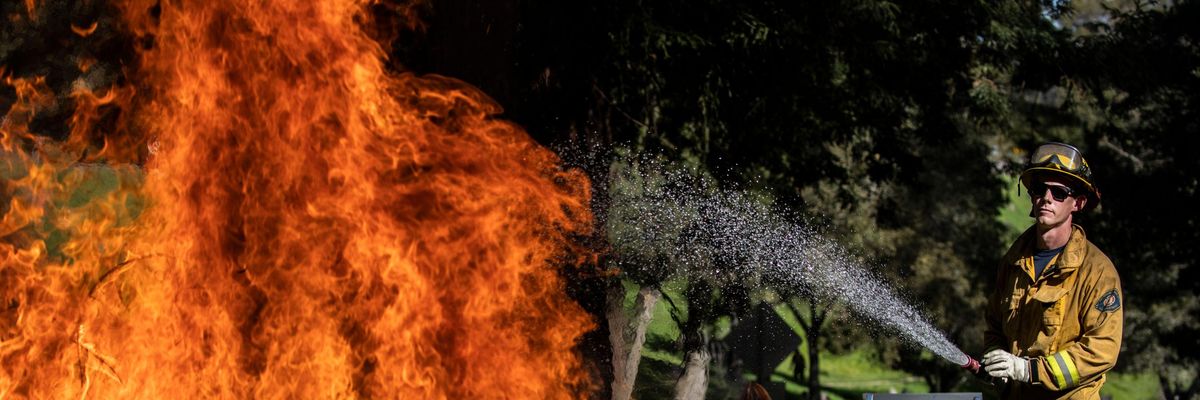
Brendan Randall, a firefighter with the East Bay Regional Parks District Fire Department, cools a flame while conducting a pile burn along Wildcat Canyon Road in Kensington, California on March 1, 2022. (Photo: Stephen Lam/The San Francisco Chronicle via Getty Images)
While many environmental advocates celebrate the Senate Democrats' climate deal this week, frontline activists and more critical voices continue to note that the legislation, whatever its promises and upsides, remains an inadequate response to the global emergency that will likely further harm communities already affected by fossil fuel pollution.
"Activists and frontline communities will continue fighting to stop fossil fuel corporations that threaten our air, our water, and a livable planet."
The Senate approved the Inflation Reduction Act (IRA) in a party-line vote Sunday and it is expected to pass the Democratic-controlled House as soon as Friday.
Writing for Jacobin in the wake of the Senate vote, Branko Marcetic called for being "clear-eyed" about the package, adding that "the urge to smooth over the IRA's serious flaws was understandable when its prospects of passing sat on a knife edge. But after passing the Senate, it's now overcome its biggest hurdle."
"People need to understand the realities of the bill--that it's a legislative ransom note written by a fossil fuel industry that backed and now celebrates it, one we had no choice but to go along with given the political realities--and that its passage isn't only the end of one battle but the start of a new front in the war to stave off calamity," he wrote.
Framing the Senate passage as a "bitter triumph," The New Republic's Kate Aronoff noted that it is "a historic achievement and vitally important given that Democrats may not get to govern again for a decade" but "also consigns more people to living next to more fossil fuel infrastructure for longer; in many cases, that means consigning more people--predominantly poor people, Black people, and Brown people--to disease and death."
"The IRA's passage doesn't close the book on U.S. climate policy so much as open it," she argued, making the case that it was only possible to pass any bill because of sustained activism. "As ever, the best guides to navigating what comes next will likely be the people who won it in the first place, and who'll have to live the closest to its consequences."
Since Sunday--when Democratic senators also rebuffed an attempt by Sen. Bernie Sanders (I-Vt.) to strip away the bill's fossil fuel handouts--frontline activists, national groups, and climate scientists have shared criticism of the legislation negotiated with Sen. Joe Manchin (D-W.Va.), an impediment to various progressive priorities whose personal wealth and political career are both tied to dirty energy.
Food & Water Watch managing director of policy Mitch Jones said that "it's no surprise that climate policy tailored to meet the demands of a coal baron would fall well short of what's needed to adequately address the severity of the climate crisis we face."
While the IRA includes about $369 billion in "energy security and climate change" investments, "the bill devotes billions to industry schemes like carbon capture, which exist solely to extend the life of the fossil fuel industry," Jones noted. It also conditions using federal lands and waters to expand wind and solar on fossil fuel leasing, and specifically enables future drilling in Alaska and the Gulf of Mexico that the Biden administration previously prevented.
"This new bill is genocide, there is no other way to put it," said Siqiniq Maupin, executive director of Sovereign Inupiat for a Living Arctic. "This is a life-or-death situation and the longer we act as though the world isn't on fire around us, the worse our burns will be."
Citing the "already abundant evidence that investing in clean, renewable energy does not, in and of itself, displace fossil fuels," Jones argued that "any adequate climate policy must directly confront" the dirty energy sector.
"The fact that oil and gas executives seem pleased with this legislation speaks volumes about its glaring shortcomings," he added. "Activists and frontline communities will continue fighting to stop fossil fuel corporations that threaten our air, our water, and a livable planet."
Jean Su of the Center for Biological Diversity--one of the groups leading the fight for ambitious legislation alongside a climate emergency declaration from President Joe Biden--was similarly critical.
"This was a backdoor take-it-or-leave-it deal between a coal baron and Democratic leaders in which any opposition from lawmakers or frontline communities was quashed," Su said. "It was an inherently unjust process, a deal which sacrifices so many communities and doesn't get us anywhere near where we need to go, yet is being presented as a savior legislation."
On Tuesday, Indigenous lawyer and Giniw Collective founder Tara Houska, Public Citizen president Robert Weissman, and Bishop William Barber of the Poor People's Campaign and Repairers of the Breach appeared on Democracy Now! to voice their concerns about the bill:
Greenpeace USA also directed attention to those who will be most affected by future fossil fuel production, saying the IRA is a "historic climate investment, but pours gasoline on the flames."
Ebony Twilley Martin, Greenpeace USA's co-executive director, called the bill "a slap in the face to the frontline communities, grassroots groups, and activists that made this legislation possible."
"The IRA is packed with giveaways to the fossil fuel executives who are destroying our planet," she continued. "It sacrifices the same people who have always borne the brunt of oil, gas, and coal infrastructure and climate crisis: Black, Indigenous, Latinx, and low-income communities. Folks living on the Gulf and in the Permian Basin."
The Greenpeace leader added that a side deal on reforming the federal permit process for energy infrastructure "is simply a disaster" but that "is what happens when the industry responsible for climate change also calls the shots on climate policy."
Center for Climate Integrity president Richard Wiles also emphasized industry influence, suggesting that while "record-breaking heatwaves, floods, wildfires, and droughts" should inspire a bolder bill that doesn't prop up polluters, "the long shadow of Big Oil's climate deception hangs over this legislation."
"The reason it has taken Congress decades to pass even this modest bill," he said, "is because the fossil fuel industry continues to wage a relentless campaign of disinformation, deception, and dark money to block climate progress and keep the nation hooked on its products."
Tom Solomon and Jim Mackenzie, co-coordinators of 350 New Mexico, concurred that "the Inflation Reduction Act is a stark example of the naked corruption of government in Washington D.C."
"The continued ability of the fossil fuel corporations to buy their way into business as usual in the face of accelerating climate catastrophe is alarming and depressing," the pair said. "Is it good that the IRA passed the Senate? Yes. Is it an insult to frontline communities? Yes."
"As climate activists," they added, "we will continue to oppose any expansion of fossil fuel infrastructure, including the proposed fossil hydrogen hubs here in New Mexico."
Ashley Engle of Ikiya Collective said that "like New Mexico, Oklahoma is situated on the frontlines of the climate crisis and fossil fuel extraction. We don't have the luxury of accepting half-measures or negotiations when our people are already dying."
"With Congress applauding their vote to turn communities like mine into sacrifice zones through the Inflation Reduction Act," she said, "the imperative is now squarely on Joe Biden to do what's right, to unleash his executive authority, and to declare a climate emergency."
Dear Common Dreams reader, It’s been nearly 30 years since I co-founded Common Dreams with my late wife, Lina Newhouser. We had the radical notion that journalism should serve the public good, not corporate profits. It was clear to us from the outset what it would take to build such a project. No paid advertisements. No corporate sponsors. No millionaire publisher telling us what to think or do. Many people said we wouldn't last a year, but we proved those doubters wrong. Together with a tremendous team of journalists and dedicated staff, we built an independent media outlet free from the constraints of profits and corporate control. Our mission has always been simple: To inform. To inspire. To ignite change for the common good. Building Common Dreams was not easy. Our survival was never guaranteed. When you take on the most powerful forces—Wall Street greed, fossil fuel industry destruction, Big Tech lobbyists, and uber-rich oligarchs who have spent billions upon billions rigging the economy and democracy in their favor—the only bulwark you have is supporters who believe in your work. But here’s the urgent message from me today. It's never been this bad out there. And it's never been this hard to keep us going. At the very moment Common Dreams is most needed, the threats we face are intensifying. We need your support now more than ever. We don't accept corporate advertising and never will. We don't have a paywall because we don't think people should be blocked from critical news based on their ability to pay. Everything we do is funded by the donations of readers like you. When everyone does the little they can afford, we are strong. But if that support retreats or dries up, so do we. Will you donate now to make sure Common Dreams not only survives but thrives? —Craig Brown, Co-founder |
While many environmental advocates celebrate the Senate Democrats' climate deal this week, frontline activists and more critical voices continue to note that the legislation, whatever its promises and upsides, remains an inadequate response to the global emergency that will likely further harm communities already affected by fossil fuel pollution.
"Activists and frontline communities will continue fighting to stop fossil fuel corporations that threaten our air, our water, and a livable planet."
The Senate approved the Inflation Reduction Act (IRA) in a party-line vote Sunday and it is expected to pass the Democratic-controlled House as soon as Friday.
Writing for Jacobin in the wake of the Senate vote, Branko Marcetic called for being "clear-eyed" about the package, adding that "the urge to smooth over the IRA's serious flaws was understandable when its prospects of passing sat on a knife edge. But after passing the Senate, it's now overcome its biggest hurdle."
"People need to understand the realities of the bill--that it's a legislative ransom note written by a fossil fuel industry that backed and now celebrates it, one we had no choice but to go along with given the political realities--and that its passage isn't only the end of one battle but the start of a new front in the war to stave off calamity," he wrote.
Framing the Senate passage as a "bitter triumph," The New Republic's Kate Aronoff noted that it is "a historic achievement and vitally important given that Democrats may not get to govern again for a decade" but "also consigns more people to living next to more fossil fuel infrastructure for longer; in many cases, that means consigning more people--predominantly poor people, Black people, and Brown people--to disease and death."
"The IRA's passage doesn't close the book on U.S. climate policy so much as open it," she argued, making the case that it was only possible to pass any bill because of sustained activism. "As ever, the best guides to navigating what comes next will likely be the people who won it in the first place, and who'll have to live the closest to its consequences."
Since Sunday--when Democratic senators also rebuffed an attempt by Sen. Bernie Sanders (I-Vt.) to strip away the bill's fossil fuel handouts--frontline activists, national groups, and climate scientists have shared criticism of the legislation negotiated with Sen. Joe Manchin (D-W.Va.), an impediment to various progressive priorities whose personal wealth and political career are both tied to dirty energy.
Food & Water Watch managing director of policy Mitch Jones said that "it's no surprise that climate policy tailored to meet the demands of a coal baron would fall well short of what's needed to adequately address the severity of the climate crisis we face."
While the IRA includes about $369 billion in "energy security and climate change" investments, "the bill devotes billions to industry schemes like carbon capture, which exist solely to extend the life of the fossil fuel industry," Jones noted. It also conditions using federal lands and waters to expand wind and solar on fossil fuel leasing, and specifically enables future drilling in Alaska and the Gulf of Mexico that the Biden administration previously prevented.
"This new bill is genocide, there is no other way to put it," said Siqiniq Maupin, executive director of Sovereign Inupiat for a Living Arctic. "This is a life-or-death situation and the longer we act as though the world isn't on fire around us, the worse our burns will be."
Citing the "already abundant evidence that investing in clean, renewable energy does not, in and of itself, displace fossil fuels," Jones argued that "any adequate climate policy must directly confront" the dirty energy sector.
"The fact that oil and gas executives seem pleased with this legislation speaks volumes about its glaring shortcomings," he added. "Activists and frontline communities will continue fighting to stop fossil fuel corporations that threaten our air, our water, and a livable planet."
Jean Su of the Center for Biological Diversity--one of the groups leading the fight for ambitious legislation alongside a climate emergency declaration from President Joe Biden--was similarly critical.
"This was a backdoor take-it-or-leave-it deal between a coal baron and Democratic leaders in which any opposition from lawmakers or frontline communities was quashed," Su said. "It was an inherently unjust process, a deal which sacrifices so many communities and doesn't get us anywhere near where we need to go, yet is being presented as a savior legislation."
On Tuesday, Indigenous lawyer and Giniw Collective founder Tara Houska, Public Citizen president Robert Weissman, and Bishop William Barber of the Poor People's Campaign and Repairers of the Breach appeared on Democracy Now! to voice their concerns about the bill:
Greenpeace USA also directed attention to those who will be most affected by future fossil fuel production, saying the IRA is a "historic climate investment, but pours gasoline on the flames."
Ebony Twilley Martin, Greenpeace USA's co-executive director, called the bill "a slap in the face to the frontline communities, grassroots groups, and activists that made this legislation possible."
"The IRA is packed with giveaways to the fossil fuel executives who are destroying our planet," she continued. "It sacrifices the same people who have always borne the brunt of oil, gas, and coal infrastructure and climate crisis: Black, Indigenous, Latinx, and low-income communities. Folks living on the Gulf and in the Permian Basin."
The Greenpeace leader added that a side deal on reforming the federal permit process for energy infrastructure "is simply a disaster" but that "is what happens when the industry responsible for climate change also calls the shots on climate policy."
Center for Climate Integrity president Richard Wiles also emphasized industry influence, suggesting that while "record-breaking heatwaves, floods, wildfires, and droughts" should inspire a bolder bill that doesn't prop up polluters, "the long shadow of Big Oil's climate deception hangs over this legislation."
"The reason it has taken Congress decades to pass even this modest bill," he said, "is because the fossil fuel industry continues to wage a relentless campaign of disinformation, deception, and dark money to block climate progress and keep the nation hooked on its products."
Tom Solomon and Jim Mackenzie, co-coordinators of 350 New Mexico, concurred that "the Inflation Reduction Act is a stark example of the naked corruption of government in Washington D.C."
"The continued ability of the fossil fuel corporations to buy their way into business as usual in the face of accelerating climate catastrophe is alarming and depressing," the pair said. "Is it good that the IRA passed the Senate? Yes. Is it an insult to frontline communities? Yes."
"As climate activists," they added, "we will continue to oppose any expansion of fossil fuel infrastructure, including the proposed fossil hydrogen hubs here in New Mexico."
Ashley Engle of Ikiya Collective said that "like New Mexico, Oklahoma is situated on the frontlines of the climate crisis and fossil fuel extraction. We don't have the luxury of accepting half-measures or negotiations when our people are already dying."
"With Congress applauding their vote to turn communities like mine into sacrifice zones through the Inflation Reduction Act," she said, "the imperative is now squarely on Joe Biden to do what's right, to unleash his executive authority, and to declare a climate emergency."
While many environmental advocates celebrate the Senate Democrats' climate deal this week, frontline activists and more critical voices continue to note that the legislation, whatever its promises and upsides, remains an inadequate response to the global emergency that will likely further harm communities already affected by fossil fuel pollution.
"Activists and frontline communities will continue fighting to stop fossil fuel corporations that threaten our air, our water, and a livable planet."
The Senate approved the Inflation Reduction Act (IRA) in a party-line vote Sunday and it is expected to pass the Democratic-controlled House as soon as Friday.
Writing for Jacobin in the wake of the Senate vote, Branko Marcetic called for being "clear-eyed" about the package, adding that "the urge to smooth over the IRA's serious flaws was understandable when its prospects of passing sat on a knife edge. But after passing the Senate, it's now overcome its biggest hurdle."
"People need to understand the realities of the bill--that it's a legislative ransom note written by a fossil fuel industry that backed and now celebrates it, one we had no choice but to go along with given the political realities--and that its passage isn't only the end of one battle but the start of a new front in the war to stave off calamity," he wrote.
Framing the Senate passage as a "bitter triumph," The New Republic's Kate Aronoff noted that it is "a historic achievement and vitally important given that Democrats may not get to govern again for a decade" but "also consigns more people to living next to more fossil fuel infrastructure for longer; in many cases, that means consigning more people--predominantly poor people, Black people, and Brown people--to disease and death."
"The IRA's passage doesn't close the book on U.S. climate policy so much as open it," she argued, making the case that it was only possible to pass any bill because of sustained activism. "As ever, the best guides to navigating what comes next will likely be the people who won it in the first place, and who'll have to live the closest to its consequences."
Since Sunday--when Democratic senators also rebuffed an attempt by Sen. Bernie Sanders (I-Vt.) to strip away the bill's fossil fuel handouts--frontline activists, national groups, and climate scientists have shared criticism of the legislation negotiated with Sen. Joe Manchin (D-W.Va.), an impediment to various progressive priorities whose personal wealth and political career are both tied to dirty energy.
Food & Water Watch managing director of policy Mitch Jones said that "it's no surprise that climate policy tailored to meet the demands of a coal baron would fall well short of what's needed to adequately address the severity of the climate crisis we face."
While the IRA includes about $369 billion in "energy security and climate change" investments, "the bill devotes billions to industry schemes like carbon capture, which exist solely to extend the life of the fossil fuel industry," Jones noted. It also conditions using federal lands and waters to expand wind and solar on fossil fuel leasing, and specifically enables future drilling in Alaska and the Gulf of Mexico that the Biden administration previously prevented.
"This new bill is genocide, there is no other way to put it," said Siqiniq Maupin, executive director of Sovereign Inupiat for a Living Arctic. "This is a life-or-death situation and the longer we act as though the world isn't on fire around us, the worse our burns will be."
Citing the "already abundant evidence that investing in clean, renewable energy does not, in and of itself, displace fossil fuels," Jones argued that "any adequate climate policy must directly confront" the dirty energy sector.
"The fact that oil and gas executives seem pleased with this legislation speaks volumes about its glaring shortcomings," he added. "Activists and frontline communities will continue fighting to stop fossil fuel corporations that threaten our air, our water, and a livable planet."
Jean Su of the Center for Biological Diversity--one of the groups leading the fight for ambitious legislation alongside a climate emergency declaration from President Joe Biden--was similarly critical.
"This was a backdoor take-it-or-leave-it deal between a coal baron and Democratic leaders in which any opposition from lawmakers or frontline communities was quashed," Su said. "It was an inherently unjust process, a deal which sacrifices so many communities and doesn't get us anywhere near where we need to go, yet is being presented as a savior legislation."
On Tuesday, Indigenous lawyer and Giniw Collective founder Tara Houska, Public Citizen president Robert Weissman, and Bishop William Barber of the Poor People's Campaign and Repairers of the Breach appeared on Democracy Now! to voice their concerns about the bill:
Greenpeace USA also directed attention to those who will be most affected by future fossil fuel production, saying the IRA is a "historic climate investment, but pours gasoline on the flames."
Ebony Twilley Martin, Greenpeace USA's co-executive director, called the bill "a slap in the face to the frontline communities, grassroots groups, and activists that made this legislation possible."
"The IRA is packed with giveaways to the fossil fuel executives who are destroying our planet," she continued. "It sacrifices the same people who have always borne the brunt of oil, gas, and coal infrastructure and climate crisis: Black, Indigenous, Latinx, and low-income communities. Folks living on the Gulf and in the Permian Basin."
The Greenpeace leader added that a side deal on reforming the federal permit process for energy infrastructure "is simply a disaster" but that "is what happens when the industry responsible for climate change also calls the shots on climate policy."
Center for Climate Integrity president Richard Wiles also emphasized industry influence, suggesting that while "record-breaking heatwaves, floods, wildfires, and droughts" should inspire a bolder bill that doesn't prop up polluters, "the long shadow of Big Oil's climate deception hangs over this legislation."
"The reason it has taken Congress decades to pass even this modest bill," he said, "is because the fossil fuel industry continues to wage a relentless campaign of disinformation, deception, and dark money to block climate progress and keep the nation hooked on its products."
Tom Solomon and Jim Mackenzie, co-coordinators of 350 New Mexico, concurred that "the Inflation Reduction Act is a stark example of the naked corruption of government in Washington D.C."
"The continued ability of the fossil fuel corporations to buy their way into business as usual in the face of accelerating climate catastrophe is alarming and depressing," the pair said. "Is it good that the IRA passed the Senate? Yes. Is it an insult to frontline communities? Yes."
"As climate activists," they added, "we will continue to oppose any expansion of fossil fuel infrastructure, including the proposed fossil hydrogen hubs here in New Mexico."
Ashley Engle of Ikiya Collective said that "like New Mexico, Oklahoma is situated on the frontlines of the climate crisis and fossil fuel extraction. We don't have the luxury of accepting half-measures or negotiations when our people are already dying."
"With Congress applauding their vote to turn communities like mine into sacrifice zones through the Inflation Reduction Act," she said, "the imperative is now squarely on Joe Biden to do what's right, to unleash his executive authority, and to declare a climate emergency."