SUBSCRIBE TO OUR FREE NEWSLETTER
Daily news & progressive opinion—funded by the people, not the corporations—delivered straight to your inbox.
5
#000000
#FFFFFF
To donate by check, phone, or other method, see our More Ways to Give page.
Daily news & progressive opinion—funded by the people, not the corporations—delivered straight to your inbox.
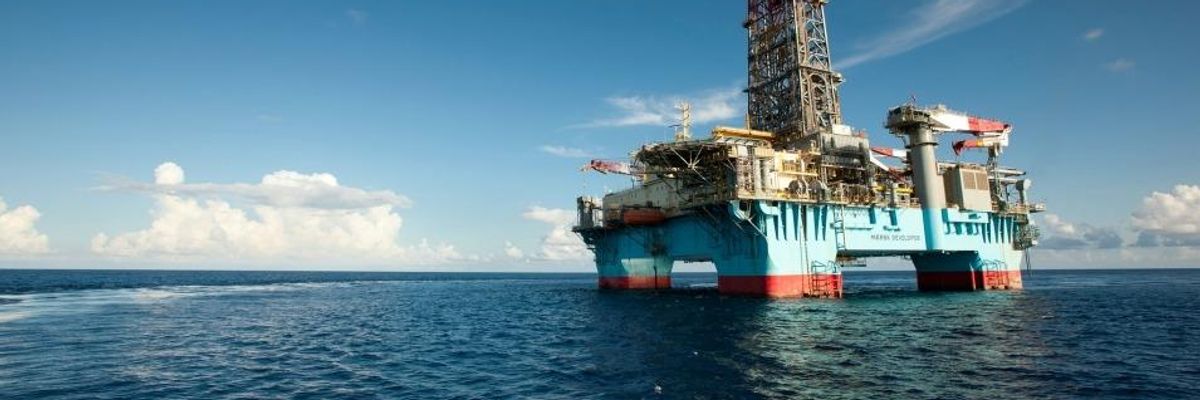
U.S. President Joe Biden unveiled the reinstatement of offshore drilling safety rules on August 22, 2023.
Even with oil spill prevention measures, said one advocate, "offshore drilling simply will never be safe."
Environmental advocates on Tuesday said the Biden administration's decision to reinstate offshore drilling safety rules would help undo damage caused by former Republican President Donald Trump's repeal of the regulations, but were clear that the rules would not change the fact that fossil fuel extraction is imperiling ecosystems and the planet.
U.S. Interior Secretary Deb Haaland announced that the rules have once again been finalized and will go into effect in October, governing the use of safety equipment on offshore oil rigs.
The rules were originally put in place by the Obama administration after BP's 2010 Deepwater Horizon disaster, which sent four million barrels of oil into the Gulf of Mexico and killed 11 people, an estimated one million seabirds, and up to five million fish.
The oil and gas industry strongly supported Trump's repeal of the rules, which Kristen Monsell, a senior attorney at the Center for Biological Diversity, said at the time would "make dirty offshore drilling even more dangerous" by making oil spills more likely.
But Jackie Savitz, chief policy officer for the ocean conservation group Oceana, said new safety regulations for drilling operations are no replacement for halting offshore drilling altogether.
"Offshore drilling simply will never be safe," she said. "When there is a spill like Deepwater Horizon, it's too late, our options are severely limited, so prevention is the only solution and this is a good step in that direction."
The reinstated rules are "a big step in getting us back on track" to ensuring there's no repeat of disasters like Deepwater Horizon, Savitz said, but "there is no way we can do enough to prevent an oil spill."
"It is an inherently risky business and it's not a matter of if, but when we will have another one," she added. "So a big part of prevention has to be to stop selling new leases."
The newly reinstated rules will require:
Ahead of the announcement, Zero Hour founder and executive director Zanagee Artis and Taproot Earth national policy director Kendall Dix wrote an op-ed in the Miami Herald, calling on U.S. President Joe Biden to "move the country off of its addiction to fossil fuels by barring new leasing on public lands and waters," as he promised to when he campaigned for the presidency in 2020.
With the Interior Department considering a five-year oil and gas leasing program that would allow the fossil fuel industry to conduct extraction operations in even more areas of the nation's oceans—a proposal expected to be finalized this fall as the revived safety regulations go into effect—"the risk of environmental disaster from offshore drilling is not a question of if disaster will strike, but when," wrote Artis and Dix.
They pointed out that in addition to the International Energy Agency's call for an immediate end to fossil fuel extraction in order to achieve net zero carbon emissions by 2050 and the United Nations' warning that oil and gas drilling are "incompatible with human survival," offshore operations are simply not necessary "to meet the nation's energy needs."
"An analysis by industry experts found that, even without a single new lease offering, oil production in the United States will remain steady into 2035, at which point the nation's transition to renewable energy will be approaching maturity," Artis and Dix wrote.
"We don't need to sell off more of our ocean to Big Oil," they added. "Every oil spill began with an offshore lease sale."
Dear Common Dreams reader, It’s been nearly 30 years since I co-founded Common Dreams with my late wife, Lina Newhouser. We had the radical notion that journalism should serve the public good, not corporate profits. It was clear to us from the outset what it would take to build such a project. No paid advertisements. No corporate sponsors. No millionaire publisher telling us what to think or do. Many people said we wouldn't last a year, but we proved those doubters wrong. Together with a tremendous team of journalists and dedicated staff, we built an independent media outlet free from the constraints of profits and corporate control. Our mission has always been simple: To inform. To inspire. To ignite change for the common good. Building Common Dreams was not easy. Our survival was never guaranteed. When you take on the most powerful forces—Wall Street greed, fossil fuel industry destruction, Big Tech lobbyists, and uber-rich oligarchs who have spent billions upon billions rigging the economy and democracy in their favor—the only bulwark you have is supporters who believe in your work. But here’s the urgent message from me today. It's never been this bad out there. And it's never been this hard to keep us going. At the very moment Common Dreams is most needed, the threats we face are intensifying. We need your support now more than ever. We don't accept corporate advertising and never will. We don't have a paywall because we don't think people should be blocked from critical news based on their ability to pay. Everything we do is funded by the donations of readers like you. When everyone does the little they can afford, we are strong. But if that support retreats or dries up, so do we. Will you donate now to make sure Common Dreams not only survives but thrives? —Craig Brown, Co-founder |
Environmental advocates on Tuesday said the Biden administration's decision to reinstate offshore drilling safety rules would help undo damage caused by former Republican President Donald Trump's repeal of the regulations, but were clear that the rules would not change the fact that fossil fuel extraction is imperiling ecosystems and the planet.
U.S. Interior Secretary Deb Haaland announced that the rules have once again been finalized and will go into effect in October, governing the use of safety equipment on offshore oil rigs.
The rules were originally put in place by the Obama administration after BP's 2010 Deepwater Horizon disaster, which sent four million barrels of oil into the Gulf of Mexico and killed 11 people, an estimated one million seabirds, and up to five million fish.
The oil and gas industry strongly supported Trump's repeal of the rules, which Kristen Monsell, a senior attorney at the Center for Biological Diversity, said at the time would "make dirty offshore drilling even more dangerous" by making oil spills more likely.
But Jackie Savitz, chief policy officer for the ocean conservation group Oceana, said new safety regulations for drilling operations are no replacement for halting offshore drilling altogether.
"Offshore drilling simply will never be safe," she said. "When there is a spill like Deepwater Horizon, it's too late, our options are severely limited, so prevention is the only solution and this is a good step in that direction."
The reinstated rules are "a big step in getting us back on track" to ensuring there's no repeat of disasters like Deepwater Horizon, Savitz said, but "there is no way we can do enough to prevent an oil spill."
"It is an inherently risky business and it's not a matter of if, but when we will have another one," she added. "So a big part of prevention has to be to stop selling new leases."
The newly reinstated rules will require:
Ahead of the announcement, Zero Hour founder and executive director Zanagee Artis and Taproot Earth national policy director Kendall Dix wrote an op-ed in the Miami Herald, calling on U.S. President Joe Biden to "move the country off of its addiction to fossil fuels by barring new leasing on public lands and waters," as he promised to when he campaigned for the presidency in 2020.
With the Interior Department considering a five-year oil and gas leasing program that would allow the fossil fuel industry to conduct extraction operations in even more areas of the nation's oceans—a proposal expected to be finalized this fall as the revived safety regulations go into effect—"the risk of environmental disaster from offshore drilling is not a question of if disaster will strike, but when," wrote Artis and Dix.
They pointed out that in addition to the International Energy Agency's call for an immediate end to fossil fuel extraction in order to achieve net zero carbon emissions by 2050 and the United Nations' warning that oil and gas drilling are "incompatible with human survival," offshore operations are simply not necessary "to meet the nation's energy needs."
"An analysis by industry experts found that, even without a single new lease offering, oil production in the United States will remain steady into 2035, at which point the nation's transition to renewable energy will be approaching maturity," Artis and Dix wrote.
"We don't need to sell off more of our ocean to Big Oil," they added. "Every oil spill began with an offshore lease sale."
Environmental advocates on Tuesday said the Biden administration's decision to reinstate offshore drilling safety rules would help undo damage caused by former Republican President Donald Trump's repeal of the regulations, but were clear that the rules would not change the fact that fossil fuel extraction is imperiling ecosystems and the planet.
U.S. Interior Secretary Deb Haaland announced that the rules have once again been finalized and will go into effect in October, governing the use of safety equipment on offshore oil rigs.
The rules were originally put in place by the Obama administration after BP's 2010 Deepwater Horizon disaster, which sent four million barrels of oil into the Gulf of Mexico and killed 11 people, an estimated one million seabirds, and up to five million fish.
The oil and gas industry strongly supported Trump's repeal of the rules, which Kristen Monsell, a senior attorney at the Center for Biological Diversity, said at the time would "make dirty offshore drilling even more dangerous" by making oil spills more likely.
But Jackie Savitz, chief policy officer for the ocean conservation group Oceana, said new safety regulations for drilling operations are no replacement for halting offshore drilling altogether.
"Offshore drilling simply will never be safe," she said. "When there is a spill like Deepwater Horizon, it's too late, our options are severely limited, so prevention is the only solution and this is a good step in that direction."
The reinstated rules are "a big step in getting us back on track" to ensuring there's no repeat of disasters like Deepwater Horizon, Savitz said, but "there is no way we can do enough to prevent an oil spill."
"It is an inherently risky business and it's not a matter of if, but when we will have another one," she added. "So a big part of prevention has to be to stop selling new leases."
The newly reinstated rules will require:
Ahead of the announcement, Zero Hour founder and executive director Zanagee Artis and Taproot Earth national policy director Kendall Dix wrote an op-ed in the Miami Herald, calling on U.S. President Joe Biden to "move the country off of its addiction to fossil fuels by barring new leasing on public lands and waters," as he promised to when he campaigned for the presidency in 2020.
With the Interior Department considering a five-year oil and gas leasing program that would allow the fossil fuel industry to conduct extraction operations in even more areas of the nation's oceans—a proposal expected to be finalized this fall as the revived safety regulations go into effect—"the risk of environmental disaster from offshore drilling is not a question of if disaster will strike, but when," wrote Artis and Dix.
They pointed out that in addition to the International Energy Agency's call for an immediate end to fossil fuel extraction in order to achieve net zero carbon emissions by 2050 and the United Nations' warning that oil and gas drilling are "incompatible with human survival," offshore operations are simply not necessary "to meet the nation's energy needs."
"An analysis by industry experts found that, even without a single new lease offering, oil production in the United States will remain steady into 2035, at which point the nation's transition to renewable energy will be approaching maturity," Artis and Dix wrote.
"We don't need to sell off more of our ocean to Big Oil," they added. "Every oil spill began with an offshore lease sale."