SUBSCRIBE TO OUR FREE NEWSLETTER
Daily news & progressive opinion—funded by the people, not the corporations—delivered straight to your inbox.
5
#000000
#FFFFFF
To donate by check, phone, or other method, see our More Ways to Give page.
Daily news & progressive opinion—funded by the people, not the corporations—delivered straight to your inbox.
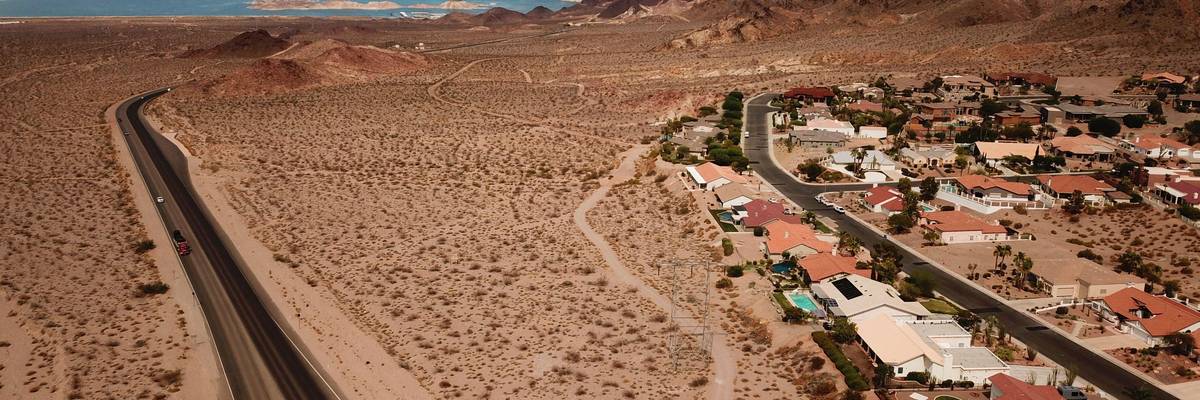
An aerial image taken on July 20, 2021 shows homes in Boulder City, Nevada adjacent to Lake Mead on the Colorado River.
"Vultures," said one critic, are "looking to make a lot of money off this public resource."
Financial speculators are buying and selling rights to the Colorado River's dwindling water resources in a bid to profit as historic drought conditions intensified by the fossil fuel-driven climate crisis lead to worsening scarcity.
Wall Street investment firms "have identified the drought as an opportunity to make money," Andy Mueller, general manager of the Colorado River Water Conservation District, told CBS News on Tuesday. "I view these drought profiteers as vultures. They're looking to make a lot of money off this public resource."
Matthew Diserio, the co-founder and president of a Manhattan-based hedge fund called Water Asset Management (WAM), makes no secret of his intentions, having described water in the United States as "the biggest emerging market on Earth" and "a trillion-dollar market opportunity." The company's website declares that "scarce clean water is the resource defining this century, much like plentiful oil defined the last."
A newly published joint investigation by CBS News and The Weather Channel found that WAM has purchased at least $20 million worth of land in Western Colorado over the past five years, making it one of the biggest landowners in a farming and ranching region known as the Grand Valley.
According to Mueller, WAM has bought more than 2,500 acres of farmland in the area. But "it's the water"—not the land—that investors are really interested in, he said, observing that the farmland comes with water rights.
"There are real fears that this crucial water supply for the West is on the brink of disaster."
Notably, WAM has "hired Colorado's former top water official as one of its lawyers," CBS News reported. Diserio previously stated that "one of his firm's strategies is to profit from water in part by making the farms it buys more efficient and then selling parts of its water rights to other farmers and cities increasingly desperate for the natural resource."
Mueller is tasked with protecting Colorado's share of the Colorado River—a sprawling 1,450-mile waterway that traverses seven states and is a key water source for 40 million people in the western U.S. and northern Mexico, including those in the metropolitan areas of Los Angeles, Phoenix, San Diego, Denver, Las Vegas, Albuquerque, and Salt Lake City.
Clean water is becoming increasingly scarce in the region for a variety of reasons, not least of which is the fossil fuel-driven climate emergency.
"The Colorado River relies mostly on snowpack in the Rocky Mountains that feeds into the river as it melts in the spring and summer," Weather Channel storm specialist Greg Postel explained. "But climate change is making the West hotter and drier. For every degree the temperature has gone up, the flow of the river has dropped by about 5%—a nearly 20% reduction over the past century."
The volume of water being withdrawn from the Colorado River has fallen since 2000 despite more people moving to the region. But with less water flowing into the river amid the West's ongoing 23-year megadrought—more severe than anything seen in the preceding 1,200 years—recent decreases in per capita water consumption are insufficient.
"It's taken a major toll on the nation's largest reservoirs," Postel said of climate change-amplified drought. "Lake Powell in Arizona and Lake Mead in Nevada—they are at historic lows. They're at just 25% of their full, combined capacity. There are real fears that this crucial water supply for the West is on the brink of disaster."
As the long-brewing crisis surrounding the Colorado River grows more acute, the federal government has taken steps to compel state-level policymakers to improve how they manage water resources in the increasingly arid region.
For instance, "Congress recently allocated $4 billion in drought funding that can be used to pay farmers to fallow their land and not use their water," CBS News reported. "Some Western states, including Colorado, are also considering paying some farmers to keep their lands fallow." Agriculture accounts for 70% of withdrawals from the Colorado River.
Last August, after the Colorado River Basin states failed to meet a federal deadline to approve a plan for achieving a 15% to 30% reduction in water use, the U.S. Department of Interior (DOI) announced—based on projected water levels for 2023—that Arizona, Nevada, and Mexico would be forced to draw less from the river this year.
On Tuesday, for the second time in six months, the seven states that depend on the Colorado River failed to reach a water conservation pact by the DOI's deadline, increasing the likelihood the agency will impose cuts later this year. Six states—Arizona, Colorado, Nevada, New Mexico, Utah, and Wyoming—agreed to slash water use. But California, the largest water consumer of the bunch, refused, setting the stage for what CNN described as a "high-stakes legal battle."
In August, Food & Water Watch research director Amanda Starbuck implored policymakers to "eliminate rampant corporate water abuse before it's too late," decrying the "massive water use of Big Ag and Big Oil."
"By switching to renewable energy sources like solar and wind, California could save 98% of the water currently needed for its fossil fuel production," said Starbuck. "And by transitioning away from industrial megadairies, thirsty crops like almonds and pistachios, and engaging in regenerative farming, California will gain enormous water savings that could serve small farmers and domestic households."
Regarding WAM and other hedge funds looking to profit from looming water shortages, Rep. Ro Khanna (D-Calif.) and Sen. Elizabeth Warren (D-Mass.) unveiled legislation last March that would prevent Wall Street from speculating on life-sustaining water resources.
The Future of Water Act, as the congressional Democrats' bicameral legislation is titled, would amend the Commodity Exchange Act to affirm that water is a human right to be managed for public benefit—not a commodity to be bought and sold by investment firms. The bill would also prohibit the trading of water rights on futures markets—a recently invented financial ploy widely condemned as "dystopian."
Wenonah Hauter, executive director of Food & Water Watch, said at the time of the bill's introduction that "with the climate crisis delivering historically devastating droughts across the West, it is clearer than ever that water should be treated as a scarce, essential resource, not a commodity for Wall Street and financial speculators."
"This groundbreaking legislation would put a lid on dangerous water futures trading before it creates a crisis," said Hauter, "and it reinforces the fact that water must be managed as a public resource, not a corporate profit center."
Mueller, for his part, said Tuesday that "water in Colorado, water in the West, is your future."
"Without water," he added, "you have no future."
Dear Common Dreams reader, It’s been nearly 30 years since I co-founded Common Dreams with my late wife, Lina Newhouser. We had the radical notion that journalism should serve the public good, not corporate profits. It was clear to us from the outset what it would take to build such a project. No paid advertisements. No corporate sponsors. No millionaire publisher telling us what to think or do. Many people said we wouldn't last a year, but we proved those doubters wrong. Together with a tremendous team of journalists and dedicated staff, we built an independent media outlet free from the constraints of profits and corporate control. Our mission has always been simple: To inform. To inspire. To ignite change for the common good. Building Common Dreams was not easy. Our survival was never guaranteed. When you take on the most powerful forces—Wall Street greed, fossil fuel industry destruction, Big Tech lobbyists, and uber-rich oligarchs who have spent billions upon billions rigging the economy and democracy in their favor—the only bulwark you have is supporters who believe in your work. But here’s the urgent message from me today. It's never been this bad out there. And it's never been this hard to keep us going. At the very moment Common Dreams is most needed, the threats we face are intensifying. We need your support now more than ever. We don't accept corporate advertising and never will. We don't have a paywall because we don't think people should be blocked from critical news based on their ability to pay. Everything we do is funded by the donations of readers like you. When everyone does the little they can afford, we are strong. But if that support retreats or dries up, so do we. Will you donate now to make sure Common Dreams not only survives but thrives? —Craig Brown, Co-founder |
Financial speculators are buying and selling rights to the Colorado River's dwindling water resources in a bid to profit as historic drought conditions intensified by the fossil fuel-driven climate crisis lead to worsening scarcity.
Wall Street investment firms "have identified the drought as an opportunity to make money," Andy Mueller, general manager of the Colorado River Water Conservation District, told CBS News on Tuesday. "I view these drought profiteers as vultures. They're looking to make a lot of money off this public resource."
Matthew Diserio, the co-founder and president of a Manhattan-based hedge fund called Water Asset Management (WAM), makes no secret of his intentions, having described water in the United States as "the biggest emerging market on Earth" and "a trillion-dollar market opportunity." The company's website declares that "scarce clean water is the resource defining this century, much like plentiful oil defined the last."
A newly published joint investigation by CBS News and The Weather Channel found that WAM has purchased at least $20 million worth of land in Western Colorado over the past five years, making it one of the biggest landowners in a farming and ranching region known as the Grand Valley.
According to Mueller, WAM has bought more than 2,500 acres of farmland in the area. But "it's the water"—not the land—that investors are really interested in, he said, observing that the farmland comes with water rights.
"There are real fears that this crucial water supply for the West is on the brink of disaster."
Notably, WAM has "hired Colorado's former top water official as one of its lawyers," CBS News reported. Diserio previously stated that "one of his firm's strategies is to profit from water in part by making the farms it buys more efficient and then selling parts of its water rights to other farmers and cities increasingly desperate for the natural resource."
Mueller is tasked with protecting Colorado's share of the Colorado River—a sprawling 1,450-mile waterway that traverses seven states and is a key water source for 40 million people in the western U.S. and northern Mexico, including those in the metropolitan areas of Los Angeles, Phoenix, San Diego, Denver, Las Vegas, Albuquerque, and Salt Lake City.
Clean water is becoming increasingly scarce in the region for a variety of reasons, not least of which is the fossil fuel-driven climate emergency.
"The Colorado River relies mostly on snowpack in the Rocky Mountains that feeds into the river as it melts in the spring and summer," Weather Channel storm specialist Greg Postel explained. "But climate change is making the West hotter and drier. For every degree the temperature has gone up, the flow of the river has dropped by about 5%—a nearly 20% reduction over the past century."
The volume of water being withdrawn from the Colorado River has fallen since 2000 despite more people moving to the region. But with less water flowing into the river amid the West's ongoing 23-year megadrought—more severe than anything seen in the preceding 1,200 years—recent decreases in per capita water consumption are insufficient.
"It's taken a major toll on the nation's largest reservoirs," Postel said of climate change-amplified drought. "Lake Powell in Arizona and Lake Mead in Nevada—they are at historic lows. They're at just 25% of their full, combined capacity. There are real fears that this crucial water supply for the West is on the brink of disaster."
As the long-brewing crisis surrounding the Colorado River grows more acute, the federal government has taken steps to compel state-level policymakers to improve how they manage water resources in the increasingly arid region.
For instance, "Congress recently allocated $4 billion in drought funding that can be used to pay farmers to fallow their land and not use their water," CBS News reported. "Some Western states, including Colorado, are also considering paying some farmers to keep their lands fallow." Agriculture accounts for 70% of withdrawals from the Colorado River.
Last August, after the Colorado River Basin states failed to meet a federal deadline to approve a plan for achieving a 15% to 30% reduction in water use, the U.S. Department of Interior (DOI) announced—based on projected water levels for 2023—that Arizona, Nevada, and Mexico would be forced to draw less from the river this year.
On Tuesday, for the second time in six months, the seven states that depend on the Colorado River failed to reach a water conservation pact by the DOI's deadline, increasing the likelihood the agency will impose cuts later this year. Six states—Arizona, Colorado, Nevada, New Mexico, Utah, and Wyoming—agreed to slash water use. But California, the largest water consumer of the bunch, refused, setting the stage for what CNN described as a "high-stakes legal battle."
In August, Food & Water Watch research director Amanda Starbuck implored policymakers to "eliminate rampant corporate water abuse before it's too late," decrying the "massive water use of Big Ag and Big Oil."
"By switching to renewable energy sources like solar and wind, California could save 98% of the water currently needed for its fossil fuel production," said Starbuck. "And by transitioning away from industrial megadairies, thirsty crops like almonds and pistachios, and engaging in regenerative farming, California will gain enormous water savings that could serve small farmers and domestic households."
Regarding WAM and other hedge funds looking to profit from looming water shortages, Rep. Ro Khanna (D-Calif.) and Sen. Elizabeth Warren (D-Mass.) unveiled legislation last March that would prevent Wall Street from speculating on life-sustaining water resources.
The Future of Water Act, as the congressional Democrats' bicameral legislation is titled, would amend the Commodity Exchange Act to affirm that water is a human right to be managed for public benefit—not a commodity to be bought and sold by investment firms. The bill would also prohibit the trading of water rights on futures markets—a recently invented financial ploy widely condemned as "dystopian."
Wenonah Hauter, executive director of Food & Water Watch, said at the time of the bill's introduction that "with the climate crisis delivering historically devastating droughts across the West, it is clearer than ever that water should be treated as a scarce, essential resource, not a commodity for Wall Street and financial speculators."
"This groundbreaking legislation would put a lid on dangerous water futures trading before it creates a crisis," said Hauter, "and it reinforces the fact that water must be managed as a public resource, not a corporate profit center."
Mueller, for his part, said Tuesday that "water in Colorado, water in the West, is your future."
"Without water," he added, "you have no future."
Financial speculators are buying and selling rights to the Colorado River's dwindling water resources in a bid to profit as historic drought conditions intensified by the fossil fuel-driven climate crisis lead to worsening scarcity.
Wall Street investment firms "have identified the drought as an opportunity to make money," Andy Mueller, general manager of the Colorado River Water Conservation District, told CBS News on Tuesday. "I view these drought profiteers as vultures. They're looking to make a lot of money off this public resource."
Matthew Diserio, the co-founder and president of a Manhattan-based hedge fund called Water Asset Management (WAM), makes no secret of his intentions, having described water in the United States as "the biggest emerging market on Earth" and "a trillion-dollar market opportunity." The company's website declares that "scarce clean water is the resource defining this century, much like plentiful oil defined the last."
A newly published joint investigation by CBS News and The Weather Channel found that WAM has purchased at least $20 million worth of land in Western Colorado over the past five years, making it one of the biggest landowners in a farming and ranching region known as the Grand Valley.
According to Mueller, WAM has bought more than 2,500 acres of farmland in the area. But "it's the water"—not the land—that investors are really interested in, he said, observing that the farmland comes with water rights.
"There are real fears that this crucial water supply for the West is on the brink of disaster."
Notably, WAM has "hired Colorado's former top water official as one of its lawyers," CBS News reported. Diserio previously stated that "one of his firm's strategies is to profit from water in part by making the farms it buys more efficient and then selling parts of its water rights to other farmers and cities increasingly desperate for the natural resource."
Mueller is tasked with protecting Colorado's share of the Colorado River—a sprawling 1,450-mile waterway that traverses seven states and is a key water source for 40 million people in the western U.S. and northern Mexico, including those in the metropolitan areas of Los Angeles, Phoenix, San Diego, Denver, Las Vegas, Albuquerque, and Salt Lake City.
Clean water is becoming increasingly scarce in the region for a variety of reasons, not least of which is the fossil fuel-driven climate emergency.
"The Colorado River relies mostly on snowpack in the Rocky Mountains that feeds into the river as it melts in the spring and summer," Weather Channel storm specialist Greg Postel explained. "But climate change is making the West hotter and drier. For every degree the temperature has gone up, the flow of the river has dropped by about 5%—a nearly 20% reduction over the past century."
The volume of water being withdrawn from the Colorado River has fallen since 2000 despite more people moving to the region. But with less water flowing into the river amid the West's ongoing 23-year megadrought—more severe than anything seen in the preceding 1,200 years—recent decreases in per capita water consumption are insufficient.
"It's taken a major toll on the nation's largest reservoirs," Postel said of climate change-amplified drought. "Lake Powell in Arizona and Lake Mead in Nevada—they are at historic lows. They're at just 25% of their full, combined capacity. There are real fears that this crucial water supply for the West is on the brink of disaster."
As the long-brewing crisis surrounding the Colorado River grows more acute, the federal government has taken steps to compel state-level policymakers to improve how they manage water resources in the increasingly arid region.
For instance, "Congress recently allocated $4 billion in drought funding that can be used to pay farmers to fallow their land and not use their water," CBS News reported. "Some Western states, including Colorado, are also considering paying some farmers to keep their lands fallow." Agriculture accounts for 70% of withdrawals from the Colorado River.
Last August, after the Colorado River Basin states failed to meet a federal deadline to approve a plan for achieving a 15% to 30% reduction in water use, the U.S. Department of Interior (DOI) announced—based on projected water levels for 2023—that Arizona, Nevada, and Mexico would be forced to draw less from the river this year.
On Tuesday, for the second time in six months, the seven states that depend on the Colorado River failed to reach a water conservation pact by the DOI's deadline, increasing the likelihood the agency will impose cuts later this year. Six states—Arizona, Colorado, Nevada, New Mexico, Utah, and Wyoming—agreed to slash water use. But California, the largest water consumer of the bunch, refused, setting the stage for what CNN described as a "high-stakes legal battle."
In August, Food & Water Watch research director Amanda Starbuck implored policymakers to "eliminate rampant corporate water abuse before it's too late," decrying the "massive water use of Big Ag and Big Oil."
"By switching to renewable energy sources like solar and wind, California could save 98% of the water currently needed for its fossil fuel production," said Starbuck. "And by transitioning away from industrial megadairies, thirsty crops like almonds and pistachios, and engaging in regenerative farming, California will gain enormous water savings that could serve small farmers and domestic households."
Regarding WAM and other hedge funds looking to profit from looming water shortages, Rep. Ro Khanna (D-Calif.) and Sen. Elizabeth Warren (D-Mass.) unveiled legislation last March that would prevent Wall Street from speculating on life-sustaining water resources.
The Future of Water Act, as the congressional Democrats' bicameral legislation is titled, would amend the Commodity Exchange Act to affirm that water is a human right to be managed for public benefit—not a commodity to be bought and sold by investment firms. The bill would also prohibit the trading of water rights on futures markets—a recently invented financial ploy widely condemned as "dystopian."
Wenonah Hauter, executive director of Food & Water Watch, said at the time of the bill's introduction that "with the climate crisis delivering historically devastating droughts across the West, it is clearer than ever that water should be treated as a scarce, essential resource, not a commodity for Wall Street and financial speculators."
"This groundbreaking legislation would put a lid on dangerous water futures trading before it creates a crisis," said Hauter, "and it reinforces the fact that water must be managed as a public resource, not a corporate profit center."
Mueller, for his part, said Tuesday that "water in Colorado, water in the West, is your future."
"Without water," he added, "you have no future."