SUBSCRIBE TO OUR FREE NEWSLETTER
Daily news & progressive opinion—funded by the people, not the corporations—delivered straight to your inbox.
5
#000000
#FFFFFF
To donate by check, phone, or other method, see our More Ways to Give page.
Daily news & progressive opinion—funded by the people, not the corporations—delivered straight to your inbox.

I'm not one of those people who insists that every kid on the T-ball team receive a group participation trophy, sweet as that may be. But equally, my teeth grind when I see a flurry of post-debate articles headlined, "Winners and Losers." They reduce this most important presidential campaign of our lives to a game where a single swing or a miss matters more than the heinous presidency we're enduring or any of the issues vital to all of us terrified about the future for our families and ourselves.
I'm also annoyed by the debate format perpetrated by cable news networks more interested in creating conflict and melodrama than a legitimate discussion. The feigned gladiatorial confrontations CNN hyped in its promotion and then attempted to foment during the actual event serve no one.
Whether Kamala Harris and Cory Booker beat up on Joe Biden, or Elizabeth Warren made a pudding pop out of former Rep. John Delaney is, in the long run of the commonweal, not that important - although I hand it to Sen. Warren, "I don't understand why anybody goes to all the trouble of running for president of the United States to talk about what we really can't do and shouldn't fight for," was an inspired response.
Thoughts: On Tuesday night in Detroit the much-heralded battle between Elizabeth Warren and Bernie Sanders was a non-starter; each was too smart to fall for that hype. And the attempt by so-called moderates to bring the two of them down quickly sputtered out.
As for Wednesday, featuring the second group of ten candidates, maybe I was just debated-out by then, but the evening seemed a fizzle. My friend Harold Meyerson of The American Prospect tweeted, "Only partly due to CNN's idiotic rules, it was a Hobbesian debate: a war of each against all; nasty, brutish and short." Maybe, but to me it felt more like an intramural squabble fought with water pistols; nasty, brutish and squirt.
You can read plenty more in-depth analyses of the evenings elsewhere, but to my mind, as we winnow down the field, Warren, Sanders and Pete Buttigieg have performed the best of the frontrunners--but that much already was true after the first pair of debates in late June. Biden was stronger this time around, even with all the knives aimed at him; Harris was not--she seems better in her professional prosecutor mode than when put on the defensive.
As in June, I thought Julian Castro, Booker and Jay Inslee acquitted themselves well. I had hopes for new entrant Montana Governor Steve Bullock but much of what he had to say seemed packaged and when responding to women on the stage, felt uncomfortably like mansplaining. Exception: justifiable pride in the campaign finance reform he's championed in his home state.
And surprises? In the first round on Tuesday, as others have noted, it was New Age spiritual healer Marianne Williamson. When she made her opening statement, I couldn't tell if she was campaigning for president or a Golden Globe. By evening's end she had made thoughtful statements on guns, racism, reparations and campaign finance reform.
"The issue of gun safety, of course, is that the NRA has us in a choke hold," she said. "But so do the pharmaceutical companies, so do the health insurance companies, so do the fossil fuel companies, and so do the defense contractors. And none of this will change until we either pass a Constitutional amendment or pass legislation that establishes public funding for federal campaigns." Hey, stop making sense.
On Wednesday, it was cyber entrepreneur Andrew Yang who got the crowd's attention. "We need to do the opposite of much of what we're doing right now, and the opposite of Donald Trump is an Asian man who likes math," he said in his opening statement, to laughter and applause. Later, he said that rather than measure the economy by Wall Street highs and interest rates, "The way we win this election is we redefine economic progress to include all the things that matter to the people in Michigan and all of us, like our own health, our well being, our mental health, our clean air and clean water, how are kids are doing. If we change the measurements for the 21st century economy to revolve around our own well being then we will win this election."
For those confused by the discussions of Medicare for All and the cascade of candidate proposals, the debates continue to illustrate how complicated and frustrating the issue of healthcare is - just ask Barack Obama or Hillary Clinton, who once produced a healthcare reform flow chart so complex it made the Manhattan Project look like the TV Guide crossword. But this remains a substantive and critical dialogue to be having and as weeks go by, fingers crossed, and with the field growing smaller, all may be clearer. But as mentioned more than once this week, it is vital as well to keep the spotlight on Trump's attempts to completely eliminate the Affordable Care Act, placing millions at risk.
Essential, too, to keep immigration policy at the forefront, although based on what was heard this week, you'd be hard-pressed to realize that almost every one of the Democrats has a comprehensive, immigration reform plan (Keep reminding voters of that--and of the Trump administration's relentless assault of the undocumented and the fact that there was a comprehensive bill in 2013 that passed in the Senate but died in the then-GOP House).
As was said more than once in this week's debates, any one of the Democratic candidates is trustworthier and better qualified for the White House than its current occupant. What's more, as Pete Buttigieg noted, "It is time to stop worrying about what the Republicans will say."
On Tuesday night, Kamala Harris declared, "We have a predator in the White House." But on Wednesday, there was way too much Obama bashing and not enough pummeling of Trump and delineating the daily disgrace of his presidency. Reports of disarray among the Democrats, of splits within the party, arguably play into the hands of the GOP. But there is still time, and history tells us there will be unforeseen plot twists and turns ahead worthy of a Dickens novel.
On November 12, 1991, a year before Election Day, I attended the first Democratic presidential candidates debate of the '92 campaign. It was at the national AFL-CIO convention, and like this week's, held in Detroit.
I sat in the second row and remember thinking that none of them performed very well, that not a single one of them particularly impressed or would make an outstanding commander-in-chief. In fact, I thought the "winner" was the potential candidate who wasn't even there and who eventually wound up deciding not to run at all - New York Governor Mario Cuomo, father of the state's current governor, Andrew Cuomo.
There were six candidates on the stage that afternoon, some of whom you may not even remember--Senators Tom Harkin of Iowa and Bob Kerrey of Nebraska, former Senator Paul Tsongas of Massachusetts, former Governors Jerry Brown of California and Doug Wilder of Virginia.
And, oh yeah, one other guy: Arkansas Governor Bill Clinton. When the smoke cleared all those weeks and months later, despite scandals surrounding his draft status, marijuana use ("I did not inhale.") and infidelity, he was the president of the United States. Who'd have thought?
A couple of lessons from that story: First, in the immortal words of the late screenwriter Bill Goldman, nobody knows anything. Ignore the pundits and enjoy a happier life.
Second, don't panic. There's still a long way to go, more than 450 days--many more weeks to Election Day than there were the day of that 1991 AFL-CIO debate.
If a week is a lifetime in politics, fifteen months is a millennium--or two. Fasten your seatbelts and hold on tight. You ain't seen nothing yet.
Americans marched to the polls last week and validated a Democratic message that is a sea change from where the party stood just a few election cycles ago. The center of gravity within the Democratic Party and the general electorate has dramatically shifted in the direction of bold economic populism.
Up and down the ballot, Democrats won by positioning themselves as advocates for working people -- willing to challenge power and shake up a rigged political and economic system in order to make a tangible difference in the lives of their constituents. This reveals a clear path to victory for any Democrat thinking about running for president in 2020.
Gone are the days of 2013, when a respected Democratic president could propose cutting Social Security benefits by decreasing promised cost-of-living adjustments for seniors. Gone are the days when the Democratic solution to the disastrous Citizens United decision was merely a Disclose Act that would make more transparent the corporate buying of our democracy. And gone are the days when those proposing to fundamentally challenge Big Insurance company power were laughed out of the room.
Researchers from the Progressive Change Institute analyzed how every winning Democratic candidate for the House campaigned in 2018 -- including their campaign ads, websites, social media and many debate performances. The resulting data shows that 65 percent of the incoming House freshman class embraced some version of Medicare-for-all or expanding Social Security benefits. Almost 80 percent embraced lowering prescription drug costs by challenging Big Pharma. And 82 percent favored challenging corporate power in our political system by rejecting corporate PAC money, passing a constitutional amendment to overturn Citizens United or passing campaign finance reform such as public financing of elections.
As Vox's Matthew Yglesias reported, this stands in stark contrast to "what a moderate Democrat looked like in the very recent past." In 2014,a typical moderate Democrat "bragged about voting with John Boehner a majority of the time, and ran against cap and trade and the Affordable Care Act."
Nothing better encapsulates this change than the shifting Democratic consensus on Social Security.
In 2013, President Barack Obama proposed a "grand bargain" with Republicans that would reduce future Social Security payments to seniors in exchange for higher taxes on the wealthy. Many congressional Democrats were willing to go along, despite the fact that the Republican positions on both Social Security and taxes were unpopular.
Progressives realized that if the entire scope of debate on Social Security was cutting benefits or doing nothing, the most we would ever win is nothing. So instead, we worked with former senators Tom Harkin (D-Iowa) and Mark Begich (D-Alaska) on legislation that would expand benefits. Sen. Elizabeth Warren (D-Mass.) delivered a shot in the arm for the idea in November 2013 with an impassioned speech that endorsed expanding Social Security.
Corporate-backed Democrats immediately lashed out. Leaders at Third Way, a think tank predominantly funded by Wall Street executives, took to the pages of the Wall Street Journal to warn Democrats not to follow Warren "over the populist cliff." They called expanding Social Security "exhibit A of this populist political and economic fantasy."
But they were too late -- a seismic shift was happening. Warren partnered with Sen. Joe Manchin (D-W.Va.) on legislation to expand Social Security benefits in March 2015 that won support from 42 of 44 Democratic or Independent senators who voted. In 2016, Hillary Clinton called for expanding Social Security in debates and in her national convention speech -- and many House and Senate Democratic candidates followed suit.
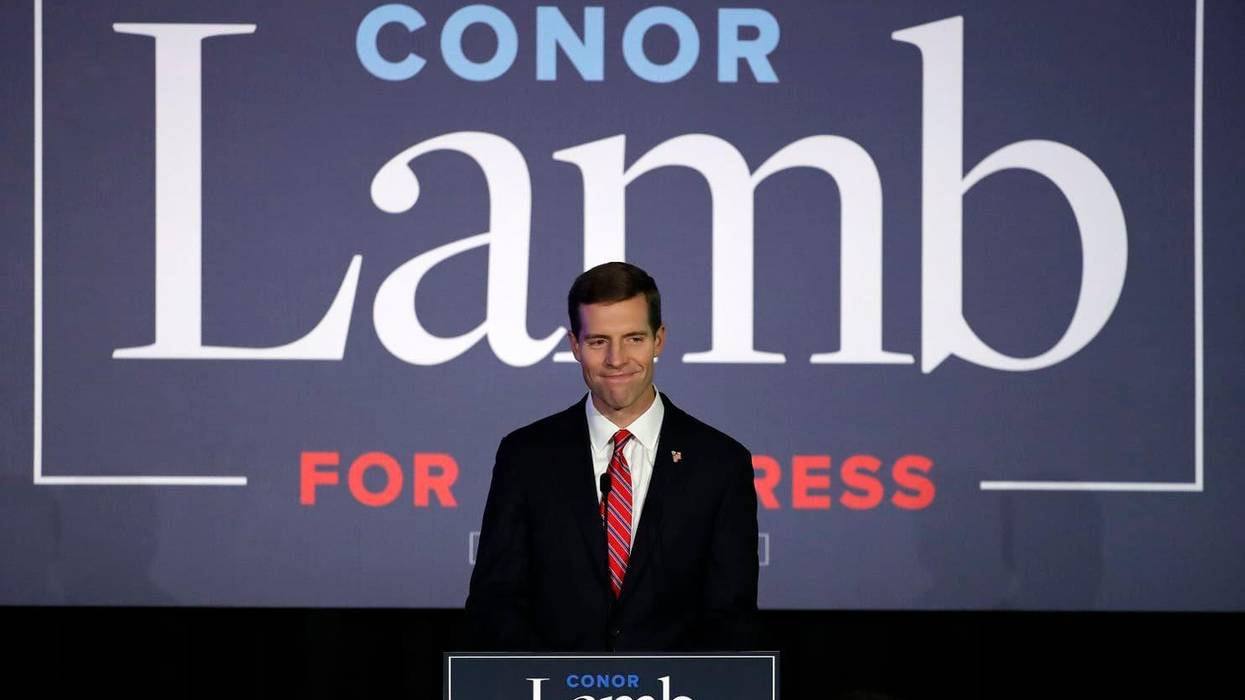
This year, Rep. Conor Lamb (D-Pa.) was perceived as a "moderate" when he won a special election in a nearly 20-point Trump district. But his TV ads focused on protecting Social Security and Medicare from cuts, rejecting corporate PAC money and fighting for workers. In September, he led 150 congressional Democrats in launching the Expand Social Security Caucus -- serving as co-chair with Warren and others.
Even Third Way did an about-face -- recently calling for the government to supplement Social Security with private savings accounts. (Of course, this proposal helps Wall Street, but this nonetheless cedes the shift from cuts to expanded benefits.)
The trajectory is clear, and corporate Democrats are in denial, arguing in a Post op-ed that progressive populism was "close to shut out" in last week's midterms and that "mainstream Democrats" won. They are right about one thing, though: Mainstream Democrats did win in 2018.
Candidates who promised to stand up for working people, challenge powerful interests and shake up a rigged political and economic system won up and down the ballot -- including more than 300 candidates supported by the Progressive Change Campaign Committee. Bold, progressive, economic-populist ideas are the mainstream. They won. And they are key to defeating President Trump in 2020.

Jeff Sessions is out as attorney general, replaced by a bootlicking Trump stooge named Matt Whitaker. Given that President Trump openly said on national television in 2017 that he fired then-FBI Director James Comey to try to stop the Russia investigation, it's a safe bet that acting Attorney General Matt Whitaker -- like Robert Bork before him -- will be the cat's paw Trump will use to halt or impede Special Counsel Robert Mueller's Russia probe.
This would be obstruction of justice.
Let's examine Whitaker's career up to now. Before serving as Sessions' chief of staff, he was a U.S. attorney in Iowa from 2004 to 2009. He mounted a campaign for Democrat Tom Harkin's Senate seat, and lost to Republican Joni Ernst. Afterwards, he joined the board of a company called World Patent Marketing. What did this company do? The Washington Post reports:
The company was shut down earlier this year amid an FTC probe that accused it of being a sham group that cheated inventors by falsely promising them help with marketing their ideas in exchange for exorbitant fees. "For the last three years, Defendants have operated an invention-promotion scam that has bilked thousands of consumers out of millions of dollars," the agency alleged in a recently unsealed court filing. "In truth and in fact, Defendants fail to fulfill almost every promise they make to consumers."
Before going to the Trump administration, Whitaker had a cushy job at a conservative nonprofit funded by dark money. In 2017, he published an op-ed on CNN's website arguing that the Mueller probe "is going too far," because it was looking into Trump's personal finances. (Heaven forfend!) He also tweeted an article calling this probe a "lynch mob."
Finally, he is good friends with Sam Clovis, a witness in the Mueller investigation due to his communication with George Papadopoulos (who pleaded guilty to lying to the FBI). In an ethical government, that alone would probably make Whitaker recuse himself as Sessions did. But more fundamentally, any Trump selection for attorney general, acting or otherwise, should recuse himself because Trump is the subject of the investigation. The conflict of interest is inherent and inescapable.
In U.S. law, obstruction of justice includes "endeavors to influence, obstruct, or impede the due administration of justice." In more plain language: "A person obstructs justice when they have a specific intent to obstruct or interfere with a judicial proceeding." For a concrete example, John Mitchell, H.R. Haldeman, and John Erlichman were convicted of obstruction of justice for (among other things) paying bribes to the Watergate burglars in an attempt to keep them quiet.
Whitaker's argument that Mueller doesn't have authority to investigate Trump's opaque personal finances is ridiculous. Whether you think he should or not, it is indisputable that Mueller does have wide powers: He has been tasked with investigating "any links and/or coordination between the Russian government and any individuals associated with the campaign of President Donald Trump," and "any matters that arose or may arise directly from the investigation," and then prosecuting any federal crimes he deems "necessary and appropriate." (Incidentally, it seems pretty clear the probe could go for a decade straight and not run out of people to prosecute.)
President Trump has already almost certainly committed obstruction of justice by firing Comey (he admitted he did it to stop the investigation on TV!) but directly shutting down or meddling with the investigation itself could not possibly be anything but obstruction. It would be the subject of a criminal investigation using his political authority to slow or stop that investigation. That is obstruction of justice.
Though they will surely try, not even the Trump hacks at The Federalist could come up with a definition of impeding or obstructing "the administration of justice" that doesn't include that. House Democrats, and the nation as a whole, better be ready to face up to this reality.

President Bill Clinton's greatest regret was his failure to respond to the Rwandan genocide. He estimated that U.S. intervention could have saved 300,000 lives.
The Vietnam War was former Secretary of Defense Robert McNamara's biggest regret. He wrote an entire book to explain why he was "terribly wrong."
Former Senate Minority Leader Harry Reid, Sen. Tom Harkin, and Sen. Walter Jones have all said that they deeply regret authorizing the war in Iraq. Jones once lamented, "I helped kill 4,000 Americans, and I will go to my grave regretting that."
In each case, government leaders regretted their complicity in hundreds of thousands of deaths. In each case, they had chosen to prioritize politics above ethics. Today's political leaders are about to make the same mistake.
We are now on the verge of another unnecessary war -- this time with North Korea -- and it is likely to wreak more havoc than Vietnam, Iraq and Rwanda combined.
Top nuclear security expert Scott Sagan warns that the risk of war is far higher than during the Cuban Missile Crisis, and predicts that one million people could die on the first day - a figure that exceeds the death toll of the entire Rwandan genocide. Even more worryingly, Russia and China are making military preparations, suggesting that a Korean war could quickly escalate into a world war.
Despite this horrific scenario, President Trump continues to ratchet up tensions by issuing bombastic threats and overseeing provocative military exercises. He is increasingly keen to launch a "preventative" strike, and there are multiple indications that he plans to do so within the next three months unless North Korea agrees to denuclearize. At the same time, he is forbidding diplomacy, blocking any possibility of a peaceful solution to the crisis.
Put simply, war could be inevitable if Trump remains in power. Government leaders therefore have an ethical obligation to remove him from office before he fulfills his dream of using nuclear weapons.
Impeachment, however, is no longer a viable solution- the impeachment process takes several months, whereas Trump is reportedly looking to drop the first bomb by March.
Congress or Trump's Cabinet will therefore need to invoke the 25th Amendment, which would immediately suspend Trump's presidential authority on the grounds that he is "unable to discharge the powers and duties of his office." While the amendment can be invoked on political grounds alone, Trump's behavior suggests he has a cognitive inability to do his job: Neurologists warn that Trump is displaying symptoms of dementia, while prominent psychiatrists have argued that Trump's particular brand of mental instability poses a grave risk to national security.
There are, however, measures short of dethroning Trump that would be helpful. Congress could pass legislation such as the Preventing Preemptive War in North Korea Act, the Restricting First Use of Nuclear Weapons Act or the No First Use Bill. All three bills would constrain the President -- be it Trump or any of his successors -- from unilaterally launching a pre-emptive nuclear strike. Congress has yet to prioritize any of these bills, and they have all remained at a standstill since they were introduced.
Finally, government officials should follow the leads of lawmakers like Sen. Chris Murphy and Rep. Ted Lieu and speak out frequently and loudly to mobilize public opposition to a potential war.
Political leaders who muster the courage to act may be taking a political risk, but they will save themselves from the prospect of spending the rest of their lives wondering if they could have prevented a historic tragedy.
Recently released Census data reveal that, in 2015, the poverty rate dropped significantly for most demographic groups. One of the only groups who didn't see an improvement were people with disabilities: the percentage of disabled Americans (age 18-64) living in poverty increased from 25.9% to 26.5%. For Americans without disabilities, the poverty rate decreased from 14.1% to 12.8%.
Recently released Census data reveal that, in 2015, the poverty rate dropped significantly for most demographic groups. One of the only groups who didn't see an improvement were people with disabilities: the percentage of disabled Americans (age 18-64) living in poverty increased from 25.9% to 26.5%. For Americans without disabilities, the poverty rate decreased from 14.1% to 12.8%.
The data suggest the challenge disabled people face in trying to escape poverty. But there is hope that an emerging bipartisan consensus on disability employment may mark an important step in the right direction.
Currently, under the Fair Labor Standards Act, a certified "sheltered workshop" can pay disabled Americans less than the minimum wage--sometimes as little as pennies per hour. As a result, approximately 400,000 disabled Americans are paid a subminimum wage, which makes it more difficult for them to work their way out of poverty.
"It's a relic from a time when our politicians embraced other draconian ideas like eugenics."
For decades, activists were unable to get even top labor Democrats like former Senator Tom Harkin--a key sponsor of the Americans with Disabilities Act--to challenge this labor law. Harkin, like many Democrats, argued that it was a key policy that helped people with disabilities get needed training for better jobs. However, studies showthat rather than finding higher-quality jobs, the overwhelming majority of these disabled workers spend their careers continuing to earn the subminimum wage.
Ari Ne'eman, who was appointed by President Obama to the National Council on Disability, says the subminimum wage is an outdated idea. "It's a relic from a time when our politicians embraced other draconian ideas like eugenics," says Ne'eman. "This is 1930's thinking."
Fortunately, a movement to extend the minimum wage to disabled workers has now spread to four states and has reached the federal level as well.
In 2003, Vermont was the first state to eliminate the subminimum wage for persons with disabilities. Instead of paying nonprofits to employ these workers at a subminimum wage, the state invested those funds in wraparound services to help employers accommodate workers with disabilities. Rather than reducing the number of jobs for disabled workers, as critics of the policy had predicted, the employment rate for disabled workers rose--it is now double the national rate. In the last five years New Hampshire, Oregon, and Maryland have followed Vermont's lead.
At the federal level, President Obama raised the minimum wage for tens of thousands of disabled federal contractors working in "concessions and concession industries;" and Labor Secretary Tom Perez has said that he wants all states to eliminate the usage of the subminimum wage to employ persons with disabilities.
Now there is also bipartisan support in both the House and the Senate for the TIME Act, which would ban the subminimum wage and provide funding to help transition disabled workers into mainstream employment.
Republican Congressman Gregg Harper, whose son has Fragile X syndrome, is a cosponsor of the legislation. Congressman Jim Langevin (D-RI), who is paralyzed, and House Republican Conference Chairwoman Cathy McMorris-Rodgers (R-WA), whose son has Down syndrome, are also supporting the push to pass the bill.
"For many of these people, it's because they have family members with disabilities," says Allison Wohl, Executive Director of the Association of People Supporting Employment First. But she says education also plays a role. "It's universal--the reaction you get when you tell a hill staffer about the subminimum wage. Their face drops and it's clear they don't know what to say."
Ne'eman hopes that the space created on both sides of the aisle to tackle low wages among disabled workers will lead to more creative thinking about how to raise wages for all workers.
"We call it the curb effect," he says. "Just like the [ramp at the] curb also makes it easier for [pedestrians with] a piece of luggage or a stroller. It ends up helping everyone."
So far it's unclear if the legislation is going to move in this Congress, but advocates remain hopeful. These days, even the possibility of Republicans and Democrats coming together to support pro-worker legislation is a rare thing. And many in the disability and labor communities hold out hope that passing this bill will be the first of more victories that lie ahead.
"Do I think Bernie Sanders should talk about democratic socialism? Yes, I do," says Iowan Mary Clark. "I want him to explain everything in detail--give people a really good explanation. People who like Bernie are probably going to like him a little more if he does that. And people who aren't supporting Bernie now might just say, 'It sounds like he's got some ideas that would actually solve our problems.'"
Clark isn't a pundit or a pollster; nor does she sell herself as an expert on economics or presidential politics. She's a rural Iowan who worries a lot about whether her neighbors will have clean water, decent housing, and fair pay. She's worked a few minimum-wage jobs herself, and she knows a lot of folks who are struggling to get by along the rural routes that pass through her corner of Iowa's Polk County. She talks to them about politics, and she always talks up Sanders. People like what they hear, she says. "But then they hear these guys on television saying, 'Bernie Sanders can't get elected because he's a democratic socialist.' So Bernie has to talk about it. But he doesn't have to apologize for anything. He should say, 'You're wrong--I can get elected as a democratic socialist, and here's why.'"
As he prepared to deliver one of the most important speeches of his presidential campaign, the independent senator from Vermont got a lot of advice on how to explain the democratic-socialist ideal that he's embraced for more than five decades--an ideology that Donald Trump equates with Soviet-style communism and Rand Paul promises will "exterminate" those who do not follow the party line.
Sanders, who has said that he would like to debate Republicans and Democrats as part of his boundary-breaking presidential run, might yet find that the best way to demythologize the notion of democratic socialism would be in a spirited debate with a member of the billionaire class like Trump. In the meantime, he finds himself leading a discussion that American politics and the American media haven't really entertained since the days of Norman Thomas, the Socialist Party candidate who appeared on the cover of Time magazine and was featured on a daily basis in The New York Times's coverage of the 1932 presidential race.
Talking about democratic socialism is nothing new for Sanders. In fact, what distinguishes his candidacy from that of any nationally noted contender since Thomas is that he not only accepts the label but willingly engages in extended discussions of the concepts, values, and models associated with it. "I'm not afraid of the word," he told The Nation earlier this year, adding that "Mitch McConnell, the Republican leader of the Senate, often criticizes President Obama--incorrectly--for trying to push 'European-style socialism,' and McConnell says the American people don't want it. First of all, of course, Obama is not trying to push European-style socialism. Second of all, I happen to believe that, if the American people understood the significant accomplishments that have taken place under social-democratic governments, democratic-socialist governments, labor governments throughout Europe, they would be shocked [by] those accomplishments. One of the goals of this campaign is to advance that understanding."
Actually, that's been one of the goals of Sanders's entire career. With remarkable consistency over the decades, he has patiently distinguished between democratic socialism and Soviet-style communism, expressed "continued opposition to authoritarianism and the concept of the one-party state," defended civil liberties, and explained, as he did after his election to Congress in 1990: "To me, socialism doesn't mean state ownership of everything, by any means; it means creating a nation, and a world, in which all human beings have a decent standard of living." Like many American democratic socialists in the post-World War II era, he has talked up the Scandinavian model of social democracy. "Healthcare is, of course, a right for all people" in countries like Norway and Denmark, which have "very strong" childcare and retirement systems, he notes. In addition, "all of their kids can go to college; not only do they go for free, they actually get stipends." And "they are very active in trying to protect their environment." Although taxes in these countries are high, the public services are robust and the social-safety net is sturdy.
"And, by the way," Sanders adds, "the voter turnout in those countries is much higher; in Denmark, in the last election, it was over 80 percent. Political consciousness is much higher than it is in the United States. It's a more vibrant democracy in many respects. So why would I not defend that?"
An October YouGov poll shows Democrats favoring socialism over capitalism by 12 percentage points.
Many social scientists and economists agree. Political economist Francis Fukuyama uses "getting to Denmark" as a metaphor for democratic development that's headed in the right direction. Yet, as CNN's Anderson Cooper noted in this year's first Democratic debate, a small Northern European country might not be the best metaphor for America. Cooper, though he may not have known it, was engaging in the latest political craze: explaining to Bernie Sanders the best way to promote democratic socialism to American voters. After so many years of neglect and misstatement, there's a lot of pent-up energy among democratic socialists as well as small-D democrats who want to open up the political discourse to include serious alternatives to the crony-capitalist status quo. Sanders himself fits into both camps--and he is smart enough to recognize that if his presidential candidacy doesn't frame that debate, the debate will frame his candidacy, probably to his detriment. Indeed, as Cooper argued during the debate, when democratic socialism is the topic, "the question is really about electability."
So why not turn from the usual circle of pundits to the people who actually do the electing? The best advice for what should become a continuing discussion long after this presidential season is over comes from the grassroots, from places like Davenport and Des Moines, where citizens will, in just three months, begin the process of choosing the Democratic nominee. Iowa caucus-goers treat presidential politics seriously--and practically. They tend toward progressivism, with a healthy Midwestern skepticism about big corporations, big money in politics, and a military-industrial complex that keeps talking up the next war. But, says Ed Fallon, a former Democratic state legislator and gubernatorial-primary candidate, "they like to think that their candidate can win in November."
Iowa has for decades been a swing state in presidential contests, and Iowa Democrats have long practiced what Michael Harrington preached: searching for the left wing of the possible. Harrington, author of the 1962 classic The Other America, counseled the Kennedys and aides to Lyndon Johnson on how to wage a "war on poverty." In the early 1980s, Harrington co-founded the group Democratic Socialists of America with an eye toward building an American version of social democracy along the lines practiced in Denmark, Norway, and other European countries. Harrington argued for situating the movement within the Democratic Party, because it tended to align itself with organized labor, attract working-class voters, and appeal to the young Americans and people of color who might be most open to an alternative politics.
However, the late 1980s and '90s saw the emergence of a dramatically more cautious Democratic Party, with the "left wing of the possible" dumbed down by "New Democrats" like Bill Clinton, who veered away from the Democrats' traditional allies in labor and other social movements and toward new allies on Wall Street and in Silicon Valley. Where Franklin Roosevelt welcomed the hatred of bankers and CEOs, and met at the White House with "my good friend Norman Thomas" and other Socialist Party leaders, Clinton as president undid New Deal-era regulations on big banks, and President Obama once called a New York Times reporter to point out not only that he was not a socialist, but that his administration was "operating in a way that has been entirely consistent with free-market principles, and some of the same folks who are throwing the word 'socialist' around can't say the same."
Yet even as the Democratic Party tended to grow more cautious, a substantial portion of the party's base continued to embrace Harrington's left wing of the possible. In the upper Midwest, activists warmly embraced Minnesota Senator Paul Wellstone, who talked up the uniquely radical legacy of the Minnesota Democratic-Farmer-Labor party, and Iowa Senator Tom Harkin's pro-labor, pro-farmer prairie populism. Wellstone and Harkin didn't identify as democratic socialists, but they kept alive an old-school progressive-populist sensibility. More recently, Sanders, their friend and frequent ally, has returned that sensibility to center stage with bolder language and bolder plans for ending austerity, taxing the rich, and tipping the balance in favor of working Americans.
Grassroots Democrats got to know Sanders as a frequent guest on MSNBC cable shows, on Thom Hartmann's radio show, and as a tireless traveler to progressive gatherings across the country. It never seemed to bother the base that he was a democratic socialist, because democratic socialism never seemed to bother the base. Long before Sanders considered making a presidential bid, a 2012 Gallup survey found that while 55 percent of Democrats had a favorable view of capitalism, a nearly equal amount--53 percent--had a favorable view of socialism. An October 2015 YouGov poll shows a growing divide, with Democrats favoring socialism over capitalism by 12 percentage points. Among young people and people of color, socialism polls significantly better than among the general population. But polls also find that only half of Americans say they would vote for a socialist for president (59 percent of Democrats, 49 percent of independents, 26 percent of Republicans). That raises the electability issue, and it's one reason Sanders started talking about delivering a "major speech" on socialism--something he probably should have done much earlier in the campaign. "I think we have some explaining and work to do," the senator told an audience at an Iowa house party, acknowledging that the word "socialist" makes some people "very, very nervous."
It doesn't have that effect on George Naylor, a farmer-activist from Churdan, Iowa: "Oh, I never thought it was as much of a problem as people say." An outspoken advocate for family farmers, he adds that "the way to talk about socialism is to remind people of what they don't like about most politicians: They're too close to big business. Well, democratic socialists aren't close to big business. They want to make sure big business doesn't run over the rest of us. Talk about it that way, and even some folks who think they're conservatives might say, 'That makes sense.'"
"There's nothing scary about what Bernie is saying. He's fighting for what people believe in, what they want."
That's a good place to start tapping into the populist sentiment that has always gotten Americans thinking about economic and political alternatives. That mood rises when capitalism is in crisis--or when many Americans feel, as they do now, that existing systems are failing them. The whole point of the "political revolution" that Sanders argues for is to get millions of Americans to respond to those failures by engaging politically. If that happens, it won't be the first time that economic turbulence has inspired interest in social-democratic solutions.
It was during the economic downturn culminating in the Panic of 1797 that Thomas Paine wrote Agrarian Justice, in which he outlined a social-welfare state with estate taxes used to fund universal old-age and disability pensions and a onetime payment to citizens to help lift them out of poverty. A century later, the Panic of 1893 brought a new generation of radicals to the fore, including Eugene Debs. The American Railway Union leader would eventually head a Socialist Party presidential ticket that twice gained nearly a million votes and elected members of the US House, as well as big-city mayors and substantial legislative caucuses in states like Wisconsin and Oklahoma.
* * *
Historian Eric Foner urges Sanders to "embrace our own American radical tradition" rather than "inadvertently [reinforce] the idea that socialism is a foreign import." Historian Harvey Kaye goes a step further, encouraging Sanders to say that "social democracy is 100 percent American" and to explain that this country has a rich history of leading rather than following Europe when it comes to guaranteeing universal access to public education and setting aside land for public parks. They're right. But Sanders has to focus on more than just the academic argument, which he could easily win; he has to focus on the electability question. As such, he must make the point that American socialists have advanced their agenda in the past by winning elections--lots of them. For more than a century, socialists, social democrats, and allied radicals have been winning elections all across America--from New York to Los Angeles, from Oklahoma to Minnesota. They have run big cities and school boards, they have written laws, and they have provided the impetus for the creation of state banks, worker-compensation programs, public-health programs, and now-cherished institutions like Social Security, Medicare, and Medicaid.
Debs's successor as the Socialist Party's presidential candidate was Norman Thomas, counselor to presidents and inspiration to the leaders of unions like the United Auto Workers and the American Federation of State, County and Municipal Employees. Thomas addressed the 1963 March on Washington at the behest of the man who called the march, Socialist Party stalwart and Brotherhood of Sleeping Car Porters union leader A. Philip Randolph. Thomas later allied with Randolph and the Rev. Martin Luther King Jr. as they worked on the unfinished business of the civil-rights revolution by promoting a "Freedom Budget for All Americans," which advocated social-welfare programs similar to those Sanders now hails in Denmark and Norway.
Sanders must make the argument that the political revolution he's calling for will occur only if his candidacy goes beyond a protest vote or educational endeavor and becomes an actual movement, similar to the Robert F. Kennedy coalition of the 1968 primaries, which aligned working-class white, Latino, and African-American voters with liberals and students. Sanders would do well to take the advice of Joe Fagan, a founder of Iowa Citizens for Community Improvement (CCI). Discussing the left wing of the possible, Fagan points out that "there are a lot of good examples from around the world. But there are some pretty good examples right here: schools, libraries, roads.... "There's nothing scary about what Bernie is saying," Fagan adds. "He's fighting for what people believe in, what they want. That's how he should talk about it. Free college education--who doesn't want that? Break up the banks--who isn't for that? Addressing inequality--who is opposed to that?"
Lou Ann Burkle, a CCI activist, argues that Sanders has a unique opportunity to open up the debate across the country. "You can change the conversation by putting things in perspective," she says. Tim Tutt, an elementary school teacher from Des Moines, suggests that Sanders "shouldn't just explain democratic socialism,--he should explain capitalism." An experienced Iowa caucus-goer, Tutt says that a lot of Iowans, like a lot of Americans, know that with bank bailouts, corporate abuses, and the widening gap between rich and poor, "what we've got now isn't working." Just as Roosevelt tempered the excesses of capitalism with a New Deal during the Great Depression, Tutt says, Sanders should lay out why he thinks democratic socialism can temper the excesses of contemporary capitalism.
"It's not something you do in a sound bite," warns Sharon Guber, a retired teacher from Ames. But, says Fallon, the former legislator, "if you're being called a democratic socialist by people who think that's a bad thing, then the only way to deal with that is to talk about why you think it's a good thing."
"Sure, it's a big conversation," says Naylor, the farm activist. "So what? If you're running for president, you ought to be able to get a big conversation going. That's what people want you to be able to do." He smiles and points to a Sanders for President sign, with an outline of Iowa and the words "The Revolution Starts Here."
The shocking video of an African American high school girl being violently grabbed and slammed to the ground has been seen and shared millions of times over the past few days. Most are sickened by what we see. This incident is sparking a much needed discussion over the use of police to respond to disciplinary issues within a school. Police tend to use force, and students they deal with become criminalized, setting patterns that continue into adulthood.
Unarmed school safety officers can be far more effective, as I saw in my 18 years in the classroom in Oakland. At our middle school of about a thousand students, we had a small team of safety officers, led for many years by Mr. Obee. Mr. Obee was respectful of students, and had a calm and steady presence in the halls. I never saw him or other safety officers initiate the use of force at our school.
There is a related issue that has smoldered under the surface for decades. While all fifty states have laws against intentional cruelty to animals, in 19 states it is legal to paddle students for misbehavior. Recent attention has been drawn to the fact that African American and disabled students are more likely to be suspended or expelled - and this pattern is seen in the use of corporal punishment as well. This report from Sarah Carr shows that African American students are physically punished at higher rates. Disabled students are likewise more likely to be beaten or restrained, and this can cause lasting harm.
The US Supreme Court, in a 1977 decision called Ingraham V Wright, upheld the constitutionality of corporal punishment for school children. This decision was used as the basis to dismiss a 2014 lawsuit brought by a Mississippi student who fainted and fell while being paddled, suffering a broken jaw.
A Tennessee parent, George Worley, has been speaking out on this issue. He wrote to me:
I've been trying to be a voice for children's rights almost daily for 7 1/2 years! I can't focus on much else because I care about kids. Handcuffed kids is just the tip of the iceberg! The National Disability Rights Network published a report in 2009, "School is Not Supposed to Hurt" telling of horrific incidents of children restrained - even smothered to death at school.
My 3 children attended schools in an unresponsive paddling district (Houston Co. Schools) Erin, TN and overheard classmates being paddled in hall just outside class then immediately faced humiliation as they returned to their seat. Our grandson will start kindergarten in a couple of years and we don't want him hit or traumatized by school employees. We have asked our local school board to prohibit corporal punishment three times since 2008 and they ignore us because state law allows corporal punishment without parental consent. Most school districts around us banned corporal punishment decades ago and it is prohibited in Nashville Metro Public Schools.
This documentary, The Board of Education, reveals the disturbing facts around this officially sanctioned abuse.
The entire 32 minute film can be viewed here:
Action on this issue in Congress has been thwarted in the past by politicians like John Kline, who view this as federal overreach, and believe states ought to be allowed to set policy in this area. According to this report by ProPublica, two organizations, the American Association of School Administrators and the National School Boards Association both opposed legislation to halt corporal punishment introduced by Tom Harkin back in 2012.
In his 1995 book, "Profiles in Character," Jeb Bush suggested that if more children were paddled in school there would be fewer school shootings. Florida, where Bush was governor, is one of the 19 states that allows paddling.
While many schools ask parents to sign forms giving them permission to paddle their children, this is sometimes ignored, and children are paddled anyway, as in this Florida case. The parent in this case was left with no recourse as Florida law protects principals and teachers from lawsuits over such abuse.
This map, created by ProPublica, shows the policies in place in states around the nation.
This month Congresswoman Judy Chu introduced the Children's Bill of Rights which features 22 principles meant to protect children. Chu said,
The Children's Bill of Rights solidifies our commitment to all of the children in our nation. It gives a comprehensive framework that ensures children are free of abuse and neglect, have quality education and a healthy environment.
Congressman Alcee Hastings of Florida introduced a bill last May called HR 2268, Ending Corporal Punishment in Schools Act of 2015. The bill would remove federal education funds from states that continue to allow corporal punishment. If you support such legislation, please contact your representative here. and encourage organizations such as the National School Boards Association and the American Association of School Administrators to support it as well.
While the Spring Valley High school incident has rightly focused attention on the use of police on school campuses, we should also take this opportunity to address other forms of violence routinely inflicted on children.
What do you think? Is it time to get rid of corporal punishment?
As she struggled to keep her 2008 campaign for the Democratic presidential nomination alive, Hillary Clinton took a turn toward economic populism. It helped; after a series of setbacks in early caucus and primary states, Clinton's abandonment of frontrunner caution and embrace of "I'm in this race to fight for you" rhetoric played a significant role in securing her big wins in states such as Ohio and Pennsylvania.
As she struggled to keep her 2008 campaign for the Democratic presidential nomination alive, Hillary Clinton took a turn toward economic populism. It helped; after a series of setbacks in early caucus and primary states, Clinton's abandonment of frontrunner caution and embrace of "I'm in this race to fight for you" rhetoric played a significant role in securing her big wins in states such as Ohio and Pennsylvania. Ultimately, she gained more votes than Barack Obama and came close to wrestling the nomination from him. If Clinton had run from the start as a populist, there is no telling what might have happened. But the important thing to remember is that Clinton did not turn up the volume until she felt she had no other choice--and by then it was too late.
Now, as she launches a new bid for her party's nomination, Clinton is starting with populist talk. In a slick announcement video released Sunday she gripes that "the deck is still stacked in favor of those at the top."
"Everyday Americans need a champion, and I want to be that champion," says the former First Lady, US Senator and Secretary of State, on the various platforms employed for the carefully coordinated social media launch of her long-anticipated candidacy.
This is conscious positioning by Clinton. She sounds the same themes in more detail in a freshly-released epilogue to her book, Hard Choices. Reflecting on the birth of her granddaughter, she writes, "I'm more convinced than ever that our future in the 21st century depends on our ability to ensure that a child born in the hills of Appalachia or the Mississippi Delta or the Rio Grande Valley grows up with the same shot at success that Charlotte will."
"Unfortunately," adds Clinton, "too few of the children born in the United States and around the world today will grow up with the same opportunities as Charlotte. You shouldn't have to be the granddaughter of a President or a Secretary of State to receive excellent health care, education, enrichment, and all the support and advantages that will one day lead to a good job and a successful life."
That's a fine line, and there is no point in questioning Clinton's sincerity. Undoubtedly, she would prefer that everyday Americans enjoy successful lives. But there is every reason to ask whether the candidate--whose $2.5 billion campaign will rely heavily on money from folks who are on the winning side of the income-inequality gap--shares the specific vision of grassroots Democrats about how best to achieve the goal. On too many issues, Clinton's record is that of "corporate Democrat," says Iowa Citizens for Community Improvement executive director Hugh Espey. In the first caucus and primary states, there are plenty of progressives who agree with New Hampshire state Representative Marcia Moody when she describes Clinton as "fundamentally a person for Wall Street and not the people."
This is why there has been so much organizing on the ground in Iowa and New Hampshire for progressive-populist alternatives: Vermont Senator Bernie Sanders, who has been actively exploring a run against Clinton, and Massachusetts Senator Elizabeth Warren, who says she is not running. And this is why the organizing must continue on behalf of alternative candidacies and a competitive race for the Democratic nomination. Clinton is way ahead in the polls, but it would be political malpractice for progressives to be satisfied with a few good turns of phrase at this point. The frontrunner must be pressed to make real commitments on real issues.
Clinton's decision to open her second presidential campaign on a populist note is a reflection of her savvy recognition that plenty of Democrats have doubts about her past support for free trade deals and her closeness to financial elites that are far more committed to their own self-interest than to the public interest. But the times demand more than just a populist note. They demand progressive populist specifics.
This is not 2008, when the economy was turning bad. This is 2015, and tens of millions of Americans have experienced a rough seven-year period of unemployment, wage stagnation, uneven recovery and growing inequality. Through a portion of that period, the country had a Democratic president and a Democratic Congress; Obama, Pelosi and Reid delivered some relief, as well as mild healthcare reform and banking regulation. But the polls suggest that Americans are unsatisfied.
When Republicans took charge of the House in 2011, gridlock replaced whatever remained of hope and change. Yet, now, Republicans such as Jeb Bush pitch themselves as born-again champions of working Americans, griping about depressed wages and slow growth. That's cynical. But it will not be enough to simply call Bush and Scott Walker out on their cynicism, and it will not be enough to echo their vapid expressions of concern for the vast majority of Americans for whom the economy is not working.
The Democratic nominee in 2016 has to propose a specific populism that recognizes the failure of free-trade deals such as NAFTA and join Elizabeth Warren in rejecting proposals to "Fast Track" a Trans-Pacific Partnership agreement that critics warns will be "NAFTA on steroids." The Democratic nominee has to recognize that the Dodd-Frank reforms were insufficient and that Ohio Senator Sherrod Brown is right when he proposes to break up "too-big-to-fail" banks. The Democratic nominee must recognize the need to raise new revenues, as Congressman Keith Ellison has with his proposal for a "Robin Hood Tax" on financial speculation. The Democratic nominee must, as Congresswoman Barbara Lee does, recognize the need to steer money away from bloated Pentagon budgets and toward meeting human needs. The Democratic nominee must, as Bernie Sanders does, recognize the absolute necessity of massive federal investments in infrastructure and programs that create and sustain living-wage jobs.
Those are the basics--along with commitments to expand Social Security, address climate change and reduce the influence of corporate interests on our politics and governance. To achieve baseline credibility as a contender, not just for the nomination but for the presidency, Clinton must offer specifics on all of these issues. No one should presume she will do this on her own. This is why progressive groups such as National People's Action and the Campaign for America's Future are arguing that a detailed "populist agenda" is essential to victory. This is why the Progressive Change Campaign Committee has launched a "Ready for Boldness" campaign--playing off the "Ready for Hillary" message of Clinton's early supporters--with support from US Senators Harry Reid, Elizabeth Warren, Al Franken, Jeff Merkley, and Sheldon Whitehouse; former US Senators Tom Harkin and Ted Kaufman and hundreds of activists in Iowa and New Hampshire. PCCC co-founder Adam Green is certainly right when he says that, "It's a great general election strategy to embrace these economic populism issues that are wildly popular across the political spectrum."
Unfortunately, Democrats presidential frontrunners have frequently failed to recognize the logic of economic populism--and even more frequently spoken about economic issues in such tepid terms that the message was muted. Every evidence is that New Hampshire state Representative Renny Cushing is right when he says "there's only one way" to get Clinton or any other frontrunner to get specific. "If you're in the electoral arena, you really need a candidate," explains Cushing, who has been working to draft Warren into the competition. "You can't do it without a candidate."
Clinton is running another race for the presidency, and this time she is starting with the populist themes she used at the end of her last race. That's progress--for her, for her party and maybe for her country. But that's not enough progress. Clinton needs to be pinned down on the details and prodded to go big.
Activist pressure is essential, and it may move Clinton some. But a real race for the nomination, as opposed to a coronation, is the best guarantee that the party will produce a sufficiently populist nominee to strike the chords that will inspire voters. If Clinton is not up to the task, then Democrats had better find an alternative. If Clinton recognizes that she must not merely note the crisis but address it--recognizing the concerns about her record and answering them with an economic agenda that makes real the populist promise--then she will have the right message for a nomination fight and for a November fight that will require a lot more than platitudes.
The college completion gap between rich and poor students has doubled over the past four decades, according to a new report published Tuesday.
Only 9 percent of students from the lowest-income families currently earn bachelor's degrees by age 24, in contrast to the 77 percent of students from the wealthiest families. While the number of wealthy students obtaining bachelor's degrees has nearly doubled since 1970, when it stood at 44 percent, it has inched only three percentage points for low-income students--up from 6 percent--in forty years, according to the report, Indicators of Higher Education Equity in the United States (pdf).
Moreover, the study found that the enrollment gap between rich and poor students has narrowed across the board--indicating that more low-income students are entering college, but far fewer are able to finish.
College costs, meanwhile, have skyrocketed. A 2012 report by Bloomberg found that tuition and fees have increased 1,120 percent since 1978. "For millions of young people, rising college costs are putting the American dream on hold, or out of reach," Sen. Tom Harkin (D-Iowa) told Bloomberg at the time. And federal aid like the Pell grant, which covered 67 percent of college costs in 1975, only covered 27 percent in 2012.
"We sometimes think that low-income students are taken care of because of the federal program. But you can see it covers so much less than when it was first established," Margaret Cahalan, director of the Pell Institute for the Study of Opportunity in Higher Education, which co-published the report, told the Associated Press on Tuesday.
As Anne Johnson, director of youth-focused think tank Generation Progress, points out:
Student debt has a greater impact on low-income borrowers than other Americans. In fact, borrowers in the least affluent one-fifth of American households faced education debt that averaged 24 percent of their income in 2010. The average for all households was 6 percent. ...
When starting out, students from low- and middle-income households already face a higher burden. They are less likely to have family assistance and more likely to have other pressures, such as a part-time job or family caretaking role in addition to classes. And many low-income students avoid applying to college altogether, citing the cost. This has resulted in a shrinking economic diversity at schools.
According to the report, the share of costs covered by state and local governments has steadily declined, and an increasing number of students from all income family groups are forced to borrow larger and larger amounts to compensate for those expenses.
"It's really quite amazing how big the differences have become between those from the highest and lowest family incomes," Laura Perna, a University of Pennsylvania professor and executive director of the Alliance for Higher Education and Democracy, which co-published the report, told the AP on Tuesday.
In January, President Barack Obama introduced a proposal that would make two years of community college free to students who maintained a certain grade point average, a proposal which is projected to benefit nine million people in all 50 states. But as AP notes, the price tag to such a plan--$60 billion over 10 years--is unlikely to be welcomed by a Republican-controlled Congress. Critics of the plan also argued that aiding students in entering community colleges will not actually help close the completion gap.
According to the report, a number of factors contribute to the growing divide in scholastic achievement, such as inequity in affordability; inadequate academic preparedness through high school; and a lack of access to the information and support necessary to enter and complete college.
Michael Kramer, a 29-year-old student at the University of California, Los Angeles, told the AP that the prohibitively high costs of tuition and fees kept him from entering college directly after graduating high school.
"We're a country that says everybody should be getting higher education, and nowadays, to get any decent job, you need a bachelor's degree," Kramer said.
Rodney Bridgett was killed when a piece of Tyson Foods' heavy equipment crushed him. Calvin Bryant was crippled in a Imperial Sugar plant explosion in Georgia that also killed 14 of his co-workers. When Alma Aranda tried to exercise her legal right to take unpaid time off to care for her dying mother, Verizon harassed her with so much paperwork that her hair fell out in clumps.
What do these three cases have in common? The federal government handed out tens of millions of dollars in contracts to these companies, without regard to how they treated their workers.
Last summer, to help put an end to these kinds of mistreatment, President Barack Obama signed the Fair Pay and Safe Workplaces Executive Order.
Here's why the executive order could help workers: Every year, the federal government awards a fortune in contracts for everything from defense systems to administrative services to companies that employ an estimated one in five American workers.
Government rules that require it to contract only with companies that have a "satisfactory record of performance, integrity, and business ethics." In practice, the contracting system does not effectively review companies' records for responsibility, nor does it ensure--before awarding contracts--that violators reform their practices.
As a result companies have continued to receive billions of dollars, despite long records of violating workplace laws. They may neglect legally required safety standards and maim a worker on the job, systematically engage in age or gender discrimination, refuse to pay overtime in violation of the law, or ignore the Americans with Disabilities Act and demote or fire disabled employees.
When these companies are caught, they may face financial penalties. Sometimes they are in the form of a fine from the Occupational Safety and Health Administration (OSHA), rarely in excess of a few hundred thousand dollars. Sometimes the payoff is a little steeper, such as when employees or state agencies file class action lawsuits and collect millions.
But the federal government did little to ensure that these companies clean up their acts before they collected tens of millions in contracts. A 2013 report from Sen. Tom Harkin (D-Iowa) found that the government awarded companies with the most egregious records of violating workplace wage and safety records $81 billion in 2012 alone.
In effect, the federal government has been subsidizing contractor misconduct with our tax dollars. As long as federal contractors have known that their lawbreaking would not jeopardize the next contract, they have had little financial incentive to stop mistreating their workers.
By signing the Fair Pay and Safe Workplaces Executive Order, President Obama signaled that it's time for this to stop. The order will ensure that federal contractors obey workplace laws before receiving government contracts.
Once implemented, the order:
* Will require federal contractors to disclose their record of compliance with workplace laws;
* Will ensure that law-breaking companies clean up their acts by empowering federal agencies to consult with the U.S. Department of Labor to investigate and remediate ongoing problems with contractors.
This report helps to put a face to the millions of workers the order is designed to protect. Through press accounts and personal interviews, CorpWatch documents the stories of Rodney Bridgett, Calvin Bryant, and Alma Aranda, explaining how their employers ignored basic workplace safety rules or undermined an employee's legal right to unpaid leave in the case of a medical emergency, yet still managed to secure tens of millions of dollars in federal money.
For far too long, federal contractors have been able to cheat or injure their employees, secure in the knowledge that their lawbreaking will not count against them when their contracts come up for renewal. Once implemented, the Fair Pay and Safe Workplaces Executive Order will take that security away from them.
The full report "Subsidizing Contractor Misconduct: Three Contractors Who Won Big Despite Egregious Labor Violations" can be downloaded here.