

SUBSCRIBE TO OUR FREE NEWSLETTER
Daily news & progressive opinion—funded by the people, not the corporations—delivered straight to your inbox.
5
#000000
#FFFFFF
To donate by check, phone, or other method, see our More Ways to Give page.
Daily news & progressive opinion—funded by the people, not the corporations—delivered straight to your inbox.
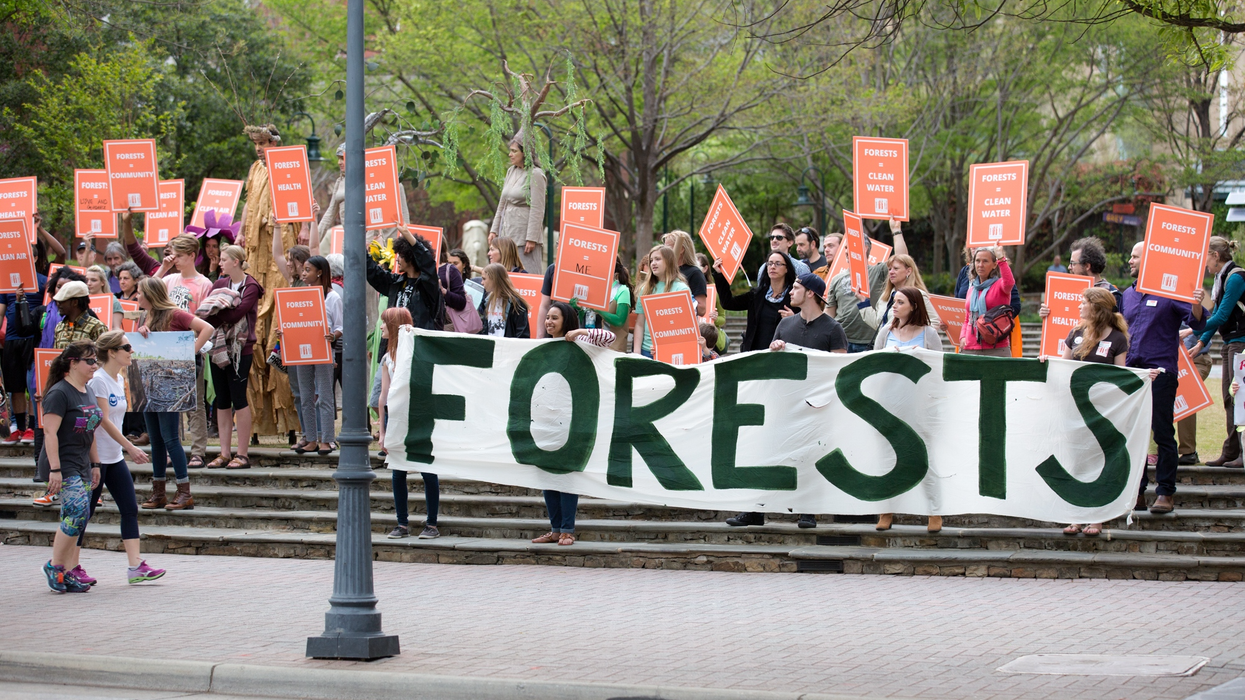
Working together, we can continue to advance a better, more sustainable vision for the South.
May is one of my favorite months to go walking through the forests near my home in Cedar Mountain, North Carolina. Up here, near the mountainous border between the Carolinas, the air smells sweet and clean this time of the year, filtered by the bounty of trees. I’ve gotten to know some of them like neighbors: the cucumber magnolias, maples, sourwoods, and, of course, dogwoods.
I am a lifelong lover of forests. I am also the executive director of the Dogwood Alliance, an environmental organization dedicated to preserving Southeastern forests. As such, I make sure to pay attention to the forests and the trees.
Lately, when I visit the forests, I see scars. I see the smoldering scars of the recent fires that sent my husband and me into a panicked evacuation. Or, I see the giant holes where trees used to be before Hurricane Helene, which devastated the area and kept me stranded in New York City for days unable to get in touch with my husband or my daughter. Ironically, I was at the annual gathering known as Climate Week as everyone learned that the Asheville area is not a climate haven. Nowhere really is. My neck of the woods is beautiful, but not invincible.
We’re not only fighting what’s bad but also working toward what’s good.
Still, when it comes to climate change, our forests are our best friends and biggest protectors. They can block the wind and absorb the water before it inundates communities. They’re also among the oldest and best tools in the toolbox when it comes to climate change because nothing—and I mean nothing—stores carbon like a good, old-fashioned tree.
And as destructive as the hurricane and the fires were, the biggest threat to our forests remains the logging industry. The rate of logging in our Southern U.S. forests is four times higher than that of the South American rainforests. Despite claims to the contrary, the logging industry is the biggest tree-killer in the nation.
The wood-pellet biomass industry is a major culprit. Over the last 10 years, our region has become the largest wood-pellet exporter in the entire world. Companies receive massive subsidies to chop our forests into wood pellets that are then shipped overseas to be burned for electricity. This process is a major waste of taxpayer dollars and produces more carbon emissions than coal.
And it seems that regardless of who is in charge at the state or federal level, they consistently fail to protect forests. Most recently, President Donald Trump signed executive orders that threaten to turbocharge logging and wood production while subverting cornerstone legal protections such as the Endangered Species Act and the National Environmental Policy Act. The truth is that policies that increase logging and wood production will only make communities like mine even more vulnerable to climate impacts, while decreasing the likelihood of recovery. The Trump administration's efforts to ramp up logging and close environmental justice offices are especially troublesome given the disproportionate impact that the forestry industry has on disadvantaged communities.
It can be an alarming picture to look at, especially when I think about the communities that will be harmed the most: low-income communities of color. But, I’m not new to this movement. I’ve seen again and again, those same communities rise up and fight off some of the biggest multinational corporations on the planet and hold our elected officials’ feet to the fire.
We’ve successfully clawed back subsidies for the biomass industry, slowing the growth of wood-pellet plants, and sounded the alarm when these facilities violated important pollution limits. They’ve had to pay millions of dollars in fines, shut down plants, and scrap plans for expansion. This is what gives me hope for the people and forests of the South.
We’re not only fighting what’s bad but also working toward what’s good.
Just last month, Dogwood Alliance’s community partners in Gloster, Mississippi scored a major victory. The community exerted huge pressure on the state’s Department of Environmental Quality to deny a permit to expand wood-pellet production for Drax—one of the most powerful multinational biomass corporations—and won! This means that the town’s residents will not have to face increased air pollution, noise pollution, traffic, and the greater mutilation of their bucolic landscape. If Gloster, a town of less than 1,000 people, can beat a megacorporation, I know we can stand up to the Trump administration and continue to advance a better, more sustainable vision for the South.
Through my work, I have the absolute privilege of partnering with some of the most inspiring leaders in the environmental justice movement. For example, we are partnering with Reverend Leo Woodberry, a pastor in South Carolina, to create a community forest on the land where his ancestors were once enslaved. With the support of community-focused donors, soon the Britton’s Neck Community Conservation Forest will be full of hiking trails, camp sites, and an ecolodge for locals and tourists from around the world to enjoy. This rise in outdoor recreation and (literal) foot traffic will create a badly needed economic rejuvenation for the local community, thus turning standing trees into gold. After all, outdoor recreation creates five times more jobs than the forestry industry.
This is not an isolated story. Four years ago this month, the Pee Dee Indian Tribe cut the ribbon on their educational center and 100-acre community forest in McColl, South Carolina as part of their effort to create a regenerative economy that prioritizes ecological harmony. All across the South, people are protecting the forests that protect them through a new community-led Justice Conservation initiative, which prioritizes forest protection in the communities on the front lines of our nation's most heavily logged areas.
The other day, when I went for my walk, I noticed that the scars are starting to give way to shoots of new growth. This is the time of year when the trees come alive, lighting the forest with purple and pink and white blossoms. That, to me, is hope. That, to me, is a miracle.
Right now, it feels like the whole world is on edge, bracing for the next major weather event. I know how helpless it can feel to watch the communities you love experience severe damage, I’ve lived it. But we are our own best hope. Just like the trees in a forest, we’re stronger together. Whether you live here in the South or across the country, I invite you to join us in protecting our forests and supporting the types of projects we’re spearheading through the Justice Conservation initiative.
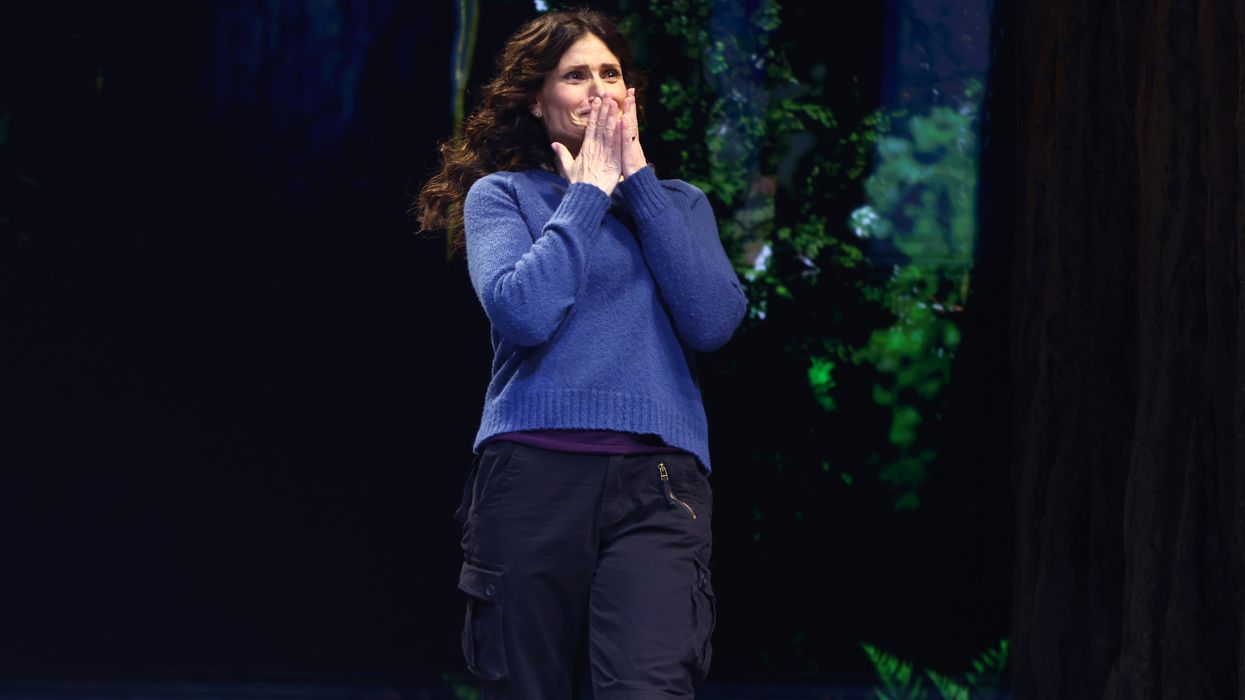
Broadway's spotlight on redwoods helps us understand why what happens above our heads matters so much for our future below.
A woman flees devastating personal loss and finds herself at the base of towering redwood trees in Northern California. There, she persuades two botanists to let her climb hundreds of feet above the forest floor into a hidden world that transforms her perspective—and her life. This isn't the latest adventure film or bestselling memoir. It's Redwood, Broadway's unlikely hit musical that's bringing attention to one of nature's most overlooked but critical ecosystems.
Many of us working in forest conservation and restoration management were delighted when it opened on Broadway. When a musical drives sold-out audiences to stand and cheer for characters climbing into a forest canopy, it creates a cultural moment that conservation science alone never could—bringing vital attention to something that most Americans never think to look up and notice.
As a child in the 1960s, I wandered among ancient redwoods, craning my neck upward in wonder, while my parents worked to establish Redwood National Park. My father, Edgar, who would later receive the Presidential Medal of Freedom for his conservation work, and my mother, Peggy, who wrote about redwoods and the need to protect them and lobbying President John F. Kennedy's administration to do so, taught me that what made these giants special wasn't just their massive trunks but the entire living forest system from roots to crown. Those early lessons helped shape my life's work because what happens hundreds of feet above the forest floor matters more than most realize.
The more people recognize the vital role and wonder of forest canopies, the more momentum we build for their restoration and protection.
These aerial systems represent nature's overlooked masterpiece—a complex world scientists call the "eighth continent." Redwood canopies host biodiversity found nowhere else. Leather-leaf ferns create massive mats—up to the size of cars—that can store 5,000 gallons of water per acre, keeping forests cool and moist during summer droughts. The dense foliage also captures fog moisture that sustains the entire forest below while creating microclimates that buffer against climate extremes.
Canopies contribute to the entire forest system, linking the top to the bottom of the forest. Dust captured in the abundant foliage of ferns and huckleberry plants combined with accumulated organic matter forms rich "aerial soil" that becomes the foundation for entire sky-high communities. Rare lichens, wandering salamanders, and small mammals thrive in this elevated habitat, maintaining delicate ecological balances. From these heights, the benefits cascade downward: Canopy cover shades streams, cooling water for salmon and other temperature-sensitive aquatic species, integrating the entire forest system from treetop to riverbed into a single, interconnected climate buffer.
Yet this hidden world faces a crisis. Only 5% of old-growth redwood forests remain and have intact canopy ecosystems. Young, secondary forests that are constantly harvested lack the structure—and are not allowed time to develop—to support these rich, diverse aerial worlds. Only the largest, oldest trees—many hundreds of years old—host these critical ecosystems, and they're increasingly rare.
But hope is taking root in innovative restoration work. Working with Cal Poly Humboldt's professor Stephen Sillett and research associate Marie Antoine, we have begun transplanting fern mats, collected from the forest floor after winter storms, into the tallest trees in secondary redwood forests we conserve and manage, rebuilding canopy ecosystems from scratch. Working in our Van Eck forest near Fieldbrook, California, we've nurtured these ferns and then "planted" them hundreds of feet high in trees that will remain permanently protected. These specially selected trees are designated as "Potentially Elite Trees" (PETs)—the giants of tomorrow. Individual old trees are a lot like the oldest elephants in a herd; they contain the wisdom and resources to help an otherwise young forest function as an old forest, just as those old elephants guide their herds. And, we continue to harvest timber on these forests—on average a million board foot a year—while restoring the structure and function of old forests.
Now, we are expanding our efforts, adding huckleberry to our plantings to support new sky gardens. This patient approach creates homes for birds, salamanders, and countless insects, jump-starting processes that would naturally take centuries.
Redwood captures an essential truth: Forests are not just timber resources. They're living systems with lessons to teach us about building resilience in an uncertain future.
The Broadway experience provides audiences a glimmer of what happens when people encounter these giants in real life—and that's critically important. The more people recognize the vital role and wonder of forest canopies, the more momentum we build for their restoration and protection. But awareness must translate to action.
As debate rages on the role of federal forests and the need to protect their old and mature forests, there is also a major opportunity for action on private forests, where landowners' decisions will endure beyond a political cycle. For private forests, working forest conservation easements offer a proven path forward—providing landowners financial incentives to conserve and manage for older forests, develop complex structures, and designate future "PETs" that can support the function of old forests. This can transform forest recovery from centuries-long waits to achievable timelines within human lifespans.
Recent sweeping cuts to the National Park Service and U.S. Forest Service workforce threaten our old forests. Rangers and scientists do more than protect and research forests—they guide visitors to witness these majestic ecosystems firsthand. These cuts, applied "like an ax rather than a scalpel", endanger both the health of our forests and the transformative experiences for the public. When people stand beneath ancient trees and look upward, they understand viscerally why these forests and their canopies must be protected.
Protecting and restoring these overlooked canopy ecosystems has never been more urgent as climate change accelerates. Broadway's spotlight on redwoods helps us understand why what happens above our heads matters so much for our future below. When audiences gasp as Idina Menzel spins and embraces that massive trunk, they glimpse not just theatrical magic but a vision of what we stand to lose—and what we must fight to restore and preserve. The living world above demands our attention, protection, and active restoration—not just in California's iconic redwoods, but in every forest ecosystem on Earth.
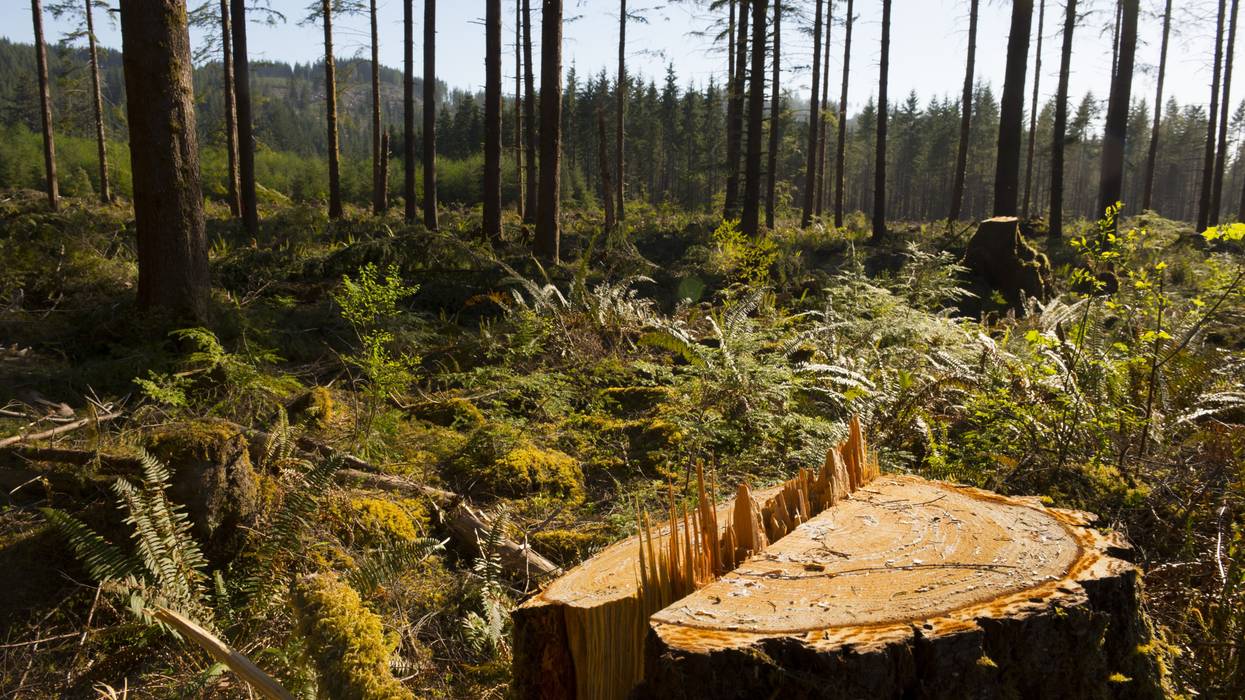
If passed, it would open millions of acres of forests to logging without scientific review or citizen input. A better name for this legislations would be the Fix It So We Can Log Without Citizen Oversight Act.
It comes in a box with a picture of a fire extinguisher on the front. Below it the words: Guaranteed to stop wildfires. But when you open it up there’s a chainsaw inside. Tucked beside it is a piece a piece of paper saying, “Now without citizen overview!”
That’s the Fix Our Forests Act, a logging bill disguised as a firefighting bill. The tell is in the numerous and creative ways it would obstruct citizen input, from delaying citizen review until after the trees are cut to reducing the statute of limitations for filing lawsuits from six months to 120 days, seriously straining the ability of small citizen groups to apply legal restraint. It waives National Environmental Policy Act protections on fire-sheds as large as 250,000 square acres and allows loggings to proceed even if courts find the logging plan violates the law. There are no limits on the size and age of trees that can be cut, and the language is so vague that even clear cuts could qualify as “fuels treatment.” If passed, it would open millions of acres of forests to logging without scientific review or citizen input. A better name for this legislations would be the Fix It So We Can Log Without Citizen Oversight Act.
Introduced by Rep. Bruce Westerman (R-Ark.), and having passed in the House, it’s now being rushed through the Senate in an attempt to capitalize on the heightened fire concern surrounding the tragic LA fires. A vote is expected any day now.
If our forests are broken, might it be the successive rounds of logging trucks and roads, chainsaws and feller bunchers, herbicidal treatments and industrial replanting of greenhouse-grown monocrops that did the breaking?
The bill claims to “protect communities by expediting environmental analyses, reducing frivolous lawsuits, and increasing the pace and scale of forest restoration projects.” But if protecting communities were really the goal, this bill would pour resources into the only methods proven to do that: hardening homes and defending immediate space.
Most homes don’t catch fire directly from flames themselves, but from embers blown ahead of a fire. Simple measures like screening vents, covering gutters, and pruning vegetation directly around buildings dramatically improve their fire resilience. Thinning vegetation in the immediate surroundings, within 100 feet or so of the dwelling, can also help. These were among the recommendations of the Wildland Fire Mitigation and Management Commission. But rather than heed those recommendations by investing in boots on the ground to harden homes and educate communities, the bill diverts resources to backcountry logging.
The U.S. Forest Service has spent years making the argument that “mechanical treatment” of forests reduces wildfire. Independent research, however, comes to different conclusions, that thinning harms the forest and actually increases the very conditions that favor fire—heat, dryness, and wind. The reasons are fairly obvious. For instance, removing trees makes it harder for forests to slow wind, increasing the wind speeds of potential fires and thus the speed of spread. It also allows more sunlight to reach the forest floor, heating up the ground. Even more importantly, trees don’t just stand around soaking up sunlight, they also cool and hydrate their surroundings. It’s called transpiration, and can be understood as a kind of sweating, just like we do to keep cool in the sun. A single tree can have the cooling power of up to 10 air conditioners.
But that really is just the beginning. Those trees also help make rain. By sweating water vapor they not only cool the air, they deliver water vapor to the sky, feeding the formation of clouds. Even more remarkable, they seed that vapor with biochemicals such as terpenes (the forest scent) and other bits of biota that provide the grains for eventual rain drops to condense around. Forests make clouds. Those clouds then rain down, watering other forests, hydrating soil and vegetation, and increasing resilience to wildfire.
In other words, what the Fix our Forests Act calls dangerous fuels are also air conditioners and humidifiers, rain makers and rain catchers, as their needles gather and slow the falling of rain, allowing it to seep into the ground and make its way to aquifers, which will prove critical during the dry season. Of course, older, deeply rooted trees are best able to tap this water, but there are no protections for them in the Fix Our Forests Act.
Given that the concern is fire, it’s remarkable how little this legislation ever mentions water, its antidote. Though I did find, in section 119, under “Watershed Condition Framework Technical Corrections,” calls to strike the word “protection” from watershed provisions in a previous, similar bill, the Healthy Forests Restoration Act of 2003, under George W. Bush. (To see a short, simple demonstration of how plant moisture effects flammability, watch this.)
Perhaps the problems with this bill are explained by the first word of the bill’s title: “Fix.” You can fix a car. You can fix a broken plate. But can you “fix” a forest? Can you “fix” a living ecosystem of infinite complexity? Such language represents an outdated way of thinking about the living world around us, and marks the very kind of thinking that’s gotten into this mess in the first place. And one needs to ask: If our forests are broken, might it be the successive rounds of logging trucks and roads, chainsaws and feller bunchers, herbicidal treatments and industrial replanting of greenhouse-grown monocrops that did the breaking?
Yes, there are instances where careful thinning of small trees and undergrowth is indicated, such as right around built communities or in industrial plantations planted too densely. But such measured action doesn’t need this bill, and this bill isn’t about such measured action. Rather, as put by Robert Dewey, vice president of government relations with Defenders of Wildlife, the bill “will do little of anything to combat fires and instead plays favorites with the timber industry which is hungry to consume more of our forests—removing large fire-resilient trees and devastating the lands and species which call them home.”
As mentioned, the bill is moving quickly. Last minute citizen outcry is the only thing standing in its way.
The following Senators have been identified as key votes: John Hickenlooper (D-Colo.), Michael Bennet (D-Colo.), Ruben Gallego (D-Ariz.), Mark Kelly (D-Ariz.), Alex Padilla (D-Calif.), Adam Schiff (D-Calif.), Angus King ((-Maine), Elissa Slotkin (D-Mich.), Gary Peters (D-Mich.), and John Fetterman (D-Pa.)

In so many ways, olive trees are a Christmas tree for Palestinians: symbols of hope and renewal.
So, there it stands in your living room—the crown jewel of December. Your Christmas tree, dressed to the nines in ornaments that range from genuinely lovely to “why do we still have this macaroni abomination from 1997?” Beneath it, gifts for loved ones and a few hastily wrapped “emergency backups” for people you forgot about until yesterday. It’s not just a tree; it’s the spirit of the season—a symbol of hope, renewal, and festivity.
But halfway across the world, another tree tells a far grittier, far less sparkly story. The olive tree. For Palestinians, this tree doesn’t glitter—it sustains. Its fruit isn’t decorative—it’s dinner. And while it doesn’t cradle stockings or fairy lights, it carries something heavier: the survival of families who’ve relied on its branches for generations.
Picture this: You arrive at your family’s olive grove in the West Bank, expecting to gather the fruit of months of labor. Instead, you find the trees—some hundreds of years old—hacked to the ground. These weren’t just trees; they were ancestors, livelihoods, the living heart of your family history. Each stump is an act of violence, as if someone took a chainsaw to your roots.
This holiday season, why not let your generosity extend beyond your living room? Support organizations like Treedom for Palestine, Development in Gardening, or Grassroots International.
This isn’t vandalism––it’s strategy. Uprooting olive trees is a brutal tool in the ongoing effort to displace Palestinian families from the land they’ve farmed for centuries. This year alone, settlers have destroyed more than 4,000 trees. Armed settlers patrol the land, while IDF soldiers turn a blind eye—or worse, assist. Two farmers were killed during the olive harvest including a 50-year-old woman shot by an Israeli soldier whilst tending her trees.
If you’re outraged, good. You should be. But rage alone isn’t enough to counter despair.
There’s also hope.
In 2018, Motaz Bsharat knelt in his field and planted 250 olive trees. But he wasn’t just planting—he was envisioning a future. His grove—fenced, irrigated, and fortified—became the first Freedom Farm. Today, there are 70 Freedom Farms across the West Bank, each a living testament to resilience.
This year, Motaz harvested his first full crop: 500 kilograms of olive oil, valued at $10,000. Next year, that yield will double. But this isn’t just an economic success. It’s proof—proof that even in a land scarred by violence, life persists.
The Freedom Farms are thriving, but the destruction hasn’t stopped. Since the occupation began, 2.5 million olive trees have been destroyed. Each tree uprooted is a scar on the land and its people. And yet, the farmers remain. They plant. They rebuild. They endure.
Olive trees are miracles of nature. They thrive in arid soil, resist drought, and live for centuries, bearing fruit for generations. They sequester carbon and sip water sparingly. In so many ways, they’re a Christmas tree for Palestinians: symbols of hope and renewal.
In response to the settler violence this year, Treedom for Palestine launched its 4,000 Strong Campaign to replace every olive tree destroyed this year by settlers. These new groves are more than replacements—they’re fortified Freedom Farms, designed to withstand violence and flourish under the harshest conditions.
Planting a tree in Palestine is not just reforestation. It’s reclamation. Each sapling declares: We are still here.
As you sit by your Christmas tree, marveling at its glow and wondering whether you really needed a third slice of pie (you did), spare a thought for the olive tree. For Palestinian families, it’s more than a decoration—it’s their lifeline, their anchor, their inheritance.
This holiday season, why not let your generosity extend beyond your living room? Support organizations like Treedom for Palestine, Development in Gardening, or Grassroots International. Every tree planted isn’t just a tree—it’s a promise. A promise that families will stay rooted, that livelihoods will be rebuilt, and that peace might actually take root one day.
This Christmas Day, while the world pauses to celebrate, Treedom for Palestine will do what it does best: plant. Instead of carols and candlelight, three new Freedom Farms—750 olive trees—will take root in the West Bank. These aren’t just trees; they’re acts of quiet defiance and faith in prosperity and peace, each one declaring: We are still here. Until peace takes root, we’re holding a space for it.
Because like the Christmas tree, the olive tree is a savior tree—but one that doesn’t just light up for a season. It lights the way for generations. By planting this holy tree in the Holy Land at a time like this, it’s not just the tree we’re saving.
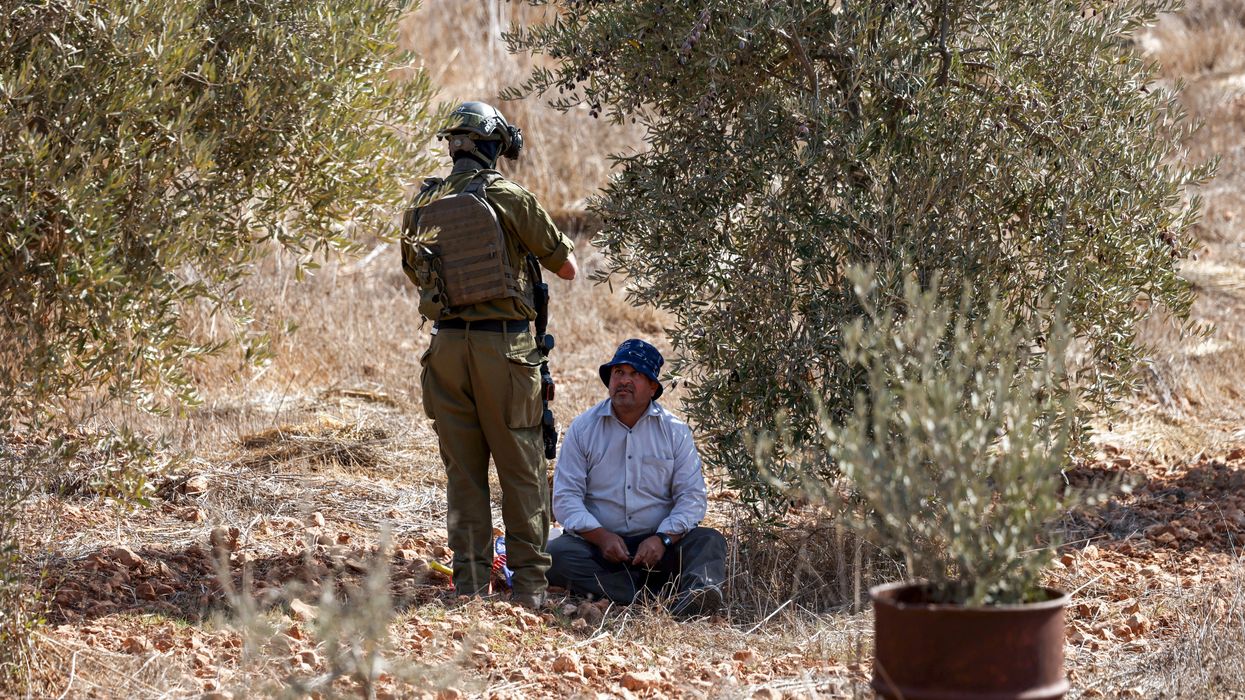
If a film like Where Olive Trees Weep can inspire thousands to plant olive trees in a conflict zone, what else might this model achieve when applied to other global challenges?
We’ve all seen movies that tug at our heartstrings, maybe even prompt a tear or two. But every so often, a film does more than just make us feel—it makes us act. From saving dolphins to battling climate change, certain films have ignited movements that leap from the screen into the real world. The latest addition to this unexpected genre? Olive trees.
Yes, olive trees. In the West Bank, no less.
Where Olive Trees Weep is a recent documentary that delves into the hardships and resilience of the Palestinian people. It has captivated viewers around the world—not just emotionally, but in a way that has moved them to action. This isn’t just a story on screen. With the help of everyday people, it has mobilized a movement that’s planting 1,500 olive trees in one of the most contested regions on the planet.
The filmmakers behind Where Olive Trees Weep didn’t just want to connect with audiences emotionally—they wanted to inspire real change. Before the film even started rolling, viewers were invited to donate to plant an olive tree in the West Bank. What began as a cinematic experience became a grassroots movement, turning passive viewership into direct action.
Every tree cut down is a blow to the Palestinian people, but every tree planted is a defiant stand for their heritage, their survival, and their future.
These trees—planted by thousands of people around the world—are doing more than taking root. They’re providing Palestinian farmers with a sustainable source of income in a region where food security and land ownership are perpetually under siege. The trees will generate $200,000 annually in olive oil sales, creating economic stability for communities that desperately need it.
But more than that, the olive trees are a symbol of defiance. In a place where Israeli settlers destroyed 4,000 trees this year alone, planting an olive tree is an act of resistance—a stand against oppression, colonialism, and environmental degradation. Like Kenya’s Green Belt Movement, where tree planting became a form of resistance against both environmental destruction and political oppression, these olive trees are symbols of resilience and survival in the face of adversity.
Since the movement began, six new Freedom Farms, each home to 250 olive trees, have sprung up in the West Bank. These trees, which will live for up to 500 years, will support 15 generations of farmers, provide food and economic stability, and scrub 54 million pounds of carbon from the air. That’s the long-term vision. For now, they’re putting down roots where few dare to dig.
In Palestinian culture, olive trees are more than just crops—they’re living legacies. They represent peace, wisdom, and deep-rooted connections to the land. Every tree cut down is a blow to the Palestinian people, but every tree planted is a defiant stand for their heritage, their survival, and their future.
As settler violence escalates, this year’s olive harvest was the most dangerous in recent memory. The Palestinian Farmers Union documented over 700 attacks on farmers during the harvest. The union met with diplomats from around the world, urging them to pressure the occupation. Yet it’s the viewers of this movie, not the politicians, who have replanted a third of the olive trees lost to settler violence. (When was the last time a speech planted anything?)
And Palestinian farmers, supported by this global tree-planting movement, are standing their ground. “Protecting the olive harvest is more than safeguarding crops; it’s about defending our culture, our heritage, and the roots of our existence,” says Abbas Milhem, president of the Palestinian Farmers Union and one of the key figures in this initiative.
Where Olive Trees Weep isn’t the first film to make waves beyond the cinema. The Cove shone a harsh light on dolphin hunting in Japan, sparking global efforts to end the practice. An Inconvenient Truth made climate change impossible to ignore. And Blood Diamond made us rethink where our jewelry comes from. But what makes Where Olive Trees Weep stand out is how it transformed viewers into activists before they even pressed play. By inviting people to plant trees in real time, the film didn’t just tell a story—it became part of the story.
As the world faces relentless crises—from Sudan to Ukraine to Gaza—storytelling has never been more critical. If a film can inspire thousands to plant olive trees in a conflict zone, what else might this model achieve when applied to other global challenges?
Moviegoers have shown that even the smallest acts—like donating $20 to plant a tree—can have profound ripple effects. When stories are paired with action, they become blueprints for real change.
As for the Palestinian olive trees standing tall in the face of destruction? They’re living proof that sometimes the most powerful act of resistance is just putting down roots.
As the world’s climate leaders discuss ambitious goals in Azerbaijan, Motaz’s trees are proof that climate action and social justice can begin in the most unexpected places.
As delegates gather for COP29 to discuss global climate commitments, there’s a man in the West Bank who knows almost nothing of policy numbers, carbon targets, or finance pledges. But if anyone should be a delegate it’s him. Sunburned and weathered, farmer Motaz Bisharat is deeply rooted to his 2.5-acre plot of green. Here on his small patch of land, Motaz fights two battles with simple tools—soil, sweat, and 250 olive trees. The trees do more than sustain his family—they hold the line against both encroaching occupation and a changing climate.
Six years ago, Motaz began a quiet experiment: Could a Palestinian farmer with scarce resources bring the ideals of sustainability to a landscape scarred by both climate change and occupation? With help from the Palestinian Farmers Union (PFU), Motaz planted the region’s first Freedom Farm—250 olive trees, fenced for protection and irrigated in the dry summer months. A bit of hope, planted in the ground, as Motaz says.
It sounds simple—plant, irrigate, protect—but nothing is easy in the West Bank. Water allocation is starkly unequal: Settlers nearby have swimming pools while Motaz rations every drop. Electricity is forbidden; even a shaded shelter is not allowed—hence, his sunburn. Fertilizers, equipment, and market access are often blocked by checkpoints, turning basic tasks into grueling ordeals. And violence looms—this year alone, settlers destroyed over 4,000 Palestinian olive trees. In total, over 2.5 million trees have been uprooted, a devastating toll on the land and lives connected to it.
Sometimes, when peace feels like an abstraction, the best thing you can do is plant.
This is what it’s like farming under the occupation. So when the Palestinian Farmers Union proposed a trial new farm, Motaz thought: Y’Allah, let’s see what happens. In a single day, they planted his farm, connected a waterline under cover of night, and built a path to make it accessible. They named it a “Freedom Farm.”
They named it well. In the West Bank, farming isn’t just a livelihood—it’s a nonviolent defense of land. An Ottoman-era law allows Israel to claim any fallow land as “state land” for settlements and military outposts. For farmers like Motaz, letting the land go unplanted means possibly losing it forever, but planted land stays in Palestinian hands. His olive trees are a bulwark—that last line of nonviolent defense.
As if politics weren’t enough, there’s also the matter of the climate. The West Bank is changing rapidly, with hotter summers, longer droughts, and erratic rainfall. A recent PFU report underscores what farmers already know: Reduced crop yields, water scarcity, and soil degradation are now the new normal. Yet olive trees are built for this challenge. They drink less water than most fruit trees, shrug off drought, and stand their ground against fire. Basically, they’re climate warriors. And as they grow, these trees quietly sequester carbon—18,000 pounds per year on Motaz’s farm alone. Over their 500 year lifespan, they’ll absorb 9 million pounds of carbon.
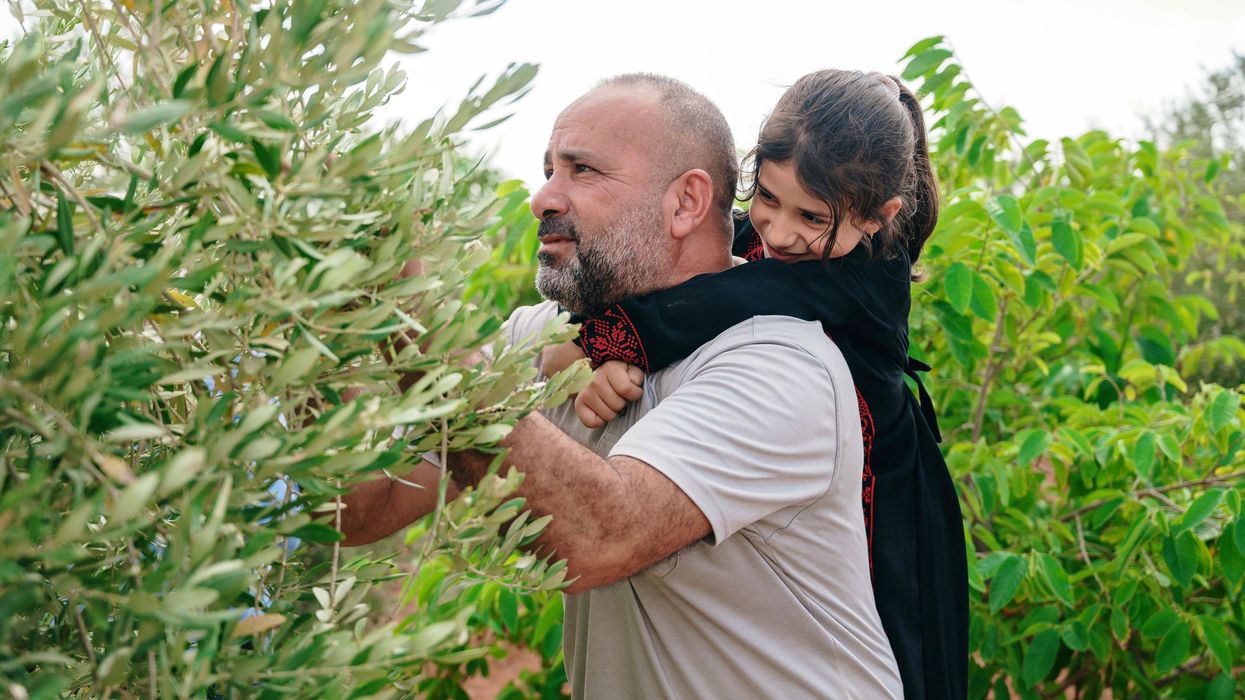
Today, Motaz’s saplings have grown into 10-foot trees heavy with olives. This year, he expects to harvest over 1,000 pounds, which he will press into oil and sell locally. With his young daughter, Shaam, wrapped snugly on his back, Motaz moves from tree to tree, gathering olives that will sustain his family through the year.
His experiment has grown into a movement. The once barren area surrounding Motaz’s farm now hosts 15 other farms, inspired by his effort—a green, one-mile circle of resilience. Across the West Bank, this momentum continues to build as Treedom for Palestine, in partnership with the Palestinian Farmers Union, brings this vision to life. These farms offer more than food and economic stability; they form a fragile network of survival in a landscape where both occupation and climate change conspire against peace. Today, over 70 Freedom Farms dot the landscape, but the need for more is urgent.
Sometimes, when peace feels like an abstraction, the best thing you can do is plant.
As the world’s climate leaders discuss ambitious goals in Azerbaijan, Motaz’s trees are proof that climate action and social justice can begin in the most unexpected places. These trees will live longer than he will. They don’t know borders, race, or politics. They quietly root in shared soil, clean the air, pass nutrients to one another through underground networks. In so many ways, these trees are a glimpse of who we might yet become—a world bound together, quietly connecting, quietly sustaining one another, anchored by hope and the strength to endure.
In the meantime, Motaz and his trees are teaching us all a profound lesson: When your roots go deep, you can weather almost anything.
"Trees directly underpin the survival of a staggering array of species—including us," said one scientist.
More than one-third of Earth's tree species are at risk of extinction, with logging, forest destruction for agriculture and urban development, and human-caused global heating most responsible for this "frightening" development that threatens life as we know it, according to a report published Monday.
The 2024 Global Tree Assessment—released at the United Nations Biodiversity Conference (COP16) in Cali, Colombia and published as part of this year's International Union for Conservation of Nature (IUCN) "Red List" of threatened species—warns that more than 16,000 of the 47,000 tree species analyzed in the report are at risk of extinction.
The report blames deforestation and catastrophic global heating, caused by human burning of fossil fuels, as the main drivers of tree extinction. More than 5,000 tree species on the IUCN Red List are felled for construction timber, while 2,000 species are used for fuel, food, and medicines.
According to the report:
Trees now account for over one-quarter of species on the IUCN Red List, and the number of threatened trees is more than double the number of all threatened birds, mammals, reptiles, and amphibians combined. Tree species are at risk of extinction in 192 countries around the world...
The highest proportion of threatened trees is found on islands. Island trees are at particularly high risk due to deforestation for urban development and agriculture at all scales, as well as invasive species, pests, and diseases. Climate change is increasingly threatening trees, especially in the tropics, through sea-level rise and stronger, more frequent storms.
"Trees are essential to support life on Earth through their vital role in ecosystems, and millions of people depend upon them for their lives and livelihoods," IUCN director-general Grethel Aguilar said in a statement. "As the IUCN Red List celebrates 60 years of impact, this assessment highlights its importance as a barometer of life, but also, crucially, as a unique tool guiding action to reverse the decline of nature."
Climate, environmental, and biodiversity defenders pointed to the new report with alarm.
"The significance of the Global Tree Assessment cannot be overstated, given the importance of trees to ecosystems and people," said Eimear Nic Lughadha, senior research leader in conservation assessment and analysis at the U.K. Royal Botanic Gardens, Kew. "We hope this frightening statistic of 1 in 3 trees facing extinction will incentivize urgent action and be used to inform conservation plans."
Fran Price, the Worldwide Fund for Nature's forest practice lead, said in a statement that "IUCN's Global Tree Assessment paints a shocking picture of the state of the world's trees."
"Trees are invaluable allies in tackling climate change and a critical foundation of our natural world," Price added. "The report is an eye-opening reminder that current efforts are falling short in safeguarding these vital natural assets. It's time to take stronger action against illegal logging and trade and enact stronger laws that protect our trees."
David Hole, an IUCN-U.S. board member and Conservation International scientist, asserted that "trees directly underpin the survival of a staggering array of species—including us."
"This latest IUCN update is flashing a warning light that those green giants need more of our attention and support the world over," he continued. "Thriving, naturally diverse forests are essential in mitigating both climate change and biodiversity loss. Not only do they store more carbon, they are also more resilient to natural and human-driven threats."
"We know what we have to do," Hole added. "We need to provide real and effective protection for tree species across the globe—particularly those that are imminently threatened. And we must do that in ways that support local people and communities, and doesn't cut them off from what is often a critical resource."
There is hope: Besides cutting carbon emissions and combating deforestation, Hole pointed to the "enormous untapped potential" of restoring native trees in previously degraded agricultural lands.
"Not only could we store more carbon, we could also enhance food security, support biodiversity, and increase agricultural systems' resilience to the myriad pressures that climate change is increasingly placing them under," he said. "These are the types of innovative approaches that can make a big positive difference—and it is vital we start implementing them at scale."
James Cameron dreamed it, but Palestinians are living it. If we continue to let violence against their land and people go unchecked, we’ll all pay the price.
Exactly one year ago today, on October 28, 2023, Bilal Saleh was shot dead by Israeli settlers while peacefully harvesting his olive trees. It happened near the field he had tended for years, with his wife and children as witnesses. He was unarmed. The settler who killed him walked free, back to Rehelim. The world barely noticed.
Cast into the shadow of the more than 40,000 Palestinian lives lost since the war on Gaza began, Bilal’s death is barely a blip.
Farmers won’t fight with guns, but they will plant. Again and again, they will plant.
But it’s a different kind of death, being murdered in an olive grove. It’s part of a larger colonial strategy of dislocation to sever the deep connection Palestinians have to their land. Olive trees, once symbols of peace, have become battlegrounds—and settlers, soldiers in this war of erasure. This year alone, 4,000 trees have been destroyed by settlers.
What does it mean to destroy a tree? It’s not just vandalism—it’s an attack on identity, history, and survival.
For Palestinians, the olive tree isn’t just a crop. It’s their Tree of Souls. Remember that scene in Avatar when the Na’vi fight the colonizers to save the giant, sacred tree that holds their entire world together? The olive tree is that for Palestinians.
For thousands of years, olive trees have provided food, oil, income, spiritual roots, and cultural pride. They have withstood droughts, fires, and wars; held back the desert; and kept the soil from vanishing into dust. And here’s another feather in their leafy cap: Each tree quietly absorbs around 75 pounds of carbon a year. So when 4,000 trees are destroyed in a single season, it’s like leaving 300,000 pounds of carbon hanging around. Worse still, the Palestinian Farmers Union estimates that since the occupation began, 2.5 million trees have been destroyed. That’s the carbon equivalent of millions of transatlantic flights.
All of which makes farmers like Bilal the last line of nonviolent defense—not just against the occupation but environmental disaster. Farmers won’t fight with guns, but they will plant. Again and again, they will plant.
Olive trees don’t just die by accident. They’re methodically cut down, one by one, in a calculated sweep of colonization. For years, Israel has leveraged an Ottoman law allowing the state to claim uncultivated land. By destroying olive trees—trees that take years to mature and produce—they clear a path for more illegal settlements. That’s the game. It’s a slow deliberate erasure.
If even a fraction of the $18 billion in U.S. military aid to Israel were spent planting trees, we’d have hundreds of millions of trees helping transform a polarized holy land into a prosperous heartland.
Each felled tree isn’t just about clearing the land or fouling the air. Passed down like heirlooms, the trees hold a different kind of currency: history, survival, pride. Destroy them, and you don’t just take away a crop, you sever a people’s claim to the soil and connection to their past.
Without their olive trees, Palestinian farmers lose their autonomy, becoming increasingly dependent on external aid and less able to resist the encroachment of settlements. The landscape changes—slowly at first, then all at once.
But here’s the thing—Palestinians refuse to disappear. When Bilal was killed, we at Treedom for Palestine worked with the Palestinian Farmers Union to plant a new “Freedom Farm” for his widow, Ikhlas. She’s now a caretaker, a breadwinner, and the steward of a new olive grove—one that will nourish her family and keep Bilal’s memory alive. The grove is surrounded by steel fencing, protecting both farmer and trees.
Today there are 70 Freedom Farms across the West Bank: 17,500 more thriving olive trees, each a source of income and prosperity in a region hungry for both. But the need for more is great. In plain numbers: $30 plants, irrigates, and protects an olive tree. If even a fraction of the $18 billion in U.S. military aid to Israel were spent planting trees, we’d have hundreds of millions of trees helping transform a polarized holy land into a prosperous heartland.
Resistance doesn’t have to be violent to be revolutionary.
Settler violence against olive trees isn’t just unsettling—it’s unsustainable. Each tree felled isn’t just a lost crop; it’s a severed connection to the past and a stolen future. For Bilal’s family, the loss is deeply personal. For the world, it’s a reminder that justice, equality, and sustainability are intertwined, like the vast mycelium network beneath the soil, linking trees together in profound ways and sustaining life. As below, so above.
Above ground, the consequences of this ecological warfare ripple outward. Climate change, biodiversity loss, environmental collapse. The destruction of olive trees in the West Bank is just one battle in a much larger war.
What’s happening in Palestine isn’t far removed from us. The violence against the land isn’t just about one place—it’s about the shared fate of people and the planet. Palestine is our Pandora. If we continue to let violence against their land and people go unchecked, we’ll all pay the price. But for now, Palestinians are teaching us an important lesson: When your roots run deep, you can withstand almost anything.
If our human intelligence has discerned over thousands of years which plants are edible and nutritious and healing, wouldn’t the evolutional ingenuity of plants which feed and sustain us and all life also constitute intelligence?
From the largest to the smallest and the oldest to the youngest creatures on Earth—Antarctic blue whales and coastal redwood trees, minute bacteria and human beings—we are all enmeshed in layers of relationships. We need each other, though some more than others.
Plants evolved hundreds of millions of years before the first humans and transformed the Earth—through their creativity in surviving predators—into a livable environment for all animals, including humans. We needed plants for our evolution and need them now for our survival from climate disaster. They, however, did not need us for their existence and would survive without us.
Putting humans at the top of the evolution chain as the crown of intelligent life, a Western worldview, is—as some keenly grasp—mistaken. The baleful consequences of this simplistic hierarchy are everywhere: out-of-control climate change; accelerating rates of animal and plant extinction; dead zones in the oceans and mass mortality of coral reefs; the vast pollution of land, air, and water; and the mounting likelihood of human extinction with nuclear war. All caused by humans, humans with financial and political power much more egregiously than others.
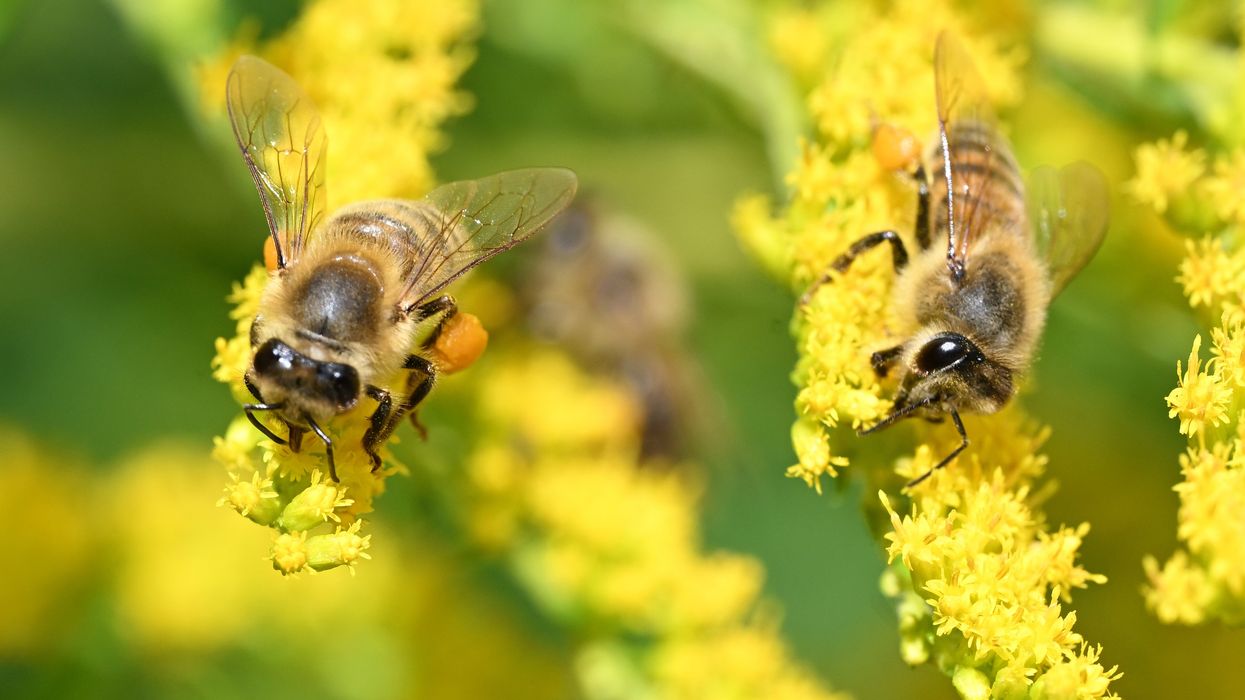
Perhaps you have you noticed that late summer asters and goldenrod tend to grow as companions. Why? Together—their combined beauty—attracts more pollinators.
Certain scientists who study plants—from the simplest to the exotic—are stirring controversy with their “ Are plants intelligent?” Consider that we humans owe our lives to plants for their food, medicines, and critical balance of 21% oxygen in the air we breathe. If our human intelligence has discerned over thousands of years which plants are edible and nutritious and healing, wouldn’t the evolutional ingenuity of plants which feed and sustain us and all life also constitute intelligence?
Studies have found that elephants recognize themselves in a mirror, crows create tools, dolphins demonstrate empathy and playfulness, and cats exhibit similar styles of attachment as human toddlers. The given explanation is that they have brains with neurological capacity for consciousness and intelligence.
But plants do not have a central brain. Could their mode of learning to evade insect predators and maximize their growth come from a diverse form of intelligence, possibly be distributed across their roots, stems, and leaves? Could the whole plant, then, function as a brain? Recent studies of plants have stirred the possibility that they are conscious and intelligent. Take communication, something we humans claim as our domain through language and more recently acknowledge that animals also possess.
Botanists have found that not only do alder and willow trees alter their leaf chemistry to defend themselves against an invasion of tent caterpillars, but that leaves of faraway trees also change their chemical composition similarly. Warned, as they are, by airborne plant chemicals released from the original trees under attack. Goldenrods signal an attack by a predator through strong chemical communication sent to all other goldenrod neighbors, just as humans warn their neighbors about a nearby fire or flood or crime.
Without any recognizable ears, plants sense sounds. The vibration of a predator insect chewing on its leaves causes a plant to make its own defensive pesticide. Beach evening primrose responds to the sound of honeybees in flight by increasing the sweetness of its nectar to attract them for pollination. Tree roots grow toward the sound of running water, including in pipes, where the roots often burst through causing great difficulties for municipalities. How do the various plants hear these stimulating sounds?
Plants have memory, some anticipating from past experience when a pollinator will show up for the plants’ pollen. Plants express social intelligence: Members of the pea family form relationships with bacteria living in their roots to have the bacteria supply beneficial nitrogen for the plants’ growth. Several kinds of plants provide a home and food for compatible ants who then attack the plants’ ant pests. Perhaps you have you noticed that late summer asters and goldenrod tend to grow as companions. Why? Together—their combined beauty—attracts more pollinators.
In finishing, I express my immense respect for the Indigenous worldview where wind, rocks, air, and rain are our kin, together with plants and nonhuman animals. We, humans, the most recent beings, depend on all of these elder kin; and this awareness, this worldview of connectivity among all beings, is our path back to Earth well-being.
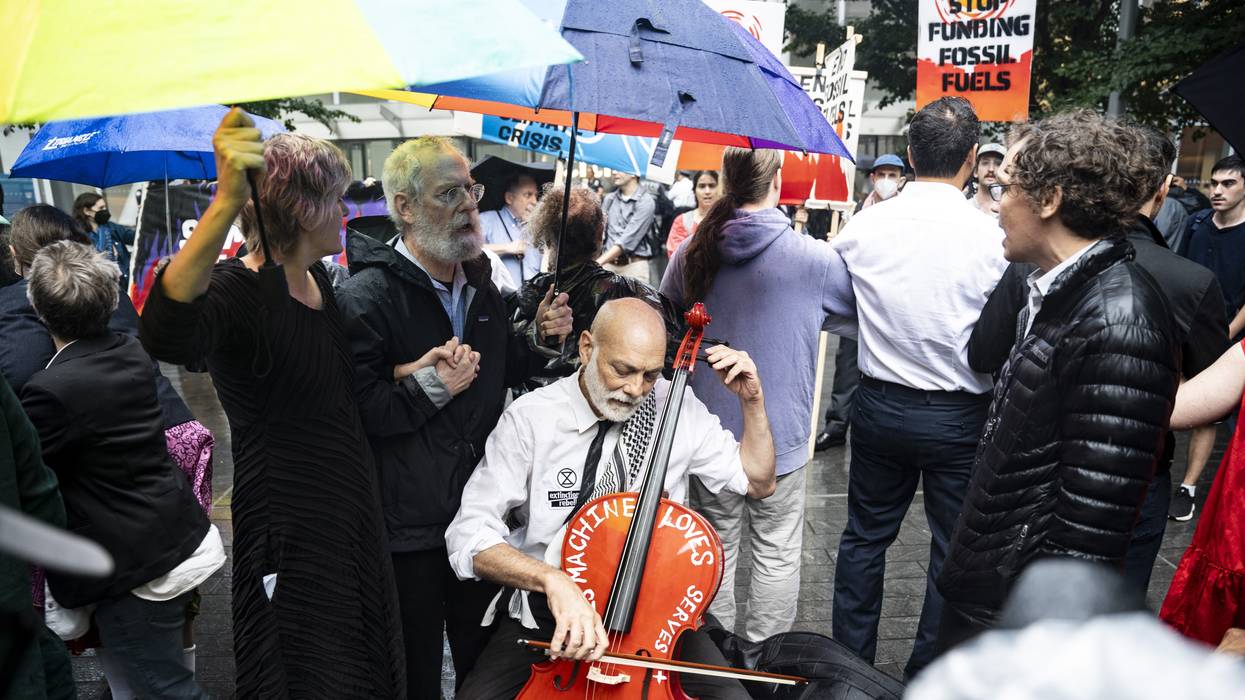
Biologist Sandra Steingraber was invited to speak as climate activist John Mark Rozendaal disobeyed a restraining order to play cello outside CitiBank’s headquarters. However, that speech was never delivered.
On August 8, 63-year-old professional cellist, climate activist, and grandfather, John Mark Rozendaal, was arrested while playing the opening strains of Bach’s “Suites for Cello” outside of CitiBank’s world headquarters in Manhattan. Rozendaal is one of the leaders of the ongoing Summer of Heat civil disobedience campaign that has targeted CitiBank for financing new fossil fuel projects. Earlier this month, Citibank used false allegations to obtain a restraining order to prevent Rozendaal, along with author and campaign leader Alec Connon, from returning to Citibank headquarters or risk being charged with criminal contempt, a crime which carries a maximum seven-year jail sentence. Biologist Sandra Steingraber was invited to bear witness to his restraining order-defying performance and speak at a press event about the significance of his actions. However, that speech was never delivered. Just as Rozendaal began to play the first measures of the suite, police rushed in. Rozendaal and Connon were arrested, as were Steingraber and 13 others in attendance who had formed a circle around the musician as he played. This is the speech that was not delivered.
Good morning. My name is Sandra Steingraber. I’m a PhD biologist, and I like nothing more than to talk about data.
But today, we are here to witness an extraordinary act of courage, and I’m going to speak very personally.
I grew up in coal-country Illinois and was adopted out of a Methodist orphanage. I was a sensitive, introverted child who struggled with human attachment and a sense of belonging. By the time I was 14, I had fallen in love with two things: the Polish composer Frederic Chopin and photosynthesis.
Of all things central to our humanity that climate change threatens, music is on the list.
The idea that I could, with my own fingers, turn black notes on a page—assembled more than a century earlier—into something divinely beautiful was thrilling to me. When I played Chopin, I felt a connection to all the other pianists who had, for generations before me, memorized and practiced this same score for their own recitals.
Meanwhile, the opera of photosynthesis, which takes place inside the miniature Quonset huts called chloroplasts, connected me to the origins of life itself. The idea that green plants can draw in all our exhaled breath through the stomata of their leaves and, in the presence of sunlight, spin carbon dioxide together with water was awesome to me.
With the aid of cytochrome transport systems and leaping electrons, plants undertake an exquisitely beautiful act of biochemical self-creation. They make themselves. They exhale oxygen. And they feed us all.
The biological phenomenon of photosynthesis gave me a sense of ancestry.
By the time I went to college, I had discovered two things: 1) My ear for music was much better than my execution, which was not great; 2) I really loved trees.
So, I forsook the piano for plant ecology and, for my PhD research I learned the skills of dendrochronology, which allowed me to reconstruct the centuries-long history of a forest by studying the patterns of tree rings inside the heartwood of 200-year-old red pines.
The inside of a tree is a living scroll that tells the story—if you are trained to read the language of xylem and phloem—of the entire ecosystem. You can learn, for example, which years great forest fires swept through or which years had especially long winters. I became a historian of forests by studying the rings of the deep inside the trunks of individual trees.
I would have liked nothing better than to spend my life studying trees. But the acceleration of the climate crisis is now torching forests around the world. And drowning them with saltwater. And ravaging them with emergent diseases. And driving their pollinators into extinction. And otherwise stressing them to the point where they can no longer remove and sequester carbon dioxide from the air around them.
So, that’s why I became a civil disobedient with the Summer of Heat campaign. My responsibility as a plant biologist in this moment in human history is to do more than just teach photosynthesis and praise trees. All the oxygen we breathe is provided to us by plants, and they are in trouble. And governments aren’t acting. And banks like Citi keep on financing new fossil fuel projects that are ravaging ecosystems.
For me, the extraordinary concert we are about to witness is the place where botany and music come together.
Orchestral instruments like cellos and violins—as well as the bows drawn across their strings—are made from trees. And not just any trees but tree species that have what musicians call tonewood.
Pernambuco. Ebony. Certain species of maple and spruce.
These trees have cell walls with acoustical properties that vibrate in certain frequencies and, if they are all uniform in size and density, provide the richness of sound that we experience as musical. Different woods have different resonant qualities due to the ratio of cellulose and lignan. Typically, trees used to make classicial musical instruments are 200-400 years old with 20-inch trunks and tree rings that show slow and steady growth.
In a warming climate, however, annual growth rings have become less consistent in size, and the wood has become softer. Instrument-making trees are also increasingly targeted by emerging insect pests.
Trees with tonewood are now growing in more extreme weather conditions and enduring more frequent droughts. Those conditions alter their cellular architecture in ways that alter the tonal qualities of the wooden soundboards of the musical instruments made from their wood. As a result, orchestral music will sound different in the future. Of all things central to our humanity that climate change threatens, music is on the list.
Fifty years ago, playing a Chopin nocturne had the power to stop me from self-injuring. Listening to my friend John Mark Rozendaal defy Citi’s attempt to silence peaceful protest again the financing of climate ruin by performing Bach’s “Suites for Cello” will, I believe, have the power to call us all to stop injury to the planet.