SUBSCRIBE TO OUR FREE NEWSLETTER
Daily news & progressive opinion—funded by the people, not the corporations—delivered straight to your inbox.
5
#000000
#FFFFFF
To donate by check, phone, or other method, see our More Ways to Give page.
Daily news & progressive opinion—funded by the people, not the corporations—delivered straight to your inbox.
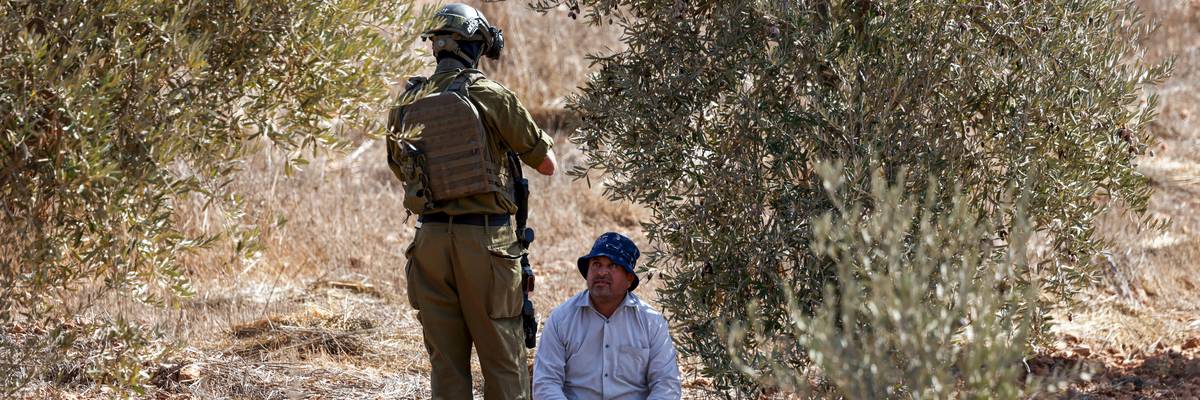
An Israeli soldier stands next to a Palestinian farmer after preventing him and others from reaching their fields for olive harvest in Qusra village, near the Israeli settlement of Majdalim, south of Nablus in the occupied West Bank on October 29, 2024.
If a film like Where Olive Trees Weep can inspire thousands to plant olive trees in a conflict zone, what else might this model achieve when applied to other global challenges?
We’ve all seen movies that tug at our heartstrings, maybe even prompt a tear or two. But every so often, a film does more than just make us feel—it makes us act. From saving dolphins to battling climate change, certain films have ignited movements that leap from the screen into the real world. The latest addition to this unexpected genre? Olive trees.
Yes, olive trees. In the West Bank, no less.
Where Olive Trees Weep is a recent documentary that delves into the hardships and resilience of the Palestinian people. It has captivated viewers around the world—not just emotionally, but in a way that has moved them to action. This isn’t just a story on screen. With the help of everyday people, it has mobilized a movement that’s planting 1,500 olive trees in one of the most contested regions on the planet.
The filmmakers behind Where Olive Trees Weep didn’t just want to connect with audiences emotionally—they wanted to inspire real change. Before the film even started rolling, viewers were invited to donate to plant an olive tree in the West Bank. What began as a cinematic experience became a grassroots movement, turning passive viewership into direct action.
Every tree cut down is a blow to the Palestinian people, but every tree planted is a defiant stand for their heritage, their survival, and their future.
These trees—planted by thousands of people around the world—are doing more than taking root. They’re providing Palestinian farmers with a sustainable source of income in a region where food security and land ownership are perpetually under siege. The trees will generate $200,000 annually in olive oil sales, creating economic stability for communities that desperately need it.
But more than that, the olive trees are a symbol of defiance. In a place where Israeli settlers destroyed 4,000 trees this year alone, planting an olive tree is an act of resistance—a stand against oppression, colonialism, and environmental degradation. Like Kenya’s Green Belt Movement, where tree planting became a form of resistance against both environmental destruction and political oppression, these olive trees are symbols of resilience and survival in the face of adversity.
Since the movement began, six new Freedom Farms, each home to 250 olive trees, have sprung up in the West Bank. These trees, which will live for up to 500 years, will support 15 generations of farmers, provide food and economic stability, and scrub 54 million pounds of carbon from the air. That’s the long-term vision. For now, they’re putting down roots where few dare to dig.
In Palestinian culture, olive trees are more than just crops—they’re living legacies. They represent peace, wisdom, and deep-rooted connections to the land. Every tree cut down is a blow to the Palestinian people, but every tree planted is a defiant stand for their heritage, their survival, and their future.
As settler violence escalates, this year’s olive harvest was the most dangerous in recent memory. The Palestinian Farmers Union documented over 700 attacks on farmers during the harvest. The union met with diplomats from around the world, urging them to pressure the occupation. Yet it’s the viewers of this movie, not the politicians, who have replanted a third of the olive trees lost to settler violence. (When was the last time a speech planted anything?)
And Palestinian farmers, supported by this global tree-planting movement, are standing their ground. “Protecting the olive harvest is more than safeguarding crops; it’s about defending our culture, our heritage, and the roots of our existence,” says Abbas Milhem, president of the Palestinian Farmers Union and one of the key figures in this initiative.
Where Olive Trees Weep isn’t the first film to make waves beyond the cinema. The Cove shone a harsh light on dolphin hunting in Japan, sparking global efforts to end the practice. An Inconvenient Truth made climate change impossible to ignore. And Blood Diamond made us rethink where our jewelry comes from. But what makes Where Olive Trees Weep stand out is how it transformed viewers into activists before they even pressed play. By inviting people to plant trees in real time, the film didn’t just tell a story—it became part of the story.
As the world faces relentless crises—from Sudan to Ukraine to Gaza—storytelling has never been more critical. If a film can inspire thousands to plant olive trees in a conflict zone, what else might this model achieve when applied to other global challenges?
Moviegoers have shown that even the smallest acts—like donating $20 to plant a tree—can have profound ripple effects. When stories are paired with action, they become blueprints for real change.
As for the Palestinian olive trees standing tall in the face of destruction? They’re living proof that sometimes the most powerful act of resistance is just putting down roots.
Dear Common Dreams reader, It’s been nearly 30 years since I co-founded Common Dreams with my late wife, Lina Newhouser. We had the radical notion that journalism should serve the public good, not corporate profits. It was clear to us from the outset what it would take to build such a project. No paid advertisements. No corporate sponsors. No millionaire publisher telling us what to think or do. Many people said we wouldn't last a year, but we proved those doubters wrong. Together with a tremendous team of journalists and dedicated staff, we built an independent media outlet free from the constraints of profits and corporate control. Our mission has always been simple: To inform. To inspire. To ignite change for the common good. Building Common Dreams was not easy. Our survival was never guaranteed. When you take on the most powerful forces—Wall Street greed, fossil fuel industry destruction, Big Tech lobbyists, and uber-rich oligarchs who have spent billions upon billions rigging the economy and democracy in their favor—the only bulwark you have is supporters who believe in your work. But here’s the urgent message from me today. It's never been this bad out there. And it's never been this hard to keep us going. At the very moment Common Dreams is most needed, the threats we face are intensifying. We need your support now more than ever. We don't accept corporate advertising and never will. We don't have a paywall because we don't think people should be blocked from critical news based on their ability to pay. Everything we do is funded by the donations of readers like you. When everyone does the little they can afford, we are strong. But if that support retreats or dries up, so do we. Will you donate now to make sure Common Dreams not only survives but thrives? —Craig Brown, Co-founder |
We’ve all seen movies that tug at our heartstrings, maybe even prompt a tear or two. But every so often, a film does more than just make us feel—it makes us act. From saving dolphins to battling climate change, certain films have ignited movements that leap from the screen into the real world. The latest addition to this unexpected genre? Olive trees.
Yes, olive trees. In the West Bank, no less.
Where Olive Trees Weep is a recent documentary that delves into the hardships and resilience of the Palestinian people. It has captivated viewers around the world—not just emotionally, but in a way that has moved them to action. This isn’t just a story on screen. With the help of everyday people, it has mobilized a movement that’s planting 1,500 olive trees in one of the most contested regions on the planet.
The filmmakers behind Where Olive Trees Weep didn’t just want to connect with audiences emotionally—they wanted to inspire real change. Before the film even started rolling, viewers were invited to donate to plant an olive tree in the West Bank. What began as a cinematic experience became a grassroots movement, turning passive viewership into direct action.
Every tree cut down is a blow to the Palestinian people, but every tree planted is a defiant stand for their heritage, their survival, and their future.
These trees—planted by thousands of people around the world—are doing more than taking root. They’re providing Palestinian farmers with a sustainable source of income in a region where food security and land ownership are perpetually under siege. The trees will generate $200,000 annually in olive oil sales, creating economic stability for communities that desperately need it.
But more than that, the olive trees are a symbol of defiance. In a place where Israeli settlers destroyed 4,000 trees this year alone, planting an olive tree is an act of resistance—a stand against oppression, colonialism, and environmental degradation. Like Kenya’s Green Belt Movement, where tree planting became a form of resistance against both environmental destruction and political oppression, these olive trees are symbols of resilience and survival in the face of adversity.
Since the movement began, six new Freedom Farms, each home to 250 olive trees, have sprung up in the West Bank. These trees, which will live for up to 500 years, will support 15 generations of farmers, provide food and economic stability, and scrub 54 million pounds of carbon from the air. That’s the long-term vision. For now, they’re putting down roots where few dare to dig.
In Palestinian culture, olive trees are more than just crops—they’re living legacies. They represent peace, wisdom, and deep-rooted connections to the land. Every tree cut down is a blow to the Palestinian people, but every tree planted is a defiant stand for their heritage, their survival, and their future.
As settler violence escalates, this year’s olive harvest was the most dangerous in recent memory. The Palestinian Farmers Union documented over 700 attacks on farmers during the harvest. The union met with diplomats from around the world, urging them to pressure the occupation. Yet it’s the viewers of this movie, not the politicians, who have replanted a third of the olive trees lost to settler violence. (When was the last time a speech planted anything?)
And Palestinian farmers, supported by this global tree-planting movement, are standing their ground. “Protecting the olive harvest is more than safeguarding crops; it’s about defending our culture, our heritage, and the roots of our existence,” says Abbas Milhem, president of the Palestinian Farmers Union and one of the key figures in this initiative.
Where Olive Trees Weep isn’t the first film to make waves beyond the cinema. The Cove shone a harsh light on dolphin hunting in Japan, sparking global efforts to end the practice. An Inconvenient Truth made climate change impossible to ignore. And Blood Diamond made us rethink where our jewelry comes from. But what makes Where Olive Trees Weep stand out is how it transformed viewers into activists before they even pressed play. By inviting people to plant trees in real time, the film didn’t just tell a story—it became part of the story.
As the world faces relentless crises—from Sudan to Ukraine to Gaza—storytelling has never been more critical. If a film can inspire thousands to plant olive trees in a conflict zone, what else might this model achieve when applied to other global challenges?
Moviegoers have shown that even the smallest acts—like donating $20 to plant a tree—can have profound ripple effects. When stories are paired with action, they become blueprints for real change.
As for the Palestinian olive trees standing tall in the face of destruction? They’re living proof that sometimes the most powerful act of resistance is just putting down roots.
We’ve all seen movies that tug at our heartstrings, maybe even prompt a tear or two. But every so often, a film does more than just make us feel—it makes us act. From saving dolphins to battling climate change, certain films have ignited movements that leap from the screen into the real world. The latest addition to this unexpected genre? Olive trees.
Yes, olive trees. In the West Bank, no less.
Where Olive Trees Weep is a recent documentary that delves into the hardships and resilience of the Palestinian people. It has captivated viewers around the world—not just emotionally, but in a way that has moved them to action. This isn’t just a story on screen. With the help of everyday people, it has mobilized a movement that’s planting 1,500 olive trees in one of the most contested regions on the planet.
The filmmakers behind Where Olive Trees Weep didn’t just want to connect with audiences emotionally—they wanted to inspire real change. Before the film even started rolling, viewers were invited to donate to plant an olive tree in the West Bank. What began as a cinematic experience became a grassroots movement, turning passive viewership into direct action.
Every tree cut down is a blow to the Palestinian people, but every tree planted is a defiant stand for their heritage, their survival, and their future.
These trees—planted by thousands of people around the world—are doing more than taking root. They’re providing Palestinian farmers with a sustainable source of income in a region where food security and land ownership are perpetually under siege. The trees will generate $200,000 annually in olive oil sales, creating economic stability for communities that desperately need it.
But more than that, the olive trees are a symbol of defiance. In a place where Israeli settlers destroyed 4,000 trees this year alone, planting an olive tree is an act of resistance—a stand against oppression, colonialism, and environmental degradation. Like Kenya’s Green Belt Movement, where tree planting became a form of resistance against both environmental destruction and political oppression, these olive trees are symbols of resilience and survival in the face of adversity.
Since the movement began, six new Freedom Farms, each home to 250 olive trees, have sprung up in the West Bank. These trees, which will live for up to 500 years, will support 15 generations of farmers, provide food and economic stability, and scrub 54 million pounds of carbon from the air. That’s the long-term vision. For now, they’re putting down roots where few dare to dig.
In Palestinian culture, olive trees are more than just crops—they’re living legacies. They represent peace, wisdom, and deep-rooted connections to the land. Every tree cut down is a blow to the Palestinian people, but every tree planted is a defiant stand for their heritage, their survival, and their future.
As settler violence escalates, this year’s olive harvest was the most dangerous in recent memory. The Palestinian Farmers Union documented over 700 attacks on farmers during the harvest. The union met with diplomats from around the world, urging them to pressure the occupation. Yet it’s the viewers of this movie, not the politicians, who have replanted a third of the olive trees lost to settler violence. (When was the last time a speech planted anything?)
And Palestinian farmers, supported by this global tree-planting movement, are standing their ground. “Protecting the olive harvest is more than safeguarding crops; it’s about defending our culture, our heritage, and the roots of our existence,” says Abbas Milhem, president of the Palestinian Farmers Union and one of the key figures in this initiative.
Where Olive Trees Weep isn’t the first film to make waves beyond the cinema. The Cove shone a harsh light on dolphin hunting in Japan, sparking global efforts to end the practice. An Inconvenient Truth made climate change impossible to ignore. And Blood Diamond made us rethink where our jewelry comes from. But what makes Where Olive Trees Weep stand out is how it transformed viewers into activists before they even pressed play. By inviting people to plant trees in real time, the film didn’t just tell a story—it became part of the story.
As the world faces relentless crises—from Sudan to Ukraine to Gaza—storytelling has never been more critical. If a film can inspire thousands to plant olive trees in a conflict zone, what else might this model achieve when applied to other global challenges?
Moviegoers have shown that even the smallest acts—like donating $20 to plant a tree—can have profound ripple effects. When stories are paired with action, they become blueprints for real change.
As for the Palestinian olive trees standing tall in the face of destruction? They’re living proof that sometimes the most powerful act of resistance is just putting down roots.