SUBSCRIBE TO OUR FREE NEWSLETTER
Daily news & progressive opinion—funded by the people, not the corporations—delivered straight to your inbox.
5
#000000
#FFFFFF
To donate by check, phone, or other method, see our More Ways to Give page.
Daily news & progressive opinion—funded by the people, not the corporations—delivered straight to your inbox.
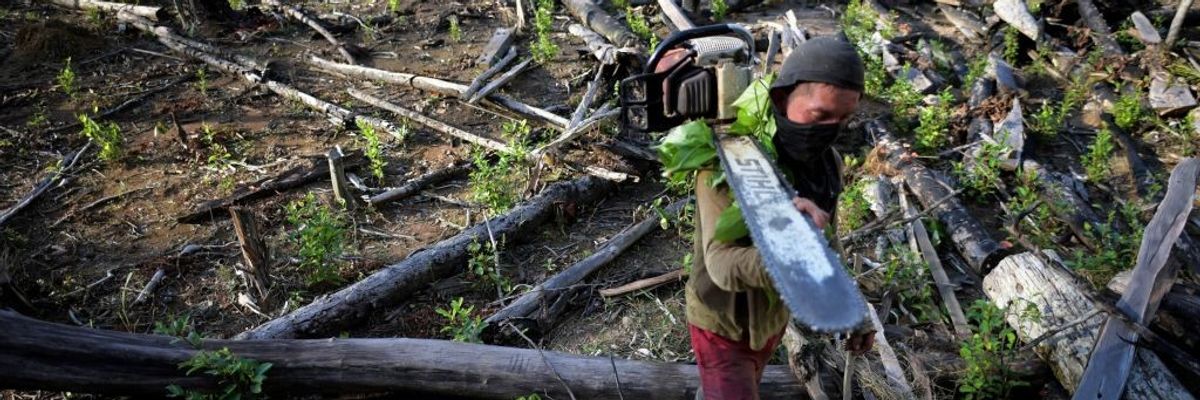
A farmer carries a chainsaw after cutting down trees to plant coca in the Amazon rainforest in Guaviare department, Colombia, on December 6, 2021.
"Trees directly underpin the survival of a staggering array of species—including us," said one scientist.
More than one-third of Earth's tree species are at risk of extinction, with logging, forest destruction for agriculture and urban development, and human-caused global heating most responsible for this "frightening" development that threatens life as we know it, according to a report published Monday.
The 2024 Global Tree Assessment—released at the United Nations Biodiversity Conference (COP16) in Cali, Colombia and published as part of this year's International Union for Conservation of Nature (IUCN) "Red List" of threatened species—warns that more than 16,000 of the 47,000 tree species analyzed in the report are at risk of extinction.
The report blames deforestation and catastrophic global heating, caused by human burning of fossil fuels, as the main drivers of tree extinction. More than 5,000 tree species on the IUCN Red List are felled for construction timber, while 2,000 species are used for fuel, food, and medicines.
According to the report:
Trees now account for over one-quarter of species on the IUCN Red List, and the number of threatened trees is more than double the number of all threatened birds, mammals, reptiles, and amphibians combined. Tree species are at risk of extinction in 192 countries around the world...
The highest proportion of threatened trees is found on islands. Island trees are at particularly high risk due to deforestation for urban development and agriculture at all scales, as well as invasive species, pests, and diseases. Climate change is increasingly threatening trees, especially in the tropics, through sea-level rise and stronger, more frequent storms.
"Trees are essential to support life on Earth through their vital role in ecosystems, and millions of people depend upon them for their lives and livelihoods," IUCN director-general Grethel Aguilar said in a statement. "As the IUCN Red List celebrates 60 years of impact, this assessment highlights its importance as a barometer of life, but also, crucially, as a unique tool guiding action to reverse the decline of nature."
Climate, environmental, and biodiversity defenders pointed to the new report with alarm.
"The significance of the Global Tree Assessment cannot be overstated, given the importance of trees to ecosystems and people," said Eimear Nic Lughadha, senior research leader in conservation assessment and analysis at the U.K. Royal Botanic Gardens, Kew. "We hope this frightening statistic of 1 in 3 trees facing extinction will incentivize urgent action and be used to inform conservation plans."
Fran Price, the Worldwide Fund for Nature's forest practice lead, said in a statement that "IUCN's Global Tree Assessment paints a shocking picture of the state of the world's trees."
"Trees are invaluable allies in tackling climate change and a critical foundation of our natural world," Price added. "The report is an eye-opening reminder that current efforts are falling short in safeguarding these vital natural assets. It's time to take stronger action against illegal logging and trade and enact stronger laws that protect our trees."
David Hole, an IUCN-U.S. board member and Conservation International scientist, asserted that "trees directly underpin the survival of a staggering array of species—including us."
"This latest IUCN update is flashing a warning light that those green giants need more of our attention and support the world over," he continued. "Thriving, naturally diverse forests are essential in mitigating both climate change and biodiversity loss. Not only do they store more carbon, they are also more resilient to natural and human-driven threats."
"We know what we have to do," Hole added. "We need to provide real and effective protection for tree species across the globe—particularly those that are imminently threatened. And we must do that in ways that support local people and communities, and doesn't cut them off from what is often a critical resource."
There is hope: Besides cutting carbon emissions and combating deforestation, Hole pointed to the "enormous untapped potential" of restoring native trees in previously degraded agricultural lands.
"Not only could we store more carbon, we could also enhance food security, support biodiversity, and increase agricultural systems' resilience to the myriad pressures that climate change is increasingly placing them under," he said. "These are the types of innovative approaches that can make a big positive difference—and it is vital we start implementing them at scale."
Dear Common Dreams reader, It’s been nearly 30 years since I co-founded Common Dreams with my late wife, Lina Newhouser. We had the radical notion that journalism should serve the public good, not corporate profits. It was clear to us from the outset what it would take to build such a project. No paid advertisements. No corporate sponsors. No millionaire publisher telling us what to think or do. Many people said we wouldn't last a year, but we proved those doubters wrong. Together with a tremendous team of journalists and dedicated staff, we built an independent media outlet free from the constraints of profits and corporate control. Our mission has always been simple: To inform. To inspire. To ignite change for the common good. Building Common Dreams was not easy. Our survival was never guaranteed. When you take on the most powerful forces—Wall Street greed, fossil fuel industry destruction, Big Tech lobbyists, and uber-rich oligarchs who have spent billions upon billions rigging the economy and democracy in their favor—the only bulwark you have is supporters who believe in your work. But here’s the urgent message from me today. It's never been this bad out there. And it's never been this hard to keep us going. At the very moment Common Dreams is most needed, the threats we face are intensifying. We need your support now more than ever. We don't accept corporate advertising and never will. We don't have a paywall because we don't think people should be blocked from critical news based on their ability to pay. Everything we do is funded by the donations of readers like you. When everyone does the little they can afford, we are strong. But if that support retreats or dries up, so do we. Will you donate now to make sure Common Dreams not only survives but thrives? —Craig Brown, Co-founder |
More than one-third of Earth's tree species are at risk of extinction, with logging, forest destruction for agriculture and urban development, and human-caused global heating most responsible for this "frightening" development that threatens life as we know it, according to a report published Monday.
The 2024 Global Tree Assessment—released at the United Nations Biodiversity Conference (COP16) in Cali, Colombia and published as part of this year's International Union for Conservation of Nature (IUCN) "Red List" of threatened species—warns that more than 16,000 of the 47,000 tree species analyzed in the report are at risk of extinction.
The report blames deforestation and catastrophic global heating, caused by human burning of fossil fuels, as the main drivers of tree extinction. More than 5,000 tree species on the IUCN Red List are felled for construction timber, while 2,000 species are used for fuel, food, and medicines.
According to the report:
Trees now account for over one-quarter of species on the IUCN Red List, and the number of threatened trees is more than double the number of all threatened birds, mammals, reptiles, and amphibians combined. Tree species are at risk of extinction in 192 countries around the world...
The highest proportion of threatened trees is found on islands. Island trees are at particularly high risk due to deforestation for urban development and agriculture at all scales, as well as invasive species, pests, and diseases. Climate change is increasingly threatening trees, especially in the tropics, through sea-level rise and stronger, more frequent storms.
"Trees are essential to support life on Earth through their vital role in ecosystems, and millions of people depend upon them for their lives and livelihoods," IUCN director-general Grethel Aguilar said in a statement. "As the IUCN Red List celebrates 60 years of impact, this assessment highlights its importance as a barometer of life, but also, crucially, as a unique tool guiding action to reverse the decline of nature."
Climate, environmental, and biodiversity defenders pointed to the new report with alarm.
"The significance of the Global Tree Assessment cannot be overstated, given the importance of trees to ecosystems and people," said Eimear Nic Lughadha, senior research leader in conservation assessment and analysis at the U.K. Royal Botanic Gardens, Kew. "We hope this frightening statistic of 1 in 3 trees facing extinction will incentivize urgent action and be used to inform conservation plans."
Fran Price, the Worldwide Fund for Nature's forest practice lead, said in a statement that "IUCN's Global Tree Assessment paints a shocking picture of the state of the world's trees."
"Trees are invaluable allies in tackling climate change and a critical foundation of our natural world," Price added. "The report is an eye-opening reminder that current efforts are falling short in safeguarding these vital natural assets. It's time to take stronger action against illegal logging and trade and enact stronger laws that protect our trees."
David Hole, an IUCN-U.S. board member and Conservation International scientist, asserted that "trees directly underpin the survival of a staggering array of species—including us."
"This latest IUCN update is flashing a warning light that those green giants need more of our attention and support the world over," he continued. "Thriving, naturally diverse forests are essential in mitigating both climate change and biodiversity loss. Not only do they store more carbon, they are also more resilient to natural and human-driven threats."
"We know what we have to do," Hole added. "We need to provide real and effective protection for tree species across the globe—particularly those that are imminently threatened. And we must do that in ways that support local people and communities, and doesn't cut them off from what is often a critical resource."
There is hope: Besides cutting carbon emissions and combating deforestation, Hole pointed to the "enormous untapped potential" of restoring native trees in previously degraded agricultural lands.
"Not only could we store more carbon, we could also enhance food security, support biodiversity, and increase agricultural systems' resilience to the myriad pressures that climate change is increasingly placing them under," he said. "These are the types of innovative approaches that can make a big positive difference—and it is vital we start implementing them at scale."
More than one-third of Earth's tree species are at risk of extinction, with logging, forest destruction for agriculture and urban development, and human-caused global heating most responsible for this "frightening" development that threatens life as we know it, according to a report published Monday.
The 2024 Global Tree Assessment—released at the United Nations Biodiversity Conference (COP16) in Cali, Colombia and published as part of this year's International Union for Conservation of Nature (IUCN) "Red List" of threatened species—warns that more than 16,000 of the 47,000 tree species analyzed in the report are at risk of extinction.
The report blames deforestation and catastrophic global heating, caused by human burning of fossil fuels, as the main drivers of tree extinction. More than 5,000 tree species on the IUCN Red List are felled for construction timber, while 2,000 species are used for fuel, food, and medicines.
According to the report:
Trees now account for over one-quarter of species on the IUCN Red List, and the number of threatened trees is more than double the number of all threatened birds, mammals, reptiles, and amphibians combined. Tree species are at risk of extinction in 192 countries around the world...
The highest proportion of threatened trees is found on islands. Island trees are at particularly high risk due to deforestation for urban development and agriculture at all scales, as well as invasive species, pests, and diseases. Climate change is increasingly threatening trees, especially in the tropics, through sea-level rise and stronger, more frequent storms.
"Trees are essential to support life on Earth through their vital role in ecosystems, and millions of people depend upon them for their lives and livelihoods," IUCN director-general Grethel Aguilar said in a statement. "As the IUCN Red List celebrates 60 years of impact, this assessment highlights its importance as a barometer of life, but also, crucially, as a unique tool guiding action to reverse the decline of nature."
Climate, environmental, and biodiversity defenders pointed to the new report with alarm.
"The significance of the Global Tree Assessment cannot be overstated, given the importance of trees to ecosystems and people," said Eimear Nic Lughadha, senior research leader in conservation assessment and analysis at the U.K. Royal Botanic Gardens, Kew. "We hope this frightening statistic of 1 in 3 trees facing extinction will incentivize urgent action and be used to inform conservation plans."
Fran Price, the Worldwide Fund for Nature's forest practice lead, said in a statement that "IUCN's Global Tree Assessment paints a shocking picture of the state of the world's trees."
"Trees are invaluable allies in tackling climate change and a critical foundation of our natural world," Price added. "The report is an eye-opening reminder that current efforts are falling short in safeguarding these vital natural assets. It's time to take stronger action against illegal logging and trade and enact stronger laws that protect our trees."
David Hole, an IUCN-U.S. board member and Conservation International scientist, asserted that "trees directly underpin the survival of a staggering array of species—including us."
"This latest IUCN update is flashing a warning light that those green giants need more of our attention and support the world over," he continued. "Thriving, naturally diverse forests are essential in mitigating both climate change and biodiversity loss. Not only do they store more carbon, they are also more resilient to natural and human-driven threats."
"We know what we have to do," Hole added. "We need to provide real and effective protection for tree species across the globe—particularly those that are imminently threatened. And we must do that in ways that support local people and communities, and doesn't cut them off from what is often a critical resource."
There is hope: Besides cutting carbon emissions and combating deforestation, Hole pointed to the "enormous untapped potential" of restoring native trees in previously degraded agricultural lands.
"Not only could we store more carbon, we could also enhance food security, support biodiversity, and increase agricultural systems' resilience to the myriad pressures that climate change is increasingly placing them under," he said. "These are the types of innovative approaches that can make a big positive difference—and it is vital we start implementing them at scale."