SUBSCRIBE TO OUR FREE NEWSLETTER
Daily news & progressive opinion—funded by the people, not the corporations—delivered straight to your inbox.
5
#000000
#FFFFFF
To donate by check, phone, or other method, see our More Ways to Give page.
Daily news & progressive opinion—funded by the people, not the corporations—delivered straight to your inbox.

Europe is facing the most significant refugee crisis since World War II. All attempts at resolving the issue have failed, mostly because they have ignored the root causes of the problem.
On June 11, Italy's new Interior Minister, Matteo Salvini, blocked the Aquarius rescue ship, carrying 629 refugees and economic migrants, from docking at its ports.
A statement by Doctors without Borders (MSF) stated that the boat was carrying 123 unaccompanied minors and seven pregnant women.
"From now on, Italy begins to say NO to the traffic of human beings, NO to the business of illegal immigration," said Salvini, who also heads the far-right League Party.
The number of refugees was repeated in news broadcasts time and again, as a mere statistic. In reality, it is 629 precious lives at stake, each with a compelling reason why she/he has undertaken the deadly journey.
While the cruelty of refusing entry to a boat laden with desperate refugees is obvious, it has to be viewed within a larger narrative pertaining to the rapidly changing political landscape in Europe and the crises under way in the Middle East and North Africa.
Italy's new government, a coalition of the anti-establishment Five-Star Movement and the far-right League party, seems intent on stopping the flow of refugees into the country, as promised on the campaign trail.
"If politicians continue to ignore the root causes of the problem, the refugee crisis will not go away on its own."
However, if politicians continue to ignore the root causes of the problem, the refugee crisis will not go away on its own.
The disturbing truth is this: Europe is accountable for much of the mayhem under way in the Middle East. Right-wing pundits may wish to omit that part of the debate altogether, but facts will not simply disappear when ignored.
European politicians should honestly confront the question: what are the reasons that lead millions of people to leave their homes? And fashion equally honest and humane solutions.
In 2017, an uprising-turned-civil-war in Syria led to the exodus of millions of Syrian refugees.
Ahmed is a 55-year old Syrian refugee, who fled the country with his wife and two children. His reason for leaving was no other than the grinding, deadly war.
He told the UN Refugees Agency: "I was born in Homs and I wanted to live there until the end, but this vicious war left us no other choice but to leave all behind. For the sake of my children's future we had to take the risk."
"I had to pay the smuggler eight thousand US dollars for each member of my family. I've never done anything illegal in my whole life, but there was no other solution."
Saving his family meant breaking the rules; millions would do the same thing if confronted with the same grim dilemma. In fact, millions have.
African immigrants are often blamed for 'taking advantage' of the porous Libyan coastline to 'sneak' into Europe. Yet, many of those refugees had lived peacefully in Libya and were forced to flee following the NATO-led war on that country in March 2011.
"I'm originally from Nigeria and I had been living in Libya for five years when the war broke out," wrote Hakim Bello in the Guardian.
"I had a good life: I was working as a tailor and I earned enough to send money home to loved ones. But after the fighting started, people like us - black people - became very vulnerable. If you went out for something to eat, a gang would stop you and ask if you supported them. They might be rebels, they might be government, you didn't know."
The security mayhem in Libya led not only to the persecution of many Libyans, but also millions of African workers, like Bello, as well. Many of those workers could neither go home nor stay in Libya. They, too, joined the dangerous mass escapes to Europe.
War-torn Afghanistan has served as the tragic model of the same story.
Ajmal Sadiqi escaped Afghanistan, which has been in a constant state of war for many years, a war that took a much deadlier turn since the US invasion in 2001.
Sadiqi told CNN that the vast majority of those who joined him on his journey from Afghanistan, through other countries to Turkey, Greece and other EU countries, died along the way. But, like many in his situation, he had few alternatives.
"Afghanistan has been at war for 50 years and things are never going to change," he said.
"Here, I have nothing, but I feel safe. I can walk on the street without being afraid."
Alas, that sense of safety is, perhaps, temporary. Many in Europe are refusing to examine their own responsibility in creating or feeding conflicts around the world, while perceiving the refugees as a threat.
Despite the obvious correlation between western-sustained wars and the EU's refugee crisis, no moral awakening is yet to be realized. Worse still, France and Italy are now involved in exploiting the current warring factions in Libya for their own interests
Syria is not an entirely different story. There, too, the EU is hardly innocent.
The Syria war has resulted in a massive influx of refugees, most of whom are hosted by neighboring Middle Eastern countries, but many have sailed the sea to seek safety in Europe.
"All of Europe has a responsibility to stop people from drowning. It's partly due to their actions in Africa that people have had to leave their homes," said Bello.
"Countries such as Britain, France, Belgium and Germany think they are far away and not responsible, but they all took part in colonizing Africa. NATO took part in the war in Libya. They're all part of the problem."
Expectedly, Italy's Salvini and other like-minded politicians refuse to frame the crisis that way.
They use whichever discourse needed to guarantee votes, while ignoring the obvious fact that, without military interventions, economic exploitation and political meddling, a refugee crisis - at least one of this magnitude - could exist in the first place.
Until this fact is recognized by EU governments, the flow of refugees will continue, raising political tension and contributing to the tragic loss of lives of innocent people, whose only hope is merely to survive.
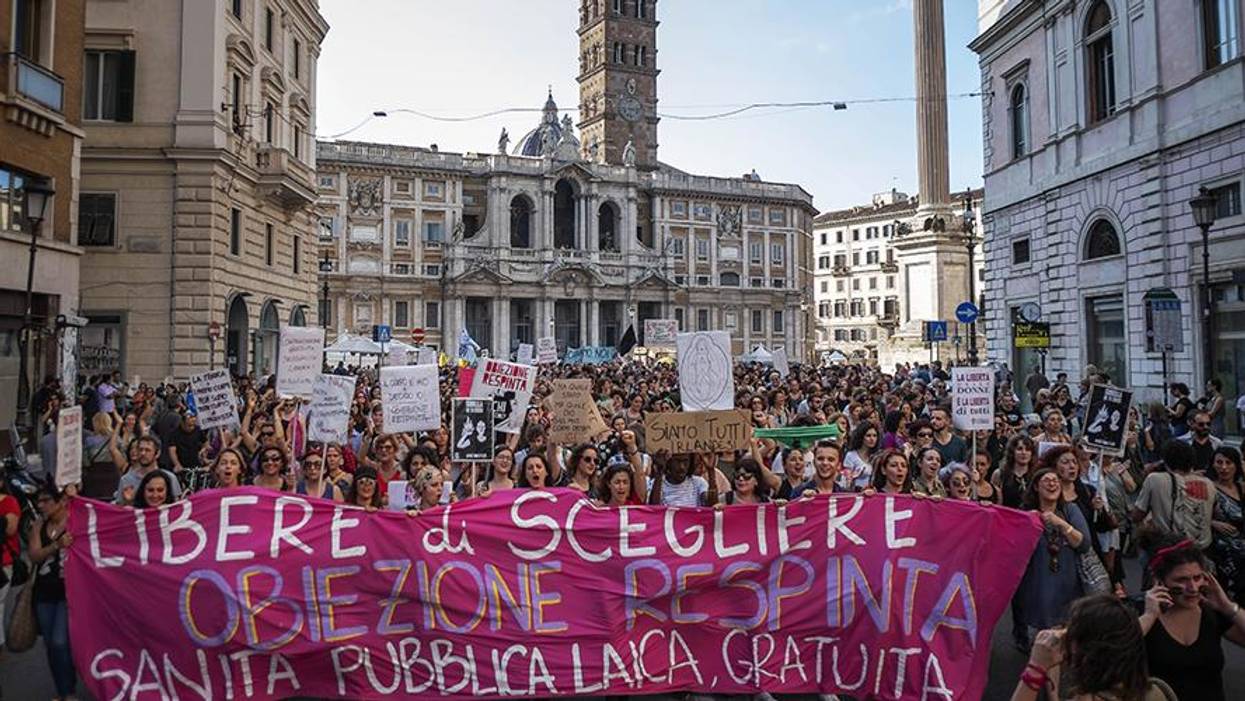
Thousands of women marched across Italy on Saturday afternoon to mark the anniversary of Italy's 194 Law, which passed in 1978 and legalized abortion in the country.
Marchers fear that the far-right, anti-European Union, anti-immigrant League, which contains many anti-choice militants, will soon threaten the 194 Law. The League stands on the brink of forming a government with the anti-establishment Five Star Movement following the general elections in March.
Saturday's mobilization was organized by 'Obiezione Respinta' (Rejected Objection) and the 'Non una di meno' (Not one less) movement.
"Italian women's battles over the last four decades show that any abortion law has to be founded on women's freedom of choice -- or it won't work," Michela Pusterla, an Italian feminist involved in the Non una di meno movement, wrote Friday in Jacobin. " In Italy and elsewhere, as fascist and sexist anti-choice movements grow their presence in Parliaments and public hospitals, the fight for reproductive rights becomes larger than itself. It becomes a global fight for liberation; for another society based on autonomy and self-determination."
The anti-abortion movement is strong in Italy, due in part to the strong influence of the Catholic Church.
Under Law 194, women have the right to an abortion in the first 90 days of pregnancy due to health, economic, social or family reasons, while between the 12th and 20th week, either a significant fetal abnormality must be present, posing a serious risk to the woman's mental or physical health, or there must be a danger to the woman's life if she continues with the pregnancy.
The law includes a recognition of the "social value of motherhood," and allows medical professionals to refuse to carry out abortions on the grounds of conscientious objection. According to the Italian health minister, just over 70 percent of gynecologists in Italy refuse to carry out the procedure. Campaigners say that the increased difficulty in accessing abortion is pushing more and more women to illegal, unsafe abortions or to travel abroad for the procedure.
Italy has been criticized by both the Council of Europe and the UN for the serious obstacles to accessing safe abortion.
Former Italian Minister of Foreign Affairs and former EU Commissioner Emma Bonino was at the forefront of bringing about the enactment of Law 194. Bonino called on Italian women not to "take their rights for granted," speaking on the 40th anniversary of the law she helped introduce. "40 years on from the passing of Legge 194, there is still a long road ahead of us," she said.
Richard Haass, President of the Council on Foreign Relations, recently wrote a column entitled "Liberal World Order, R.I.P."
Haass sees the post-World War II order succumbing to centrifugal forces. He foresees a fragmented and chaotic world made up of "regional orders" or "disorders", along with the return of great-power rivalries that some thought had ended with the Cold War.
He's offering a eulogy, but one he hopes will revive the deceased before the burial is final.
Haass has a distinguished resume as a diplomat, Defense Department official, presidential advisor, author, and Harvard lecturer. Few people have achieved as much prominence in the current system of international relations. He writes with the authority of an insider who has stood near the epicenter of global power.
But the view from the periphery, where most people live and work, is very different.
It's true that we are in a period of global change, and the loss of a governing world order brings instability, uncertainty, and risk. But the real causes of today's political instability lie within the order itself.
That order has served the economic and strategic interests, not of nations, but of certain powerful interests within nations. The contradiction may not have been as apparent in times of relative prosperity, but became more visible after the financial crisis of 2008 - a crisis brought on, in part, by financial deregulation imposed by the order itself.
Haass never offers a critical examination that order. In his telling, the most powerful system of international governance in human history is largely the victim of forces beyond its control.
Haas cites "the effects of growing populism" as "parties of the political extremes have gained ground in Europe." The United Kingdom's Brexit vote "attested to the loss of elite influence" and notes that "even the US is experiencing unprecedented attacks from its own president on the country's media, courts, and law-enforcement institutions."
Why is this happening? Haass acknowledges the role of "stagnating incomes and job loss," but otherwise treats these events as news from nowhere. The "liberal" world order's role in creating those conditions is ignored. Instead, Haass says that "new technologies" are "mostly" responsible.
A working paper from the International Monetary Fund contradicts this claim. It concludes, "Among developed countries...the adverse impact of globalization is somewhat larger than that of technological progress."
Haass' interpretation ignores the impact of global trade deals on jobs and wages in the United States and other developed countries. The U.S. Department of Labor has identified nearly one million individual American workers who lost their jobs to NAFTA.
Trade between the United States and China after the creation of the World Trade Organization resulted in the loss of an estimated 2 million to 2.4 million American jobs between 1999 and 2011.
The pain wasn't restricted to the U.S., either. A U.N. commission led by Nobel Prize-winning economist Joseph Stiglitz concluded that international agreements and institutions "prevent them from regulating the operations of financial institutions and instruments or capital flows," putting them at risk for additional harm.
These treaties have placed corporate interests above emerging nations' rights to protect their environments, their consumers, and their workers. Studies have shown that their dispute resolution mechanisms heavily favor corporations and the extremely wealthy, and that they have accelerated wealth inequality.
Extreme poverty has been reduced worldwide in recent decades, which is something to celebrate. But that reduction in extreme poverty largely occurred in China, and came largely at the expense of working people in the developed world.
The wealthy and influential few continue to benefit from the current order. A recent report concluded that 82 percent of the wealth created last year went to the world's richest 1 percent. Oxfam calculates that the new wealth obtained by billionaires alone could end world poverty seven times over.
Haass rightly decries Donald Trump's rise, but ignores the economic conditions that contributed to it. Wealth inequality is reaching new extremes in the United States, Entire portions of the United States are being left behind. In a new paper, economists Benjamin Austin, Edward Glaeser, and Lawrence Summers conclude,
"The economic convergence of American regions has greatly slowed, and rates of long-term non-employment have even been diverging. Simultaneously, the rate of non-employment for working age men has nearly tripled over the last 50 years, generating a terrible social problem that is disproportionately centered in the eastern parts of the American heartland."
"America," they write, "appears to be evolving into durable islands of wealth and poverty."
These disparities, which include the persistent rates of poverty and unemployment in America's inner cities, make it increasingly clear that entire portions of the United States have been economically abandoned.
Economic insecurity is also tied to far-right victories throughout the developed world. Inequality is extremely high in the United Kingdom, where voters rejected the EU. The far-right AfD party recently gained strength in the eastern part of Germany, which is lagging behind the western part of that country economically.
In France, where racist Marine Le Pen had an unexpectedly strong showing in first-round presidential voting, inequality is greater than is commonly believed. In Italy, where the maverick Five Star movement won a string of recent victories, almost one in three people is at risk for poverty or social exclusion (defined as the inability to fully participate economically, politically and socially in the nation or their communities).
We live in a profoundly unequal world. 70 percent of the world's population owns only 3 percent of its wealth, while 8.6 percent of the population owns more than 85 percent. Eight men own more wealth than four billion people, making up half the human population. Even as their economies grow, extreme wealth inequality plagues countries like Kenya, Brazil, and Nigeria.
And yet, the closest Haass comes to acknowledge the world order's faults is his admission that "global institutions have failed to adapt to new power balances and technologies." That leaves out the active role these institutions have played in today's unjust outcomes. The current order hasn't just "failed to adapt" to today's negative changes; in many cases, it has imposed them on unwilling populations.
Those outcomes have not only been economic. Haass correctly points out that the postwar order has prevented another global conflagration on the scale of World Wars I and II. But the liberal world order, we are told, was to be based on the rule of law and respect for countries' sovereignty and territorial integrity. Human rights were to be protected."
Adds Haass: "All this was to be applied to the entire planet."
And yet, under the "liberal world order," labor leaders are slaughtered with impunity in Ecuador. The U.S. was complicit, and other developed nations were indifferent, when the Indonesian dictator Suharto terrorized and murdered as many as a million in his country. The brutal exploitation of slave labor in Malaysia was downplayed in an unsuccessful attempt to pass another trade deal, the Trans-Pacific Partnership.
The United States is, as Haass reminds us, "the principal architect of the liberal world order and its principal backer." It was also, as Haass notes, "a principal beneficiary" of that order. But the real "beneficiaries" were frequently those wealthy and powerful interests who profited from its trade deals and military expenditures.
The U.S.'s role as "principal architect" of the world order didn't prevent it from engaging in some very disordered wars, especially in Vietnam and Iraq, where its military intervention triggered the ongoing Middle Eastern conflicts that Haass chalks up to "regional disorder."
The "liberal world order" hasn't helped competing nations get along. It has helped a small number of people, representing powerful interests in competing nations, work for their shared self-interest. It has permitted an international system of tax havens that undercuts national sovereignty and accelerates wealth inequality. And it has left most other people behind.
Complaints like these often sound tendentious and preachy to the people who lead our global system of finance and diplomacy. But the lived reality of the world's majority contradicts the perceptions of the influential few. If they are concerned with the future of the order they have built, they will need to confront that broader reality.
They'll also need to avoid facile dismissals of "parties of political extremes." That phrasing obscures the differences between the plutocratic nativism of Donald Trump in the U.S. and the social-democratic vision of Jeremy Corbyn in the U.K., or of the neo-fascist Party of the Golden Dawn in Greece and the nonviolent "political revolution" of Bernie Sanders in the U.S.
Corbyn wants to revitalize the political movement that built Western Europe. Sanders wants to reinvigorate the ideals of Franklin D. Roosevelt's New Deal. These ideals - along with those of Spain's Podemos and other progressive movements - are the world's best protection against the terrifying prospect of hate-based ultranationalist movements.
The "liberal world order" must own up to its mistakes. They were errors of commission, as well as omission. Today's chaos - from Brexit to Trump - is fallout from a global system that works for the benefit of a privileged few and has failed to offer democratic alternatives to inequality and oligarchy.
Richard Haass once compared the United States to a "reluctant sheriff," saying it should accept the responsibility of maintaining world order along with a "posse" of cooperating nations. That's an appealing image for Americans. But life isn't a western movie, and the American sheriff has been more trigger-happy than Haass may care to admit.
For role models, the country would be better off turning to Martin Luther King, Jr. April 4 will mark the 50th anniversary of Dr. King's assassination. In his "Beyond Vietnam" speech, Dr. King called that war "a symptom of a far deeper malady within the American spirit," adding that "if we ignore this sobering reality, we will find ourselves organizing ... for the next generation ... and attending rallies without end ..."
Through war after war, in the US and worldwide, people living under the "liberal world order" over the lst 50 years have done exactly that.
Is the "liberal world order" worth saving? Not in its present form. Yes, it has provided some semblance of order. But order without justice is both unfair and unstable. The unfairness has been apparent for many decades. Now we're seeing the instability.
In a new book, "A World in Disarray: American Foreign Policy and the Crisis of the Old Order," Haass proposes restructuring the world order along globalized lines. Under the principle of "sovereignty as responsibility," governments would be held accountable for meeting certain obligations to other nations. Haass calls this "realism for an era of globalization."
He proposes nothi9ng however, that would alter the trajectory of global inequality. When Haass addresses economic issues, in this book or elsewhere, he falls back on the elite financial prescriptions that have repeatedly failed the global majority: a fixation on debt, cuts to social programs like Medicare and Social Security, and an over-reliance on education as a solution for labor displacement.
These errors reflect those of the overall "liberal world order." For a world population seeking transformation, there are no answers here.
The current world order must fundamentally reform itself along democratic lines, both politically and economically. If it doesn't, it will fall. Haass fears that, if that happens, "the result will be a world that is less free, less prosperous, and less peaceful, for Americans and others alike."
He may be right. What follows could either be better - or much, much worse - than what we have today. But today's global power elite has failed to deliver freedom, prosperity, or peace to billions of people across the world.
The greatest threat to the "liberal world order" lies in its failure to reflect on its own fundamental injustices. It lacks accountability. If those who lead it can't acknowledge its flaws - if Dr. King's "revolution of values" can't turn it into an engine of change for workers, the poor, refugees, and the other victims of its manifold failures - the system that Richard Haass wants to protect and improve will fail. And it will deserve to.

For over 40 years, Britain has pushed extreme, free-market policies in the European Union (EU). While the EU has delivered, for Britain, better workers' rights, cleaner air and water, and more enforceable human rights, Britain has consistently argued against the regulation of big business and big finance and against better social protection.
While enjoying special privileges and rebates, Britain consistently argued for opt-outs, believing it was an exceptional member of the EU, too good for the rules that apply to everyone else. David Cameron's pre-referendum negotiations wanted more exemptions, which would have allowed it to crack down on migrants' rights, protect the City of London's financial excesses and drive deregulation.
So it might seem strange to suggest Britain could help save the EU from the existential crisis it finds itself in - a crisis caused by too many years of kowtowing to big business, deregulation and stripping back the welfare state. Even more so, given that Britain is set to leave the EU in 12 months' time. Yet this is exactly what a group of Labour Party activists posit in a new report released on March 8, "The Corbyn moment and European Socialism".
The argument is made by Another Europe is Possible, backed by supporters of Labour Party leader Jeremy Corbyn, like Julie Ward, MEP, and union leader Manuel Cortes. They urge Corbyn to commit to remaining in the EU if he wins the next election, and working with allies to push a series of dramatic reforms to transform the EU.
"The election of a left-wing government inside the EU could promote radical reform across Europe, including reform of the EU institutions, harmonisation of corporation tax, clamping down on tax avoidance, regulating banks, introducing a financial transaction tax, protecting migrant workers while strengthening trade unions, and opening up legal routes into Europe for migrants."
They argue that Britain cannot tackle the power of big business on its own, and, indeed, a future Labour government locked into hard Brexit would be beset by economic and political chaos, caused by Britain pulling out of Europe, falling prey to financial destabilisation and to bullying by big business and Donald Trump.
On the other hand, the election of a left-wing government inside the EU could promote radical reform across Europe, including reform of the EU institutions, harmonisation of corporation tax, clamping down on tax avoidance, regulating banks, introducing a financial transaction tax, protecting migrant workers while strengthening trade unions, and opening up legal routes into Europe for migrants.
Is it really serious to think Britain could play an important role in making Europe fairer?
Britain's political system is in chaos as a result of the referendum in 2016, but this shouldn't blind us to the deep crisis across the EU. Fascists, spouting anti-migrant rhetoric, are on the march throughout Europe. Italy's elections showed the anti-establishment, populist Five Star Movement trouncing the social democrats. The German social democrats faced an awful decision: a coalition with the centre-right, a strategy which has caused their loss of popularity, or causing another election and letting the increasingly fascistic AFD get one step closer to power. They chose the former, and are daily haemorrhaging support.
Elsewhere, Greece, pushed into depression by the European institutions, continues to suffer a depression more severe and longer-lasting than that experienced by the US in the 1930s. From north to south, east to west, people are angry and desperate after 40 years of anti-social, free-market economics which hollowed out communities and disenfranchised citizens.
We are in a political crisis deeper than any in a generation. Brexit and Trump will be only the beginning of a dark descent, unless radical reform is enacted. Control must be handed back to people at a local level, but the nation-state is not a modern answer to our problems. Within our current economic system, nation-states will ferociously compete, undercutting and blaming each other for their common problems. That's the history of the last century.
A radically transformed EU, however, is a political unit which could replace rule by multinational corporations with rule by citizens, tackle climate change by ending its exploitation of the world's resources for profit, and create a fairer world of peace and collaboration.
Another point is this: there is a bigger chance of really big change in Britain than we've ever seen. That change is needed across Europe. If we remain in the EU, a radical government could light the spark of transformation across our continent.
The good news out of Europe is that Marine Le Pen's neo-Nazi National Front took a beating in the May 7 French presidential election. The bad news is that the program of the winner, Emmanuel Macron, might put Le Pen back in the running six years from now.
The good news out of Europe is that Marine Le Pen's neo-Nazi National Front took a beating in the May 7 French presidential election. The bad news is that the program of the winner, Emmanuel Macron, might put Le Pen back in the running six years from now.
Macron pledges to cut 120,000 public jobs, reduce spending by 60 billion Euros, jettison the 35-hour workweek, raise the retirement age, weaken unions' negotiating strength, and cut corporate taxes. It's a program that is unlikely to revive the morbid French economy, but it will certainly worsen the plight of jobless youth and seniors -- and hand the National Front ammunition for the 2022 election.
"Europe is enmeshed in an economic crisis brought on by the structure of the European Union on one hand and the nature of capitalism on the other."
Europe is enmeshed in an economic crisis brought on by the structure of the European Union on one hand and the nature of capitalism on the other. That convergence has derailed economies throughout the 27-member trade group, impoverished tens of millions, and helped conjure up racist, right-wing movements that aren't likely to be deterred by a few election losses.
Obscuring the roots of this crisis is the myth that debt is the result of spendthrift behavior, the economic sluggishness a consequence of high taxes, and rigid labor rules that handcuff businesses and inhibit growth. German Chancellor Angela Merkel is fond of saying that countries should behave like a "frugal Swabian house frau."
Is Merkel's observation based on a myth or is it allegory? While an allegory is the "figurative treatment of one subject under the guise of another," a myth is "an unproven or false collective belief that is used to justify a social institution." While the difference may seem pedantic, it's anything but.
And because myths are particularly hard to dislodge once they become widespread, it's essential to unpack exactly how the EU got itself in trouble.
The Nested Crises of Capitalism
Part of the problem is capitalism itself, an economic system that generates both enormous productive capacity and economic chaos.
Capitalism is afflicted by two kinds of crisis: cyclical and structural. The cyclical ones -- recessions -- tend to occur pretty much every 10 ten years. The U.S. and Europe went through recessions in the early 1980s, early 1990s, and the first years of 2000. They are painful and unpleasant but generally over in about 18 months.
Every 40 or 50 years, however, there's a structural crisis like the 1929 crash and the ensuing Great Depression.
When a structural crisis hits, capitalism re-organizes itself. In the 1930s, the solution was to create a redistributive capitalism that used the power of the state to prime the economic pump and alleviate some of the chaos that accompanies such re-organizations. Unemployment insurance and Social Security took some of the edge off the pain, public works absorbed some of the jobless, and unions got the right to organize and strike.
Capitalism went through another structural crisis at the end of the 1970s, and it is the fallout from that one that currently plagues the EU -- and the U.S. Using the 1979-1981 recession as a screen, taxes on corporations and the wealthy were slashed, business and finance de-regulated, public institutions privatized, and unions assaulted. Capitalism also went global.
Globalism did spur enormous growth, but with a deep flaw. With unions weakened -- in part by direct attack, in part by the enormous pool of cheap labor now available in the developing world -- wages either stagnated or fell in Europe and the U.S., and the gap between rich and poor widened. A 2015 study by Oxfam found that 1 percent of humanity now controls over half the world's wealth, and the top 20 percent owns 94.5 percent. In short, 80 percent of the world gets by on just 5.5 percent of the world's wealth.
This isn't just a problem for the developing and under-developed world. Germany has the biggest economy in the EU, and the fourth largest in the world. In 2000, Germany's top 20 percent earned 3.5 percent more than the bottom 20 percent. Today that number has increased five times. For the bottom 10 percent, income has actually fallen.
If that Swabian house frau is among that 10 percent, it doesn't make a whole lot of difference how frugal she is -- she's broke.
Bailing Out the Speculators
Globalization generated instability by creating a crisis of accumulation. A few people had lots of money, but far too many had very little, certainly not enough to absorb the output of the global economy. Global capitalism was awash with cash, but where to use it? The answer was financial speculation -- especially since many of the restraints and safety measures had been removed through deregulation.
For Europe, most of that speculation went into land. Land prices in Spain and Ireland rose 500 percent from 1999 to 2007. In the case of Ireland, it was almost unreal. Irish real estate loans went from 5 billion Euros in 1999 to 96.2 billion Euros in 2007, or more than half the GDP of the Irish Republic. Over the same period, European household debt increased on the average by 39 percent.
That this was a bubble was obvious, and all bubbles pop sooner or later. This one exploded in the U.S. in late 2007 and quickly spread to Europe.
What's important to keep in mind is that the EU countries that got in trouble were hardly spendthrifts. Spain, Portugal, and Ireland all had modest debt ratios and budget surpluses at the time of the crisis.
The problem was not prodigal governments but a sudden hike in borrowing rates, which made it expensive to finance government operations. That was coupled with a decision to use taxpayer money to bail out banks that had gotten themselves in trouble speculating on real estate. Essentially, ordinary Portuguese, Spaniards, Greeks, and Irish picked up the debts of banks they had never borrowed anything from.
Irish taxpayers shelled out 30 billion euros to bailout the Irish-Anglo bank, a figure equivalent to the Republic's tax revenues for an entire year. Since none of these countries had that kind of money on hand, they applied for "bailouts" from the International Monetary Fund, the European Central Bank, and the European Commission, the so-called "troika." Some 89 percent of those bailouts went to banks. The day the Greek bailout was announced, French bank shares rose 24 percent.
It was not that EU countries were debt free. But in 2014, the Committee for a Citizen's Audit on the Public Debt found that between 60 and 70 percent of those debts were due not to overspending, but instead to tax cuts for corporations and the wealthy, and increases in interest rates. The latter favors creditors and speculators. The committee found that most deficits were the result of "political decisions" that shift the wealth from one class to another.
In the long run, some of that debt will have to be forgiven because it is simply unpayable. The 1952 London Debt Convention that cut Germany's post-war debt and ignited an economic revival could serve as a template.
"We Cannot Possibly Let an Election Change Anything"
Converging with this crisis of capitalism is the way the EU is structured, although the two are hardly independent of one another. Many of EU's strictures were specifically designed to favor capital and finance and to marginalize the control that the Union's 500 million members have over economic matters.
The first problem is that all economic decisions are made by the "troika," an unelected body that answers to no one. There is a European Parliament, but it has little power or control over finance. The same is true for EU member governments. When former Greek Finance Minister Yanis Varoufakis told German Finance Minister Wolfgang Wolfgang Schauble that his left-wing Syriza Party was elected to resist the austerity policies of the EU, Schuable replied, "We cannot possibly let an election change anything."
The second problem is that national governments have no control over the value of the euro. Of the EU's 27 members, 19 of them use the common currency and make up the Eurozone. Germany's condition for giving up the mark and adopting the euro was that Eurozone members were required to keep budget deficits to no more than 3 percent of national income, and debt levels to no higher than 60 percent of GDP. While that formula works well for Germany's powerful export model, it doesn't for a number of other Eurozone economies.
The Euro's value is set by the European Central Bank, which means that members cannot devalue their currency -- a common strategy for dealing with debt, and one near and dear to the U.S. Treasury. As long as it's smooth sailing, this rule works, but when a financial crisis hits, the common currency and the debt restrictions can mean big trouble for the smaller, less export-centered economies.
When the financial bubble popped in 2008, countries like Italy, Spain, Portugal, and Ireland -- and to a certain extent, France -- saw their debts soar, with strategies for dealing with it hamstrung by the Eurozone rules.
And that's when the third problem with the Eurozone kicked in. While there is a common currency, there is no sharing of debt through tax receipts. In a single currency system like the U.S., powerful economies in California and New York pay for bills in poorer places like Mississippi and Louisiana.
Some 44 percent of Louisiana's state budget is paid for by the federal government, which collects taxes in wealthy states and doles out some of it to regions whose economies are either too small or inefficient to meet their budget needs. If you get into trouble in the Eurozone, on the other hand, you're on your own.
While the EU has been good for banks and countries like Germany and Austria, it hasn't been so good for many other members. Applying austerity as a cure for debt doesn't cure the problem, it just creates a spiral of more debt and yet more austerity. As Rana Foroohar, business columnist for the Financial Times put it, "No nation can grow when the consumer, the corporate sector, and the public sector stop spending."
Because most of Europe's center-left parties bought into the austerity-as-a-cure-for-debt formula, they have been devastated at the polls. The Dutch Labor Party was crushed in the last election, the French Socialists got less than 7 percent of the vote, and the Spanish Socialists are barely keeping ahead of the much more left-wing Podemos Party. The Italian Socialist Party has dropped over 15 points in the polls and is now running behind the rather bizarre Five Star Movement. The Greek Socialists are a footnote.
Signs of Life on the Left?
The lesson for the left would seem to be that moving to the center or the right is a prescription for electoral disaster.
True, Macron's new centrist party, En Marche, did win big in France's recent legislative elections -- but mostly due to the anti-Le Pen vote. His program of austerity, restraints on unions, and corporate tax cuts is not embraced by most French people. Though he appears likely to win a decisive majority, he plans to push the measures through by decree if he doesn't.
It's unlikely that such a centrist program will do anything to reduce France's unemployment rate -- 9.6 percent overall and 25 percent among youth aged 18 to 29 -- or lift the economy. Labor "reform" and austerity don't jumpstart economies, and tax cuts have an equally dreary record.
Indeed, as Foroohar points out, there's not a single example in the last 20 years where tax cuts for businesses or the wealthy stimulated an economy. Indeed, the economic surge in the 1990s happened while tax rates were on the rise.
If the economic situation worsens, or even stays the same, the right will be waiting to pounce with their easy answers to economic crisis: nationalism and racism.
The clock is ticking. Germany will hold elections in September, and it looks as if Italy will also go to the polls this fall. In Spain, the right-wing minority government is looking increasingly fragile and another election is a strong possibility.
Center-left parties are doing well in Portugal, where the Socialists have made common cause with two more leftist parties. In Britain the Labor Party's sharp break with Blairite centrism upended the Conservative Party, denying it a majority in Parliament. A recent YouGov poll found that a majority of Britons supported Labor's left-wing platform over the Conservatives' austerity program.
The Portuguese coalition is demonstrating that there are successful economic models out there to deal with debt and growth that don't impoverish the many for the benefit of a few. The question is, can the left in Italy, Spain, and Germany put together programs that tap into the seething unrest that globalism's inequality has generated?
Going in to the recent elections in the Netherlands, the mainstream story seemed lifted from William Butler Yeats poem, The Second Coming: "Things fall apart; the center cannot hold -- The best lack all conviction, while the worst are full of passionate intensity."
The right was on the march, the left at war with itself, the traditional parties adrift, and the barbarians were hammering at the gates of the European Union.
It's a grand image, rather like Game of Thrones. But the reality is considerably more complex.
There is, of course, some truth in the apocalyptic imagery: right-wing parties in the Netherlands, France, and Germany have grown. There are indeed some sharp divisions among left parties. And many Europeans are pretty unhappy with those that have inflicted them with austerity policies that have tanked living standards for all but a sliver of the elite.
But there are other narratives at work in Europe these days besides an HBO mega series about blood, war, and treachery.
A Shot Across the Status Quo in the Netherlands
The recent election in the Netherlands is a case in point. After holding a lead over all the other parties, Geert Wilders' right-wing, racist Party for Freedom faltered. In the end, his Islamophobes didn't break the gates, though they did pick up five seats.
Overall it was a victory for the center, but it was also a warning for those who advocate "staying the course" politics -- and, most pointedly, the consequences of abandoning principles for power.
The Left Greens did quite well by taking on Wilders' anti-Islam agenda and challenging Prime Minister Mark Rutte's center-right Popular Party for Freedom and Democracy on the economic front. In one national debate, Jesse Klaver, the GreenLeft's dynamic leader, argued that janitors should be paid more and bankers less. The election, he said, is not about "Islam and Muslims," but about "housing, income, and health care." The voters clearly bought it.
Rutte's coalition partner, the center-left Labor Party, was crushed, losing 29 seats. For the past four years, the Dutch Labor Party has gone along with Rutte's program of raising the retirement age and cutting back social spending, and voters punished them for shelving their progressive politics for a seat at the table.
Rutte's party also lost eight seats, which probably went to centrist parties like Democrats66, suggesting that Rutte's "business as usual" isn't what voters want either (though it's still the number one party in the 150-seat parliament).
There were some lessons from the Dutch elections, though not the simplistic one that the "populist" barbarians lost to the "reasonable" center.
What it mainly demonstrated is that voters are unhappy with the current situation, they are looking for answers, and parties on the left and center left should think carefully about joining governments that think it "reasonable" to impoverish their own people.
France on the Brink
Next up in the election docket is France, where polls show Marine Le Pen's neo-Nazi National Front leading the pack in a five-way race with traditional right-wing candidate Francois Fillon, centrist and former Socialist Party member Emmanuel Macron, Socialist Party candidate Benoit Hamon, and leftist Jean-Luc Melenchon.
The first round, scheduled for April 23, will eliminate all but the two top vote getters. A final round will be held May 7.
With Melenchon and Hamon running at 11.5 percent and 13.5 percent respectively, thus splitting the left vote, the race appears to be between Fillon, Macron, and Le Pen, with the latter polling slightly ahead of Macron and considerably better than Fillon.
If you're attracted to the apocalypse analogy, France is probably your ticket.
Le Pen is running a campaign aimed against anyone who doesn't look like Charlemagne or Joan of Arc, but her strong anti-EU positions play well with young people, in small towns, and among rural inhabitants. All three groups have been left behind by neoliberal EU policies that have resulted in de-industrialization and growing economic inequality. Polls indicate she commands 39 percent of 18-to-24 year olds, compared with 21 percent for Macron and 21 percent for Fillon.
Fillon has been wounded by the revelation that he's been using public funds to pay family members some $850,000 for work they never did. But even before the scandal, his social conservatism played poorly with the young, and workers are alienated by his economic strategy that harkens back to that of British Prime Minister Margret Thatcher, whom he greatly admires. His programs sound much like Donald Trump's: Cut jobless benefits and social services, lay off public workers, and give tax cuts to the wealthy.
Macron, an ex-Rothschild banker and former minister of economics under Hollande, is running neck and neck with Le Pen under the slogan "En Marche" ("On Our Way"), compelling critics on the left to ask "to what?" His platform is a mix of fiscal discipline and mild economic stimulation. At 39, he's young, telegenic, and a good speaker. But his policies are vague, and it's not clear there's a there there.
Most polls indicate a Le Pen vs. Macron runoff, with Macron coming out on top, but that may be dangerous thinking. Macron's support is soft. Only about 50 percent of those who say they intend to vote for him are "certain" of their vote. In comparison, 80 percent of Le Pen's voters are "certain" they will vote for her.
There are, as well, some disturbing polling indications for the second round. According to the IFOP poll, some 38 percent of Fillon's supporters say they'll jump to Le Pen -- that's 2 million voters -- along with 7 percent of Hamon voters and 11 percent of Melenchon backers.
What may be the most disturbing number, however, is that 45 percent of Melenchon voters say they won't vote at all if Macron is the anti-Le Pen candidate in the second round. Some 26 percent of Fillon's voters and 21 percent of Hamon's voters would similarly abstain.
Le Pen will need at least 15 million votes to win, and the Front has never won more than 6 million nationally. But if turnout is low, Le Pen's strongly motivated voters could put her into the Elysee Palace. In this way, France most resembles Britain prior to the Brexit vote.
If that comes to pass, Le Pen will push for a national referendum on the EU. There's no guarantee the French will vote to stay in the Union. And if they leave, that will be the huge trade organization's death knell. The EU can get along without Britain, but it could not survive a Frexit.
Surprising Strength on the German Left
Germany will hold national elections on September 24, but the story there is very different than the one playing out in France.
The German government is currently a grand coalition between Chancellor Angela Merkel's conservative Christian Democrats and the center-left Social Democrats. The alliance has been a disaster for the Social Democrats, which at one point saw its poll numbers slip below 20 percent.
But German politics has suddenly shifted. On Merkel's left, the Social Democrats changed leaders and have broken with industrial policies that have driven down the wages of German workers in order to make the country an export juggernaut. On the chancellor's right, the racist, neo-Nazi Alternative for Germany has drained Christian Democrat voters to support a ban on immigration and a withdrawal from the EU, although the Alternative is dropping in the polls.
The game changer has been the sudden popularity of former EU president Martin Schulz, the new leader of the Social Democrats. The party is now neck and neck with Merkel's bloc, and some polls show Schulz actually defeating Merkel. In terms of personal popularity, Schulz is now running 16 points ahead of Merkel. While the chancellor's Christian Democrat alliance tops the polls at 34 percent, the Social Democrats are polling at 32 percent and climbing.
Schulz has made considerable headway critiquing declining living standards. Germany has large numbers of poorly paid workers, and almost 20 percent of workers age 25-to-34 are on insecure, short-term contracts. Unemployment benefits have also been cut back, even though Germany's economy is the most robust in Europe and the country has a $310 billion surplus.
In any case, the days when Merkel could pull down 40 percent of the vote are gone. Even if her coalition comes in number one, it may not have enough seats to govern, even if its traditional allies, the Free Democrats, make it back into the Bundestag.
That creates the possibility of the first so-called "red-red-green" national government of the Social Democrats, the left-wing Die Linke Party, and the Green Party. Die Linke and the Greens are both polling at around 8 percent. Such an alliance currently runs several major cities, including Berlin. It would not be an entirely comfortable united front: The Social Democrats and the Greens are pro-EU, while Die Linke is highly critical of the organization.
But there is a model out there that gives hope.
Portugal is currently run by a three-party center-left to left alliance. Those parties also disagree on things like the EU, the debt, and NATO membership, but for the time being they've decided that stimulating the economy and easing the burden of almost a decade of austerity trumps the disagreements.
An Italian Wild Card
And then there are the Italians.
While Italy hasn't scheduled elections, the defeat of a constitutional referendum supported by Democratic Party leader and then-Prime Minister Matteo Renzi last December almost guarantees a vote sometime in the next six months.
Italy has one of the more dysfunctional economies in the EU, with one of the Union's highest debt ratios and several major banks in deep trouble. It's the EU's third largest economy, but growth is anemic and unemployment stubbornly high, particularly among the young.
Renzi's center-left Democratic Party still tops the polls, but only just, and it's fallen nearly 15 points in two years. Nipping at its heels is the somewhat bizarre Five Star Party run by comedian Beppe Grillo, whose politics are, well, odd.
Five Star is strongly opposed to the EU, and allies itself with several right-wing parties in the European Parliament. It applauded the election of Donald Trump. On the other hand, it has a platform with many progressive planks, including economic stimulation, increased social services, a guaranteed income for poor Italians, and government transparency. It is also critical of NATO.
Five Star has recently taken a few poll hits, because the party's mayor of Rome has done a poor job keeping the big, sprawling city running -- in truth, even the ancient Romans found it a daunting task -- and is caught up in a financial scandal. Some Democratic Party leaders are also being investigated for corruption.
The only other major parties in the mix are former Prime Minister Silvio Berlusconi's center-right Forza Italia, which is polling around 13 percent, and the racist, xenophobic Northern League at 11.5 percent.
The latter, which is based the northern Po Valley, made a recent effort to broaden its base by taking its campaign to Naples in southern Italy. The result was a riot, with protestors tossing rocks, bottles, and Molotov cocktails at Northern League leader Matteo Salvini.
There are informal talks going on about uniting the two right-wing parties. Berlusconi has worked with the Northern League in the past.
There are also a gaggle of smaller parties in the parliament, ranging from the Left Ecology/Greens to the Brothers of Italy, none registering over 5 percent. But since whoever comes out on top will need to form a coalition, even small parties will likely punch above their weight.
If Five Star does come in first and patches together a government, it will press for a referendum on the EU, and there is no guarantee that Italians -- battered by the austerity policies of the big trade group -- won't decide to bail like the British did. An Italexit would probably be a fatal blow to the EU.
Europe's Choice
Predicting election outcomes is tricky these days, the Brexit and the election of Donald Trump being cases in point.
The most volatile of the upcoming ballots are in France and Italy. Germany's will certainly be important, but even if Merkel survives, the center-right will be much diminished and the left stronger. And that will have EU-wide implications.
The European left is divided, but not all divisions are unhealthy, and a robust debate is not a bad thing.
None of the problems Europe faces are simple. Is the EU salvageable? What are the alternatives to austerity? How do you tackle growing inequality and the marginalization of whole sections of society? How do you avoid the debt trap facing many countries, blocked by the EU's economic strictures from pursuing any strategy other than more austerity?
In a recent interview, Yanis Varoufakis, the former Greek finance minister and one of the founders of the left organization DiEM25, proposed a "New Deal" for Europe, where in "All Europeans should enjoy in their home country the right to a job paying a living wage, decent housing, high-quality health care and education, and a clean environment."
The New Deal has five goals that Varoufakis argues can be accomplished under the EU's current rules and without centering more power in Brussels at the expense of democracy and sovereignty. These would include "large-scale" investment in green technology, guaranteed employment with a living wage, an EU-wide anti-poverty fund, a universal basic income, and anti-eviction protections for the vulnerable.
None of those goals will be easy to achieve, but neither can Europe continue on its current path. The right-wing "populists" may lose an election, but they aren't going away.
Almost 40 years ago, British Prime Minister Margaret Thatcher launched her conservative assault on trade union rights, health care, education, and social services with the slogan, "There is no alternative." The world is still harvesting the bitter fruits of those years and the tides of hatred and anger they unleashed. It is what put Trump into the Oval Office and Le Pen within smelling distance of the French presidency.
But there is an alternative, and it starts with the simple idea of the greatest good to the greatest number.
The main message of 2016 was that we are entering a period of economic and political upheaval comparable to the industrial revolution of 1780-1850, and nothing expressed that message more clearly than Donald Trump's appointment of Andrew Puzder as Secretary of Labor. Even though it's clear that neither man understands the message.
The main message of 2016 was that we are entering a period of economic and political upheaval comparable to the industrial revolution of 1780-1850, and nothing expressed that message more clearly than Donald Trump's appointment of Andrew Puzder as Secretary of Labor. Even though it's clear that neither man understands the message.
Puzder bears a large part of the responsibility for fulfilling Trump's election promise to "bring back" America's lost industrial jobs: seven million in the past 35 years. That's what created the Rust Belt and the popular anger that put Trump in power. But Puzder is a fast-food magnate who got rich by shrinking his costs, and he has never met a computer he didn't like.
"They're always polite, they always upsell, they never take a vacation, they never show up late, there's never a slip-and-fall, or an age-, sex-, or race-discrimination case," he rhapsodised. They also never take lunch or toilet breaks, they'll work 24 hours a day, and they don't have to be paid. So out with the workers and in with the robots.
It was not evil foreigners who "stole" most of those seven million American jobs, and will probably eliminate up to 50 million more in the next 20 years. It's the 'intelligent machines' that did most of the damage, starting with simple assembly-line robots and ATMs. ("Every Automated Teller Machine contains the ghosts of three bank tellers.")
But the automation keeps moving up the skill sets. The first self-driving cars are now on the road in the United States. That's another four million jobs down the drain, starting with taxi drivers and long-distance truckers. In recent years eight American manufacturing jobs have been lost to automation for every one lost to "globalization", and it will only get worse.
A 2013 study concluded that 47 percent of existing jobs in the United States are vulnerable to automation in the next 20 years, and the numbers are as bad or worse for the other developed countries. This is what is really driving the "populist revolution" that caused two of the world's oldest democracies to make bizarre, self-harming political choices in the past year. First Brexit, then Trump.
Leaving the European Union will hurt Britain's economy badly, and putting a man like Donald Trump in the US presidency is a serious mistake. Yet half the voters in each country were so angry that they didn't care about the likely negative consequences of their vote.
There is more to come. Beppe Grillo's populist Five-Star Movement may win the next election in Italy. Marine Le Pen's National Front (no longer openly anti-Semitic, but still basically neo-fascist) could win the French presidential election next spring. The Netherlands and Germany may see hard-right, anti-immigrant parties in governing coalitions after their forthcoming elections.
Some people fear that we are seeing a re-run of the 1930s. Economic growth has slowed since the crash of 2008, and unemployment is much higher than it looks. The official US unemployment figure is only 5 percent, but almost one-third of American men between the ages of 25 and 54 are "economically inactive". So angry populist leaders are popping up again all across the developed world.
The 'Dirty Thirties' ended in the Second World War, and there are obvious parallels today. The European Union is fraying at the edges, and Donald Trump has talked about curtailing US support for NATO. He has also threatened to slap huge tariffs on Chinese exports to the US, and it's probably a bad idea to push China too hard when it is already in grave economic trouble.
But this is not the 1930s. There are no ranting dictators promising revenge for lost wars, and government benefits mean that unemployment is no longer a catastrophe for most people in Western countries. The old white working class (and some of the middle class) are angry because jobs are disappearing and because immigration is changing the ethnic balance in their countries, but they are not angry enough to want a war.
Trump's election means that we are in for a wild ride in the next four years, but he will ultimately disappoint his supporters because he is barking up the wrong tree. He cannot bring back the jobs that were lost, because most of them were not lost to his favourite culprits: free trade and uncontrolled immigration.
Even if Trump understood this, he could not admit it in public, because there is nothing he can do about it. He might ban immigrants coming in to "steal American jobs", and he can tear up free-trade deals to his heart's content, but his own cabinet contains people who have built their careers on eliminating jobs through automation.
This is change on the scale of the (first) industrial revolution, and you can't fight it. But then, you really don't need to. American industry has shed seven million jobs since 1979, but the value of US factory production has more than doubled (in constant dollars). It is only jobs that are being destroyed, not wealth.
It is not a disaster for a rich society to reach a point where the same goods are being produced and the same services are being provided, but most people no longer have to work 40 or 50 hours a week (in jobs that most of them hate). Or rather, it's not a disaster UNLESS HAVING NO WORK MEANS HAVING NO MONEY OR SELF-RESPECT.
The main political task for the next generation (post-Trump) in the developed countries will be to ensure that those without work have an income they can live on, and don't lose their self-respect. Other ways will doubtless be suggested, but one way of achieving this that is already getting attention is a Universal Basic Income (UBI).
The UBI would provide everybody with enough to live on. Since everybody got it, there would be no stigma involved in living on it. And 53 percent of today's jobs will still be there in 2033, so those who really wanted to work could top up their UBI with earned income. There would still be millionaires.
The first national referendum on UBI was held in Switzerland last June. It was a radical new idea, so of course it was overwhelmingly rejected. But this idea will not go away, and there will be more like it. The rich countries can stay rich and stable if they understand the nature of the task - but the developing countries may face a grim future.
No UBI for them -- they are not rich enough, not even China. But automation is eating into their newly gained industrial jobs too. A recent Citibank report estimated that 77 percent of Chinese jobs are at risk from automation, and in India there is talk of "premature deindustrialisation" (i.e. industrial jobs in India may be peaking right now, and will then go into decline).
That would not just mean continuing poverty for many, but huge political turmoil - populist revolutions and super-Trumps. The future (including the near future) will be quite interesting.
While far-right populist forces in Italy and beyond are claiming Sunday's referendum outcome and Prime Minister Matteo Renzi's subsequent resignation as a victory, others say that while the losers are clear, the winners of the vote on constitutional reform are far less obvious.
The plebescite asked Italians to vote on a package of changes to the country's constitution, which would have afforded more power to Renzi and future prime ministers. A broad coalition of opponents included anti-establishment and right-wing parties--leading some to wonder if the vote "could ultimately lead to Italy's exit from the E.U."
But "Italy's no vote does not fit quite so neatly into the narrative of a populist revolt against globalization and elites," wrote Luigi Scazzieri of the Center for European Reform on Monday, responding to those who declared the vote in line with those for Brexit in the U.K. and Donald Trump in the U.S..
"Themes such as globalization and immigration did not feature as strongly in the debate," Scazzieri explained. "Instead, after Renzi stated that he would resign if the constitutional reforms were rejected, the debate was focused on his own record as prime minister. And while of course populists voted no, many of the other no voters did so against the substance of the reforms, arguing that they were anti-democratic and would have altered constitutional checks and balances. Unlike Britain and the U.S., where elites were homogeneously in favor of remaining in the E.U. and opposed to Trump, in the Italian case, the political establishment and the experts were split in two."
And while the vote will almost certainly result in political and financial upheaval, the outcome "looks less like a rejection of Europe and the political establishment, and more like a serious miscalculation on the part of Renzi," journalist Noah Barkin argued at Reuters, citing polls that "show that a solid majority of Italian voters are in favor of both the E.U. and the euro."
Indeed, New Statesman correspondent Stephen Bush pointed out, "a vote that was supported by Silvio Berlusconi, two of the three major parties, as well as Mario Monti, the technocrat appointed effectively on the demands of Italy's creditors, and the Economist [cannot] be accurately described as a revolt against 'the establishment' if that term is to have any meaningful use whatsoever."
Bush pushed back further online:
Still, compared with the heartening liberal victory in Austria's presidential election, the outcome in Italy has clearly emboldened the far right as well as the populist Five Star Movement, whose leader Beppe Grillo has been compared to Trump.
The Five Star Movement and the anti-immigration Northern League (Lega Nord)--which both campaigned vigorously against the referendum--are now calling for snap elections in the wake of the vote, "suggesting both believe the large margin of victory in the 'no' camp would translate into big wins in a national election," the Guardian's Stephanie Kirchgaessner reported from Rome.
However, she continued, "it is clear that many Italians who voted 'no' would not necessarily support either party in a general election. Indeed, some were indifferent to Renzi's fate but believed the rise of populism made proposed changes to the constitution especially dangerous."
As Scazzieri wrote Monday:
A takeover by the populist Five Star Movement is unlikely either now or in the next election. The movement may run out of steam, as it increasingly becomes embroiled in political mishaps arising from its administration of Rome and Turin. Crucially, planned electoral reforms are likely to lead to a form of proportional representation that will make it difficult for any single party to form a government. The continuation of coalition governments will exclude the Five Star Movement, which refuses to take part in them.
And any new Italian government is likely to behave in the same way as Renzi's government did towards its European allies, seeking to bend fiscal rules in its favour and to press for a more expansive fiscal policy. It will also continue to demand solidarity from the E.U. with its efforts to deal with migrants and to rebuild the areas affected by recent earthquakes.
"Italy is unlikely to be the domino that leads to more instability in Europe," he concluded.
"Today saying No is the most beautiful and glorious form of politics....Whoever doesn't understand that can go screw themselves." It could have been Donald Trump before the US election two weeks ago, or Boris Johnson during the Brext campaign in Britain last June, but it was actually Beppe Grillo, founder and leader of Italy's populist Five Star Movement.
"Today saying No is the most beautiful and glorious form of politics....Whoever doesn't understand that can go screw themselves." It could have been Donald Trump before the US election two weeks ago, or Boris Johnson during the Brext campaign in Britain last June, but it was actually Beppe Grillo, founder and leader of Italy's populist Five Star Movement.
Grillo unhesitatingly compares his movement to "Trumpismo" in the United States, and the Five Star Movement (M5S) is currently running neck-and-neck with Prime Minister Matteo Renzi's Democratic Party in the opinion polls. Moreover, if Renzi loses the referendum on changing the Italian constitution that takes place this Sunday, there may be an election in Italy quite soon.
Matteo Renzi wanted to replace the elected Senate with a smaller appointed body and make other changes to streamline the process of passing laws in Italy. He got his proposal through both houses of parliament last April - but with such a slim majority that the results had to be confirmed by a referendum. At the time Renzi was confident that he would win it easily.
But that was before the Brexit vote in the United Kingdom and the irresistible rise of Donald Trump in the United States put wind in the sails of the Five Star Movement. Now the M5S's "Io Dico No" (I Say No) campaign is drawing huge crowds as it tours Italian cities, and the final opinion polls before the vote on 4 December gave the "No" a five-point lead in the referendum.
"Italian cities don't look as devastated as the U.S. Rust Belt, but the same processes that brought Donald Trump to the presidency have been at work in Italy."As the polls began to turn against his constitutional reforms, Renzi warned that he would resign if the vote went against them. But all that did was to turn it into a referendum on his own popularity, which is turning out to be considerably less than he imagined. And if M5S comes to power, it is pledged to hold another referendum - this time on pulling Italy out of the euro "single currency".
At the moment a large majority of Italians still want to keep the euro, but that could change. Italian cities don't look as devastated as the U.S. Rust Belt, but the same processes that brought Donald Trump to the presidency have been at work in Italy. Average family income is still less that it was before the 2008 crash, and unemployment among the young is close to 40 percent.
An estimated quarter of Italian industry has closed down in the past decade, and the country is staggering under the burden of a public debt that amounts to 132 percent of GDP. If uncertainty about the euro crashes Italy's economy (the third-largest economy in the Eurozone), then all 19 countries that use the euro, some 340 million people, are in deep trouble.
And the Italian economy could go belly up, because Italian banks are now as vulnerable as American banks were before 2008. They are stuffed with "non-performing loans" that have not been written off, but stay on the banks' books at around 45-50 percent of their original value. But they are really only worth about 20 percent of the original price.
"A lot of Italians are so angry that they just want to punish 'the elites.'"If Italian banks marked these loans down to their true market value, it would wipe out their capital and they would all go bankrupt overnight. It is an accident waiting to happen - and a "No" victory in the referendum could be that accident, because it might open the Five Star Movement's road to power.
In theory, it's a long road from a "No" in Sunday's constitutional referendum to an M5S government and a referendum on the euro. If Renzi resigns, and if no other combination of parties in parliament can form a government (probably not), there would be an election. But then M5S would have to win a majority, which is a long way from its current 30 percent support.
"[T]he entire 60-year-old project of European unity could crumble by the end of next year."In practice, it might be quite a short road. A lot of Italians are so angry that they just want to punish "the elites." If both M5S and the right-wing Lega Nord (which also wants to quit the euro) did well in the election, they might be able to form a coalition government, and then the fat would be in the fire.
Technically, only the single currency would be at risk, but in the current febrile atmosphere in Western politics, with support for populist parties surging everywhere, things can change very rapidly.
It is no longer inconceivable that the National Front, which wants to leave not just the euro but the European Union, could win the French presidential election in April. With Britain on its way out, a French government that wants to follow suit, and an Italian government that at least wants to leave the euro, the entire 60-year-old project of European unity could crumble by the end of next year.
That's a lot of ifs, and the likelihood of such a calamity is still very small. But we do live in interesting times.
In protesting the Treaty of Versailles ending World War I, John Maynard Keynes wrote: "The policy . . . of depriving the lives of millions of human beings, of depriving a whole nation of happiness should be abhorrent and detestable -- abhorrent and detestable, even if it were possible, even if it enriched ourselves, even if it did not sow the decay of the whole civilized life of Europe."
In protesting the Treaty of Versailles ending World War I, John Maynard Keynes wrote: "The policy . . . of depriving the lives of millions of human beings, of depriving a whole nation of happiness should be abhorrent and detestable -- abhorrent and detestable, even if it were possible, even if it enriched ourselves, even if it did not sow the decay of the whole civilized life of Europe."
Last year's third bailout of Greece, imposed by Europe and the International Monetrary Fund, does to Greece what Versailles did to Germany: It strips assets to satisfy debts. Germany lost its merchant marine, its rolling stock, its colonies, and its coal; Greece has lost its seaports, its airports -- the profitable ones -- and is set to sell off its beaches, the public asset that is a uniquely Greek glory. Private businesses are being forced into bankruptcy to make way for European chains; private citizens are being forced into foreclosure on their homes. It's a land grab.
And for what? To satisfy old public debts, incurred for tanks, submarines, the Olympics, big construction projects outsourced to German firms, and to hide deficits in health care, with creditor connivance -- a quagmire of graft to support an illusion, that Greece could "compete" as part of the euro. Already in 2010 the IMF knew it was breaking its own rules by pretending that Greece could recover quickly, sustain a huge primary surplus, and repay its debts. Why? To help save French and German banks, which the IMF's sainted managing director, Dominique Strauss-Kahn, wanted to do, because he wanted to be president of France.
Europe crushed the Greek resistance in 2015. Not because Wolfgang Schauble, the German finance minister, thought his economic plan would work; he candidly told the Greek finance minister, Yanis Varoufakis, that "as a patriot" he would not sign it himself. But Germany wants to impose its order on Italy and on France, where civil society continues to fight back. And Chancellor Angela Merkel could not admit to her voters, or to fellow Europeans from Slovakia to Portugal, that back in 2010 she'd saved Germany's banks by saddling them with Greek debts that could never be paid.
Greece was given collective punishment as a lesson. It was done to show that "there is no alternative." It was done to stop any other attempt to develop, articulate, and defend a more rational policy. It was done to protect the power of the European Central Bank, the German government in Europe, and the policy-making authority, in face of a long record of failure, of the IMF.
Greece is now a colony -- the polite say "protectorate." Elsewhere in Europe the left -- Podemos in Spain, the Left Bloc in Portugal, Die Linke in Germany -- has stalled out, for now. In France the Socialists are destroying themselves. Italy alone is interesting: It is in the midst of a banking crisis whose only solution is stronger growth; this requires the government to defy Eurozone doctrine or it may lose power to the radical Five Star movement soon. But, apart from that one case, progressive Europe is blocked.
Next up will be the far right, especially the National Front in France, which if it came to power would blow the European Union apart. Similar pressures are building in Poland and Hungary, which have governments already outside of European democratic norms. In Britain, right-wing Tories and the UK Independence Party have combined to vote the UK out of the European Union -- although with surprisingly moderate political results so far.
That is why Europe needs the Democracy in Europe Movement. DiEM25, started by Varoufakis, is a new transnational European progressive movement. It is just getting underway, and it may go nowhere. But it presents a last, slim hope of holding the European Union together on terms that the peoples of Europe might accept.
Democracy would come by small steps at first. Transparency and accountability for Europe's opaque governing institutions would come first. After that, an economic policy focused on jobs, investment, and sustainability. Ultimately there would have to be big changes, as revolutionary as the 2015 Athens Spring. The old oligarchies, the Brussels cabals, the self-serving technocrats, and the economic ideologues who now dominate European economic policy would have to yield.
Bring it on.