SUBSCRIBE TO OUR FREE NEWSLETTER
Daily news & progressive opinion—funded by the people, not the corporations—delivered straight to your inbox.
5
#000000
#FFFFFF
To donate by check, phone, or other method, see our More Ways to Give page.
Daily news & progressive opinion—funded by the people, not the corporations—delivered straight to your inbox.
One controller was doing the work of two people at the long-understaffed tower in the Washington, D.C. area.
A preliminary report on Wednesday night's crash involving a American Airlines commercial flight and a military helicopter revealed that the air traffic control tower in the vicinity of the accident was not staffed at "normal" levels, with just one controller handling a task that two employees ordinarily would have done in the high-stress job.
The Federal Aviation Administration (FAA) report on Thursday said the staffing at the time of the crash was "not normal for the time of day and volume of traffic."
One controller was instructing helicopters near Ronald Reagan Washington National Airport while also directing planes landing at and departing from the airport.
As The New York Times reported, controllers use different radio frequencies to communicate with helicopter pilots and those flying planes.
"While the controller is communicating with pilots of the helicopter and the jet, the two sets of pilots may not be able to hear each other," according to the Times.
Air traffic controllers have been forced to work longer hours and workweeks in recent years, amid budget constraints and high turnover. In 2023, the tower near Washington, D.C. had 19 fully certified air traffic controllers. The FAA and the controllers' union say the optimal number is 30.
The FAA report was released shortly after President Donald Trump presented his own theory, without evidence, of why the crash that killed 67 people happened.
Trump suggested at a press briefing that under the Biden administration, the FAA had overseen a "diversity push" with a "focus on hiring people with severe intellectual and psychiatric disabilities."
A reporter at the briefing asked whether Trump was saying the crash "was somehow caused and the result of diversity hiring" and called on him to offer evidence to support the claim.
"It just could have been," Trump said, adding that his administration has "a much higher standard than anybody else" for hiring federal employees.
Government Executive noted that the FAA began diversity, equity, and inclusion (DEI) hiring programs as early as 2013, which continued under the first Trump administration.
No identifying information has been reported about the air traffic controller who was handling the flight paths in question on Wednesday. American Airlines has also not released any personal information about who was piloting its aircraft; Army officials said the helicopter was piloted by one man and one woman, and a male staff sergeant was also on board.
Trump told reporters that he was confident that DEI hiring practices played a role in the crash because he has "common sense."
But critics including Rep. Alexandria Ocasio-Cortez (D-N.Y.) noted that Trump has taken several steps since taking office less than two weeks ago that could make air travel more dangerous for Americans in the long term.
"Trump gutted the aviation safety committee last week," said the congresswoman, referring to the Aviation Security Advisory Committee. "Air traffic controllers—already understaffed—got Trump's 'buyout' this week with a one-week ultimatum to decide. It's not DEI—it's him."
Rep. Rick Larsen (D-Wash.) also warned last week that Trump's federal hiring freeze could worsen understaffing among air traffic controllers.
"Hiring air traffic controllers is the number one safety issue according to the entire aviation industry," said Larsen at the time. "Instead of working to improve aviation safety and lower costs for hardworking American families, the administration is choosing to spread bogus DEI claims to justify this decision. I'm not surprised by the president's dangerous and divisive actions, but the administration must reverse course."
On Thursday, Larsen offered condolences for the families of the victims in the crash, and cautioned against speculating "on the causes of aviation accidents before we have the facts and the details."
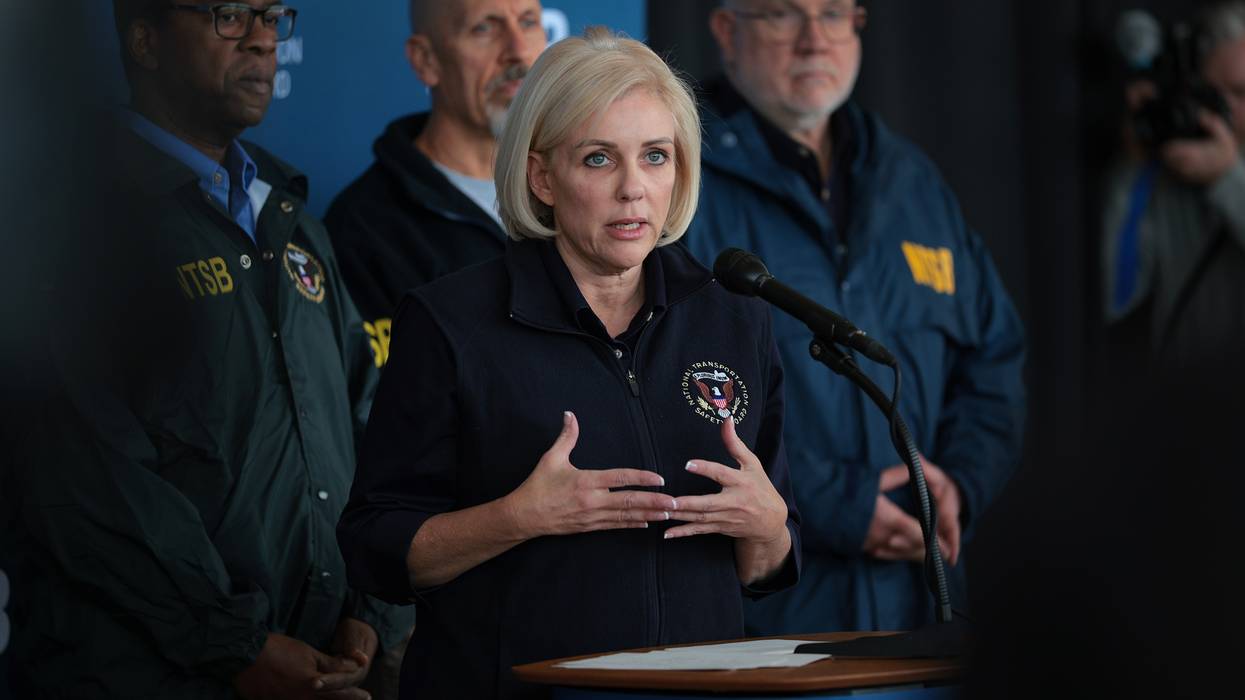
"However, I know it's not DEI because it never is," said Larsen. "The National Transportation Safety Board will look at the causes and contributing factors of this accident. It is important to let the NTSB complete its work before we consider any potential policy response."
"We have flight attendants who are struggling to make ends meet while our CEOs are on private jets," said one union leader. "We want some respect shown in the contract."
Hoping to leverage the looming Labor Day travel rush to secure better pay and working conditions, unionized United Airlines flight attendants on Wednesday voted overwhelmingly in favor of authorizing a strike if management fails to meet their demands.
The United flight attendants—who are represented by the Association of Flight Attendants-CWA (AFA)—voted 99.99%, with 90.21% of members participating, to greenlight a work stoppage unless they win concessions including a double-digit raise, more schedule flexibility, improved work rules, job security, and retirement benefits.
"We deserve an industry-leading contract. Our strike vote shows we're ready to do whatever it takes to reach the contract we deserve," said Ken Diaz, president of the United chapter of AFA. "We are the face of United Airlines and planes don't take off without us. As Labor Day travel begins, United management is reminded what's at stake if we don't get this done."
"The United management team gives themselves massive compensation increases while flight attendants struggle to pay basic bills," Diaz added. "The 99.99% 'yes' vote is a clear reminder that we are unified in the fight against corporate greed and ready to fight for our fair share of the profits we create."
Kim Montgomery, who has been a flight attendant for 38 years and is president of the Council 6 chapter at AFA-CWA that represents workers based out of Newark Liberty International Airport in New Jersey, told The Bergen Record that United "continues to make money hand over fist."
"Our leaders get pay raises regularly while some of us have not gotten a raise in years," she added. "We have flight attendants who are struggling to make ends meet while our CEOs are on private jets. We want some respect shown in the contract."
AFA said it can now seek to enter the 30-day "cooling-off" period required by the National Mediation Board (NMB) before the federal agency decides whether to allow a strike. Unlike unionized U.S. workers governed by the National Labor Relations Board, airline and rail workers fall under the jurisdiction of the NMB, which rarely grants permission to strike.
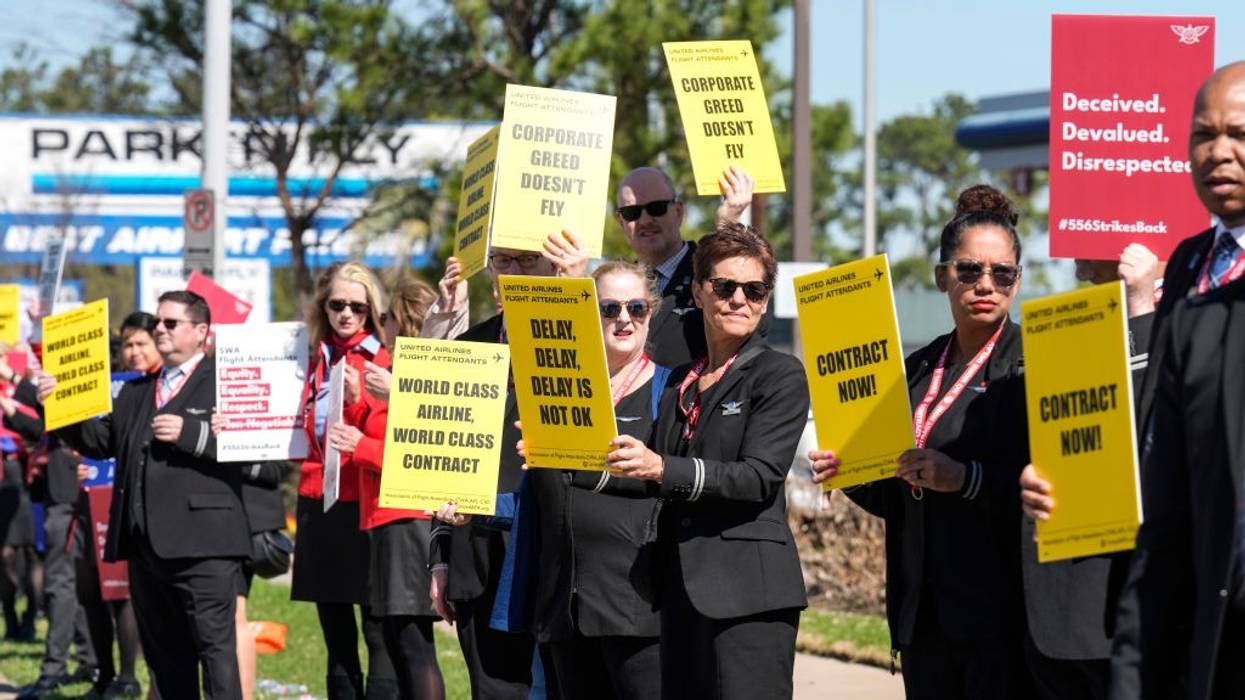
United AFA members staged picket marches at 20 U.S. airports on Tuesday after the union vote result was announced. Flight attendants chanted slogans including, "United Airlines, you're no good, pay your workers like you should," and, "Delay, delay, delay is not okay."
United Flight attendants—who have been working under an amendable contract for nearly three years—applied for federal mediation over eight months ago. AFA flight attendants from United and other airlines staged protest rallies at U.S. airports earlier this year to draw attention to their demands and to pressure management to act. Unionized United pilots also picketed for a better contract last year.
"We have not had a new contract since 2019, which means that we haven't had any raises since 2019," said one American Airlines AFA member in a More Perfect Union video published last year. "We kept this airline running during a pandemic, and all we're asking for is fair wages. All we're asking for is quality of life improvements."
Last month, American Airlines flight attendants and company management agreed to a tentative contract that contains $4.2 billion in pay and benefits, including an immediate 18% raise and boarding pay, with some veteran workers in line for much higher increases.
"This sweetheart deal deceptively presents a version of Boeing's crime that conceals the fact that Boeing's lies to the FAA directly and proximately killed 346 people," said one attorney representing families.
Lawyers for families of the hundreds of victims killed in a pair of Boeing 737 MAX 8 plane crashes filed motions this week urging U.S. Judge Reed O'Connor to reject a "morally reprehensible" plea agreement and instead force the company to go to trial.
The Texas-based judge is considering a proposed deal, finalized by the U.S. Department of Justice (DOJ) last week, in which Boeing would plead guilty to conspiracy to defraud the Federal Aviation Administration (FAA) about the safety of the aircraft involved in the Lion Air Flight 610 crash in Indonesia in 2018 and Ethiopian Airlines Flight 302 crash the next year.
Under the deal—which comes after the DOJ determined that Boeing breached its obligations under a 2021 deferred prosecution agreement (DPA) and federal prosecutors recommended criminal charges—the company would also pay a $243.6 million fine, invest $455 million in compliance and safety, and be subject to oversight by an independent monitor for three years.
"We urge Judge O'Connor to use his recognized authority to reject this inappropriate plea and set the matter for a public trial."
"This sweetheart deal deceptively presents a version of Boeing's crime that conceals the fact that Boeing's lies to the FAA directly and proximately killed 346 people," said Paul Cassell, an attorney for families and University of Utah law professor, in a Wednesday statement. "This plea deal is not in the public interest."
"It is deceptive and unfair," he added, "and we urge Judge O'Connor to use his recognized authority to reject this inappropriate plea and set the matter for a public trial, so that all the facts surrounding the case will be aired in a fair and open forum before a jury."
The filing from Cassell's team argues that the court should reject the "rotten deal" because:
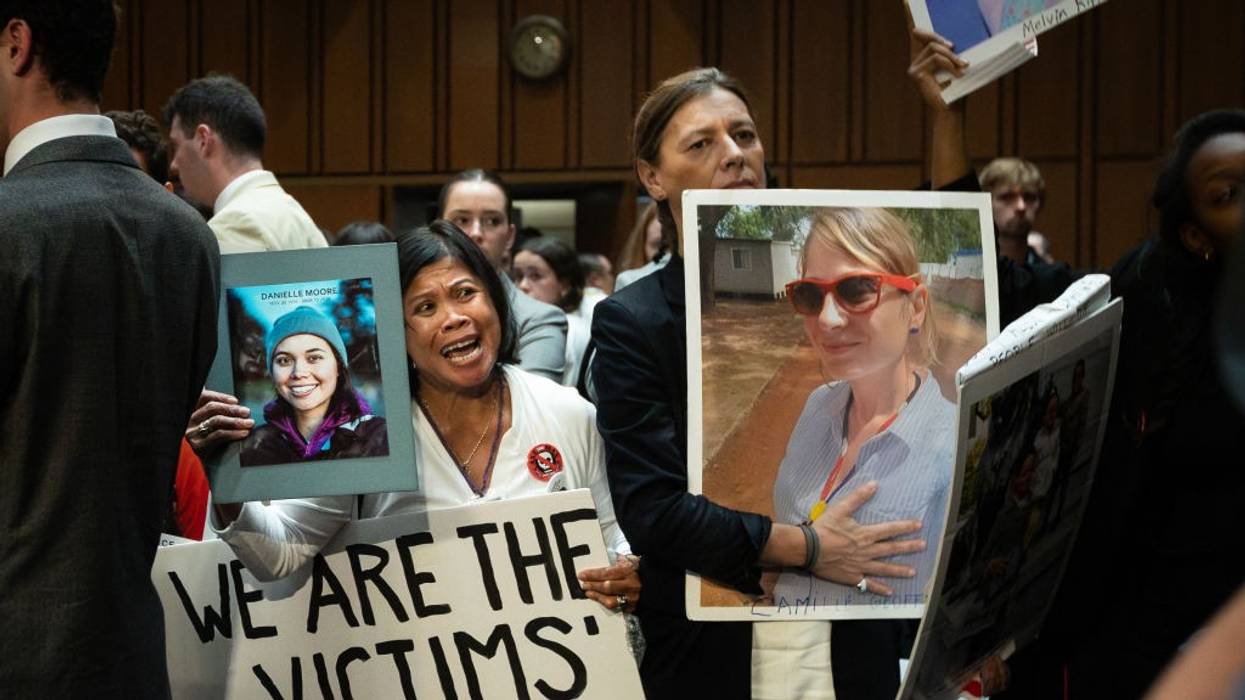
"Whereas the DPA, was a 'sweetheart deal,' the plea bargain is a 'do-over,'" declared Chris Moore, a Canadian whose 24-year-old daughter Danielle was killed in the 2019 crash in Ethiopia. "The average citizen during criminal prosecutions doesn't get a 'do-over.' More to the point, my daughter didn't get a 'do-over,' which is why the DOJ should take justice seriously instead of bowing to the pressures of commerce."
Javier de Luis, who lost his sister Graziella in the same crash, said that "the ultimate aim of this agreement should be to ensure that the two 737 MAX crashes are never repeated. This agreement does nothing to achieve that objective."
Both de Luis and Catherine Berthet, whose daughter Camille also died in the 2019 crash, highlighted a January incident: A door plug flew off the Boeing 737 MAX 9 used for Alaska Airlines Flight 1282, causing minor injuries and forcing an emergency landing.
"Basically, this appalling door plug incident in January happened because, despite the constraints imposed by the DPA, nothing has changed at Boeing," Berthet said. "What will the plea deal change? Nothing."
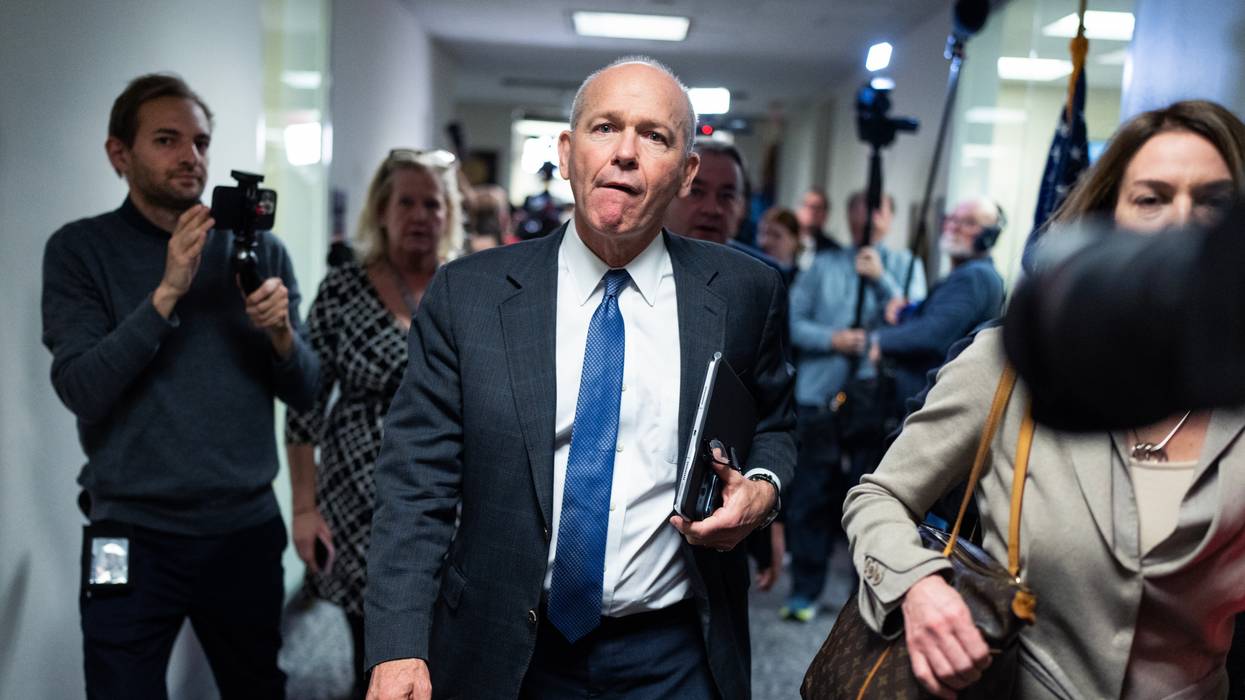
"The only way to change Boeing is simply to apply justice," she added, arguing that Boeing, outgoing chief executive officer Dave Calhoun, and ex-CEO Dennis Muilenburg must be held "accountable for their actions and decisions by facing a jury at a trial."
"My daughter didn't get a 'do-over,' which is why the DOJ should take justice seriously instead of bowing to the pressures of commerce."
After announcing in March that Calhoun would voluntarily leave his post by the end of this year, Boeing revealed Wednesday that he will be replaced by Robert "Kelly" Ortberg of Rockwell Collins, who is set to start his new role on August 8.
"The arrival of a new CEO at Boeing could not have happened at a more crucial and necessary time for the safety of the traveling public around the world," said Robert A. Clifford, lead counsel for victims' families in pending civil litigation, in a Wednesday statement. "As a company, Boeing has been nosediving in self-destructive flight under the past leadership of Muilenburg, Calhoun, and the do-nothing board of directors."
"This move may give the company the ability to pull out of its impending total and fatal crash, unlike what occurred to the 346 innocent victims of the two Boeing 737 MAX 8 preventable disasters," he continued. "While this man is an industry insider, he does come from outside of Boeing and on the face of it has a well-regarded reputation in the industry. Maybe he can bring the company back to the stature it once held before it criminally and preventively killed 346 people."
"There is no accountability, no admission that Boeing's admitted crime caused the 346 deaths, and the families will most certainly object," said one lawyer for victims' relatives.
The families of 346 people who were killed on two Boeing 737 MAX airplanes in 2018 and 2019 were expected to "strenuously object" to a plea deal reportedly proposed by the U.S. Department of Justice a week after federal prosecutors recommended criminal charges for the company.
The penalties proposed by the DOJ "are totally inadequate," said Javier de Luis, whose sister was killed when the Ethiopian Airlines Boeing 737 MAX plane she was on crashed in 2019.
Family members take issue with the proposal "both from the perspective of accountability for the crimes committed, and from the perspective of acting in the public interest by ensuring a change in Boeing's behavior," said de Luis, who served on a panel assembled by the Federal Aviation Administration (FAA) to review Boeing's safety culture.
The agreement, which has been denounced as a "sweetheart deal" by family members and their attorneys, reportedly includes a requirement that Boeing plead guilty to conspiring to defraud the FAA in connection with the crashes, as well as a $487.2 million financial penalty. The company board would be required to meet with the victims' families and appoint an independent monitor to oversee Boeing's safety practices.
Boeing would be required to pay only half of the fine because prosecutors would give the company credit for a settlement payment officials already made in relation to the crashes.
Boeing paid $2.5 billion as part of another deal that granted it immunity from criminal prosecution over its planes' safety flaws, with the agreement mandating that it abide by the terms for a three-year period that ended in January. Two days before that period ended, the company came under new scrutiny after a door plug that was missing several bolts blew off a Boeing 737 MAX 9 flown by Alaska Airlines while the plane was at an elevation of 16,000 feet.
Erin Applebaum, a lawyer representing victims' relatives, said Sunday as the new plea deal proposal was reported that "when there is inevitably another Boeing crash and DOJ seeks to assign blame, they will have nowhere else to look but in the mirror."
Boeing has until the end of the week to accept or reject the agreement; if it agrees, U.S. District Judge Reed O'Connor will decide whether the deal is in the public interest.
Attorneys for the families said the relatives plan to call on the judge to reject the deal.
"The families are very unhappy and angered with DOJ's decisions and proposal," said Robert Clifford, lead counsel for the families who have filed civil litigation. "There is no accountability, no admission that Boeing's admitted crime caused the 346 deaths, and the families will most certainly object before Judge Reed O'Connor and ask that he reject the plea if Boeing accepts."
The memory of victims of the crashes in 2018 and 2019, said Paul Cassell, who represents the families of 15 people who were killed on the Ethiopian Airlines and Lion Airlines planes, "demands more justice than this."
David Dayen, executive editor of The American Prospect, noted that some reporting on the deal suggests the DOJ will make a criminal charge, but said, "That's probably just trying to get Boeing to admit wrongdoing."
The reported deal comes a week after an employee of a contractor for one of Boeing's partner companies, Spirit Aerosystems, became the latest of more than a dozen whistleblowers to come forward about safety issues with the company's aircrafts. The worker notified Boeing of problems with 787 Dreamliner planes that posed "catastrophic" danger to people on board.
"Why are working class people apathetic about politics? Because politics is completely dominated by corporations."
If there is a chicken-or-the-egg question as it regards working class politics in the year 2024 and beyond, some of the boldest labor leaders in the United States have a very unified response: organized workers come first and then—and only then—can the progressive vision of a healthier democracy and more equal nation that meets the material needs of all its people finally come to pass.
"What we have to organize around," says union leader Sara Nelson, "are the issues that really matter."
President of the Association of Flight Attendants-CWA (AFA), Nelson argues that what constitutes those specific "issues that really matter" has not changed very much since Franklin Delano Roosevelt promoted his Economic Bill of Rights nearly 80 years ago: a living wage and dignity at work, decent and affordable housing, universal healthcare, quality education for all, retirement security, and a life with recreation and leisure not just toil and labor.
"Stop doing bullshit applause lines and do real work on workers' rights." —AFA president Sara Nelson
While the Republican Party remains the chief political obstacle to achieving those goals, says Nelson—currently at the bargaining table representing her members in contract negotiations with several major airline carriers—the Democrats also have a long way to go. Meanwhile, the corporate interests that pump massive amounts of money into both major parties can only be challenged by a more cohesive and strategically-minded working class.
"Democrats in general," she says, "need to get back to talking about that Economic Bill of Rights fundamentally across the board. And that is what is going to attract people to the party—not just talking about it, but fighting for it and having actual demands."
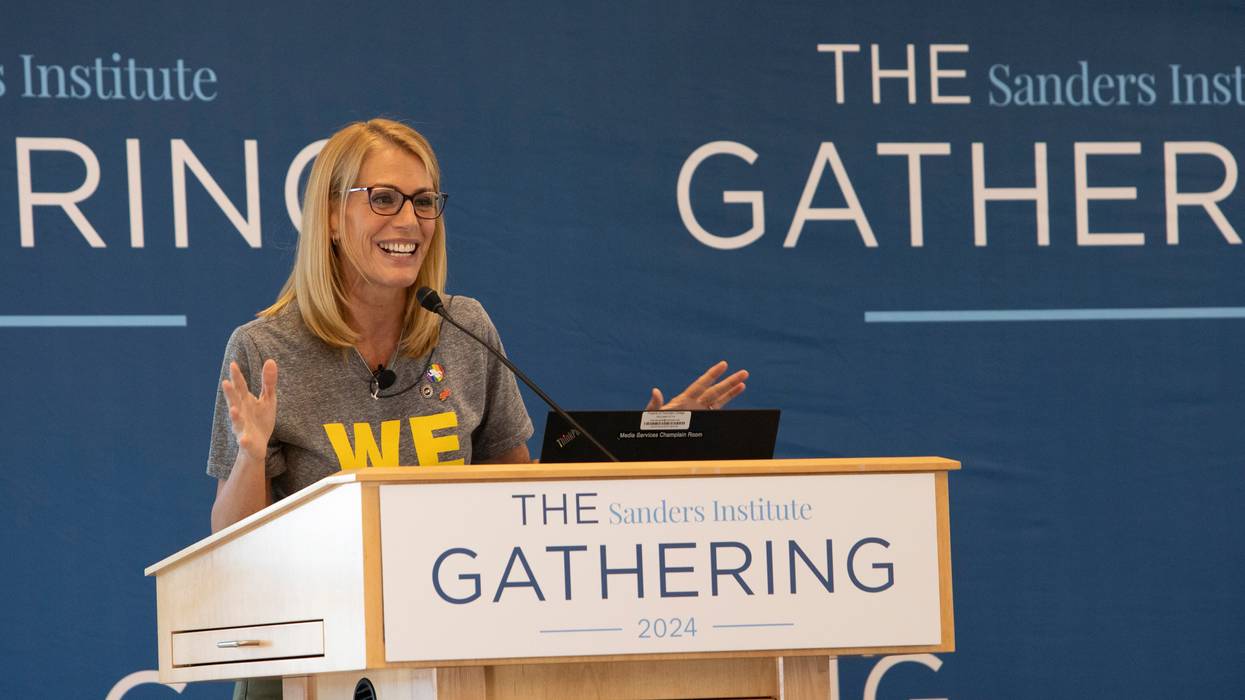
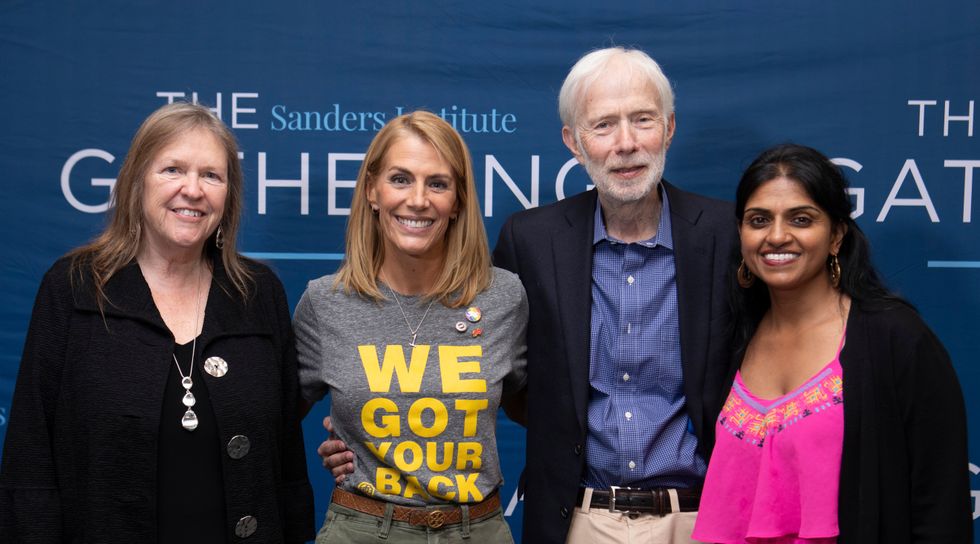
In a series of discussions during and after The Sanders Institute Gathering that took place in Burlington, Vermont on the first weekend of June, Nelson explained how being "pro-labor," regardless of party affiliation, "has to be more than just not killing labor every single day."
"It has to be more than that," she told Common Dreams during a lengthy interview, "and it has to be more than politicians going to a rally and saying the same tired applause lines that they've been saying for 80 years—things like: 'We like labor because you gave us the 8-hour work day.'"
"I promise you, politician," she continued, "that the vast majority of people in the audience listening to you no longer have an eight-hour day. It is the same with the line about how it was labor who delivered the weekend. I promise you, the vast majority of people in the audience do not have their weekends off anymore. 'Oh, labor that gave us sick leave and vacations!' Same thing again. Stop doing bullshit applause lines and do real work on workers' rights."
In Vermont, Nelson explained to attendees at the Sanders Institute event that "the labor movement"—especially in a nation that is 90 percent non-unionized—"is the entire working class, not just people who currently have a union card."
Sara Nelson: Let's not divide ourselves further from a corporate class who has been trying to divide us since the beginning of time...the labor movement is the entire working class. It is not just people who currently have a union card. [applause] @FlyingWithSara pic.twitter.com/JiQPaYNF3T
— Sanders Institute (@TheSandersInst) June 1, 2024
Saru Jayaraman, a professor at the University of California, Berkeley and president of the advocacy group One Fair Wage, which she co-founded, explained to those at the Gathering how the approximately 13 million restaurant and food service workers her group represents are on the front lines of a largely non-unionized worker movement focused like a laser on improving the material conditions of individual, families, and the wider working class.
During her earlier organizing with the Restaurant Opportunity Center (ROC) in the decade after Sept. 11, 2001, Jayaraman said that workers wherever she went—"from California to the Deep South, to the Midwest, and to the Northeast"—would all say the same thing: "It's my wages, it's my wages, it's my wages."
With a new book titled "One Fair Wage: Ending Subminimum Pay in America," and state-level ballot fights for wage increases this election season in Arizona, Michigan, Ohio, Massachusetts, and elsewhere, Jayaraman says the organizing of workers making less than $15 in real wages is vital within the nation's "absolute largest" private employer sector, the restaurant and food service industry.
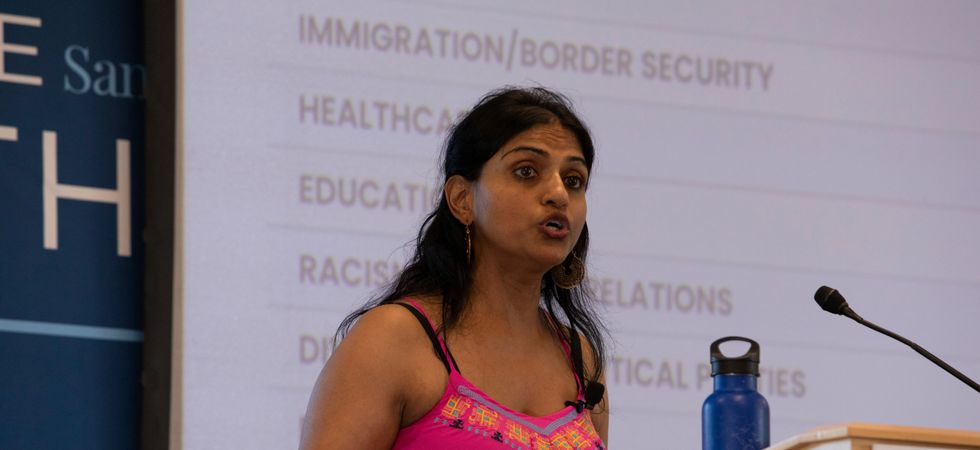
After a show of hands from audience members in Burlington who had at one point worked in a restaurant, Jayaraman reminded them how "one in two Americans has worked in the industry at some point in their lives."
"It is the largest private sector employer of women. It is the largest private sector of young people," she said. "It's the largest private sector employer of immigrants, formerly incarcerated individuals, people of color—pretty much everybody—but it is the absolute lowest-paying employer in the United States of America."
With the lobbying power of the National Restaurant Association, founded in 1919—"we call it the other NRA," Jayaraman noted—owners and investors in the food industry have generated massive profits for themselves by paying poverty wages and forcing tipped wages on their employees "for generations."
What this "other NRA" has been able to achieve over the course of its existence, she said, is ensuring that millions of restaurant workers across the country are forbidden from earning more per hour than the $2.13 that such tipped workers currently receive.
.@SaruJayaraman: We are on the cusp of an incredibly historic moment and we decided it was time to go huge…We are going to raise 3.5 million workers wages because guess what, when minimum wage is on the ballot it never ever fails. Ever. pic.twitter.com/0TKWqmNmLK
— Sanders Institute (@TheSandersInst) June 1, 2024
In her book, Jayaraman writes, "Subminimum wages are subhuman. They are reflection of the value America has placed on the humanity of the people" who work in those sectors.
Those receiving this paltry hourly wage, still the law in 43 U.S. states, she said in Burlington, is "not some niche group. It's where all of us worked, our kids work. It's the largest employer in America, and it gets to pay $2 an hour because we've let it."
And the current outrage among restaurant workers isn't restricted to that. In context of the Covid-19 pandemic that shook the nation and the world in 2020, Jayaraman spoke with fury about the thousands of food industry workers who "died—no, the 12,000 workers who were murdered—because they were forced to go back to work before it was safe, into an industry that the CDC named as the most dangerous place for adults to be during the pandemic."
"They died because they were poor," she roared. "For those that survived, 60% told us that tips went way down and the women, more than half of women told us harassment went way up. They said, I'm regularly asked, 'Take off your mask so I can see how cute you are before I decide how much I want to tip you.'" Reports like that from workers, she said, are endless and continue to this day.
"The only way it's going to work is that we are going to have this huge base, the ability to mobilize them, but it's got to be a thousand flowers blooming." —Saru Jayaraman, One Fair Wage
It's for these reasons and more that tipped workers are fighting for the Raise the Wage Act, a bill which passed the U.S House in 2021 but failed in the U.S. Senate despite support from Sen. Bernie Sanders (I-Vt.) and other Democrats. After House Democrats lost their House majority in 2022, Sanders reintroduced the bill in the Senate last year, but it has no hope of passing until Republican opposition is vanquished.
Again, Jayaraman pointed to the restaurant industry lobby as the key villain in the workers fight.
"They're the major opposition in every state," she said. "They're the major opposition at the federal level. And there can be no change at the federal level until we defeat the 'other NRA' and we are on our way."
What she sees in her work among non-unionized restaurant workers fighting to destroy sub-minimum wages is that it's workers that must lead.
"We are not trying to mobilize these hundreds of thousands of people in the same way," Jayaraman told Common Dreams. "The only way it's going to work is that we are going to have this huge base, the ability to mobilize them, but it's got to be a thousand flowers blooming. That is how this moment of worker power has happened."
It was workers on their own, she explained, who "started walking out of their restaurants and putting up signs saying: 'We all left. The pay is too low.' Nobody gave them a sign and trained them how to do that. There was a moment of power where they all collectively felt 'I'm worth more' and walked out."
"There's no humanity in capitalism, it's only about extracting as much profit as possible from the entire machinery, which includes human beings." —Sara Nelson
Like Jayaraman, Nelson spoke about the lessons she learned after seeing corporate bosses willing to sacrifice the safety, and even the lives, of workers at the altar of profit.
Speaking passionately about her career in the airline industry—including close colleagues killed on the hijacked planes used in the 9/11 attacks—Nelson describes the AFA as a union that centers the needs of its members but also one that recognizes its role in the broader fight for economic equality and the common good.
In the years after 2001, she saw firsthand how the industry exploited the horrific tragedy of 9/11 to undermine worker power while protecting owners and investors through a bankruptcy process.
"For me, that was real people, those were my friends and it was my friends who died too," she explained to Common Dreams. It was painful, she said, "coming to grips with the fact that there's no sympathy, there's no humanity in capitalism, it's only about extracting as much profit as possible from the entire machinery, which includes human beings."
While the union fought to protect their pensions during that time, executives were clamoring for unlimited compensation packages, Nelson recounted. It was during those battles, she said, "that I got a firsthand experience in the four D's of union busting: divide, delay, distract, and demoralize. And I saw workers go through all of those very divisive tactics."
"So the first question is, why aren't we winning? And the answer is we don't have a working-class base." —Les Leopold, Labor Institute
Joining Jayaraman and Nelson on the Sanders Institute panel focused on workers was Les Leopold, executive director of the Labor Institute and author of the new book, "Wall Street's War on Workers: How Mass Layoffs and Greed Are Destroying the Working Class and What to Do About It."
What Nelson, Jayaraman, and Leopold all argued in separate interviews with Common Dreams during and after the Gathering is that organized workers need to be at the center of fighting for their own economic well-being. A more unified and coordinated working class is also the key missing ingredient if the broader progressive agenda—from voting rights and democracy protection to the climate fight and economic battles over healthcare and housing—is ever to be won.
"There are all these organizations and we're fighting all these good fights on all these issues," Leopold said on the edge of the three-day event, referring to green groups, healthcare advocates, and organizers on a range of social justice issues gathered in Burlington. "So the first question is, why aren't we winning? And the answer is we don't have a working-class base."
Without workers in the fight in a deep and organized way, Leopold argued, progressives can't win—"or can't win substantially"—and that means new structures are needed to galvanize workers. In his book, Leopold identifies years of mass layoffs, driven in large part by stock buybacks and leveraged buyouts by private equity and other powerful investors, as evidence of the battering workers have taken from their corporate bosses and neoliberal capitalism.
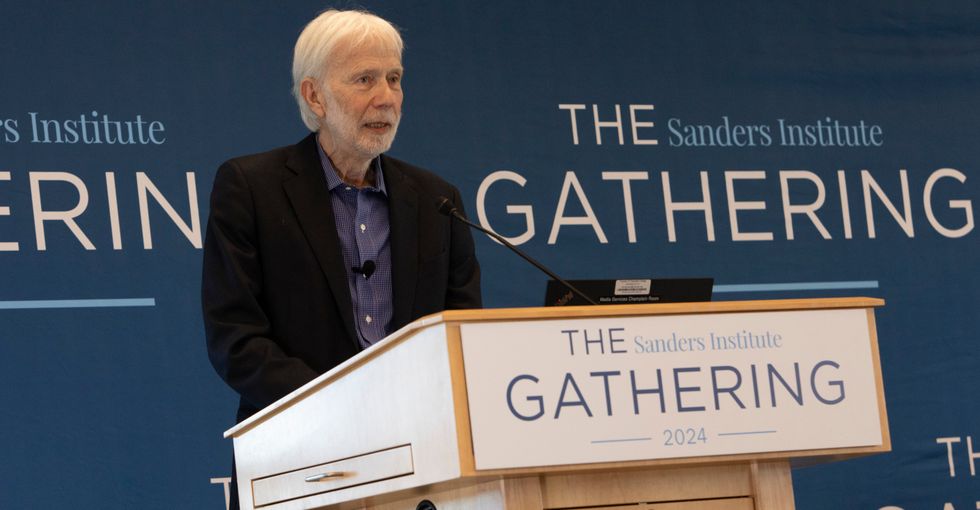
"As Wall Street has routinized the financial strip-mining of productive enterprises," Leopold writes in the book, "more than 30 million of us have experienced mass layoffs [over recent decades]. And even more have felt the pain and suffering as our family members lost jobs."
Despite that, he says, the occurrence of mass layoffs has "become so commonplace, so normalized, so routinized, that for-profit and nonprofit executives alike do not hesitate to slash jobs whenever they feel it necessary." But with a working class fractured and pummeled from the decades-long corporate crusade against unionization, Leopold told Common Dreams in Burlington that he believes a fight against mass layoffs could be a way to help turn the tide.
"Why are working class people apathetic about politics?" asked Leopold. "Because politics is completely dominated by corporations and they're totally alienated from that. We've got to fight the class war around politics. We have got to get working-class control over politics."
"The working class is going to save the working class. It's never going to be a party."
Nelson echoed that, saying the policies passed in Congress "are not going to be the policies we need until we extract money from our politics."
Getting corporate money out of politics can't be won in Congress "because we don't have the politicians in office that can vote it out because money is still controlling it," Nelson said. "So the only way to get at it, the only way to change our politics is to have workers in a massive way organize their unions and take the money from capital so that they don't have it to spend in our politics."
In Leopold's mind, a worker-centered politics and a "class war" framework is something "we can sell anywhere." It can work with organized workers already with labor unions like Nelson's AFA, the United Auto Workers (UAW), and other major trade unions. It can also be the linchpin for workers who are not yet organized within unions, like Jayaraman's approach with One Fair Wage.
It can work for "Trump people" that have looked to the far-right because they saw Democrats year after year not fighting for their interests, he said, and it can work for "not Trump people," who are simply looking for allies to stand with them in the demand for better wages, job security, healthcare, housing costs, and more.
Offering a concrete example for workers to rally around, Leopold proposed in Vermont—something he has written about extensively in recent months, including for Common Dreams—is the idea of putting a target on mass layoffs and stock buybacks by large employers to help galvanize working-class power.
What he's calling for is a provision that would prohibit any company that receives a government contract from carrying out a compulsory mass layoff—defined as the termination of 50 jobs or more at one time.
"Think about how easy it is to add one sentence to a federal contract, which says: 'If you take this contract, no compulsory layoffs, no stock buybacks," Leopold told Common Dreams. Having calculated the amount of money flowing through such contracts for large corporations at about $700 billion, he admits it's not clear exactly how many jobs that could save—but it would be a significant number.
"Well, $700 billion worth of no layoffs is a lot of no layoffs," he said, but even more important is this: "It would be a fight." And if the Democratic Party was willing to put such a proposal into its 2024 platform it would be a signal that the party was willing to go to bat for working people in ways it has not done in a very long time.
"If they fight for that plank, people will hear them," said Leopold. "It would show there's a fight going on in Democratic Party on behalf of the working class. Then labor can rally. Then progressive organizations can rally. But there has to be a fight."
"You're going to conduct a mass layoff or spend billions on stock buybacks while there's layoffs, then you don't get the federal contract. The federal government has a lot of power with the purse strings that they need to use."
Last week, Leopold wrote an op-ed calling for President Joe Biden to intervene on behalf John Deere workers facing mass layoffs by the owners of the iconic tractor company. "Come on Joe, go to bat for these workers," Leopold wrote. "Put the heat on John Deere and show the working class that you’re tougher than Trump when it comes to saving American jobs."
And Nelson agrees that the onus is on the Democrats to be much bolder than they have been.
"The Democratic Party has to put working peoples central to its platform and put in its platform things like Les Leopold's idea on mass layoffs," she told Common Dreams.
"It's a very simple idea," Nelson continued, but it's exactly on the right track. "You're going to conduct a mass layoff or spend billions on stock buybacks while there are layoffs, then you don't get the federal contract. The federal government has a lot of power with the purse strings that they need to use."
Despite the hopes for big labor's abilities to get something dramatic accomplished in the coming months and years, both in their own contract fights and building up their own unions, Leopold said they also need to use their size and resources to help build "an organization for unorganized workers."
Leopold happens to think the mass layoffs could be a vehicle for that, though he admits it's not been tested and would need a much larger buy-in as a strategy before it could be proven effective. Jayaraman noted in her discussion with Common Dreams that low wages is a more likely issue for the broader working class to organize around.
"If we're waiting for the law to change, we're just going to keep waiting until we're completely extinct."
Nelson recognized the value of a number of approaches, and said unions and the unorganized workforce must go much further than they've gone since Reagan busted the PATCO strike in 1981.
"We have to organize like never before," she said, noting how large established unions like the UAW have been putting resources and energy into helping non-unionized works in the south, including Tennessee and Alabama, win recognition. "That's important," Nelson explained, "but it's also not enough if we're really going to do the kind of organizing that can truly put a check on capital and change the political environment."
When it comes to the Pro Act, or Protecting the Right to Organize Act, which would enhance workers rights and that Democrats tried but failed to pass during the first half of Biden's term, Nelson said it is very much "a chicken and egg situation." The legislation, she said, "is not going to come before we organize more workers" in order to tilt the political scales that would make passage possible.
"So if we're waiting for the law to change," she warned, "we're just going to keep waiting until we're completely extinct."
Referencing an effort by United Auto Worker's president Shawn Fain to align as many contract fights as possible around May 1, 2028 in an effort to further create broader worker solidarity and increase pressure across various trade and service union sectors and industries, Nelson expressed hope for Leopold's mass layoff idea and what Fain has proposed.
Both show, she said, "the working class that there is a way to be strategic" and can wake people up to "the power we have in standing together," whether it be on wages, firings, union card campaigns, or contract fights.
And it may not take as long as May of 2028, Nelson added. "The moment may come to us before then, but talking about and really defining the problems—which we're doing over and over again—is key, showing that these are not isolated issues," she said. "The issue with housing, the issue with gun violence, the issue with healthcare, the issue with education and debt—these are not isolated issues. The issue is pure and simple corporate greed, and that's what we have to organize against."
"The issue with housing, the issue with gun violence, the issue with healthcare, the issue with education and debt—these are not isolated issues. The issue is pure and simple corporate greed, and that's what we have to organize against."
"Solidarity is our power," Nelson explained during her interview with Common Dreams. "And so the strike is not itself the most powerful weapon here. It is the consciousness of worker power and the threat of the strike that is going to make change in our economy and in people's lives."
In a podcast interview with Sen. Bernie Sanders earlier this week, Fain of the UAW spoke along similar lines.
"We have to harness that power" of working-class power led by organized labor, Fain said to Sanders.
"Union or not, we have to bring workers together all over, not just in America, but all over the globe," Fain continued. "We want to see working-class people all over this globe come together. The only way we're going to beat the corporate global fight is by standing together globally and fighting for better standards for everyone and standard wages for everyone. So we lift everyone up everywhere. And to a lot of people, that seems like a pipe dream. I don't believe it is."
It was during the panel discussion in Burlington that Nelson looked out at the audience where Sen. Sanders—"our organizer-in-chief," she called him—was seated and thanked him for the leadership he showed in both 2016 and 2020 while seeking the Democratic nomination for president.
"We want to see working-class people all over this globe come together." —UAW president Shawn Fain
"One of the reasons that unions are one of the most popular ideas in this country is because Bernie Sanders went around this country telling people that the trade union movement is the only way for us to lift up the standards for the working class," Nelson said. "It is the only way to get back to the issues that we were talking about a hundred years ago and pushing forward on them. It is the only way to build the power that we need to change our politics. It is the only way to give working people agency to feel the democracy is something that they own, not what the capital class does."
While speaking of Trump—who "lives the very antithesis of what it means to be union"—and his Republican Party with outright contempt as enemies of working people everywhere, Nelson was clear that nobody should think the Democratic Party is riding courageously to the rescue of the tens of millions of workers who toil and sweat to provide themselves and their families a decent life.
"The working class is going to save the working class," she said. "It's never going to be a party. We are going to bring politics to us if we do our jobs right. It doesn't happen the other way around."
"Airline carriers do not feel pressured to reach agreements quickly, likely because the flight attendants' ability to strike has rarely been allowed to be exercised," senators wrote to the National Mediation Board.
U.S. Sen. Bernie Sanders on Wednesday led 31 Senate Democrats in a letter calling on the agency that facilitates labor and management relations within the country's railroad and airline industries to allow flight attendants to strike if necessary.
Sanders (I-Vt.), who chairs the Senate Committee on Health, Education, Labor, and Pensions, and his colleagues—including Senate Majority Leader Chuck Schumer (D-N.Y.)—wrote to the three-member National Mediation Board (NMB), established by 1934 amendments to the Railway Labor Act of 1926.
"Unlike workers covered by the National Labor Relations Act, workers covered by the Railway Labor Act do not possess the right to strike or engage in any other form of 'self-help' without a formal vote by the board," notes the letter. "We are concerned about the increasing number of contract negotiations before the NMB that are being unnecessarily drawn out at the expense of workers."
"We understand that there are ongoing negotiations that have dragged on for as long as five years and we have heard from workers who are rightfully frustrated that they are being subjected to unfair delays in bargaining," the letter explains. "In particular, over 100,000 flight attendants have recently been or currently are stuck in contract negotiations with many working under contracts that expired several years ago."
Noting flight attendant rallies at airports earlier this year, the letter states that "these workers were on the frontlines of the Covid-19 pandemic and were instrumental in saving the airline industry from collapse, but now, in some cases, find themselves working for
pre-pandemic wage levels. They deserve better."
The senators suggested that "airline carriers do not feel pressured to reach agreements quickly, likely because the flight attendants' ability to strike has rarely been allowed to be exercised," with the NMB only allowing two strikes since 2006, "compared to dozens of instances in the 1980s and 1990s."
"Therefore, we join with our 178 colleagues in the House to urge the board to use all of the tools at your disposal, including releasing parties from mediation as necessary, to resolve these long-pending contract negotiations," they wrote, referencing a May letter led by Rep. Melanie Stansbury (D-N.M.).
Union leaders in the industry have praised both the House and Senate efforts. Thanking Sanders for spearheading the latest letter, Sara Nelson, president of the Association of Flight Attendants-CWA, which represents nearly 55,000 workers at 20 airlines, said Wednesday that "when negotiations drag on for three to more than five years it's clearly time to call the question."
"Airline executives have believed they have a free pass to delay conclusion of negotiations, while richly rewarding themselves. No more!" she declared. "Flight attendants and other aviation workers are ready to back up demands for long overdue record contracts. The strike is not the goal, but it is the means in these situations to get real on getting a deal."
Julie Hedrick, national president of the Association of Professional Flight Attendants (APFP), which represents 28,000 American Airlines workers, stressed that "contract negotiations must have reasonable deadlines in order for both parties to be motivated to reach an agreement."
"APFA thanks Sen. Bernie Sanders for leading this letter to the National Mediation Board that says exactly that," she added, also thanking the signatories for supporting workers' fight for better wages and working conditions. "It's been five years since APFA members worked under an updated contract and our members are not able to wait any longer."
The Senate letter comes on the eve of workers around the world "kicking off this red hot Solidarity Summer with a Worldwide Flight Attendant Day of Action to demand our contracts."
"No matter what uniform we wear, we've earned the long-term security, benefits, flexibility, dignity, and respect that comes with a strong contract," say organizers, who have planned dozens of pickets. "It's time for airline management to pay up and get this done."
"For real and lasting change to occur," said Public Citizen's Robert Weissman, "Boeing must now be held criminally accountable."
Embroiled once again in an alarming quality control and safety scandal, the aircraft manufacturing giant Boeing on Monday announced a management shake-up that will see CEO Dave Calhoun step down at the end of the year, the head of the company's commercial airplanes division resign immediately, and the chairman of the board depart after Boeing's annual meeting in May.
Calhoun, who said he decided on his own to resign, took charge at Boeing in the midst of the company's previous high-profile crisis—the grounding of the 737 MAX jet following a pair of crashes in 2018 and 2019 that killed more than 340 people.
Robert Weissman, president of the consumer advocacy group Public Citizen, said in response to the news of Calhoun's coming departure that "if Boeing had been held criminally accountable after the... 737 MAX disasters, the more recent quality debacles quite likely could have been averted."
Earlier this year, a door plug of a Boeing 737 MAX 9 flew off the aircraft as it ascended, causing minor injuries and forcing the pilots to conduct an emergency landing. More than 170 MAX 9s were subsequently grounded to undergo inspections.
The incident prompted federal regulators, airlines, and journalists to—once again—closely scrutinize Boeing's manufacturing process, cost-cutting efforts, lobbying against safety regulations, and executive and shareholder payouts.
The Lever reported days after the January 5 incident that "less than a month before a catastrophic aircraft failure prompted the grounding of more than 150 of Boeing's commercial aircraft, documents were filed in federal court alleging that former employees at the company's subcontractor repeatedly warned corporate officials about safety problems and were told to falsify records."
The outlet also found that "operators of Boeing's troubled 737 MAX planes have filed more than 1,800 service difficulty reports—more than one per day—warning government regulators about safety problems with the aircraft since the fleet was allowed to resume flying after two fatal crashes."
Alaska Airlines, the operator of the January 5 flight, said in late January that it found loose bolts on "many" of Boeing's 737 MAX 9s.
"The FAA identified noncompliance issues in Boeing's manufacturing process control, parts handling and storage, and product control."
In an update published on March 4, the Federal Aviation Administration (FAA) said its six-week audit of Boeing and Spirit AeroSystems—a major Boeing contractor—uncovered "multiple instances where the companies allegedly failed to comply with manufacturing quality control requirements."
"The FAA identified noncompliance issues in Boeing's manufacturing process control, parts handling and storage, and product control," the agency said. "To hold Boeing accountable for its production quality issues, the FAA has halted production expansion of the Boeing 737 MAX, is exploring the use of a third party to conduct independent reviews of quality systems, and will continue its increased onsite presence at Boeing's facility in Renton, Washington, and Spirit AeroSystems' facility in Wichita, Kansas."
Earlier this month, days after the FAA update was published, a Boeing whistleblower who raised concerns about the company's quality control practices was found dead of what local officials said appeared to be a self-inflicted gunshot wound.
Weissman of Public Citizen said Monday that "of course CEO Dave Calhoun should be dismissed" over the company's latest safety crisis.
"But for real and lasting change to occur," he argued, "Boeing must now be held criminally accountable both for the recent safety failures and the... crashes that took 346 lives."
In 2021, Boeing entered into a deferred prosecution agreement with the U.S. Justice Department to avoid a criminal charge over an alleged conspiracy to defraud the FAA in the wake of the 2018 and 2019 crashes.
Public Citizen noted in a report published Monday that "such agreements now help the most powerful businesses in the world dodge the legal consequences of their criminal misconduct."
"Instead of facing prosecution—which would mean plea agreements or trial in a public court of law—leniency deals are negotiated quietly between prosecutors and corporate lawyers with little or no judicial oversight," the group said. "Proponents say the agreements are a streamlined way to effectively deter corporate crime. Public Citizen research, however, shows about 15% of the agreements historically involve repeat offenders, casting doubt on their deterrent effect."
We work hard during the busy holidays and throughout the year, but the irony isn’t lost on us that while airport service workers ensure the safety and comfort of millions of travelers, our own safety net is nonexistent.
For many, the holiday season evokes a sense of joy and excitement for travel and quality time with loved ones. But it can also bring the exact opposite—immense stress—especially when you work at Phoenix Sky Harbor International Airport (PHX), one of the nation’s top 10 busiest airports.
I’m a cabin cleaner at PHX, where I clean and do security sweeps of plane cabins overnight to ensure they’re safe for passengers. I’m one of the hundreds of blue-collar airport service workers who help Arizonans get to their destination safely and on time. We cabin cleaners also ensure that passengers are flying in planes that are clear of bombs, knives, or other security threats. It’s crucial work that I don’t take lightly. But between the short staffing, poverty wages, and lack of accessible benefits—not to mention last summer’s extreme heat—my coworkers and I are reaching a breaking point.
Travelers are reaching a breaking point too, and rightfully so. They’re frustrated with the long lines, flight delays, lost baggage, and outright chaos that have become a common part of the travel experience.
That’s why my coworkers and I have been raising public demands for Arizona’s congressional delegation to vote for the Good Jobs for Good Airports minimum wage and benefit standards when they reauthorize the Federal Aviation Administration (FAA) in the coming months. It should write in those minimum standards for workers like us, because we’re the foundation of the entire air travel system.
I’m counting on our members of Congress to deliver better wages, affordable benefits, and paid time off for the airport service workers who help everyone get where they’re going.
We need action from Congress because the current system isn’t working for anyone other than airline executives. Major airlines and their contractors helped create this dysfunction by failing to ensure living wages and affordable benefits for service workers like me. Because of this, high turnover is leading to staffing shortages that contribute to your lost bag or delayed flight. While major airlines boast of record revenues—for American Airlines, it’s upwards of $14 billion last quarter—wages for the Black, brown and immigrant-powered airport service workforce remain stagnant, barely enough to make ends meet.
Right now, my colleagues and I are bracing for impending holiday travel dysfunction after a brutal summer of inhumane working conditions and grueling heat—which extended well into the Fall. Phoenix set a new total heat record this year, reaching 54 days of 110 degrees or higher in 2023, including the hottest recorded September in our state’s history. October also saw temperatures that were “well above normal.” This summer, I briefly lost consciousness after working for hours in the extreme heat without the ability to take a water break. Conditions like this make it all the more outrageous that many of us don’t have affordable health care coverage.
There is no reprieve—and we’re fed up.
The irony isn’t lost on us that while airport service workers ensure the safety and comfort of millions of travelers, our own safety net is nonexistent. It also doesn’t go unnoticed that we are the gateway for travelers to get home to their families, yet many of us are denied paid time off to spend with our families. We make up more than one in three workers in the air travel industry, and we deserve nothing less than fair pay and benefits like affordable health care and PTO.
Our years are split between grueling heat and working through the holiday chaos because we can’t miss a paycheck. There is no reprieve—and we’re fed up. That’s why I’m fighting alongside my coworkers and airport service workers across the country to demand Congress step up and hold airlines accountable to passengers and workers alike. They benefit from billions in public money, and now it’s time for Congress to make sure that money fuels better jobs and quality service with wage and benefit standards for the airport service workers who help keep our travel system safe, clean, and functioning.
I’m counting on our members of Congress to deliver better wages, affordable benefits, and paid time off for the airport service workers who help everyone get where they’re going. That means including the Good Jobs for Good Airports wage and benefit standards as part of the FAA Reauthorization. That’s how they’ll help fix what’s broken in U.S. air travel.
On behalf of travelers and the working people at the foundation of our travel system, we need change. We can’t afford to wait any longer.
"I am prepared to pay this price, if it helps raising awareness among the public and the societal leadership on the desperate situation we are in," said Giancarlo Grimalda.
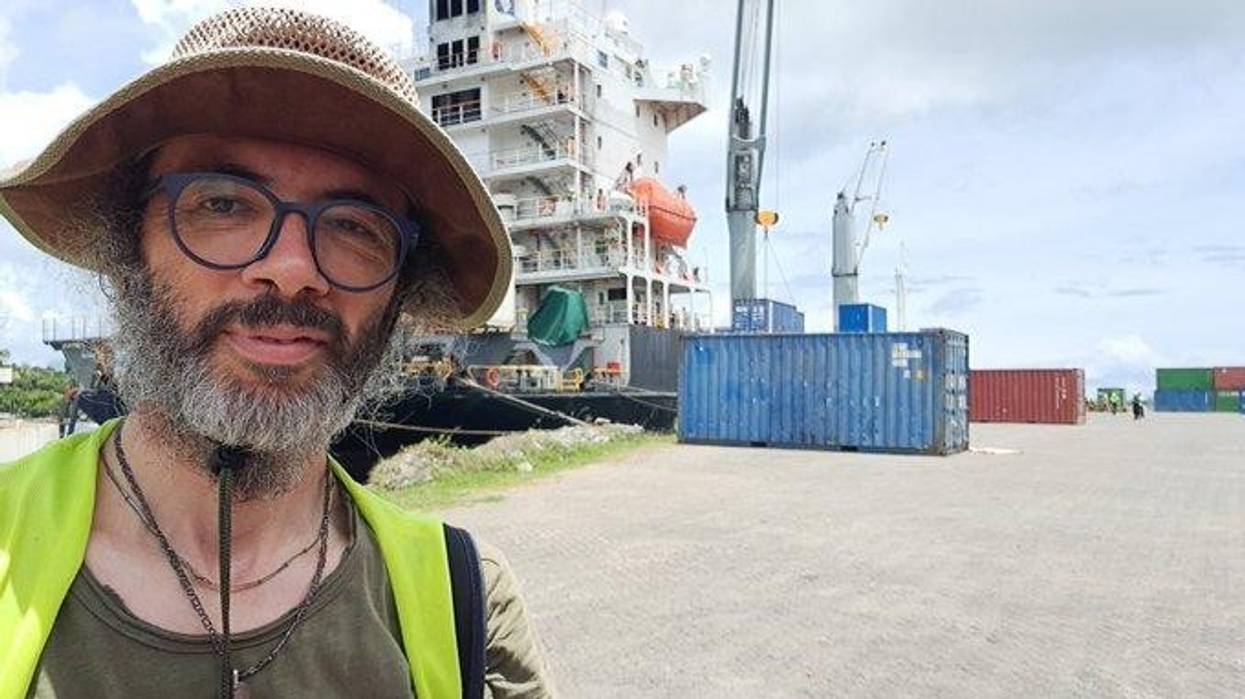
A climate researcher based in Kiel, Germany said Monday that he was prepared to lose his job at a globalization think tank, after his employer gave him an ultimatum and demanded he go against his climate-based objection to aviation travel in order to return to his place of work—a requirement at least one critic said was rooted in retaliation for the scientist's activism.
Gianluca Grimalda has been working on a field assignment in Papua New Guinea for the past six months, studying the relationship between globalization, climate change, and social cohesion for his employer, the Kiel Institute for the World Economy (IfW). He traveled to Papua New Guinea without the use of airplanes and has planned to get back to Germany the same way, boarding cargo ships, ferries, trains, and coaches to avoid 3.6 tonnes of carbon emissions.
Grimalda was originally scheduled to be finished with his work on September 10, but said in an essay on Monday that he received permission from the head of his department to remain in Papua New Guinea after wrapping up the project and noted that he is able to complete his work while traveling.
Nevertheless, on Friday the president of IfW informed Grimalda that he was required to be back in Kiel on Monday, which would require him to board a plane—a demand that he said ignores the climate impact of aviation travel and the effects already being felt by communities across the globe, including in Papua New Guinea.
"Traveling by plane would produce around four tons of carbon dioxide—the greenhouse gas responsible for global warming," wrote Grimalda. "In my outbound journey, I limited my emission to two tons by traveling over land and sea for 35 days over 16,0000 of the 22,000 kilometers. In my inbound journey I plan to cover the entire distance without catching a plane, which would limit carbon dioxide emissions to 400 kilograms—ten times less than traveling by plane."
By resolving to carry out his "slow-travel" plans instead of flying back to Kiel, Grimalda said he is risking his job.
"I know that most people would swallow the bitter pill, take a plane, and go ahead with their work—both as a professional and as an activist," wrote Grimalda. "With this job, I have enough economic stability and spare time to pursue environmental causes. Nevertheless, I believe that we have reached the point where instrumental rationality is no longer applicable. The most recent scientific evidence says that we have transgressed six out of nine planetary boundaries and that several ecosystems are close to collapse (or likely past their point of collapse) because of temperature rise—in turn caused by greenhouse gases emissions."
Grimalda acknowledged that his individual refusal to support the airline industry is no match for the continued emissions of the sector as well as fossil fuel giants, industrial farming, and other corporate actors.
"My decision not to catch a plane will mean close to nothing for the protection of the environment," he wrote. "'That plane will fly even if you have not boarded it,' many people have already told me. This is true, but giving less money to the aviation industry may mean fewer planes in the future. In any case, all the science I know, all the evidence I see, point to the fact that we are in [an] emergency. In [an] emergency, extraordinary actions should be taken. That is why, with enormous sadness, I have decided not to take a plane and face all the consequences this will lead to."
"I am prepared to pay this price, if it helps raising awareness among the public and the societal leadership on the desperate situation we are in," Grimalda added. "It is my act of love to the current and future generations, to the animal species under threat of extinction, to the idea of humanity that I instinctively and undeservedly abide by."
Grimalda and direct action group Scientist Rebellion went public with the researcher's dilemma on the same day the Institute for Policy Studies (IPS) in the U.S. released a report on private jet travel out of Laurence G. Hanscom Field near Boston, the largest private aviation field in New England.
Constrasting with Grimalda's commitment to reduce his support for carbon-intensive activities, IPS found that over 18 months, private jet owners and operators were responsible for an estimated 106,676 tons of carbon emissions, with half of those flights used for recreational or luxury travel. More than 40% of the flights were less than an hour long.
Climate groups in the area are currently pushing to ensure developers don't expand Hanscom in order to avoid even more planet-destroying emissions.
Grimalda told Scientist Rebellion that IfW has withheld his pay for the month of September without notice.
Julia Steinberger, a lead author of the latest report by the International Panel on Climate Change—which reiterated that "human activities, principally through emissions of greenhouse gasses, have unequivocally caused global warming" and warned that "approximately 3.3 to 3.6 billion people live in contexts that are highly vulnerable to climate change"—said it was "extraordinary that a research institute threatens to dismiss a researcher for doing his job too diligently and for avoiding flying during a climate emergency."
She added that she believes IfW aims to "retaliate for Gianluca's past participation in civil disobedience on climate change with Scientist Rebellion."
Grimalda has taken part in actions such as a blockade of the entrance of a biofuel refinery controlled by Eni, Italy's energy company.
The researcher expressed hope that his latest action "will sound yet another alarm bell to the ears of an inactive political leadership."
"As a scientist, I feel I have the moral responsibility to be proactive in sounding such alarms," Grimalda wrote. "It is true that thus far hundreds, if not thousands, of protests have all but gone unheard and have changed very little. Nevertheless, 'social tipping points' have existed for much progressive social change and things have changed rapidly for the good after a critical mass of support has been garnered."
Cheap airline tickets, made possible by favorable government tax treatment, "come at a high cost to the planet and its inhabitants," the environmental group warned.
A study released Thursday by Greenpeace found that the policy decisions of European governments have made flying a significantly cheaper option than traveling by train, even though the former is far worse for the climate than the latter.
For its analysis, Greenpeace Central and Eastern Europe compared air and rail fares for nine different days on 112 European travel routes.
"In the majority (79 out of 112) of routes analyzed, flights are less expensive than rail," the group noted in its new study. "Rail trips are on average twice as expensive as flights, despite the fact that the overall climate impact of flying can be over 80 times worse than taking a train."
"Why would anyone take the train from London to Barcelona and pay up to €384 when air tickets are available for the ridiculously low price of €12.99?" the group asked. (That's roughly $427 for a rail trip versus $14 to fly.)
Greenpeace attributed the often substantial differences in price to "unfair tax" policies that "favor air travel over rail." The group pointed out that "while airlines pay neither kerosene tax nor [a value-added tax] on international flights and benefit from subsidies paid with taxpayers' money, railways have to pay energy taxes, VAT, and high rail tolls in most countries."
"For the planet and people's sake, politicians must act to turn this situation around."
Lorelei Limousin, a senior climate campaigner with Greenpeace E.U., said Thursday that "airlines benefit from outrageous fiscal advantages."
"Planes pollute far more than trains, so why are people being encouraged to fly?" Limousin continued. "Low-cost airlines, in particular, have exploited every loophole and trick in the book. €10 [$11] airline tickets are only possible because others, like workers and taxpayers, pay the true cost. For the planet and people's sake, politicians must act to turn this situation around and make taking the train the more affordable option, or else we're only going to see more and more heatwaves like the one currently wreaking total havoc in Spain, Italy, Greece, and elsewhere."
Flying has been the fastest-growing source of transport emissions in the E.U. in recent years, and Greenpeace argued that European governments and institutions are effectively subsidizing the aviation industry's planet-warming emissions "through giveaways to airlines and airports" while simultaneously "closing down railway stations and lines."
Low-cost airlines in particular have benefited from government subsidies and less regulation. Greenpeace's analysis shows that "incentives for new routes from an airport are mainly designed for low-cost carriers, which are typically flying to small airports near large airports, which are considered new destinations (Paris-Beauvais, Frankfurt-Hahn…)."
"Thanks to the outrageous subsidies that airlines benefit from, they can offer unreasonably low prices—low-cost airlines are at the forefront with their aggressive pricing strategies," Greenpeace said. "But these cheap tickets come at a high cost to the planet and its inhabitants, including their employees, airport neighbors, customers, people affected by extreme weather events."
To promote less polluting travel, Greenpeace urged European national governments to "introduce climate tickets, affordable and simple long-term tickets valid on all means of public transport in a country or a defined region."
"Together with the E.U. institutions, they should also cooperate for the implementation of a cross-border climate ticket," the group said in a statement. "Windfall profit taxes, the phaseout of airline subsidies, and a fair taxation system based on CO2 emissions would make revenues available for funding climate tickets while improving public transport networks."