

SUBSCRIBE TO OUR FREE NEWSLETTER
Daily news & progressive opinion—funded by the people, not the corporations—delivered straight to your inbox.
5
#000000
#FFFFFF
To donate by check, phone, or other method, see our More Ways to Give page.
Daily news & progressive opinion—funded by the people, not the corporations—delivered straight to your inbox.
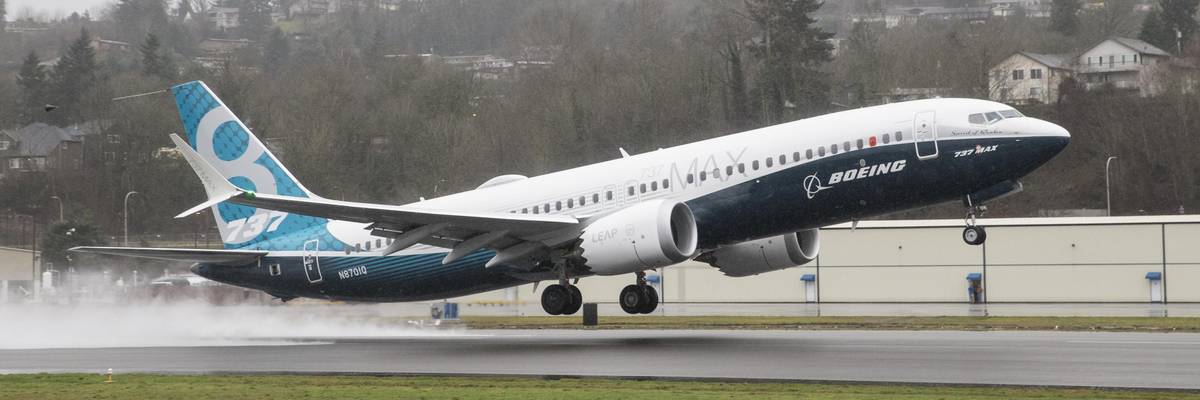
A Boeing 737 MAX 8 airliner lifts off for its first flight on January 29, 2016 in Renton, Washington. The 737 MAX is the newest of Boeing's most popular airliner featuring more fuel efficient engines and redesigned wings.
"Apparently, you have to kill hundreds of people before they even start to think about consequences," said one observer.
Federal prosecutors have recommended that the U.S. Department of Justice criminally charge Boeing for violating a 2021 settlement over two fatal crashes of the aerospace giant's troubled 737 MAX jetliners.
As Reuters reported Monday:
In May, officials determined the company breached a 2021 agreement that had shielded Boeing from a criminal charge of conspiracy to commit fraud arising from two fatal crashes in 2018 and 2019 involving the 737 MAX jet. Under the 2021 deal, the Justice Department agreed not to prosecute Boeing over allegations it defrauded the Federal Aviation Administration so long as the company overhauled its compliance practices and submitted regular reports. Boeing also agreed to pay $2.5 billion to settle the investigation.
The Department of Justice (DOJ) said Boeing violated the settlement by "failing to design, implement, and enforce a compliance and ethics program to prevent and detect violations of the U.S. fraud laws throughout its operations."
Boeing declined to comment on the Reuters report. Referring to the settlement, the company said last month that "we believe that we have honored the terms of that agreement."
The DOJ has until July 7 to decide whether to prosecute Boeing officials.
News of the prosecutors' recommendation came days after The New York Times reported that the DOJ is considering letting Boeing avoid prosecution for violating the terms of the 2021 settlement. According to the Times, the department is weighing a negotiated resolution under which the company takes a plea deal or deferred prosecution agreement (DPA)—which would impose monitoring and compliance terms—in lieu of a trial fraught with uncertainties.
Boeing entered into a DPA after 737 MAX jets crashed, killing hundreds of people. On October 29, 2018, Lion Air Flight JT610, a nearly new 737 MAX 8, crashed into the Java Sea shortly after taking off from Jakarta, Indonesia, killing all 189 passengers and crew on board. Indonesian investigators subsequently concluded that a faulty sensor caused the plane's Maneuvering Characteristics Augmentation System (MCAS) to continually tilt the aircraft downward.
On March 10, 2019, Ethiopian Airlines Flight 302, also a MAX 8, crashed into a field six minutes after taking off from Addis Ababa, Ethiopia en route to Nairobi, Kenya. All 157 people aboard were killed. Boeing acknowledged that a MCAS-related software error caused the crash and vowed to "prevent erroneous data from causing MCAS activation."
As Boeing whistleblowers—who claim they've been retaliated against—and outside aviation safety experts revealed what consumer safety advocate Ralph Nader described as "serial criminal negligence" in the company's handling of the crisis, public pressure urging the government to ground all 737 MAX planes increased. Then-Republican U.S. President Donald Trump finally did so on March 13, 2019 amid a worldwide wave of groundings that lasted until December 2020 in the United States and longer in some countries.
Yet problems persisted. Earlier this year, a door plug flew off a 737 MAX 9 during an Alaska Airlines flight, injuring passengers and forcing an emergency landing. The incident also prompted a temporary MAX 9 grounding and a DOJ criminal probe. The FAA found "multiple instances" in which Boeing and Spirit AeroSystems—a parts supplier—"allegedly failed to comply with manufacturing quality control requirements." The agency also noted "noncompliance issues in Boeing's manufacturing process control, parts handling and storage, and product control."
Last week, relatives of the 737 MAX 8 crash victims urged federal prosecutors to file criminal charges against Boeing and fine the company $25 billion.
U.S. Sen. Richard Blumenthal (D-Conn.)—a former federal prosecutor and state attorney general—said last week at a hearing on Boeing's broken safety culture that "the evidence is near-overwhelming to justify" DOJ prosecution.
"Boeing needs to stop thinking about the next earnings call and start thinking about the next generation," Blumenthal said, echoing allegations that the company prioritizes profit over safety.
Boeing CEO Dave Calhoun said at the hearing that he is "proud of every action" his company has taken in response to the 737 MAX safety crisis. Calhoun announced in March that he would step down as CEO at the end of the year—a move critics called insufficient if there is no criminal accountability.
Monday's reporting followed news that two NASA astronauts who left Earth aboard Boeing's
Starliner are stranded on the International Space Station after engineers found numerous problems with the reusable capsule. Astronauts Butch Wilmore and Suni Williams were scheduled to return to Earth on June 13 after a week aboard the ISS. This is the third time their return home has been delayed. The Starliner is docked to the ISS' Harmony module and has just 45 days of docking time left before the window for a safe return closes.
Dear Common Dreams reader, It’s been nearly 30 years since I co-founded Common Dreams with my late wife, Lina Newhouser. We had the radical notion that journalism should serve the public good, not corporate profits. It was clear to us from the outset what it would take to build such a project. No paid advertisements. No corporate sponsors. No millionaire publisher telling us what to think or do. Many people said we wouldn't last a year, but we proved those doubters wrong. Together with a tremendous team of journalists and dedicated staff, we built an independent media outlet free from the constraints of profits and corporate control. Our mission has always been simple: To inform. To inspire. To ignite change for the common good. Building Common Dreams was not easy. Our survival was never guaranteed. When you take on the most powerful forces—Wall Street greed, fossil fuel industry destruction, Big Tech lobbyists, and uber-rich oligarchs who have spent billions upon billions rigging the economy and democracy in their favor—the only bulwark you have is supporters who believe in your work. But here’s the urgent message from me today. It's never been this bad out there. And it's never been this hard to keep us going. At the very moment Common Dreams is most needed, the threats we face are intensifying. We need your support now more than ever. We don't accept corporate advertising and never will. We don't have a paywall because we don't think people should be blocked from critical news based on their ability to pay. Everything we do is funded by the donations of readers like you. When everyone does the little they can afford, we are strong. But if that support retreats or dries up, so do we. Will you donate now to make sure Common Dreams not only survives but thrives? —Craig Brown, Co-founder |
Federal prosecutors have recommended that the U.S. Department of Justice criminally charge Boeing for violating a 2021 settlement over two fatal crashes of the aerospace giant's troubled 737 MAX jetliners.
As Reuters reported Monday:
In May, officials determined the company breached a 2021 agreement that had shielded Boeing from a criminal charge of conspiracy to commit fraud arising from two fatal crashes in 2018 and 2019 involving the 737 MAX jet. Under the 2021 deal, the Justice Department agreed not to prosecute Boeing over allegations it defrauded the Federal Aviation Administration so long as the company overhauled its compliance practices and submitted regular reports. Boeing also agreed to pay $2.5 billion to settle the investigation.
The Department of Justice (DOJ) said Boeing violated the settlement by "failing to design, implement, and enforce a compliance and ethics program to prevent and detect violations of the U.S. fraud laws throughout its operations."
Boeing declined to comment on the Reuters report. Referring to the settlement, the company said last month that "we believe that we have honored the terms of that agreement."
The DOJ has until July 7 to decide whether to prosecute Boeing officials.
News of the prosecutors' recommendation came days after The New York Times reported that the DOJ is considering letting Boeing avoid prosecution for violating the terms of the 2021 settlement. According to the Times, the department is weighing a negotiated resolution under which the company takes a plea deal or deferred prosecution agreement (DPA)—which would impose monitoring and compliance terms—in lieu of a trial fraught with uncertainties.
Boeing entered into a DPA after 737 MAX jets crashed, killing hundreds of people. On October 29, 2018, Lion Air Flight JT610, a nearly new 737 MAX 8, crashed into the Java Sea shortly after taking off from Jakarta, Indonesia, killing all 189 passengers and crew on board. Indonesian investigators subsequently concluded that a faulty sensor caused the plane's Maneuvering Characteristics Augmentation System (MCAS) to continually tilt the aircraft downward.
On March 10, 2019, Ethiopian Airlines Flight 302, also a MAX 8, crashed into a field six minutes after taking off from Addis Ababa, Ethiopia en route to Nairobi, Kenya. All 157 people aboard were killed. Boeing acknowledged that a MCAS-related software error caused the crash and vowed to "prevent erroneous data from causing MCAS activation."
As Boeing whistleblowers—who claim they've been retaliated against—and outside aviation safety experts revealed what consumer safety advocate Ralph Nader described as "serial criminal negligence" in the company's handling of the crisis, public pressure urging the government to ground all 737 MAX planes increased. Then-Republican U.S. President Donald Trump finally did so on March 13, 2019 amid a worldwide wave of groundings that lasted until December 2020 in the United States and longer in some countries.
Yet problems persisted. Earlier this year, a door plug flew off a 737 MAX 9 during an Alaska Airlines flight, injuring passengers and forcing an emergency landing. The incident also prompted a temporary MAX 9 grounding and a DOJ criminal probe. The FAA found "multiple instances" in which Boeing and Spirit AeroSystems—a parts supplier—"allegedly failed to comply with manufacturing quality control requirements." The agency also noted "noncompliance issues in Boeing's manufacturing process control, parts handling and storage, and product control."
Last week, relatives of the 737 MAX 8 crash victims urged federal prosecutors to file criminal charges against Boeing and fine the company $25 billion.
U.S. Sen. Richard Blumenthal (D-Conn.)—a former federal prosecutor and state attorney general—said last week at a hearing on Boeing's broken safety culture that "the evidence is near-overwhelming to justify" DOJ prosecution.
"Boeing needs to stop thinking about the next earnings call and start thinking about the next generation," Blumenthal said, echoing allegations that the company prioritizes profit over safety.
Boeing CEO Dave Calhoun said at the hearing that he is "proud of every action" his company has taken in response to the 737 MAX safety crisis. Calhoun announced in March that he would step down as CEO at the end of the year—a move critics called insufficient if there is no criminal accountability.
Monday's reporting followed news that two NASA astronauts who left Earth aboard Boeing's
Starliner are stranded on the International Space Station after engineers found numerous problems with the reusable capsule. Astronauts Butch Wilmore and Suni Williams were scheduled to return to Earth on June 13 after a week aboard the ISS. This is the third time their return home has been delayed. The Starliner is docked to the ISS' Harmony module and has just 45 days of docking time left before the window for a safe return closes.
Federal prosecutors have recommended that the U.S. Department of Justice criminally charge Boeing for violating a 2021 settlement over two fatal crashes of the aerospace giant's troubled 737 MAX jetliners.
As Reuters reported Monday:
In May, officials determined the company breached a 2021 agreement that had shielded Boeing from a criminal charge of conspiracy to commit fraud arising from two fatal crashes in 2018 and 2019 involving the 737 MAX jet. Under the 2021 deal, the Justice Department agreed not to prosecute Boeing over allegations it defrauded the Federal Aviation Administration so long as the company overhauled its compliance practices and submitted regular reports. Boeing also agreed to pay $2.5 billion to settle the investigation.
The Department of Justice (DOJ) said Boeing violated the settlement by "failing to design, implement, and enforce a compliance and ethics program to prevent and detect violations of the U.S. fraud laws throughout its operations."
Boeing declined to comment on the Reuters report. Referring to the settlement, the company said last month that "we believe that we have honored the terms of that agreement."
The DOJ has until July 7 to decide whether to prosecute Boeing officials.
News of the prosecutors' recommendation came days after The New York Times reported that the DOJ is considering letting Boeing avoid prosecution for violating the terms of the 2021 settlement. According to the Times, the department is weighing a negotiated resolution under which the company takes a plea deal or deferred prosecution agreement (DPA)—which would impose monitoring and compliance terms—in lieu of a trial fraught with uncertainties.
Boeing entered into a DPA after 737 MAX jets crashed, killing hundreds of people. On October 29, 2018, Lion Air Flight JT610, a nearly new 737 MAX 8, crashed into the Java Sea shortly after taking off from Jakarta, Indonesia, killing all 189 passengers and crew on board. Indonesian investigators subsequently concluded that a faulty sensor caused the plane's Maneuvering Characteristics Augmentation System (MCAS) to continually tilt the aircraft downward.
On March 10, 2019, Ethiopian Airlines Flight 302, also a MAX 8, crashed into a field six minutes after taking off from Addis Ababa, Ethiopia en route to Nairobi, Kenya. All 157 people aboard were killed. Boeing acknowledged that a MCAS-related software error caused the crash and vowed to "prevent erroneous data from causing MCAS activation."
As Boeing whistleblowers—who claim they've been retaliated against—and outside aviation safety experts revealed what consumer safety advocate Ralph Nader described as "serial criminal negligence" in the company's handling of the crisis, public pressure urging the government to ground all 737 MAX planes increased. Then-Republican U.S. President Donald Trump finally did so on March 13, 2019 amid a worldwide wave of groundings that lasted until December 2020 in the United States and longer in some countries.
Yet problems persisted. Earlier this year, a door plug flew off a 737 MAX 9 during an Alaska Airlines flight, injuring passengers and forcing an emergency landing. The incident also prompted a temporary MAX 9 grounding and a DOJ criminal probe. The FAA found "multiple instances" in which Boeing and Spirit AeroSystems—a parts supplier—"allegedly failed to comply with manufacturing quality control requirements." The agency also noted "noncompliance issues in Boeing's manufacturing process control, parts handling and storage, and product control."
Last week, relatives of the 737 MAX 8 crash victims urged federal prosecutors to file criminal charges against Boeing and fine the company $25 billion.
U.S. Sen. Richard Blumenthal (D-Conn.)—a former federal prosecutor and state attorney general—said last week at a hearing on Boeing's broken safety culture that "the evidence is near-overwhelming to justify" DOJ prosecution.
"Boeing needs to stop thinking about the next earnings call and start thinking about the next generation," Blumenthal said, echoing allegations that the company prioritizes profit over safety.
Boeing CEO Dave Calhoun said at the hearing that he is "proud of every action" his company has taken in response to the 737 MAX safety crisis. Calhoun announced in March that he would step down as CEO at the end of the year—a move critics called insufficient if there is no criminal accountability.
Monday's reporting followed news that two NASA astronauts who left Earth aboard Boeing's
Starliner are stranded on the International Space Station after engineers found numerous problems with the reusable capsule. Astronauts Butch Wilmore and Suni Williams were scheduled to return to Earth on June 13 after a week aboard the ISS. This is the third time their return home has been delayed. The Starliner is docked to the ISS' Harmony module and has just 45 days of docking time left before the window for a safe return closes.

