SUBSCRIBE TO OUR FREE NEWSLETTER
Daily news & progressive opinion—funded by the people, not the corporations—delivered straight to your inbox.
5
#000000
#FFFFFF
To donate by check, phone, or other method, see our More Ways to Give page.
Daily news & progressive opinion—funded by the people, not the corporations—delivered straight to your inbox.
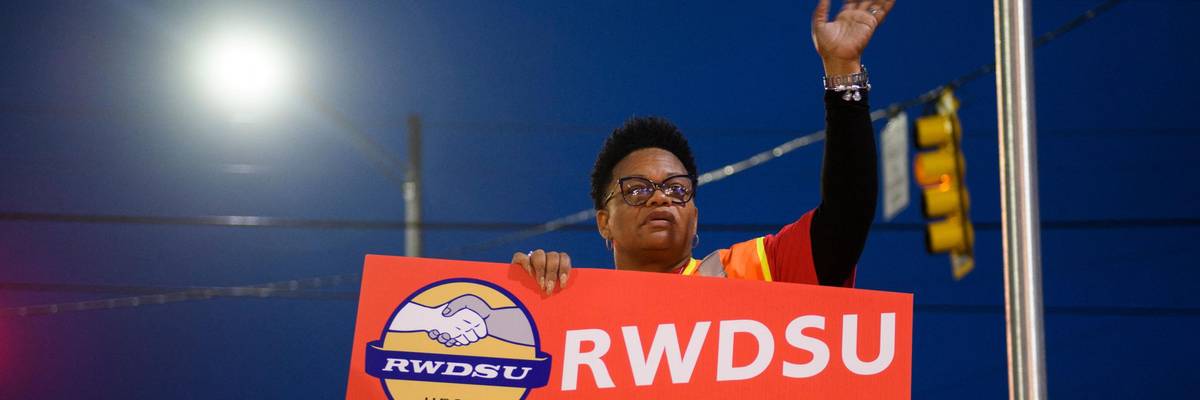
Union organizer Syrena waves to cars outside an Amazon warehouse on March 27, 2021 in Bessemer, Alabama. The warehouse's second union election in less than a year began Friday. (Photo: Patrick T. Fallon/AFP via Getty Images)
As the National Labor Relations Board began sending out union election ballots to Amazon warehouse workers in Bessemer, Alabama on Friday--less than a year after the workers lost an initial election and the board accused the company of illegal interference--Sen. Bernie Sanders condemned the U.S. Senate's failure to pass proposed legislation that would strengthen unionization efforts.
"We're seeing efforts around the country for people to become unionized and we're seeing corporations responding in sometimes absolutely illegal ways."
"We're seeing efforts around the country for people to become unionized and we're seeing corporations responding in sometimes absolutely illegal ways," the Vermont independent senator told The Hill. "Workers need protection and of course we've got to give them that protection through the PRO Act."
The Senate has thus far failed to pass the PRO Act, or Protecting the Right to Organize Act, whose provisions are included in the stalled Build Back Better social spending and climate package. Due to the legislative filibuster--and right-wing Democrats' opposition to reforming the tool--the Democrats need 60 votes to pass the legislation.
The NLRB concluded after last spring's union election that Amazon unfairly ensured its own decisive victory by employing aggressive anti-union tactics, including improperly polling workers about the vote.
The company also pressured the U.S. Postal Service to install a mailbox at the warehouse and gave security guards access to the box, giving "the appearance of irregularity in the election procedure," according to the NLRB.
Although workers in Bessemer are celebrating their second chance at voting to join the Retail, Wholesale, and Department Store Union (RWDSU), the absence of federal worker protections has ensured Amazon can intimidate and pressure the employees as the company did last year.
"In many ways the situation has not changed a great deal from a year ago," labor professor John Logan of San Francisco State University told The Hill.
Under the PRO Act, employers would face civil penalties for union-busting activity, including firing and threatening union supporters and requiring workers to attend anti-union meetings. Companies also would be blocked from involvement in setting union procedures.
Despite a request filed by RWDSU, without federal protections, the mailbox Amazon placed at the Bessemer warehouse is still there as workers begin voting, according to The Hill.
"It is an ominous reminder for all of us of Amazon's surveillance capabilities," warehouse employee Jennifer Bates told reporters.
According to workers who spoke with labor-focused media organization More Perfect Union, the company is also still holding anti-union meetings and requiring them to attend.
But some workers are optimistic that they have a better chance at victory this year due to a coordinated effort to educate the roughly 6,000-person workforce about the union drive as well as pushback among employees against Amazon's union-busting efforts.
At the company's "captive audience" anti-union meetings, one worker told More Perfect Union, "pro-union workers have been speaking up and that has done wonders, that has really helped to shift the attitude towards the union within the facility."
National unions from across the country, including the Service Employees International Union and the Teamsters, sent dozens of organizers to Bessemer in recent weeks to rally the employees and launch a door-knocking campaign, according to the New York Times.
"By the time people start voting on Monday or Tuesday, we will have gone to every single door--all 6,000 workers," Stuart Appelbaum, president of RWDSU, told the Times.
Voting in the union election will continue until March 25.
Dear Common Dreams reader, It’s been nearly 30 years since I co-founded Common Dreams with my late wife, Lina Newhouser. We had the radical notion that journalism should serve the public good, not corporate profits. It was clear to us from the outset what it would take to build such a project. No paid advertisements. No corporate sponsors. No millionaire publisher telling us what to think or do. Many people said we wouldn't last a year, but we proved those doubters wrong. Together with a tremendous team of journalists and dedicated staff, we built an independent media outlet free from the constraints of profits and corporate control. Our mission has always been simple: To inform. To inspire. To ignite change for the common good. Building Common Dreams was not easy. Our survival was never guaranteed. When you take on the most powerful forces—Wall Street greed, fossil fuel industry destruction, Big Tech lobbyists, and uber-rich oligarchs who have spent billions upon billions rigging the economy and democracy in their favor—the only bulwark you have is supporters who believe in your work. But here’s the urgent message from me today. It's never been this bad out there. And it's never been this hard to keep us going. At the very moment Common Dreams is most needed, the threats we face are intensifying. We need your support now more than ever. We don't accept corporate advertising and never will. We don't have a paywall because we don't think people should be blocked from critical news based on their ability to pay. Everything we do is funded by the donations of readers like you. When everyone does the little they can afford, we are strong. But if that support retreats or dries up, so do we. Will you donate now to make sure Common Dreams not only survives but thrives? —Craig Brown, Co-founder |
As the National Labor Relations Board began sending out union election ballots to Amazon warehouse workers in Bessemer, Alabama on Friday--less than a year after the workers lost an initial election and the board accused the company of illegal interference--Sen. Bernie Sanders condemned the U.S. Senate's failure to pass proposed legislation that would strengthen unionization efforts.
"We're seeing efforts around the country for people to become unionized and we're seeing corporations responding in sometimes absolutely illegal ways."
"We're seeing efforts around the country for people to become unionized and we're seeing corporations responding in sometimes absolutely illegal ways," the Vermont independent senator told The Hill. "Workers need protection and of course we've got to give them that protection through the PRO Act."
The Senate has thus far failed to pass the PRO Act, or Protecting the Right to Organize Act, whose provisions are included in the stalled Build Back Better social spending and climate package. Due to the legislative filibuster--and right-wing Democrats' opposition to reforming the tool--the Democrats need 60 votes to pass the legislation.
The NLRB concluded after last spring's union election that Amazon unfairly ensured its own decisive victory by employing aggressive anti-union tactics, including improperly polling workers about the vote.
The company also pressured the U.S. Postal Service to install a mailbox at the warehouse and gave security guards access to the box, giving "the appearance of irregularity in the election procedure," according to the NLRB.
Although workers in Bessemer are celebrating their second chance at voting to join the Retail, Wholesale, and Department Store Union (RWDSU), the absence of federal worker protections has ensured Amazon can intimidate and pressure the employees as the company did last year.
"In many ways the situation has not changed a great deal from a year ago," labor professor John Logan of San Francisco State University told The Hill.
Under the PRO Act, employers would face civil penalties for union-busting activity, including firing and threatening union supporters and requiring workers to attend anti-union meetings. Companies also would be blocked from involvement in setting union procedures.
Despite a request filed by RWDSU, without federal protections, the mailbox Amazon placed at the Bessemer warehouse is still there as workers begin voting, according to The Hill.
"It is an ominous reminder for all of us of Amazon's surveillance capabilities," warehouse employee Jennifer Bates told reporters.
According to workers who spoke with labor-focused media organization More Perfect Union, the company is also still holding anti-union meetings and requiring them to attend.
But some workers are optimistic that they have a better chance at victory this year due to a coordinated effort to educate the roughly 6,000-person workforce about the union drive as well as pushback among employees against Amazon's union-busting efforts.
At the company's "captive audience" anti-union meetings, one worker told More Perfect Union, "pro-union workers have been speaking up and that has done wonders, that has really helped to shift the attitude towards the union within the facility."
National unions from across the country, including the Service Employees International Union and the Teamsters, sent dozens of organizers to Bessemer in recent weeks to rally the employees and launch a door-knocking campaign, according to the New York Times.
"By the time people start voting on Monday or Tuesday, we will have gone to every single door--all 6,000 workers," Stuart Appelbaum, president of RWDSU, told the Times.
Voting in the union election will continue until March 25.
As the National Labor Relations Board began sending out union election ballots to Amazon warehouse workers in Bessemer, Alabama on Friday--less than a year after the workers lost an initial election and the board accused the company of illegal interference--Sen. Bernie Sanders condemned the U.S. Senate's failure to pass proposed legislation that would strengthen unionization efforts.
"We're seeing efforts around the country for people to become unionized and we're seeing corporations responding in sometimes absolutely illegal ways."
"We're seeing efforts around the country for people to become unionized and we're seeing corporations responding in sometimes absolutely illegal ways," the Vermont independent senator told The Hill. "Workers need protection and of course we've got to give them that protection through the PRO Act."
The Senate has thus far failed to pass the PRO Act, or Protecting the Right to Organize Act, whose provisions are included in the stalled Build Back Better social spending and climate package. Due to the legislative filibuster--and right-wing Democrats' opposition to reforming the tool--the Democrats need 60 votes to pass the legislation.
The NLRB concluded after last spring's union election that Amazon unfairly ensured its own decisive victory by employing aggressive anti-union tactics, including improperly polling workers about the vote.
The company also pressured the U.S. Postal Service to install a mailbox at the warehouse and gave security guards access to the box, giving "the appearance of irregularity in the election procedure," according to the NLRB.
Although workers in Bessemer are celebrating their second chance at voting to join the Retail, Wholesale, and Department Store Union (RWDSU), the absence of federal worker protections has ensured Amazon can intimidate and pressure the employees as the company did last year.
"In many ways the situation has not changed a great deal from a year ago," labor professor John Logan of San Francisco State University told The Hill.
Under the PRO Act, employers would face civil penalties for union-busting activity, including firing and threatening union supporters and requiring workers to attend anti-union meetings. Companies also would be blocked from involvement in setting union procedures.
Despite a request filed by RWDSU, without federal protections, the mailbox Amazon placed at the Bessemer warehouse is still there as workers begin voting, according to The Hill.
"It is an ominous reminder for all of us of Amazon's surveillance capabilities," warehouse employee Jennifer Bates told reporters.
According to workers who spoke with labor-focused media organization More Perfect Union, the company is also still holding anti-union meetings and requiring them to attend.
But some workers are optimistic that they have a better chance at victory this year due to a coordinated effort to educate the roughly 6,000-person workforce about the union drive as well as pushback among employees against Amazon's union-busting efforts.
At the company's "captive audience" anti-union meetings, one worker told More Perfect Union, "pro-union workers have been speaking up and that has done wonders, that has really helped to shift the attitude towards the union within the facility."
National unions from across the country, including the Service Employees International Union and the Teamsters, sent dozens of organizers to Bessemer in recent weeks to rally the employees and launch a door-knocking campaign, according to the New York Times.
"By the time people start voting on Monday or Tuesday, we will have gone to every single door--all 6,000 workers," Stuart Appelbaum, president of RWDSU, told the Times.
Voting in the union election will continue until March 25.