EMAIL SIGN UP!
Most Popular This Week
- One American Who Isn't For Sale
- Edward Snowden: Saving Us from the United Stasi of America
- Major Loss to Organic Farmers as Court Rules in Favor of Monsanto
- The Judicial Lynching of Bradley Manning
- Remembering Satyajit Ray’s Hirok Rajar Deshe: On Edward Snowden, Resistance and Inverted Totalitarianism
Popular content
Today's Top News
Super Weeds Pose Growing Threat to U.S. Crops
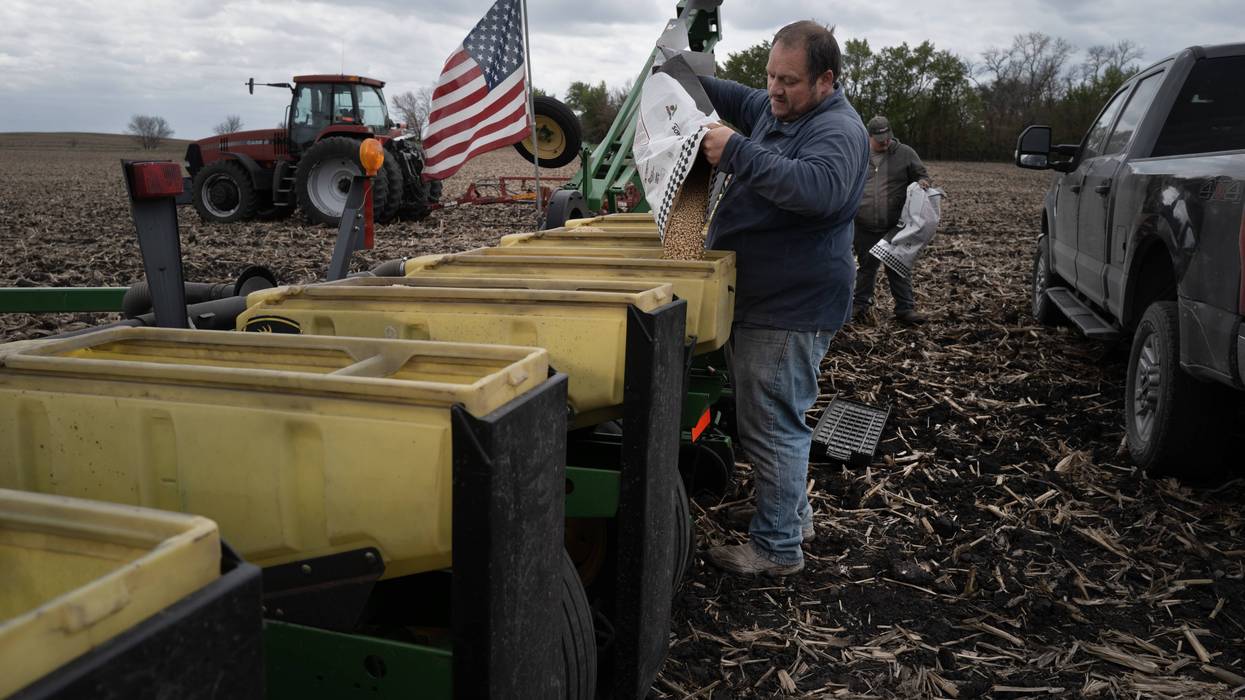
PAOLA, Kansas - Farmer Mark Nelson bends down and yanks a four-foot-tall weed from his northeast Kansas soybean field. The "waterhemp" towers above his beans, sucking up the soil moisture and nutrients his beans need to grow well and reducing the ultimate yield. As he crumples the flowering end of the weed in his hand, Nelson grimaces.
"We are at a disturbing juncture," said Margaret Mellon, director of the food and environment program at the Union of Concerned Scientists. "The use of toxic chemicals in agriculture is skyrocketing. This is not the path to sustainability." "When we harvest this field, these waterhemp seeds will spread all over kingdom come," he said.
Nelson's struggle to control crop-choking weeds is being repeated all over America's farmland. An estimated 11 million acres are infested with "super weeds," some of which grow several inches in a day and defy even multiple dousings of the world's top-selling herbicide, Roundup, whose active ingredient is glyphosate.
The problem's gradual emergence has masked its growing menace. Now, however, it is becoming too big to ignore. The super weeds boost costs and cut crop yields for U.S. farmers starting their fall harvest this month. And their use of more herbicides to fight the weeds is sparking environmental concerns.
With food prices near record highs and a growing population straining global grain supplies, the world cannot afford diminished crop production, nor added environmental problems.
"I'm convinced that this is a big problem," said Dave Mortensen, professor of weed and applied plant ecology at Penn State University, who has been helping lobby members of Congress about the implications of weed resistance.
"Most of the public doesn't know because the industry is calling the shots on how this should be spun," Mortensen said.
Last month, representatives from the U.S. Environmental Protection Agency, the Department of Agriculture and the Weed Science Society of America toured the Midwest crop belt to see for themselves the impact of rising weed resistance.
"It is only going to get worse," said Lee Van Wychen, director of science policy at the Weed Science Society of America.
MONSANTO ON THE FRONT LINE
At the heart of the matter is Monsanto Co, the world's biggest seed company and the maker of Roundup. Monsanto has made billions of dollars and revolutionized row crop agriculture through sales of Roundup and "Roundup Ready" crops genetically modified to tolerate treatment with Roundup.
The Roundup Ready system has helped farmers grow more corn, soybeans, cotton and other crops while reducing detrimental soil tillage practices, killing weeds easily and cheaply.
But the system has also encouraged farmers to alter time-honored crop rotation practices and the mix of herbicides that previously had kept weeds in check.
And now, farmers are finding that rampant weed resistance is setting them back - making it harder to keep growing corn year in and year out, even when rotating it occasionally with soybeans. Farmers also have to change their mix and volume of chemicals, making farming more costly.
For Monsanto, it spells a threat to the company's market strength as rivals smell an opportunity and are racing to introduce alternatives for Roundup and Roundup Ready seeds.
"You've kind of been in a Roundup Ready era," said Tom Wiltrout, a global strategy leader at Dow AgroSciences, which is introducing an herbicide and seed system called Enlist as an alternative to Roundup.
"This just allows us to candidly get out from the Monsanto story," he said.
Gilford Securities analyst Paul Christopherson last month reiterated a "sell" recommendation on Monsanto's shares, citing Monsanto's "overdependence" on glyphosate and Roundup Ready crops, calling glyphosate resistance by weeds a "big and growing phenomenon."
Monsanto officials say they are asking farmers to use different types of herbicides to fight weeds, but insist that Roundup remains effective for the majority of U.S. farmers.
Still, company spokesman Tom Helscher said weed resistance was a "wake-up call for all U.S. farmers."
"We have a shared responsibility and we're committed to working with farmers to take the steps necessary to insure that glyphosate continues to be an effective weed control tool for many years to come," Helscher said in a statement.
POURING ON THE PESTICIDES
To fight superweeds, farmers are using stronger dousings of glyphosate as well as other harsh chemicals that have sparked concern among environmental and public health groups.
Nelson, for example, has been a fan of Roundup since Monsanto introduced Roundup Ready soybeans and corn in the 1990s. For years he needed no other herbicides for his 2,000 acres, marveling at how easily Roundup wiped out weeds. He often did not even use the full concentration recommended.
Now Nelson uses several pesticides and sprays his fields multiple times to try to control waterhemp, which can grow eight-feet tall and can be toxic to livestock.
He uses the maximum amount of Roundup along with other herbicides including one known as 2,4-D, which some scientific organizations have deemed a cancer risk.
"Just spraying Roundup was so easy," he said. "There is no ease anymore."
In Ohio, the nightmare weed for farmer John Davis is "marestail," an annual weed that grows well in key crop-growing areas of the U.S. Midwest and which is resistant to glyphosate and other herbicides.
"I see marestail in my sleep," said Davis, president of the Ohio Corn Growers organization. "I have spent a significant amount of dollars trying to control marestail until I realized I was not going to control marestail."
Davis calls the weed resistance problem a "major economic blow" to his farming operation.
Some farmers have resorted to hiring crews to weed fields by hand, and some are returning to tilling their fields, a practice that contributes to soil erosion.
"We are at a disturbing juncture," said Margaret Mellon, director of the food and environment program at the Union of Concerned Scientists. "The use of toxic chemicals in agriculture is skyrocketing. This is not the path to sustainability."
Penn State's Mortensen said farmer efforts to control resistant weeds are estimated to cost nearly $1 billion a year and result in a 70 percent increase in pesticide use by 2015.
Since Monsanto introduced its glyphosate-resistant crops, 21 weed species have evolved to resist the herbicide, up from none in 1995. The list is growing by one to two species per year, Mortensen said.
Farmers and crop experts say that when superweeds take root in farm fields, yield reductions of 1-2 bushels an acre are common, even with extra pesticide doses.
With soybeans at more than $14 a bushel, a 1,000-acre farm might lose more than $20,000 to weeds on top of the costs of the added pesticides.
ENVIRONMENTAL PROBLEMS
Then there are the environmental woes. A U.S. government study released last month gave evidence that glyphosate is also polluting the air and waterways. The chemical was found in waterways through Mississippi and Iowa, according to the report issued in August by the U.S. Geological Survey Office, a part of the U.S. Department of the Interior.
The USGS said more than 88,0000 tons of glyphosate was used in 2007, up from 11,000 tons in 1992.
"This is a big problem that actually does threaten the ability of nations to feed their people. it needs a fair amount of research and studies dedicated to it," said Iowa agronomist Bob Streit.
Streit is among a group of scientists who believe glyphosate is actually harming the plants it is supposed to protect by tying up nutrients in the soil the plants need. The group has lobbied regulators to rein in use of glyphosate.
The Environmental Protection Agency has started a review of the safety and efficacy of glyphosate and is considering the arguments of critics and the findings of the USGS study.
"EPA considers all relevant information in its review," said an EPA spokesperson. "We will be evaluating it as part of the glyphosate review."
EPA plans to propose a decision in 2014 and issue a final registration review decision for glyphosate in 2015.
For Monsanto, the weed resistance problem is more significant than the recent concerns raised about possible insect resistance developing to Monsanto's corn seed, said Gabelli & Co analyst Amon Wilkes.
Wilkes remains bullish on Monsanto's prospects. While he sees competition to Roundup as a "potential problem," he noted the company has been moving to introduce new products.
"You always have to be continually innovating. Monsanto is doing that."
Monsanto insists that the Roundup Ready crops and herbicide system "has long-term value" and that any rivals will also run the risk of triggering weed resistance.
"The benefits of glyphosate-tolerant crops have been real for farmers and the environment," said Monsanto's Helscher.
Comments
Note: Disqus 2012 is best viewed on an up to date browser. Click here for information. Instructions for how to sign up to comment can be viewed here. Our Comment Policy can be viewed here. Please follow the guidelines. Note to Readers: Spam Filter May Capture Legitimate Comments...


71 Comments so far
Show AllI got a kick out of CD's fear-mongering headline for this story. Ah, the drama! Yes, it's true, those waterhemp weeds are a problem for me too, but can we please skip the doom n gloom? Weeds have always been a problem for myself and all farmers. Some weeds were such a problem that many years ago I would sometimes apply 5 pounds of atrazine per acre. This killed all the weeds, but forced me to grow corn 2 years in a row which I did not ordinarily ever do. Then along came one of those "super weeds." Then it was wooly cupgrass which was completely unfazed by atrazine. Anyway, new chemicals are discovered and some that are now in use are applied at a rate of a fraction of an ounce per acre. We cannot feed the world 'organically,' and nearly no one reading this has the slightest interest in spending day after day ad nauseum hoeing weeds. So, anyway, go ahead and rail against me, a typical American farmer.
No railing from me.
We're always only a step ahead of evolution. If glyphosate stops working, that will be too bad. I still use it on my stone walls and fence lines. There are no "super" weeds here (yet).
I too noticed the ridiculous headlines. Liberals lose their minds over "chemicals" and farming the same way conservatives lose their minds over global warming and evolution
The definition of insanity is to keep doing the same thing over and over and expecting a different result. This is a prime example of evolution at work. All of those chemicals haver to go somewhere, and guess where? Into the water supply that we all drink and bathe in. At what point do we reach a lethal dose of poison? Is your fear of hoeing weeds so strong you are willing to poison the entire population of your county? Like it or not, something has got to change, and changing from one untested poison to another, or adding more, is NOT the answer if you want to keep living on this planet.
Smallbear, a small farmer using Roundup on his stone walls bears no resemblance to large farmers spraying Roundup-Ready crops.
"Fear" of hoeing weeds? How about inability? I don't own slaves.
Get a grip.
For once I have to agree with you. Life is hard for family farmers. They need help and subsidies to move over to sustainable practices.
You can take your self-righteous attitude and shove it up your cultivator.
The headline is actually pretty mild relative to the seriousness of chemical intensive agriculture that is destroying soil fertility to the point where several thousand acres of farms are taken out of production each year.
Glyphosphate is blocks any plants ability to uptake nutrients. How do you know you don't have superweeds? You continue to use it and all you're doing is creating better conditions for weeds, which actually thrive in extremely poor soil where 99% of organisms - hey, did you ever wonder where the word "organic" comes from? it's root is based in organisms. A fertile soil is full of microscopic organisms and bacteria that actually feed plant roots - have been destroyed by chemicals and synthetic fertilizers
Anyways.... you should be losing your mind over the fact that that bacterium are excellent communicators. Turns out that gene splicing is done by telling the DNS what to do. Really. The bacteria talks and the DNA obeys its instructions. Turns out that the bacteria chosen to do this is E. coli.
Just trust them that they're using a strain that won't bother you. Sleep easy - don't go losing your mind now! - knowing that if it's not organic, then you're consuming a bacteria that accesses every cell in your body. Careful, you might develop resistance to facts, truth and other liberal diseases.
"I got a kick out of CD's fear-mongering headline for this story."
This story was published by Reuters...
BP, you failed to compare CDs headline with Reuters.
Title from CD;
"Super Weeds Pose Growing Threat to US Crops"
Title from Reuters;
"Analysis: Super Weeds Pose Growing Threat to US Crops"
http://www.reuters.com/article/2011/09/20/us-monsanto-superweeds-idUSTRE78J3TN20110920
Yep, the former is definitely fear mongering, while the latter makes me feel all warm and tingly inside...
lol, you may eventually figure it out...or not.
Probably not. I'll try to help:
Rise of the Super Weeds Skyrocketing Toxic Chemical Use
Thanks BProgress. I think we've all figured out that Pesticide Greg and MBendzela (nee Monsanto on a Cracker) are Monsanto stooges, and you've proved it once again.
Greg R -- Glad to hear you got a kick "out of CD's fear-mongering headline". Now I have a hint for you: it's a Reuter's article and Reuter's headline. You can see the same headline and article at Scientific American:
http://www.scientificamerican.com/article.cfm?id=analysis:-super-weeds-pose
Enjoy your spraying.
Your good friends at Monsanto have new and improved herbicides and pesticides in the pipeline. Stock prices will boom. Industrial agriculture has no shortcomings that cannot be overcome by increased inputs of hydrocarbons, increased applications of novel petrochemicals & synthetic toxins, and wily genetic tinkering.
As many of these chemicals are carcinogenic -- despite all the safety assurances in the glossy brochures handed out by Monsanto -- I would be more concerned about that than the "super weeds" anyway.
GregR, You are incorrect in saying we cannot feed the world organically. We are not only destroying the environment with lethal doses of poison, the majority of the stuff produced is transformed into over processed junk with little nutritional value or negative health effects. Quality and common sense need to trump quantity and profit. It would help if there was as much energy put into personal vegetable gardens as there is in cutsy landscapes which often require more poisons. Monsanto is the super weed!
The usual unsupported claims.
Better read this:
http://foodpreparednessnetwork.com/organic-crops-alone-cant-feed-the-world/
Monsanto has destroyed this farmer's land. Is it for decades or for eternity only - eons will tell. How many of our struggling farmers will be heading for the Last Roundup (al)ready?
lol
Indian farmers are committing suicide at the rate of one per hour thanks to Monsanto, and you think that's funny?
Monsanto et al have caused "an estimated 125,000 farmers to take their own life as a result of the ruthless drive to use India as a testing ground for genetically modified crops."
http://www.dailymail.co.uk/news/article-1082559/The-GM-genocide-Thousands-Indian-farmers-committing-suicide-using-genetically-modified-crops.html
Don't try to put words in my mouth, asshole. Fuck you.
Weeds are the symptom, not the problem. Want to see what agriculture does? Look at North Africa and Iraq. They were once forests very much like the Pacific Northwest. North Africa was Rome's bread basket. No longer.
I don't get your point. I don't look at weeds as a "symptom," they are natural. They seek to evolve and flourish.
The point is that if we keep abusing our agricultural land as we have been, we won't have any. It will no longer sustain any crop, just the way Iraq and Ethiopia are now. In historical times they were lush, rich farmlands, but no longer. Now, they are sterile deserts, and we are headed for the same.
Desertification happens for many reasons. Sometimes too much tillage which opens the land to erosion is the main cause. Certainly erosion and mining of nutrients leads to degradation. There are no excellent answers when trying to feed billions and supply fuel for cars. People want to eat and they want to eat well. They also want to move (therefore I am).
Iraq (or Mesopotamia), since ancient times, has relied upon extensive irrigation for agricultural purposes. You can read about it here:
http://www.waterencyclopedia.com/Hy-La/Irrigation-Systems-Ancient.html
and here:
http://mygeologypage.ucdavis.edu/cowen/~GEL115/115CH17oldirrigation.html
Currently, Iraq is experiencing a drought, which has been exacerbated by lack of infrastructure repair (infrastructure that was destroyed and left to rot after the invasion), government corruption, and the placement of dams upstream on the Tigris and Euphrates Rivers by other neighboring countries.
In other words, what we see today in Iraq is not due to human abuse of agricultural land, but rather due to the inability of humans to maintain the agriculture they have practiced for thousands of years.
From Derrick Jensen's book, "Strangely Like War" ...He describes Iraq and Greece and Israel as forrested land, thick old growth forrest. Then....it was all chopped down for war ships, temples and yes, agriculture....and ...... we wouldn't have had to feed the world, if we hadn't gone in and destroyed much of the rest of the world's economic and cultural foundations..... through colonialism etc...... the west...... we are the dominate reason for much of the world's woes....... The US has ......stated from Derrick's book.....lost 95 % of the forrest that was here when we first came.... gee.....and look at all that CO2 we are ;putting in the atmosphere......with less and less trees to suck it up.....no, at this point it would be very hard to feed billions on organic farming....because, most people would not give up sitting their fat butts in their office chairs or give up going to the nail salon ..... or give up riding around in their BMW or jaguar or mustang........ won't give up slurpping their latte ......to go out and put seeds in the ground to grow their own food..... they'd rather just let the planet dry up and blow away or burn away or drown.... than live a life close to nature..... yeah, we humans are too good to give up the good life..... and go ahead....make my day and say how I am exaggerating about the planet becoming unable to sustain life...... especially our lives..... yeah, eventually the earth would most likely come back ..... but we'd be gone......the worst part about it is that the first to go..... those with no power and no money.... would suffer first, while the rich suck the rest bloodless.... the planet into oblivion and then..... then.....they too would succumb..... to death's call ......
Thank you for bringing up Derrick Jensen. He has more valuable things to say than bookshelves of other authors. More people should read his chilling descriptions of human destruction of their own world.
Yeah, but the statement about Iraq is flat-out wrong. The victim is being blamed instead of the true cause of the problem.
Iraq was never heavily forested, except for parts of the mountainous north. Archaeologists who are familiar with the region would tell you that. Furthermore, if these heavily forested regions in the north of Iraq were over-harvested for wood (I'm not saying that deforestation didn't happen), it didn't destroy food production - agriculture was still maintained from ancient Mesopotamia, through the Arab empire, until today. Modern Iraq was one of the world's largest suppliers of dates, for instance. While Derrick Jensen may be correct about some things, deforestation in northern Iraq didn't result in the obliteration of agriculture in Iraq (*if* that's what he really said).
I've actually done a good bit of reading on this topic. Ancient Mesopotamians invented and had to rely upon extensive irrigation for farming, especially throughout the central and southern parts of Iraq (which are part of the Fertile Crescent). There was a type of farming practiced in ancient Mesopotamia that utilized date palms in "gardens" (or "groves" or "plantations", as we call them now, or you could think of them as "managed forests"), but they were planted and maintained by humans. These gardens of date palms were meant to help support other, lower-strata plants, as well: the leaves of the palms helped to prevent the harsh sun from damaging plants growing beneath them, and the roots of the palms helped to stabilize the soil for those other plants. You can read more about ancient Mesopotamia's climate and agriculture in any number of scholarly books and articles.
There is a totally man-made reason for the problem with agriculture in Iraq today - the invasion and occupation and "wars". All of the symptoms of the problem that I mentioned earlier are either direct or indirect effects of the wars/sanctions/invasion/occupation of Iraq.
The Arc from Ethiopia's Nile River Valley thru to Iraq's Mesopotamia was the Ancient 'Fretile Crescent' where Agriculture & Civilization began.
One big reason why so much of Ethiopia & Iraq are now 'waste-lands' is because Mussolini's Fascist Italians Devastated much of Ethiopia after they failed to subdue it [Mussolini once said, as he unleashed his fascist forces on Ethiopia, 'Give me Ethiopia & I'll Feed All of Europe!']; -&- the US, UK, UN devastated Iraq w the 2 Bushes' [Sr & Jr + Bliar] Wars & the devastating UN sanctions & of course the Iran - Iraq War. Most folks don't know that WAR causes famine & devastates farm-land as much if not more so than droughts!
War in combo w eco-destroying industrialized farming using GMO / mono-crops, petro-chem fertilizers-herbicides-pesticides, CAFO animal factory farms, nuke plant melt-downs, toxic spills, etc - is at-least as much & likely even more so a threat to the eco-sphere than drought, climate-change, etc.
This article is indicative that 'The Chicken have Come back home to Roost'! GMO crops & Round-up may have sounded like a 'real bargain' [w the devil] back in the early 1990s. But now we're paying for it w super resistant super-weeds & super-bugs, & bee-colony collapses, etc. But Monsanto's competitors see an opening so whats their solution- More Of the Same O_Same O just w a different Brand & Label- IE: No Solution at All! The Real Solution is to Stop relying so much on- GMO Crops & mono-crop farming. environmentally poisoning Petro-chem fertilizers-herbicides-pesticides, CAFO animal factory farms, etc! Going back to more natural & eco-friendly farming methods! If not we're headed for a Total & Catastrophic Collapse!
Thank you for your insightful comment, Nixakliel. Your statement about Iraq is correct. Yes, the drought that Iraq is experiencing now has been exacerbated and magnified by the "wars," and this is what has devastated Iraqi agriculture. For some reason, people want to blame the indigenous people of Iraq for the problem, instead of the "wars," even though successful, sustainable agriculture was practiced in Iraq for millenia until now.
Greg, "They are natural. They seek to evolve and flourish." Alas, humans have forgotten those directives.
Weeds flourish on disturbed ground. If you don't disturb the ground, their seeds cannot sprout and compete with the plants already there. One answer to the weed problem would be perennial crops. Come up with perennial corn, wheat, soybeans and the like. No more tillage, no more weeds, no more soil erosion. Just put your feet up on the dashboard of your pickup and watch 'em grow.
Depends what you call a weed.
Wait, what is the point? (Forget this comment I posted, looks like Smallbear and others offered some insights)
Somehow I don't think "the world" wants either to be left in the dark or much interested in accusations of 'fear mongering'. There is technology and there is science. Agribusiness would benefit tremendously from revisiting the distinction. Application of agribusiness technology is, because they are companies with stockholders, beholden to the bottom line - first and foremost. The model is broken, impact extending far beyond just the "pride" of an individual agriculturalist.
Globalization is not an abstract pie-in-the-sky perpetually deferred set of perfected benefits. Toxification is a reality, birth defects are a reality; loss of diversity is a reality; desertification is a reality; water table toxification is a reality- most folks these days are pretty familiar with the reports on range, intensity, scope and irreversibility in far too many cases of cumulative impact.
The chemicals that are replaced in innovation are sold to 'poor' countries - some of which are only beginning the process of outlawing them. It ain't so simple and cut'n dried a question. When agribusiness drops the "pride"crap and starts to function according to DIGNIFYING rather than manipulating the science,we will probably see a drop in the incidence of "attention getting headlines"
It is bizarre that the genetic engineers of industrial agriculture don't understand the first thing about evolution: the shorter the lifespan of an organism, the more quickly it will evolve. If you saturate your fields in glyphosphate, it will only take a few years for weeds to develop immunity. If you saturate your corn in Bt, it will take even less time for some insects to develop immunity. This is because the individuals which survive a marginal dose are the ones which reproduce. This is not rocket science.
The same principle applies to the overuse of antibiotics in Concentrated Animal Feed Operations (CAFOs) - only more so: the germs, having very short lifespans, evolve even more quickly. As a side effect of this futile arms race, we're quickly losing the protection from disease antibiotics formerly provided.
Monsanto always trots out some line about further products in development, to remedy the problems their previous products caused, for the benefit of Wall Street investors. Most of their current efforts are focused on pesticides even older than glyphosphate, where immunity in the target populations is already established. It's transgenic three-card monty, a dangerous game for human and non-human inhabitants of planet Earth.
They do understand the ability of organisms to adapt. Rules have been put in place to slow the adaptation, but often farmers are the problem by not following these rules. They see the benefit of the new seeds and instead of planting a refuge to slow the undesired evolution, they skip the refuge in an attempt to gain 100% of the new benefit. Short-sightedness is universal, as is greed.
Here's a snippet I found on the subject of a non-B.t. refuge:
Plant a minimum 20% non-B.t. common (corn rootworm and corn
borer) refuge within or adjacent to each Genuity VT Triple PRO
corn field. Can be separated by a road, path, ditch, etc., but not by
another field.
Please help us to understand the theory behind this recommended practice, if you can. Intuitively, if the concern is organisms adapting first to a marginal dose, it's hard to imagine how this marginal area called a refuge is supposed to help.
Thanks.
I am no scientist and have no expertise, but I found this which should help: http://en.wikipedia.org/wiki/Genetically_modified_maize
Excellent article, thanks again. The explanation of how resistance develops in a recessive allele makes sense to me now.
The same article reports that 25% of Bt corn growers violate the law (not just a rule) mandating a non-Bt refuge. You can call this greed if you like, but if the law against robbing banks were as laxly enforced, there'd be a lot more heists. It's not about greed or morality, it's about coercion. To have such a law without coercion just gives a competitive advantage to the scofflaws, as usual. The resistant bugs (and weeds) will have little trouble finding their way from the fields of the scofflaws to those of the law-abiding.
This is all an excuse & playing the Blame Game [it ain't our drugs thats the problem - its the drug addict]. The truth of the matter its Both the GMO crops [& their makers & hawkers] & those farmers who bought into using them that are the problem!
The problem of petro-chem herbicide & pesticide resistance is Perfectly analogous to the problem of drug resistant super-germs! It all indicates that we've become too dependent on using chemicals & drugs in our every-day lives -&- too far removed from Nature!
Doubling-down w more of the same [GMO's, Petro-chem, drugs] is likely [sooner or later] to make the problem much worse! Just like you don't cure a junkie &/or alcoholic by giving them more drugs &/or whiskey [that leads to them ODing]! Nor can the junkie &/or alcoholic be cured by switching from heroin to cocaine nor from scotch to gin! You can only cure them by weaning them off drugs &/or whiskey - Period!
Furthermore- We need to ask ourselves how & why did former makers of- Munitions & Bomb making materials, Agent Orange, Napalm, artificial petrol for the NAZI War Machine & Cyanide Gas used at Auschwitz- get into the Agra-Biz??!! And why the Hell should we trust Corps w such notorious histories anywhere Near our Food supply??!!
These resistant weeds remind me of MRSA, which has evolved to survive the use of antibiotics, particularly the overuse of antibiotics and the prophylactic use of antibiotics. I am not a farmer, but I have read agricultural journals at the farm of a relative. Very complicated stuff, and I was impressed by the knowledge required to run a farm. I once read that there is a technique of weed control that does not require blanketing large areas with herbicide, but spot applications where weeds show up. According to the article, that is more sustainable. I hope that we can find moderate and sensible approaches to crops, some of which are not chemical but involve practices like crop rotation. We may not be able to milk the land to the nth degree, but achieve reasonable results that last over time.
MRSA was initially a nosocomial infection, meaning it is acquired in a hospital setting. It has developed or evolved as an emergent pathogen for several reasons. Antibiotic use is one reason, the use of broad spectrum antibiotics specifically. There is now community acquired MRSA, a different strain. Several others as well and many are very expensive to treat.
For Monsanto, it spells a threat to the company's market strength as rivals smell an opportunity and are racing to introduce alternatives for Roundup and Roundup Ready seeds.And there you have it. The solution to the herbicide-resistant weed problem is more herbicide (or other herbicide, if you will), which will give greater returns...for a while...and then devolve into this same problem once again.
Perhaps I am just the undying cynic but it seems Monsanto is not going into litigation mode against all these articles which blaspheme the US capitalism model by spouting true statements. I think perhaps Monsanto's patent on glyphosate may be coming to an end. Now to sit back and let it be fully discedited so they can rollout their even better and deadlier poisons to apply by the ton to our environment.
Also to GregR I do not believe that we cannot feed the world through organic farming. Currently it is estimated that the US throws 40 - 50% of it's food production in the trash. If we only needed half the food we eat now could organic farming be realistically sustained?
The glyphosate patent ended quite a few years ago. I bought my generic glyphosate this year for $10/gallon. That works out to $2.50/acre. There are no huge profits in this for the chemical companies. The money is in the seed. Today farmers pay a great deal more for seed than they did a couple of decades ago. It is worth it, however (just barely). Better genetics and less need for multiple pesticide applications lead the list. Today a farmer has a better chance of harvesting a good crop than ever before. That's peace of mind and worth something too. Perhaps the biggest danger is global climate change. Wacky weather extremes are the bane of the farmer. As far as food waste, I'm sure we could do better, but logistics and timing do not always work out so well. We waste a great deal of tomatoes, zucchini and other food from seasonal gluts in our garden, for instance. Have you heard the joke about the free zucchini left curbside? Instead of disappearing, the pile gets bigger.
I agree with you that global warming is going to have a more profound effect on crop yields than the weed issue. I am no farmer but I do my best to support those who are not using these poisons. In other words, I put my $$ where my mouth is in a very literal sense. But I digress, do not warmer temperatures have a devastating effect on wheat kernel bulk? Also, I have been noticing that certain local crops are becoming more hit and miss becasue of year to year climate variations. This year tomatoes were plentiful but mostly unripe in my area. Last year they were fantastic if you didn't get late blight. Cucumbers were a bumper crop this year. What happened to the balance? The climate change issues will get us before the chemicals do but I don't want the chemicals either.
I know very little about wheat so cannot comment. Every year some crops do better than others. That has always been the case, but I have no doubt this will increasingly get crazier. Planting a wide variety of items in the garden is an excellent plan. We almost never use pesticides on our vegetables. Unless one's gardens are humongous a bit of hoeing exercise is a good thing. This year we tossed our heirloom 'Brandywine' tomato as it was crap. All our hybrid varieties were excellent.
I'm over such "heirlooms." There's a reason people stopped growing them.
Brandywines gets something I call "baboon ass." The blossom end folds in on itself, creating this ugly orifice...