SUBSCRIBE TO OUR FREE NEWSLETTER
Daily news & progressive opinion—funded by the people, not the corporations—delivered straight to your inbox.
5
#000000
#FFFFFF
To donate by check, phone, or other method, see our More Ways to Give page.
Daily news & progressive opinion—funded by the people, not the corporations—delivered straight to your inbox.
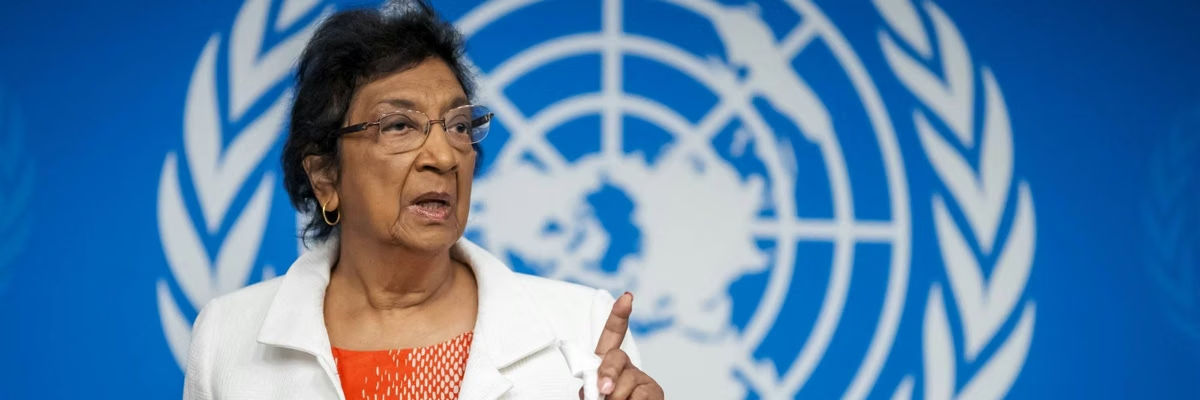
Chair of the Independent International Commission of Inquiry on the Occupied Palestinian Territory, including East Jerusalem, and Israel, South African judge Navanethem "Navi" Pillay, gestures after a press conference in Geneva on September 16, 2025.
With one seemingly off-hand comment, Pillay framed a comparison between a cause she has fought for her whole life on behalf of her fellow human beings and the smallness of a man who is doing his best to unravel that work.
Asked for her thoughts, after learning that the Nobel Committee had awarded her the 2026 Peace Prize, Navi Pillay added a one-liner to an appreciative response, “I’ll share the award with Trump.” The seemingly off-hand comment was anything but. Rather, it showed power and depth in its pointedness, irony, sarcasm, humor, wisdom, and humanity. Here, within the context in which it was made, is what I gleaned from the comment.
The Nobel Committee’s rationale for awarding Pillay the prize included her dedicated efforts to defend international institutions and protect human rights. As a justice on the International Criminal Court, she had secured the indictment of Israeli Prime Minister Benjamin Netanyahu for crimes against humanity committed against the people of Gaza, which amounted to genocide.
Perhaps the most obvious connection she was making with the comment was the futile gesture of Maria Corina Machado, 2025 Peace Prize winner. Machado attempted to leverage Trump’s support for her movement’s claim to the presidency of Venezuela, by sharing her Peace Prize with him—a move the Nobel Committee prohibits. In effect, Pillay was saying, ”Look what that got her, nothing.” The implication is that it is wrongheaded to believe that pandering to petty, aspiring dictators will yield anything positive for a righteous cause.
Her use of humor highlighted its essential role in dressing down bullies who blatantly seek to dominate other human beings and trample on their inherent rights.
At the same time, with her sarcastic jibe, she added emphasis to the cause for which she was awarded the prize, the defense of international institutions and protection of human rights. In citing Trump by name she implied that he is the “poster boy” for the very assault she has dedicated her life to countering, particularly through her work at the International Criminal Court and the United Nations Human Rights Commission.
Additionally, her use of humor highlighted its essential role in dressing down bullies who blatantly seek to dominate other human beings and trample on their inherent rights. Through implicit ridicule she deftly punctured an overblown ego. Whether the target of the jibe gathered the intent or not was immaterial. Others would get the gist.
Navi’s use of sarcasm also served another purpose. It eviscerated Trump’s assertions of power, making a distinction between real power that derives from righteous cause and mutual respect, and the semblance of power that comes from the fawning of sycophants. It also reinforced the absence of Trump’s moral standing as world leader and portrayed him appropriately as one for whom “I’ll scratch your back if you scratch mine” is his most notable achievement.
With one seemingly off-hand comment, Navi Pillay framed a comparison between a cause she has fought for her whole life on behalf of her fellow human beings and the smallness of a man who is doing his best to unravel an endeavor which, for a quarter of a millennium, has served as a beacon to the world for the ennoblement of humanity. More power to her!
Dear Common Dreams reader, It’s been nearly 30 years since I co-founded Common Dreams with my late wife, Lina Newhouser. We had the radical notion that journalism should serve the public good, not corporate profits. It was clear to us from the outset what it would take to build such a project. No paid advertisements. No corporate sponsors. No millionaire publisher telling us what to think or do. Many people said we wouldn't last a year, but we proved those doubters wrong. Together with a tremendous team of journalists and dedicated staff, we built an independent media outlet free from the constraints of profits and corporate control. Our mission has always been simple: To inform. To inspire. To ignite change for the common good. Building Common Dreams was not easy. Our survival was never guaranteed. When you take on the most powerful forces—Wall Street greed, fossil fuel industry destruction, Big Tech lobbyists, and uber-rich oligarchs who have spent billions upon billions rigging the economy and democracy in their favor—the only bulwark you have is supporters who believe in your work. But here’s the urgent message from me today. It's never been this bad out there. And it's never been this hard to keep us going. At the very moment Common Dreams is most needed, the threats we face are intensifying. We need your support now more than ever. We don't accept corporate advertising and never will. We don't have a paywall because we don't think people should be blocked from critical news based on their ability to pay. Everything we do is funded by the donations of readers like you. When everyone does the little they can afford, we are strong. But if that support retreats or dries up, so do we. Will you donate now to make sure Common Dreams not only survives but thrives? —Craig Brown, Co-founder |
Asked for her thoughts, after learning that the Nobel Committee had awarded her the 2026 Peace Prize, Navi Pillay added a one-liner to an appreciative response, “I’ll share the award with Trump.” The seemingly off-hand comment was anything but. Rather, it showed power and depth in its pointedness, irony, sarcasm, humor, wisdom, and humanity. Here, within the context in which it was made, is what I gleaned from the comment.
The Nobel Committee’s rationale for awarding Pillay the prize included her dedicated efforts to defend international institutions and protect human rights. As a justice on the International Criminal Court, she had secured the indictment of Israeli Prime Minister Benjamin Netanyahu for crimes against humanity committed against the people of Gaza, which amounted to genocide.
Perhaps the most obvious connection she was making with the comment was the futile gesture of Maria Corina Machado, 2025 Peace Prize winner. Machado attempted to leverage Trump’s support for her movement’s claim to the presidency of Venezuela, by sharing her Peace Prize with him—a move the Nobel Committee prohibits. In effect, Pillay was saying, ”Look what that got her, nothing.” The implication is that it is wrongheaded to believe that pandering to petty, aspiring dictators will yield anything positive for a righteous cause.
Her use of humor highlighted its essential role in dressing down bullies who blatantly seek to dominate other human beings and trample on their inherent rights.
At the same time, with her sarcastic jibe, she added emphasis to the cause for which she was awarded the prize, the defense of international institutions and protection of human rights. In citing Trump by name she implied that he is the “poster boy” for the very assault she has dedicated her life to countering, particularly through her work at the International Criminal Court and the United Nations Human Rights Commission.
Additionally, her use of humor highlighted its essential role in dressing down bullies who blatantly seek to dominate other human beings and trample on their inherent rights. Through implicit ridicule she deftly punctured an overblown ego. Whether the target of the jibe gathered the intent or not was immaterial. Others would get the gist.
Navi’s use of sarcasm also served another purpose. It eviscerated Trump’s assertions of power, making a distinction between real power that derives from righteous cause and mutual respect, and the semblance of power that comes from the fawning of sycophants. It also reinforced the absence of Trump’s moral standing as world leader and portrayed him appropriately as one for whom “I’ll scratch your back if you scratch mine” is his most notable achievement.
With one seemingly off-hand comment, Navi Pillay framed a comparison between a cause she has fought for her whole life on behalf of her fellow human beings and the smallness of a man who is doing his best to unravel an endeavor which, for a quarter of a millennium, has served as a beacon to the world for the ennoblement of humanity. More power to her!
Asked for her thoughts, after learning that the Nobel Committee had awarded her the 2026 Peace Prize, Navi Pillay added a one-liner to an appreciative response, “I’ll share the award with Trump.” The seemingly off-hand comment was anything but. Rather, it showed power and depth in its pointedness, irony, sarcasm, humor, wisdom, and humanity. Here, within the context in which it was made, is what I gleaned from the comment.
The Nobel Committee’s rationale for awarding Pillay the prize included her dedicated efforts to defend international institutions and protect human rights. As a justice on the International Criminal Court, she had secured the indictment of Israeli Prime Minister Benjamin Netanyahu for crimes against humanity committed against the people of Gaza, which amounted to genocide.
Perhaps the most obvious connection she was making with the comment was the futile gesture of Maria Corina Machado, 2025 Peace Prize winner. Machado attempted to leverage Trump’s support for her movement’s claim to the presidency of Venezuela, by sharing her Peace Prize with him—a move the Nobel Committee prohibits. In effect, Pillay was saying, ”Look what that got her, nothing.” The implication is that it is wrongheaded to believe that pandering to petty, aspiring dictators will yield anything positive for a righteous cause.
Her use of humor highlighted its essential role in dressing down bullies who blatantly seek to dominate other human beings and trample on their inherent rights.
At the same time, with her sarcastic jibe, she added emphasis to the cause for which she was awarded the prize, the defense of international institutions and protection of human rights. In citing Trump by name she implied that he is the “poster boy” for the very assault she has dedicated her life to countering, particularly through her work at the International Criminal Court and the United Nations Human Rights Commission.
Additionally, her use of humor highlighted its essential role in dressing down bullies who blatantly seek to dominate other human beings and trample on their inherent rights. Through implicit ridicule she deftly punctured an overblown ego. Whether the target of the jibe gathered the intent or not was immaterial. Others would get the gist.
Navi’s use of sarcasm also served another purpose. It eviscerated Trump’s assertions of power, making a distinction between real power that derives from righteous cause and mutual respect, and the semblance of power that comes from the fawning of sycophants. It also reinforced the absence of Trump’s moral standing as world leader and portrayed him appropriately as one for whom “I’ll scratch your back if you scratch mine” is his most notable achievement.
With one seemingly off-hand comment, Navi Pillay framed a comparison between a cause she has fought for her whole life on behalf of her fellow human beings and the smallness of a man who is doing his best to unravel an endeavor which, for a quarter of a millennium, has served as a beacon to the world for the ennoblement of humanity. More power to her!