Demobilizing America
Outsourcing Action in an Imperial World
Excuse me if, at 62, and well into my second era of protest against yet another distant, disastrous, and disabling American war, I express a little confusion. Was it actually like this in Rome while the legions were off fighting on the German frontiers? Was this the way it felt in London while the imperial forces conducted their frontier wars in Afghanistan, or Paris when the Foreign Legion was holding down North Africa? Was this how it felt in Washington when Douglas MacArthur’s father was suppressing the Filipinos and General Jacob Smith was turning the island of Samar into a “howling wilderness”? Is this the way it usually feels in the heartlands of great empires until the barbarians actually do come knocking at the gates?
I went marching against the President’s Iraqi war of choice in my hometown last Sunday. I found myself in an older crowd, many visibly from the Vietnam era. It was relatively quiet, small-scale, and lacking in energy; all in all — for me at least — a modestly dispiriting experience, given the crisis at hand and the disillusioned state of public opinion here in the U.S.
I came home wondering whether some Bush-era version of the old Roman formula had indeed been working. Had bread and circuses become croissants and iPods, or Bud and American Idol, or Sony PlayStation 3 and 24? I couldn’t help puzzling over the gap between public opinion on the President’s war and public action, or between the conclusions opinion polls tell us so many Americans have reached and those generally reached in Washington as well as in the mainstream media.
I know I’m not alone in wondering about such things, so here’s my provisional exploration of some of what’s puzzled me most. I don’t claim to have the answers, only perhaps some of the questions. Think of this, then, as a guided tour of a few of the trees on our landscape — with the hope that you’ll be able to spot the forest.
An Imperial Frame of Mind
For four years now, journalists have reported on Iraq; editorial pages have editorialized; and pundits — that special breed of Ciceros — have opined; while the retired generals who fought our last frontier wars have trooped onto FOX, MSNBC, and CNN to analyze this one; and experts and political figures of every expectable sort have appeared again and again on the Charlie Rose Show, Meet the Press, and their ilk, without our general fund of wisdom seeming to improve appreciably.
The same people who once thought Bush’s war was a great idea, or a good idea, or at least an okay idea, or something we should all support no matter what, are still at it. Now, some of them claim the war was a lousy idea but, following Colin Powell’s Pottery Barn rule, are convinced that, since we “broke” Iraq, it’s “ours” anyway. Some, like the Washington Post editorial page’s editors, still think the invasion was a good idea, just somehow poorly — the word you always see is “incompetently” — carried out, making the mess the Iraqis are in still ours.
Of course, many of those who once praised the war have revised their opinions and judgments somewhat (and were usually exorbitantly praised for doing so). Still, just about all of them, not to speak of just about everyone in Washington who hasn’t gone numb or mum, seems to agree on one thing. As the Washington Post put it in its fourth-anniversary-of-the-war lead editorial, “It’s tempting to say that if it was wrong to go in, it must be wrong to stay in. But how Iraq evolves will fundamentally shape the region and deeply affect U.S. security. Walking away is likely to make a bad situation worse.”
Under the many conflicts between George W. Bush and most of his opponents in the Democratic and Republican parties lies an area of agreement seldom challenged in the mainstream political or media world (or, when challenged, given remarkably little attention). On the deepest points, major politicians and the most influential parts of the media are actually in remarkable accord. In fact, you could say that, in the world of our media gatekeepers, there’s just another version of the sort of accord that existed before the invasion of Iraq.
That country, it is said, is crucial to “American interests” — “vital national security interests in Iraq” was the way, for instance, Hillary Clinton put the matter recently. There is also agreement (as there was about such things in the Vietnam era) that if we were to leave Iraq totally or “precipitously,” American credibility would take a terrible hit, that the terrorists would be “celebrating.” It is similarly agreed that, while all sorts of partial withdrawals from Iraq might sooner or later be possible, actually withdrawing from the country is hard to imagine, even if staying seems hardly less so. This is why, as in the recently passed House legislation, withdrawal of all American forces has been replaced by the withdrawal of all, or most, American “combat troops” (or “combat brigades”), a technical term that actually accounts for less than half of American forces in Iraq.
The two categories are now so conveniently blurred that it would be pardonable if few Americans grasped the difference any more than did Charles Gibson, anchor of ABC’s World News Tonight. On last Friday’s news, he claimed the House had voted to get “all U.S. forces” out when his own White House correspondent used the correct phrase, “combat forces.”
Americans lived through endless similar non-withdrawal (or partial withdrawal) “withdrawal” plans back in the Vietnam years. Now, it seems, we must do so again. At that time, a crucial argument against full-scale withdrawal was the “bloodbath” sure to follow. It was common knowledge in Washington then that any American withdrawal would result in an unimaginable version of the bloodbath already long underway in that country. That it didn’t, of course, hasn’t stopped the Vietnam playbook from being pulled out again. Now, we have the “Iraqi bloodbath” to contend with.
It’s not just that those “vital national security interests” would be endangered by a withdrawal from Iraq. On one predominant “fact,” just about everyone who matters in Washington agrees. We cannot leave Iraq because only we protect the Iraqis from themselves; only we have any hope of “stabilizing” the country. Even the Pentagon has finally acknowledged that a brutal civil war is underway in areas of Iraq; nonetheless, if we were to up and depart, it is agreed, a near genocidal-level bloodletting would certainly be in the cards. We are, in other words, the only force standing between the Iraqis and the “gates of hell.” Yes, we may have loosed all this on them in the first place; yes, our tactics in the field may only clear the way for greater bloodshed; yet our “presence” remains their sole remaining hope. This is considered a reality of our world, a clear, if understandable, limit on American policy-making, whether Republican or Democratic.
That this common Washingtonian wisdom is but a prediction about a future yet to be made is seldom noted; that it is being offered by people who often, however unconsciously, have a stake in its coming true is not commented upon either; that, for many of them, such a bloodbath might justify much that has gone wrong, conveniently highlighting the “depravity” of the Iraqis we tried to help, isn’t a subject for discussion; that most of these seers have had uncommonly poor records when it comes to predicting any developments in Iraq over the last four-plus years is seldom brought up either.
There is also, of course, something grimly self-fulfilling about this particular prophesy. If a single conclusion can be drawn about the U.S. presence in Iraq, it’s this: The longer we have been there, the worse it’s gotten. We’ve now reached the point where, with Americans “protecting” Iraqis from themselves, nearly one in five of them have nonetheless either fled their country, been forced into internal exile, or died in the mayhem. If you were projecting into the future, it would be far more logical to assume that, with us present, this situation would only worsen. (Of course, by now, both predictions might prove accurate.)
Even the President’s surge plan, a version of the old Vietnam-era “oil spot strategy,” is but an attempt to extend the control of the American military and the dependent, largely Shiite Iraqi government from the citadel-microstate of the fortified Green Zone inside the Iraqi capital to most of Baghdad. It is aimed at turning our “Iraq,” at best, into a full-scale city-state, while driving much of the internecine killing to the outskirts of the capital or surrounding provinces. How such a plan could possibly “stabilize” the situation there in any long-term way remains beyond serious explanation.
But perhaps this sort of deep agreement on the “realities” of our world should not surprise us. After all, we’re talking about a literal “conspiracy” here — in the original Latin sense of the word: to con-spire once essentially meant to breathe the same air. Indeed, our politicians and top media figures do breathe the same air and, in a way that wasn’t true decades ago, cohabit in the same rarified class atmosphere.
Not surprisingly, then, they often agree on the basics, holding in common, above all else, an essentially imperial mindset. In this way, they are genuine representatives of what was — before a ragtag minority insurgency fought the U.S. military to a stand-still — hailed as the planet’s “last superpower,” its only “hyperpower,” its “global sheriff,” the ultimate inheritor of Western civilization, not to speak of the mantles of the Roman and British empires, and so on. This imperial mindset can, at its most kindly, be expressed in this way: In any situation where American “interests” are at stake, the United States can only be imagined as part of the solution, not part of the problem. In the present Iraqi situation, such thinking also represents an imaginative failure, your essential deck-of-the-Titanic strain of thinking.
So call all this the fog of imperial war and, if you want to see it in action, just turn on your TV and check out David Brooks, or Tom Friedman, or Richard Perle, or George Packer, or various of the New York Times or Washington Post reporters who regularly double as pundits, or retired General Jack Keane, or Senator Joe Biden, or countless others nattering on about our prospects in Iraq. Sometimes it seems as if all the major figures on our television landscape were simply in some hypnotic state, claustrophobically recycling the same stale air.
Oddly enough, as far as I can see, the only disqualification for being a pundit or expert in our TV world, when it comes to the President’s Afghan and Iraq wars (or his prospective Iranian one), is having been right in the first place, having imagined from the start something of what actually did occur — as, for instance, was the case with Nation columnist Jonathan Schell and Boston Globe columnist James Carroll, or, for that matter, any of the millions of protestors who took to the streets in early 2003.
The Protesting Public: Erased from the Story
Among the missing-in-action of these last years are all those Americans who went out into the streets before the invasion of Iraq began, part of the largest global antiwar demonstrations ever mounted. Even a fine piece like Frank Rich’s “The Ides of March 2003,” his recent return to the countdown to war, leaves out that mass of people — a distinct minority in the U.S., but already part of a global majority.
They carried a plethora of handmade signs, including “No blood for oil,” “Contain Saddam — and Bush,” “Uproot Shrub,” “Oil for Brains, We Don’t Buy It, Liberate Florida,” “The Bush administration is a material breach,” “Pre-emptive war is terrorism,” “W is not healthy for Iraqis and other living things,” “Use our Might to Persuade, not Invade,” “Give Peace a Chance, Give Inspections a Chance,” “How did USA’s oil get under Iraq’s sand,” “Peace is Patriotic,” and thousands more. In their essential grasp of the situation, they were on target and they marched directly into the postwar period in vast numbers before seemingly disappearing from the scene and then being wiped from history.
It wasn’t, as people now often claim, that almost everyone was gulled and manipulated into supporting this war by the Bush administration, that no one could have had any sense of what a disaster was in the making. Millions of Americans had a strong sense of what might be coming down the pike and many of them actively tried to stop it from happening. I certainly did and I found myself repeatedly in crowds of staggering size.
Women traced out pleas for peace naked on beaches, while in the Antarctic well bundled bodies formed similar peace signs in the snow. And almost everywhere on the planet hundreds of thousands, millions, marched. After the invasion was launched and we had broken Iraq like a Pottery Barn vase, Americans in startling numbers went to the effort of officially apologizing in photos at the Sorry Everyone website.
The demonstrations of that moment were impressive enough that my hometown paper, the New York Times, which loves to cover large demonstrations as if they were of no significance, had a fine front-page piece by Patrick Tyler claiming that we might be seeing the planet’s other superpower out on the streets.
Here is a description I offered of an enormous demonstration in New York City four days after the shock-and-awe invasion was launched:
“Twenty to thirty minutes after the group I was with ended our march at Washington Square and dispersed, I called my son — thanks to the glories of the cell phone — and he told me he was stuck at the end of the march over 30 blocks north of us. And we hadn’t even been near the front of the march. That’s a lot of people and there were sizeable crowds of onlookers, cheering from the street side as well as people waving or offering V signs from windows all along the way. It was a remarkably upbeat experience. We were all, perhaps, stunned by the evidence of our existence. Many, many young people. Wonderful signs. Drums and music. Roaring waves of cheers at the end. I think we felt something like shock and awe — of the genuine kind — that we had not gone away, that we were not likely to go away.”
And then, in a sense, we were gone. And yet, in another sense, we never left the scene.
At the time the invasion was launched, polls showed over 70% of Americans in support of the President’s war (or in a state of terror about terror, should we not stop Saddam Hussein from nuking us). Now, here we are, four years later, and the pundits who were telling us that we should indeed do it are still familiar fixtures on our TVs, while the faces of the pundits who didn’t, and of the Americans, in their millions, who arrived at similar conclusions and tried to stop possibly the maddest, most improvident war in our history, have been erased from memory.
And yet, to offer a little hope to those who believe that the mainstream media holds the idling brains of hundreds of millions of Americans helplessly in its thrall, that we are all merely the manipulated, let’s consider something curious indeed: The general point of view of the minority represented in those giant prewar demonstrations took deep hold as time passed and has now been embraced by a striking majority.
Back in December 2006, when James Baker’s Iraq Study Group released its report — and was hailed in the press for finding genuine “common ground” on Iraq — I argued that the American people, without much help from politicians or the media, “had formed their own Iraq Study Group and arrived at sanity well ahead of the elite and all the ‘wise men’ in Washington.”
The Bush administration, of course, rejected the findings of the Iraq Study Group, while the Democrats, by and large, accepted them. But no one turned out to be particularly interested in the “Iraq Study Group” formed by ordinary Americans whose “findings” were expressed in that least active of all forms: the opinion poll (and later, the midterm election). Nonetheless, the numbers in those polls represent a modest miracle, if you think about it.
According to a poll released that December by the reliable Program on International Policy Attitudes (PIPA), 58% of Americans wanted a withdrawal of all U.S. troops from Iraq on a timeline — 18% within six months, 25% within a year, 15% within two years; 68% of Americans wanted us completely out of that country with no permanent bases left behind, including a majority of Republicans — despite the fact, that you could search the American press, most of the time, in vain for any indication that the Bush administration had built a series of vast military bases, big enough to have multiple bus routes and capable of housing 20,000 or more American troops and contractors. In addition, according to PIPA, by the end of 2006, 60% of Americans had reached the conclusion that the U.S. military presence was “provoking more conflict than it is preventing”; while only 35% still thought it a “stabilizing force” in Iraq.
Too bad we don’t have similar polls for politicians, opinion-makers, and media gatekeepers. They would surely bear little relation to PIPA’s findings.
In 2007, if anything, such polling figures have only grown more emphatic. A recent Newsweek poll, for instance, offered the following figures: 69% of Americans disapprove of the President’s “handling” of the Iraqi situation; 61% think the U.S. is losing ground in Iraq; 64% oppose the President’s “surge” plan; 59% favor Congressional legislation requiring the withdrawal of all U.S. forces by the fall of 2008.
In the most recent CNN poll, 61% of Americans feel the decision to launch the invasion of Iraq was “not worth it”; 54% think the U.S. will not win there; 58% believe we should either withdraw “now” or “in a year”; in the most recent USA Today/Gallup poll, 58% favor total withdrawal from Iraq either immediately or within 12 months. So it goes in poll after poll, while the President’s approval ratings continue their slow slide into the low 30s.
Let’s remember, by the way, that, unlike mainstream Democratic “withdrawal” plans, the American public is talking about actually leaving Iraq, as in that old, straightforward slogan of the Vietnam era: Out now! In other words, there is a hardly noted but growing gap — call it, in Vietnam-era-speak, a “credibility gap” — between the Washington consensus and what the American people believe should be done when it comes to Iraq.
Add in one more odd fact here: It’s possible that American public opinion is now actually closer in its conclusions to its Iraqi equivalent than to the Washington consensus. A number of recent polls, in which Iraqis expressed grim feelings about what has happened to their country, have been released and, like the American polls, they seem to reflect a belief that American forces are anything but “stabilizing” and an urge simply to have the Americans out. A PIPA September 2006 poll found “that seven in ten Iraqis want U.S.-led forces to commit to withdraw within a year.”
Outsourcing Protest
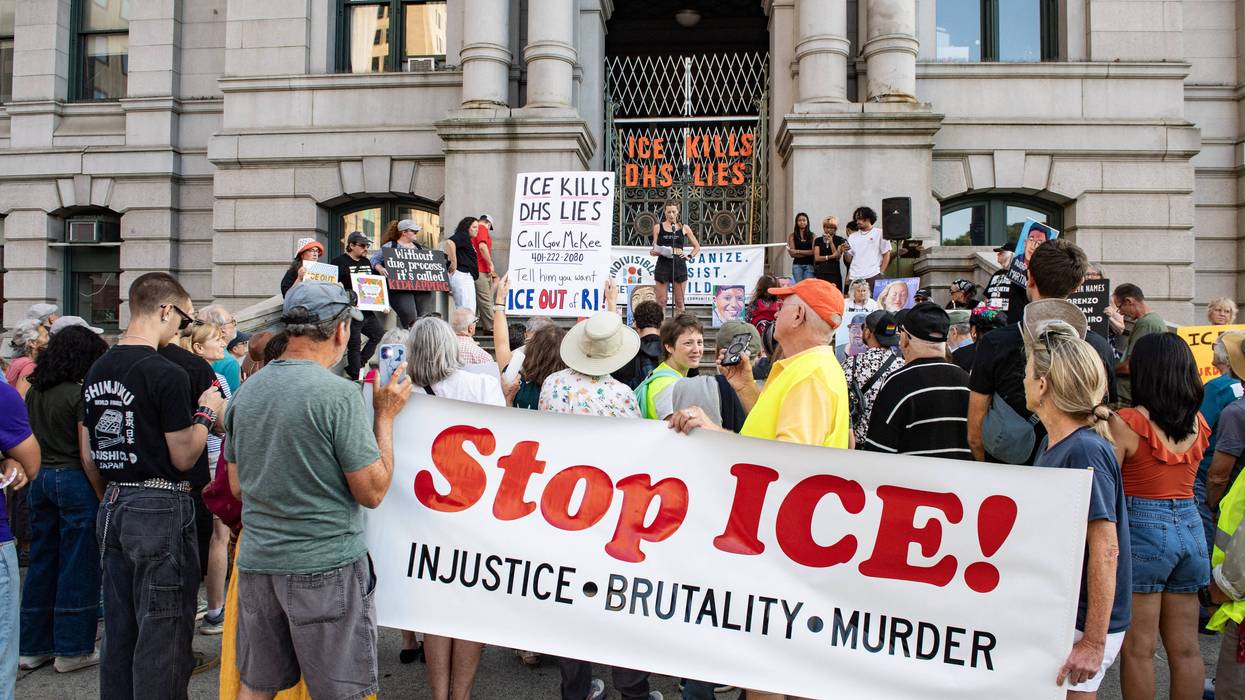
And yet the translation of all this sentiment, of these conclusions, into visible action, despite inspirational moments, has generally been less than overwhelming. Yes, in the years since the invasion, there have been a few enormous marches; and yes, there are groups that protest regularly, even heroically; and yes, in cities and towns across the country, protesters have gone out weekly with their signs, sometimes to freezing mid-winter street corners, simply to make a point. Nonetheless, given the extremity of the Bush administration and its acts, it’s hard not to wonder why, most of the time, the levels of mobilization have been so relatively weak.
Those of us who can use the tumultuous mobilizations of the Vietnam era as a point of comparison — there was even a group called The Mobe then — are certainly aware that this time around nothing comparable has happened. It’s crossed my mind that there might even be a silver lining in the disappearance of those large, boisterous prewar crowds, in the fact that, generally speaking, the country seems, in protest terms, strangely demobilized.
In the Vietnam era, though few realize this, antiwar sentiment was strongest at the bottom, in the blue-collar world. As Vietnam scholar Chris Appy has pointed out, for instance, a Gallup poll in January 1971 “showed that the less formal education you had, the more likely you were to want the military out of [Vietnam]: 80% of Americans with grade school educations were in favor of a U.S. withdrawal from Vietnam; 75% of high school graduates agreed; only among college graduates did the figure drop to 60%.”
What largely neutralized the full development of antiwar sentiment among the majority of Americans in that era was, I believe, the strength of anti-antiwar-movement sentiment, the visceral reaction of many working-class Americans against the crowds of protestors, against the look of that far wilder moment (and a media that invariably focused its cameras and attention on the wildest-looking of the demonstrators, especially those carrying the flags of the enemy and chanting, “Ho, Ho, Ho Chi Minh, NLF is going to win”). That visceral dislike for antiwar sentiment, as expressed in the streets, was strongest at the bottom. In other words, in those years, angry feelings about the disastrous war in Vietnam were offset by angry feelings about the most visible of those demonstrating against it.
Interesting enough, according to John Mueller of Ohio State University, an expert on the subject, the loss of support the Bush administration has experienced for its Iraqi adventure has followed the same arc as in the Vietnam era (and the Korean War era as well); but, in the Iraqi case, support has eroded far more “precipitously,” based on far fewer American casualties and, Mueller wrote back in late 2005, “there is little the Bush administration can do to reverse this decline.”
On this he proved correct. If anything, the decline in support seems only to have intensified in recent months, leaping well ahead of equivalent figures for the Vietnam era. Only four years into the Iraqi catastrophe, polling figures match or exceed those for 1970 (perhaps seven years into the Vietnam conflict, depending on how you count) on questions like whether you favor the complete withdrawal of American forces. In 1970, for instance, 56% of Americans thought going into Vietnam had been a mistake, already way below figures for Iraq. In the latest ABC News/Washington Post poll, for example, a record 64% of Americans say the war was “not worth fighting.”
Given that, why were antiwar Americans so mobilized in the Vietnam era and why are they so relatively demobilized now? (And don’t think, by the way, that the Vietnam-era mobilization in the streets, with all its wildness and excesses, made no difference. Seymour Hersh, for example, points out in The Price of Power: Kissinger in the Nixon White House that President Nixon was considering a major escalation of the war in 1969 when vast crowds of demonstrators descended on the capital. “Those Americans who marched in Washington on October 15 to protest the war,” Hersh wrote, “had no idea of their impact; they were protesting the policies already adopted by the Nixon administration and not those under consideration. Nixon came out of the crisis convinced that the protesters had forced him to back down [from his secret plans to escalate the war]. The protestors thought the Moratorium had been largely a failure.”)
The reason most often cited for the Vietnam-era mobilization is the draft. After all, we still had a citizen army then. Usually, the draft explanation is linked only to fear — the fear, in particular, that middle-class kids had of going to Vietnam; and fear was certainly a factor that drove some young men into the streets. But it wasn’t, to my mind, the predominant one. The draft had a more important effect. It reminded young men (and also young women, who couldn’t be drafted) and their friends, relatives, and parents that the killing going on in Vietnam wasn’t just some distant event, that it touched and affected them. The draft made the war, and anger about it, real in a mobilizing way as nothing has done today.
Here’s a second difference of eras: The young in revolt in the 1960s, whether on campuses or in the military, even those who claimed they were out to change the “system” or bring down “the establishment,” had grown up with a deeply embedded belief that this was a system that could be challenged, could be changed; that real democracy (or “participatory democracy” in the phrase of the moment) was actually possible; that each person could make a difference. We still retained — whether we knew it or not — a kind of faith in the American system and its ability to respond. We had hope.
Similarly — and this is a third point seldom mentioned today — the young in the streets, however frustrated by the moment, however unresponsive or even criminal they found their leaders, still believed that, at some level, they would be, and should be, listened to. And the fact is they were being listened to. When President Lyndon B. Johnson complained about “that horrible song” (”Hey, hey, LBJ, how many kids did you kill today?”), he was listening; when Richard Nixon went out of his awkward way to claim that he would be watching a Washington Redskins football game as demonstrators arrived in town, he was signaling that he knew they were coming.
Today, it crosses no young minds that the top officials in the White House might be listening. Many fewer young people, I suspect, have any remnant of that deep faith that our political system could be responsive to them or that anything they could do might change it. When they look to Washington, what they see is fraud, dysfunction, conspiracy, cronyism, cabal, influence-peddling, corruption, fear — in short, a system, a world, beyond response, possibly beyond repair, and utterly alien to their lives. In such a situation, despair or apathy tends to replace anger and hope.
The Iraq demobilization, then, is certainly part of a larger demobilization, a deeper belief that, as Bill Moyers made vividly clear in a recent speech, your vote doesn’t matter; that democracy is a-functional; that none of this has anything to do with you, or your ballot, or your feet, or your sign, or your shout.
Our world has changed radically since the Vietnam era. Today, an increasing part of what matters in public life (and work life) has been “privatized” and subcontracted out, or simply outsourced. The U.S. military has essentially been subcontracted out to small-town and immigrant or green-card America — to, that is, the forgotten or ignored places in our land; as a result, for most people in draft-less America, the war is not part of our lives or that of our children. (The draft itself has been carefully kept off the table by the Bush administration, despite the desperation of a body-hungry, overstretched military.) In addition, war-fighting has been outsourced to private corporate contractors who deliver the mail and the fuel, do KP, wash the laundry, build the bases, and, in the case of tens of thousands of rent-a-cop mercenaries, do some of the guarding, fighting, and interrogating in Iraq and Afghanistan.
And yes, the political system has increasingly been subcontracted out, with malice aforethought, to thieves, looters, cronies, and absolute dopes. Little wonder that Americans, living through the Age of Enron, scanning the horizon from Iraq to New Orleans to Walter Reed Army Medical Center, and watching Halliburton head for Dubai, generally believe their system no longer works; that those high-school civics texts are a raging joke (that, in fact, fierce joking, à la Jon Stewart, is the only reasonable response to the extreme, roiling absurdity of this administration as well as our world); and that, if you took to the streets of the capital, no one in either party would be paying the slightest attention.
No wonder Americans have arrived at a series of striking conclusions on Iraq, but haven’t done much about them.
In an interview with the President, Jim Lehrer recently inquired about why he hadn’t asked the public (other than the military) to “sacrifice” more. Bush, who had urged Americans to show their post-9/11 mettle by heading for Disney World and intensifying their shopping behavior, fumbled around before replying this way:
“Well, you know, I think a lot of people are in this fight. I mean, they sacrifice peace of mind when they see the terrible images of violence on TV every night. I mean, we’ve got a fantastic economy here in the United States, but yet, when you think about the psychology of the country, it is somewhat down because of this war.”
Perhaps the formula wasn’t so much bread and circuses as terror and consumerism. (Stop al-Qaeda, use more gas.) Same idea, though. This was, after all, an administration intent on terrifying and demobilizing most Americans (while mobilizing the foot-soldiers of the political right), all so that they could create a Pax Americana world and a Pax Republicana “homeland.”
It was a mad dream, now in ruins. In response — and this is just my own hunch — Americans performed their own acts of privatization, even as they came to reject this administration, its war, and the way it was gambling with all our lives. That’s not so surprising. After all, we really do all breathe the same air, live in the same world. And so, while they were at it, many Americans may have subcontracted out their war protest to others, to the pros maybe (even if those pros were actually dedicated amateurs, some of whom really were sacrificing something in their place). That, I think, is the forest I see.
Tom Engelhardt, who runs the Nation Institute’s Tomdispatch.com (”a regular antidote to the mainstream media”), is the co-founder of the American Empire Project and, most recently, the author of Mission Unaccomplished: Tomdispatch Interviews with American Iconoclasts and Dissenters (Nation Books), the first collection of Tomdispatch interviews.
Copyright 2007 Tom Engelhardt


Thanks for saying what I’ve been thinking! The apathy of the majority really is horrifying.
In current American history, Americans were demobilized in the ’60s with the murders of John, Martin and Bobby. Many of us went underground and are still underground. I don’t intend to come up for the sake of the spineless, pleasure-seeking populace that constitutes America today. This is not my America. My America lives underground: we grow our own food, pool our resources and live according to need, rather than want want want want want want ad nauseam. Welcome to your Waterloo, folks. Have at it.
I grew up in the aftermath of the vietnam war. I did not realize until later in my life the circumstances. Same with Watergate, Kennedy, and all of the rest of the crimes that our own Government has been involved with. I will agree tho, that there is a feeling of hopelessness around what is going on today. What most people don’t realize is that the stage for what is happening now was set almost at the turn of the last century, when corporations were given the rights of citizens and the Federal Reserve took over our monetary system. Those two events may have seemed small at the time, but have put us where we are today - without a democracy.
The hopelessness I feel (and many, many people my age or younger) comes from the fact that there is no more democracy - our government has been co-opted by corporate and powerful religious interests, entrenched now to the point where there is no turning back without a serious, bloody, and possibly world-destroying conflict between ordinary people and the superpower which is the U.S.A…
Sure, there are well-meaning Congressmen and women here and there, but they are ineffectual at making real change. Our Congress make big noise about issues that are emotional touchpoints between “conservative” and “liberal”, and these issues are hashed out every election cycle. But when it comes to real reform - i.e. healthcare, imperial motives around the world, tax reform, and even lobby reform - none of this will EVER happen in a way that is really beneficial to Americans, because the government is no longer in the business of doing what real Americans want. They are in the business of pleasing the businesses and lobbyists who keep them in power, thus assuring mutual control over the power system, bought and paid for by the richest people on earth.
I feel despondent, depressed, and carry with me a silent but ever-burning extreme rage at the reality of our system, the system that started out for the people and ended up being for the corporations and the uber-rich. The reason I don’t march to the White House in protest is because I KNOW that no one is listening there anymore - the takeover was complete as of January 2000, stolen election and all. If anyone has any doubt about this, just think about healthcare for all Americans - something that should be easy for us to do in the richest country in the world. The medical/pharma/insurance industries will make sure this NEVER happens, no matter what the people want. Same with Marijuana legalization - which was originally demonized by corporate interests who feared hemp as a grass-roots rival to the paper/textile industry monopolies. Funny how politicians will say they support that reform until they get elected… i.e. Bill Clinton, for example. Suddenly their tune changes and they realize that corporate interests, under-the-table money, and other monetary factors remove it from reform consideration.
I do not hold much hope for this country as it stands in its current state. As bleak as that sounds, I believe it is a realistic assessment. Government and Corporate power have become incredibly sophisticated both in their power control and their use of technologies to control the masses. Never before have humans been so powerless against this massive web of world power. Countries that resist end up like Iraq. People that resist end up like Rachael Corrie, or John Kennedy, or the Dixie Chicks, or any number of others who knew they stood on the side of right and chose to speak truth to power. They were killed, shot, bulldozed, ridiculed, or otherwise moved out of the way.
So maybe I am guilty of being demobilized. It’s hard enough just to get through each day living with all of this bull****. As Billy Joel says - “I believe I’m past the age of consciousness and righteous rage - I found that just surviving is a noble fight.” I’m hoping the whole thing will implode on itself and something more human can be built in it’s place.
How can anyone celebrate their apathy and retreat to their underground and still remain sane? Yes, we were all demoralized by the assasinations of the ’60s. Yes, many of us went underground and tried to lead our lives in such a way that at least we were not making the world worse. And yes, while we slept in our underground bunkers, our government was taken over by the rich and the corporations that have corrupted our country and the world. And yes, by our withdrawal and acquiescence we are now reeping the what we have sewn.
As usual, if we keep doing the same thing over and over and expect a different result, we are truely insane. We all have to get over our mutual perception of individual impotance. We, together, can make a difference. The time is now!
Focus people! What is the basis for our having lost our voice? What has caused our representative form of government to no longer represent “we the people”? We have to start with election and campaign finance reform! We can demonstrate all we want, but our “representatives” are not going to listen until they are truely held acountable to THE AMERICAN PEOPLE. So, get out of your bunkers. Take truely meaningful action. Get started by going to commoncause.org, fairvote.org, or nationalpopularvote.com.
Go! Do it now! And continue to raise your voice EVERY day. Raise hell! Raise the volumn! And don’t forget to have a good time and a laugh along the way.
P.S. The Dixie Chicks are back and in full voice!
One thing we need to be careful of is that a lot of people in this Bush administration are the same people who were present during some of the death squad years in Latin and South America.
I think the Bushies would still argue that they achieved their goals south of the border because there are more democracies and less military dictatorships now in those areas.
Of course, many democracy movements were crushed with American funding for death squads. Drugs and weapons were sold (Iran Contra scandal) to fund some of the death squads. The right wing leaders we installed in those countries allowed the countries to be privatized with most of the resources and wealth creation going to multinational corporations with few benefits going to the people.
Now there is a backlash against the United States, World Bank, IMF, and privatization causing populist leaders to be elected.
I fear the same thing in the Middle East. If we remove the troops, the Bush Administration will probably just take heroin money from Afghanistan to hire mercenary (privatized) armies or will support various militias and terrorist groups to continue their goal of installing regimes that will support the privatization of the Middle East.
The “people” of the Middle East will get nothing except death and destruction if they try to stop what is happening.
I want legitmate governments, fair markets, and healthy environments in the Middle East. I think the region and the world will get there.
I think violence is a terrible strategy for achieving the goal.
12/21/12 is only five years and 9 months (approximately) away. Who knows, all our problems may become moot at that time. And look how fast the past five years have gone by!
Croissants & I-Pods, Bud & American Idol, Sony Play Stations plus tales of ticking time bombs and torture, done by the good guys in the name of national security…..
Not exactly symetrical there at the end, but apt analogy enough for an age of Big Macs & NASCAR, slurpees and WWF.
And if the unruly, unwashed masses don’t like it, well let ‘em eat tofu instead.
As an age contemporary of Tom who’s done a share of marching in the streets, I entirely agree with the importance of the draft and idealism about fundamental change as major factors that make the atmosphere of ‘68 different from ‘08. Another important difference is the depth of ideological diversity and stark cultural clash that accompanied the Vietnam era antiwar movement. Although today’s Iraq War demonstration crowds are also diverse in message and appearance, I believe the fault lines ran deeper, and were demanding of more tolerance from the participants, back then in those bad old days.
Long hair. Feminism. Free speech. Drugs. Black power. Love. Off the pigs. Student rights. Turn on, tune in, drop out. Smash the capitalist state. Peace. Do your own thing. Solidarity with Third World peoples. Conscientious objection. Nonviolence. By all means necessary. Different strokes for different folks.
There was more anti-antiwar fervor back in the 60’s and early 70’s because the social conflicts were more divisive, and Tricky Dick was perhaps more willing to really stir the pot with COINTELPRO tactics on behalf of a monolithic, middle class status quo. Even if that meant Kent or Jackson State, so be it.
Today, the job of fomenting domestic unrest has been outsourced to Faux News and the hate speech end of your AM radio dial. The fear mongering and demagoguery appears designed more to garner votes for the GOP in the next election cycle than it is calculated to divide and crush the grassroots enemies of the Bush regime. At least so far.
Marginalize rather than criminalize. Different tactics for different times.
Nixon was the master of the non-withdrawal withdrawal, a Quaker man of peace, an adroit manipulator of those perpetually ongoing secret high level negotiations always on the verge of extricating the nation with honor from Lyndon Johnson’s botched war in southeast Asia. In contrast, George W. Bush is a true believer in the power of the sword, a strutting warrior Commander in Chief unabashedly pursuing dreams of victory everlasting in the Middle East.
And so it’s probably to be expected that today’s antiwar protests are visibly and functionally different from those of the Vietnam days of rage.
Different men. Different avowed missions.
But same basic mistakes, pursuing similar visions of empire. Two major political parties, only one even grudgingly willing to acknowledge (sometimes) that it has a “peace wing” flapping around somewhere out there beyond the beltway.
Don’t despair. Lots of work to do. But in the meantime, open up the Twinkies and pass the remote control.
To the Author, Mr. Englehardt:
I think you do see apathy, or more likely withdrawal, in the eyes of the aware. We have realized the scale of the problem, and are a bit dazed by it.
One poster said “your Waterloo approaches, enjoy it” has a point; our Western society is built on some voracious appetites that can’t be sustained without some form of theft, either from weaker peoples, or from subsequent generations.
We are presiding over the tipping point moment, and have the feeling that there are larger things at stake than whether a Democrat or Republican wears the crown this next term.
I think the single item that most causes the withdrawal is the realization that there’s too much momentum for any of us to affect the trajectory of events, and that only a terrific crash will bring a significant opportunity for rebuilding. Those thoughts are very dispiriting, and really de-humanizing. I have been afflicted by them. And they could, possibly, be wrong.
Just like the rest of you, I figured out that the top people aren’t very smart, and are even less courageous. Most of your peers are asleep at the switch. So, once you stop expecting the top people to do anything worthwhile, it’s not a long jump to realize that if it’s going to get done, you’re going to be the one to do it. Then you pick up your tools, and start building what’s needed.
I live in a conservative area, with a smattering of so-called Liberals here and there. I can tell you that the wheels of change are grinding forward. Conservatives are becoming quite uncomfortable. It’s important to realize that they aren’t real imaginative, and must be shown tangible alternatives, not just ideas. The so-called “Progressives” seem to be the ones with all the new ideas, but they don’t often exhibit the focus and tenacity to reduce their great ideas to practice.
Maybe that’s what we most need: some inventor-types. Maybe we need to ignore the politics for a while, and just create some useful stuff that solves the problems, instead of just talking about them.
I think the biggest problem with all of our manufacturing jobs going overseas is that people seem to think that our ability to invent stuff was packed up along with the drill presses and the lathes.
Last point, again to Mr. Engelhardt: Don’t get too close to the fire. Despair comes from hoping for too much too soon, and powerful as you are, even you cannot turn a battleship by yourself, or in one lifetime. This is a multi-generational marathon; please scale it thusly. We need you whole.
here are two poems
the sorrow of the earth is too large to hear.
when we first came to this desert we thought
despair was ours -
and in some ways it was - we did
love the ones we’d loved and lost -
after all.
we grieved for our own deprivation -
we longed for tall trees that were
water into wood
and the rain we never saw was
grit on red flesh.
even still -
the ache is too large -
it cannot be ours -
if our joy is lost in some extravagant bowl
then this should
come as no surprise.
our sorrow swims in schools
the swim in schools
that sleep in seas
we cannot know -
just as the sea that swam
the fish now buried
under salt -
the weight of the sea
gone missing from the land -
the rings around the hills mark the
layers of this loss
and that menace we call time
stretched and stretching-
thinned and thickened
no escape and death’s no out
we cannot be removed -
accept or reject that unbound core -
the drum of blood that
carries the tune -
we came to this desert
to make that drumming
cease -
we came to this vast grave.
the sorrow of the earth finds its tongue
or none are safe - earth’s sorrow
rages - stultified - shakes
each branch on every tree -
heaves the sleeping rocks -
the great hidden grief of the world
thunders in my beloved’s
chest - throws bones and
boxcars overboard -
it coughs red blood and splits
fine wrists and stops
our throats with sobs
that we mistake as we mistook
the heaving ribs
and sting and wind
as patterned after us -
as if the loon’s despairing cry
comes from the loon herself
and she is not mere
particle
of the world’s lament.
for me and my kind
i can tell you this:
like so many others i have wanted more than anything to make a real
and true picture of our beautiful world
and for its own sake but not its own sake alone
i confess right here that ive wanted to correct or possibly infect the
mind of whoever crossed paths with my poem
i mean i look around these days - all days really
its easy to see the cars on the freeway and the shopping malls spread
under the rise of the moon and feel doomed.
anything else is a sucker punch.
anything else is a refusal to see, ive said, and more than once, and
meant it, and do - even right now - do you see?
forget the pattern
a narrow scope from under the sea.
before the stars i am large but among you i am small
among you the forests are so many matchsticks
among you the worst of us always get their way - this is the world that
you’ve built with your own hands
it says so in every breath that we take.
this is the message of love that i bring.
frankly this falls into the category of the plain as the nose on your
face - and everyone knows it - you can see it in the way
that everyone drives - like the laws on their tail - ( i commit these
crimes myself so dont try to hide)
you like a little distance between the plate and the foundry and you
like a little respect when being addressed in a poem -
well weve had our poems and poets -
how many more poems do you think that you get when all that you got are
broken and left out in the rain.
forget the story of jesus and the flood
and the parting of the sea of blood -
and forget the four directions
and the true red road
and forget about
the people
roaming in dreamtime or carefully hollowing a slender white bone.
think of how many nice little books youve crammed down your throat and
shit out at parties as if the words were a joke -
as if somehow the score was added up from the times
that you chose to betray.
as if winning was the act of despising the truth
and what is the truth? you might say
- and this is more proof.
do you wonder about truth when a hawk carves the sky?
i dare you to think that a hawk is cliche
i dare you to find no drive in a wave
i dare you to find no voice in the night
i dare you to find no thought in the tree
I have an idea…not a new idea but it would have a definite impact. Obviously we feel disempowered by the elite neo-con steamroller, but we continue to fund it with tax dollars. Why? I say refuse to pay these illegal taxes, we could just “forget to file” on April 15th…just say NO! Simple and effective, just fire the bastards and don’t pay them! Marching just don’t cut it no more, gotta hit ‘em where it hurts. If Congress isn’t gonna cut the purse strings, we just have to do it ourselves. Screw the IRS, screw the terrormongers, screw the corporate fascists.Enough is enough!
Like Tom, I marched in the Vietnam era and again on March 18th, but I certainly was not expecting the White House to take notice. The point of the rallies and marches all over the country was to help the Democrats to find their backbone and end this war.
His long article quotes poll after poll showing that the populace has come around to the point of view of those of us who were marching in 2002 and 2003 before the war began. So marching is very powerful, because the public notices, and it helps them to think about the issues.
But Tom takes a very short view, and he is old enough to realize that politics works and makes changes in long arcs. He says about our youth, “When they look to Washington, what they see is fraud, dysfunction, conspiracy, cronyism, cabal, influence-peddling, corruption, fear — in short, a system, a world, beyond response, possibly beyond repair, and utterly alien to their lives. In such a situation, despair or apathy tends to replace anger and hope.”
Those feelings are boiling in large parts of the population not just the young, and nothing political remains as status quo for long. Those beliefs are just the ones which cause people to revolt. Thus, it is quite reasonable that before long the younger people will be fed up and revolt along with the rest of us. This does not have to be the nightmare scenario where the tanks will mow them all down. Many of them are too smart to be in the street where the tanks can find them. There will be general noncooperation, civil disobedience in different forms, and a great uprising which will change the system. The only thing that could stop a revolt would be for the establishment, both parties, to change the system, and we all know how unlikely that is.
So take heart, all the marching we do is fuel for the changes in the future. The revolt will come, and the Prophets (60s people) among us (See The Fourth Turning, an excellent book on inevitable changes in societies every few generations.) must be active in guiding the revolt in effective nonviolent methods. Especially, because it is obvious because of the generalized wording describing terrorists in the Patriot Act, drafted after the WTO demonstrations in Seattle, that the politicians are expecting a violent domestic revolt and are preparing for it. So it will not be stopped, because it is decentralized and nonviolent. Nothing is more powerful than a population which simply will not cooperate with its rulers and insists on change.