

SUBSCRIBE TO OUR FREE NEWSLETTER
Daily news & progressive opinion—funded by the people, not the corporations—delivered straight to your inbox.
5
#000000
#FFFFFF
To donate by check, phone, or other method, see our More Ways to Give page.
Daily news & progressive opinion—funded by the people, not the corporations—delivered straight to your inbox.

"'Thanksgiving' is a white-washed holiday designed to conceal its true origins of violence, genocide, land theft, and forced assimilation," said the Indigenous Environmental Network.
In contrast with Thanksgiving celebrations across the United States on Thursday, Native Americans held a National Day of Mourning, promoted accurate history, and championed Indigenous voices and struggles.
Despite rainy conditions, the United American Indians of New England held its 55th annual National Day of Mourning at Cole's Hill in Plymouth, Massachusetts. Kisha James, who is an enrolled member of the Wampanoag Tribe of Gay Head (Aquinnah) and also Oglala Lakota, shared how her grandfather founded the event in 1970 and pledged to continue to "tear down the Thanksgiving mythology."
"The past influences the present" and "the settler project" continues with racism, misogyny, and anti-LGBTQ+ discrimination, James told the crowd. "The Pilgrims are not ancient history."
James took aim at fossil fuel pipelines, oil rigs, skyscrapers, corporations, the U.S. military, mass incarceration, and the criminalization of immigrants, and declared that "no one is illegal on stolen on land."
Jean-Luc Pierite, a member of the Tunica-Biloxi Tribe of Louisiana and president of the board of directors of the North American Indian Center of Boston who helped organize this year's gathering, told USA Today that "while we are mourning some tragic history but also contemporary issues, we are also expressing gratitude for each [other] and building this community space."
"Coming together as a community for a feast and to express gratitude—that's not something that was imported to this continent because of colonization," Pierite said. "Indigenous peoples have had these practices going back beyond, beyond colonial contact."
This year's event in Plymouth included speeches about the suffering of Palestinians—as Israel wages a U.S. government-backed war on the Gaza Strip that has killed at least 44,330 people, injured 104,933, and led to a genocide case at the International Court of Justice—and of people impacted by extractive industries.
"The message from Indigenous peoples internationally has been consistent: that we need to center the development of traditional ecological knowledge, Indigenous knowledge, and move away from fossil fuel extractive economies," said Pierite. "At this time the world needs Indigenous peoples."
In New York City, police
arrested 21 pro-Palestinian protesters who blocked the Macy's Thanksgiving Day Parade route.
According to ABC 7:
For the second year in a row, the group ran in front of the Ronald McDonald float to briefly stop the parade.
This year, they jumped the barricades at West 55th Street just after 9:30 am.
Many sat on the ground, locking arms and chanting "Free, free Palestine!"
Others held a banner behind them, reading "Don't celebrate genocide! Arms embargo now."
Video footage shared on social media shows members of the New York Police Department grabbing protesters and their banner, and throwing at least one person face-first into the road.
Multiple Indigenous groups circulated messages about Thanksgiving on social media Thursday.
NDN Collective said that "as Indigenous peoples, we reject colonial holidays rooted in the genocidal erasure of our existence. We demand #LANDBACK to reclaim sovereignty, repair ties with Mother Earth, and protect Indigenous ways of life—honoring them for generations to come."
The Indigenous Environmental Network similarly
highlighted that "'Thanksgiving' is a white-washed holiday designed to conceal its true origins of violence, genocide, land theft, and forced assimilation."
"We must re-evaluate what we've been taught about the history of this land and recognize that genocide, extraction, and exploitation of our lands and communities continue today," the group argued.
Brenda Beyal, an enrolled member of the Diné Nation and program coordinator of the Brigham Young University ARTS Partnership's Native American Curriculum Initiative, wrote about the history of Thanksgiving on Wednesday for The Salt Lake Tribune.
"Our history books mark 'the first Thanksgiving' in 1621 when at least 90 Wampanoag men, led by Massasoit, walked in on a Puritan harvest feast," Beyal detailed. "Approximately 150 years later, all 13 colonies celebrated a day of solemn Thanksgiving to celebrate the win of the Battle of Saratoga in December of 1777. [U.S. President] George Washington called for a day of thanksgiving and prayer in 1789 to give gratitude for the end of the Revolutionary War."
"Then, in 1863, [President] Abraham Lincoln proclaimed Thanksgiving a national holiday to be held in November of every year," she continued. "During the same year that Lincoln canonized Thanksgiving, the Shoshone experienced the worst slaughter of Native Americans in U.S. history while winter camped on the Boa Ogoi (Bear River) near what is now Preston, Idaho. More than 400 men, women and children were massacred."
"This Thursday, my family and I will gather for a meal of thanksgiving. I have extended an invitation to whomever needs a place to rest, feast, and give gratitude. There is room at my table," she explained. "Ultimately, it is my hope that we as a nation can continue to consecrate days of remembrance, where we can both celebrate and mourn, acknowledge and repair, and find ways to be thankful, even with a wounded heart."
Writing for the San Francisco Chronicle on Thursday, Diné/Dakota writer Jacqueline Keeler addressed the future under U.S. President-elect Donald Trump, who won another term in the White House this month.
"In my book Standoff: Standing Rock, the Bundy Movement, and the American Story of Sacred Lands, which was published after Trump's first term, I delved into the settler colonial mindset that the Pilgrims landed with on these shores, and contrasted it with the perspective of the Indigenous people of the United States," Keeler noted.
"Origin stories define people by articulating the terms of their relationships with our Mother, the Earth, as well as other living beings, and each other. In my book, I proposed that these stories could act as algorithms," she continued. "The 'origin story' algorithm for settler colonists was straightforward; they came to other people's lands, occupied them, and sent the wealth back to their ruling 1%. Based on that origin story, you can predict what Trump and his base will do next."
"My question at Thanksgiving time," she concluded, is "how do we create a new origin story that includes everyone and puts us on a path to come together as a people—in harmony with each other and the Earth, our Mother."
Lakota historian Nick Estes, a citizen of the Lower Brule Sioux Tribe and co-founder of the Indigenous group the Red Nation, appeared on Democracy Now! on Thursday to discuss the origins of Thanksgiving and his book Our History Is the Future, which focuses on seven historical moments of resistance that form a road map for collective liberation.
Estes examined the Standing Rock Sioux Tribe's battle against the climate-wrecking Dakota Access Pipeline. "I actually look at a physical map that was handed out to water protectors who came to the camp. And on that map there was, you know, where to find food, where to find the clinics," he said. "To me, that provided, you know, a kind of interesting parallel to the world that surrounded the camps."
"You had the North Dakota National Guard, the world of cops, the world of the militarized sort of police state. And in the camps themselves you had sort of the primordial sort of beginnings of what a world premised on Indigenous justice might look like. And in that world, you know, everyone got free food. There was a place for everyone," Estes noted. "The housing... obviously, was transient housing and teepees and things like that, but then also there was health clinics to provide healthcare, alternative forms of healthcare, to everyone. And so, if we look at that, it's housing, education—all for free, right?—a strong sense of community."
"Given the opportunity to create a new world in that camp, centered on Indigenous justice and treaty rights, society organized itself according to need and not to profit. And so, where there was, you know, the world of settlers, settler colonialism, that surrounded us, there was the world of Indigenous justice that existed for a brief moment in time," he said. "And in that world, instead of doing to settler society what they did to us—genociding, removing, excluding—there's a capaciousness to Indigenous resistance movements that welcomes in non-Indigenous peoples into our struggle, because that's our primary strength, is one of relationality, one of making kin."
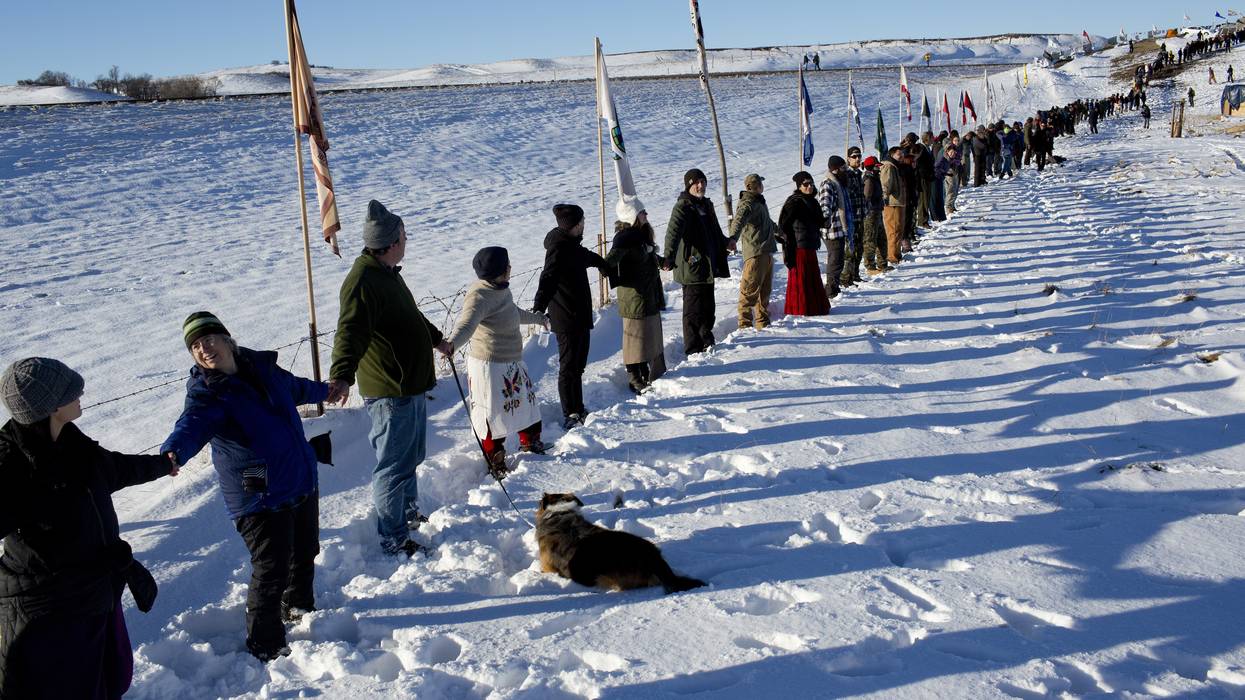
"Energy Transfer's lawsuit is a perfect prototype of what the E.U. Directive aims to end: wealthy players using towering legal claims and costs to muzzle criticism," said a senior legal counsel for Greenpeace.
With "the future of advocacy and peaceful protest" on the line, as one leader of Greenpeace USA said, the international environmental group has become the first entity to use a new European Union law aimed at stopping powerful corporations from filing meritless legal challenges.
Greenpeace International is among the defendants in a $300 million lawsuit originally filed in 2017 by Energy Transfer (ET), the Texas-based oil company that has accused Greenpeace of inciting protests against the firm's Dakota Access Pipeline in North Dakota, and of vandalizing property and delaying the pipeline project.
Greenpeace's home base of Amsterdam allows it to apply the E.U.'s Anti-SLAPP Directive, which was adopted in April with the goal of stopping legal challenges that are deemed to be "Strategic Lawsuits Against Public Participation"—lawsuits that are meant to bankrupt civil society groups and nonprofits with years of litigation and legal fees.
As The New York Times reported Tuesday, Greenpeace International last month sent a Notice of Liability to ET, which is headed by a close ally of Republican presidential nominee Donald Trump, saying it will use the Anti-SLAPP Directive to counter-sue the company in the Netherlands.
The group said it aims to recover all damages and costs it has suffered as a result of ET's lawsuit unless the company withdraws the case and pays Greenpeace back for the fees it has incurred fighting the litigation so far.
"Energy Transfer's lawsuit is a perfect prototype of what the E.U. Directive aims to end: wealthy players using towering legal claims and costs to muzzle criticism. Thanks to a concerted civil society campaign, there is now a strong tool to stop these cases at the E.U. border and to fight back against them," said Daniel Simons, senior legal counsel for strategic defense for Greenpeace International.
Greenpeace has argued it did not organize protests that included a huge encampment near the Standing Rock Sioux Reservation from 2016-17, where Indigenous tribes and environmental advocates protested ET's construction of the 1,170-mile crude oil pipeline. It has said it did not participate in any violence or property destruction at the protests.
"From the outset, this has been an attempt by ET to bury nonprofits and activists in legal fees, push them towards bankruptcy, and ultimately silence dissent," said Greenpeace.
The group's chapter in the United Kingdom spoke out on Wednesday, saying the lawsuit represents an "existential threat" to Greenpeace.
The Standing Rock Sioux tribe and its allies said the pipeline would endanger the water supply for the reservation and violate the tribe's right to its land. The pipeline began operating in 2017 after Trump issued an executive order, but it has yet to receive federal approval.
ET's lawsuit against Greenpeace is scheduled to go before a jury in Morton County, North Dakota next February.
Anna Myers, executive director of the Whistleblowing International Network and member of the steering committee for the Coalition Against SLAPPs in Europe, said Greenpeace is applying the Anti-SLAPP Directive to confront a growing threat posed by powerful corporations, including fossil fuel firms.
"The Coalition Against SLAPPs in Europe was set up in response to build solidarity and advance the case for anti-SLAPP legislation, including the E.U. Anti-SLAPP Directive published in April 2024," said Myers. "Energy Transfer's lawsuit—and the Notice of Liability issued by Greenpeace International—represents a crucial test of this new law."
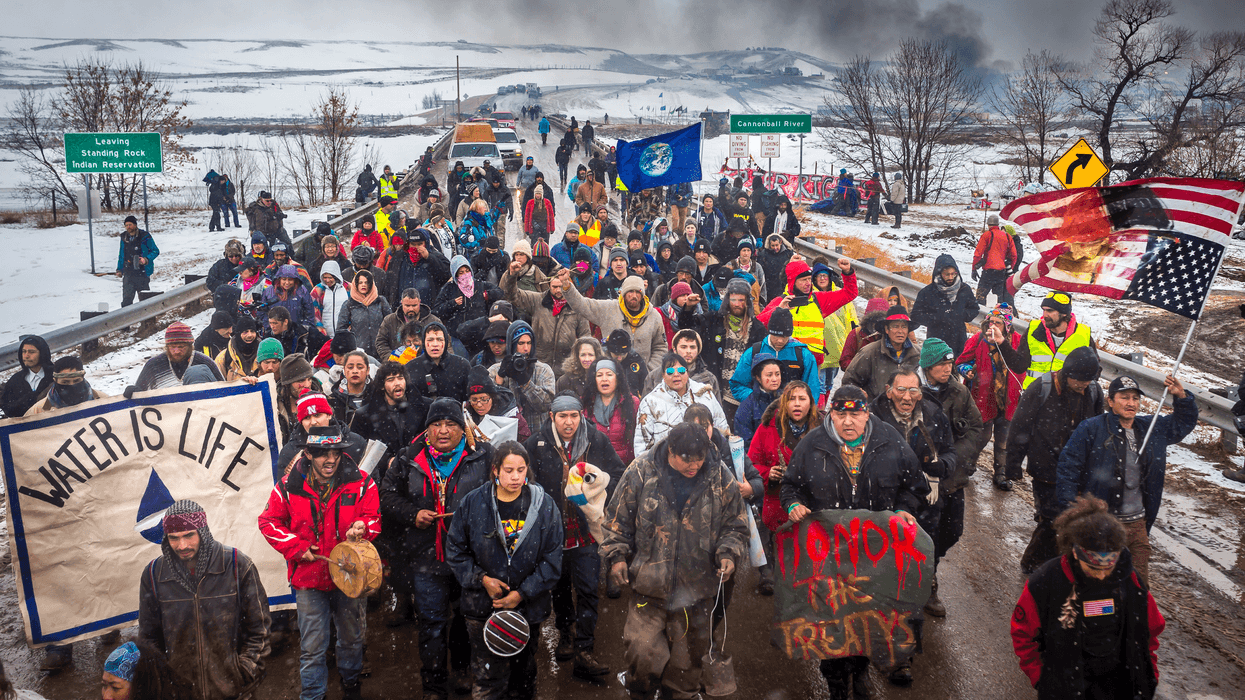
"No matter who you are, no matter what your politics are, this is one of the most important issues in America right now," one Greenpeace spokesperson said.
Nearly 300 organizations and tens of thousands of individuals have signed an open letter supporting Greenpeace USA against a $300 million lawsuit brought against the environmental group by Energy Transfer—a company with a majority stake in the Dakota Access pipeline.
The corporation is falsely accusing Greenpeace of being the driving force behind Indigenous-led protests against the Dakota Access pipeline (DAPL) in 2016 and 2017.
Greenpeace USA announced its supporters on Thursday as it launched a campaign to raise awareness about the lawsuit—which it said could "functionally bankrupt" the organization, threatening its "existence." However, Greenpeace said that the dangers posed by strategic lawsuits against public participation (SLAPPs), like the one it faces, extend far beyond one organization.
"No matter who you are, no matter what your politics are, this is one of the most important issues in America right now," Greenpeace USA spokesperson Rolf Skar said in a statement. "Energy Transfer built the Dakota Access pipeline. But they're suing anyway in order to send a message: If you dare to oppose us, we will financially ruin you."
The Dakota Access pipeline drew massive protests from the Standing Rock Sioux Tribe, more than 300 other tribal nations, and non-Indigenous allies. While former U.S. President Donald Trump forced the pipeline through shortly after taking office in early 2017, the protests rattled the fossil fuel industry and their allies in government. After 2016, 18 states passed anti-protest laws that shielded around 60% of U.S. oil and gas production and related infrastructure from peaceful protests. The industry also turned to "judicial harassment."
Energy Transfer (ET) initially brought suits against Standing Rock Tribal Chairman Dave Archambault and other Water Protectors, as well as a federal suit against Greenpeace in 2017.
At the time, ET CEO Kelcy Warren told a reporter: "Could we get some monetary damages out of this thing, and probably will we? Yeah, sure. Is that my primary objective? Absolutely not. It's to send a message—you can't do this, this is unlawful, and it's not going to be tolerated in the United States."
"Everyone who says they care about freedom—of whatever political stripe—should join together to support the Greenpeace campaign to protect people's right to speak out against corporate abuses."
While the 2017 cases were all dismissed, ET immediately filed a similar case against Greenpeace in North Dakota state court in 2019. The new case, which is scheduled to go to trial in February 2025, makes what Greenpeace called a "deeply racist" case that Greenpeace, and not Indigenous leaders, coordinated the Dakota Access protests.
"The lawsuit against Greenpeace is also an attack on the Indigenous movement in our fight for self-determination to protect Mother Earth, our waters, sacred and cultural sites, and our youth and future generations," Morgan Brings Plenty of the Standing Rock Youth Council said in a statement. "These colonialist lawsuits are trying to send a warning to anyone who might consider speaking out and to be quiet—any of you could be next."
ET also makes several claims that would set a dangerous precedent if upheld, including denouncing legitimate speech as defamatory and making anyone who is present at a protest liable for things that occurred at the same protest.
"The whole point of this type of lawsuit is to limit freedom of expression, so even if you don't care about climate change, or you don't care about Greenpeace, you should pay attention," Skar said. "What's at stake isn't just Greenpeace or environmentalism, but the fundamental American rights to freedom of peaceful expression and advocacy for all of us."
Greenpeace has circulated a letter to ET that has so far been signed by more than 290 organizations—including 350.org, Public Citizen, ACLU North Dakota, SEIU, Indigenous Environmental Network, and Amnesty International USA—and tens of thousands of individuals, including prominent celebrities and activists like Jane Fonda, Susan Sarandon, Billie Eilish, and Adam McKay.
"This is corporate overreach that is part of a disturbing trend of attacks on advocacy and speech around the world," the letter reads. "We will not allow lawsuits like this one to stop us from advocating for a just, green, and peaceful future. On the contrary, we will ensure they have the opposite effect, increasing the support for organizations like Greenpeace and strengthening the broader movement for justice."
"This legal attack on Greenpeace is an attack on us all," the letter continues. "We will not stand idly by. We will not be bullied. We will not be divided and we will not be silenced."
Organizations also issued individual statements of support.
"Everyone who says they care about freedom—of whatever political stripe—should join together to support the Greenpeace campaign to protect people's right to speak out against corporate abuses," said Robert Weissman, co-president of Public Citizen. "As Greenpeace knows from its own experience, too often corporations use their political, economic, and legal power not just to run PR campaigns justifying their wrongdoing, but to threaten public interest advocates with bad-faith lawsuits (SLAPPs) and other intimidation tactics."
Brian Hauss, a senior staff attorney for the ACLU, said: "Protesters and advocacy groups should never have to fear the weight of groups like ETP as a condition for expressing their First Amendment rights. The court should see this lawsuit for what it is and toss it."
Progressives are also calling for a national legislative solution to the problem of SLAPP suits. While most states do have laws on the books against them, North Dakota is one of the 18 that do not.
Rep. Jamie Raskin (D-Md.) introduced the Strategic Lawsuits Against Public Participation (SLAPP) Protection Act during Congress' last session, and plans to reintroduce it in September of this year.
"The case against Greenpeace illustrates how mega-corporations can use lawsuits to silence, intimidate, and ruin their critics," Raskin said. "America must demand, and Congress must pass, bipartisan legislation to protect First Amendment rights against ruinous litigation practices."
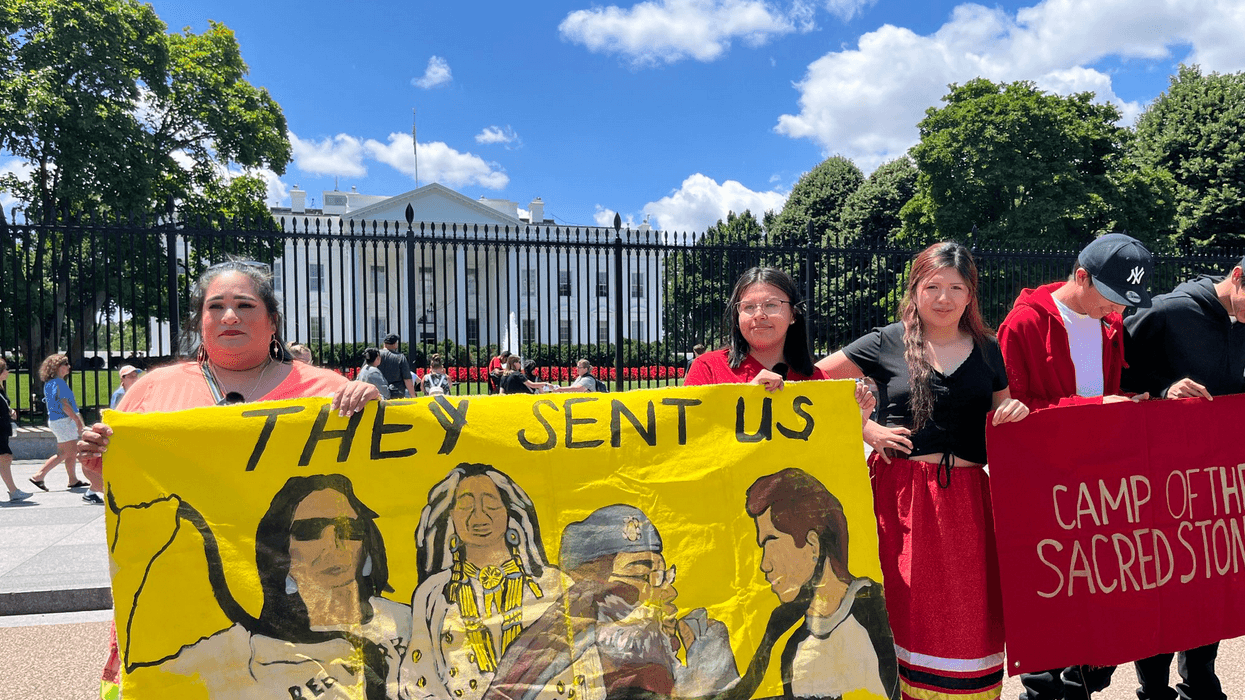
"The injustices of the Dakota Access Pipeline are many, including an assault on Indigenous rights and the right to defend our lands, waters, and communities," said one campaigner.
Indigenous campaigners, climate action groups, and other environmental justice advocates converged in Washington, D.C. on Tuesday to amplify the message they have aimed to send to the federal government for more than eight years, since they led a historic, monthslong mass civil disobedience action in 2016 with tens of thousands of supporters in an effort to shut down the Dakota Access Pipeline.
The Standing Rock Sioux Tribe and Cheyenne River Sioux Tribe organized Tuesday's rally, calling on President Joe Biden and the Army Corps of Engineers (ACOE) to revoke all permits for the Dakota Access Pipeline (DAPL) and end operations for a project that transports 600,000 barrels of crude oil per day nearly 1,200 miles, running just a mile upstream from the Standing Rock reservation.
The rally comes nine months after the ACOE released an Environmental Impact Statement (EIS) for the pipeline, which is in operation despite lacking a permit to cross land adjacent to and beneath Lake Oahe, the main drinking water source for the Standing Rock Sioux Tribe.
The EIS included a number of alternative measures the ACOE could take aside from keeping DAPL in operation, including ceasing operations and excavating the pipeline, rerouting it, and abandoning it in place, but the ACOE did not make a recommendation when it released the report in September, saying it would issue a recommended plan of action after the release of the final EIS, which is now expected in 2025.
At the rally, demonstrators called on the Biden administration to recommend "Alternative #2."
"We demand that President Biden and the ACOE listen to our voices and choose the 'No Action Alternative #2' in the Environmental Impact Statement deliberation, which would result in the shutdown and capping of the pipeline at the crossing of Lake Oahe," said Stephanie Yellow Hammer, tribal leader of Standing Rock.
One Standing Rock member led campaigners in a chant, declaring, "We stand! For our water! For life!"
Morgan Brings Plenty of the Indigenous Environmental Network said they were driven to travel from South Dakota to Washington, D.C. to once again protest a pipeline that carries risks for an oil spill in the crucial Lake Oahe, violates tribal treaty rights and sovereignty, and could unleash more than 120 million metric tons of planet-heating greenhouse gas emissions per year if it remains in operation, according to the EIS released in September.
"Being a long-time pipeline fighter since a young age, you travel and go where you are needed without hesitations," said Brings Plenty. "Going to D.C. over and over with so many youth and allies and family to continue on the fight to stop the Dakota Access Pipeline completely to ensure not only our future but the next generations to come to have a better future in mind. I will not rest until this pipeline and many other fossil fuel projects are put to an end."
Tefere Gebra, chief program officer for Greenpeace USA, participated in the action ahead of the group's scheduled trial in North Dakota stemming from a $300 million lawsuit filed against it by Energy Transfer, the owner of DAPL.
The company has accused Greenpeace of secretly organizing the 2016 mass protests against DAPL, which were actually led by the Standing Rock Sioux Tribe and other Indigenous water protectors, and is claiming the organization defamed Energy Transfer.
"The injustices of the Dakota Access Pipeline are many, including an assault on Indigenous rights and the right to defend our lands, waters, and communities," said Gebra. "Another attack on Indigenous sovereignty—and on all of our rights to peaceful protest—comes in the form of a $300 million lawsuit."
"No matter what happens, today we stand in solidarity with the Standing Rock and Cheyenne River Sioux Tribes and call on the Biden administration to shut down DAPL," Gebra added, "while defending ourselves against outrageous attempts to silence and divide our movements."

"The Corps' covering for the pipeline company's outrageous safety record and the reviewer's serious conflict of interest have now resulted in a failed effort," said Standing Rock Sioux Tribe Chairwoman Janet Alkire. "They need to start over with adult supervision."
Standing Rock Sioux Tribe Chairwoman Janet Alkire is leading a fresh demand that the U.S. Army Corps of Engineers throw out an ongoing environmental review process of the controversial Dakota Access Pipeline and start again from scratch alongside a superseding call for the pipeline to be shuttered completely.
Following Friday's release of a revised Environmental Impact Statement (EIS), ordered by a federal court, the tribe said the document reveals the entire process has been a failure and that the pipeline—currently operating across their land without consent in what they consider an "illegal" manner by the Energy Transfer company—should be shut down once and for all.
"We're furious that the Army Corps has addressed none of our major concerns during the review process," Chairwoman Alkire said in a statement.
"The pipeline is an imminent threat to the Missouri River, sensitive habitat, and sacred burial sites along the riverbank," she continued. "The oil company's emergency response plans are inadequate, its safety track record is horrendous, and there's been a stunning lack of transparency with Standing Rock throughout the environmental review process, including inaccurate characterizations of tribal consultation."
The Army Corps did not make any recommendations or indicate preferences among the alternatives presented in the new EIS report, which included keeping it in operation, possible rerouting, removing the pipeline by excavation, or abandoning it in place. The Corps said its final recommendations will accompany a final report once the review process is complete, but the Standing Rock Sioux said the process has been seriously flawed.
The tribe said the draft EIS fails to "account for the existence of criminal charges and a host of fines and serious citations" from regulators faced by Energy Transfer. Alkire accused the Corps of "doing all it can to ignore the company’s poor safety record and the high risk" of the pipeline. According to the statement by the tribe:
the entirety of the environmental review process hasn't been taken seriously and is compromised because the Corps selected a company with a clear conflict of interest to prepare the just-released draft EIS. Environmental Resources Management — which also produced a sparkling environmental review for the Keystone XL pipeline, later shelved due to environmental concerns — is a member of the American Petroleum Institute. That organization previously filed a legal brief in support of DAPL in Standing Rock’s suit against the Army Corps.
Moreover, Environmental Resources Management has contracted with at least five separate companies with an ownership interest in DAPL.
The release of the EIS triggers a 45-day public comment period and the Standing Rock Sioux Tribe is now requesting public support in opposition of the project.
"The Corps' covering for the pipeline company's outrageous safety record and the reviewer's serious conflict of interest have now resulted in a failed effort," said Alkire of the current process. "They need to start over with adult supervision."
Amy Mall, senior advocate at NRDC, said her group stands "in solidarity with the Standing Rock Sioux Tribe in opposing this dirty and dangerous pipeline that harms the climate and threatens the primary water source for the Tribe."
"The Army Corps must consider all of the risks of this pipeline, make all significant environmental information available without redactions, and honor the Tribe’s treaty rights," Mall added. "We call on the Corps to shut it down."
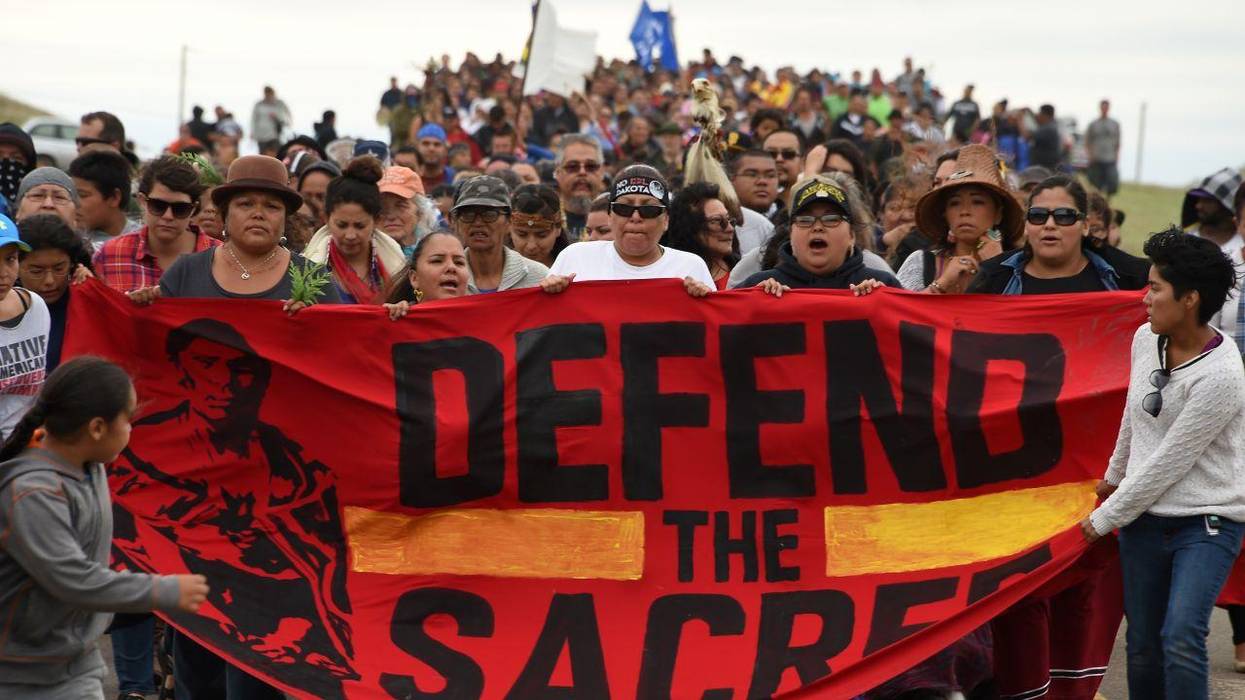
May Boeve, who heads 350.org, decried private security firm TigerSwan's "astonishing abuse of power and significant interference with the right to political freedom of thought and the right to protest."
A private security firm that worked with law enforcement to suppress the Indigenous-led movement against the Dakota Access Pipeline targeted peaceful activist groups including the 350.org climate campaign as part of a sweeping surveillance effort, according to a report published Thursday by The Intercept.
Previous reporting by The Intercept's Alleen Brown showed how TigerSwan—which was founded by U.S. special forces veteran James Reese—infiltrated and spied on water protectors during the 2016-2017 #NoDAPL protests at the Standing Rock Indian Reservation in North and South Dakota.
The new reporting from Brown and Naveena Sadasivam—who received more than 50,000 pages of documents via a public records request—details how "TigerSwan used social media monitoring, aerial surveillance, radio eavesdropping, undercover personnel, and subscription-based records databases to build watchlists and dossiers on Indigenous activists and environmental organizations."
TigerSwan—which did not even have the requisite security license to operate in North Dakota—then tried to sell the intelligence it illegally gleaned to other oil companies.
One of those groups was the nonviolent climate organization 350.org. According to a TigerSwan client document titled Background Investigation: 350.org:
350.org's ability to bring global attention to the DAPL protest via their network of supporters and their media concerns represents a significant concern for TigerSwan and their client. 350.org's ability to mobilize large groups of people is also of significant concern. They are unlikely to remove themselves from the protesters' groups because their goals align perfectly with the Standing Rock Sioux tribe. They have a track record of success and should only be engaged after significant preparation.
Brown and Sadasivam also found that:
TigerSwan also attempted to dig up dirt on legal workers with the Water Protector Legal Collective, which represented pipeline opponents. The security company used the CLEAR database, which is only available to select entities like law enforcement and licensed private security companies, to dig up information on attorney Chad Nodland...
At the same time, the National Sheriffs'Association was building its own profiles and sharing them with TigerSwan. In one instance, a contractor for the sheriffs' group passed along a six-page backgrounder on LaDonna Brave Bull Allard, a prominent Dakota Access pipeline opponent and historian, to TigerSwan. The document included statements Allard made to the press, her public appearances, social media posts, and details about tax liens filed against her and her husband.
"Across the globe we know that thousands of groups have been spied on by government and private security firms that are serving the interests of the fossil fuel industry," 350.org chief executive May Boeve said in a Thursday statement in response to the latest reporting. "This represents an astonishing abuse of power and significant interference with the right to political freedom of thought and the right to protest."
Wasté Win Young, a citizen of the Standing Rock Sioux Tribe and a plaintiff in a class-action civil rights lawsuit against TigerSwan and local law enforcement, told The Intercept that for pipeline supporters, the surveillance "was an opportunity to help create a narrative against our tribe and our supporters."
Boeve contended that "ultimately, it is a means for those who hold power to preserve the status quo and prevent action on the climate crisis and necessary social change."
"We need to always be very clear that the industry knows what a risk the climate movement is," she told The Intercept. "They're going to keep using these kinds of strategies, but they'll think of other things as well."
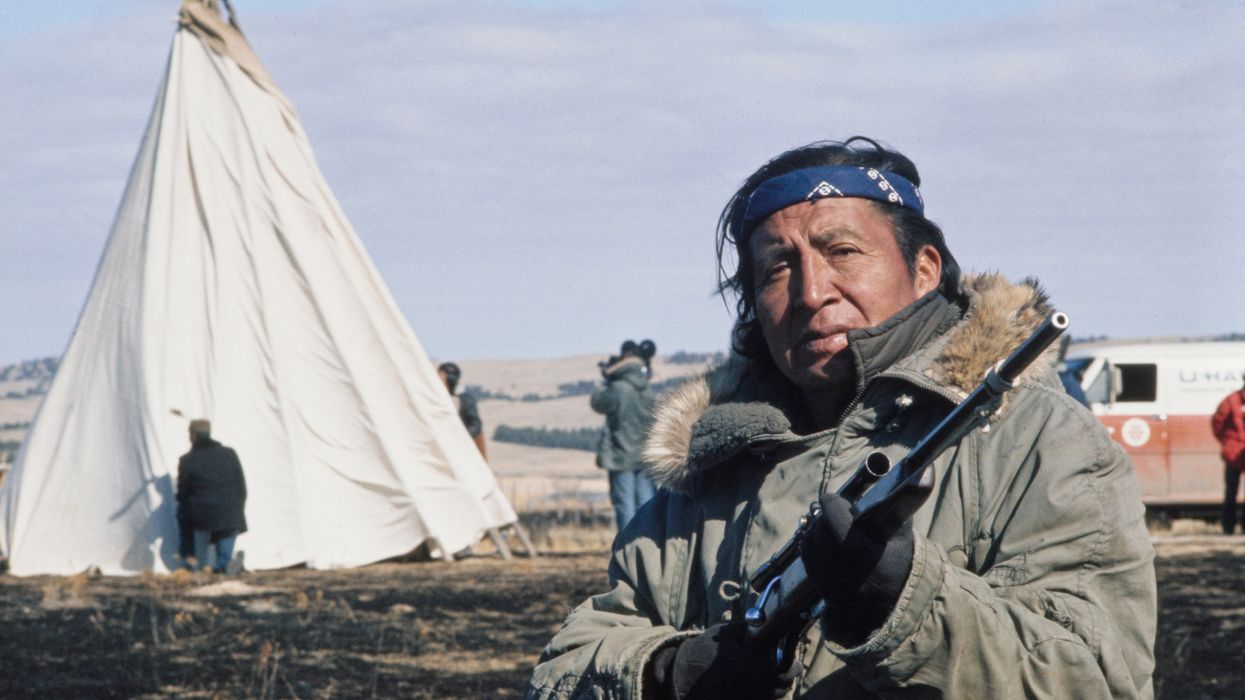
"We're not the subjugated and disenfranchised people that we were," said one Ponca elder who took part in the 1973 revolt. "Wounded Knee was an important beginning of that."
As many Native Americans on Monday marked the 50th anniversary of the militant occupation of Wounded Knee, South Dakota, participants in the 1973 uprising and other activists linked the deadly revolt to modern-day Indigenous resistance, from Standing Rock to the #LandBack movement.
On February 27, 1973 around 300 Oglala Lakota and members of the American Indian Movement (AIM), seething from centuries of injustices ranging from genocide to leniency for whites who committed crimes against Indians, occupied the hamlet of Wounded Knee on the Pine Ridge Reservation for more than two months. The uprising occurred during a period of increased Native American militancy and the rise of AIM, which first drew international attention in 1969 with the 19-month occupation of Alcatraz Island in San Francisco Bay.
"The Native people of this land after Wounded Knee, they had like a surge of new pride in being Native people," Dwain Camp, an 85-year-old Ponca elder who took part in the 1973 revolt, told The Associated Press.
"Anything that goes on, anything we do, even today with the #LandBack issue, all of that is just a continuation."
Camp said the occupation drove previously "unimaginable" changes, including the Indian Self-Determination and Education Assistance Act, the Indian Child Welfare Act, the American Indian Religious Freedom Act, and the Indian Gaming Regulatory Act.
"After we left Wounded Knee, it became paramount that protecting Mother Earth was our foremost issue," he explained. "Since that period of time, we've learned that we've got to teach our kids our true history."
Camp said the spirit of Wounded Knee lives on in Indigenous resistance today.
"We're not the subjugated and disenfranchised people that we were," he said. "Wounded Knee was an important beginning of that. And because we're a resilient people, it's something we take a lot of pride in."
Some of the participants in the 1973 uprising had been raised by grandparents who remembered or even survived the 1890 massacre of more than 200 Lakota Lakota men, women, and children by U.S. troops at Wounded Knee.
"That's how close we are to our history," Madonna Thunder Hawk, an 83-year-old elder in the Oohenumpa band of the Cheyenne River Sioux Tribe who was a frontline participant in the 1973 occupation, told Indian Country Today. "So anything that goes on, anything we do, even today with the #LandBack issue, all of that is just a continuation. It's nothing new."
Nick Tilsen, an Oglala Lakota who played a prominent role in the 2016-17 protests against the Dakota Access Pipeline at Standing Rock, North Dakota and who founded the NDN Collective, told Indian Country Today that "for me, it's important to acknowledge the generation before us—to acknowledge their risk."
"It's important for us to honor them," said Tilsen, whose parents met at the Wounded Knee occupation. "It's important for us to thank them."
Akim Reinhardt, an associate professor of history at Townson State University in Baltimore, told Indian Country Today that the AIM protests "helped establish a sense of the permanence of Red Power in much the way that Black Power had for African-Americans, a permanent legacy."
"It was the cultural legacy that racism isn't okay and people don't need to be quiet and accept it anymore," he added. "That it's okay to be proud of who you are."
Indian Country Today reports:
The occupation began on the night of Feb. 27, 1973, when a group of warriors led by Oklahoma AIM leader Carter Camp, Ponca, moved into the small town of Wounded Knee. They took over the trading post and established a base of operations along with AIM leaders Russell Means, Oglala Lakota; Dennis Banks, Ojibwe; and Clyde Bellecourt, White Earth Nation.
Within days, hundreds of activists had joined them for what became a 71-day standoff with the U.S. government and other law enforcement.
Black activist Ray Robinson, who had been working with the Oglala Sioux Civil Rights Organization, went missing during the standoff. In 2014, the FBI confirmed that Robinson died at Wounded Knee, but his body was never recovered.
AIM remains active today. Its members have participated in the fights against the Dakota Access, Keystone XL, and Line 3 pipelines, as well as in the effort to free Leonard Peltier, a former AIM leader who has been imprisoned for over 45 years after a dubious conviction for murdering two FBI agents during a separate 1975 shootout on the Pine Ridge Reservation.
Kevin McKiernan, then a rookie reporter for NPR who was smuggled into Wounded Knee after the Nixon administration banned journalists from covering the standoff, said in an interview with NPR that the #LandBack movement—spearheaded in the U.S. by NDN Collective—is a leading example of the occupation's legacy.
"And I think that there is a collective or a movement like that on every reservation with every tribe," McKiernan said. "They're going to get back, to buy back, to get donated—just do it by inches."
"That's what's going on in every inch of Indian country today," he added.
The fight for Standing Rock is over, at least for now. With the help of Donald Trump and the banks, the oil industry has imposed its agenda. The construction of the pipeline has been completed. Our prayers are with that handful of people who are still there, still standing their ground. Last year, thousands of people, from every culture and from all over the world, traveled great distances to come together on the land. They came despite the freezing cold, to take part in the resistance. By now, nearly all of them are gone. Was this all just another passing phase, a brief episode in the imperial powers' centuries-long war against life?
What would happen if all those different tribes and groups, having come together from every continent, would have a shared goal for further collaboration: to concretely create a post-capitalist world? The only way to overcome the existing system is to establish a deep commitment to what we want to come after. But what is it? What will come after?
Do we have a strategy to permanently overcome the violence in today's world--to overcome the power of the banks, the oil companies, the pharmaceutical industry, the arms industry, and their servants in government? Such a strategy, if we can find it, would offer protection to all the Standing Rocks of the world, now and in the future. It has been clear for some time that the questions raised by Standing Rock are global issues. Is there a power that can make it possible for life--life lived in love and trust--to overcome the power of guns? This is the revolutionary and ethical question of our time. And here is our answer: Yes, there is such a power.
In the shadow of every current catastrophe, forces of global renewal and creating a nonviolent planetary society are taking shape. We have a realistic chance to make this happen in the near future. Upon hearing this, the inner reaction often is, "I don't believe it." Yet, it comes too quick. Who would have believed in self-driving cars just thirty years ago? Human beings are able to manifest whatever they believe in, whatever they can envision. This applies to every area of life, from extreme sports, to research and technology, all the way to the possibility of global annihilation. Why not apply this power to global healing and global peace?
"In the shadow of every current catastrophe, forces of global renewal and creating a nonviolent planetary society are taking shape."Around the world today, there is a suffering that compels us to rise to new standards of peacework. The inconceivable events in Aleppo and Mosul, in Somalia and South Sudan; the refugees in inflatable rafts; and also the disintegrating marriages in our own culture, the child pornography and sexual violence... all this demands our deep introspection, and that we make a profound change in our own ways of thinking.
250 million children are currently living in war zones. 50 million children are refugees, searching for a new home. Humanity is faced with an apocalyptic situation; the age of materialism is on the verge of self-destruction. On the one hand, we stand on the brink of a third World War - and on the other hand, at the beginning of a new civilization. The lives of billions of human beings and animals will depend on this historical shift. We can offer our children, and our children's children, a future worth living, if we take an active part in this transformation of the earth. What does this transformation consist of?
We live simultaneously in two realities: in the reality of global war, and in another reality, which we call the "Sacred Matrix." To "Defend the Sacred" was and remains the motto for the Sioux in the Dakotas. It is ours too. The Sacred Matrix contains the holy and healing powers of life. Transformation is what we call the transition from one reality to another. We are at the beginning of a planetary system change. The new civilization will be based on the Sacred Matrix. This will also be the foundation for new communities. We started the global Healing Biotopes Project to make it possible for many such groups around the world to connect with one another on this basis.
What is the Sacred Matrix?
There is a documentary film , The Man who Swims With Crocodiles, available on the internet. It shows the love between a man and a crocodile. The two are connected by such a tender intimacy, that one can hardly imagine it existing between human beings. The man gives the fully-grown crocodile a kiss on its muzzle...It seems so otherworldly, that it's hard to believe until one sees it. But the story is not something from another world. It's real, and here on earth. It simply shows us something that contradicts all the beliefs and fear-projections we have been taught.
This story is not unique. Research with animals has revealed countless other examples. One can read, for example, the book, Kinship with All Life by J. Allen Boone (3). We have had many similar experiences here in Tamera. Nine year-old Simon met a wild boar with its little ones in the night, and he remained unafraid. When a classmate from the neighborhood asked him the next day, why he had not been afraid, he answered, "The wild boar are just the same as us." To this, the young neighbor said, "I want to take care of the wild boar in Tamera with you." Six year-old Aaron tripped over a terrier on a chain, who then snapped at him. Aaron let out a short scream, but then said, "The dog isn't mean. He was just shocked, the same as I was."
These experiences describe a possible world of contact with animals and a new door opens for us. All these real events show possibilities of another existence, in which there is neither fear nor hostility. They show what life itself can do, when fear and violence do not interfere. It is the world of the Sacred Matrix that exists as a real possibility and waits for us to activate it. The world of the Sacred Matrix is the fundamental entelechy pattern of life, and is the goal of a new planetary civilization. The world could be a love affair. Love is the most valuable of humanity's cultural assets; it is the sacred aspect of existence. It is our genetic foundation, written into the nuclei of our cells. It is the core information of all life, all striving towards unity. The Jesuit priest and paleontologist Teilhard de Chardin wrote, "Through the power of love, the fragments of the world search for one another, so that the world can may find perfection."
Perhaps we cannot simply create this world right away. We can, however, recognize the preconditions, from which it would arise by itself. In the case of the crocodile, the story has a very simple beginning: The man found a small, injured crocodile on the banks of the river. For two years he nursed the crocodile back to health. He said, "I doesn't only need to be fed; it also needs my love." When it was healthy again, he wanted to release it back in the wild river. But it immediately swam back to him. From then on, they have been inseparable friends. Can we imagine that new communities might arise on earth, where people and animals, and children and parents, grow up in this kind of friendship? Communities, in which there is no fear and no hostility, neither among human beings, nor between humans and their fellow creatures? Can we imagine a world, in which the concept of enmity has been made obsolete? Are we ready to acknowledge--and put into practice--the necessary ethical, social, ecological, and spiritual conditions, from which such a world can emerge in reality? Are we not then very close to the idea of daring to make such an attempt?
By virtue of digital technology, we are currently able to land a robot on a distant comet with microscopic precision, or to destroy any enemy anywhere with sophisticated weapon systems. Could we, using the same intelligence, not develop systems of life, in which no weapons are needed, because our passions are guided by a higher power?
A global network is arising on the earth, with the goal of bringing these thoughts into reality. We call it Terra Nova. It is not bound to any particular group, but rather belongs to the global information of the Sacred Matrix.
Information is one of the world's basic raw materials. Everything is guided by information. How far this can go is demonstrated by the strange success of Silicon Valley's digital companies. It seems to be a voyage without limits. The same applies to our lives, when we allow them to be guided by the information of the Sacred Matrix. Here too is a voyage without limits - but in another direction. Whether there will be war or peace on earth, whether we will be sick or healthy, whether we will experience jealousy or solidarity in our relationships, depends on the fundamental information steering our lives. A civilization that has made war for millenia carries the information of mistrust and war deep in its cellular memory. Such a civilization will respond to the information of the Sacred Matrix with defense, derision , and violence. But this defense leads to humanity's self-destruction. Even the modern high-tech industries will not be able to endure if they continue to work as they have until now, without reevaluating their basic ethical principles. In the system that has lead to millennia of war, the dominant information arises from traumas in the collective unconscious of all humanity, and in the private lives of each individual. Also in our private lives, everything depends on which side we choose, and which information we follow. The system of violence obtains its power from a collective substratum of fear. We must recognize and dissolve it.
Our higher souls can do anything, if our higher will is present. Whether a lasting love relationship arises or not, depends on which information we allow to enter us and guide our on-board computers. The same applies to the collective organism of humanity as a whole - which path humanity will take depends on which information we enter into its information body. The love story between man and crocodile reveals something that is relevant for the whole planet. It goes so very deep. Within the vision of the Sacred Matrix is a possibility of salvation, which we have to get used to, at first. It is so other-worldly and yet so real, like the love between human and crocodile. And yet we have a deep sense that it is true; that the possibility of such a planetary love affair exists. We feel that such a world could exist, and that we could manifest it, if we agree together to do so. If this succeeds in one place, it will succeed in many places.
The sacred alliance of life includes all beings; all are connected to this basic pattern, all carry this vision in their souls like an ancient memory. It is built into humanity's entelechy program. When a group of people builds a new structure for life based on the Sacred Matrix, this will activate a vision of life, latent in every other living being. As soon as this vision is put into practice in real life, it will be possible to receive it everywhere, because the collective consciousness of humanity is in an "excited state." Everywhere, there are sensors that will record the image; everywhere, there are powers that will manifest it. Because the vision will be understood and loved, on a cellular level, everywhere. This is the secret of how healing works: healing though contact with the healing power of life. A sick child can become healthy, just because a little dog lays beside her.
We see an entirely different logic at work, wherever trust, love, and care--not hostility and fear--reign among human beings and all their fellow creatures. It is an entirely different concept for life--a different concept for love, for its healing, and for what love can do. Indeed, it is the concept of the Sacred Matrix. This concept is the basis for paradise, a new earth. It is the concrete utopia of a human race that has finally left the old fields of hostility and violence behind. Again and again we must question the facts, and test this realityies, until we see that this utopia is not a dream and not an illusion. Rather, it is a message about a different global culture written into the genome of every living thing.
We're talking about planetary system-change - in every community and in every individual. No more, "What do I get?" but rather, "How can I support?" A shift from egocentrism to participation. It is a shift on many levels--from the hologram of fear to the hologram of love. In this context, the subject of Eros is central, for here the traumatic wound is the deepest. The subjects of sex, love, partnership and community take on new meaning when they are reconnected with the sacred. Through trust-building work in community, love and sexuality must be freed from all the old degradation, hypocrisy, and lies. In an erotic culture without fear or lies, Patriarchy will collapse. A new culture will take root in a new relationship between the genders. (This is described in detail in my previous books. (1)(2)) Eros too--even including its animalistic aspects--is part of the sacred. The goddess also reveals herself in the wallowing pig.
What is sacred? A world, where people practice solidarity, and care for one another, even in times of need: that is part of the sacred. A world where children can completely trust their parents, and indeed all adults: that is part of the sacred. A world where the sexual interest of one person in another does not create fear, jealousy, or hate in a third: that is a part of the sacred. A world in which animals come closer to humans, because we welcome them, and they do not have to fear us anymore: that is part of the sacred. A world in which we see and care for earth and water as a living organism: that is a part of the sacred. When a rescuer reaches out a hand to a drowning refugee, that is part of the sacred. And when people pray for someone who is terminally ill, and they become healthy again, the sacred has achieved another of its countless miracles. We do not necessarily have to call it "God," because the sacred does not need a name. It is the inner power that brings us all together, and connects us eternally with all our fellow creatures.
When we understand this, we are faced with an absolute imperative: To shift to the other system of reality that we call the Sacred Matrix. This shift is the goal of the global Healing Biotopes Project, that we have been working on for so long in Tamera. Healing Biotopes are are communities of human beings and nature, in which all participants--including the animals--are connected, on a foundation of trust. Every rural commune, and many urban neighborhoods, could transform themselves into Healing Biotopes. The planetary community of the future will develop out of a complex network of autonomous communities, built on the basis of the Sacred Matrix. Could that be a solution?
Despite the immense failures of the Democratic Party to live up to its stated progressive ideals, there are differences between the two major parties. Nowhere is that difference more obvious in recent days than in the decision by Donald Trump to reinstate the Keystone XL and Dakota Access (DAPL) pipeline projects. Tens of thousands of environmental, indigenous and other activists slogged for months, even years, to push President Obama to stop the climate-destroying projects. They marched, locked themselves to each other and to heavy equipment, faced arrests and felony charges, were hit by tear gas and rubber bullets, and even bitten by dogs. But they prevailed over Obama. With the stroke of a pen, Trump signed memorandums Tuesday to undo the results of those sacrifices and struggles, even though he knows he has no popular mandate. And he did it on day five of his administration.
Despite the dismay felt by many Americans, Kandi Mossett, the Native Energy and Climate Campaign organizer with Indigenous Rising, a project of the Indigenous Environmental Network, expressed optimism in an interview for "Rising Up With Sonali." Of the 2015 Keystone victory, she said, "We won it once and we'll win it again, even in a Trump administration." Just over a year before last November's election, Obama bowed to public pressure in the face of congressional support for the project and killed it. Less than two months ago, Obama took a similar stand on the DAPL. "Even though we celebrated for one day on December 4th," said Mossett, referring to the day of Obama's action, "we knew that this was coming in a Trump presidency, and so we were prepared."
Indeed, the encampment at the Standing Rock Indian Reservation in North Dakota, where the struggle over the DAPL is centered, never closed down. Mossett, who is heading back to the site, explained that about 500 activists, also known as "water protectors," have remained at the camp through the dead of winter. Because there are serious concerns about springtime flooding in the area, activists plan to move to higher ground and are undergoing training to withstand the seasonal weather and the expected crackdown by law enforcement. Just days before Trump revived the project, 16 people were arrested in protests over the pipeline, bringing the total number arrested over the course of the fight to 600.
Mossett said that the fight against the pipeline has brought indigenous groups together. But so has the election. "Native nations across the country have been coming together in response to a Donald Trump presidency," she said. "We will band together as nations in this country and make a significant change using our treaty rights and the legal system."
Trump, however, has not even acknowledged the existence of the Standing Rock Sioux tribe, which has led the legal fight against the project. Asked by a reporter about the tribe moments after he signed the DAPL memorandum, Trump simply ignored him and moved onto the next question. Press secretary Sean Spicer suggested Trump would "negotiate" with the tribe, saying, "He is willing to sit down with all of the individuals that are involved in the Dakota pipeline to make sure that it's a deal that benefits ... all of the parties of interest, or at least gets them something that they want." But, Mossett countered, "We won't negotiate. There's no negotiating with our lives."
Despite the grim news of the pipeline renewal, Mossett remains hopeful. "We are so strong as a result of a Trump administration," she said. "Him being in there is causing this revolution." More than 300 tribal nations have expressed formal support for the Standing Rock Sioux's fight against DAPL. Worldwide, approximately 600 indigenous groups have done the same. Mossett believes Trump may be "underestimating the power of the indigenous nations, our treaty rights, our right to exist and thrive on a planet that actually impacts everyone, even him."
In recent years, the fight for climate justice, particularly under the leadership of indigenous communities and organizations, has blossomed into a full-fledged movement, winning victories on national and local levels. It therefore was not surprising to me that at the largest women's march, which took place in Los Angeles on Saturday, I spotted many signs that sported "#NODAPL." Mossett, who was at the main march in Washington, D.C., was thrilled to hear marchers chant, "We support Standing Rock."
She and other indigenous activists recommend that supporters engage in civil disobedience and other forms of political activism in their own communities and in centers of power. Indeed, within hours of Trump approving the pipeline projects, at least a thousand people gathered outside the White House to demand an end to the DAPL. The morning after the decision, members of the environmental organization Greenpeace unfurled a gigantic banner that said "Resist" from a construction crane overlooking Trump's new residence. Greenpeace cited the pipeline decision during its action. In New York, Los Angeles and Seattle, emergency #NODAPL protests have already been organized.
Another prong in the multifaceted struggle against the DAPL is a divestment effort to push banks funding the pipeline to pull their money. The website defunddapl.org offers a guide to approaching banks and applying public pressure. To date, the effort takes credit for pushing banks to divest more than $50 million from the project.
In addition to being a focus of indigenous human rights and treaty rights, the fight against these pipeline projects is part of the broader struggle for climate justice. In dismissing climate change as a hoax and appointing pro-fossil fuel industry leaders to top Cabinet positions, Trump has declared war on the global climate. How we respond at this political moment will determine whether we push our atmosphere past its tipping point or manage to dodge the worst impacts of the warming that is already in progress. If the fight against the Dakota Access pipeline was the most important grass-roots political battle of 2016, it may very well win that distinction for the second year in a row.
Standing Rock (Nov. 2) -- Drone footage taken of the ridge overlooking the camp showed that the water protecters worst fears had been realized. Construction of the Dakota Access Pipeline had reached just a quarter of a mile from the river, plowing through burial grounds and sacred sites of the Sioux people. And the only access to the construction site was via a bridge that has been closed since last Thursday's confrontation with police.
People at camp were tense and restless. A group of about 20, led by a guy named Angry Bird, decided to build a bridge to cross over a small marshy tributary of the river to "Turtle Island." The crossing would allow the water protectors to pray by the disturbed gravesite and sacred lands of the Sioux. This is also within a short distance of the pipeline construction.
All night the team worked, using plywood, logs, rope, and other materials scrounged from around the camp. At 2 a.m., someone brought sandwiches.
We arrived at the bridge construction site just as it was getting light this morning, and there were just two sections of the bridge remaining to be rolled over logs along the creek and to be held in place with logs pounded into the creek bed. To the west, a long line of police cars were keeping track.
No worries, the bridge builders said. We are here just to pray. And Turtle Island is Army Corps of Engineers land; it does not belong to DAPL.
As the sun rose, things started happening fast. Word spread in camp that there was a prayer in the offing, and people started streaming in, some on foot, some in pickup trucks along the long rutted road across the flood plain. Young Lakota men on horseback arrived, also, along with a large drum and the team of singers that provide the sound track. High above, on the ridge across from the bridge builders, police cars pulled up to the edge of the cliff, officers looked down at the drummers and the bridge builders, and announced that the bridge would have to be dismantled and that all should return to camp. The suggestion was met with louder drumming, and suggestions that it was the police, not the water protecters, who were trespassing.
Soon, a line of about 50 riot clad police lined the banks of the river across from the bridge builders. After repeated demands by police to dis-assemble the bridge, a boat loaded with heavily armed police pulled up to the bridge, chopped the bridge rope support, and towed a section of the bridge away from the remainder of the bridge.
The action continued for hours after that. On one side was drumming and burning sage, sacred staffs and songs. On the other was millions of dollars spent on helicopters, imported police, heavy arms, helmets, boats, and rifles. Still, the police looked relatively relaxed. By now, they know these are unarmed, peaceful people, and that they have no reason to fear.
"Consider your own children and grandchildren," water protecters called out. "What will the drink when the water is poisoned?"
People began to swim to the other side, where they remained in the frigid water facing the police. Some got up on land. Police fired rounds of mace into the crowd of swimmers, and there were reports also of rubber bullets (couldn't confirm). A small boat carried people back who were overwhelmed by the cold or the mace, and medics waited on the shore to wash out their eyes and treat hypothermia.
It was a stand-off that lasted for hours and the two sides remain in a stalemate, North Dakota bringing in police from jurisdictions throughout the region, sending helicopters and planes to circle the camp and keep the camp under constant surveillance.
Water protectors believe it is not just for themselves that they are protecting the water, but for generations into the future, and that belief evokes the fierceness of anyone who is protecting their children. They repeatedly call for nonviolence, but they will not back down. Hundreds of clergy are here, now, answering a call from the local Episcopal Church. Human rights observers are here, too. And preparations for winter continue.
The stalemate continues as all await the Obama administration decision about whether the black snake will be allowed to cross the Missouri River.