
SUBSCRIBE TO OUR FREE NEWSLETTER
Daily news & progressive opinion—funded by the people, not the corporations—delivered straight to your inbox.
5
#000000
#FFFFFF
To donate by check, phone, or other method, see our More Ways to Give page.


Daily news & progressive opinion—funded by the people, not the corporations—delivered straight to your inbox.
Things are not well here, but the good, if not happy, news is that millions here have not rolled over and played dead.
Dear Taka,
You asked for news and some analysis about what is happening here in the U.S. You may be sorry that you asked.
Back in February, I shocked a Bikini Day* workshop by reporting about what could only be described as fascist assaults on U.S. constitutional democracy. Unfortunately, I was not exaggerating. Trump and his MAGA allies are in the midst of fighting a counterrevolution to consolidate white supremacy, to multiply the obscene wealth of the richest oligarchs—especially Trump and his family—in the tradition of monarchs and feudal lords, and to impose the structures and repression necessary to maintain a plutocratic, and potentially military, dictatorship.
Drawing on the foundation of the Heritage Foundation’s Project 2025 report, from day one of Trump 2.0 ambitious and opportunistic operatives and incompetent but loyal cabinet members, Trump has excelled in further enriching himself and his cabinet while doing his best to deliver punishing retribution to all who have or will challenge him, including leading celebrities like Bruce Springsteen and Beyonce. With a firehose of Executive Orders—many either unconstitutional or illegal—Trump has sought to remake U.S. government in the kleptocratic tradition of the 1890s Gilded Age, spiked by nostalgic efforts to recreate Jim Crow apartheid, and smash-and-grab imperialism (think Greenland, Panama, and Gaza).
Trump is no intellectual shining light, but he rules in the autocratic, but less enlightened tradition of former French President De Gaulle. In 1950, soon after assuming power, De Gaulle humiliatingly upbraided a member of his cabinet by saying that the official had been appointed to his position because he was stupid, and that his stupidity ensured his loyalty.
On the subject of stupidity, just the other day Kristi Noem—the current head of Homeland Security and former governor of South Dakota who once boasted about shooting her dog—revealed her dangerous ignorance. This is the beautiful cabinet member who recently and obscenely posed in a tight sweater, pin up style, in front of hundreds of jailed and dehumanized deportees in a El Salvador gulag jail that has been compared to Nazi concentration camps. She demonstrated the truth of the Gaullist model of Trump/MAGA rule when she was asked during a Senate hearing if she knew the meaning of habeas corpus. She failed that basic test, saying that it is a law that allows the president to deport immigrants. She didn’t flinch when she was then corrected with news that it is the 13th century’s most essential and founding principle of Anglo-Saxon governance. Referred to as “show us the body,” the writ of habeas corpus established the right of anyone who has been imprisoned to come before a judge for adjudication of the legality of his or her detention. And it was written into the U.S. Constitution 250 years ago in direct response to the abuses of King George III. Without the right of habeas corpus, we are all vulnerable to arbitrary arrest, imprisonment, and of being disappeared.
But clearly Trump is not all powerful. In the tradition of a schoolyard bully, he is brutal to those he sees as weak, but he retreats when those with as much or more power stand up to him. He retreated when Putin and Netanyahu refused his efforts to win ceasefires in Ukraine and Gaza and when China embarrassingly forced him to back down from threatened 145% tariffs.
Our good fortune is that despite Republicans clicking their heels and saluting every Trumpian whim or executive order and the business-as-usual instances of most Congressional Democrats, three hopeful guardrails—in the form of the stock market, the courts, and a popular opposition movement—have emerged. Trump measures his political standing and survival by the daily Dow Jones average (which dropped 800 points the other day, losing a LOT of people a LOT of money). And the courts have almost consistently ruled against his illegal deportations, shuttering government agencies, and withholding funds from universities.
The outstanding questions on which our future depends are whether Trump will obey Supreme Court decisions, and if martial law will be declared to prevent the 2026 Congressional elections, which Trump and MAGA likely will lose. Vice President JD Vance (it hurts to refer to that lost soul as vice president) has said that the Trump government need not obey court rulings. As the saying has it, the Supreme Court has no army to enforce its decisions, and as we saw with Trump’s January 6, 2021, attempted coup and his more recent pardoning of insurrectionists, Trump, MAGA, and their armed goons do not feel bound to honor electoral democracy.
The good, if not happy, news is that millions here have not rolled over and played dead. In a worst-case scenario, those of us committed to constitutional democracy and the rights and freedoms that flow from it may need to insist on popular sovereignty via a massive and nationwide general strike.
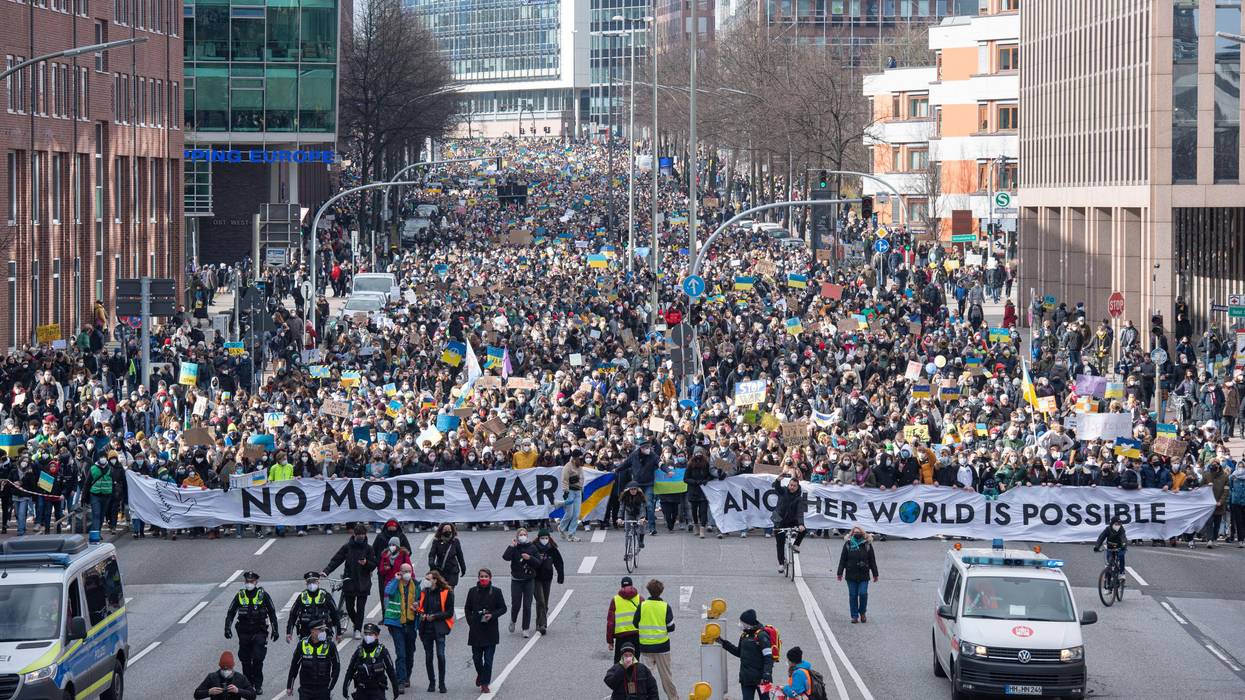
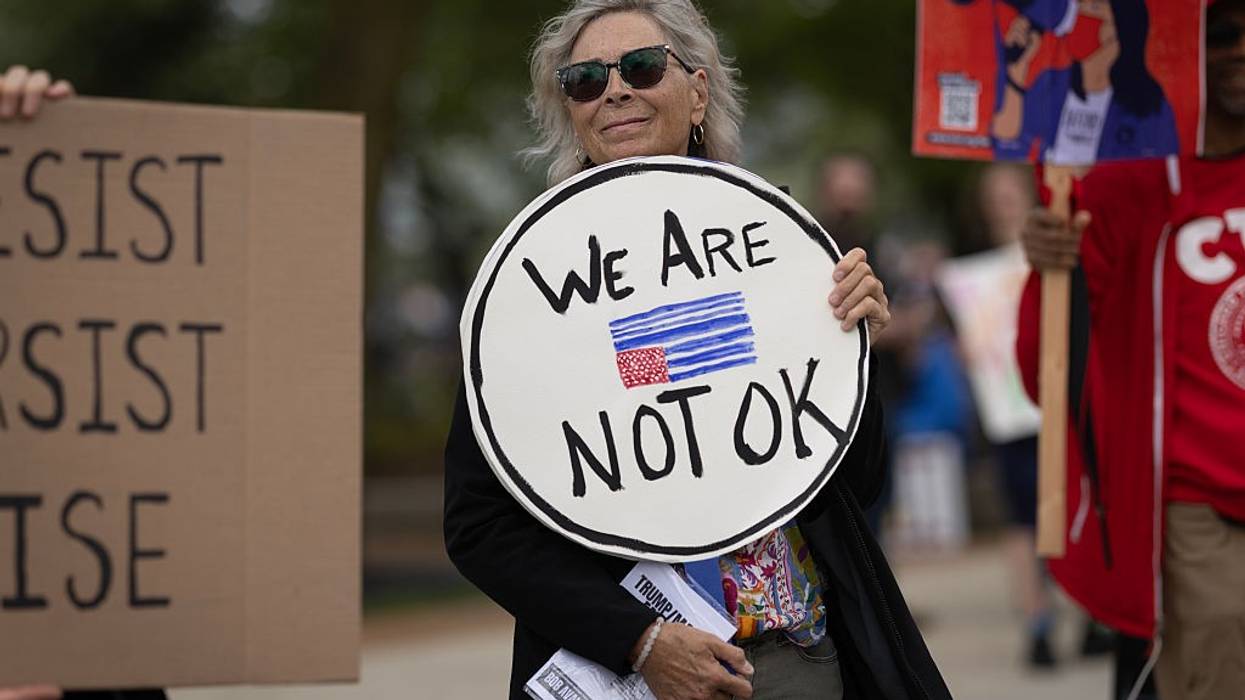
An estimated five million people came out to protest in major cities and smaller towns on April 5, and there have been almost daily demonstrations ever since. These actions give us affirmation, stoke our courage, and prepare the way for the future. It is my sense that if we are prepared, Trump’s refusal to fulfill a particularly significant Supreme Court order or the cancellation of the 2026 election could serve as the trigger for a general strike.
We have a lot of organizing to do between now and then and recalling the past some of us are stressing the absolute importance of remaining and calling for NONVIOLENT resistance. Dictators, kings, and autocrats from time immemorial have inserted violent agents provocateurs into popular movements to discredit them. The history of the Nazi 1933 Reichstag fire hangs over us, and the Palestine rights movement just suffered significant blowback when a frustrated and lost soul assassinated two Israeli embassy employees in Washington, D.C.
It is an uphill struggle and hardly an entirely new situation. I’ve been reminded how the masters of wealth in Germany in the 1920s and 30s believed that they could use and control Hitler and his Nazis to reinforce their privilege and power. They were quickly swallowed up by Nazi totalitarianism once they’d bought the 1933 election for Hitler. Trump’s father was a Ku Klux Klan slumlord. The roots of MAGA lie in racism and in the myth of the “Lost Cause” of the Confederacy during our civil war. And over the last couple of years several compelling histories have been written about the failed U.S. coups of the 1930s and that era’s American Firsters who were manipulated by German agents.
Moving from abstractions, histories, and systems analyses, let me provide the texture of detail, we can turn to the May 21 edition of last week’s New York Times. More than 100 days into the Kakistocracy (the word for a corrupt, incompetent autocracy) we could read the following headlines in that paper:
That was all in a single day’s depressing paper. And if that wasn’t enough, the day ended with the Times reporting that in a classical dictatorial action, the Trump administration banned Harvard University from enrolling foreign students. Ninety years ago, during the Great Depression and Jim Crow apartheid, the liberal theologian and later Cold Warrior Reinhold Niebuhr wrote that a critical method used by those exercising illegitimate power to retain their ill-gotten privilege is to deny education and knowledge to those they are committed to exploiting. The attack on Harvard and the other pinnacles of U.S. academia is being pursued under the false flag of antisemitism. Harvard’s president is Jewish, and Secretary of Defense Hegseth just appointed an openly antisemitic woman who shares neo-Nazi posts as the Pentagon’s spokesperson.
Fortunately, those who skipped to a Times op-ed page last week in order to preserve their sanity and to contain their fears came to an excellent and encouraging article by Nicholas Kristoff. “Well-Tested Ways to Undermine Autocrats.” It drew heavily upon and shared the scholar Gene Sharp’s studies of nonviolent actions to fight for democracy: humor and mockery (Czechoslovakia and China,) call out their corruption (Navalny in Russia as the outstanding example,) and focusing on the power of one: “individual tragedy rather than the sea of oppression (the abused fruit seller in Tunisia who sparked Arab Spring or Iranian women who refuse to wear the hijab.)
Lani and I, who as white citizens are not yet especially vulnerable, will be outside the Massachusetts State House on Monday at an Indivisible rally. Our demand: Massachusetts’ lackluster Democratic governor should order the police to arrest masked and unidentifiable ICE (Immigration, Control and Enforcement) operatives who are kidnapping our immigrant neighbors and even some U.S. citizens from our streets.
More than a few of us take heart and courage from African Americans’ centuries of struggle for freedom and dignity and from resistance to fascist dictatorships around the world. How could we not be inspired by the European women and men we knew in the 1970s who had engaged in resistance to Hitler’s rule or by your compatriots who were harassed and jailed for refusing to kowtow to 1930s and 40s Japanese militarism? And I take heart from an Argentine friend who over breakfast remarked that her mother had survived and “lived through two coups.” And then there are the Hibakusha* who say, “Never Give Up!”
P.S. There is also the reality of Trump’s acceleration of the American Empire’s decline. In high school and college, we were taught that there was a taboo against naming our country an Empire, but we were instructed there is a straight line from the Greek, Roman, and British empires down to our land of liberty. Two years ago, I finally read Mary Beard’s SPQR Roman history. She argues that the Roman republic was corrupted and brought to an end after roughly 500 years by too much wealth, deluging Rome’s political system, and by militarism brought home from Rome’s foreign conquests and colonial rule. Oh, so familiar!
*For U.S. readers with whom this letter is being shared Bikini Day is an annual commemoration of the 1954 Bravo H-Bomb test, 1,000 times more powerful than the Hiroshima A-bomb. It decimated Bikini Atoll in the Marshall Island, poisoned Japanese fishermen and much of Japan’s food supply, and sparked the creation of Japan’s peace and disarmament movement. And Hibakusha are A- and H- Bomb victim survivors.

To the brave students following in our noble tradition, I say, keep going.
Author's Note: The following are remarks I delivered on Saturday, May 4, 2024 at the 55-year reunion of the Stanford University antiwar movement, in which I participated. On April 3, 1969, an estimated 700 Stanford students voted to occupy the Applied Electronics Laboratory (AEL), where classified research on electronic warfare was being conducted at Stanford. That spawned the April Third Movement (A3M), which holds reunions every five to 10 years. The sit-in at AEL, supported by a majority of Stanford students, lasted nine days. Stanford moved the objectionable research off campus, but the A3M continued with sit-ins, teach-ins and confrontations with police in the Stanford Industrial Park.
This reunion comes at an auspicious time, with college campuses erupting all over the country in solidarity with the Palestinian people. Once again, 55 years later, Stanford students are rising up for peace and justice. They have established a "People's University" encampment and they are demanding that Stanford: (1) explicitly condemn Israel’s genocide and apartheid; (2) call for an immediate ceasefire, and for Israel and Egypt to allow humanitarian aid into Gaza; and (3) immediately divest from the consumer brands identified by the Palestinian BDS National Committee and all firms in Stanford’s investment portfolio that are complicit Israeli war crimes, apartheid and genocide.
At this moment in history, there are two related military occupations occurring simultaneously – 5,675 miles apart. One is Israel’s ongoing 57-year occupation of Palestinian territory, which is now taking the form of a full-fledged genocide that has killed more than 34,000 Palestinians. The other is at Columbia University, where the administration has asked the New York Police Department to occupy the school until May 17. Both occupations are fueled by the Zionist power structure. Both have weaponized antisemitism to rationalize their brutality.
The students at Columbia are demanding that the university end its investments in companies and funds that are profiting from Israel's war against the Palestinians. They want financial transparency and amnesty for students and faculty involved in the demonstration. Most protesters throughout the country are demanding an immediate ceasefire and divestment from companies with interests in Israel. More than 2,300 people have been arrested or detained on U.S. college campuses.
Israel has damaged or destroyed every university in Gaza. But no university president has denounced Israel’s genocide or supported the call for divestment.
The U.S. government continues to fund Israel’s occupation and genocide, and protect the Israeli regime from any accountability.
The Boycott, Divestment and Sanctions movement was launched in 2005 by 170 Palestinian civil society organizations who described BDS as “non-violent punitive measures” to last until Israel fully complies with international law. That means Israel must (1) end its occupation and colonization of all Arab lands and dismantle its barrier wall; (2) recognize the fundamental rights of the Arab-Palestinian citizens of Israel to full equality; and (3) respect, protect and promote the rights of Palestinian refugees to return to their land as mandated by UN General Assembly Resolution 194.
Boycotts are the withdrawal of support for Israel, and Israeli and international companies that are violating Palestinian human rights, including Israeli academic, cultural and sporting institutions. Divestment occurs when universities, churches, banks, pension funds and local councils withdraw their investments from all Israeli and international companies complicit in the violation of Palestinian rights. Sanctions campaigns pressure governments to stop military trade and free-trade agreements and urge them to expel Israel from international fora.
“A particularly important source of Palestinian hope is the growing impact of the Palestinian-led nonviolent BDS movement,” according to Omar Barghouti, co-founder of BDS. It “aims at ending Israel’s regime of military occupation, settler-colonialism, and apartheid and defending the right of Palestinian refugees to return home.”
Israeli Prime Minister Benjamin Netanyahu has called the BDS movement an existential threat to Israel – an absurd claim in light of Israel’s arsenal of nuclear weapons.

The BDS movement is modeled largely on the boycott that helped end apartheid in South Africa. As confirmed by Human Rights Watch, Amnesty International, and the Israeli human rights organization B’Tselem, Israel also maintains a system of apartheid. Israel’s system is “an even more extreme form of the apartheid” than South Africa’s was, the South African ambassador told the International Court of Justice (ICJ) at the recent hearing on the legality of the Israeli occupation.
The U.S. has a long, proud history of boycotts – from the civil rights bus boycott to the United Farm Workers Union’s grape boycott. But at the behest of Zionists, anti-boycott legislation has been passed at the federal and state levels to prevent the American people from exercising their First Amendment right to boycott.
“The genocide underway in Gaza is the result of decades of impunity and inaction. Ending Israel’s impunity is a moral, political and legal imperative,” Palestine’s Foreign Minister Riyad al-Maliki told the ICJ. “Successive Israeli governments have given the Palestinian people only three options: displacement, subjugation or death; these are the choices, ethnic cleansing, apartheid or genocide.”
“Israel restricts every aspect of Palestinian life, from birth to death, resulting in manifest human rights violations and an overt system of repression and persecution,” al-Maliki said. “Through indiscriminate killing, summary execution, mass arbitrary arrest, torture, forced displacement, settler violence, movement restrictions and blockades, Israel subjects Palestinians to inhumane life conditions and untold human indignities, affecting the fate of every man, woman and child under its control.”
The Israeli military is poised to compound its genocidal campaign by ethnically cleansing 1.4 million people sheltering in Rafah, who have nowhere to flee. The violence in Gaza did not start on October 7, 2023, with the killing of some 1,200 Israelis by Hamas. It is the continuation of Israel’s brutal Nakba (Arabic for “catastrophe”) that began 75 years ago.
The Ambassador of Belize told the ICJ, “No state reserves to itself the right to systematically violate the rights of a people to self-determination — except Israel. No state seeks to justify the indefinite occupation of another’s territory — except Israel. No state commits annexation and apartheid with impunity, except — it seems — Israel.” He said that “Israel must not be allowed such blatant impunity.”
Yet the U.S. government continues to fund Israel’s occupation and genocide, and protect the Israeli regime from any accountability. The U.S. also provides Israel with diplomatic cover, consistently vetoing resolutions in the Security Council that call for an enduring ceasefire.
Israeli officials believe that the International Criminal Court is about to issue arrest warrants for senior Israeli government officials, including Netanyahu, for their crimes, including the obstruction of humanitarian aid to the people starving to death in Gaza. Hamas leaders also reportedly face arrest warrants. The Biden administration is taking steps to shield Israelis from ICC arrest warrants.
Meanwhile, Francesca Albanese, United Nations special rapporteur for the occupied Palestinian territory, called for an arms embargo and sanctions on Israel. The amazing student movement that only promises to grow will hopefully be a game changer in stopping Israel’s US-backed genocide.
To the brave students following in our noble tradition, I say, you are on the right side of history. Dare to struggle, dare to win!
What it looks like to build a movement of ordinary people... creating a sane future, one human being at a time.
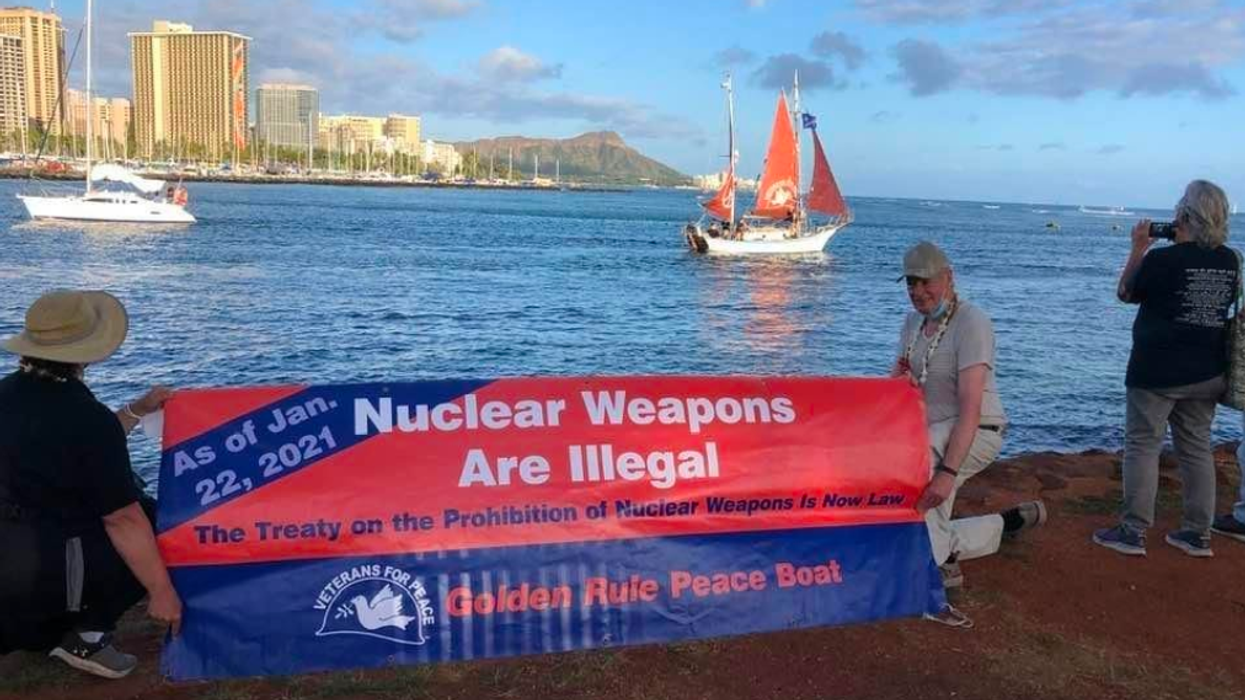
It’s 10 p.m. at Montrose Harbor in Chicago. Kiko and Tamar help me step from the dock into the wobbly rowboat. Kiko rows us out to the Golden Rule and I climb aboard in wonder. Oh my God! This is it—the 30-foot, anti-nuke sailboat with a history going back almost seven decades . . . back to the era of atmospheric nuclear testing and the Cold War at its simmering height.
The Golden Rule: “Floating for sanity in an insane world.”
Well, somebody’s got to do it! The United Nations has tried. In 2017 it passed the Treaty on the Prohibition of Nuclear Weapons, which was finally ratified (by 50 countries) in 2021. Technically, nuclear weapons are now “illegal”—what a joke. The possibility of nuclear war, i.e., Armageddon, is more alive than ever. The Bulletin of the Atomic Scientists’ Doomsday Clock is now set at 90 seconds to midnight.
But the nuclear-armed nations and their allies haven’t given an inch. Their motto remains: Nukes forever (or at least until the end of the world as we know it). This is the case despite an overwhelming global opposition to nukes and “mutually assured destruction.”
Perhaps humanity’s primary—or only—hope is a global reunification from the ground up: the creation of one world, which is not at perpetual war with itself and realizes that power results not from domination but connection: power with others, not over them.
And this, I believe, is where the Golden Rule comes in. Let’s return for a moment to 1958, when hell was still naked and visible: when atmospheric nuclear testing was the order of the day. For the United States, the chosen test site was Bikini Atoll, a coral reef in the Marshall Islands. The inhabitants were relocated and their home destroyed. A total of 67 nuclear tests were conducted, beginning in 1946, with nuclear fallout spreading across the island chain.
A man named Albert Bigelow, unable to shrug off what could be the end of the world, finally felt driven to action, declaring; “How do you reach men when all the horror is in the fact that they feel no horror?” He bought a boat, which was named the Golden Rule, and he and three other Quakers took it upon themselves to sail to the Marhsall Islands and disrupt the testing – you know, with their own lives. As they prepared to do so, they declared their intention to the world.
What happened, however, was that the Golden Rule was stopped by the U.S. Coast Guard before it reached the island chain and the four men were arrested. They were jailed for several months, but the publicity surrounding the event was enormous, igniting outrage. The eventual outcome was the end of atmospheric nuclear testing—step one, you might say, in the process of global nuclear disarmament.
Bigelow eventually sold the Golden Rule and, by 2010, it was just a forgotten fragment of history, sitting derelict in Humboldt Bay, California. One day it sank. Though it was pulled up, the plan was to burn it. This is where Veterans for Peace—aware of the boat’s history—stepped in. The organization purchased and restored the Golden Rule, and it became, once again, a floating force for peace.
The Golden Rule is reborn. And its most recent journey is something called the Great Loop. The boat was transported from Humboldt Bay to Minneapolis, where it set sail down the Mississippi River, captained (for much of the journey) by Kiko Johnston-Kitazawa, a Hawaiian educator, sailor and canoe builder, who responded when Veterans for Peace began seeking a crew and captain.
Kiko described the Great Loop to me thus: “one year, 10,000 miles, a hundred stops.” It went down the Mississippi to the Gulf of Mexico, then sailed around the tip of Florida, went over to Cuba to reconnect with that island (ah, site of the infamous “Cuban Missile Crisis” of 1962), then came back to the U.S. coast. Up to New York, into the Hudson River and the Erie Canal, then across Lake Erie, up the Detroit River and around the Great Lakes. Its final stop was Chicago, which was where I met Kiko and connected with the Golden Rule, at a reception hosted by Nuclear Energy Information Service.
This is a peace journey extraordinaire. Kiko was adamant, when he talked to me, that reaching beyond the community of committed peace activists was a crucial part of their mission—connecting with people regardless of their political viewpoints: simply talking about nuclear weapons and the danger humanity is facing: building, you might say, a movement of ordinary people... creating a sane future, one human being at a time.
The Veterans for Peace website describes the Golden Rule’s Great Loop journey thus: “We’ve had great reception from local peace activists, politicians, and people of faith. Brass bands, Raging Grannies, musicians and artists have welcomed us in many towns. . . Media coverage has been outstanding, with frequent interviews on local radio, TV and newspapers. Twenty mayors, city councils and state legislatures welcomed the Golden Rule with proclamations supporting the Treaty on the Prohibition of Nuclear Weapons. Thousands of volunteers helped with events, hosting and crewing the Golden Rule!”
It was when I was talking to Kiko at the NEIS event that he invited me to see the Golden Rule, which was docked just a few miles away. There’s no way I could turn down this invitation, despite my balance issues and untrustworthy joints. We drove to the harbor, then rowed beneath a shimmering moon out to the boat. I was able to climb aboard. They showed me around. I stood on the historic vessel—this floating future of peace—and took in its cramped quarters with reverence and awe.
We’re all on this journey—to transcend war and nukes, to evolve, to create a world at peace with itself.
Those in power change, but the tradition of putting political opponents behind bars, alas, remains.
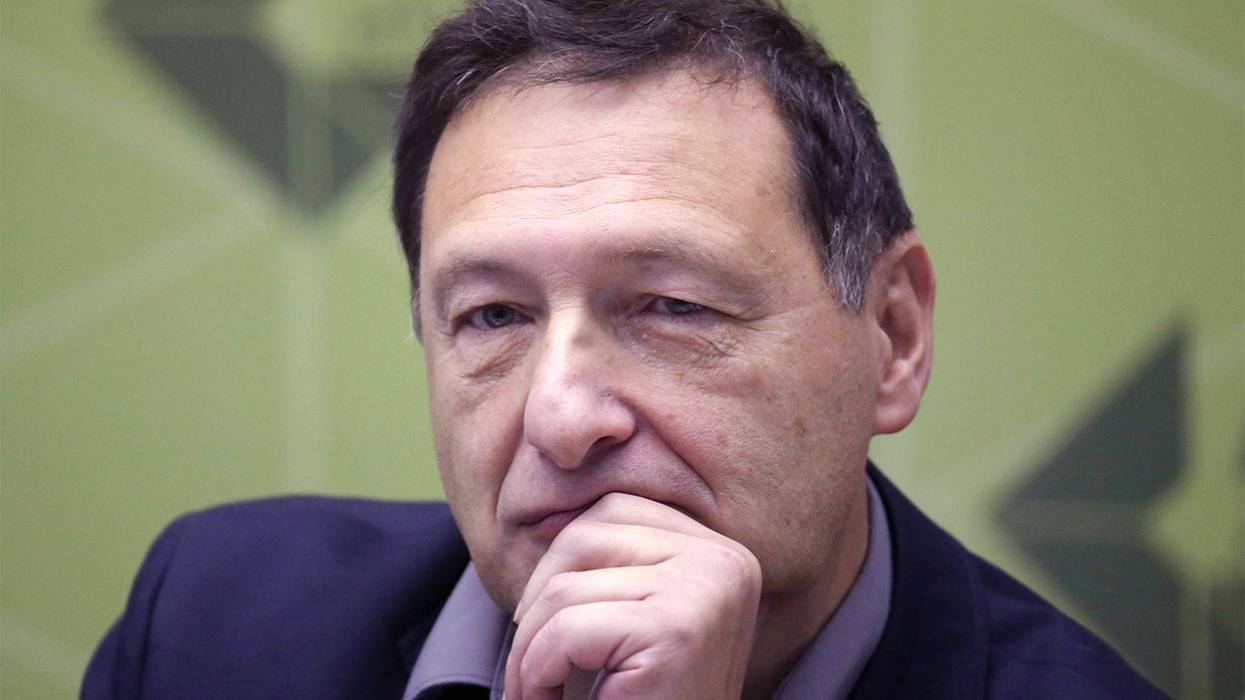
Boris Kagarlitsky, an internationally renowned scholar and political activist, was arrested on July 25 by the Russian Federal Security Service. Despite his lifelong anti-terrorism stance, he is accused of "justifying terrorism" based on a blog post about the Russia-Ukraine war. He is being held until September 24 and may face a seven-year prison term upon trial. An international campaign is demanding his release from prison and rallying to support the Russian movement against the Ukraine war.
After his detention, activists managed to talk to Kagarlitsky. He gave them a letter, which he asked them to make publicly available to his supporters and friends.
The full text of the letter (in Russian) was broadcast via Rabkor's telegram channel on August 16 at 8:00 am EDT and already received over 35,000 views in the first 12 hours.
This translation was provided to ZNetwork.org by Sergey Voronin and Alexandria Shaner:
This is not the first time in my life. I was locked up under Brezhnev, beaten and threatened with death under Yeltsin. And now it's the second arrest under Putin. Those in power change, but the tradition of putting political opponents behind bars, alas, remains. But the willingness of many people to make sacrifices for their beliefs, for freedom, and social rights remains unchanged.
I think that the current arrest can be considered a recognition of the political significance of my statements. Of course, I would have preferred to be recognized in a somewhat different form, but all in good time. In the 40-odd years since my first arrest, I have learned to be patient and to realize how fickle political fortune in Russia is.
The weather is not bad in the Komi Republic, where I now find myself by the will of fate and the FSB investigators, and everything in the prison is not badly organized. So I am fine. Unfortunately, I'm not yet allowed to use the books I brought with me. They're being checked for extremism. I hope the censors will broaden their horizons in the process of studying them. One book is about the situation of modern universities, and it was written by Sergei Zuev, the former rector of Shaninka [Moscow School for the Social and Economic Sciences], who was also imprisoned. The other is about the history of the Second World War.
The experience of the past years, it would seem, does not dispose much to optimism. But historical experience as a whole is much richer and gives much more grounds for positive expectations.
I am allowed to receive letters. There are a lot of them. And it is possible to reply to them. In this sense, it is easier to be locked up now than it was under Brezhnev.
Food is also much better. There is a stall where it's possible to put money on my account. The list of items in the stall is no worse than in some delivery stores. The prices are higher, though. One can even order lunch in the prison cafe. The menu is quite good! However, there is no microwave to heat up the food.
All in all, one can live. The only question is how long it will last. But it's not just my problem. Millions of people all over the country are thinking the same thing. We share the same fate, no matter where we are or what conditions we're in.
It is difficult to understand from the TV set in the cell what is really going on. But they will tell us the important news anyway. I remember how in 1982, in Lefortovo prison, every day we waited with interest for the Pravda newspaper in a mourning frame, to be placed through the tray-slot of the cell.
The experience of the past years, it would seem, does not dispose much to optimism. But historical experience as a whole is much richer and gives much more grounds for positive expectations. Remember what Shakespeare wrote in Macbeth?
"The night is long that never finds the day."
Boris Kagarlitsky
P.S. Many thanks to all those who have expressed solidarity with me, to those who demand my release, who write letters to prison. Of course, it is necessary to seek the release of all political prisoners. Sooner or later it will happen. And for some reason, I think sooner rather than later.
To sign a petition demanding freedom for Boris Kagarlitsky: https://freeboris.info.
Read an overview of Kagarlitsky's recent writings by fellow activist Jeremy Brecher, from a Ukraine peace plan to climate movement strategy.
I have always thought that the global peace movement began in the wake of the escalation of the Vietnam War, but reading Kennedy’s speech has made me realize otherwise.
Was he kidding? Are these words for real?
“I have, therefore, chosen this time and this place to discuss a topic on which ignorance too often abounds and the truth is too rarely perceived—yet it is the most important topic on earth: world peace.”
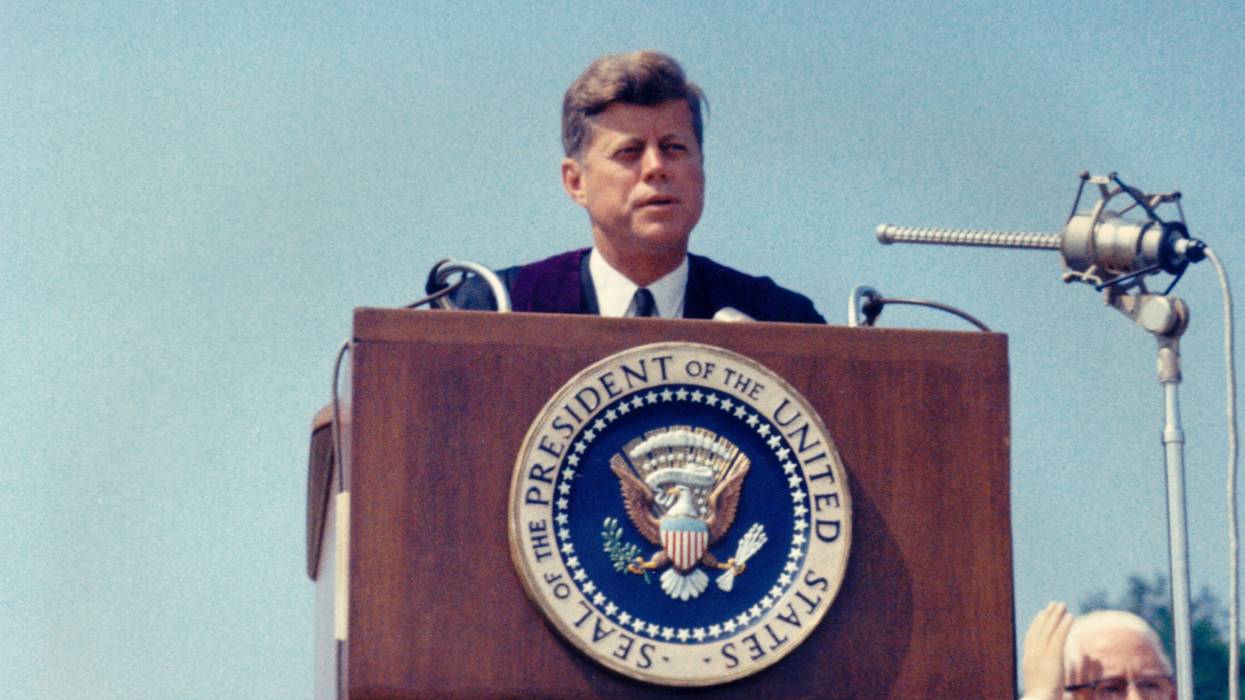
This was 60 years ago: June 10, 1963. John F. Kennedy—less than six months before his assassination—delivered a commencement address at American University. He spoke like a renegade, defying the certainties of state, the old Cross of Iron, that war is inevitable and always (when we wage it) necessary. At the time, the United States was ankle-deep in the Vietnam War and, at least according to some accounts, Kennedy wanted out. He was also in direct communication with Nikita Khrushchev; the two, working in sync, had averted a nuclear catastrophe during the Cuban Missile Crisis less than a year earlier, and were in the process of establishing a nuclear disarmament treaty.
You mean peace actually had political traction then, at least for a brief moment in time? It wasn’t just a cry of protest from the social margins, aka, a fantasy?
My takeaway, after reading Kennedy’s speech—“A Strategy of Peace”—all these decades later, is stunned wonderment. You mean peace actually had political traction then, at least for a brief moment in time? It wasn’t just a cry of protest from the social margins, aka, a fantasy? The creation of a global political structure based on cooperation rather than domination (or mutually assured destruction), was truly in the works?
“Today the expenditure of billions of dollars every year on weapons acquired for the purpose of making sure we never need to use them is essential to keeping the peace. But surely the acquisition of such idle stockpiles—which can only destroy and never create—is not the only, much less the most efficient, means of assuring peace.”
Kennedy’s words dig deeper into basic sanity than the generic political blather I’ve gotten used to in my lifetime, which would never, ever, ever challenge U.S. militarism or fail to glorify it, much less suggest that the creation of peace requires the participation of everyone on the planet, including our declared enemies.
“So, let us not be blind to our differences—but let us also direct attention to our common interests and to the means by which those differences can be resolved. And if we cannot end now our differences, at least we can help make the world safe for diversity. For, in the final analysis, our most basic common link is that we all inhabit this small planet. We all breathe the same air. We all cherish our children’s future. And we are all mortal.”
This is an American president, acknowledging that the commies breathe the same air that we do, and cherish their children as much as we do? He didn’t simply want “them” to disarm. His own country also needed to disarm. Yeah, he was a renegade. He had come to realize that the generals who surrounded him, some of whom were pushing for the use of nukes in Vietnam, were a far greater threat to global peace and sanity than Khrushchev.
And, oh yeah, as Al Jazeera noted: “After Kennedy’s assassination, instead of an end to American involvement in Vietnam, the U.S. deployed 100,000 troops in 1965—with more than 530,000 in country by 1968—and a decade of carnage was under way.”
That’s the country I live in. How many stupid and horrific wars have we waged in my lifetime? How many politicians have defended, and voted for, these wars? When it comes to peace, when it comes to disarmament, are we not a democracy in name only? “Democracy”—oh, what a useful public-relations cliché! But when it comes to countering militarism, it means absolutely nothing, because that’s not allowed. The U.S. has one role only: to destroy evil, and that requires a trillion-dollar annual military budget.
So digging 60 years into the past, reading the words of a president who—my God—declared that this nation must look inward, at its own wrongs and shortcomings, rather than merely condemn its enemies, opens up the peace movement, links it, oh so tentatively, to the highest levels of government.
“What kind of peace do I mean?” he asked. “What kind of peace do we seek? Not a Pax Americana enforced on the world by American weapons of war. Not the peace of the grave or the security of the slave. I am talking about genuine peace, the kind of peace that makes life on earth worth living, the kind that enables men and nations to grow and to hope and to build a better life for their children—not merely peace for Americans but peace for all men and women—not merely peace in our time but peace for all time.”
A president transcending nationalism, envisioning a world beyond “USA! USA!”? Was Kennedy daring to look beyond his own interests—his own re-election—and the interests of his party? Apparently so. He understood that “the pursuit of peace is not as dramatic as the pursuit of war” but decided to pursue it anyway, because “we have no more urgent task.”
But Kennedy was killed and the pursuit of peace ground to a halt. Soon enough, the war in Vietnam “escalated.” I have always thought that the global peace movement began in the wake of this escalation, but reading Kennedy’s speech has made me realize otherwise. The peace movement—the peace process, to be more precise—was already under way. Then it was interrupted by one magic bullet.
It’s been in the political margins ever since.
Russia's invasion of Ukraine has created a catastrophe for the people living there and an inflection point for the peace movement. In the last five weeks, thousands of people have been killed and millions have fled their homes to escape the violence. Billions of people all over the world are now living under the greatest threat of conflict between nuclear-armed states in a generation. Beyond the immediate suffering, events taking place right now in Eastern Europe will have an impact on peace issues and defense policy for years to come. Woefully, the peace movement in the United States, limited in its influence already, has been unable to unite around a message to oppose calls for more militarization.
Instead, an inordinate amount of focus has been put on where the blame for the conflict should be placed and on attempts to see through the fog of war and get an accurate picture of the true situation on the ground in Ukraine. These distractions not only take valuable time and effort away from developing peaceful solutions, they also serve to increase the hostility within a movement that is already too fragmented. At the risk of spending even more time on what's wrong with the peace movement, it's worth looking at the breakdown, if only to understand the divisions in an attempt to find common ground.
Three major ideological groups have emerged within the peace movement in regard to who is at fault for the tragedies taking place in Ukraine.
First is the group that places all blame on Russia for the war in Ukraine. This group loudly denounces Putin and the Russian government. It does not clearly oppose the transfer of weapons, or "lethal aid," from the United States and her NATO allies to Ukrainian forces. It does not oppose intelligence sharing that could lead to more deaths on the Russian side. It does not view that level of involvement as making the US a party to this conflict. It wants to stay quiet on these fights, viewing them as unwinnable and as just serving to hurt the credibility and respectability of the peace movement. In this formulation Ukrainians have a right not only to defend themselves but also a right to US/NATO weapons to do so. Talk of denazification as a motive or claims that the invaders aren't intentionally targeting civilians en masse are Russian propaganda, the "anti-imperialism of useful idiots."
On the other end of the spectrum is a group that refuses to denounce Russia's invasion of Ukraine. In fact they're unwilling to call the 3-pronged attack on the country by over 100,000 troops, by land, air, and sea, an invasion at all. Instead, the war in Ukraine is described as a "special military operation," the term used by the Russian government. For this group, Russia's hand was forced. What else could they do but what they've done? The invasion is viewed as only the latest development in a war that began over 8 years ago, with a coup orchestrated by the US. From their perspective Ukraine is a puppet state of the West, inordinately influenced and possibly controlled by neo-Nazis like the Azov battalion. Its sovereignty has been in doubt for years. This war is NATO's fault for its reckless expansion, backing Russia into a corner. The United States is the world hegemon and they are to blame. Criticism of Russia's actions serve Western imperialism.
The third group is a blend of the first two. It condemns Russia's invasion as a clear violation of international law and Ukraine's sovereignty, but it admits that NATO expansion set the stage. Placing blame solely on the United States is American exceptionalism in reverse and denies the agency of other countries to do wrong. This group opposes sending more weapons and intelligence into the situation. Where will those weapons end up? In their view we can't fuel an insurgency lasting for years to come, turning Ukraine into Afghanistan in the 1980s. Ukraine's military and politics clearly have a Nazi problem, but that's no excuse for Russia's invasion. The conflict is brutal and civilians are being killed, but the violence against the populace and civilian infrastructure have yet to reach the extreme levels of US attacks on Middle Eastern nations. Seen positively, this group seeks to compromise between the other two wings of the peace movement. Seen negatively it's sitting on the fence and won't pick a side. To the others, this group is alternatively a tool of Russian or Western imperialism.
While the American peace movement argues internally, trying to decide who's right and who's wrong, the American government is doubling down on militarism. Proposals for even higher defense budgets are being made. Harsher and broader sanctions are being imposed. Nuclear postures are becoming more hawkish and dangerous. Peace-loving people all over the world need to unite in opposition to these reckless policies; unfortunately, the peace movement's already limited influence is diminished by infighting.
All three of these groups make valid points and, believe it or not, have far more in common with each other than they want to admit. They all oppose US troops to Ukraine, a "no-fly" zone, and nuclear weapons. They all support the rights of refugees and increased humanitarian aid. Certainly, all three groups see themselves, and can validly be seen, as opponents of militarism, but the struggle between them is blunting their impact. Let's be clear. The ideological differences between these groups are real. The differences in their policy recommendations are real. But these are secondary to more important questions: What do we do now? and How do we make a difference?
Advocates for peace need to advocate for peace, both on the battlefield and in communication amongst ourselves. Escalation must be opposed. This conflict must be solved at the bargaining table, through negotiations. Peace talks happening now should be encouraged and supported. Violence by either side should not be cheered on or excused, but attempts to understand the conflict must not be portrayed as condoning the atrocities seen in every war. Let's stop calling each other names and assuming the worst of one another. Right now this war is being used as an excuse to continue dividing the world into camps, and to arm each of those camps to the teeth.
The peace movement must call for global coexistence, mutual respect, and cooperation to solve common problems. It should lead by example.
As Russian and Ukrainian negotiators expressed cautious optimism following this week's peace talks in Turkey, it is clear that we face two distinct challenges: stopping this war and resetting international relations to prevent World War III.
As for popular support, a global peace movement intent on breaking the logic of war and reorienting global priorities toward combating climate change, preventing future pandemics and tackling other shared threats is gathering force.
Our ability to meet these challenges rests on whether leaders will exhibit the wisdom to accept hard compromises and the courage to rethink assumptions that have gone largely unquestioned for decades. Three lessons about how wars end and how peace is built should guide their thinking:
First, nothing positive can be achieved until the bloodshed stops. Wars unleash decades of irreversible damage. Much of what has been destroyed in just a few weeks of war will never be restored. That which can be restored -- the livelihoods of those fortunate enough to survive, a sense of security for the citizens of Ukraine and the broader region and a hopeful future for Ukraine's youth -- will only come with a full generation of reconciliation, restitution, peacebuilding and (re)development. And this process can only begin after the violence stops.
That is why we must support all steps, whether facilitated by Turkey, China or others, to hasten a ceasefire. Global leaders -- and the public -- should rally behind the terms of any agreement that Ukrainian and Russian leaders may reach to end this war, even if the terms may be antithetical to the hopes of outside observers: They may offer Russian President Vladimir Putin a face-saving claim of victory, delay full accountability for atrocities already committed, or offer security assurances to which outside powers object. The terms of an agreement to end this war must be determined by those whose people are dying and being driven from their homes by it -- the rest of us should apply all our efforts to hasten and support the processes that can get there.
Second, violence today lays the groundwork for future violence, unless we break the cycle. The danger that war in Ukraine could spark World War III is so acute that steps that would otherwise be feared as a threat to global security are being lauded: the reversal of decades-old isolationist defense policy in Japan, Germany and Sweden, which could signal the start of a new global arms race; the severe steps to sanction Russia, even while that isolation threatens the livelihoods of more than 140 million Russian citizens and millions more in neighboring countries that depend on Russia's economy; the recruitment of disparate foreign fighters and armed groups to tip the balance on the battlefield, despite countless disastrous precedents that began with the arming of "the enemy of my enemy."
These steps are being taken to hasten the end of this war. Yet, they also make World War III more likely. This is the logic of war: that increased confrontation now may lead to greater stability tomorrow. Such approaches do sometimes work. The United Kingdom military's intervention against the West Side Boys in Sierra Leone was pivotal in that country's pathway from civil war to today's lasting peace. But the West Side Boys were not a sovereign nation, let alone a nuclear power, and we cannot acknowledge instances when armed confrontation has hastened peace without recognizing that it much more often fuels more devastation, as is evident today from Syria to Yemen. Leaders must chart a path to reverse the momentum toward greater isolation and militarization that this war has triggered. And this points to the most sobering lesson.
Third, if this crisis does not shock us sufficiently to generate a better way to prevent war, then it is likely that only World War III will. History reveals that we rarely achieve breakthroughs to a new world order absent the complete breakdown of the old one. Even after World War I claimed 20 million lives and was dubbed "the war to end all wars," it was not until World War II claimed at least three times as many that we created a multilateral system that prevented war between great powers for the next 75 years. It is a travesty that countless lives lost to wars in the Democratic Republic of Congo, Iraq, or Yemen have failed to mobilize our collective will to modernize that system. These man-made disasters, combined with our inability to meet shared challenges like climate change or COVID, were blaring warning signals that the post-World War II multilateral system was failing. We must not allow this war too to pass without taking up this effort as if our lives depend on it, because they do.
The ingredients may be there.
Increasingly, leaders recognize that in a globalized world, war is more senseless and self-defeating than ever. As a way to expand territory and political influence, modern wars are unwinnable. Just last August, we saw the strongest military in history end its longest war ever in defeat to a non-state armed movement in Afghanistan. It has been decades since the U.S. has definitely "won" a war, not because of the state of its military, but rather because of the nature of modern conflict. Even among those who predict the ultimate military victory of Russia in Ukraine, it is hard to find anyone who believes Russia can maintain political control of a population of tens of millions who oppose it.
As for popular support, a global peace movement intent on breaking the logic of war and reorienting global priorities toward combating climate change, preventing future pandemics and tackling other shared threats is gathering force. The largest youth cohort in history is more connected and better able to mobilize collective action than ever and is justifiably furious about the monumental challenges that are being left to them to sort out while today's political leaders fight yesterday's wars.
Major social and political changes often appear to come suddenly, through watershed moments. In reality, the pressure for them builds over years until triggered, often by tragedy. As we embrace every effort to end the tragedy unfolding in Ukraine today, we must seize this moment for what it is: our last best chance to prevent even greater tragedy tomorrow.
With U.S. President Joe Biden "convinced" that Russian President Vladimir Putin is planning not only confirmed nuclear drills but also an invasion of Ukraine that Moscow has repeatedly denied, the global peace movement on Friday reiterated calls for de-escalation.
"Stop the War opposes any war over Ukraine, and believes the crisis should be settled on a basis which recognizes the right of the Ukrainian people to self-determination and addresses Russia's security concerns," declares a statement from the U.K.-based coalition signed by thousands of people.
The Russian Ministry of Foreign Affairs on Thursday accused the Biden administration of ignoring Moscow's security demands--including Ukraine's exclusion from the North Atlantic Treaty Organization (NATO)--but also insisted that "there is no 'Russian invasion' of Ukraine."
Despite the assurance from Moscow, when asked Friday if there is any indication whether Putin has decided to invade Ukraine, Biden told reporters--without providing any further details or evidence--that "as of this moment, I'm convinced he's made the decision. We have reason to believe that."
Members of the Biden administration--and other Western officials--have also recently claimed, without offering proof, that Russia will engage in a false flag operation as a pretext for invasion.
Eight years into fighting in Ukraine's Donbas region, pro-Russian separatists and Ukrainian forces on Thursday accused each other of violating a cease-fire. After the Ukrainian military said shells fired by separatists hit a kindergarten, U.K. Prime Minister Boris Johnson claimed it "was a false-flag operation designed to discredit the Ukrainians, designed to create a pretext, a spurious provocation for Russian action."
Stop the War took aim at recent actions and comments from U.K. leaders.
"Our focus is on the policies of the British government which have poured oil on the fire throughout this episode," the coalition explained. "In taking this position we do not endorse the nature or conduct of either the Russian or Ukrainian regimes."
"The British government has talked up the threat of war continually," the statement continued. "Unlike the French and German governments, it has advanced no proposals for a diplomatic solution to the crisis, and has contributed only saber-rattling."
Instead of pursuing diplomacy, the British government has not only "sent arms to Ukraine and deployed further troops to eastern Europe," but also "declared that Ukraine has a 'sovereign right' to join NATO," the coalition added.
"Britain needs to change its policy, and start working for peace, not confrontation," the group asserted, encouraging a halt to the eastward expansion of NATO.
The statement also said:
We refute the idea that NATO is a defensive alliance, and believe its record in Afghanistan, Yugoslavia, and Libya over the last generation, not to mention the U.S.-British attack on Iraq, clearly proves otherwise.
We support all efforts to reach new arms control agreements in Europe and to move towards nuclear disarmament across the continent.
We urge the entire anti-war movement to unite on the basis of challenging the British government's aggressive posturing and direct its campaigning to that end above all.
High-profile signatories to the statement include former Labor Party Leader Jeremy Corbyn, along with another dozen members of Parliament, the heads of several U.K. unions, and various academics, activists, and artists such as musician Brian Eno and rapper Lowkey.
Other signatories include Joe Glenton of Veterans for Peace; Pawel Wargan, coordinator of Progressive International's international secretariat; and Kate Hudson, general secretary of the Campaign for Nuclear Disarmament.
The statement came as anti-nuclear and peace campaigners urged against Russia's planned drills, which are scheduled for Saturday, set to be overseen by Putin, and will involve launching cruise missiles and intercontinental ballistic missiles (ICBM).
"Test-firing ICBMs at this time of heightened tensions is particularly irresponsible but any practice to use WMDs at any time is unacceptable," the International Campaign to Abolish Nuclear Weapons (ICAN) tweeted Friday, referring to weapons of mass destruction.
Once again a self-defeating Washington consensus threaten the real security interests of the U.S. people. Military confrontations and preparations for great power war with China are a clear and present danger when our priorities should be international collaborations to address real threats to our security: today's and future pandemics and the existential dangers of the climate emergency and nuclear weapons.
With his trade war, provocative military actions, and his election-related scapegoating of China for everything that ails the United States, Donald Trump crystalized a new Cold War with China.
With Joe Biden's election, more than half the nation is exhaling with a sense of relief. Donald Trump's defeat provides a stay of execution for U.S. democracy and will hopefully lead to life-affirming changes in U.S. domestic policies. Unfortunately, the rhetoric will be different, but not a lot more can be expected to change as Biden, Blinken, General Austin and their comrades embrace the Cold War with China.
PARADIGMS, DOCTRINES & ALTERNATIVES
Two paradigms illuminate the present danger. First is the Thucydides Trap, named for the ancient Greek historian's analysis of the Peloponnesian War between Athens and Sparta. He stressed the inevitable tensions between rising and declining powers that more often than not have resulted in catastrophic wars. The post-WWII Bretton Woods international order and the transformation of the Pacific Ocean into an "American Lake" were both imposed by the United States when China was an extremely poor and technologically undeveloped nation. Chinese needs and interests were not considered. In recent decades, as China has risen to become the world's second largest economy and a technological and military power, it has understandably been pressing to revise, but not overturn, the rules of the road.
Similarities to the period leading to WWI include tensions between rising and declining powers, complex alliance structures, intense nationalism with the attendant hatred of others, territorial disputes, arms races with new technologies, economic integration and competition, autocracies, and wild-card actors. Just as a nationalist's gunshots in remote Sarajevo triggered a global war, today an incident, accident, or miscalculation - for example, a collision of warships or war planes in the South China Sea or near Taiwan - could easily escalate to a major, potentially nuclear, war.
We urgently need to understand the seriousness of the moment and the imperative of pressing the Biden Administration to reject the containment policies that date to the 1990s, and which were escalated by Obama and Trump. Despite our differences, detente and Common Security diplomacy with China are essential.
Human security is also endangered as the two powers expand their military capabilities at a frightening pace, diverting funds from critical human needs to military purposes, and igniting a new nuclear arms race.
We share common interests with the Chinese people and government, despite our profound differences. Together we face the existential threats of climate change, current and future pandemics, and the dangers of nuclear cataclysm.
The New Cold War is fueled by a dynamic of seemingly irreconcilable assessments of U.S. and Chinese behavior. A formerly marginalized but now rising power is asserting its interests against those of a long dominant hegemon, leading each side to assert ostensibly legitimate reasons for actions that the other side considers threatening, resulting in spiraling tensions.
Human security is also endangered as the two powers expand their military capabilities at a frightening pace, diverting funds from critical human needs to military purposes, and igniting a new nuclear arms race.
The Pentagon's new strategic doctrine is its third major transition over the past 75 years. It comes after cold war containment of the Soviet Union and the futile war on terrorism. The U.S. military and related institutions are again preparing for great power war against China and/or Russia. The Pentagon has designated China as its peer competitor. Secretary of State and possible 2024 Republican presidential nominee Mike Pompeo named the Chinese Communist Party as an enemy, not an adversary, while Antony Blinken sees China as a rival against which the U.S. has to bolster its military alliance. The U.S. is pressuring other nations to reduce their ties with Beijing, and despite Trump's "American First" unilateralism and disruptive diplomacy has already be reinforcing alliances and military ties with nations surrounding China. Largely unnoticed in early December, what used to be the "Atlantic Alliance" launched "NATO 2030", which makes containing China NATO's new priority.
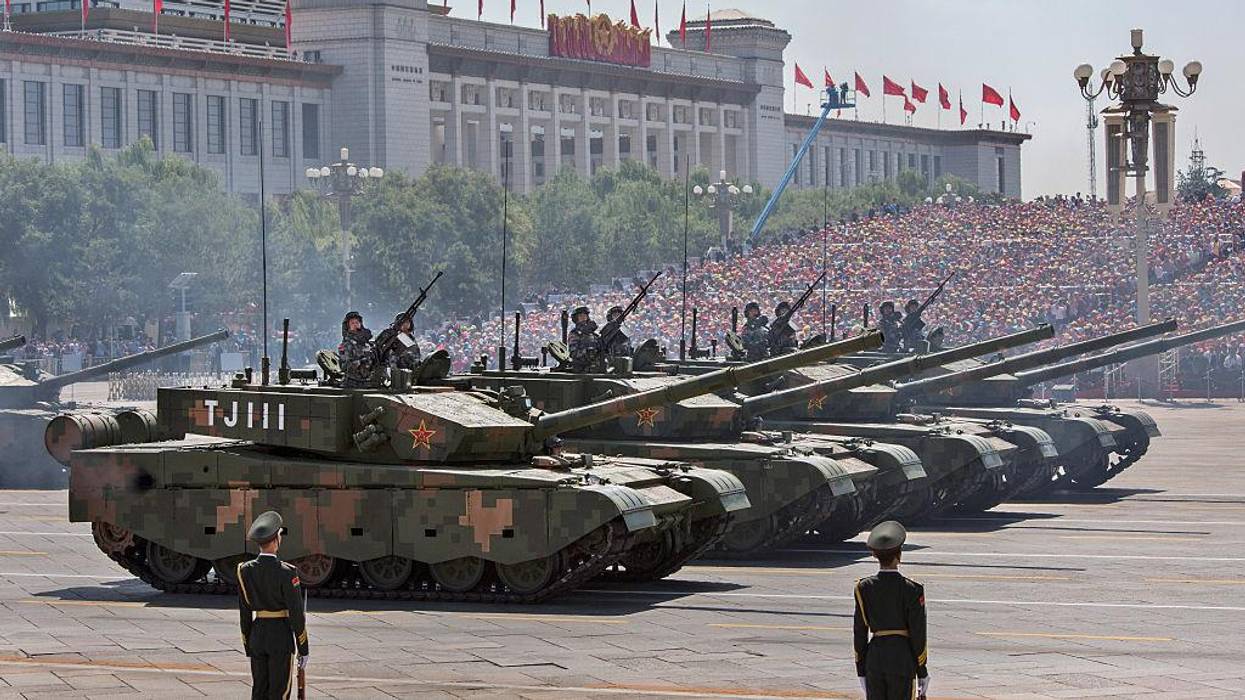
The New Cold War is unfolding on many fronts. Biden will continue the Obama and Trump campaigns to contain China militarily, technologically, and economically. Beijing is being surrounded with hundreds of U.S. military bases, alliances, and near-alliances along China's eastern, southern, and western peripheries - including Japan, Korea, Taiwan, the Philippines Australia, and India, reinforced by the omnicidal power of the U.S. Seventh Fleet. This system is being reinforced by increasing military collaborations by the QUAD, the not quite Asian NATO: the U.S., Japan, Australia, and India. Add to this deployments of offensive land- and sea-based intermediate range missiles opposite China's eastern coast.
One measure of the military imbalance is that the US has five aircraft carrier groups in Asia Pacific, while China has two, one a 40-year-old Ukrainian carrier and the other a Chinese built ship, a replica of the Ukrainian model.
Recalling the dawn of the nuclear age, we live in a time when arms races and pursuit of dominance are wed to scientific and technological breakthroughs. Vast U.S., Chinese, and Russian fortunes are being invested in the weaponization of artificial intelligence, robotic, cyber and hypersonic technologies, several of which may operate beyond human control. This race for technological military superiority is deepening the militarization of the societies of all three great powers, including mining their private sectors and universities for the technologies that can assure victory in a future war. Star Wars science fiction is becoming 21st-century reality.
As part of its containment campaign, the U.S. is blocking Chinese access to U.S. technologies. Most well-known is the global campaign against Huawei. But a growing number of Chinese scientists in the U.S. are being charged and deported as spies, which in turn fuels anti-Asian racism. Barriers are being raised against Chinese students studying in our colleges and universities, and visa restrictions are making it increasingly difficult for Chinese tourists to visit Disneyland.
China, of course, is no innocent. It has blocked its citizens' access to Facebook, Google, and other U.S. tech platforms, and its lack of respect for intellectual property rights and its history of industrial espionage are well known.
Because economic power serves as the foundation of political stability and military and technological capacities, the U.S. is working to "decouple" its economy from China, stifling Chinese exports to the U.S. with tariffs on Chinese goods that the Biden Administration is likely to continue. China has retaliated with high tariffs on some U.S. products.
At the very least, we need to work for demilitarization in contested regions, beginning with ending military provocations that could escalate beyond control. The U.S. has increased naval show-of-force operations in waters adjacent to China, especially in the East and South China Seas, in order to intimidate and humiliate China. The South China Sea, over which 40% of world trade and nearly all of the oil which fuels China's economy travels, has become the geopolitical center of the struggle for world power. Were the U.S. to blockade China and cut off its oil supplies, the Chinese economy would screech to a halt. Add to that, the U.S. Air-Sea Battle doctrine is designed to hold hostage China's economic and financial foundations, concentrated along its coastlines.
It is no wonder that China is engaged in a major military buildup, including its construction of military bases on islets in waters claimed by other nations, in violation of international law and a recent Permanent Court of Arbitration ruling.
The Pentagon recognizes that China's policy is strategic defense. Beijing is focused on its traditional strategic vulnerability: the threat coming from the sea, as it did during the murderous Opium Wars and Japan's 20th century invasions. Chinese industry is concentrated in Southeast and East China. Its navy faces the threat of being bottled up in the South China Sea, and there are those hundreds of US bases and the 7th fleet.
Even as the Pentagon warns of a rising Chinese military threat, Beijing is hardly on a par with the U.S. The Pentagon budget is three times that of China and Washington has twenty times more nuclear weapons than China. And the U.S. military as been continuously at war for the past four decades, making it battle hardened, while China has not been to war over the same period.
Although she was passed over as Joe Biden's Secretary of Defense, a statement by Michelle Flournoy reflects a key Pentagon goal: the ability to sink China's navy within 72 hours. That said, China's asymmetric warfare capabilities should not be underestimated. Its cyber and space warfare, and artificial intelligence capacities could prove able to offset the imbalance of power.
All of this has fueled China's massive military modernization and buildup since Bill Clinton sent two nuclear-capable aircraft carriers through the Taiwan Strait in 1996. It is also the source of China's unjustified claims of sovereignty over 80-90% of the South China Sea, its construction of military bases on rocks and islets in waters claimed by other Asian-Pacific nations, and its massive naval and related military buildup. But China's priority has been creating area-denial capabilities within the First Island Chain, not global military hegemony. This comes at the expense of Vietnam, the Philippines, Indonesia and other claimants to South China Sea waters.
As the Philippine scholar and political figure Walden Bello has repeatedly stated, this is the wrong solution to the very real challenge China faces. The solution lies in demilitarization of the region and intensified Chinese-ASEAN diplomacy.
The second major flashpoint is Taiwan, which since 1949 the Chinese government has seen as a renegade province. The situation has become more complicated with the development of a democratic society there since the 1980s and China's recent consolidation of control over Hong Kong, which undermines confidence in its ability to respect one-country two-systems reunification commitments in the future. As part of the Trump administration's ratcheting up of tensions with China, the U.S. has upgraded diplomatic and military ties with Taipei, increased its air and naval presence in the area, and committed to an additional $3.4 billion in arms sales to Taiwan, including potentially offensive weapons. In response, China has responded with increased military muscle-flexing in waters near Taiwan and in and around Taiwanese airspace. The dangers of an accident, incident, or miscalculation are thus very high and could lead to a catastrophic war.
In an era in which our society and the rest of humanity are confronted by pandemics, the climate emergency, massive unemployment, poverty, crumbling infrastructures and nuclear dangers, the pursuit of hegemony and preparations for catastrophic war are self-destructive and insane.
Pressing for peaceful resolution of U.S.-China tensions in ways that provide mutual benefit for both sides and other Asia-Pacific nations needs to become a peace movement priority. Peaceful alternatives are available and must be pursued. Among them: halting freedom of navigation provocations, encouraging ASEAN-Chinese negotiations, cancelling arms sales to Taiwan, and encouraging Taiwanese-Chinese negotiations. Equally important is insisting on changing U.S. national budget priorities. Real security lies in investing in public health, education, housing, and food for all. With the seas rising, our security and future health can be achieved only by investing in green energy and the infrastructure needed to protect our coastal cities.
Remarkably, we can even find a call from the U.S. Naval War College for the U.S. to meet China halfway. A host of new peace and anti-war formations have emerged to prevent and reverse the Cold War with China. Among them, look for statements and webinars in the coming months from the newly created Committee for a Sane U.S. China Policy and a more movement-oriented Asia-Pacific Working Group.
MAD (Mutually Assured Destruction) is truly mad. At the height of the Cold War some military analysts and planners maintained that parity in weapons that would destroy civilization prevented either side from resort to those weapons. Parity, however, is a slippery concept, especially in an environment where science and engineering are continually evolving. Each side may have moments when it believes or imagines that it has a decisive edge. Trusting in MAD is especially foolish when the participants still refuse to pledge no first use of atomic or thermonuclear weapons.
MAD poses other dilemmas as well. How do you convince current or potential adversaries that in the event of nuclear attack you will respond in kind? The best and only sure way to show you are serious about and would use nuclear weapons is actually to launch a nuclear attack. But short of that apocalyptic act one can demonstrate proficiency and willingness to act by playing "war games."
On the surface this may seem a safer outlet for the military's elevated testosterone, but just as fantasies often morph into ugly acts of aggression, nuclear war games stand on the edge of the real thing. This is especially the case when the games are staged in contested territory and/or during periods of great stress. War games are meant to send a message, but there is often a gap between message sent and message received. The gap can have tragic consequences. Nuclear weapons cannot be used. Winners join the losers in an unlivable world. They need to be abolished. Abrogating INF only fuels the fantasy, which war games help sustain, that such weapons can be employed to win a war.
One war game with cautionary lessons for today is the Able Archer exercise at one of the Cold War's most tense moments. We learn of this incident only through the diligent work over many years by a nuclear whistle blower,, Nate Jones, director of the Freedom of Information Act Project for the National Security Archive in Washington DC,, The BBC has provided a concise summary of the findings. BBC: According to the fictional scenario behind the Able Archer 83 war game, turmoil in the Middle East was putting a squeeze on Soviet oil supplies.
Meanwhile, Yugoslavia - which wasn't aligned to either side of the Cold War - decided to back the West. The Soviet leaders in the game feared this would lead to a cascade of other eastern European countries following suit, switching allegiance from the Warsaw Pact to NATO, and putting the entire communist system at risk. The imagined 'war' started when Soviet tanks rolled across the border into Yugoslavia. Scandinavia was invaded next, and soon troops were pouring into Western Europe. Overwhelmed, NATO forces were forced into retreat.
A few months after the pretend conflict began, Western governments authorised the use of nuclear weapons. Role-playing NATO forces launched a single medium range nuclear missile, wiping Ukrainian capital Kiev from the map. It was deployed as a signal, a warning that NATO was prepared to escalate the war. The theory was that this 'nuclear signalling' would help cooler heads to prevail. It didn't work.By 11 November 1983, global nuclear arsenals had been unleashed. Most of the world was destroyed. "
The kicker in this BBC story, the part US nuclear planners fought so hard to withhold, is what was actually occurring on the Soviet side. In 1983, the leader of the Soviet Union was Yuri Andropov. As BBC put it, he was: "A former head of the KG he wasas seriously ill. And seriously paranoid."
"There was a paranoia," says Martin Chalmers, deputy director general of London-based security think-tank RUSI. "The Soviet leadership could remember the trauma of Hitler's surprise attack in 1941 t."
I find the choice of the noun paranoia misleading, a word that reduces the policy issues to highly personal virtues or pathologies. As even the BBC points out suspicions were intensified by war gamers' determination to make the play as close to the real thing as possible, right down to wheeling out pretend nuclear warheads, use of encrypted messages, and periods of total silence., all warlike actions. BBC reports that the Soviet response was to ground all flights and begin a process of prioritizing targets.
Fortunately this time around even Reagan and Thatcher became appalled when they learned of this incident. The fears that it evoked - along with the rise of Gorbachev and a growing anti-nuclear movement-played a role in incentivizing retreat from nuclear brinksmanship. It does, however, raise issues that are just as salient today.
Why does the national security establishment work so hard to conceal information about this old war game? Surely the Russians are fully aware of this near miss. The only conclusion I draw is that concerns about war games and accidental nuclear war would give aid and comfort to anti-nuclear movements here and around the world.
Besides the grave risks of miscalculation, don't these "games" run the long- term danger of normalizing these weapons? Just another part of the arsenal to be trotted out at the appropriate time.
Unfortunately, at least until recently, superiority in nuclear weaponry has been an article of faith for both political parties. As Daniel Ellsberg has pointed out, every President since Truman has wanted to assert and preserve nuclear superiority as a bargaining chip. In addition, military contracting is a disproportionately generous source of corporate profits and campaign contributions. Thus bipartisanship is alive and well on issues that pose an existential threat to all life on this planet. At the least advocates of the Green New Deal should elevate nuclear arms reduction and rapid elimination to an immediate concern.
Former Boston Globe columnist James Carroll highlights one very promising endeavor that Green New Deal advocates should consider joining. : " In 2017, the Union of Concerned Scientists, together with Physicians for Social Responsibility, launched Back from the Brink: The Call to Prevent Nuclear War, "a national grassroots initiative seeking to fundamentally change U.S. nuclear weapons policy and lead us away from the dangerous path we are on." Back From the Brink and Green New Deal share concerns and many policy objectives. The enthusiasm of each can reverberate back and forth, lending more strength to both.
Nuclear modernization is one of the most wasteful aspects of a bloated military budget and drains the economy of persons and resources needed to mitigate the damage climate change is already inflicting. The Cold War is over. Nuclear weapons did not win it. Spend that money on the other gravest threat to our existence.
Video: