
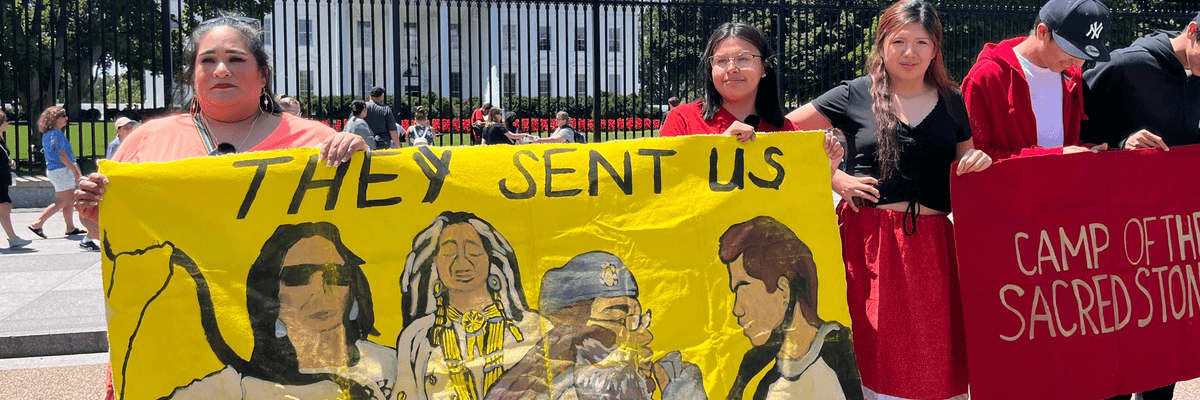
Indigenous campaigners led a rally outside the White House in Washington, D.C. on June 11, 2023 to demand that President Joe Biden revoke all permits for the Dakota Access Pipeline.
Indigenous Tribes Lead DC Rally to Shut Down Dakota Access Pipeline
"The injustices of the Dakota Access Pipeline are many, including an assault on Indigenous rights and the right to defend our lands, waters, and communities," said one campaigner.
Indigenous campaigners, climate action groups, and other environmental justice advocates converged in Washington, D.C. on Tuesday to amplify the message they have aimed to send to the federal government for more than eight years, since they led a historic, monthslong mass civil disobedience action in 2016 with tens of thousands of supporters in an effort to shut down the Dakota Access Pipeline.
The Standing Rock Sioux Tribe and Cheyenne River Sioux Tribe organized Tuesday's rally, calling on President Joe Biden and the Army Corps of Engineers (ACOE) to revoke all permits for the Dakota Access Pipeline (DAPL) and end operations for a project that transports 600,000 barrels of crude oil per day nearly 1,200 miles, running just a mile upstream from the Standing Rock reservation.
The rally comes nine months after the ACOE released an Environmental Impact Statement (EIS) for the pipeline, which is in operation despite lacking a permit to cross land adjacent to and beneath Lake Oahe, the main drinking water source for the Standing Rock Sioux Tribe.
The EIS included a number of alternative measures the ACOE could take aside from keeping DAPL in operation, including ceasing operations and excavating the pipeline, rerouting it, and abandoning it in place, but the ACOE did not make a recommendation when it released the report in September, saying it would issue a recommended plan of action after the release of the final EIS, which is now expected in 2025.
At the rally, demonstrators called on the Biden administration to recommend "Alternative #2."
"We demand that President Biden and the ACOE listen to our voices and choose the 'No Action Alternative #2' in the Environmental Impact Statement deliberation, which would result in the shutdown and capping of the pipeline at the crossing of Lake Oahe," said Stephanie Yellow Hammer, tribal leader of Standing Rock.
One Standing Rock member led campaigners in a chant, declaring, "We stand! For our water! For life!"
Morgan Brings Plenty of the Indigenous Environmental Network said they were driven to travel from South Dakota to Washington, D.C. to once again protest a pipeline that carries risks for an oil spill in the crucial Lake Oahe, violates tribal treaty rights and sovereignty, and could unleash more than 120 million metric tons of planet-heating greenhouse gas emissions per year if it remains in operation, according to the EIS released in September.
"Being a long-time pipeline fighter since a young age, you travel and go where you are needed without hesitations," said Brings Plenty. "Going to D.C. over and over with so many youth and allies and family to continue on the fight to stop the Dakota Access Pipeline completely to ensure not only our future but the next generations to come to have a better future in mind. I will not rest until this pipeline and many other fossil fuel projects are put to an end."
Tefere Gebra, chief program officer for Greenpeace USA, participated in the action ahead of the group's scheduled trial in North Dakota stemming from a $300 million lawsuit filed against it by Energy Transfer, the owner of DAPL.
The company has accused Greenpeace of secretly organizing the 2016 mass protests against DAPL, which were actually led by the Standing Rock Sioux Tribe and other Indigenous water protectors, and is claiming the organization defamed Energy Transfer.
"The injustices of the Dakota Access Pipeline are many, including an assault on Indigenous rights and the right to defend our lands, waters, and communities," said Gebra. "Another attack on Indigenous sovereignty—and on all of our rights to peaceful protest—comes in the form of a $300 million lawsuit."
"No matter what happens, today we stand in solidarity with the Standing Rock and Cheyenne River Sioux Tribes and call on the Biden administration to shut down DAPL," Gebra added, "while defending ourselves against outrageous attempts to silence and divide our movements."
We are at a crossroads
This country and this world are at a monumental crossroads. In a few short weeks, US voters will have an opportunity to beat back the forces of fascism and confront the billionaires who are rigging the economy, our media system, and our democracy, making it increasingly impossible for ordinary people to get by. We’re not just talking about the election. We’re talking about what must be done once these fascist elements are vanquished from power. We need a bolder set of solutions than what either major party has so far been willing to offer and a working-class movement ready to fight like hell for it. Trump didn't emerge from nowhere. The conditions that fueled MAGA authoritarianism were created by decades of radical neoliberal economic policies and a corrupt political system dominated by corporate interests. They slashed taxes on the super-rich, promising that the benefits would trickle down. They said giveaways to the corporate titans would make life more affordable for the rest of us. It was all bullshit. And when a bitter, betrayed populace searches for someone to blame, right-wing demagogues have little trouble finding scapegoats. People know when they're being lied to, but you won't hear any of this from the corporate media. Only independent journalism—powered and funded by people who believe in building a better world—can deliver truly trustworthy daily news. Our Fall Campaign is underway, and we need your help. To power our newsroom through the rest of the year, we need to raise $125,000 by midnight on October 31. So if you share our vision, please contribute whatever you can to sustain our work. |
Indigenous campaigners, climate action groups, and other environmental justice advocates converged in Washington, D.C. on Tuesday to amplify the message they have aimed to send to the federal government for more than eight years, since they led a historic, monthslong mass civil disobedience action in 2016 with tens of thousands of supporters in an effort to shut down the Dakota Access Pipeline.
The Standing Rock Sioux Tribe and Cheyenne River Sioux Tribe organized Tuesday's rally, calling on President Joe Biden and the Army Corps of Engineers (ACOE) to revoke all permits for the Dakota Access Pipeline (DAPL) and end operations for a project that transports 600,000 barrels of crude oil per day nearly 1,200 miles, running just a mile upstream from the Standing Rock reservation.
The rally comes nine months after the ACOE released an Environmental Impact Statement (EIS) for the pipeline, which is in operation despite lacking a permit to cross land adjacent to and beneath Lake Oahe, the main drinking water source for the Standing Rock Sioux Tribe.
The EIS included a number of alternative measures the ACOE could take aside from keeping DAPL in operation, including ceasing operations and excavating the pipeline, rerouting it, and abandoning it in place, but the ACOE did not make a recommendation when it released the report in September, saying it would issue a recommended plan of action after the release of the final EIS, which is now expected in 2025.
At the rally, demonstrators called on the Biden administration to recommend "Alternative #2."
"We demand that President Biden and the ACOE listen to our voices and choose the 'No Action Alternative #2' in the Environmental Impact Statement deliberation, which would result in the shutdown and capping of the pipeline at the crossing of Lake Oahe," said Stephanie Yellow Hammer, tribal leader of Standing Rock.
One Standing Rock member led campaigners in a chant, declaring, "We stand! For our water! For life!"
Morgan Brings Plenty of the Indigenous Environmental Network said they were driven to travel from South Dakota to Washington, D.C. to once again protest a pipeline that carries risks for an oil spill in the crucial Lake Oahe, violates tribal treaty rights and sovereignty, and could unleash more than 120 million metric tons of planet-heating greenhouse gas emissions per year if it remains in operation, according to the EIS released in September.
"Being a long-time pipeline fighter since a young age, you travel and go where you are needed without hesitations," said Brings Plenty. "Going to D.C. over and over with so many youth and allies and family to continue on the fight to stop the Dakota Access Pipeline completely to ensure not only our future but the next generations to come to have a better future in mind. I will not rest until this pipeline and many other fossil fuel projects are put to an end."
Tefere Gebra, chief program officer for Greenpeace USA, participated in the action ahead of the group's scheduled trial in North Dakota stemming from a $300 million lawsuit filed against it by Energy Transfer, the owner of DAPL.
The company has accused Greenpeace of secretly organizing the 2016 mass protests against DAPL, which were actually led by the Standing Rock Sioux Tribe and other Indigenous water protectors, and is claiming the organization defamed Energy Transfer.
"The injustices of the Dakota Access Pipeline are many, including an assault on Indigenous rights and the right to defend our lands, waters, and communities," said Gebra. "Another attack on Indigenous sovereignty—and on all of our rights to peaceful protest—comes in the form of a $300 million lawsuit."
"No matter what happens, today we stand in solidarity with the Standing Rock and Cheyenne River Sioux Tribes and call on the Biden administration to shut down DAPL," Gebra added, "while defending ourselves against outrageous attempts to silence and divide our movements."
- #NoDAPL: Native American Leaders Vow to Stay All Winter, File Lawsuit Against Police ›
- 'Huge Victory' for Standing Rock Sioux Tribe as Federal Court Rules DAPL Permits Violated Law ›
- Climate Activists Targeted by Fossil Fuel Industry Spies at Standing Rock ›
- Allies Vow to Fight Off Big Oil Lawsuit Aimed at Ending 'Existence' of Greenpeace | Common Dreams ›
- Opinion | Energy Transfer Is Putting Free Speech and Climate Activism on Trial | Common Dreams ›
Indigenous campaigners, climate action groups, and other environmental justice advocates converged in Washington, D.C. on Tuesday to amplify the message they have aimed to send to the federal government for more than eight years, since they led a historic, monthslong mass civil disobedience action in 2016 with tens of thousands of supporters in an effort to shut down the Dakota Access Pipeline.
The Standing Rock Sioux Tribe and Cheyenne River Sioux Tribe organized Tuesday's rally, calling on President Joe Biden and the Army Corps of Engineers (ACOE) to revoke all permits for the Dakota Access Pipeline (DAPL) and end operations for a project that transports 600,000 barrels of crude oil per day nearly 1,200 miles, running just a mile upstream from the Standing Rock reservation.
The rally comes nine months after the ACOE released an Environmental Impact Statement (EIS) for the pipeline, which is in operation despite lacking a permit to cross land adjacent to and beneath Lake Oahe, the main drinking water source for the Standing Rock Sioux Tribe.
The EIS included a number of alternative measures the ACOE could take aside from keeping DAPL in operation, including ceasing operations and excavating the pipeline, rerouting it, and abandoning it in place, but the ACOE did not make a recommendation when it released the report in September, saying it would issue a recommended plan of action after the release of the final EIS, which is now expected in 2025.
At the rally, demonstrators called on the Biden administration to recommend "Alternative #2."
"We demand that President Biden and the ACOE listen to our voices and choose the 'No Action Alternative #2' in the Environmental Impact Statement deliberation, which would result in the shutdown and capping of the pipeline at the crossing of Lake Oahe," said Stephanie Yellow Hammer, tribal leader of Standing Rock.
One Standing Rock member led campaigners in a chant, declaring, "We stand! For our water! For life!"
Morgan Brings Plenty of the Indigenous Environmental Network said they were driven to travel from South Dakota to Washington, D.C. to once again protest a pipeline that carries risks for an oil spill in the crucial Lake Oahe, violates tribal treaty rights and sovereignty, and could unleash more than 120 million metric tons of planet-heating greenhouse gas emissions per year if it remains in operation, according to the EIS released in September.
"Being a long-time pipeline fighter since a young age, you travel and go where you are needed without hesitations," said Brings Plenty. "Going to D.C. over and over with so many youth and allies and family to continue on the fight to stop the Dakota Access Pipeline completely to ensure not only our future but the next generations to come to have a better future in mind. I will not rest until this pipeline and many other fossil fuel projects are put to an end."
Tefere Gebra, chief program officer for Greenpeace USA, participated in the action ahead of the group's scheduled trial in North Dakota stemming from a $300 million lawsuit filed against it by Energy Transfer, the owner of DAPL.
The company has accused Greenpeace of secretly organizing the 2016 mass protests against DAPL, which were actually led by the Standing Rock Sioux Tribe and other Indigenous water protectors, and is claiming the organization defamed Energy Transfer.
"The injustices of the Dakota Access Pipeline are many, including an assault on Indigenous rights and the right to defend our lands, waters, and communities," said Gebra. "Another attack on Indigenous sovereignty—and on all of our rights to peaceful protest—comes in the form of a $300 million lawsuit."
"No matter what happens, today we stand in solidarity with the Standing Rock and Cheyenne River Sioux Tribes and call on the Biden administration to shut down DAPL," Gebra added, "while defending ourselves against outrageous attempts to silence and divide our movements."
- #NoDAPL: Native American Leaders Vow to Stay All Winter, File Lawsuit Against Police ›
- 'Huge Victory' for Standing Rock Sioux Tribe as Federal Court Rules DAPL Permits Violated Law ›
- Climate Activists Targeted by Fossil Fuel Industry Spies at Standing Rock ›
- Allies Vow to Fight Off Big Oil Lawsuit Aimed at Ending 'Existence' of Greenpeace | Common Dreams ›
- Opinion | Energy Transfer Is Putting Free Speech and Climate Activism on Trial | Common Dreams ›