

SUBSCRIBE TO OUR FREE NEWSLETTER
Daily news & progressive opinion—funded by the people, not the corporations—delivered straight to your inbox.
5
#000000
#FFFFFF
To donate by check, phone, or other method, see our More Ways to Give page.
Daily news & progressive opinion—funded by the people, not the corporations—delivered straight to your inbox.
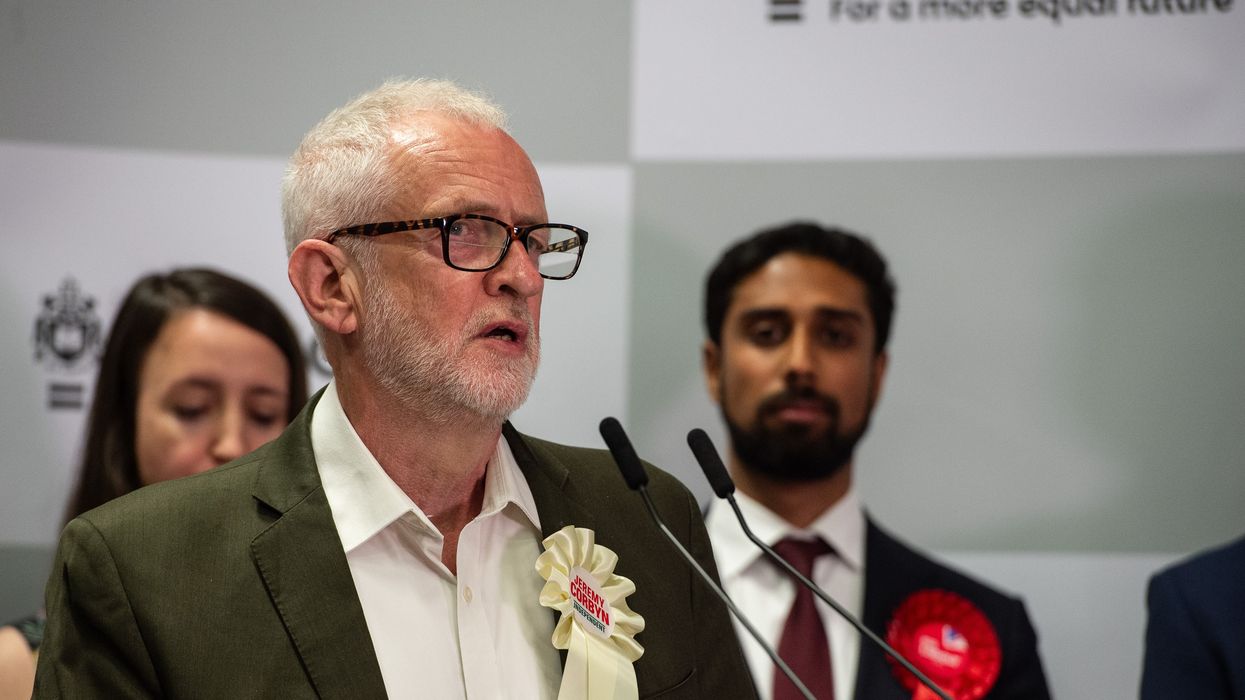
The former Labour leader issued a warning to the incoming government of Keir Starmer: "Dissent cannot be crushed without consequences."
Former U.K. Labour leader Jeremy Corbyn won reelection as an Independent on Thursday against a candidate from his erstwhile party as Labour—despite its unpopularity under incoming Prime Minister Keir Starmer—ended 14 years of disastrous Conservative rule at the national level with a landslide victory.
Corbyn, who last year was banned by Labour's governing body from running as a party candidate in the 2024 elections, kept the Islington North seat he has held since 1983 with a 7,000-plus vote margin over local Labour councillor Praful Nargund.
Corbyn used his victory statement to send a message to Labour, calling his win "a warning to the incoming government that dissent cannot be crushed without consequences" and "that ideas of equality, justice, and peace are eternal."
"Tonight, we celebrate. Tomorrow, we organize," said Corbyn. "The energy we have unleashed will not go to waste. We are a movement made up of all ages, backgrounds, and faiths. A movement which can win with and for people all over the country."
In 2020, Corbyn was suspended from the Labour Party following the publication of a government watchdog report alleging that, under his leadership, the party failed to adequately handle antisemitism complaints. Corbyn apologized for the failures while defending himself from relentless attacks, saying at the time that "the scale of the problem was dramatically overstated for political reasons by our opponents inside and outside the party, as well as by much of the media."
"Labour has won by default because of the Tories' implosion, not because of enthusiasm for Starmer or his Tory-lite policies."
Starmer was elected Labour leader in April 2020, and he has since moved to stifle the party's left faction with what critics have described as "deeply anti-democratic" tactics.
Oliver Eagleton, an assistant editor at New Left Review, wrote in a New York Times op-ed earlier this week that since the inception of his leadership, Starmer has engaged in a "merciless crackdown on the mildest forms of internal dissent."
"He expelled his predecessor, blocked left-wing candidates from standing for Parliament, proscribed various socialist groups, barred politicians from joining picket lines and introduced antidemocratic rules for leadership elections. He has also demanded a stifling level of ideological conformity," Eagleton wrote. "Lawmakers who criticize NATO face instant expulsion, and members who oppose Israel’s actions are cynically accused of antisemitism."
"This purge has turned Labour into a mirror image of the Conservatives: obsequious toward big business, advocating austerity at home and militarism abroad," he added. "It has also foreshadowed how Mr. Starmer would operate in Downing Street. He has said he intends to retain the Public Order Act, which places unprecedented restrictions on protests and makes it easier to lock up activists. He has described climate campaigners as 'contemptible' and 'pathetic,' pledging to impose harsh sentences on them. He has even backed a proposal to punish protesters who vandalize monuments with 10 years in prison."
Labour's landslide victory Thursday was a reflection of widespread discontent with nearly a decade and a half of Tory rule and the deep unpopularity of Conservative leader Rishi Sunak.
"Fourteen years, five prime ministers, four election cycles, two U.K.-wide referendums, and a global pandemic: a lot has happened since the Conservative Party entered coalition in 2010," The Guardian noted Thursday. "But there are other, bigger figures on voters' minds: 7.6 million people on waiting lists for hospital treatment in England (three times the 2010 figure); 3% of Britons having to use a food bank, all while the cost of a weekly shop, household bills, and mortgage repayments is rising."
The advocacy group We Deserve Better said in a statement following Thursday's election that "this is a hollow victory for Labour, which is taking power as the most unpopular incoming government in U.K. political history, with the lowest vote share won by any single-party majority government."
"It's unprecedented for an opposition party entering government to have several of its leading politicians unseated, and to actively be losing votes across the country. Labour has won by default because of the Tories' implosion, not because of enthusiasm for Starmer or his Tory-lite policies," the group said. "Nationwide, Labour's vote share is lower under Starmer than it was under Jeremy in 2017 or even Blair in 2005. The Greens have triumphed by increasing their MPs from 1 to 4; Labour was trounced by Jeremy Corbyn in a historic victory; and several other independents have unseated Labour bigwigs or come close to doing so.
"Labour's heartlands are rebelling against them before they've even taken office," the statement continued. "Voters have sent them a clear message on Gaza, the climate, and austerity measures. Labour will continue to haemorrhage votes to pro-Palestine and socialist independent and Green candidates if they don't listen to their base."
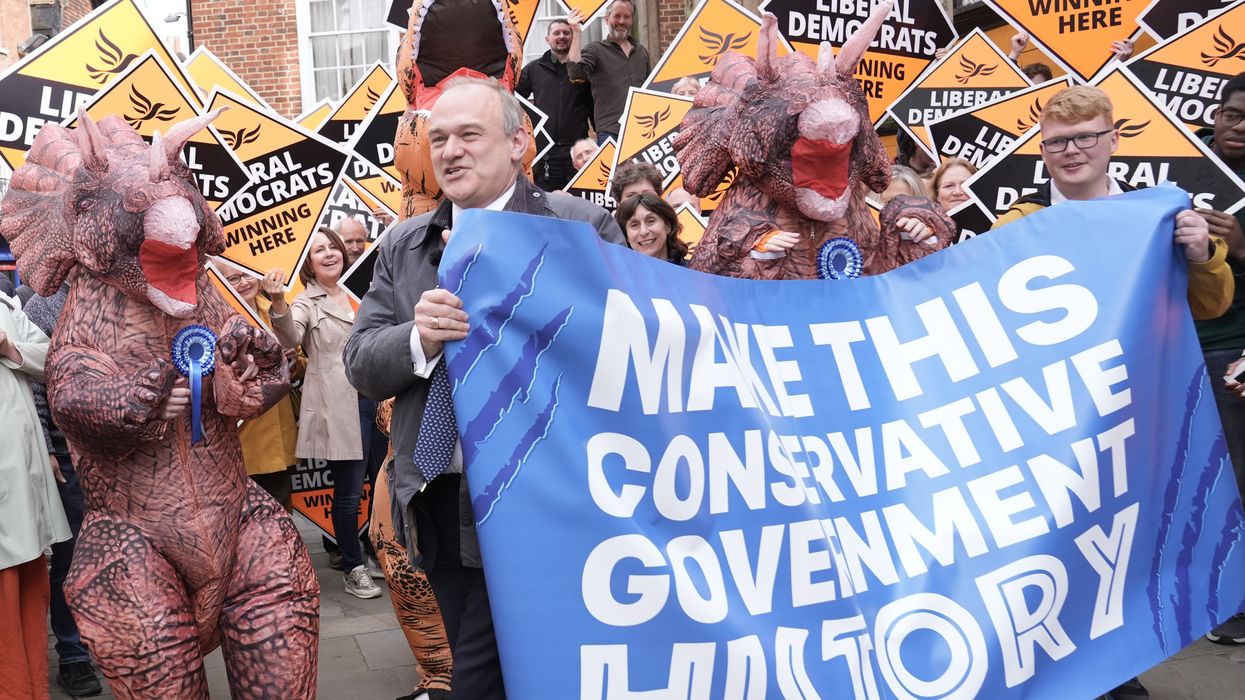
"We are probably looking at certainly one of the worst, if not the worst, Conservative performances in local government elections for the last 40 years," said one analyst.
Nearly two weeks after the British Conservative Party pushed through a proposal to deport asylum-seekers to Rwanda in what one lawyer called "performative cruelty" in the name of winning the general election expected later this year, the local election results announced throughout the day Friday made increasingly clear the ploy hadn't worked.
Elections expert John Curtice projected the Tories could ultimately lose up to 500 local council seats as vote counting continues into the weekend, following elections in which voters cast ballots for 2,661 seats.
The Conservatives have lost around half of the seats they are defending Curtice told BBC Radio.
"We are probably looking at certainly one of the worst, if not the worst, Conservative performances in local government elections for the last 40 years," the polling expert said.
Curtice added that if the results were replicated in a general election, Labour would likely win 34% of the vote, with the Tories winning 25%—five years after the right-wing party won in a landslide in the last nationwide contest.
Labour leader Keir Starmer said the results represented a decisive call for "change" from British voters, particularly applauding the results of a special election in Blackpool South, where Labour candidate Chris Webb won nearly 11,000 votes while Conservative David Jones came in a distant second with just over 3,200.
Webb's victory represented a 26% swing in favor of Labour.
"That's the fifth swing of over 20% to the Labour party in by elections in recent months and years. It is a fantastic result, a really first class result," Starmer said. "And here in Blackpool, a message has been sent directly to the prime minister, because this was a parliamentary vote, to say we're fed up with your decline, your chaos... your division and we want change. We want to go forward with Labour."
"That wasn't just a little message," he added. "That wasn't just a murmur. That was a shout from Blackpool. We want to change. And Blackpool speaks for the whole country in saying we've had enough now, after 14 years of failure, 14 years of decline."
The Conservatives also lost ground in the northern town of Hartlepool, where they lost six council seats. The region swung toward the Tories after the party led the push for Brexit, the U.K.'s exit from the European Union.
A similar result was recorded in York and North Yorkshire, which includes the area Conservative Prime Minister Rishi Sunak represented as a member of Parliament.
"Yorkshire voted for Brexit in 2016," wrote William Booth, London bureau chief for The Washington Post. "But long gone are the days when many Conservatives want to stand before the voters and extol the advantages of leaving the European Union, which has been, in most sectors, a flop."
Sunak, added Booth, is "betting that immigration is still an issue with resonance and has promised to 'stop the boats,' the daily spectacle of desperate migrants risking their lives on rubber rafts trying to cross the English Channel. Sunak's government plans to fly asylum seekers arriving by boat to Rwanda. No flights have taken off yet. But the Home Office last week began a self-proclaimed 'large scale' operation to detain asylum seekers destined for removal."
The Labour Party has called Sunak's Rwanda plan a "gimmick" and said it would reverse a Tory policy blocking refugees from applying for asylum.
Average wages in the U.K. last year were "back at the level during the 2008 financial crisis, after taking account of inflation," according to The Guardian.
"This 15 years of lost wage growth is estimated by the Resolution Foundation thinktank to have cost the average work £10,700 ($13,426) a year," reported the newspaper in March. "The performance has been ranked as the worst period for pay growth since the Napoleonic wars ended in 1815."
Analysts noted one setback for Labour in Oldham, where the party lost some seats in areas with large numbers of Muslim voters to independent candidates, costing it overall control of the council.
Arooj Shah, the Labour leader of the Oldham Council, told the BBC that the party's support for Israel in its bombardment of Gaza was behind its losses.
" Gaza is clearly an issue for anyone with an ounce of humanity in them, but we've asked for an immediate cease-fire right from the start," said Shah. "We have a rise of independents because people think mainstream parties aren't the answer."
The losses "should be a wake-up call for the Starmer leadership: Every vote must be earned," said the socialist and anti-racist group Momentum. "That means calling for an immediate arms ban to Israel, calling out Israeli war crimes, and delivering real leadership on climate."
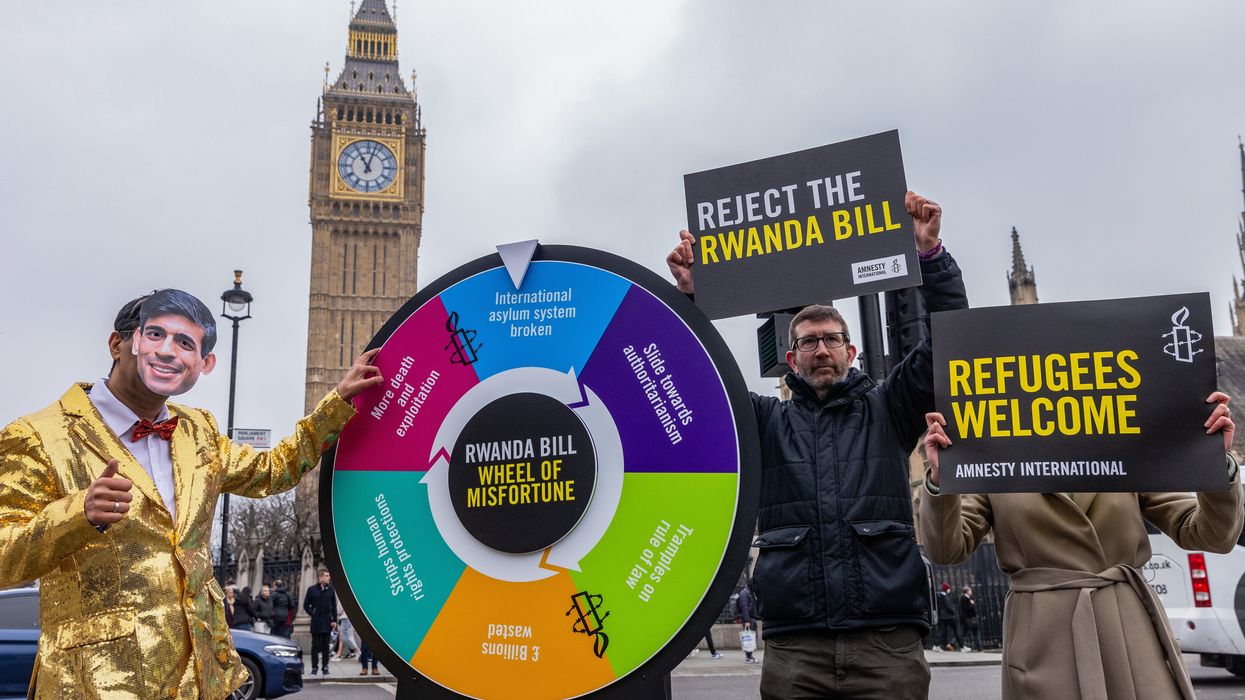
"The U.K. government could literally pay every refugee a £30,000 annual salary for life, and it would be cheaper," said one critic. "We're burning money just to enjoy the cruelty."
Legal and human rights experts on Tuesday said the British Conservative Party's decision to push through a bill allowing the government to deport asylum-seekers to Rwanda—effectively overriding last year's Supreme Court ruling—represented a "desperate low" from lawmakers eager to exploit migrants ahead of elections expected later this year.
"A lot of this is performative cruelty," Daniel Merriman, a lawyer whose clients have included some asylum-seekers whom the Tories tried to deport after it first introduced its plan in 2022, told NPR. "The elephant in the room is the upcoming election."
After a prolonged debate, the unelected House of Lords cleared the way to pass the Safety of Rwanda bill early Tuesday morning, after dropping several proposed amendments including one that would have required independent verification that the central African country is a safe place to send migrants.
The House of Commons then passed the bill, and King Charles III is expected to formally approve the legislation in the coming days.
The bill requires courts and immigration officials to "conclusively treat the Republic of Rwanda as a safe country" to send asylum-seekers, even though the Supreme Court ruled in November that people deported to the country would face a significant risk of refoulement, or being sent back to the countries where they originally fled persecution or violence.
The Conservative government signed a treaty with Rwanda last December to strengthen protections for asylum-seekers, including a provision that partially bans Rwanda from sending people back to their home countries.
But the United Nations Office of the High Commissioner for Human Rights (OHCHR) called on the U.K. to abandon the plan and instead "take practical measures to address irregular flows of refugees and migrants, based on international cooperation and respect for international human rights law."
"The new legislation marks a further step away from the U.K.'s long tradition of providing refuge to those in need, in breach of the Refugee Convention," said Filippo Grandi, the U.N. high commissioner for refugees. "Protecting refugees requires all countries—not just those neighboring crisis zones—to uphold their obligations. This arrangement seeks to shift responsibility for refugee protection, undermining international cooperation and setting a worrying global precedent."
"The U.K. has a proud history of effective, independent judicial scrutiny," Grandi added. "It can still take the right steps and put in place measures to help address the factors that drive people to leave home, and share responsibility for those in need of protection, with European and other international partners."
Dorothy Guerrero, head of policy and advocacy at Global Justice Now, noted that "disastrous foreign and economic policies of successive governments have contributed to the need for people to seek refuge."
"These same people's lives are continually used as a political football, after years of being scapegoats for bad government decisions," said Guerrero. "Statements from politicians are now even more blatantly devoid of any pretense of care for human rights. We will not stop pushing for a change of course, with safe routes to seek asylum in the U.K. so that people no longer have to risk their lives in the Channel."
"The passing of the Rwanda Bill is a shameful day for the U.K.," she added.
Hours after the legislation was passed, French officials announced that at least five people, including a seven-year-old child, had been killed while attempting to cross the English Channel, bound for the U.K. in an overloaded inflatable boat.
At The New Statesman, associate political editor Rachel Cunliffe wrote Tuesday that the tragedy reveals "the flaws of the Rwanda plan," which proponents say could deter migrants from seeking refuge in Britain.
Proponents of the Rwanda plan will inevitably point to today's disaster as further evidence that strong measures are needed to address the issue of Channel crossings. They will accuse Labour and opposition parties of ignoring the human cost of letting this crisis continue and argue that lives are at stake if the government does not act.
[...]
The reality is that a substantial number of people who pay people traffickers large sums of money to crowd them on to a tiny boat do so because they feel they have no other option. Fleeing war and persecution, they are desperate. And so they are prepared to take desperate measures. Measures that sometimes lead to tragedy, but which are deemed necessary given the hopelessness of their situation.
It is hard to see how the threat to send a tiny fraction of those who arrive (Rwanda has said it will only take 150-200 migrants) changes this calculation.
The Labour Party, which is leading Conservatives in polls ahead of the expected elections, has vowed to scrap the legislation if it wins control of the government later this year, and critics have expressed doubt that Prime Minister Rishi Sunak will actually secure deportation flights before Britons vote.
One flight was grounded in June 2022 after the European Court of Human Rights intervened, and on Monday the OHCHR warned aviation authorities that they would risk violating international law if they allow "unlawful removals" of asylum-seekers to Rwanda.
Critics have also pointed to a finding by the National Audit Office that the deportations would cost £1.8 million ($2.2 million) per person.
"The U.K. government could literally pay every refugee a £30,000 annual salary for life, and it would be cheaper than sending them to Rwanda," said David Andress, a history professor at the University of Portsmouth. "We're burning money just to enjoy the cruelty."
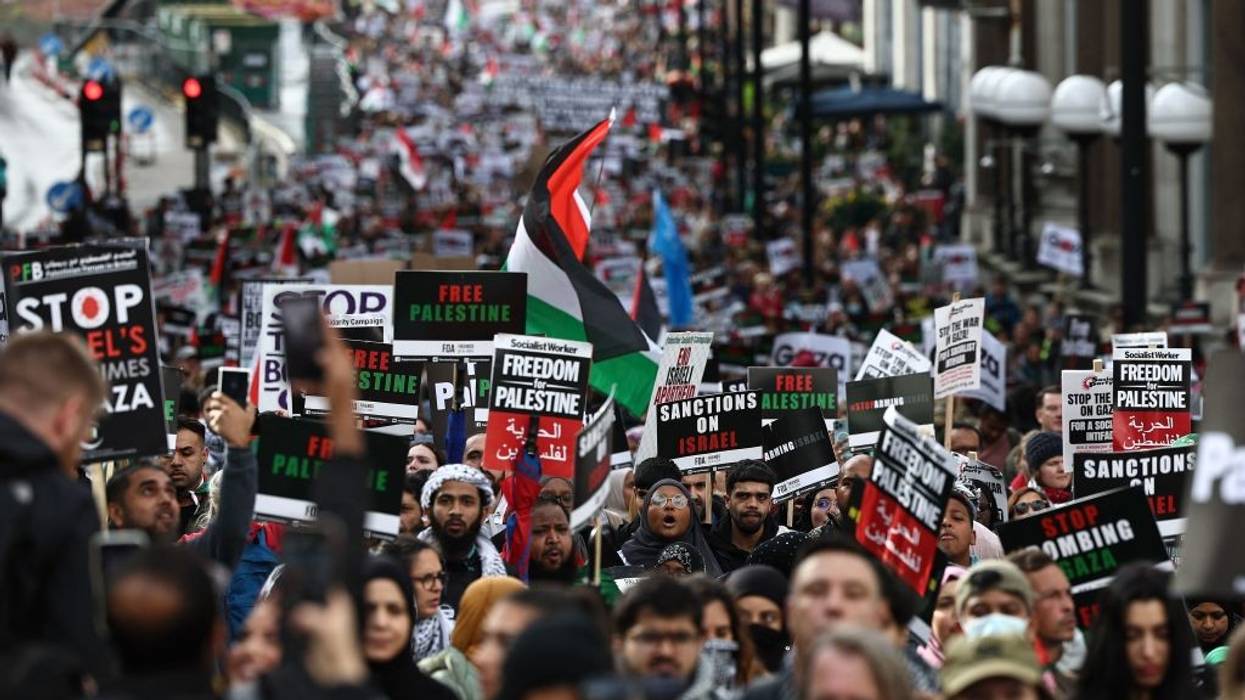
"The government should recognize that real British values involve defending the rights of all political opponents to speak freely and openly," said one advocate.
Coming weeks after British Prime Minister Rishi Sunak claimed the United Kingdom is in danger of "mob rule... replacing democratic rule," a new definition of "extremism" published by the government on Thursday was viewed by one rights advocate as a "smash and grab" on the right to protest, among other freedoms.
The Conservative government updated the definition of the word under its anti-extremism agenda, known as Prevent. The government will now treat as extremism "vocal or active opposition to fundamental British values, including democracy, the rule of law, individual liberty, and mutual respect and tolerance of different faiths and beliefs."
"The government will undertake a robust process to assess groups for extremism against the definition, which will then inform decisions around government engagement and funding," said a public notice from Michael Gove, Sunak's secretary of state for leveling up, housing, and communities.
The government is expected to release a list in the coming weeks of groups it deems as in violation of the new definition of extremism.
The U.K.-based human rights group Reprieve warned that "placing the power to define who is and who is not 'extreme' in the hands of a single cabinet minister is a nakedly political gesture which purports to defend liberal democracy but is fundamentally illiberal and undemocratic."
The notice was published amid widespread outcry over the U.K.'s support for Israel's relentless bombardment of Gaza, where the Israel Defense Forces have killed at least 31,341 Palestinians since last October.
Tens of thousands of Britons marched through London over the weekend, demanding that Sunak push Israel to declare an immediate and permanent cease-fire and to condemn the prime minister's recent comments, in which advocates said "support of the Palestinian cause" had been conflated "with extremism."
"I am here to support Palestine, to call for an end to the genocide, and to call out the double standards of our government," one protester, Sundari Anitha, told The Guardian on Saturday. "They are widening the concept of extremism to attack the right of people to protest. I'm here both to defend the rights of Palestinian people and also my freedom to criticize my government."
Sacha Deshmukh, chief executive officer of Amnesty International U.K., noted on Thursday that the government's Prevent program has also been marked by the 2023 Public Order Act, which expanded the definition of a "serious disruption" by protesters and imposed penalties of up to 12 months in prison.
"From the prime minister's disturbing Downing Street speech earlier this month, the introduction of further anti-protest measures, and now the expansion of the extremism definition, it looks as if the government is set on shrinking the space for dissenting views and the right to protest," said Deshmukh. "An overwhelmingly peaceful protest movement seeking an end to Israel's mass killing of civilians in Gaza is being used by ministers to clamp down on our civil liberties—the irony is crushing and frightening."
He continued:
This attempt to stigmatize legitimate, peaceful political activity is taking us further down the road toward authoritarianism.
In any democracy worth the name, nonviolent political activity should be protected and even celebrated as a sign that a country respects human rights and differing opinions.
[...]
The government should recognize that real British values involve defending the rights of all political opponents to speak freely and openly.
Deshmukh said Amnesty has found in its research that "legitimate political activity" is already being referred to the government under the Prevent program.
"If criminality among certain groups or organizations is suspected, we already have a host of laws to deal with this," he said. "Today's announcement is a dangerous gimmick and this whole enterprise should be abandoned."
Other critics of the government's new focus on so-called "extremism" include Peter Hain, a member of the Labour Party and the House of Lords, and Member of Parliament Diane Abbott.
"I think it's an appalling direction to go down and [the definition] could probably have been applied to the suffragettes in their day, who were equally vilified, spat at, hated, and treated very badly by the police and the authorities," Hain told The Guardian on Sunday.
LGBTQ+ rights campaigner Peter Tatchell noted that "British values" in the past have included "slavery, colonialism, homophobic discrimination, and the denial of votes to women and working-class people."
"Broadening the definition of extremism risks criminalizing peaceful protests by legitimate groups," he told The Guardian.

"The only responsible, effective, and decent response to this judgement should be to get down to the serious task of fairly and efficiently determining people's claims," said one rights advocate.
Rights advocates in the United Kingdom on Wednesday called on the Conservative government to finally abandon its efforts to detain and deport asylum-seekers after the British Supreme Court ruled that a proposal to send refugees to the East African country of Rwanda violated domestic and international law and could not move forward.
Speaking for five justices on the court, Justice Robert Reed said the Supreme Court agreed with an earlier ruling by the British Court of Appeal, which had found that refugees sent to Rwanda faced a significant risk of refoulement, or being sent back to the countries where they originally fled persecution or violence.
"We agree with their conclusion," said Reed.
The judge pointed out that Britain follows the legal principle of non-refoulement under the United Nations Refugee Convention and several other international agreements.
"It is a core principle of international law, to which the United Kingdom government has repeatedly committed itself on the international stage," Reed said.
Despite this fact, former Conservative Prime Minister Boris Johnson announced the plan to send asylum-seekers to Rwanda in 2022, and his successor, Prime Minister Rishi Sunak, pledged to follow through on the effort.
The government has already paid Rwanda 140 million pounds (nearly $175 million) with the intention of deporting anyone who used "illegal, dangerous, or unnecessary methods" to reach the U.K., including on small boats. More than 45,000 people crossed the English Channel on small vessels in 2022.
A deportation flight was scheduled for June 14, 2022, but a ruling by the European Court of Human Rights forced the government to ground the plane, which was carrying a man who had sought refuge in England after leaving Iraq. Subsequent legal challenges kept other refugees from being sent to Rwanda.
Former Home Secretary Suella Braverman, who was fired this week after saying unhoused people had made a "lifestyle choice" and claiming London police were biased toward pro-Palestinian rights protesters, had said it was her "dream" to send refugees to Rwanda and had pushed for the U.K. to exit the European Convention on Human Rights in order to move forward with the policy.
"That 'dream' has just been ruled to be unlawful by the Supreme Court," said Member of Parliament Zarah Sultana. "Let's make sure that's the end of these cruel and callous anti-migrant policies."
Agnes Callamard, secretary-general of Amnesty International, called the ruling one piece of good news in an "ocean of horrific sufferings."
Amnesty International U.K.'s chief executive, Sacha Deshmukh, called on new Home Secretary James Cleverly to "not only abandon the idea of doing a deal with Rwanda, but to scrap the underlying policy of refusing to process people's asylum claims and the Illegal Migration Act that has entrenched that dismal policy."
The law, which passed in July, states that anyone who arrives in the U.K. via small boats or other "unsafe" methods will have their asylum claim deemed "inadmissable."
"This policy has made complete chaos of the U.K.'s asylum system and this shameful deal has simply exacerbated the mess," said Deshmukh. "The only responsible, effective, and decent response to this judgement should be to get down to the serious task of fairly and efficiently determining people's claims."
"The idea that the U.K. should withdraw from the European Convention to pursue this failed policy is nonsensical and should be immediately binned," he added. "The government should make policies which fit with the law, not fit the law around their policies."
Nearly 130 U.K. rights organizations signed a joint statement on Wednesday welcoming the Supreme Court's ruling and and urging the government to "protect the rights of people who have come to our country in search of sanctuary."
"While we welcome the decision today, we remain concerned by this government's overall treatment of people who move to their country," said the groups, including the Joint Council for the Welfare of Immigrants (JCWI), the Scottish Refugee Council, and the Muslim Council of Britain. "We know that as a community we are compassionate and welcoming, and we need immigration policies that are rooted in that same care, compassion, and respect for human rights."
The JCWI noted that Sunak's government could still try to move forward with the Rwanda deal "in a different form, such as a treaty which would need to go through Parliament."
"Our fight continues!" said the group. "Although immediate removal risks are reduced, challenges persist. Let's resist hostile policies and safeguard the universal right to seek asylum in the U.K."
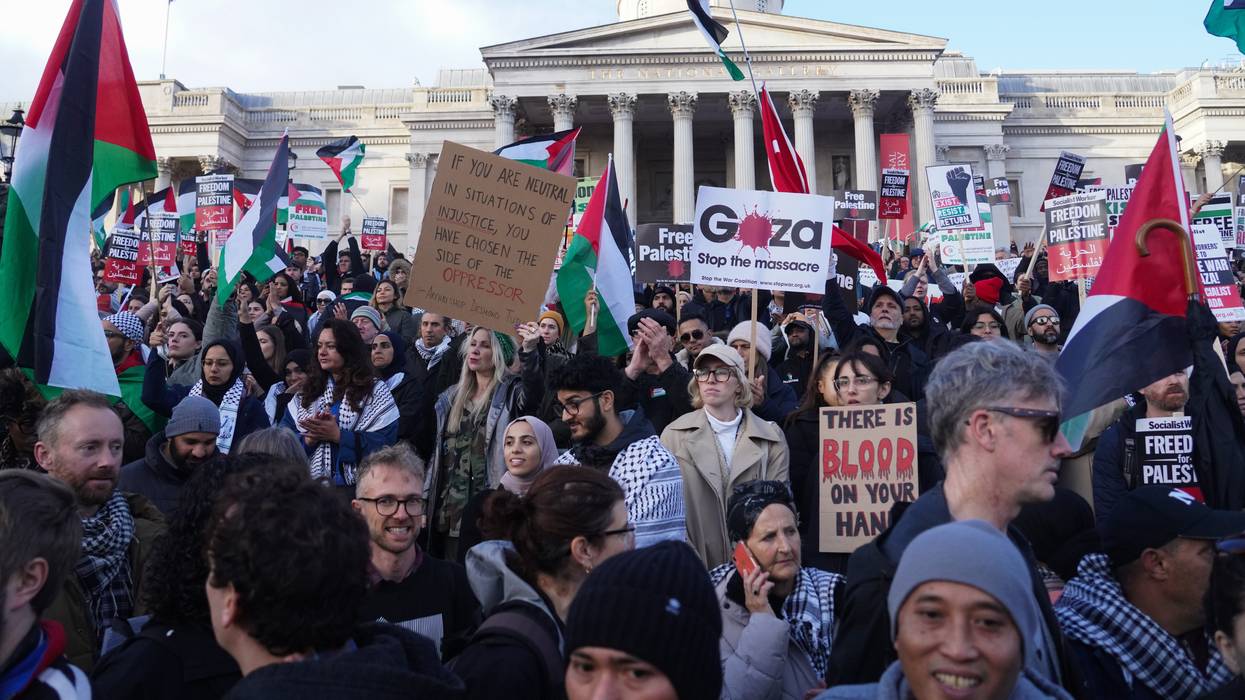
"We want to send a clear message from the march that we represent the majority of the population in our calls for a cease-fire and that the movement in support of the Palestinians is growing in strength."
Organizers are expecting hundreds of thousands of people from across the United Kingdom to join an "inspiring, peaceful, and united show of solidarity" with Palestinians enduring the Israeli war on Gaza by marching from London's Hyde Park to the U.S. Embassy on Saturday.
"More than 500,000 people are expected to converge in London, making it one of the largest political marches in British history," the Palestine Solidarity Campaign (PSC), one of the organizers, said in a Friday statement reported by The Guardian.
Stop the War Coalition (STWC) convenor Lindsey German said Thursday that "our local groups in towns and cities across the U.K., along with coach companies, are telling us that every one of their coaches have been booked to bring people to London. This is comparable only to the 2 million strong protest against the Iraq War in 2003."
The other organizations behind the National March for Palestine on November 11—which is Armistice Day—are the Campaign for Nuclear Disarmament, Friends of Al-Aqsa, Muslim Association of Britain, and Palestinian Forum in Britain.
"We want to send a clear message from the march that we represent the majority of the population in our calls for a cease-fire and that the movement in support of the Palestinians is growing in strength," says STWC's event webpage.
The Israel Defense Forces' (IDF) air and ground assault of Gaza—launched last month in response to a Hamas-led attack—has killed over 11,000 people, according to the Palestinian Health Ministry. Israeli troops on Friday attacked multiple hospitals in the besieged enclave, including the largest, where tens of thousands of civilians have sought shelter.
Throughout the bloodshed and Israel's destruction of civilian infrastructure including homes, schools, and places of worship, people around the world have taken to the streets to call for a cease-fire, with some also demanding International Criminal Court action on "escalating Israeli war crimes and genocide of the Palestinian people" in Gaza.
"Our call for a cease-fire is rooted in a sincere wish to see an end to all violence, especially that which targets civilians, while recognizing that this cannot be achieved unless the root causes of that violence, the 75 years of ongoing Nakba against the Palestinian people, are adequately addressed," the STWC webpage explains.
Nakba, or "catastrophe," is a term Palestinians use to describe the ethnic cleansing of over 750,000 people from Palestine during the creation of the modern state of Israel in 1947-48. During this latest monthlong war, at least two plans from Israeli officials to permanently expel Palestinians from Gaza have been circulated.
Right-wing Israeli Prime Minister Benjamin Netanyahu said during a Monday interview with an American reporter that after the current assault ends, Israel plans to control Gaza for an "indefinite period," adding that his nation will "have the overall security responsibility because we've seen what happens when we don't have it."
U.K. Prime Minister Rishi Sunak has refused to support a cease-fire in Gaza, leaving some British Muslims feeling "disappointed and disheartened." The Conservative leader has also fired a government aide who called for cease-fire and condemned related demonstrations, saying this week that "my view is that these marches are disrespectful."
Faced with pressure to stop Saturday's march, Metropolitan Police Commissioner Sir Mark Rowley said Wednesday that "the laws created by Parliament are clear. There is no absolute power to ban protest." Noting Armistice Day events, he added that marchers had shown a "complete willingness to stay away from the Cenotaph and Whitehall and have no intention of disrupting the nation's remembrance events."
Sunak, who met with Rowley this week, said of the commissioner: "He has said that he can ensure that we safeguard remembrance for the country this weekend as well as keep the public safe. Now, my job is to hold him accountable for that."
Meanwhile, STWC welcomed the Met leader's acknowledgement that police lack the power to ban the upcoming demonstration, and declared that "any other decision would have represented a capitulation to political pressure by the government and would not have been accepted by the movement of solidarity with the Palestinian people."
"Saturday's march too will be peaceful and will restore the focus to where it should be—the suffering in Gaza and the urgent need for the British government to support a cease-fire," the coalition added. "We urge the largest possible turnout for Gaza on Saturday."

The word ‘hypocrisy’ here does not even begin to describe what is taking place, and the repercussions of this moral failure will be felt around the world for years to come.
On October 20, Secretary-General of the United Nations, Antonio Guterres, stood on the Egyptian side of the Rafah crossing, between Egypt and besieged Gaza.
Guterres was not the only international figure to travel to the Gaza border, hoping to mobilize the international community in the face of an ongoing genocide, in an already impoverished and besieged Strip.
“Behind these walls, we have two million people that is suffering (sic) enormously,” Guterres said.
These efforts, however, paid little dividends.
The spokesperson for the Ministry of Health in Gaza, Ashraf al-Qudra, said in a statement on October 24, that the flow of humanitarian aid into Gaza is “too slow (for it to) change the reality” on the ground.
Never again should the West be allowed to play the role of the mediator, the impartial politician, the judge, or even the self-serving humanitarian.
This means that the seemingly endless UN Security Council debates, General Assembly resolutions and calls for action did little to alter the tragic situation in Gaza in any meaningful way.
This begs the question, what is the use of the elaborate international political, humanitarian and legal systems, if they are unable to stop, or even slow down a genocide that is being aired live on TV screens all across the world?
In previous genocides, whether those accompanying the Great Wars or that of Rwanda in 1994, various justifications were offered to explain the lack of immediate actions. In some cases, no Geneva Conventions existed and, as in Rwanda, many pleaded ignorance.
But, in Gaza, no excuse is acceptable. Every international news company has correspondents or some presence in the Strip. Hundreds of journalists, reporters, bloggers, photographers and cameramen are documenting and counting every event, every massacre and every bomb dropped on civilian homes. It is important here to note that scores of journalists have already been killed in Israeli attacks.
Scientific approximations are telling us, for example, that nearly 25,000 tons of explosives have been dropped on Gaza by Israel in the first 27 days of war. It is equivalent to two atomic bombs, like those dropped by the US on Hiroshima and Nagasaki in 1945.
When US President Joe Biden callously tried to question the numbers of the Palestinian dead, the Gaza medical staff, who are forced to perform life-saving surgeries on the dirty grounds of hospitals, took the time to prove him wrong. On October 26, they produced a list containing the names of 6,747 Palestinian casualties who were killed in the first 19 days of war.
Thousands have been killed and wounded since then, yet Washington and its Western allies insist that “Israel has the right to defend itself” even if this comes at the expense of a whole nation.
The Israelis are not masking their language in any way. The New York Times reported on October 30 that “in private conversations with American counterparts, Israeli officials referred to how the United States and other allied powers resorted to devastating bombings in Germany and Japan during World War II … to try to defeat those countries.” A few days later, Israeli Minister Amichai … has openly declared that nuking Gaza is an option in his country’s genocidal war on the Palestinian people.
On the day the NYT report appeared, Karim Khan, the Prosecutor of the International Criminal Court (ICC), arrived at the Egyptian side of the Rafah border.
He still used the same guarded language, as if not to offend the sensibilities of Israel and its Western allies. “Crimes allegedly committed in both places have to be looked into,” he said, referring to both Israel and Gaza.
One could excuse Khan by arguing that legal jargon must be restrained until a thorough investigation is conducted. But thorough investigations are rarely conducted when it comes to Israeli crimes in Gaza or anywhere else in Palestine.
When an investigation is carried out, international judges frequently find themselves accused by the US and Israel of bias or worse, anti-Semitism. In the case of the investigation spearheaded by a respected South African judge, Richard Goldstone in 2009, the man was forced to retract part of his report.
Khan knows this too well because he is currently sitting on a large and growing file of Israeli war crimes in Palestine, insisting on delaying the procedure under various excuses. Obviously, the US does not favorably view ICC judges who advance war crime cases against Israel. The anti-ICC sanctions imposed by the Trump Administration in 2020 are an example.
Many officials in Western institutions are becoming aware of this hypocrisy. On October 28, Craig Mokhiber resigned from his position as the Director of the New York office of the UN’s High Commissioner for Human Rights in protest of the UN’s failure to stop “a genocide unfolding before our eyes in Gaza.”
On October 20, around 850 members of the EU staff signed a letter to EU Commission President, Ursula von der Leyen, criticizing her “unconditional support” for Israel.
The letter was polite and diplomatic, considering the horrendous moral failure of Von der Leyen, especially when her gung-ho approach to the Russian war in Ukraine is compared to her blind support of Israeli crimes in Gaza. “Only if we acknowledge Israel's pain, and its right to defend itself, will we have the credibility to say that Israel should react ... in line with international humanitarian law,” she said.
The International Olympic Committee, which insists on separating between politics and sports, has no problem meddling in politics when the enemy is a Palestinian.
The IOC issued a statement on November 1, warning any participant in the Paris Olympics, scheduled for 2024, from engaging in any “discriminatory behavior” against Israeli athletes, because “athletes cannot be held responsible for the actions of their governments.”
The word ‘hypocrisy’ here does not even begin to describe what is taking place, and the repercussions of this moral failure will be felt around the world for years to come. Never again should the West be allowed to play the role of the mediator, the impartial politician, the judge, or even the self-serving humanitarian.
This is not a difficult conclusion to reach. Gaza has been turned into a Hiroshima as a result of Western bombs and the blank political check handed to Israel by Western governments and leaders from the onset of the war, in fact, 75 years prior.
Nothing will ever alter this fact, and no ‘strongly worded’ future statements will ever help the West redeem its collective moral failure.
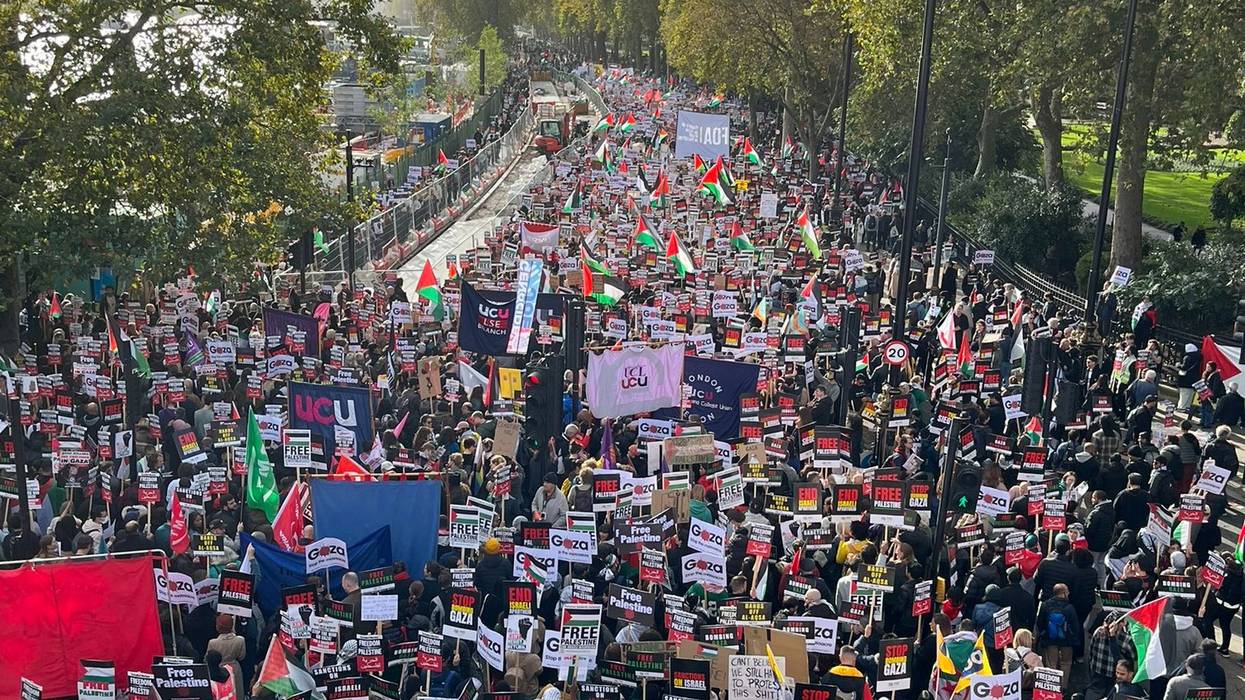
"This is not about Hamas. This is about protecting Palestinian lives," one demonstrator said.
The day after Israel unleashed its most intensive bombing campaign against Gaza since October 7, hundreds of thousands of protesters marched in cities around the world calling for a cease-fire and the protection of Palestinian lives.
Gaza lost all telephone and internet communication Friday night as Israeli officials said the country had entered the "next stage" of the war on Saturday as it expanded its operations on the ground.
"[L]ast night Israel launched a major bombardment and cut off all communications. This is an act of pure barbarism," Ben Jamal, the director of Palestine Solidarity Campaign (PSC), told Middle East Eye from a march in London. "So we are marching today, not knowing how many Palestinians are dead, how many children now lie under the rubble."
PSC estimated on social media that half a million people attended the London march, which went from Embankment past U.K. Prime Minister Rishi Sunak's official residence at Downing Street to Westminster. Aerial footage showed streets and bridges thick with crowds. Sunak has stopped short of calling for a cease-fire, and Great Britian has emphasized Israel's right to defend itself after the surprise October 7 attack by Hamas that killed around 1,400.
"The superpowers at play are not doing enough at the moment. This is why we're here: we're calling for a cease-fire, calling for Palestinian rights, the right to exist, to live, human rights, all our rights," London marcher Camille Revuelta told Reuters. "This is not about Hamas. This is about protecting Palestinian lives."
Protests also took place in cities across Europe, the Middle East, and Asia, including what +972 Magazine journalist Oren Ziv said was the first anti-war protest in Tel Aviv.
Israeli officials said Saturday they had expanded their ground operations in Gaza after smaller raids Wednesday and Thursday night, while Hamas promised to meet them with "full force," Al Jazeera reported.
Prime Minister Benjamin Netanyahu said Saturday night that Israel had entered the "second stage" of the war with an expanded ground operation, according to The Associated Press.
He said the goals of the incursion were "to destroy the military and governmental capabilities of Hamas and bring the hostages home."
"The most important thing for us is for them to stop killing kids. They need to stop."
Friday's bombardment was heavy enough to cut most forms of communications to Gaza, leaving families, aid organizations, and news rooms unable to reach their loved ones or staff. Al Jazeera journalist Hani Mahmoud succeeded in reporting Saturday morning that Friday night had been "the most difficult and bloodiest night since the beginning of this war."
Mahmoud said Israel launched a major attack around 7 pm local time Friday near al-Shifa hospital in the north of Gaza and that "we have been hearing reports that hundreds of people have been killed in those areas and emergency services were not able to get to them in time to help."
"The problem with cutting Gaza from the outside world has made people feel it could be a genocide in the making without them knowing what has happened to their relatives," Mahmoud said.
The Gaza Health Ministry reported 377 more deaths since late Friday night, according to AP. The total death toll is now at more than 7.703 killed in Gaza, 3,595 of them children, Al Jazeera reported.
"The most important thing for us is for them to stop killing kids. They need to stop," Abdul Mahfuudi, who joined the London protest with his own children, told BBC News.
Saturday marked the third weekend in a row of Palestine solidarity marches across the U.K. Demonstrators also rallied in Manchester, Belfast, and Glasgow, among others.
Beyond the U.K., crowds marched for a cease-fire in Copenhagen; Rome; Stockholm; Istanbul; Wellington, New Zealand, and Kuala Lumpur, Malaysia, Reuters reported.
In Turkey, President Recep Tayyip Erdogan repeated his denials that Hamas a terrorist organization and said that Israel was an "occupier," according to Al Jazeera.
"The main culprit behind the massacre unfolding in Gaza is the West," he said.
Despite bans, a small group of protesters also gathered in Paris and thousands marched in Berlin, according to Reuters and Al Jazeera.

Parents in Gaza have begun writing their children's names on their hands and legs so they can be identified by medical providers.
Mourners at a vigil outside British Parliament on Tuesday wrote on their hands the names of some of the more than 2,300 Palestinian children killed in Israel's bombardment so far, following reports that parents in Gaza have taken to labeling their children's hands and legs so that medical workers will be able to identify them if they become the next victims of a bombing.
"We received some cases where the parents wrote the names of their children on the legs and abdomen," Dr. Abdul Rahman Al Masri, who heads the emergency department at Al-Aqsa Martyrs Hospital, told CNN on Monday. "Anything could happen... They feel they are targeted at any moment."
The people gathered at the vigil in Parliament Square in London, organized by Medical Aid for Palestinians (MAP), called for "an immediate cease-fire to stop the loss of thousands more young lives."
"Today we mourn the at least 2,000 children that have been killed since Israel's bombardment and siege of Gaza began. A further 5,000 children have been injured and 800 children are missing, believed to be dead under the rubble," said Melanie Ward, CEO of MAP.
One mourner wrote the name of 13-year-old Bayan Shabat, who was one of seven children killed in an airstrike on her home in Beit Hanoun on October 8.
"Many of the children are missing, many get here with their skulls broken," the supervisor told CNN, "and it's impossible to identify them, only though that writing do they get identified."
CNN reported that the hospital is one of many where supplies are running perilously low. Doctors are being forced to operate on some children "without the correct dose of narcotics, without the correct dose of morphine," Leo Cans, head of mission in Jerusalem for Médecins Sans Frontières, told the outlet.
"Time is running out for the 1 million children of Gaza who are living an unspeakable nightmare," Ward said. "Their basic needs such as food and water are rapidly running out, and many have been forced to flee their homes as Israel's bombardment and siege continues. Indiscriminate bombing must stop, a cease-fire must be secured, and sufficient aid, including fuel, must be allowed in. World leaders have a responsibility to end these horrors and protect Gaza's children."
The vigil was held a day after Conservative U.K. Prime Minister Rishi Sunak rejected calls from members of the House of Commons for a cease-fire, echoing U.S. officials who have claimed this week that such a demand from Western countries would benefit Hamas.
Laura Rozen of Al-Monitor reported Tuesday that "something of a gap" has emerged between American and European officials at the United Nations Security Council, with France's foreign minister "calling for a humanitarian pause that would ultimately lead to cease-fire" after previously joining the U.S. in supporting Israel's onslaught.
European leaders are debating the question of a cease-fire call this week, Bloomberg's Maria Tadeo reported, as demands for a humanitarian pause grow within the European Union—which the U.K. left in 2020.
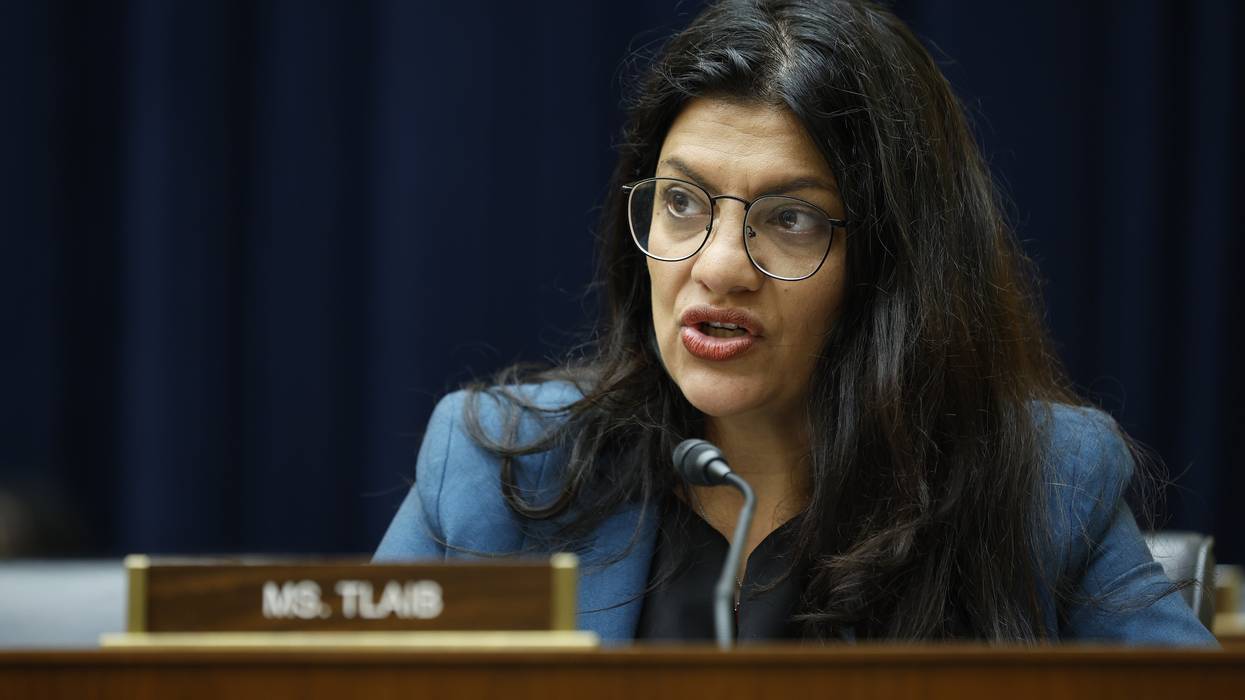
U.S. Rep. Rashida Tlaib demanded to know whether President Joe Biden would "remain silent" as Israel threatened the lives of thousands of Palestinians sheltering at al-Quds Hospital.
U.S. Rep. Rashida Tlaib called on President Joe Biden on Friday to pressure Israeli Prime Minister Benjamin Netanyahu out of his most recent evacuation order in Gaza, this one threatening thousands of people in al-Quds Hospital in Gaza City with an imminent bombing unless they leave the facility.
The Palestinian Red Crescent Society (PRCS) said the hospital has become a "sanctuary" to more than 400 patients, some of whom are critically injured, and 12,000 displaced people in recent days as the Israel Defense Forces (IDF) has bombarded Gaza with airstrikes, killing at least 4,137 Palestinians so far.
Tlaib (D-Mich.), the only Palestinian American member of Congress, demanded to know whether Biden would "remain silent" about Israel's threat.
"Where are they supposed to go? Where!" she said, addressing the president on social media. "You must demand that your BFF Netanyahu withdrawal his evacuation order. Our country can't keep supporting this massacre of civilians."
PRCS issued an "urgent appeal" to the international community, warning that Israel had threatened to bomb the hospital.
The reported threat came days after a bombing at al-Ahli Hospital in Gaza City, for which Hamas and Israel have traded blame this week.
"We call on the world to take immediate and urgent action to prevent a new massacre like the one that occurred on the al-Ahli Baptist Hospital," said PRCS.
Al-Quds, the group said on social media, "could turn to ashes if those threats are carried out."
PRCS posted a video that showed dozens of families, including small children, who are currently relying on al-Quds Hospital for shelter.
In the U.K., former Member of Parliament Chris Williamson called on Prime Minister Rishi Sunak to intervene.
At Al Jazeera, Youmna ElSayed reported that following "an hour of relative, cautious calm" earlier in the evening in Gaza City, Israel has stepped up its bombardments throughout the city.
"Is there a world power capable of stopping the threats of the Israeli occupation army to bomb hospitals with innocent civilians inside?" asked PRCS.
The Institute for Middle East Understanding warned that "400 patients cannot simply evacuate."
"Neither can the 12,000 Palestinians sheltering inside," the group said. "Israel has bombed hospitals, schools, churches, and homes. No one in Gaza is safe, no matter where they go."