

SUBSCRIBE TO OUR FREE NEWSLETTER
Daily news & progressive opinion—funded by the people, not the corporations—delivered straight to your inbox.
5
#000000
#FFFFFF
To donate by check, phone, or other method, see our More Ways to Give page.
Daily news & progressive opinion—funded by the people, not the corporations—delivered straight to your inbox.
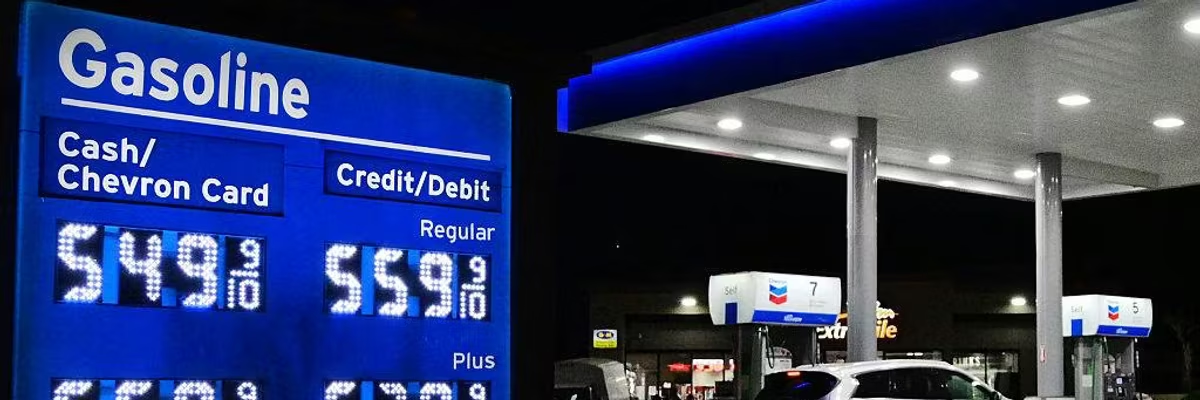
High gas prices are listed at Chevron gas station in Los Angeles on March 9, 2026, as gasoline prices surge amid the ongoing war with Iran.
"Bahrain, Iraq, Kuwait, and Qatar have no bypass capability whatsoever," said one expert. "Their shipments are wholly reliant on Hormuz transit."
House Speaker Mike Johnson is trying to downplay the rise in gas prices caused by President Donald Trump's war with Iran, but energy analysts are warning that Americans are in for significant pain at the pump.
Speaking at a press conference on Tuesday, Johnson (R-La.) said that the rise in gas prices was a small price to pay for achieving American military objectives in Iran, which he baselessly claimed was about to strike the US if the US didn't strike first.
Johnson also predicted that the rise in gas prices, which on Wednesday reached an average of $3.58 per gallon in the US, would be short lived.
"Most of this is because the Strait of Hormuz has been closed by the regime down there," Johnson said. "But it will be reopened, and it will take a couple of weeks, but gas prices will come back down... So this is a temporary blip in an extraordinary trend of a return to American energy dominance."
Despite Johnson's rosy assessment, energy experts Trevor Higgins and Akshay Thyagarajan of the Center for American Progress published an analysis on Wednesday explaining why there will be no quick fix for high gas prices.
What's more, the analysts said that the Iran conflict appeared ready to raise prices on much more than just gasoline.
"Many parts of the US economy are still dependent on fossil fuels, and higher prices for oil and gas increase the prices for gasoline, electricity, fertilizer, food, and more," they noted. "As long as this war continues—and perhaps for some time thereafter—American households will pay higher prices at the pump, on their utility bills, and on their grocery bills."
Higgins and Thyagarajan documented how the Iran war's impact on oil prices was already greater than the impact that Russia's invasion of Ukraine had in 2022, and they warned it would only grow more severe the longer the conflict persisted.
One particularly worrisome impact of the Iran war, Higgins and Thyagarajan said, would be putting upward pressure on Americans' utility bills, which have already been rising significantly over the last year thanks to the enormous energy demands of artificial intelligence data centers.
They pointed to the dependence of US power infrastructure on liquified natural gas (LNG), which generates roughly 43% of electricity in the US, as a serious vulnerability.
"Following the start of Operation Epic Fury, both European and Asian LNG futures prices have already skyrocketed," they wrote. "As of March 9, they’ve increased by 77% and 51%, respectively, compared to prices before the event. This price increase is much higher than the increase immediately after Russia’s invasion of Ukraine. If this increase persists, it could raise utility bills further."
Clayton Seigle, energy analyst at the Center for Strategic and International Studies, said on Monday that there was very little hope of US gas prices decreasing until Iran reopened the Strait of Hormuz for commercial shipping.
Seigle said that Iran could wage a relatively cheap military campaign against ships attempting to traverse the strait using a combination of speedboats, naval mines, and drones.
"Their destructive firepower is less than that of missiles," he wrote, "but sufficient to cause damage and deter commercial shipping."
Seigle also dismissed any plans by other oil-producing nations to ship their products through alternative trade routes, which he said would do too little to ease the oil supply crisis caused by the strait's closure.
" Bahrain, Iraq, Kuwait, and Qatar have no bypass capability whatsoever," he explained. "Their shipments are wholly reliant on Hormuz transit."
Dear Common Dreams reader, It’s been nearly 30 years since I co-founded Common Dreams with my late wife, Lina Newhouser. We had the radical notion that journalism should serve the public good, not corporate profits. It was clear to us from the outset what it would take to build such a project. No paid advertisements. No corporate sponsors. No millionaire publisher telling us what to think or do. Many people said we wouldn't last a year, but we proved those doubters wrong. Together with a tremendous team of journalists and dedicated staff, we built an independent media outlet free from the constraints of profits and corporate control. Our mission has always been simple: To inform. To inspire. To ignite change for the common good. Building Common Dreams was not easy. Our survival was never guaranteed. When you take on the most powerful forces—Wall Street greed, fossil fuel industry destruction, Big Tech lobbyists, and uber-rich oligarchs who have spent billions upon billions rigging the economy and democracy in their favor—the only bulwark you have is supporters who believe in your work. But here’s the urgent message from me today. It's never been this bad out there. And it's never been this hard to keep us going. At the very moment Common Dreams is most needed, the threats we face are intensifying. We need your support now more than ever. We don't accept corporate advertising and never will. We don't have a paywall because we don't think people should be blocked from critical news based on their ability to pay. Everything we do is funded by the donations of readers like you. When everyone does the little they can afford, we are strong. But if that support retreats or dries up, so do we. Will you donate now to make sure Common Dreams not only survives but thrives? —Craig Brown, Co-founder |
House Speaker Mike Johnson is trying to downplay the rise in gas prices caused by President Donald Trump's war with Iran, but energy analysts are warning that Americans are in for significant pain at the pump.
Speaking at a press conference on Tuesday, Johnson (R-La.) said that the rise in gas prices was a small price to pay for achieving American military objectives in Iran, which he baselessly claimed was about to strike the US if the US didn't strike first.
Johnson also predicted that the rise in gas prices, which on Wednesday reached an average of $3.58 per gallon in the US, would be short lived.
"Most of this is because the Strait of Hormuz has been closed by the regime down there," Johnson said. "But it will be reopened, and it will take a couple of weeks, but gas prices will come back down... So this is a temporary blip in an extraordinary trend of a return to American energy dominance."
Despite Johnson's rosy assessment, energy experts Trevor Higgins and Akshay Thyagarajan of the Center for American Progress published an analysis on Wednesday explaining why there will be no quick fix for high gas prices.
What's more, the analysts said that the Iran conflict appeared ready to raise prices on much more than just gasoline.
"Many parts of the US economy are still dependent on fossil fuels, and higher prices for oil and gas increase the prices for gasoline, electricity, fertilizer, food, and more," they noted. "As long as this war continues—and perhaps for some time thereafter—American households will pay higher prices at the pump, on their utility bills, and on their grocery bills."
Higgins and Thyagarajan documented how the Iran war's impact on oil prices was already greater than the impact that Russia's invasion of Ukraine had in 2022, and they warned it would only grow more severe the longer the conflict persisted.
One particularly worrisome impact of the Iran war, Higgins and Thyagarajan said, would be putting upward pressure on Americans' utility bills, which have already been rising significantly over the last year thanks to the enormous energy demands of artificial intelligence data centers.
They pointed to the dependence of US power infrastructure on liquified natural gas (LNG), which generates roughly 43% of electricity in the US, as a serious vulnerability.
"Following the start of Operation Epic Fury, both European and Asian LNG futures prices have already skyrocketed," they wrote. "As of March 9, they’ve increased by 77% and 51%, respectively, compared to prices before the event. This price increase is much higher than the increase immediately after Russia’s invasion of Ukraine. If this increase persists, it could raise utility bills further."
Clayton Seigle, energy analyst at the Center for Strategic and International Studies, said on Monday that there was very little hope of US gas prices decreasing until Iran reopened the Strait of Hormuz for commercial shipping.
Seigle said that Iran could wage a relatively cheap military campaign against ships attempting to traverse the strait using a combination of speedboats, naval mines, and drones.
"Their destructive firepower is less than that of missiles," he wrote, "but sufficient to cause damage and deter commercial shipping."
Seigle also dismissed any plans by other oil-producing nations to ship their products through alternative trade routes, which he said would do too little to ease the oil supply crisis caused by the strait's closure.
" Bahrain, Iraq, Kuwait, and Qatar have no bypass capability whatsoever," he explained. "Their shipments are wholly reliant on Hormuz transit."
House Speaker Mike Johnson is trying to downplay the rise in gas prices caused by President Donald Trump's war with Iran, but energy analysts are warning that Americans are in for significant pain at the pump.
Speaking at a press conference on Tuesday, Johnson (R-La.) said that the rise in gas prices was a small price to pay for achieving American military objectives in Iran, which he baselessly claimed was about to strike the US if the US didn't strike first.
Johnson also predicted that the rise in gas prices, which on Wednesday reached an average of $3.58 per gallon in the US, would be short lived.
"Most of this is because the Strait of Hormuz has been closed by the regime down there," Johnson said. "But it will be reopened, and it will take a couple of weeks, but gas prices will come back down... So this is a temporary blip in an extraordinary trend of a return to American energy dominance."
Despite Johnson's rosy assessment, energy experts Trevor Higgins and Akshay Thyagarajan of the Center for American Progress published an analysis on Wednesday explaining why there will be no quick fix for high gas prices.
What's more, the analysts said that the Iran conflict appeared ready to raise prices on much more than just gasoline.
"Many parts of the US economy are still dependent on fossil fuels, and higher prices for oil and gas increase the prices for gasoline, electricity, fertilizer, food, and more," they noted. "As long as this war continues—and perhaps for some time thereafter—American households will pay higher prices at the pump, on their utility bills, and on their grocery bills."
Higgins and Thyagarajan documented how the Iran war's impact on oil prices was already greater than the impact that Russia's invasion of Ukraine had in 2022, and they warned it would only grow more severe the longer the conflict persisted.
One particularly worrisome impact of the Iran war, Higgins and Thyagarajan said, would be putting upward pressure on Americans' utility bills, which have already been rising significantly over the last year thanks to the enormous energy demands of artificial intelligence data centers.
They pointed to the dependence of US power infrastructure on liquified natural gas (LNG), which generates roughly 43% of electricity in the US, as a serious vulnerability.
"Following the start of Operation Epic Fury, both European and Asian LNG futures prices have already skyrocketed," they wrote. "As of March 9, they’ve increased by 77% and 51%, respectively, compared to prices before the event. This price increase is much higher than the increase immediately after Russia’s invasion of Ukraine. If this increase persists, it could raise utility bills further."
Clayton Seigle, energy analyst at the Center for Strategic and International Studies, said on Monday that there was very little hope of US gas prices decreasing until Iran reopened the Strait of Hormuz for commercial shipping.
Seigle said that Iran could wage a relatively cheap military campaign against ships attempting to traverse the strait using a combination of speedboats, naval mines, and drones.
"Their destructive firepower is less than that of missiles," he wrote, "but sufficient to cause damage and deter commercial shipping."
Seigle also dismissed any plans by other oil-producing nations to ship their products through alternative trade routes, which he said would do too little to ease the oil supply crisis caused by the strait's closure.
" Bahrain, Iraq, Kuwait, and Qatar have no bypass capability whatsoever," he explained. "Their shipments are wholly reliant on Hormuz transit."

