SUBSCRIBE TO OUR FREE NEWSLETTER
Daily news & progressive opinion—funded by the people, not the corporations—delivered straight to your inbox.
5
#000000
#FFFFFF
To donate by check, phone, or other method, see our More Ways to Give page.


Daily news & progressive opinion—funded by the people, not the corporations—delivered straight to your inbox.
The administration sees the world as divided between U.S. military and economic power and the alliances supporting it, and the only peer competitor facing the United States.
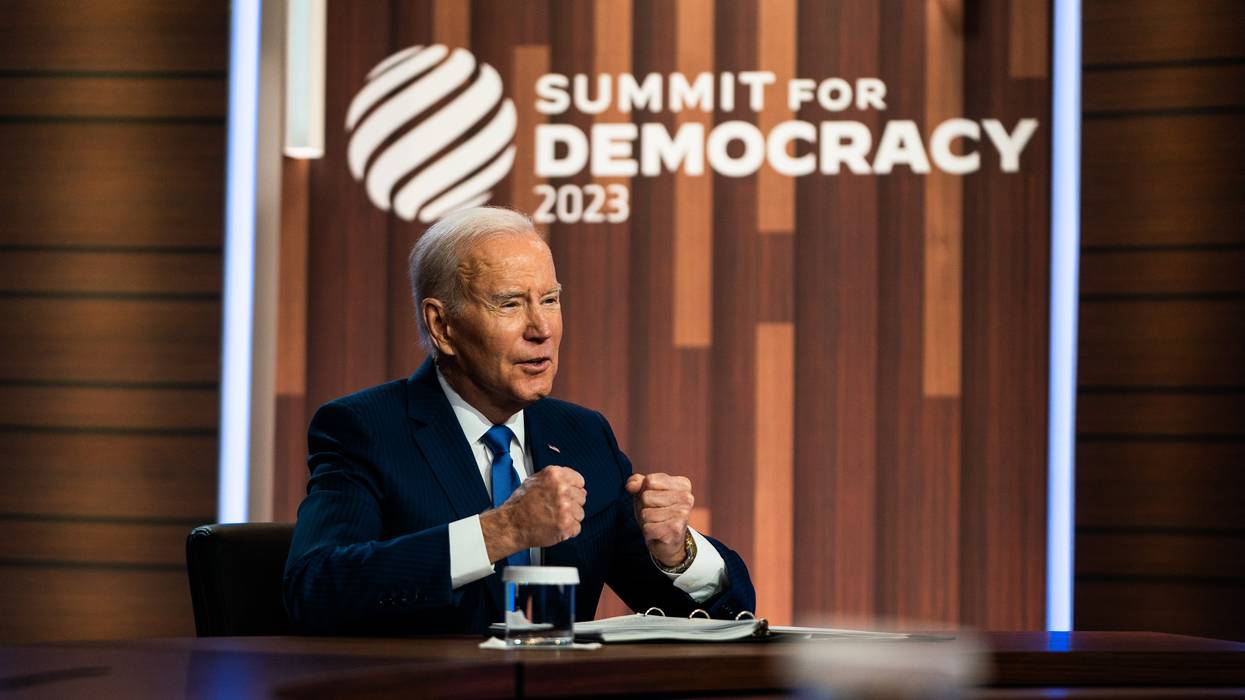
The Biden administrationopened its second Summit for Democracy this week with a panel featuring India's Narendra Modi and Israel's Benjamin Netanyahu. As the leaders of their countries, both have pursued similar forms of exclusionary nationalism.
Indeed, both Modi and Netanyahu were—as they spoke—facing political crises at home in response to their attempts to permanently sideline democratic opposition.
This was a seemingly discordant note with which to begin a democracy conference. Even so, it is very much in keeping with what the Biden administration means when it says that the United States is fighting a global battle for democracy against autocracy. Understanding the counterintuitive meaning of Biden's slogan is important both to see why this framing is so powerful among American leaders and why it is so dangerous to the health of global democracy.
The administration's interpretation is best captured in its 2022 National Security Strategy:
The most pressing strategic challenge facing our vision [of a free, open, prosperous, and secure world] is from powers that layer authoritarian governance with a revisionist foreign policy. It is their behavior that poses a challenge to international peace and stability—especially waging or preparing for wars of aggression, actively undermining the democratic political processes of other countries, leveraging technology and supply chains for coercion and repression, and exporting an illiberal model of international order. Many non-democracies join the world's democracies in forswearing these behaviors. Unfortunately, Russia and the People's Republic of China (PRC) do not.
The salient division in the world, then, is not between democracies and autocracies but between countries that support the existing international order and the two autocracies—China and Russia—that are seeking to reshape it in illiberal ways.
But this raises some awkward questions:
One: Which side are autocratic U.S. allies on if, like Saudi Arabia and UAE, they wage wars of aggression, undermine the democratic political processes of other countries, and use technology for repression?
Two: Which side are democratic countries on if they support China's efforts to reshape the international order? This is quite common, because many of the things that China does to "tilt the global playing field to its benefit" are things that poor countries—democratic or not—must do if they are to achieve economic development.
Three: Which side is the U.S. on? Because the U.S. violates the rules-based order and engages in coercion on a regular basis. Leaving aside a long list of examples under earlier presidents and looking only at the Biden administration, the U.S. is currently incapacitating the world trade dispute resolution system; supporting Russia's argument that it can exempt itself from any economic agreement (in this case, throttling Ukraine's trade) merely by invoking national security; building a comprehensive blockade on Chinese businesses' access to certain advanced technologies; seeking to destroy China's most successful private multinational company, Huawei; and maintaining an extraterritorial sanctions regime that has done terrible damage to Iran's economy.
The United States welcomes as client states outright autocracies like Saudi Arabia or Egypt and deteriorating democracies like India, Israel, and Italy in order to turn back the huge threat that administration officials think a powerful China poses to the principle of democracy itself.
So the particular list of allegations against Russia and China, which does not apply equally to both countries, also fails to clearly distinguish the "democracy" team from the "autocracy" team. But the Biden administration has a deeper rationale in mind. As Secretary of State Antony Blinken said, "China is the only country with both the intent to reshape the international order and, increasingly, the economic, diplomatic, military, and technological power to do it." Ultimately the United States welcomes as client states outright autocracies like Saudi Arabia or Egypt and deteriorating democracies like India, Israel, and Italy in order to turn back the huge threat that administration officials think a powerful China poses to the principle of democracy itself.
What is the nature of that threat? Often the administration accuses China of exporting its authoritarian model in the form of surveillance technology—technology that companies in the U.S. and allied states also sell. Or they highlight China's campaign to change "democratic norms" at the United Nations. For example, China has sought to elevate collective rights, such as the right to economic development, to the same level as individual rights.
Members of the Biden administration have argued that such a goal would dilute individual rights and empower autocratic states to speak in the name of their people. This perspective, however, is not shared by the overwhelming majority of democratic developing countries. They stand on this issue and many others alongside their authoritarian counterparts, against the opposition of the rich democratic countries. In U.S. political culture, the interests of wealthy countries are often represented as the interests of democratic countries.
Beijing also rejects the "universal values" that the U.S. champions and seeks respect for "the diversity of civilizations," including those that do not recognize liberal democratic rights and freedoms. The Biden administration has a point here—China does seek to overturn the rhetorical dominance that liberal values have enjoyed in recent decades—but the presence of numerous autocrats and aspiring autocrats in U.S.-led coalitions is eloquent proof that liberal rhetoric does little to restrain authoritarians.
Finally, Biden has made the point that if Chinese authoritarianism is stable and prosperous while U.S. democracy is dysfunctional and stagnant, democracy will lose its appeal around the world. But it is hard to find examples of this happening in practice. China's recent history of Party-state rule sets it apart from most other countries, making it unpersuasive as a model. And third countries are perfectly capable of valuing partnership with China without losing faith in democracy. In a 2022 survey of African leaders, China was preferred over the United States (46% to 9%) as a partner on infrastructure development; yet the U.S. was chosen over China (32% to 1%) when it comes to cooperation around governance and the rule of law.
The idea that a popularity contest between two powerful countries is what determines the choice of political regime in other countries is, in any case, both implausible and insulting.
Why, then, is the idea that China poses a potentially existential threat to democracy so widespread in Washington? Because over the last two decades, the ideological hegemony of neoliberalism ("free markets and free individuals")—which underwrote the narrow concept of democracy that drove the Third Wave of democratization and supplied the intellectual foundations for the U.S. political elite in recent decades—has disintegrated at home and abroad.
This ideology's loss of legitimacy is a global phenomenon, but in Washington it was experienced as the outcome of a series of increasingly disastrous setbacks for U.S. economic and military aspirations, starting with the dotcom crash and 9/11, ramifying through the failures of the Free Trade Area of the Americas, the Iraq War, and the Doha Round of WTO negotiations, and culminating in the 2008 global financial crisis and the Great Recession.
The sense of crisis only grew over the following decade as previously marginalized political currents represented by Donald Trump and Bernie Sanders suddenly posed a serious challenge to the political status quo in the United States.
For mainstream American political leaders, the three essential parts of the post-Cold War global system—U.S. military hegemony, free market globalization, and a specifically neoliberal vision of democracy and human rights—were inseparably interwoven
For mainstream American political leaders, the three essential parts of the post-Cold War global system—U.S. military hegemony, free market globalization, and a specifically neoliberal vision of democracy and human rights—were inseparably interwoven. Now referred to in Washington as the "rules-based international order," a challenge to any part of the package is considered an attack on the whole, and American leaders are particularly sensitive to such challenges given the fragility of the whole system.
Today's China, though a product of that very system, was also the most prominent country to reject liberal democracy and U.S. hegemony. And in the years since 2008, it has been a step or two ahead of other countries—in some ways constructive and in some horrifying—as every country moves beyond the system. So even though China has been little involved in the specific U.S. failures of the last two decades, it nonetheless stands in as a symbol of all the setbacks that U.S. power and ideology have faced.
Though China's success within the "rules-based international order" has given it a major stake in sustaining and shoring up significant parts of the system, that success has also made China far more powerful than more antagonistic countries like Russia or North Korea. Because Washington sees China as both hostile and powerful, the image of a menacing China offers a shared focus for U.S. leaders that could overcome the debilitating partisan divisions afflicting the country's governance—a point that Biden has made many times.
So it's true that the Biden administration does not see the world as divided between democracies and autocracies. But it does see the world as divided between democracy in the abstract—understood to be the same as U.S. military and economic power and the alliances supporting it—and autocracy in the abstract, represented by the only peer competitor facing the United States, China.
This emerging consensus in Washington is driven by insecurity and defensiveness rather than a serious analysis of the real forces endangering democracy around the world. As such, U.S. leaders have neglected the single most important question: is international conflict and geopolitical bloc formation likely to nourish democracy—or will it strengthen in every country the most threatening authoritarian political currents, namely militarism, nationalism, and nativism?
It is widely agreed that President Donald Trump's handling of the coronavirus pandemic--his conscious and non-stop lies, his blundering incompetence, and his open disdain for science--has helped lead the U.S. to where it is today: Record-shattering Covid-19 infections, hospitalizations, and deaths and an economy in shambles.
But placing the blame for the disastrous current state of affairs entirely at the feet of Trump risks letting off the hook a more fundamental culprit, namely the conservative anti-government ideology and "free market"-worship at the core of much of the administration's response to the deadly pandemic.
"Conservative leaders refused to marshal the resources of government to actually combat the spread of the disease. Instead, in keeping with their ideology, they wanted to leave it to individuals and the 'free market.'"
--Michael Linden, Groundwork Collaborative
That's the argument advanced in a recent essay for Talking Points Memo by Michael Linden and Sammi Aibinder of the Groundwork Collaborative, a progressive policy shop.
Unsatisfied with explanations of the current crisis that posit Trump as the principal cause--a position which suggests that simply removing Trump, as U.S. voters decided to do last month, is the solution--Linden and Aibinder write that "though Donald Trump lost reelection, the ideology and belief system underpinning so many of the debacles of his presidency prevails, and was always doomed to fail the country in the face of a disaster like this one."
"At base, conservative ideology itself was just as responsible for the failure to appropriately and effectively respond to this crisis as Trump's personal failings were," the two argue. "And that ideology will still be present--rife, in fact--in our government long after Trump is gone."
While acknowledging that conservatism is "not homogenous," Linden and Aibinder argue that at the heart of the reactionary ideology is the view that "government itself tends to cause more problems than it solves, and that free markets--unencumbered by government intervention--are always best positioned to allocate resources and improve society."
Adherence to those two positions, according to Linden and Aibinder, is incompatible with an effective response to a pandemic that necessitates coordinated state action to control the spread of the virus, which has now killed more than 273,000 people in the U.S.--the highest Covid-19 death toll in the world.
In contrast with countries like New Zealand and South Korea, where decisive government action helped prevent Covid-19 from running rampant, Linden and Aibinder noted that the U.S. response was plagued by "the conservative belief that government is more often the problem than the solution," which "made it practically inevitable that Republicans would render their own government ineffective."
"Instead of coordinating a national strategy to address the acute shortage of personal protective equipment and vital medical supplies across the country, this administration encouraged state leaders to essentially compete with one another to save their own people," write Linden and Aibinder. "When pressed by state leaders to help solve the PPE shortage, senior White House adviser Jared Kushner replied, 'The free market will solve it.' When asked about the federal government's role in assuring schools are able to resume in-person instruction safely, Education Secretary Betsy DeVos contended that was not her department's job."
The devastating consequences of conservative ideology are also evident in the nation's response, or lack thereof, to the economic crisis that the coronavirus pandemic spawned.
Since Congress in March passed the $2.2 trillion CARES Act--a measure whose most successful elements, such as the federal boost to unemployment insurance and direct cash payments, drew loud GOP backlash--Republican lawmakers have actively opposed efforts to provide any additional stimulus even as the economy remains in deep recession, a predictable and totally preventable outcome of inaction.
As Linden and Aibinder write:
By May, the S&P 500 had recovered 30 percent of its losses, and Senate Majority Leader Mitch McConnell (R-Ky.) declared that additional measures were no longer urgent, despite the fact that the unemployment rate was still almost 15 percent and the economy was still over 20 million jobs in the hole. Months passed, and the stock market continued to recover, while the broader economic recovery stalled. Emergency aid lapsed, job gains have slowed, hunger and precariousness has risen. But so long as the stock market continues to thrive, it is unlikely that conservatives will be moved to address these underlying problems.
Capital primacy not only leads conservatives to disregard real economic challenges, it also leaves them with very few tools to use when they do decide to act. Conservatives tend to rely on tax cuts -- especially for the wealthy and corporations--as their primary economic policy lever, and disdain public investments, as well as more direct aid or targeted aid to anyone who is not a "job creator."
Ultimately, Linden and Aibinder argue that while "there is no doubt that as president, Donald Trump stamped his own personal brand of ineptitude on this crisis," the coronavirus pandemic "was the test that conservatism was built to fail."
"A public health crisis that demands a coordinated, powerful public response, leveraging all the power and reach of the federal government, meets an ideology that cannot accept a robust role for the public sector and believes the free market will solve all," the two write. "An incredibly unequal economic crisis driven by a collapse in customers, in which the wealthy are mostly doing fine while everyday people teeter on the brink of generational ruin, meets an ideology that cares only for the prospects of those at the top and sees tax cuts as the only useful economic answer."
In the wake of his victory last month, President-elect Joe Biden promised a more coordinated federal response to the coronavirus crisis and appointed economic advisers who appear willing to buck the conservative deficit dogma embraced--often selectively and hypocritically--by Republicans and Biden's former boss, Barack Obama.
But if Democrats fail to retake control of the Senate by winning the pair of Georgia runoffs set for January 5, Biden's vow to tackle the twin public health and economic crises with bold action could be dramatically hindered by McConnell, who appears hellbent on ensuring that the economic meltdown continues no matter the cost to the increasingly hungry and desperate population.
"So long as the stock market continues to thrive," write Linden and Aibinder, "it is unlikely that conservatives will be moved to address these underlying problems."
Eli Broad is a housing and insurance tycoon whose California-based Eli and Edythe Broad Foundation has poured hundreds of millions into "transforming" K-12 urban education by training administrators and supporting charter schools, merit pay and other market-based reforms. And now, Broad wants to do even more, trying to lead a campaign to raise nearly half a billion dollars to open enough charter schools to enroll nearly half of the students in the country's second-largest school district.
Broad, according to various reports, wants to open 260 new charter schools in the Los Angeles Unified School District over the next eight years -- effectively doubling today's number.
Whether the city's officials will ultimately approve the plan is unclear, but the idea is clearly spelled out in a 44-page memo obtained by the Los Angeles Times. It names other foundations and wealthy philanthropists who could be involved, including the Bill & Melinda Gates Foundation as well as the Hewlett and Annenberg foundations. Individuals include Tesla Motors' Elon Musk and entertainment magnate David Geffen. (Note: The Broad Foundation has partly funded the Los Angeles Times' new digital initiative to expand education coverage.)
Broad was one of the early members of what education historian and activist Diane Ravitch dubbed "The Billionaire Boys Club," whose members, including Gates, have spent so much money on corporate school reform that private philanthropy has had a major effect on public policy. Broad has repeatedly championed charter schools -- which are publicly funded schools that are privately run. Earlier this year his foundation suspended a program in which it gave annual $1 million awards to high-achieving traditional public urban school districts, but Broad is carrying on with a $250,000 Broad Prize for charter schools, which he says do a better job than traditional public schools in educating high-needs students who live in urban areas.
His memo cites three major charter operators -- Green Dot Public Schools, Alliance College-Ready Public Schools and KIPP Public Charter Schools -- as having seen "significant" gains by students. But it turns out that those results have actually been mixed. According to the LA School Report, a pro-reform publication:
In building a case for creating 260 charter schools within in LA Unified eight years at a cost of $490 million, the Eli and Edythe Broad Foundation has cited "significant" gains by three charter organizations that have received $75 million from the foundation.
But when all factors are considered, there is little conclusive evidence in the report outlining the expansion plans that shows big investments in charters always -- or evenly routinely -- achieve consistent academic improvements, raising an important question: Just what can Broad and other foundations promise for an investment of nearly half a billion dollars in an expansion effort that would dramatically change the nation's second-largest school district?
The LA School Report story details where test scores went up -- and down -- at the three cited charter school networks in Los Angeles, pointing to what is generally known about charter performance around the country: On the whole they don't perform better than traditional public schools, but it is hard to compare because the populations of students are often not the same.
The Los Angeles Times notes in this story that "charter forces point to test scores showing that their students, on average, do better than those in L.A. Unified" but that district officials "argue that it's more accurate to compare charter schools not with the district as a whole but with magnet schools. In that match, magnets generally do better." Of course, that isn't a fair comparison, either, given that the populations of charters and magnets are also different.
The proposal, called Great Public Schools Now, would require some 5,000 teachers, according to this story in the Times, which also says:
The Broad proposal, which would set aside $43.1 million for a "teacher pipeline," refers to Teach For America as the "strongest human capital partner" for charters in Los Angeles. That group recruits recent college graduates and provides training that consists of six weeks before they start teaching -- more in some cases -- combined with ongoing support and course work.
The plan also looks to other fast-track programs, the New Teacher Project and the Relay Graduate School of Education, as avenues for hires. The New Teacher Project recruits those who want to change careers as well as recent grads; Relay is an emerging program developed in conjunction with charter leaders. It's based in New York City, with regional campuses in five states, not yet including California.
Younger teachers offer a workforce that charters consider more flexible and one that is willing to work at a pace that may be unsustainable over the long term, some experts said.
Teach For America is the nonprofit famous for recruiting new college graduates, giving them five weeks of training in a summer institute and placing them in schools that are among America's neediest. It has been a prime mover in the "no excuses" movement, which promotes the notion that the conditions in which children live can't be blamed for poor academic performance. In other words, teachers should be able to overcome a child's hunger, sickness or trauma.
Most charter schools have teachers who are not unionized, and so it is no surprise that unionized teachers in the traditional Los Angeles public schools oppose Broad's proposal. Several hundred last month protested the Broad charter plan at the opening of a new Broad museum in Los Angeles, the Times reported:
"You want art for the masses?" one person shouted into a bullhorn.
"Then fund more classes!" others shouted in reply as they paraded back and forth under the museum's much-discussed honeycomb facade.
Charter schools have not proven to be the magic bullet that their supporters had hoped a few decades ago when they began to open as a way to push improvements in traditional urban public education. Still, the Times' editorial board likes Broad's idea, endorsing it in an editorial titled, "A charter school expansion could be great for LA." The editorial notes that all charter schools are not high quality and that it will be important to make sure that bad charters are monitored and closed. It actually says:
The only serious official scrutiny that charter operators typically get is when they are issued the right to operate, and five years later when they apply for renewal. It would seem a more thoughtful approach could be developed.
It would seem so, don't you think?
Here's what Ravitch wrote in 2011 about the growing influence of the wealthy on education reform policy. It still has resonance today:
What does all this outpouring of interest by the wealthiest people in the United States mean? Some no doubt are motivated by idealism. Some think they are leading a new civil rights movement, though I doubt that Dr. King would recognize these financial titans as his colleagues as they impose their will on one of our crucial public institutions. Some hate government. Some love the free market. Some think that the profit motive is more efficient and effective than any public-sector enterprise. All of them share a surprising certainty that they know how to "fix" the public schools and that the people who work in those schools are lazy, unmotivated, incompetent, and not to be trusted.
For me, as a historian, the scary part is that our public schools have never before been subject to such a sustained assault on their very foundations. Never before were there so many people, with such vast resources, intent on dismantling public education. What does this mean for the future of public education? What does it mean for our democracy?
My theme for today: Whose children have been left behind?

Let me tell you a little bit about myself. For many years, I was a strong advocate of testing, accountability, and choice. I worked in three conservative think tanks where these ideas were held sacred. In 1998, I went to Albany, New York, to testify on behalf of charter legislation. At the time I was connected to the conservative Manhattan Institute. I thought that testing would help diagnose the problems that children had and enable teachers to identify their needs. I thought that charters would enroll the kids who had failed in regular public schools or who were not well served by regular public schools. I thought that charters would collaborate with the public schools.
In a book published last year, I said that I was wrong. I was wrong on every count. Testing should be used for diagnostic purposes, to help students and teachers, but it has turned into a blunt instrument that is used to reward and punish teachers and schools. Charters should serve the neediest, but, with some notable exceptions, they have become aggressive and entrepreneurial. Instead of seeking out the neediest students, many of them exclude the neediest students and skim the best. In some states, like Michigan, most of the charters are for-profit, with big dividends to the investors; their profits come right out of the public school budget and into the pockets of shareholders. In some states, like Ohio, Colorado, and Pennsylvania, virtual charter schools are making millions of dollars for their owners, while children sit home alone in front of a computer. These cyber charters get full state tuition, but they have no buildings, no playgrounds, no library, no custodian, no nurse, and few teachers. They often have one teacher to monitor 100 screens. For investors, it's a great business, but the educational results are awful. In Colorado, for example, only 12% graduate from the Virtual Academy, compared to a statewide graduation rate of 78%.
We have had a full decade of No Child Left Behind, and we now know that the law has been a disaster. True, it has documented the shocking gaps in passing rates between different groups of children, but it has done nothing to change the conditions that cause those gaps. We know the gaps are there; actually, we knew about the gaps long before NCLB was passed. Yet Congress is still patting itself on the back for identifying a problem and doing nothing meaningful to solve it.
Many children are still left behind. We know who they are.
In the year 2000, during the Presidential campaign, candidate George W. Bush told the nation about the Texas miracle. He said that there was a simple way to reduce the gaps: Just test every child every year, he said; reward the teachers and schools where the scores went up; and humiliate the teachers and schools where the scores went down. Texas did this, he said, and the gaps were closing; test scores were rising; graduation rates were going up; dropout rates were going down. He said that we had to end the "soft bigotry of low expectations" and set the same standards for all children, rich and poor, black and white, advantaged and disadvantaged.
After his election, Congress bought this story and passed No Child Left Behind. This law mandated that all children would be proficient by 2014 in grades 3-8. All children without exception. Bear in mind that no nation in the world has ever achieved 100% proficiency.
Now we know the results of this absurd law. More than 80% of our schools have been labeled failing schools. By the year 2014, nearly 100% of our schools will be considered failures. Has any other national legislature in history ever passed a law guaranteed to label every single one of its schools a failure? I don't know of any.
We now know that NCLB was based on a phony claim. On national tests, Texas does not lead the pack; it's right in the middle. We now know that the achievement gap did not close in Texas, and that dropout rates went up. But the whole nation is stuck with this testing regime.
Let's be clear about what NCLB has really accomplished: It has convinced the media and major philanthropies and Wall Street hedge fund managers that American public education is a failure and that radical solutions are required. The philanthropists and Wall Street hedge fund managers and Republicans and the Obama administration and assorted rightwing billionaires have some ideas about how to change American education. They aren't teachers but they think they know how to fix the schools.
Their ideas boil down to this strategy: NCLB failed because we didn't use enough carrots and sticks. They say that schools should operate like businesses, because the free market is more efficient than government. So these reformers--I call them corporate reformers--advocate market-based reforms. They say that states must hand public schools over to private management because the private sector will be more successful than the public sector. They say that teachers will work harder if they get bonuses when test scores go up. They say that teachers should have no job protections because workers in the private sector don't have job protections, not even the right to a hearing. They say that if schools have low scores, they should be closed and replaced by new schools, just like a chain store--a burger franchise or a shoe store--would be closed if it didn't make a profit; or the entire staff should be fired and replaced by new staff. They say that the quality of teachers should be judged based on whether their students' scores go up or down.
The Tea Party governors embraced this narrative and took it to the next level. They used their sweeping victories in 2010 to eliminate collective bargaining rights for public workers and to slash spending on public education, even as they demanded more funding for charters and vouchers. The mayor of New York City said a week ago that if he had the power to do it, he would fire half the city's teachers, double the pay of those that remained, and double class size. He said when he went to school, he was in a large class and he turned out OK. He didn't mention that his daughters went to schools where the class size was 12. My youngest grandchild attends kindergarten in a Brooklyn public school. He has a class size of 24. Under the mayor's plan, his teacher would have a class of 48. None of them would get any individual attention. I don't see this as progress, particularly because the evidence is clear and strong that minority children benefit most when class sizes are reduced below 20 in a classroom.
So which children would be left behind?
We have now had ten years of No Child Left Behind, and we now know that there has been very little change in the gaps between the children of the rich and the children of the poor, between black children and white children, between Hispanic children and white children. Meanwhile our policymakers say we need higher standards, more rigorous standards, and more testing. How exactly will that help children who are struggling to read and do math? Or, in some cases, struggling to read and speak English? Or in the case of children with disabilities, how are they helped by harder tests? This is like saying, "if these children can't jump over a four-foot bar, let's lift the bar to six feet and see how they do." Do you know how they will do? It seems obvious to me.
Just this week, the federal government released the urban district test results and we could see that the gap remained as large as ever. After ten years of NCLB, the children at the bottom were still at the bottom. Those districts where poverty and racial segregation--such as Detroit and Washington, D.C.--are most concentrated had the lowest scores.
But wait, some of the districts tested by the federal government have been actually implementing the market-based reforms advocated by the corporate reformers: New York City, which has had mayoral control since 2002; Washington, D.C., which has had mayoral control since 2007; Chicago, where Arne Duncan launched market-based reforms in 2001; and Milwaukee, which has had vouchers since 1990.
Since the mayor took charge in 2002, New York City has enthusiastically imposed market-style reforms. It has more choice than any other major city--parents and students get to choose among 400 high schools, as well as more than 100 charter schools. All schools are given letter grades based on test scores. NYC spent $56 million on merit pay, then abandoned the program when it showed zero results. After nine years of market-based reforms, however, the achievement gap between black and white students is unchanged. On the federal tests, math scores are up but no more than in districts without market reforms. Eighth grade reading scores have been flat since 2003.
Which children do you think were left behind?
In Washington, D.C., there have been many claims in the media about sensational test score gains, but that's not what you see on the latest federal tests. In fourth grade reading, the scores have been rising steadily since 2003, but not for all students. The scores of high-income students have gone up but the scores of black students, Hispanic students, and low-income students remain unchanged for the past four years. In eighth grade reading, scores are down for the past four years for black students, Hispanic students, and low-income students. And most importantly, the District of Columbia public school system has the largest achievement gap of any city in the nation between white and black students, a staggering 64 points in 4th grade, compared to an average of 30 points for all urban districts; and an equally staggering 58 points in eighth grade, compared to 28 points for all urban districts.
So whose children were left behind?
In Chicago, where Secretary Duncan's reform program led to the closing of 100 neighborhood schools, only 18% of the new schools were judged successful by the state of Illinois. On the NAEP for cities, Chicago continues to be one of the lowest performing in the nation. Since 2003, black and Hispanic students have seen no improvement in their reading scores in fourth grade. In eighth grade reading, there have been no gains whatever for black students or low income students since federal testing began in 2002, and no gains for Hispanic students since 2005. According to the latest research, the black-white achievement gap is larger now in Chicago than when the reforms began.
In Milwaukee, after 21 years of vouchers, black students have among the lowest scores of any city tested, ranked at the bottom along with Detroit, Fresno, and Cleveland. Independent research has shown that the black and low-income students in Milwaukee's voucher schools have the same low scores as the black students in the public schools. Their scores are about the same as those of poor black kids in the Deep South. Vouchers and competition did nothing for the children of Milwaukee. These children were left behind.
And consider this: Tea-party governors know that vouchers do nothing to improve education, but they are pushing them anyway. The Governor of Indiana, Mitch Daniels, pushed through the first statewide voucher program in the nation. Governor Scott Walker in Wisconsin got his conservative legislature to expand the Milwaukee program, to raise the income eligibility cap, so that more children could go to voucher schools, despite the evidence that vouchers don't improve education. The whole point seems to be to decimate the public sector.
And here is the latest voucher scandal. When Jeb Bush was governor of Florida, he pushed through a voucher program. The state courts struck down one part of the voucher program, the part for students in failing schools. But the courts did not eliminate the McKay Scholarships, which enabled students with disabilities to get vouchers to attend any school. Just this week, the Florida press revealed that some of the deregulated voucher schools are fly-by-night operations, conducted in storefronts, churches, and dingy homes, staffed by administrators and teachers with criminal records. They found students who spent their entire day filling out workbooks or hanging around a gymnasium watching television. One school had a class, described as "business management," which consisted of shaking cans on street corners. Florida has pumped over $1 billion into this voucher program and Governor Scott wants to expand it to more deregulated schools.
Whose children are left behind by these policies?
From all the developments, experiences, and research of the past decade, here is what I have learned:
First, charter schools have been portrayed as a silver bullet that will raise up every child, especially poor and minority children, but they are not. By their very nature, charters vary. Some are excellent, some get high scores but are boot camps where children are taught to obey without question, some are terrible. On the whole--and study after study shows this--charters don't get different results from regular public schools. When I was active a decade ago with the Manhattan Institute, which is led by conservative business leaders, it was decided that the best way to market charter schools was to present them as a way to save minority children. This strategy, it was believed, would win liberal support for a very conservative idea. They were right. Liberals could not resist this narrative.
So today we see Wall Street hedge funders and billionaires saying that they are leading the civil rights movement of our time. I have trouble imagining Dr. Martin Luther King, Jr., walking arm in arm with billionaires in a crusade to privatize control of public education. Dr. King understood that social movements need a mass base, and that they are not based in Wall Street. He knew that the civil rights movement depended on its moral authority as well as its ability to mobilize poor and working people in coalition with labor unions. He had no desire to privatize. He wanted to make private interests bow to the demands of the public interest. As I watch rightwing politicians doing their best to destroy the public sector unions, I recall that Dr. King was assassinated at the very time that he was fighting to organize the sanitation workers of Memphis. How dare they invoke his legacy to attack public education and public sector workers!
We know--or we should know--that poor and minority children should not have to depend on the good will and beneficence of the private sector to get a good education. The free market works very well in producing goods and services, but it works through competition. In competition, the weakest fall behind. The market does not produce equity. In the free market, there are a few winners and a lot of losers. Some corporate reformers today advocate that schools should be run like a stock portfolio: Keep the winners and sell the losers. Close schools where the students have low scores and open new ones. But this doesn't help the students who are struggling. No student learns better because his school was closed; closing schools does not reduce the achievement gap. Poor kids get bounced from school to school. No one wants the ones with low scores because they threaten the reputation and survival of the school.
The goal of our education system should not be competition but equality of educational opportunity. There should not be a Race to the Top. What is the Top? Who will get there first? Will it be poor and minority students? Don't count on it. The Top is already occupied by the children of the 1%.
To be a healthy society, we must improve our public schools. We must provide better schools in every neighborhood. We must help the children who need help. We must treat our teachers and principals and administrators with respect. If they need support, they should get it.
With all the talk about the achievement gap, it is important for you to know that there are two different achievement gaps. One is the gap between the children of the wealthy and the children of the poor. This gap has doubled in the past half century, as poverty and income inequality have increased. The racial achievement gap was actually cut in half in the 1970s and 1980s. Paul Barton of the Educational Testing Service attributed the shrinking of the racial achievement gap to the creation of federal assistance programs for the neediest children, such as Title I; to desegregation; to reduced class sizes; to early childhood education; and to increased economic opportunities for African-American families. He pointed out, however, that the racial achievement gap has remained almost unchanged since the 1980s.
We now know that none of the current carrot-and-stick policies will shrink the gap. We know it because they have been tried for 10 years and they haven't worked. Structural changes like charters and vouchers overall will not make a difference. Merit pay makes no difference. Judging teachers by test scores demoralizes teachers and will lead to narrowing of the curriculum--so that the districts where children have the lowest scores will have more time for test preparation and less time for the arts, less time for history or civics, less time for science, less time for physical education. The children who need a great education the most will get the least.
And many more children will be left behind.
The entire current reform movement rests on a fanatical belief in standardized testing. Yet testing experts warn us that the tests should be used for diagnostic purposes, not to fire teachers and close schools. The basic rule of testing is that a test should be used only for the purpose for which it was designed. A test of fifth grade reading tests whether students can read at a fifth grade level; it is not a test of teacher quality. Testing experts warn that tests are subject to statistical error, measurement error, and human error. Sometimes the answer is wrong. Sometimes the question is wrong. Sometimes a thoughtful child will pick the wrong answer because it sounds plausible.
One thing we know for certain about standardized testing. Poor and minority kids consistently get lower test scores than white and privileged kids. So why would we make testing the most important measure of education? Why would we take the technology that is most discouraging to children in the bottom half and then insist that it matters more than anything else? Why would we give more credibility to standardized tests than to teachers' and parents' judgments about children's potential?
In September, I visited Finland and I want to share with you what this tiny nation has accomplished. It regularly scores at the top of international tests in reading, mathematics, and science. It has the least variance from school to school, meaning that almost every school is a good school. Students in Finland never take a standardized test until they complete high school. Teachers in Finland are required to have a master's degree. Teaching is a highly respected profession. Parents trust teachers. Teachers have autonomy to exercise professionalism.
Every child has regular medical checkups and healthcare, at no cost. Schools have health clinics. Whereas more than 20% of our children live in poverty, less than 4% of Finnish children do. Higher education is tuition-free.
Finland has no charter schools, no vouchers, no merit pay, no standardized testing. Instead, every teacher is trained to take care of the needs of individual children. If children are having learning problems, there are specialists and social workers in every school to take care of them early and provide whatever assistance is needed. Nearly half of all Finnish students get extra attention and services in the early years of schooling.
Finland has no tracking. All children get the education and support they need to succeed in school. Finland does not have a longer school day or a longer school year. Finnish schools emphasize creativity, ingenuity, problem-solving, the arts, projects, activities, physical education, and risk-taking.
By the way, Finnish teachers and principals belong to the same union. It doesn't seem to be a problem.
So what can we do? First, we should speak out when politicians say "there is no more money." There is money to do what we want to do. There is money to fight wars in the Middle East. There is enough money to give big corporate cuts. There is enough money for 1% of this nation to live lives of splendor. Why is there not enough money to provide the basic public services that every child needs?
Do we want to be a decent society or a decadent society? Do we want to nurture, protect and inspire all of our children? Do we want children who are leaders or followers? Do we want to make sure that this generation of young people is prepared to sustain our democracy? Do we want citizens prepared to ask questions or just to answer questions posed by authorities?
We must stop the trash talk about our public schools and dedicate ourselves to making every one of them a school that is just right for all our children. Yes, it will cost more, but ignorance and neglect are much more expensive.
Surely the greatest nation in the world can mobilize the will to do what is right for the children. It won't be easy, it won't be cheap, and it won't be fast. Doing the right thing never is. The only simple part is to recognize that what we are doing now is not working and will never work. What we need is a vision of a good education for every child. We should start now. Today.