SUBSCRIBE TO OUR FREE NEWSLETTER
Daily news & progressive opinion—funded by the people, not the corporations—delivered straight to your inbox.
5
#000000
#FFFFFF
To donate by check, phone, or other method, see our More Ways to Give page.


Daily news & progressive opinion—funded by the people, not the corporations—delivered straight to your inbox.
Thwarting this duo's brazen attempt to use Wisconsin to sanction their methods would go a long way to signal the people's disgust nationwide.
Anyone who remembered Donald Trump's first-term as president knew what to expect.
So it's no surprise to them that virtually every day brings a new outrage, another crisis and unabated turmoil. If you're a federal employee or a private firm worker with a government contract, no matter how competent, you worry that come tomorrow you won't have a job to support your family.
If you're on Social Security or Medicare you fret opening your emails. If you're a farmer who invested money in a Department of Agriculture program, you may be out of luck. If you're a parent with a child in special education or a dependent with a disability you worry about losing any government assistance.
You might say that on Nov. 5, 2024, we asked for all this and now we must live with it.
Come this Tuesday, though, Wisconsin has a chance to send a message to those causing all the angst and pain that is visiting the American people.
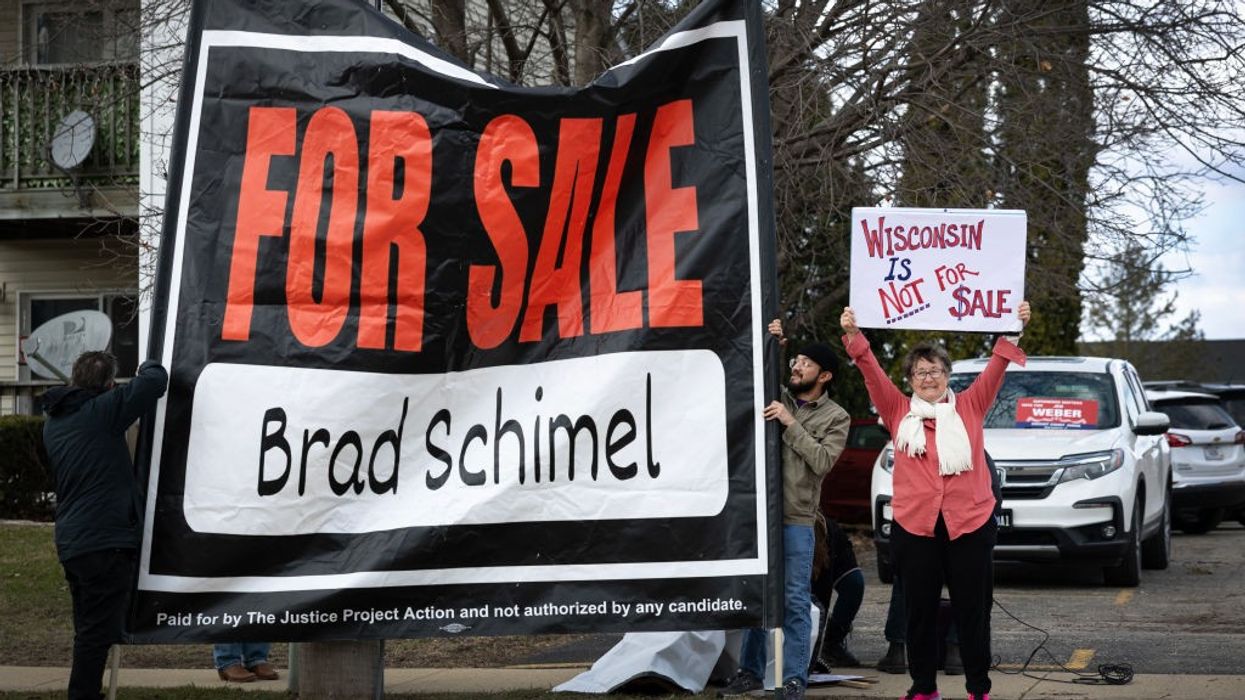
Perhaps it's hard to understand how a state Supreme Court race in Wisconsin could send that message. But Donald Trump himself and his co-president Elon Musk have made that easy. They're in effect betting the farm on candidate Brad Schimel to triumph over Susan Crawford and send the message that voters actually like the chaos that the Trump-Musk tag team has brought to America.
Waukesha County Judge Schimel has gleefully invited them to participate. He has gone out of his way to demonstrate how closely he's linked to the MAGA crowd. Last Halloween he dressed in a Trump costume. Earlier this month he posed for a photo in front of a towering inflatable balloon of Trump at a GOP dinner.
Trump reciprocated with a full-throated endorsement of Schimel's candidacy, an unprecedented involvement of a sitting president in a state court race that's presumably nonpartisan.
“All Voters who believe in Common Sense should GET OUT TO VOTE EARLY for Brad Schimel,” Trump posted on his social media site. “By turning out and VOTING EARLY, you will be helping to Uphold the Rule of Law, Protect our Incredible Police, Secure our Beloved Constitution, Safeguard our Inalienable Rights, and PRESERVE LIBERTY AND JUSTICE FOR ALL.”
Not to mention, of course, banning a woman's choice, making sure the anti-union Act 10 of his friend Scott Walker remains on the books and squelching future attempts to eliminate the gerrymanders of the state's political boundaries.
Meanwhile, the world's richest man is pumping millions into the Wisconsin court race, just like he did in last fall's presidential race. He believes that extravagant campaign spending to buy overly vicious attack ads works. Just this past week, a new set of ads focused on fomenting fear of transgender men in women's locker rooms.
As far as Musk is concerned, this Wisconsin court race is the perfect place to prove his thesis that money and outlandish attack ads work. He used the same tactics against Kamala Harris last fall.
They work, unless, of course, Wisconsin voters say otherwise.
Donald Trump has already put America's richest people in charge of dismantling the U.S. government, exacting supposed savings from programs that mostly benefit those most in need to help extend the tax cuts for the rich that are expiring later this year.
Thwarting this duo's brazen attempt to use Wisconsin to sanction their methods would go a long way to signal the people's disgust — and maybe, just maybe, wake up some Republicans.
"All Wisconsinites deserve the opportunity to live in a state that treats all workers with respect and dignity," one state representative said.
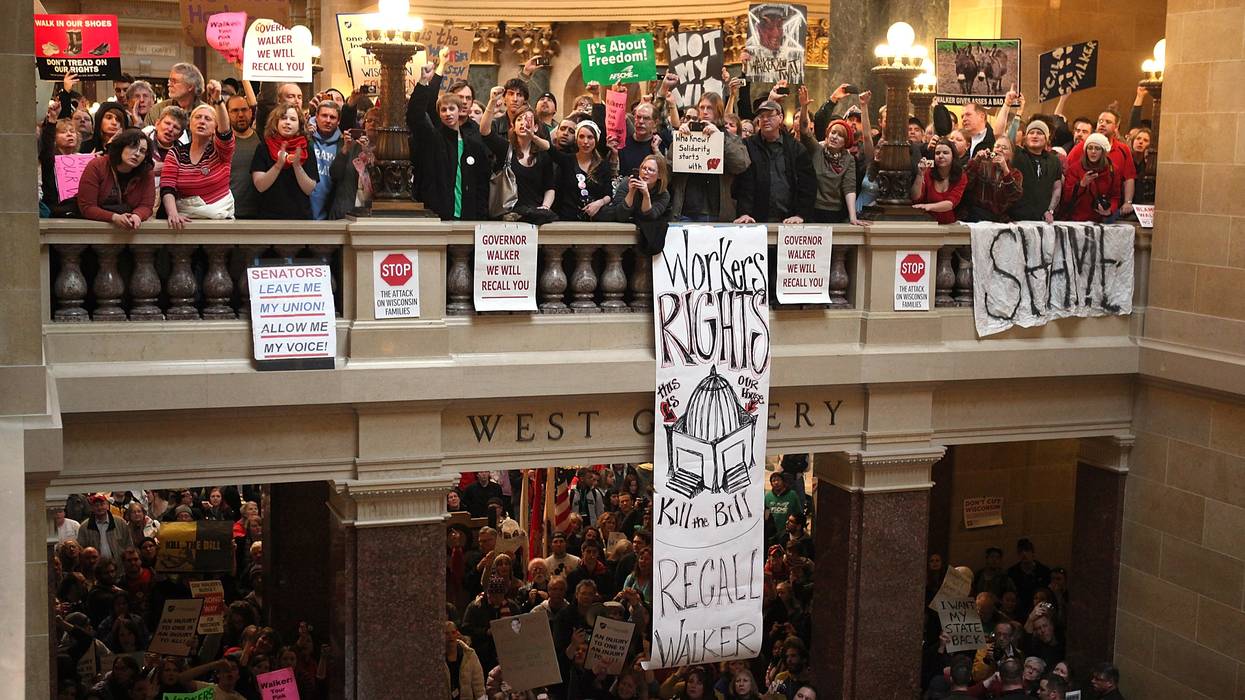
More than a decade after it sparked massive protests in the state capital, a Wisconsin judge on Monday struck down a controversial law that effectively ended public sector collective bargaining in the state.
In his final judgement, Dane County Circuit Judge Jacob Frost crossed out 85 sections of the 2011 law known as Act 10, which was championed by then-Republican Gov. Scott Walker. Frost's ruling restored the union rights of teachers, sanitation workers, nurses, and other public sector employees.
"After 14 years of battling for our collective bargaining rights, we are thrilled to take this step forward," Rocco DeMark, a building service worker and SEIU Wisconsin worksite leader, said in a statement. "This victory brings us immense joy. Our fight has been long, but we are excited to continue building a Wisconsin where we can all thrive."
"We realize there may still be a fight ahead of us in the courts, but make no mistake, we're ready to keep fighting until we all have a seat at the table again."
Act 10 severely weakened the power of public sector unions in Wisconsin by only permitting them to bargain for wage increases that did not surpass inflation. It also raised what public employees paid for healthcare and retirement, ended the automatic withdrawal of union dues, and required workers to recertify their union votes every year.
The law has had a major impact on the Wisconsin workforce. Between 2000 and 2022, no state saw a steeper decline in its proportion of unionized employees, a drop that the nonpartisan Wisconsin Policy Forum partly attributed to Law 10. Unions say that the law has caused a "crisis" for the state's education workforce, as 40% of new teachers leave within six years due to low pay and an unequal wage system. There is also a 32% vacancy rate for state correction officers.
Act 10 had one exception, however: Certain "public safety" employees such as police and firefighters were exempt from the collective bargaining restrictions imposed on "general" employees. It was this division that unions used to challenge the law in November 2023, arguing that it violated the equal protection clause of the Wisconsin Constitution. In July, Frost affirmed that the law was unconstitutional when he struck down an attempt to dismiss the suit. Then, on Monday, he specified exactly which parts of the law would be struck down.
"Judge Frost's ruling is a monumental victory for Wisconsin's working class," Democratic Wisconsin State Assembly Member Darrion Madison told Courthouse News Service. "All Wisconsinites deserve the opportunity to live in a state that treats all workers with respect and dignity."
The lawsuit was brought by Ben Gruber, Matthew Ziebarth, the Abbotsford Education Association (WEAC/NEA), AFSCME Local 47, AFSCME Local 1215, Beaver Dam Education Association (WEAC/NEA), SEIU Wisconsin, Teaching Assistants Association (TAA/AFT) Local 3220, and Teamsters Local 695.
"Today's decision is personal for me and my coworkers," said Gruber, who serves as president of AFSCME Local 1215. "As a conservation warden, having full collective bargaining rights means we will again have a voice on the job to improve our workplace and make sure that Wisconsin is a safe place for everyone."
The news was also celebrated by state›wide advocacy groups and national leaders.
"We applaud today's ruling as a win for workers' rights and as proof that when we come together to ensure our courts and elected leaders are working on behalf of our rights and freedoms instead of partisan antics, we can accomplish great things," said A Better Wisconsin Together deputy director Mike Browne.
American Federation of Teachers president Randi Weingarten said: "This decision is a big deal. Act 10 stripped workers of the freedom and power to have a voice on the job to bargain wages, benefits, and working conditions. It's about the dignity of work. And when workers have a voice, they have a vehicle to improve the quality of the services they provide to students, patients, and communities."
"Former Gov. Scott Walker tried to eliminate all of that, and it hurt Wisconsin," she continued. "Now, many years later, the courts have found his actions unconstitutional."
Rep. Mark Pocan (D-Wis.) wrote on social media, "I voted against Act 10 more than 13 years ago, and am thrilled our public servants are able to once again organize and make their voices heard."
This is not the first time that Act 10 has been challenged in court, but it is the first time since the state's Supreme Court switched from a conservative to a liberal majority in 2023. Since Republican lawmakers have promised to appeal Frost's ruling, the law's ultimate fate could depend on elections in April 2025, which will determine whether the court maintains its liberal majority, according to The Associated Press.
As they celebrated, the plaintiffs acknowledged the legal fight was not yet over.
"We realize there may still be a fight ahead of us in the courts, but make no mistake, we're ready to keep fighting until we all have a seat at the table again," Gruber said.
WEAC President Peggy Wirtz-Olsen said: "Today's news is a win and, while there will likely be more legal legwork coming, WEAC and our allies will not stop until free, fair, and full collective bargaining rights are restored."
Betsy Ramsdale, a union leader who teaches in the Beaver Dam Unified School District, said that public sector collective bargaining rights ultimately helped the state.
"We're confident that, in the end, the rghts of all Wisconsin public sector employees will be restored," she said. "Educators' working conditions are students' learning conditions, and everyone benefits when we have a say in the workplace."
"Wisconsin, for the first time in over a decade, we will not have some of the most gerrymandered maps in America," Evers said.
For the first time since 2011, Wisconsin has state Assembly and Senate maps that do not unconstitutionally favor Republican candidates.
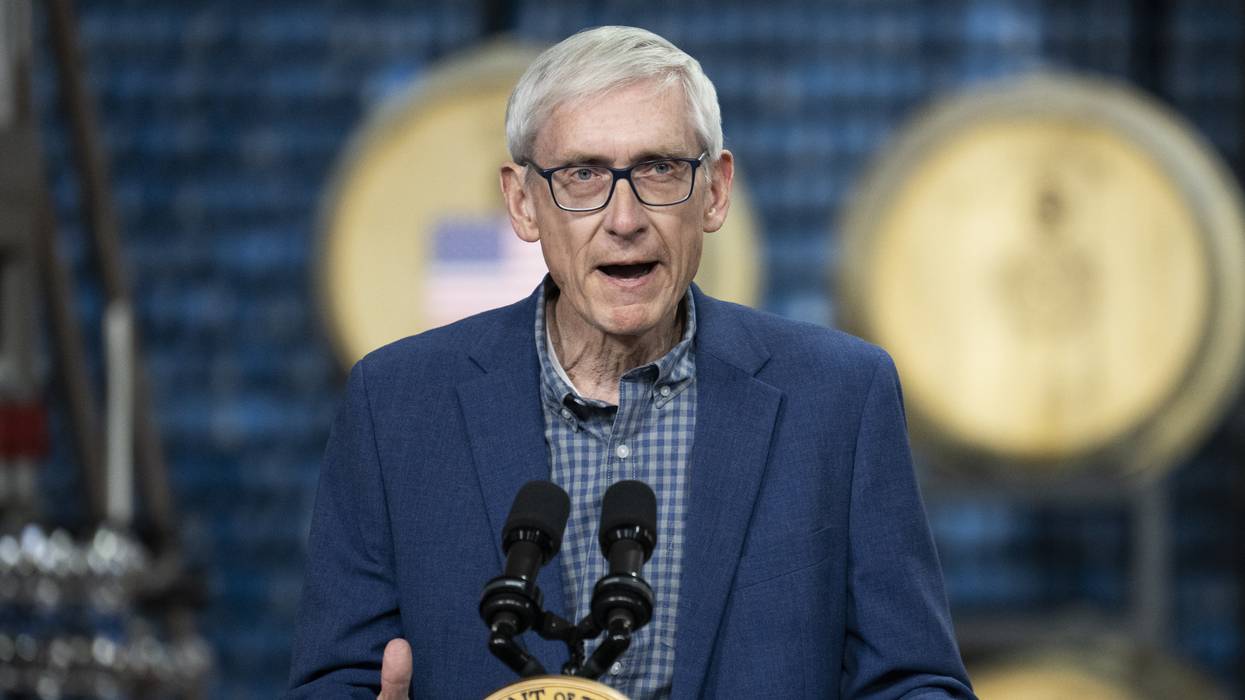
Gov. Tony Evers, a Democrat, signed new legislative maps into law on Monday that were crafted by his office and approved by the state Supreme Court.
"I've promised from the beginning that I will always try to do the right thing. Today, I'm keeping that promise and I'm signing fair maps for Wisconsin," Evers said in a statement posted on social media. "Wisconsin, for the first time in over a decade, we will not have some of the most gerrymandered maps in America."
"This is a win for Wisconsinites, who for decades have suffered under maps that Republicans gerrymandered to protect their power and allow themselves to obstruct action on popular policies while avoiding accountability at the ballot box."
Evers said that Wisconsin was a "purple state," and that its maps "should reflect that basic fact."
"The people should get to choose their elected officials, not the other way around," Evers continued.
Wisconsin has been one of the most gerrymandered states in the nation since 2011, when Republican lawmakers redrew the state's maps under Gov. Scott Walker. In one recent example, the GOP made so many alterations to the 73rd Assembly District in 2022 that residents said it looked like a Tyrannosaurus rex, according to ProPublica.
Fair election groups saw a chance to challenge the maps in August 2023, when the state's Supreme Court flipped from a conservative to liberal majority with the swearing in of Justice Janet Protasiewicz, who had criticized the maps during her campaign. Advocacy groups and law firms filed a suit on behalf of 19 Democratic Wisconsin voters, and, in December, the court ruled that the maps were unconstitutional because the districts were not "composed of physically adjoining territory" as the state Constitution requires.
The court asked different groups to submit new maps and tasked University of California, Irvine political scientist Bernard Grofman and Carnegie Mellon University political scientist Jonathan Cervas with reviewing them, as Wisconsin Public Radio reported. The experts determined that maps submitted by Evers, the Wisconsin Democrats behind the lawsuit, Democratic state senators, and a group of independent mathematicians were competitive, while two by the state legislature and the conservative Wisconsin Institute for Law and Liberty amounted to gerrymandering. Though Evers' maps are slightly more favorable to Republican candidates, the court determined that, using his maps, "the party that wins the most votes will win the most seats."
"The governor's maps are pretty darn good," said Jay Heck, the executive director of Common Cause Wisconsin.
The resolution to the fight over Wisconsin's maps came as something of a surprise, as Republican lawmakers had initially opposed Evers' maps before introducing them last week and passing them through both the Assembly and Senate. GOP legislators said they decided that the governor's maps were their best option.
"This fall Republicans will prove that we can win on any maps because we have the better policy ideas for the State of Wisconsin," Assembly Speaker Robin Vos, (R-63) said, as Wisconsin Public Radio reported.
Most Democrats voted against the maps out of concern that the GOP was not acting in good faith and was in fact preparing a new legal challenge.
"I am voting no because I do not trust what you guys are up to," Sen. Chris Larson, a Milwaukee Democrat, said, as ProPublica reported.
Good governance groups, however, applauded the development.
"This is a win for Wisconsinites, who for decades have suffered under maps that Republicans gerrymandered to protect their power and allow themselves to obstruct action on popular policies while avoiding accountability at the ballot box," Chris Walloch, executive director of A Better Wisconsin Together, said in a statement.
Walloch added that Evers' maps were "a more fair and accurate representation of Wisconsin's diverse communities than other maps proposed by Republicans" and that they would give Wisconsin voters "a renewed chance for competitive elections and a truly representative government for all." He also expressed gratitude to the state Supreme Court and Evers for making the new maps possible.
Walloch concluded: "We deserve a legislature that represents us as constituents and prioritizes our best interests. MAGA faction politicians and their special interest allies have gone to great lengths, and great expense, to protect a rigged system that benefited them, and we will continue to hold accountable any politician who attempts to obstruct today's progress."
The Democratic Legislative Campaign Committee (DLCC) said they saw the new maps as an opportunity, especially since the entire Wisconsin Assembly and half of its Senate are up for re-election in November, when the new maps will be in use.
"While we still have more work to do to ensure fair representation in each and every Wisconsin community, with these new maps in place, the Democratic Legislative Campaign Committee reaffirms its commitment to reverse the Republican takeover of this state and shift the balance of power in both the Wisconsin Assembly and the Wisconsin Senate," committee president Heather Williams said in a statement.
"Wisconsin is a top priority for the DLCC in 2024, and we're already hard at work building the campaigns that will fuel our legislative gains this fall," Williams continued. "The time for fair representation in Wisconsin is long overdue, and we are building winning campaigns and sustainable infrastructure to build power this cycle and ultimately take back both majorities."
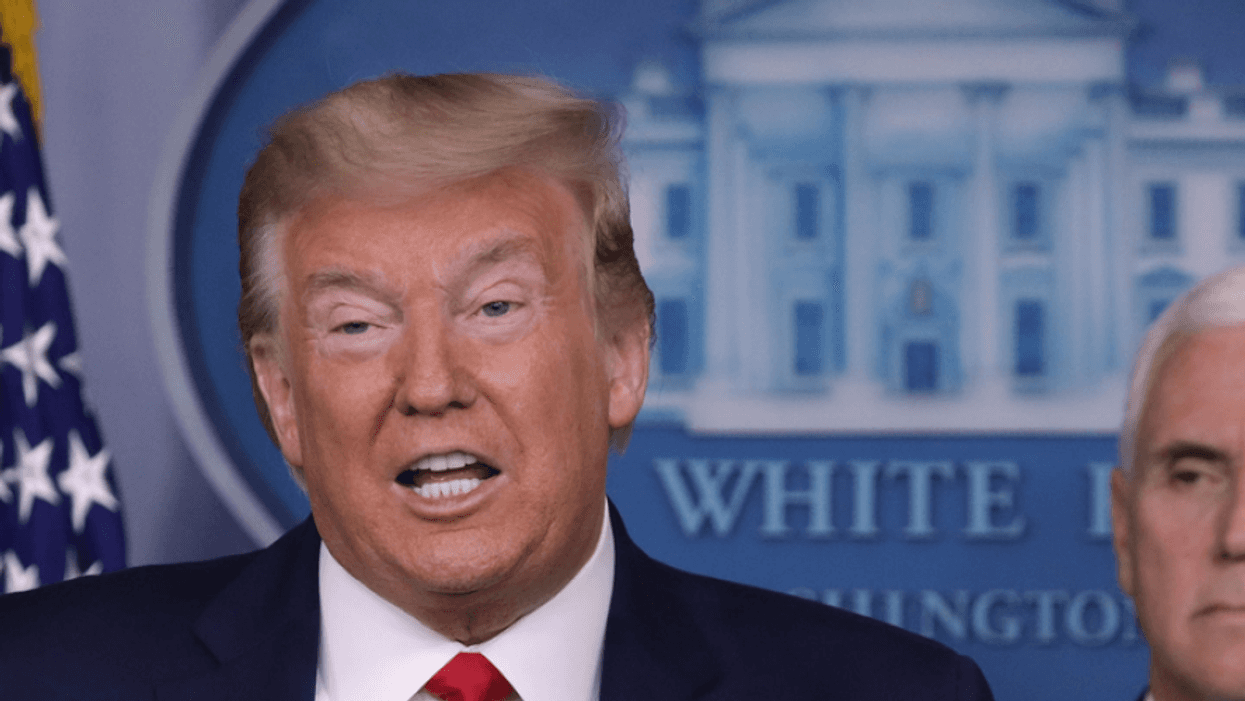
In a direct attack on China and a clear indictment of international cooperation to combat the COVID-19 pandemic, U.S. President Donald Trump unilaterally ordered withholding funds from the World Health Organization. In a White House statement, Trump accused the international body of "preferential treatment" for China and "mismanaging" the pandemic.
Not only is this racist strategy a blow to democracy in the U.S., but it also puts many lives at risk, here and around the world.
Aside from the glaring hypocrisy and irony of Trump's projection of his mismanagement of the crisis onto international actors, the move is part of a broader Trump campaign strategy in the run-up to the November presidential elections. The strategy entails using anti-Chinese xenophobia and racism to mobilize white voters to support Trump and Republican candidates.
Not only is this racist strategy a blow to democracy in the U.S., but it also puts many lives at risk, here and around the world.
U.S. public opinion has turned sharply against the Trump administration because of its unsympathetic incompetence in handling the epidemic .
Trump ally and right-wing columnist Ben Shapiro, in social media and published columns, promoted this racist strategy. He senselessly defended the racist use of the phrase "Chinese virus." Shapiro and other Republican commentators and politicians have used the term to blame China for the pandemic openly. "The Chinese government is chiefly responsible," he wrote, and described it as having been deliberately "unleashed."
In a tweet in mid-March, Shapiro wrote, "If the media want Trump re-elected by massive numbers, they should keep asking him why he's mean to China after they unleashed coronavirus on an unsuspecting world." Shapiro claimed that the virus originated because of alleged Chinese unsanitary food culture, and implied that the Chinese government used it as an attack on the U.S.
Florida Republican Sen. Rick Scott recklessly accused China of causing the pandemic with the WHO as an accomplice. "The bottom line is the WHO's actions and China's actions killed a lot of people," the Trump ally claimed. Scott, who went unpunished for his part in a massive medical fraud scandal as the CEO of Columbia/HCA, represents a state that is usually considered a toss-up in presidential elections.
Other Republican politicians attempted to promote conspiracy theories about the origin of the virus to fuel this campaign strategy. Sen. Tom Cotton of Arkansas cruelly claimed that the virus originated in a military facility supposedly near Wuhan, China, and was deployed as a military operation.
These contradictory conspiracy theories were echoed by Sen. Lindsey Graham of South Carolina, who added the demagogic and odd proposal that the U.S. should refuse to pay the public debt owed to China. Graham's demand seemed to indicate his low-level of knowledge of how the international bond market works.
Given the contradictions between Shapiro's and Cotton's theories about the origins of the virus, it is evident that Republican campaign strategists do not care about learning or sharing scientific truths about the disease. Instead, they want to promote fear and hostility to deflect from the incompetence of the Trump administration and his callous response to the deaths of tens of thousands of Americans.
A group of scientists prudently cautioned, "Conspiracy theories do nothing but create fear, rumors, and prejudice that jeopardize our global collaboration in the fight against this virus."
In an open letter published in the British science journal The Lancet, a group of scientists prudently cautioned, "Conspiracy theories do nothing but create fear, rumors, and prejudice that jeopardize our global collaboration in the fight against this virus."
False and racist rhetoric as a strategy in the presidential campaign has coincided with a surge of anti-Asian racism and hostility in the U.S. In late March, the New York Times interviewed dozens of Asian Americans, who reported being yelled at, spit on, and treated with hostility since Trump's decision to deflect his incompetence with anti-China rhetoric.
"The rhetoric from the nation's highest office is creating a climate of hate that is permeating the country and putting people at risk," warned Southern Poverty Law Center's interim CEO Karen Baynes Dunning. "There has been an increase in reports of bias-related attacks against Asians and Asian Americans in communities and online."
In the state of Michigan, also a hotly contested state in the presidential election, "multiple reports of discrimination and bias incidents targeting Asian Americans and individuals of Asian descent in Michigan" raised new alarms, according to the Michigan Civil Rights Commission.
Denise Yee Grim, who serves on the Michigan Civil Rights Commission, in a public message directly to President Trump, said, "You just put a target on the Asian community." She cited physical assaults on Asian people as well as boycotts of Asian-American owned businesses.
Republican rhetoric about the virus and China fans the flames of racist hatred. The president and his allies crave racist violence, abuses, and hostility to flourish between now and the election, perhaps even permanently. These so-called leaders might as well be walking the streets themselves lashing out at Asian Americans. But they will leave that work up to their emboldened fans and followers.
In Michigan this week, the Republican Party mobilized a pro-Trump political rally that defied medical advice about social distancing and demanded an end to the statewide stay-at-home order.
In Michigan this week, the Republican Party mobilized a pro-Trump political rally that defied medical advice about social distancing and demanded an end to the statewide stay-at-home order. The Republican Party rally was fueled in part by a widespread fear of Michigan Gov. Gretchen Whitmer's popularity for authoritatively taking on Trump's callous response to the pandemic and forcing him to use more federal resources to address it.
In part, the rally organizers were motivated by Trump's widespread lies and distortions of the "stay-at-home" policy spread, Sen. Ted Cruz of Texas, and Republican media personality Meghan McCain. For her part, Whitmer ordered a moratorium on utility shut-offs and extensions for rent payments, won promises from health insurers to pay for COVID-19 testing and treatment, and accessed stockpiles of persona protective equipment for healthcare workers and a host of other worker protections during the pandemic.
The pro-Trump political rally prompted participation from large groups of heavily armed right-wing militias along with the white supremacist Proud Boys waving the Confederate flag. Dark money groups tied to Education Secretary Betsy DeVos and the Trump campaign funded the event.
Public health experts warned that the gathering of so many people for the Republican Party rally could result in the further spread of the virus and necessitate an extension of the "stay-at-home" order.
Right-wing media has taken up Trump's demand to force people to defy medical advice to stay at home during the pandemic and return to the workplace. Anti-worker ideologue Scott Walker told Fox News that workers should be forced to return to manufacturing first. Companies should close down break rooms, he said, and force workers to stay at their machines.
TV-Dr. Oz told Fox News that authorities should force children back to school. Describing that idea as "appetizing," Oz claimed that a 2-3% mortality would be likely but acceptable to him.
The energized campaign to force people back to work and back into the public puts the lives of workers and their families at risk of infection, illness, and death.
Adding to the push to force workers back into the economy and children back into schools was another celebrity "Dr." Phil McGraw. McGraw told his viewers that staying at home to stop the spread of COVID-19 would have economic effects that would be deadlier than the disease.
The energized campaign to force people back to work and back into the public puts the lives of workers and their families at risk of infection, illness, and death. It dovetails with right-wing callousness and resistance to public interventions during times of social crisis. It highlights the worst characteristics of neoliberal political strategies that aim to privatize public entities and energize the predatory nature of the corporate sector to profit from disaster.
More fundamentally, this move exposes how desperate capitalism is to access the labor-power of the 22 million workers who have been laid off and the millions more whose productivity has been drastically reduced due to the pandemic. Because capitalism cannot operate without the labor-power of workers, the profits of the capitalist class are in danger. Thus, they have mobilized right-wing callousness to shift the public discourse from solidarity against the disease and support for the working class in this crisis to the return to work.
The Trump campaign and the Republican Party have shown themselves willing to align with this capitalist urge. They have used campaign and public resources to mobilize their fringe allies in the militia movement, as well as neo-Nazi and neo-Confederate elements to threaten public officials who resist forcing workers into dangerous exposure for the sake of Wall Street profits.
Two groups from outside of Wisconsin may have been responsible for President Donald Trump's narrow win in the state in 2016, according to a recently obtained "confidential" report.
The groups have used their "independent" brand name to appeal independents, an advantage Higgins touted to donors at an event in 2015: "Being branded as neutral, but actually having people who know know that you're actually conservative puts us in a unique position."
Between October 29 and November 7, 2016, sister groups Independent Women's Voice and Independent Women's Forum, two nonprofits based in Washington, D.C., launched a campaign to target registered independents and Republican-leaning women in Wisconsin. These efforts moved independent voters in the state by 16 percentage points toward Trump, says the report, which was prepared for both groups by Daron Shaw, a professor at the University of Texas, Austin.
The groups targeted approximately 1.54 million registered voters with multiple choice and 'true or false' quizzes, consisting of questions on the Affordable Care Act and the U.S. Supreme Court. The quizzes were delivered via digital outreach, postcards, and phone calls starting eleven days before the 2016 presidential election.
Heather Higgins, an heiress to the Vicks VapoRub fortune who has led the groups' boards for years, summed up Shaw's findings: Had the quiz messaging not occurred, "Trump would have received an estimated 215,840 fewer votes in Wisconsin, the state completely written off by all the political professionals."
Her website for the group added that without the groups' intervention, "both Trump and [Wisconsin Republican U.S. Senator Ron] Johnson would otherwise have lost Wisconsin by over 100,000 votes each."
Trump won the popular vote in Wisconsin by less than 23,000 votes.
True North Research, a research organization I founded and lead, has just issued a report about the groups, whose election-season activities flew below the radar of most national and state media outlets. It documents the groups' involvement in the 2016 election, as elucidated by Shaw's report, which was obtained by True North last year.
As Shaw's description of Higgins's strategy highlighted, most of the funding to influence women voters came from the Independent Women's Forum, the 501(c)(3) arm of the duo.
That's troubling, Marcus Owen, the former head of the agency's tax-exempt organizations division, told the Center for Media and Democracy. He noted that the IRS stipulates that 501(c)(3) charities "must avoid any issue advocacy that functions as political campaign intervention," whether they name a candidate or not.
Shaw suggested in his report that the potency of the messaging by the Independent Women's Forum and Independent Women's Voice was attributable in part to the power of repeated quizzes to reinforce the answers suggested. As he explained it:
"[E]ven relatively modest quiz messaging can have an impact on people, especially with respect to their knowledge of issue and policy arguments. However, to persuade people about the salience of the issue, or to move broader attitudes on the issue, it seems that multiple 'touches' and different modes of outreach are necessary, as we saw in the Wisconsin test."
The Independent Women's Voice used its outreach to tie those issues to the election.
Shaw found that the quizzes made Wisconsin independents 16 percent more likely to vote for Trump. He also found that the quizzes were more effective with Republican and independent women than with men in making women "more likely to support Trump over Clinton" (17 percent versus 11 percent).
Since 2010, Independent Women's Voices has been deploying women to tell other women to worry about government health insurance interfering with their access to doctors.
The groups have used their "independent" brand name to appeal independents, an advantage Higgins touted to donors at an event in 2015: "Being branded as neutral, but actually having people who know know that you're actually conservative puts us in a unique position."
Although the quizzes were not included in Shaw's report, the website for Independent Women's Voice has quizzes on the Affordable Care Act (ACA) and on the importance of the U.S. Supreme Court (from when Senator Mitch McConnell was blocking President Barack Obama's ability to appoint Merrick Garland). Another quiz combines the two issues.
Since 2010, Independent Women's Voices has been deploying women to tell other women to worry about government health insurance interfering with their access to doctors. The group has also created numerous sites attacking the ACA, particularly around pivotal elections.
Higgins's groups poured millions into ads and other marketing efforts in 2016. Although the amount spent in Wisconsin alone was not reported, the two groups spent a combined total of more than $3.7 million that year. The Independent Women's Forum carried the bulk of that expense, spending more than $2.5 million on what they called "active engagement and market evaluation."
Independent Women's Voice also spent almost $700,000 on "active engagement" and communications, plus nearly $500,000 on polling in 2016.
In contrast, in 2015, the two groups spent only $12,000 on what they called active engagement.
Since 2016, my research found that the groups have raised nearly $20 million, not counting any funds raised in the past fourteen months. In the last presidential election year, donors gave them more than $8 million. That year, they targeted Wisconsin, Pennsylvania, and New York, but Shaw concluded their messaging was not as effective in the latter two states, where there was more "noise" from spending by others.
The Independent Women's Voice also issued individual press releases applauding sixty-eight members of Congress who were re-elected after signing a repeal "Obamacare" pledge, including one for Senator Johnson of Wisconsin.
How much the groups will raise and spend this year is not yet known.
Higgins has been focused on Wisconsin since at least 2011, when her groups worked to influence voters' views of unions as Republican Governor Scott Walker faced a potential recall from office. She later claimed the Independent Women's Voice played a decisive role in his success in remaining in office.
Here's how she described that race:
"IWV's research showed that the core belief among Independents who opposed Gov. Walker's reforms was that public employees are underpaid and are making a sacrifice to hold those jobs. Through our educational program, we changed this foundational belief into an understanding that unionized public employees are overcompensated relative to the private sector."
According to Higgins, "support for Scott Walker increased by 31 points among 10,000 likely voters who received our message . . . even though we made no reference to Walker, his reforms, or the recall."
The Independent Women's Voice and Independent Women's Forum grew out of a group of women who were friends of Clarence Thomas and defended him against allegations of sexual harassment during his Supreme Court confirmation hearing in 1991.
They argued, essentially, that because he had not sexually harassed them, he could not have harassed Anita Hill, despite her testimony under oath. Thomas, who angrily denied Hill's charges, was confirmed to the U.S. Supreme Court.
Since then, the Independent Women's Forum has countered the unequal pay claims of the U.S. women's soccer champions and opposed Title IX's guarantees for equal opportunity for athletics for women and girls, among other things.
More recently, the group has attacked a proposal to add a small payroll tax to fund paid leave to care for oneself or a loved one, and urged instead that parents borrow from future Social Security payments to cover time off for a newborn.
Independent Women's Voice has also repeatedly backed male candidates over women, as when it helped Scott Brown, a Republican U.S. Senate contender in Massachusetts, beat Martha Coakley in 2010. Three years later, Independent Women's Voice claimed to have played "a unique and critical role" in South Carolina Republican Mark Sanford's Congressional election win against Democrat Elizabeth Colbert Busch. It even made $176,991 in independent expenditures on behalf of Richard Mourdock in 2012, after the Republican contender for U.S. Senate in Indiana said that, when a woman gets pregnant from being raped, "it's something God intended."
And both groups went to bat for Brett Kavanaugh, as he denied attempting to sexually assault Dr. Christine Blaisey Ford.
The Independent Women's Voice received $4 million from the Freedom and Opportunity Fund, one of conservative operative Leonard Leo's dark money groups, as they fought to keep President Obama's nominee from getting a hearing and while helping make sure President Trump's nominees were confirmed.
In the Trump Administration, the leaders of these two women's groups are gaining an even larger voice.
In 2018, Heather Higgins was appointed by then-House Speaker Paul Ryan to the U.S. Commission commemorating the centennial of the passage of the 19th Amendment, giving women the right to vote. Last November, she was invited to the Oval Office as Trump signed a bill to honor this occasion with a commemorative $1 coin.
Kellyanne Conway, a White House counselor, is a former director on the Independent Women's Forum board and for years was one of the pollsters the Independent Women's Voice used in Wisconsin and elsewhere.
Political observers have long debated how Trump was able to win Wisconsin in 2016. Pundits often cite Trump's digital campaign, the Republican's efforts at voter suppression, Hillary Clinton's failure to visit Wisconsin after Bernie Sanders won the primary, third party votes for Jill Stein, and even documented Russian interference. But the press in Wisconsin has largely failed to cover the role of these stealthy "independent" women's groups.
Whether the groups played as big a role as Higgins claims may never be known. The only question now is whether she will repeat the same game plan in Wisconsin and other swing states in 2020. If so, we need to make sure folks are paying attention this time.
There is no more ardent champion of Wisconsin's progressive tradition than John Nichols, national affairs correspondent for The Nation and associate editor of The Capital Times and the author of many books, including "The Genius of Impeachment," "The Death and Life of American Journalism" (with Robert McChesney) and "The Capital Times: A Proudly Radical Newspaper's Century Long Fight for Justice and for Peace" (with Dave Zweifel).
Nichols became the ebullient face of the uprising against then-Gov. Scott Walker in 2011 (and wrote a book about it, "Uprising: How Wisconsin Renewed the Politics of Protest from Madison to Wall Street"). He delivered fiery speeches to giant crowds gathered outside the Capitol building in Madison, and appeared countless times on national television, even bringing his friend Ed Schultz to town to set up a huge MSNBC stage in front of the Capitol.
From his earliest years, Nichols was a journalist. He started writing for the daily newspaper in Union Grove, Wisconsin, when he was 11 years old. When I first met him, in the early 1990s, he was the national correspondent for newspapers in both Toledo and Pittsburgh. I remember catching up with him at the Democratic Convention in 1996, where he was busy filing more than 50 stories in the space of a week.
Despite his frenetic work schedule, Nichols is, as anyone who lives in Madison can attest, always ready to stop and chat. He is a fixture at the local farmer's market, where he can be found greeting thousands of his closest friends with a cheerful "Hey, comrade!" on any given Saturday. He produced many of his books at Ancora coffee shop in downtown Madison, steps away from the Wisconsin Examiner's new office.
Nichols, together with his writing partner Robert McChesney, has thought as deeply as anyone in America about the crisis in journalism, as well as in our democracy, and about how the two are related.
I caught up with him at his home in Madison to talk about what we are trying to do here at the Examiner. As usual, he was happy to share his thoughts.
RUTH CONNIFF: You wrote a book about journalism in Wisconsin. What's your sense of where it stands today?
JOHN NICHOLS: It's in a bad way. There's a void, a gap that we'll talk about in a moment. You and your colleagues will help to fill it, which is vital for renewing and sustaining Wisconsin democracy. But let's start by putting things in perspective.
The editor I wrote about with my friend and colleague Dave Zweifel was William T. Evjue, the founder of The Capital Times who said, "Let the people have the truth and the freedom to discuss it and all will go well." There were not enough truth tellers in Evjue's time. Things were never perfect. But there are even fewer journalists who are employed as truth tellers today.
Newspapers have closed across the state -- including the weekly paper in Union Grove that I started writing for at the age of 11. Radio stations have eliminated local news operations, which has had a devastating impact in small towns where they were essential parts of local life -- broadcasting the high school football games and school board meetings and the reports of births and deaths. Television stations have become increasingly homogenized, with packaged reports that are designed to get ratings rather than to provide coverage of the towns, villages and cities where we live. They overwhelm us with weather reporting but never get around to the steady coverage of city councils and county boards and state government that people have to have if they are going to govern their own lives.
We've seen wave after wave of consolidations and mergers and, above all, cuts to staffing in newsrooms. Over the past decade, according to the Pew researchers, we have lost a quarter of newsroom jobs nationwide. And I would submit that Wisconsin, a state that historically benefitted from a great deal of diverse and contentious journalism, has seen the worst of it. These losses are across the board: in print, broadcast and online. Amusingly, you still hear people suggest that online media will fill the void. But there is scant evidence that this will be the case. In fact, when we studied the numbers a few years ago we found that, for every 10 job losses in traditional newsrooms, there was at best one hire in an online newsroom. Anyone who has been paying attention has seen the reports that online media outlets have been struggling over the past few years with many of the same challenges as so-called "legacy" media. The challenge is an economic one, and it cuts across media platforms.
RC: You believe that a cornerstone of democracy is being weakened. Is that an urgent moment -- especially in states such as Wisconsin?
JN: Absolutely. Advertising no longer sustains newsrooms in the way that it once did, and that means that we're beginning to see news deserts: communities, whole regions, that are simply not being covered in any real sense. While the places where the wealthy cluster may still be covered, vast stretches of urban and rural America are now neglected by major media outlets. By some estimates, as many as 1 in 5 Americans now live in news deserts, and the problem is rapidly growing worse.
By some estimates, as many as 1 in 5 Americans now live in news deserts, and the problem is rapidly growing worse.
Cuts in the coverage of low-income and working-class communities are a huge issue. They make it harder to tackle inequality, to identify environmental racism, to preserve services and to maintain robust democracy. And the damage is compounded by cuts in statehouse coverage.
Unfortunately, when newspapers and broadcast outlets make newsroom cuts, reporting on state capitals and state courts is invariably reduced. That compounds the crisis because people know less about how to respond to the challenges. An overemphasis on coverage of Washington makes people think that answers come from the federal government when, in reality, people have far more ability to influence state government.
The problem is that Wisconsinites and people across the country are getting less statehouse news. The Pew folks found that, over a roughly 10-year period concluding in 2014, the number of statehouse reporters nationwide collapsed by 35 percent. Every indication is that the decline has accelerated since then. There's a recent study out of Oregon that shows the number of statehouse reporters has declined by two-thirds since 2005. And no one would suggest that the picture in Wisconsin is much better.
RC: Yet, statehouse coverage remains important.
JN: Vitally important. The states are still what Robert M. La Follette and Louis Brandeis understood them to be: our laboratories of democracy. The states are where great reforms are initiated, as Wisconsinites know. It's not just that this state led the way on the issues that mattered at the start of the last century: progressive taxation, unemployment compensation, primary elections to break the power of the political bosses. This is the state that led on conservation and environmental protection in the 1960s and 1970s, on LGBTQ rights in the 1980s, on state-based responses to the health-care crisis such as Badgercare and FamilyCare.
Journalists who want to see where new ideas are coming from have historically looked to progressive states such as Wisconsin and Oregon because these are the places where the future is written. It is very rare that policy innovations come from Washington. In part that is because the special interests that defend a corrupt status quo concentrate their resources on electing a Congress that will serve their interests. No matter what party is in charge in DC, there is pressure from bankers and CEOs and their lobbyists for deregulation and tax cuts. The Republicans have tended in recent decades to be more inclined to be subservient to corporate interests than the Democrats, but remember that Bill Clinton championed the disastrous deregulation of Wall Street in the late 1990s and that Democrats joined Republicans in supporting the bailout of the banks in 2008. So Washington is a mess. At best, there's a little more hope in the states.
RC: But that hasn't really been the case in Wisconsin in recent years
JN: Unfortunately, the same forces that seek to influence decisions in DC also spend money on electioneering and lobbying in the states -- as Wisconsin saw when the Koch brothers and their allies poured money into electing Scott Walker and Republican majorities in the legislature. Walker's governorship was a time of retrenchment for Wisconsin. Instead of innovating, Wisconsin's elected leaders literally borrowed templates from right-wing "think tanks" in Washington rather than listening to Wisconsinites. We need journalism to expose this dumbing down and bartering off of policy making.
There are still some fine reporters covering the Capitol here. I'm associated with The Capital Times, Wisconsin's historic progressive newspaper, and I'm very proud of the fact that we maintain serious investigative reporting and a good deal of statehouse coverage -- as well as an aggressive editorial page. The Associated Press and Wisconsin Public Radio still provide some excellent coverage. The [Wisconsin] State Journal makes an effort, as does the [Milwaukee] Journal Sentinel -- especially Dan Bice. I also give high marks to Isthmus, the Center for Media and Democracy and the Wisconsin Center for Investigative Journalism. But we would be lying to ourselves if we imagined that there is sufficient day-to-day coverage of the legislature, state agencies and the state courts.
RC: How big a gap is there?
JN: An overwhelming one. As I said, we have some fine people making an effort to cover politics and policy in Wisconsin. But it would be absurd, and shameful, to suggest that there are enough reporters on the beat. There simply are not.
One of the big challenges is this: We have media outlets that do important investigations and feature stories. The problem is that traditional beat coverage just isn't happening. Let me give you an example: It has been devastating for Wisconsin that there have not been teams of reporters covering the Foxconn debacle and the mess with WEDC [the Wisconsin Economic Development Corporation] and what passes for economic development in Wisconsin. This is a full-on, clown-car parade. National publications have done tons of exposes regarding Foxconn yet many Wisconsinites are still under the illusion that this was a credible economic development deal. It never was credible, and it never would have gotten as far as it did if there was serious and sufficient day-in, day-out coverage.
Of course, that's just the beginning of the void. In a state of 5.8 million people, we really should have multiple reporters from multiple publications and broadcast outlets covering not just the governor and the legislature, but the day-to-day workings of state agencies such as the Department of Revenue, the Department of Transportation and, of course, the Department of Corrections. There has been some fine reporting on some egregious circumstances for incarcerated young people, but understand this: If we had consistent beat reporting on the criminal justice system, we would be see dramatically more progress toward the criminal justice reforms that are so urgent.
The Supreme Court and the state appellate courts should be covered by reporters from different publications with different perspectives -- and there should be several reporters covering the Supreme Court elections beat. Supreme Court elections are different from elections for other state posts -- different rules, different streams of money, different ethical concerns and impacts. Yet, they tend to be covered as standard political campaigns. That feeds into a cynicism regarding the courts and, frankly, empowers those who would corrupt the courts by politicizing them.
But it's not just about the institutions. It's about the issues -- profound issues that are changing Wisconsin.
Wisconsin is experiencing a farm crisis. This state should have reporters covering the state Department of Agriculture and the intersection of its operations and those of the federal Department of Agriculture, Trump's tariff machinations and all the related issues. This is "America's Dairyland," but farm and rural issues tend to be treated as an afterthought by most media.
RC: What's the most serious gap in coverage?
JN: I'd say the corruption crisis. Our political campaigns are guided by out-of-state donors and consultants, not candidates and voters. Our legislative chambers are gerrymandered. Our court races are politicized in ways that are dramatically at odds with how they were designed to be run. And, mark my words, the 2021 contest for state Superintendent of Public Instruction will be a brutal battle that is slathered in outside money.
We need a lot more journalism. Fast!
RC: That's what we're trying to do.
JN: Good. Every expansion in the pool of journalists covering Wisconsin is an exciting prospect. And it becomes more exciting because of the people involved -- experienced men and women who understand the state and the issues. What you and your colleagues are proposing to do is important. It begins to fill the void. I'm afraid the key word is "begins." There will still be a void, but putting more reporters on the beat matters now more than ever. Ultimately, we have to identify new revenue models, new structures. The fight for the future of journalism in Wisconsin and nationally -- indeed, internationally -- is a critical one. What we want is more journalism and, frankly, more competition, with lots of different beats and lots of different perspectives. The point isn't just the journalism. It's the democracy, because Evjue's equation is still the right one: "Let the people have the truth and the freedom to discuss it and all will go well."
Most Americans don't realize it, but the United States didn't always have a President. From 1781 to 1789, the nation was governed by the Articles of Confederation, which due to fears about creating another king put all the power in the hands of the states. This quickly became unworkable, so the states called for the Philadelphia Convention, where they disposed of the Articles of Confederation and drafted the Constitution of the United States.
Yet the new document included a provision, Article V, stating that if two-thirds of the state legislatures agree, they can call another Constitutional Convention, where, like the original Philadelphia Convention, they can meet-up and create a new constitution.
That would be a hard sell to most Americans, but what if the convention was narrowly sold as a way to force those rascals in Washington, D.C., to live within their means and pass a Balanced Budget Amendment? Who's not concerned about the runaway national debt?
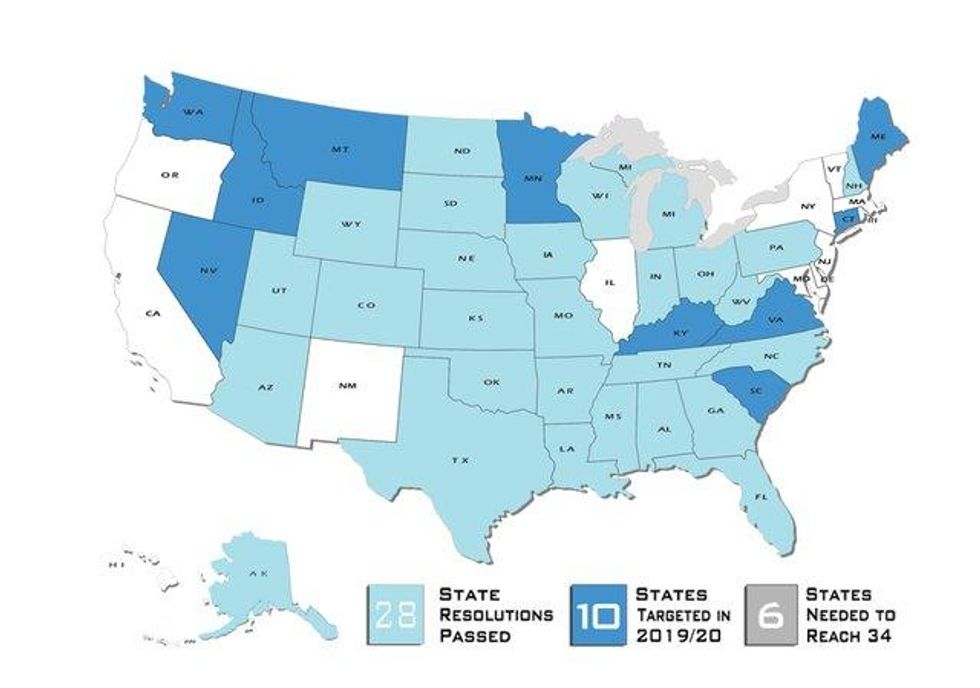
That's pretty much been the pitch of the awkwardly named Center for State-led National Debt Solutions (CSNDS), which in recent years, (thanks to some heavy lifting from the American Legislative Exchange Council), has quietly gotten twenty-eight of the thirty-four states necessary to sign-up under the auspices of passing a Balanced Budget Amendment (BBA).
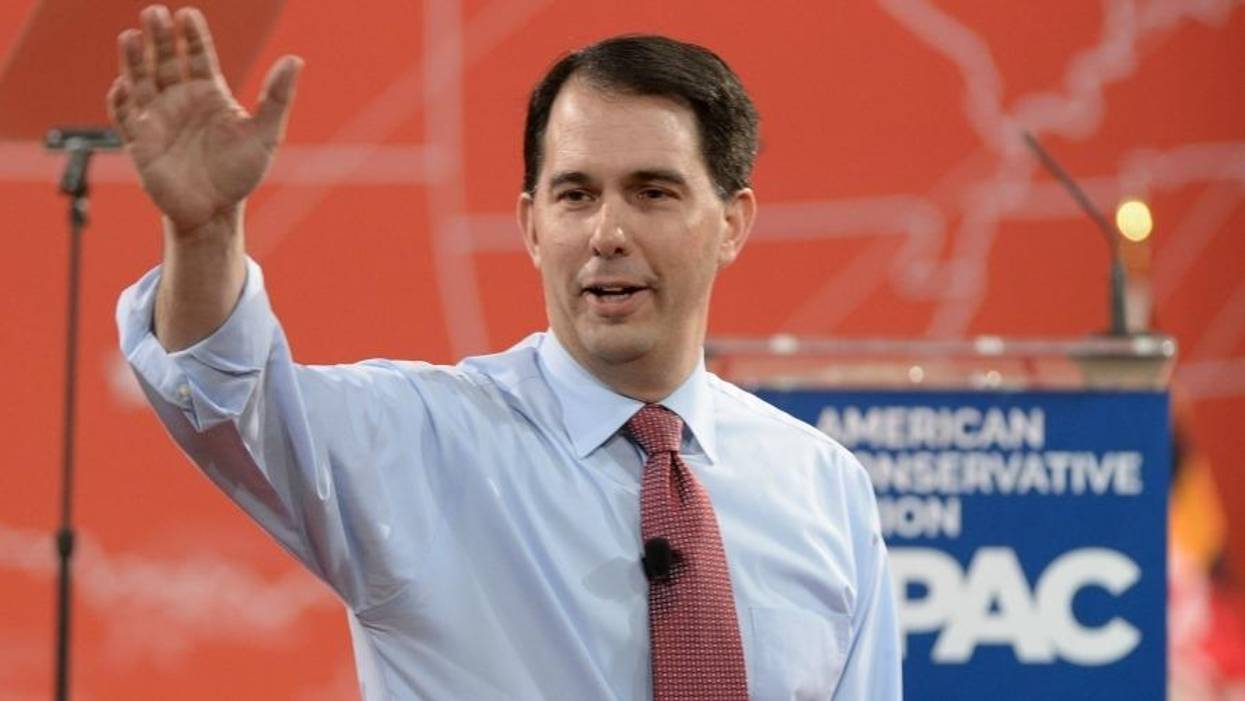
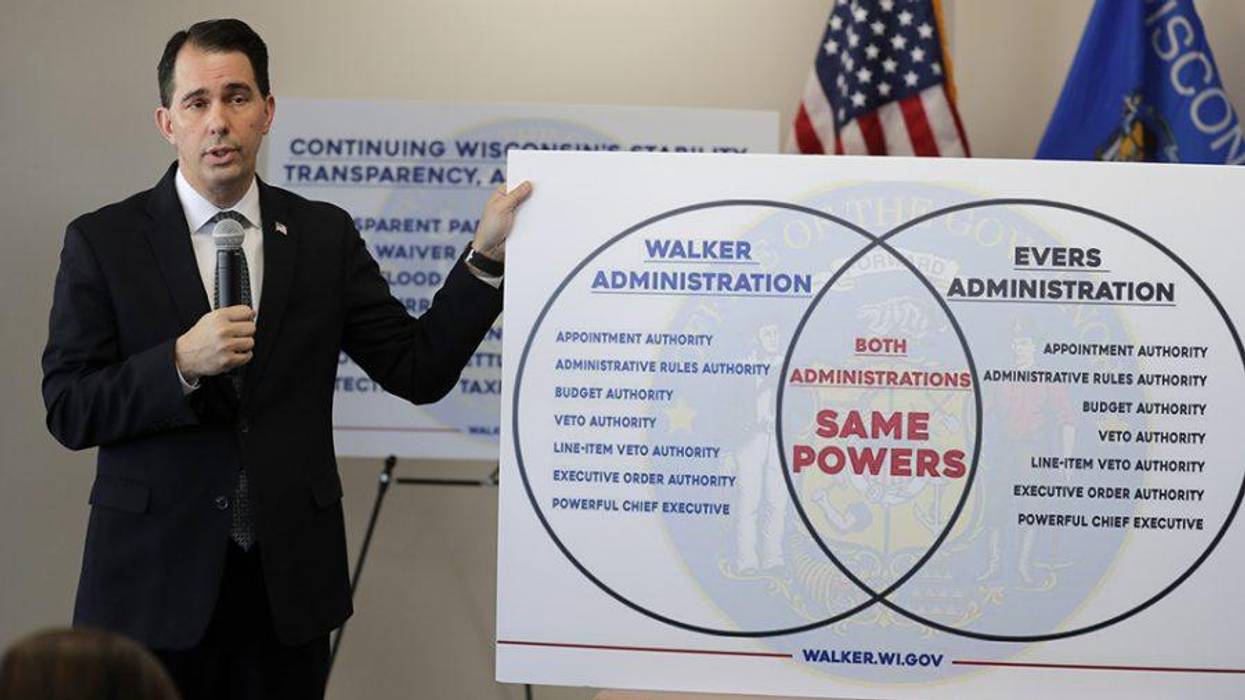
Last week, the group tapped former governor Scott Walker as its new leader.
Of the ten states that CSNDS, which in recent years has merged with the Balanced Budget Amendment Task Force, has targeted in 2019-20 (see map below), Republicans have full control of the state legislatures in five. In other words, the thirty-four-state threshold is very much in grasp.
Scott Rogers, who served as executive director for Task Force for a Balanced Budget Amendment for seven years, says his old organization is actually an elaborate bait-and-switch scheme that is hiding its true intentions, as its pick of Walker makes clear.
"The movement became less about reforming our nation's government, but a vehicle to limit and destroy the power of the federal government."
"Scott Walker isn't working for a balanced budget amendment and neither is the movement," Rogers tells The Progressive. "When I first became involved with the Article V movement, it was much more open to bipartisan efforts, and as a registered Democrat, I felt like I could work across the aisle to ensure a fiscally responsible government. However, as the years went on, the movement took a darker turn. It became less about reforming our nation's government, but a vehicle to limit and destroy the power of the federal government."
According to Rogers, "The movement is about using constitutional change to destroy the power of the federal government in the name of old-fashioned 'states rights.' This is nothing but a polished, media-friendly version of the 'states rights' advocated by southern racists in the 1960s."
Currently serving as the mayor of Charles Town, West Virginia, Rogers believes that once a convention commences, it will "enshrine the doctrines of the Koch Brothers, ALEC, and the religious right" and "endanger the civil rights we all hold dear. One could expect them to pass anti-LGBT amendments, amendments that would limit the ability of African-Americans to vote, the ability of woman to control their own reproductive health, and the list goes on and on."
Rogers says another part of the group's strategy to trigger a convention is to bring in people on the left with promises of a Constitutional amendment to overturn Citizens United and address other campaign-finance -reform concerns. Although campaign-finance-reform groups such as Common Cause and Democracy 21 are strongly opposed to a Constitutional Convention, other groups such as Move to Amend are open to a convention "with reservations," while Wolf PAC, the group founded by progressive activist Cenk Uygur, has voiced strong support.
"There has been a willingness by some of the conservative side to work together to get a Wolf PAC-Balanced Budget Amendment application passed in some states," Rogers said. "The idea is to appeal to liberals and conservatives, however, it disguises the true nature which is to get the BBA to thirty-four states, knowing that the Wolf Pack Citizens United Article V application has no chance to make it to thirty-four."
Wolf PAC, on its website, argues that the need for 75 percent state approval will ensure that only bipartisan and common-sense proposals get through. But Fred Wertheimer, former longtime head of Common Core and currently President of Democracy 21, calls that wishful thinking.
"Any Constitutional convention throws up for grabs all of the Constitutional rights and protections currently afforded to the American people," Wertheimer tells The Progressive. "We share the view of most legal scholars that once a Constitutional convention is called, you cannot limit the issues which the convention can consider."
"Once a Constitutional convention is called, you cannot limit the issues which the convention can consider."
Wertheimer adds that it is "unclear how ratification would work" in a convention setting. "Normally, you would need three-quarters of the states to ratify an amendment," he says. "But the convention could change the ratification rules by amendment and require, for example, a majority of states to ratify the amendments it adopts which, once approved, could supersede the three-quarters requirement."
These concerns echo those of the late Chief Justice Warren Berger, who said, "There is no way to effectively limit or muzzle the actions of a Constitutional Convention. The Convention could make its own rules and set its own agenda."
Here's the kicker: Just days after Scott Walker announced that he was the new head of CSNDS, he announced that he also would be working for a group whose primary focus is to defend Republican state legislatures that have gerrymandered their states.
In last fall's election in gerrymandered Wisconsin, under the contorted map Walker helped create, Republicans in the Assembly won 64 percent of the seats, despite winning only 46 percent of the votes for those seats.
And like many other gerrymandered states, these rigged legislatures would be the ones sending delegates to a Constitutional Convention. As Rogers aptly puts it, "This a slow-moving coup."
A Wisconsin judge ruled on Thursday that laws passed by the Republican-controlled legislature in December to limit the powers of newly elected Democratic Governor Tony Evers and Attorney General Josh Kaul were unconstitutional.
The lame-duck bills limited early voting, stopped the newly elected governor from expanding Medicaid coverage to more citizens, prevented him from withdrawing the state from a lawsuit attacking the Affordable Care Act, prevented the attorney general from representing the legislature in lawsuits, and further curtailed the administrative powers of the new government.
The lawsuit was brought by a coalition of plaintiffs, including three citizen's groups, the League of Women Voters, Disability Rights Wisconsin, Black Leaders Organizing for Communities. It argues that three bills passed last December in the lame-duck session as well as the confirmation of 82 nominees to various boards "are unenforceable" on the basis that "executive session" during which the laws were enacted "was not convened in accord with the Wisconsin Constitution."
The Wisconsin Constitution Article IV Section 11 provides for a "special session" convened by the governor and a regular session as provided by statute, but the statute makes no mention of an "extraordinary session." The legislature's policy on extraordinary sessions, which curtail public notice and participation and suspend the regular rules of debate, was created by a rule of the legislature, not a statute.
Dane County Circuit Judge Richard Niess issued a temporary injunction to block the laws. "The bottom line in this case is that the Legislature did not lawfully meet during its December 2018 'Extraordinary Session,'" therefore violating Article IV of the constitution.
The judge made clear that Article IV was created by the people of Wisconsin in 1848 specifically to safeguard the citizenry from "irregular, capricious, precipitous and unpredictable meetings of the legislature," in an era when irregular meetings were a regular occurrence, making public participation difficult.
"That the people's liberty is imperiled by a legislature that can meet at will any time, with little warning and even less of a published agenda, was a genuine threat on the minds of the people in 1848," wrote Judge Niess. "Through coiled reasoning, the legislature essentially adds language and meaning to the Constitution that the people of Wisconsin had not approved."
The decision renders the three lame-duck laws and 82 nominees, including Scott Beightol's appointment to the University of Wisconsin System Board of Regents, null and void. As CMD has reported, Beightol is a Republican attorney, who represents corporations against complaints of discrimination and sexual harassment, with no higher education experience.
"Today's ruling is a victory for the people of Wisconsin and for preserving the Wisconsin Constitution," said Governor Tony Evers. "I look forward to putting this disappointing chapter behind us so we can move forward together to put the needs of the people of Wisconsin first."
Following the ruling, the governor took immediate action to pull Wisconsin out of a multi-state lawsuit that challenged the Affordable Care Act. Wisconsin's former Solicitor General was a lead lawyer in the suit that resulted in a Texas federal court ruling that ACA was unconstitutional. The governor and the attorney general promised to pull the state out of the lawsuit during their campaigns, but were prohibited due to legislation put into action during the lame-duck session.
"We are pleased with the court's careful, thorough analysis," said Jeffrey Mandell, an attorney with Stafford Rosenbaum LLP, which brought the lawsuit on behalf of Wisconsin citizens and voters. "We agree with the court that the Legislature's arguments in defense of the December 2018 Extraordinary Session are meritless. Because the December 2018 Extraordinary Session was unlawful, today's result was necessary and appropriate."
Democratic legislative leaders quickly pointed out that the judge's injunction of the law that allowed the legislature to hire private attorneys to represent GOP legislative leaders was now null and void. "Wisconsin taxpayers should not pay one more cent to hire private attorneys to defend [Speaker] Robin Vos' indefensible power grab," said Assembly Democratic Leader Rep. Gordon Hintz, who requested that Vos terminate any and all payments to the outside attorneys, including the former Solicitor General Misha Tseytlin who was making $500 an hour.
"Rep. Vos and Senator Fitzgerald should immediately reimburse the taxpayers of our state for the money they spent intervening in this lawsuit and trying to defend their unconstitutional actions. It's time for their abuse of power and fiscal irresponsibility to end," said Rep. Chris Taylor of Madison.
Today's ruling was on one of four challenging the lame-duck laws. The advocacy group One Wisconsin Now convinced U.S. District Judge James Peterson to block the early voting restrictions in January of this year. A lawsuit brought by a coalition of labor unions, including Service Employees International Union (SEIU) and the Wisconsin chapter of the American Federation of Teachers (AFT), argues that the lame-duck session stole power from the executive and gave it to the legislature, violating the separation of powers doctrine. The Wisconsin Democratic Party filed suit arguing that the lame-duck statutes violate free speech and equal protection guarantees.
As for Governor Evers, who was not a party in this lawsuit, he is getting on with governing and representing the will of the voters. Erin Grunze, the Executive Executive Director of the League of Women Voters of Wisconsin said that the people of Wisconsin were "entitled to a government that represents their interests transparently, welcomes citizens' input, and respects the limits of its constitutional authority."
President Donald Trump, Wisconsin's former Republican Gov. Scott Walker, and former House Speaker Paul Ryan (R-Wis.) spent a lot of time at press events and photo-ops last year touting the 13,000 manufacturing jobs Foxconn was supposedly going to create in the U.S., but--as with many of his job claims--the president's soaring promises are looking increasingly hollow.
"Trump bragged about his deal with Foxconn to bring jobs to Wisconsin. So far 178 people were hired--but the company is on track to score over $4 billion in incentives.
That's $22M per job. #WhatADeal."
--Swing Left
As Reuters reported on Wednesday, the Taiwanese tech firm--which Walker lured to Wisconsin with over $4 billion in taxpayer subsidies--is now saying "it intends to hire mostly engineers and researchers rather than the manufacturing workforce the project originally promised."
In an exclusive interview with Reuters, Louis Woo, a special assistant to Foxconn chairman Terry Gou, said the company is completely walking back its plan to build $10 billion factory in Wisconsin.
"In Wisconsin we're not building a factory. You can't use a factory to view our Wisconsin investment," Woo said.
As Reuters notes, FoxConn "initially said it expected to employ about 5,200 people by the end of 2020; a company source said that figure now looks likely to be closer to 1,000 workers. It is unclear when the full 13,000 workers will be hired. But Woo, in the interview, said about three-quarters of Foxconn's eventual jobs will be in R&D and design--what he described as 'knowledge' positions--rather than blue-collar manufacturing jobs."
"Foxconn took Wisconsin for a ride. Other states, beware the allure of the mega deal," wrote Reid Wilson, reporter for The Hill.
News that FoxConn is slowly reversing its promises of manufacturing investment and job-creation will come as no surprise to progressive analysts and corporate welfare critics, who have argued all along that the sweetheart deal Walker and Wisconsin Republicans cut with FoxConn in 2017 was an "absolute fraud."
"I remain skeptical that the Foxconn project will ever play out as advertised," Greg LeRoy, executive director of Good Jobs First, told Bloomberg last week.
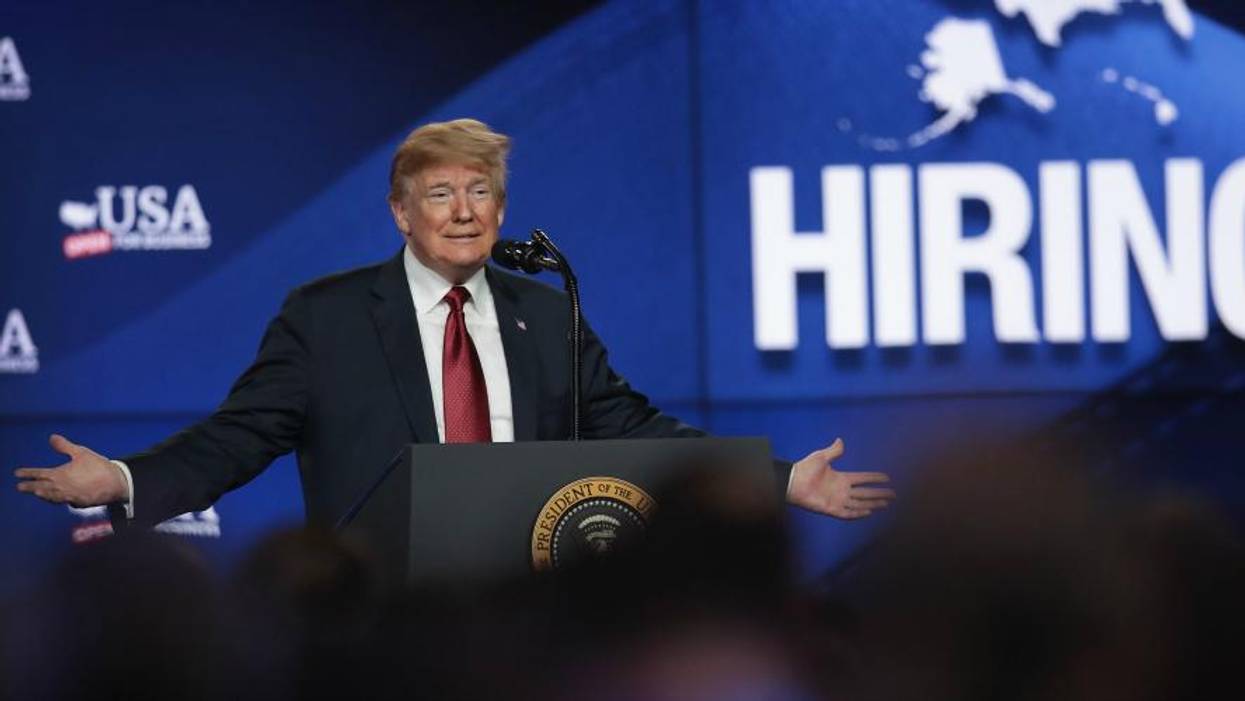
Following Reuters' report on Foxconn's moves to renege on its previous job pledges, critics pointed to footage of Trump participating in a "groundbreaking" ceremony with Walker, Ryan, and Foxconn's chairman at the site of the company's planned facility last June, where he touted the 13,000 manufacturing positions the tech firm vowed to create.
"I'm thrilled to be here in the Badger State with the hardworking men and women of Foxconn working with you," Trump declared during the event. "Moments ago, we broke ground on a plant that will provide jobs for much more than 13,000 Wisconsin workers. Really something. Really something."
The Washington Post had an article about how Republicans and right-wingers have become obsessed with trying to attack Alexandria Ocasio-Cortez, the newly elected representative from New York. At one point it refers to former Wisconsin governor Scott Walker's attack on Ocasio-Cortez's position advocating a high marginal tax rate on high-income individuals.
"Former Wisconsin governor Scott Walker, a Republican who was defeated in November, on Tuesday mocked Ocasio-Cortez for her tax proposal and suggested it was an elementary-school understanding of the issue. 'Even fifth graders get it,' he tweeted."
While the piece noted part of Ocasio-Cortez's response, that rich people are the ones with the money, it left out the more important part: Walker misled the fifth graders he refers to in his tweet. In his tweet, Walker confuses a marginal tax rate with an average tax rate
"Explaining tax rates before Reagan to fifth graders: 'Imagine if you did chores for your grandma and she gave you $10. When you got home, your parents took $7 from you.' The students said: 'That's not fair!' Even fifth graders get it."
Ocasio-Cortez correctly pointed out in her reply that the $10 the students earned for doing chores for their grandma would not be taxed because the 70 percent tax rate she proposes would only apply to incomes above $10 million.
"Explaining marginal taxes to a far-right former Governor:
'Imagine if you did chores for abuela & she gave you $10. When you got home, you got to keep it, because it's only $10.
'Then we taxed the billionaire in town because he's making tons of money underpaying the townspeople.'"
Ocasio-Cortez is right on this point and Walker is wrong. He either does not understand how our income tax system works or is deliberately lying to advance his agenda. Either way, the Post should have pointed out that Walker was wrong.
Many people are confused about the concept of a marginal tax rate (the higher tax rate only applies to the income above a cutoff). Opponents of high marginal taxes on the rich try to take advantage of this confusion in the way Scott Walker did with his class of fifth graders. It is the media's responsibility to try to inform people about how the tax system works and to expose politicians who misrepresent the issue.