
SUBSCRIBE TO OUR FREE NEWSLETTER
Daily news & progressive opinion—funded by the people, not the corporations—delivered straight to your inbox.
5
#000000
#FFFFFF
To donate by check, phone, or other method, see our More Ways to Give page.


Daily news & progressive opinion—funded by the people, not the corporations—delivered straight to your inbox.
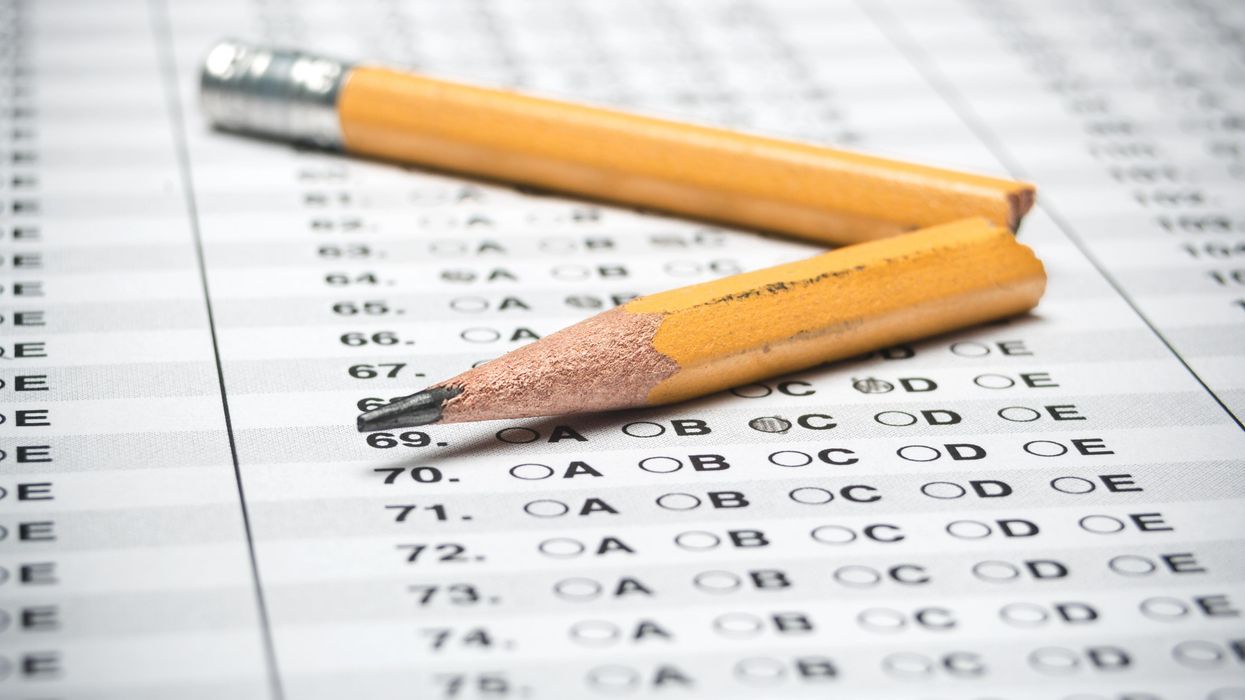
Standardized tests were supposed to be the magic remedy to fix our public schools.
They were supposed to make all students proficient in reading and math.
They were supposed to ensure all students were getting the proper resources.
They were supposed to ensure all teachers were doing their best for their students.
But after more than four decades, standardized tests have not fulfilled a single one of these promises.
In fact, all they've done is make things worse at public schools while creating a lucrative market for testing companies and school privatization concerns.
So why haven't we gotten rid of them?
To answer that question, we have to understand how we got here in the first place - where these kinds of assessments came from in the US and how they became the guiding policy of our public schools.
Standardized testing has been around in this country since the 1920s.
It was the product of the pseudoscientific eugenicist movement that tried to justify white supremacy with bad logic and biased premises.
Psychologists Robert Yerkes and Carl Brigham invented these assessments to justify privileging upper-class whites over lower class immigrants, Blacks and Hispanics. That was always the goal and they tailored their tests to find that result.
From the very start, it had serious consequences for public policy. The results were used to rationalize the forced sterilization of 60,000 to 70,000 people from groups with low test scores, thus preventing them from "polluting" the gene pool.
However, Brigham's greatest claim to fame was the creation of the Scholastic Assessment Test (SAT) to keep such undesirables out of higher education. These tests were not central to school curriculum and mainly used as gatekeepers with the SAT in particular still in wide use today.
The problem then - as now - is that standardized tests aren't very good assessments. They work okay for really simple things like rudimentary math. However, the more complex a skill you're assessing, the more inadequate the tests. For example, imagine just trying to have a conversation with someone where your only choices of reply were limited to four canned responses. That's a multiple-choice assessment. The result is a testing system that selects against the poor and minorities. At best, it reproduces the economic and racial disparities of society. At worst, it ensures those disparities will continue into the next generation.
That isn't to say the system went unchallenged. By the 1960s, the junk science and leaps of logic behind standardized testing were obvious and people began fighting back in court. Black plaintiffs began winning innumerable lawsuits against the testing industry.
Perhaps the most famous case is Hobson v. Hansen in 1967, which was filed on behalf of a group of Black students in Washington, DC. The court ruled that the policy of using tests to assign students to tracks was racially biased because the tests were standardized to a White, middleclass group.
Nevertheless, just as the tests were beginning to disappear, radical economists like Milton Friedman saw them as an opportunity to push their own personal agenda. More than anything, these extreme capitalists wanted to do away with almost all public services - especially public schools. They hoped the assessments could be repurposed to undermine these institutions and usher in an era of private education through measures like school vouchers.
So in the 1980s, the Reagan administration published "A Nation at Risk," a campfire tale about how America's public schools were failing. Thus, the authors argued we needed standardized testing to make American children competitive in a global marketplace.
However, the report, which examined test scores from the past 20 years, was misleading and full of statistical and mathematical errors.
For instance, it concluded that average student test scores had decreased but didn't take into account that scores had actually increased in every demographic group. It compared two decades worth of test scores, but failed to mention that more students took the test at the end of that period than at the beginning, and many of the newer students were disadvantaged. In other words, it compared test scores between an unrepresentative group at the beginning of the comparison with a more representative group at the end and concluded that these oranges were nothing like the apples they started with. Well, duh.
Most people weren't convinced by the disaster capitalism at work here, but the report marks a significant moment in the standardization movement. In fact, this is really where our modern era began.
Slowly governors and state legislators began drinking the Kool-aide and mandating standardized testing in schools along with corporate-written academic standards the tests were supposed to assess. It wasn't everywhere, but the model for test-and-punish was in place.
It took an additional two decades, until 2001, for President George W. Bush's No Child Left Behind (NCLB) legislation to require standardized testing in ALL public schools.
With bipartisan support, Bush tied federal funding of schools to standardized test performance and annual academic progress. And from then on, the die was cast. This policy has been upheld through both Republican and Democratic regimes.
In fact, standardized testing intensified under President Barack Obama and was continued with few changes by Donald Trump and even Joe Biden. Far from changing course, Biden broke a campaign promise to discontinue the tests. Once in office, he thought testing was so important that he forced schools to give the assessments during the Covid-19 pandemic when districts had trouble even keeping school buildings open.
And that brings us to today.
From the 1980s to 2022 we've had wide scale standardized testing in our schools. That's roughly 40 years where the entirety of what is done in public school has been organized around these assessments. They drive the curriculum and are the ultimate benchmark by which success or failure is judged. If this policy was ever going to work, it would have done so by now.
However, it has achieved NONE of its stated goals.
NCLB specifically stated that all children would be proficient in reading and math by 2014. That has not happened. Despite spending billions of dollars on remediation and completely reorganizing our schools around the assessments, test scores have remained mostly static or even decreased.
The law also justified its existence with claims to equity. Somehow taking resources away from districts with low test scores was supposed to increase funding at the neediest schools. Unsurprisingly this did not happen. All it did was further increase the funding gap between rich and poor schools and between wealthy and disadvantaged students.
NCLB also championed the idea that competing for test scores would result in better teachers. However, that didn't happen either. Instead, educators were forced to narrow the curriculum to cover mostly what was assessed, reduce creativity and critical thinking, and teachers who served poor and minority students were even punished for doing so.
If the purpose of standardized testing was all the things the law purported, then it was a decades long failure. It is the policy equivalent of slamming your head into a wall repeatedly and wondering why you aren't moving forward. (And where did this headache come from?)
If, however, the purpose of standardized testing was to fulfill Friedman's privatization dreams, then it was a resounding success. Public schools still persist, but they have been drained, weakened and in many ways subverted.
Look at the evidence.
Standardized testing has grown from a $423 million industry before 2001 to a multi-billion dollar one today. If we add in test prep, new text books, software, and consultancy, that figure easily tops the trillion dollar mark.
Huge corporations make the tests, grade the tests and then sell remediation materials when students fail. It's a huge scam.
But that's not the only business created by this policy. Test and punish opened entirely new markets that hadn't existed before. The emphasis on test scores and the "failing schools" narrative stoked unwarranted distrust in the public school system and a demand for more privatized alternatives.
Chief among these was charter schools.
The first charter school law was passed in 1991 in Minnesota. It allowed for the creation of new schools that would have special agreements (or charters) with states or districts to run without having to abide by all the usual regulations. Thus, the school could go without an elected board, pocket public money as private profit, etc. The bill was quickly copied and spread to legislatures across the country by the American Legislative Exchange Council (ALEC).
Today, there are charter schools in 43 states and the District of Columbia educating nearly three million students. Charter schools enroll about 6% of the students in the country.
However, charter schools are rife with fraud and malfeasance. For instance, more than a quarter of charter schools close within 5 years of opening. By year 15, roughly 50% of charter schools close. That's not a stable model of public education. It's a get rich quick scheme. And since these types of schools are free from the kinds of regulations, democratic governance and/or transparency that keeps authentic public schools in check, another charter school scandal pops up almost every day.
But let's not forget school vouchers. Before high stakes testing, the idea of using public money to pay for private or parochial schools was widely considered unconstitutional. Now about 4% of US students go to private and parochial schools some of which are funded with school vouchers. This is an option in 32 states and the District of Columbia, and more than 600,000 students participated in a voucher, scholarship tax credit or education savings account program last school year, according to EdChoice, a pro-voucher and school choice group.
There is little evidence that school vouchers actually improve student performance, however, and there's even evidence that students who receive vouchers to attend private schools may do worse on tests than they would have if they had stayed in authentic public schools.
Moreover, the cost of attending one of these private or parochial schools isn't completely covered by the voucher. On average, vouchers offer about $4,600 a year, according to American Federation for Children, which supports voucher programs. The average annual cost of tuition at a private K-12 school nationwide is $12,350, according to Educationdata.org, though that can be much more expensive in some states. In Connecticut, for example, the average tuition is almost $24,000. So vouchers only REDUCE the cost of attending private or parochial schools for a few kids while siphoning away tax dollars that should go to educating all kids.
In short, they're subsidies for wealthier kids at the expense of the middle class and disadvantaged.
Without standardized testing, it is impossible to imagine such an increase in privatization.
High stakes testing is a Trojan horse. It is a way to secretly undermine and weaken public schools so that testing corporations, charter schools and voucher schools can thrive.
Judged by its own metrics of success, standardized testing is an abject failure. Judged by the metric of business and school privatization it is a rousing success.
And that's why it has been so hard to discontinue.
This is corporate welfare at its finest, and the people getting rich off our tax dollars won't allow us to turn off the flow of funding without a fight.
On the right, policymakers are often boldly honest about their goals to bolster privatization over public schools. On the left, policymakers still cling to the failed measures of success testing has not been able to meet time-and-again.
However, both groups support the same system. They only give different reasons.
It is past time to wake up and smell the flowers.
If we want to ensure education dollars go to education and not profiteers, we need to end standardized testing.
& If we want to help students learn to the best of their abilities, we need to stop gaslighting them with faulty measures of success or failure.
If we want to allow teachers to do the best for their students, we need to stop holding them back with antiquated eugenicist shackles.
And if we truly want to save our public school system, we have to stop propping up privatization.
In short, we need to end standardized testing.
The sooner, the better.

The new Every Student Succeeds Act passed the Senate by an overwhelming vote. It will be law as soon as the President signs it, which he has said he will do. No Child Left Behind is history, a cruel law that set goals so far out of reach that it was certain to label every school in the nation a failure. Because of NCLB, data became more important than education. It was a boon for the standardized testing industry. It labeled and ranked schools by test scores and led to cheating, teaching to bad tests, gaming the system (by districts and states), and narrowing the curriculum. Thanks to this dreadful law, many schools abandoned or reduced time for the arts, physical education, recess, science, history, and foreign languages. NCLB was the platform for the even harsher, even more punitive, even more disastrous Race to the Top.
The fight for better education for all now shifts to the states. As Mercedes Schneider reports here, the 1,061 page act was released to the public on November 30. It is now December 9. Who read the entire act? We know from Kenneth Zeichner's reading of the section on teacher education that the new law opens the doors to alternative routes, in some cases enables institutions to award graduate degrees that have no faculty with graduate degrees (Relay, Match). We know from Mercedes Schneider's work thatTeach for America moles on the Congressional staff protected TFA. We know from the crowing of charter organizations that the bill protects them.
There is much we don't know. What we can say for certain is that the fight for the survival of public education and the teaching profession now shifts to the states. The battle to repel the monetization of education funds goes on. The struggle to allow teachers to teach goes on. The battle to prevent technology entrepreneurs from replacing teachers and mechanizing teaching goes on.
Now, as never before, our role as citizens and defenders of the common good is necessary. The Network for Public Education will continue to be in the forefront of the struggles ahead. Plan to join us at our annual meeting in Raleigh on April 16-17 to discuss how we can make our schools ready for all our children, not just a few. And how we can repel the privatization movement in its efforts to capture and profit from what belongs to all of us.
Testing resistance and reform activists can help determine the result of the House-Senate conference committee that will write a compromise bill to reauthorize the Elementary and Secondary Education Act (ESEA, now named No Child Left Behind).
Both houses of Congress took important steps to end federally mandated accountability but failed to reduce the amount of required testing. While they do little to advance high-quality education, the bills are a valuable step forward in overhauling the testing and accountability regime that has undermined public education. The new shared version written by the conference committee this fall will go back to each chamber for final votes and, if approved, to President Obama for his signature. If a bill does not become law in this Congress, NCLB, and the waivers will continue until at least 2017.
FairTest has analyzed the bills (see here) and will work toward these goals at the conference:
1) Block NCLB-style accountability provisions. This is the most contentious accountability issue. The Senate rejected a Democratic amendment that would have significantly restored NCLB-style accountability, including a variation of Adequate Yearly Progress (AYP) and mandated school interventions. Democrats from both houses, backed by the Obama-Duncan administration, will try to use the conference process to insert what they could not win in either chamber. They have threatened to block final passage if they do not get their way. However, all but three Senate Democrats voted for the bill, signaling most members do not want to keep NCLB. Now, activists must win over Democrats to counter the threat to reestablish "test-and-punish." Fortunately, no one is pushing to restore the mandate for escalating sanctions. Both bills leave interventions up to the states and end the federal mandate to use student scores to judge teachers.
2) Retain state power to limit the weight given to test scores in accountability provisions. Both bills leave it up to the states to determine their accountability indices, provided that statewide assessment is part of the mix. Some Democrats will push to give test scores the majority of the weight.
3) Retain as strong an opt-out provision as possible. The House bill allows parents to opt their children out of federally mandated exams, while the Senate allows states or districts to decide. Where allowed, opt-outs would not count against schools. FairTest will press the conference committee to adopt the House version while recognizing that the Senate version would still be a step forward.
4) Retain the Senate section authorizing states to develop "innovative" assessment programs and the House section authorizing local assessments. The Senate bill allows up to seven states to develop innovative systems built on various local, performance, and other assessments. More states would be allowed to participate after three years. The conference bill should allow as many states to participate as they meet the criteria. The House bill allows districts to design assessment systems, continuing an NCLB provision. (State efforts to use it were blocked by the U.S. Department of Education until the recent approval of a New Hampshire pilot.) In both cases, scores have to be comparable on a statewide basis. FairTest recommends combining the two: the House for its greater flexibility and availability to all states, the Senate for its explicit support of spending federal funds to build new assessment systems, pushing the Department to allow innovation.
5) Retain limits to the power of the U.S. Department of Education to manipulate state policies on standards, assessments, and accountability, as well as bar the Department from granting waivers that require state actions not already mandated by federal law. Again, some Democrats aim to weaken the prohibitions to allow the Department to intervene in state tests and accountability.
What can people do?
The trouble with the Common Core is not primarily what is in these standards or what's been left out, although that's certainly at issue. The bigger problem is the role the Common Core State Standards (CCSS) are playing in the larger dynamics of current school reform and education politics.

Today everything about the Common Core, even the brand name--the Common Core State Standards--is contested because these standards were created as an instrument of contested policy. They have become part of a larger political project to remake public education in ways that go well beyond slogans about making sure every student graduates "college and career ready," however that may be defined this year. We're talking about implementing new national standards and tests for every school and district in the country in the wake of dramatic changes in the national and state context for education reform. These changes include:
I think many supporters of the Common Core don't sufficiently take into account how these larger forces define the context in which the standards are being introduced, and how much that context is shaping implementation. As teacher-blogger Jose Vilson put it:
People who advocate for the CCSS miss the bigger picture that people on the ground don't: The CCSS came as a package deal with the new teacher evaluations, higher stakes testing, and austerity measures, including mass school closings. Often, it seems like the leaders are talking out of both sides of their mouths when they say they want to improve education but need to defund our schools. . . . It makes no sense for us to have high expectations of our students when we don't have high expectations for our school system.
My own first experience with standards-based reform was in New Jersey, where I taught English and journalism to high school students for many years in one of the state's poorest cities. In the 1990s, curriculum standards became a central issue in the state's long-running funding equity case, Abbott v. Burke. The case began by documenting how lower levels of resources in poor urban districts produced unequal educational opportunities in the form of worse facilities, poorer curriculum materials, less experienced teachers, and fewer support services. At a key point in the case, in an early example of arguments that today are painfully familiar, then-Gov. Christine Whitman declared that, instead of funding equity, what we really needed were curriculum standards and a shift from focusing on dollars to focusing on what those dollars should be spent on. If all students were taught to meet "core content curriculum standards," Whitman argued, then everyone would receive an equitable and adequate education.
At the time, the New Jersey Supreme Court was an unusually progressive and foresighted court, and it responded to the state's proposal for standards with a series of landmark decisions that speak to some of the same issues raised today by the Common Core. The court agreed that standards for what schools should teach and students should learn seemed like a good idea. But standards don't deliver themselves. They require well-prepared and supported professional staff, improved instructional resources, safe and well-equipped facilities, reasonable class sizes, and--especially if they are supposed to help schools compensate for the inequality that exists all around them--a host of supplemental services like high quality preschools, expanded summer and after-school programs, health and social services, and more. In effect, the court said adopting "high expectations" curriculum standards was like passing out a menu from a fine restaurant. Not everyone who gets a menu can pay for the meal. So the court tied New Jersey's core curriculum standards to the most equitable school funding mandates in the country.
And though it's been a constant struggle to sustain and implement New Jersey's funding equity mandates, a central problem with the Common Core is the complete absence of any similar credible plan to provide--or even to determine--the resources necessary to make every student "college and career ready" as defined by the CCSS.
Funding is far from the only concern, but it is a threshold credibility issue. If you're proposing a dramatic increase in outcomes and performance to reach social and academic goals that have never been reached before, and your primary investments are standards and tests that serve mostly to document how far you are from reaching those goals, you either don't have a very good plan or you're planning something else. The Common Core, like NCLB before it, is failing the funding credibility test before it's even out of the gate.
Last winter, the Rethinking Schools editorial board held a discussion about the Common Core; we were trying to decide how to address this latest trend in the all-too-trendy world of education reform. Rethinking Schools has always been skeptical of standards imposed from above. Too many standards projects have been efforts to move decisions about teaching and learning away from educators and schools, and put them in the hands of distant bureaucracies and politicians. Standards have often codified sanitized versions of history, politics, and culture that reinforce official myths while leaving out the voices and concerns of our students and communities. Whatever potentially positive role standards might play in truly collaborative conversations about what schools should teach and children should learn has repeatedly been undermined by bad process, suspect political agendas, and commercial interests.
Although all these concerns were raised, we also found that teachers in different districts and states were having very different experiences with the Common Core. There were teachers in Milwaukee who had endured years of scripted curriculum and mandated textbooks. For them, the CCSS seemed like an opening to develop better curriculum and, compared to what they'd been struggling under, seemed more flexible and student-centered. For many teachers, especially in the interim between the rollout of the standards and the arrival of the tests--a lot of the Common Core's appeal is based on claims that:
Viewed in isolation, the debate over the Common Core can be confusing; who doesn't want all students to have good preparation for life after high school? But, seen in the full context of the politics and history that produced it--and the tests that are just around the bend--the implications of the Common Core project look quite different.
The CCSS emerged from the wreckage of NCLB. In 2002, NCLB was passed with overwhelming bipartisan support and presented as a way to close long-standing gaps in academic performance. NCLB marked a dramatic change in federal education policy--away from its historic role as a promoter of access and equity through support for things like school integration, extra funding for high-poverty schools, and services for students with special needs, to a much less equitable set of mandates around standards and testing, closing or "reconstituting" schools, and replacing school staff.
NCLB required states to adopt curriculum standards and to test students annually to gauge progress toward reaching them. Under threat of losing federal funds, all 50 states adopted or revised their standards and began testing every student, every year, in every grade from 3-8 and again in high school. The professed goal was to make sure every student was on grade level in math and language arts by requiring schools to reach 100 percent passing rates on state tests for every student in 10 subgroups.
By any measure, NCLB was a failure in raising academic performance and narrowing gaps in opportunity and outcomes. But by very publicly measuring the test results against arbitrary benchmarks that no real schools have ever met, NCLB succeeded in creating a narrative of failure that shaped a decade of attempts to "fix" schools while blaming those who work in them. The disaggregated scores put the spotlight on gaps among student groups, but the law used these gaps to label schools as failures without providing the resources or supports needed to eliminate them.
By the time the first decade of NCLB was over, more than half the schools in the nation were on the lists of "failing schools" and the rest were poised to follow. In Massachusetts, which is generally considered to have the toughest state standards in the nation--arguably more demanding than the Common Core--80 percent of the schools were facing NCLB sanctions. This is when the NCLB "waivers" appeared. As the number of schools facing sanctions and intervention grew well beyond the poor communities of color where NCLB had made "disruptive reform" the norm and began to reach into more middle-class and suburban districts, the pressure to revise NCLB's unworkable accountability system increased. But the bipartisan coalition that passed NCLB had collapsed and gridlock in Congress made revising it impossible. So U.S. Education Secretary Arne Duncan, with dubious legal justification, made up a process to grant NCLB waivers to states that agreed to certain conditions.
Forty states were granted conditional waivers from NCLB: If they agreed to tighten the screws on the most struggling schools serving the highest needs students, they could ease up on the rest, provided they also agreed to use test scores to evaluate all their teachers, expand the reach of charter schools, and adopt "college and career ready" curriculum standards. These same requirements were part of the Race to the Top program, which turned federal education funds into competitive grants and promoted the same policies, even though they have no track record of success as school improvement strategies.
Because federal law prohibits the federal government from creating national standards and tests, the Common Core project was ostensibly designed as a state effort led by the National Governors Association, the Council of Chief State School Officers, and Achieve, a private consulting firm. The Gates Foundation provided more than $160 million in funding, without which Common Core would not exist.
The standards were drafted largely behind closed doors by academics and assessment "experts," many with ties to testing companies. Education Week blogger and science teacher Anthony Cody found that, of the 25 individuals in the work groups charged with drafting the standards, six were associated with the test makers from the College Board, five with the test publishers at ACT, and four with Achieve. Zero teachers were in the work groups. The feedback groups had 35 participants, almost all of whom were university professors. Cody found one classroom teacher involved in the entire process. According to teacher educator Nancy Carlsson-Paige: "In all, there were 135 people on the review panels for the Common Core. Not a single one of them was a K-3 classroom teacher or early childhood professional." Parents were entirely missing. K-12 educators were mostly brought in after the fact to tweak and endorse the standards--and lend legitimacy to the results.
The substance of the standards themselves is also, in a sense, top down. To arrive at "college- and career-ready standards," the Common Core developers began by defining the "skills and abilities" they claim are needed to succeed in a four-year college. The CCSS tests being developed by two federally funded multistate consortia, at a cost of about $350 million, are designed to assess these skills. One of these consortia, the Partnership for Assessment of Readiness for College and Careers, claims that students who earn a "college ready" designation by scoring a level 4 on these still-under-construction tests will have a 75 percent chance of getting a C or better in their freshman composition course. But there is no actual evidence connecting scores on any of these new experimental tests with future college success.
And it will take far more than standards and tests to make college affordable, accessible, and attainable for all. When I went to college many years ago, "college for all" meant open admissions, free tuition, and race, class, and gender studies. Today, it means cutthroat competition to get in, mountains of debt to stay, and often bleak prospects when you leave. Yet "college readiness" is about to become the new AYP (adequate yearly progress) by which schools will be ranked.
The idea that by next year Common Core tests will start labeling kids in the 3rd grade as on track or not for college is absurd and offensive.
Substantive questions have been raised about the Common Core's tendency to push difficult academic skills to lower grades, about the appropriateness of the early childhood standards, about the sequencing of the math standards, about the mix and type of mandated readings, and about the priority Common Core puts on the close reading of texts in ways that devalue student experience and prior knowledge.
A decade of NCLB tests showed that millions of students were not meeting existing standards, but the sponsors of the Common Core decided that the solution was tougher ones. And this time, instead of each state developing its own standards, the Common Core seeks to create national tests that are comparable across states and districts, and that can produce results that can be plugged into the data-driven crisis machine that is the engine of corporate reform.
The way the standards are being rushed into classrooms across the country is further undercutting their credibility. These standards have never been fully implemented in real schools anywhere. They're more or less abstract descriptions of academic abilities organized into sequences by people who have never taught at all or who have not taught this particular set of standards. To have any impact, the standards must be translated into curriculum, instructional plans, classroom materials, and valid assessments. A reasonable approach to implementing new standards would include a few multi-year pilot programs that provided time, resources, opportunities for collaboration, and transparent evaluation plans.
Instead we're getting an overhyped all-state implementation drive that seems more like a marketing campaign than an educational plan. And I use the word marketing advisedly, because another defining characteristic of the Common Core project is rampant profiteering.
Joanne Weiss, Duncan's former chief of staff and head of the Race to the Top grant program, which effectively made adoption of the Common Core a condition for federal grants, described how it is opening up huge new markets for commercial exploitation:
The development of common standards and shared assessments radically alters the market for innovation in curriculum development, professional development, and formative assessments. Previously, these markets operated on a state-by-state basis, and often on a district-by-district basis. But the adoption of common standards and shared assessments means that education entrepreneurs will enjoy national markets where the best products can be taken to scale.
Having financed the creation of the standards, the Gates Foundation has entered into a partnership with Pearson to produce a full set of K-12 courses aligned with the Common Core that will be marketed to schools across the country. Nearly every educational product now comes wrapped in the Common Core brand name.
The curriculum and assessments our schools and students need will not emerge from this process. Instead, the top-down, bureaucratic rollout of the Common Core has put schools in the middle of a multilayered political struggle over who will control education policy--corporate power and private wealth or public institutions managed, however imperfectly, by citizens in a democratic process.
The web-based news service Politico recently described what it called "the Common Core money war," reporting that "tens of millions of dollars are pouring into the battle over the Common Core. . . . The Bill & Melinda Gates Foundation already has pumped more than $160 million into developing and promoting the Common Core, including $10 million just in the past few months, and it's getting set to announce up to $4 million in new grants to keep the advocacy cranking. Corporate sponsors are pitching in, too. Dozens of the nation's top CEOs will meet to set the plans for a national advertising blitz that may include TV, radio, and print."
At the same time, opposing the Common Core is "an array of organizations with multimillion-dollar budgets of their own and much experience in mobilizing crowds and lobbying lawmakers, including the Heritage Foundation, Americans for Prosperity, the Pioneer Institute, FreedomWorks, and the Koch Bros." These groups are feeding a growing right-wing opposition to the Common Core that combines hostility to all federal education initiatives and anything supported by the Obama administration with more populist sentiments.
But while this larger political battle rages, the most immediate threat for educators and schools remains the new wave of high-stakes Common Core tests.
Duncan, who once said "The best thing that happened to the education system in New Orleans was Hurricane Katrina" and who called Waiting for Superman "a Rosa Parks moment," now tells us, "I am convinced that this new generation of state assessments will be an absolute game-changer in public education."
The problem is that this game, like the last one, is rigged. Although reasonable people have found things of value in the Common Core standards, there is no credible defense to be made of the high-stakes uses planned for these new tests. Instead, the Common Core project threatens to reproduce the narrative of public school failure that just led to a decade of bad policy in the name of reform.
Reports from the first wave of Common Core testing provide evidence for these fears. Last spring, students, parents, and teachers in New York schools responded to new Common Core tests developed by Pearson with outcries against their length, difficulty, and inappropriate content. Pearson included corporate logos and promotional material in reading passages. Students reported feeling overstressed and underprepared--meeting the tests with shock, anger, tears, and anxiety. Administrators requested guidelines for handling tests students had vomited on. Teachers and principals complained about the disruptive nature of the testing process and many parents encouraged their children to opt out.
Only about 30 percent of students were deemed "proficient" based on arbitrary cut scores designed to create new categories of failure. The achievement gaps Common Core is supposed to narrow grew larger. Less than 4 percent of students who are English language learners passed. The number of students identified by the tests for "academic intervention" skyrocketed to 70 percent, far beyond the capacity of districts to meet.
The tests are on track to squeeze out whatever positive potential exists in the Common Core:
This is not just cynical speculation. It is a reasonable projection based on the history of the NCLB decade, the dismantling of public education in the nation's urban centers, and the appalling growth of the inequality and concentrated poverty that remains the central problem in public education.
Common Core has become part of the corporate reform project now stalking our schools. As schools struggle with these new mandates, we should defend our students, our schools, and ourselves by pushing back against implementation timelines, resisting the stakes and priority attached to the tests, and exposing the truth about the commercial and political interests shaping this false panacea for the problems our schools face.
There are encouraging signs that the movement we need is growing. Last year in Seattle, teachers led a boycott of district testing that drew national support and won a partial rollback of the testing. In New York this fall, parents sent score reports on new Common Core tests back to the state commissioner of education with a letter declaring "This year's test scores are invalid and provide NO useful information about student learning." Opt-out efforts are growing daily. Even some supporters of the CCSS have endorsed a call for the moratorium on the use of tests to make policy decisions. It's not enough, but it's a start.
A New York Times front-page story today by Motoko Rich asks whether No Child Left Behind has been "essentially nullified" by the Obama administration in the face of inaction from a divided Congress.
While it's true the administration has offered more than half the states waivers freeing them from a central provision of the law--that schools that do not achieve universal academic "proficiency" by 2014 be labeled as "failing" and subject to state intervention--it would be too simple to conclude NCLB is no longer a potent force in American public education. For starters, the law's best innovation remains in place, requiring schools and states to break out achievement numbers by race, socioeconomic status, English-language learner status and special-education status, so we can all grasp exactly how big achievement gaps actually are. And the law's most controversial feature--its reliance on standardized test scores as the most powerful marker of school success--has actually been doubled down on by the Obama administration, which has used the NCLB waiver process and its Race to the Top grant program to push states to tie teacher evaluation and tenure to student test scores. (As Rich notes, under the original NCLB test scores were used to shame schools, but not individual teachers.)
What's more, the NCLB waivers don't fundamentally change schools' and states' relationship to the federal Department of Education, because the under-funded law never provided a way for districts, states, or Washington to sanction supposedly "failing" schools. About half of all American schools are "failing" according to the terms of the law, yet there was no chance budget-crunched states could have effectively intervened in that many schools, or provided all those tens of millions of students with education alternatives. In fact, only about 1 percent of eligible families were able to take advantage of NCLB's dictate that children in underperforming schools be allowed to transfer to better schools within their districts. There were no consequences whatsoever for the districts and states unable to deliver on this promise, or many of the others contained in the Pollyannish law.
For more analysis of the weakening of the bipartisan consensus in favor of the original NCLB, read my Nation essay here.

--Private providers accounted for 88 percent of all state-approved providers in May 2008, an increase from 60 percent in May 2003.--Expenditures for Title I supplemental educational services varied, $192 million to $375 million per year.--By 2007, only eight states had databases containing student achievement and participation information that would permit rigorous evaluations of achievement effects of providers on a statewide basis.
Test-prep firm Princeton Review swindled the federal government out of millions by falsely claiming it tutored needy city kids, the Manhattan U.S. attorney charges.
From 2006 to 2010, Princeton Review was reimbursed for tutoring services that were either faked or inflated, said Manhattan U.S. Attorney Preet Bharara, whose office filed a civil fraud suit Tuesday.
"The Princeton Review and its employees were supposed to tutor needy students, not cheat a federal program," said Bharara, who didn't specify how much money is involved.
During those years, city education officials paid Princeton Review $38 million for tutoring funded by the federal government under No Child Left Behind, the suit says.
During that time, Princeton Review staffers submitted phony attendance forms and invoices for thousands of hours of instruction, the suit claims.
Bharara said staffers changed hundreds of kids' absent marks to present -- in one case falsely signing in a student named Dontae as "Donate."
The company billed for sessions with kids who were on vacation and gave some site managers bonuses of up to $9,600 for reporting high daily attendance, the suit says. . . .
My theme for today: Whose children have been left behind?

Let me tell you a little bit about myself. For many years, I was a strong advocate of testing, accountability, and choice. I worked in three conservative think tanks where these ideas were held sacred. In 1998, I went to Albany, New York, to testify on behalf of charter legislation. At the time I was connected to the conservative Manhattan Institute. I thought that testing would help diagnose the problems that children had and enable teachers to identify their needs. I thought that charters would enroll the kids who had failed in regular public schools or who were not well served by regular public schools. I thought that charters would collaborate with the public schools.
In a book published last year, I said that I was wrong. I was wrong on every count. Testing should be used for diagnostic purposes, to help students and teachers, but it has turned into a blunt instrument that is used to reward and punish teachers and schools. Charters should serve the neediest, but, with some notable exceptions, they have become aggressive and entrepreneurial. Instead of seeking out the neediest students, many of them exclude the neediest students and skim the best. In some states, like Michigan, most of the charters are for-profit, with big dividends to the investors; their profits come right out of the public school budget and into the pockets of shareholders. In some states, like Ohio, Colorado, and Pennsylvania, virtual charter schools are making millions of dollars for their owners, while children sit home alone in front of a computer. These cyber charters get full state tuition, but they have no buildings, no playgrounds, no library, no custodian, no nurse, and few teachers. They often have one teacher to monitor 100 screens. For investors, it's a great business, but the educational results are awful. In Colorado, for example, only 12% graduate from the Virtual Academy, compared to a statewide graduation rate of 78%.
We have had a full decade of No Child Left Behind, and we now know that the law has been a disaster. True, it has documented the shocking gaps in passing rates between different groups of children, but it has done nothing to change the conditions that cause those gaps. We know the gaps are there; actually, we knew about the gaps long before NCLB was passed. Yet Congress is still patting itself on the back for identifying a problem and doing nothing meaningful to solve it.
Many children are still left behind. We know who they are.
In the year 2000, during the Presidential campaign, candidate George W. Bush told the nation about the Texas miracle. He said that there was a simple way to reduce the gaps: Just test every child every year, he said; reward the teachers and schools where the scores went up; and humiliate the teachers and schools where the scores went down. Texas did this, he said, and the gaps were closing; test scores were rising; graduation rates were going up; dropout rates were going down. He said that we had to end the "soft bigotry of low expectations" and set the same standards for all children, rich and poor, black and white, advantaged and disadvantaged.
After his election, Congress bought this story and passed No Child Left Behind. This law mandated that all children would be proficient by 2014 in grades 3-8. All children without exception. Bear in mind that no nation in the world has ever achieved 100% proficiency.
Now we know the results of this absurd law. More than 80% of our schools have been labeled failing schools. By the year 2014, nearly 100% of our schools will be considered failures. Has any other national legislature in history ever passed a law guaranteed to label every single one of its schools a failure? I don't know of any.
We now know that NCLB was based on a phony claim. On national tests, Texas does not lead the pack; it's right in the middle. We now know that the achievement gap did not close in Texas, and that dropout rates went up. But the whole nation is stuck with this testing regime.
Let's be clear about what NCLB has really accomplished: It has convinced the media and major philanthropies and Wall Street hedge fund managers that American public education is a failure and that radical solutions are required. The philanthropists and Wall Street hedge fund managers and Republicans and the Obama administration and assorted rightwing billionaires have some ideas about how to change American education. They aren't teachers but they think they know how to fix the schools.
Their ideas boil down to this strategy: NCLB failed because we didn't use enough carrots and sticks. They say that schools should operate like businesses, because the free market is more efficient than government. So these reformers--I call them corporate reformers--advocate market-based reforms. They say that states must hand public schools over to private management because the private sector will be more successful than the public sector. They say that teachers will work harder if they get bonuses when test scores go up. They say that teachers should have no job protections because workers in the private sector don't have job protections, not even the right to a hearing. They say that if schools have low scores, they should be closed and replaced by new schools, just like a chain store--a burger franchise or a shoe store--would be closed if it didn't make a profit; or the entire staff should be fired and replaced by new staff. They say that the quality of teachers should be judged based on whether their students' scores go up or down.
The Tea Party governors embraced this narrative and took it to the next level. They used their sweeping victories in 2010 to eliminate collective bargaining rights for public workers and to slash spending on public education, even as they demanded more funding for charters and vouchers. The mayor of New York City said a week ago that if he had the power to do it, he would fire half the city's teachers, double the pay of those that remained, and double class size. He said when he went to school, he was in a large class and he turned out OK. He didn't mention that his daughters went to schools where the class size was 12. My youngest grandchild attends kindergarten in a Brooklyn public school. He has a class size of 24. Under the mayor's plan, his teacher would have a class of 48. None of them would get any individual attention. I don't see this as progress, particularly because the evidence is clear and strong that minority children benefit most when class sizes are reduced below 20 in a classroom.
So which children would be left behind?
We have now had ten years of No Child Left Behind, and we now know that there has been very little change in the gaps between the children of the rich and the children of the poor, between black children and white children, between Hispanic children and white children. Meanwhile our policymakers say we need higher standards, more rigorous standards, and more testing. How exactly will that help children who are struggling to read and do math? Or, in some cases, struggling to read and speak English? Or in the case of children with disabilities, how are they helped by harder tests? This is like saying, "if these children can't jump over a four-foot bar, let's lift the bar to six feet and see how they do." Do you know how they will do? It seems obvious to me.
Just this week, the federal government released the urban district test results and we could see that the gap remained as large as ever. After ten years of NCLB, the children at the bottom were still at the bottom. Those districts where poverty and racial segregation--such as Detroit and Washington, D.C.--are most concentrated had the lowest scores.
But wait, some of the districts tested by the federal government have been actually implementing the market-based reforms advocated by the corporate reformers: New York City, which has had mayoral control since 2002; Washington, D.C., which has had mayoral control since 2007; Chicago, where Arne Duncan launched market-based reforms in 2001; and Milwaukee, which has had vouchers since 1990.
Since the mayor took charge in 2002, New York City has enthusiastically imposed market-style reforms. It has more choice than any other major city--parents and students get to choose among 400 high schools, as well as more than 100 charter schools. All schools are given letter grades based on test scores. NYC spent $56 million on merit pay, then abandoned the program when it showed zero results. After nine years of market-based reforms, however, the achievement gap between black and white students is unchanged. On the federal tests, math scores are up but no more than in districts without market reforms. Eighth grade reading scores have been flat since 2003.
Which children do you think were left behind?
In Washington, D.C., there have been many claims in the media about sensational test score gains, but that's not what you see on the latest federal tests. In fourth grade reading, the scores have been rising steadily since 2003, but not for all students. The scores of high-income students have gone up but the scores of black students, Hispanic students, and low-income students remain unchanged for the past four years. In eighth grade reading, scores are down for the past four years for black students, Hispanic students, and low-income students. And most importantly, the District of Columbia public school system has the largest achievement gap of any city in the nation between white and black students, a staggering 64 points in 4th grade, compared to an average of 30 points for all urban districts; and an equally staggering 58 points in eighth grade, compared to 28 points for all urban districts.
So whose children were left behind?
In Chicago, where Secretary Duncan's reform program led to the closing of 100 neighborhood schools, only 18% of the new schools were judged successful by the state of Illinois. On the NAEP for cities, Chicago continues to be one of the lowest performing in the nation. Since 2003, black and Hispanic students have seen no improvement in their reading scores in fourth grade. In eighth grade reading, there have been no gains whatever for black students or low income students since federal testing began in 2002, and no gains for Hispanic students since 2005. According to the latest research, the black-white achievement gap is larger now in Chicago than when the reforms began.
In Milwaukee, after 21 years of vouchers, black students have among the lowest scores of any city tested, ranked at the bottom along with Detroit, Fresno, and Cleveland. Independent research has shown that the black and low-income students in Milwaukee's voucher schools have the same low scores as the black students in the public schools. Their scores are about the same as those of poor black kids in the Deep South. Vouchers and competition did nothing for the children of Milwaukee. These children were left behind.
And consider this: Tea-party governors know that vouchers do nothing to improve education, but they are pushing them anyway. The Governor of Indiana, Mitch Daniels, pushed through the first statewide voucher program in the nation. Governor Scott Walker in Wisconsin got his conservative legislature to expand the Milwaukee program, to raise the income eligibility cap, so that more children could go to voucher schools, despite the evidence that vouchers don't improve education. The whole point seems to be to decimate the public sector.
And here is the latest voucher scandal. When Jeb Bush was governor of Florida, he pushed through a voucher program. The state courts struck down one part of the voucher program, the part for students in failing schools. But the courts did not eliminate the McKay Scholarships, which enabled students with disabilities to get vouchers to attend any school. Just this week, the Florida press revealed that some of the deregulated voucher schools are fly-by-night operations, conducted in storefronts, churches, and dingy homes, staffed by administrators and teachers with criminal records. They found students who spent their entire day filling out workbooks or hanging around a gymnasium watching television. One school had a class, described as "business management," which consisted of shaking cans on street corners. Florida has pumped over $1 billion into this voucher program and Governor Scott wants to expand it to more deregulated schools.
Whose children are left behind by these policies?
From all the developments, experiences, and research of the past decade, here is what I have learned:
First, charter schools have been portrayed as a silver bullet that will raise up every child, especially poor and minority children, but they are not. By their very nature, charters vary. Some are excellent, some get high scores but are boot camps where children are taught to obey without question, some are terrible. On the whole--and study after study shows this--charters don't get different results from regular public schools. When I was active a decade ago with the Manhattan Institute, which is led by conservative business leaders, it was decided that the best way to market charter schools was to present them as a way to save minority children. This strategy, it was believed, would win liberal support for a very conservative idea. They were right. Liberals could not resist this narrative.
So today we see Wall Street hedge funders and billionaires saying that they are leading the civil rights movement of our time. I have trouble imagining Dr. Martin Luther King, Jr., walking arm in arm with billionaires in a crusade to privatize control of public education. Dr. King understood that social movements need a mass base, and that they are not based in Wall Street. He knew that the civil rights movement depended on its moral authority as well as its ability to mobilize poor and working people in coalition with labor unions. He had no desire to privatize. He wanted to make private interests bow to the demands of the public interest. As I watch rightwing politicians doing their best to destroy the public sector unions, I recall that Dr. King was assassinated at the very time that he was fighting to organize the sanitation workers of Memphis. How dare they invoke his legacy to attack public education and public sector workers!
We know--or we should know--that poor and minority children should not have to depend on the good will and beneficence of the private sector to get a good education. The free market works very well in producing goods and services, but it works through competition. In competition, the weakest fall behind. The market does not produce equity. In the free market, there are a few winners and a lot of losers. Some corporate reformers today advocate that schools should be run like a stock portfolio: Keep the winners and sell the losers. Close schools where the students have low scores and open new ones. But this doesn't help the students who are struggling. No student learns better because his school was closed; closing schools does not reduce the achievement gap. Poor kids get bounced from school to school. No one wants the ones with low scores because they threaten the reputation and survival of the school.
The goal of our education system should not be competition but equality of educational opportunity. There should not be a Race to the Top. What is the Top? Who will get there first? Will it be poor and minority students? Don't count on it. The Top is already occupied by the children of the 1%.
To be a healthy society, we must improve our public schools. We must provide better schools in every neighborhood. We must help the children who need help. We must treat our teachers and principals and administrators with respect. If they need support, they should get it.
With all the talk about the achievement gap, it is important for you to know that there are two different achievement gaps. One is the gap between the children of the wealthy and the children of the poor. This gap has doubled in the past half century, as poverty and income inequality have increased. The racial achievement gap was actually cut in half in the 1970s and 1980s. Paul Barton of the Educational Testing Service attributed the shrinking of the racial achievement gap to the creation of federal assistance programs for the neediest children, such as Title I; to desegregation; to reduced class sizes; to early childhood education; and to increased economic opportunities for African-American families. He pointed out, however, that the racial achievement gap has remained almost unchanged since the 1980s.
We now know that none of the current carrot-and-stick policies will shrink the gap. We know it because they have been tried for 10 years and they haven't worked. Structural changes like charters and vouchers overall will not make a difference. Merit pay makes no difference. Judging teachers by test scores demoralizes teachers and will lead to narrowing of the curriculum--so that the districts where children have the lowest scores will have more time for test preparation and less time for the arts, less time for history or civics, less time for science, less time for physical education. The children who need a great education the most will get the least.
And many more children will be left behind.
The entire current reform movement rests on a fanatical belief in standardized testing. Yet testing experts warn us that the tests should be used for diagnostic purposes, not to fire teachers and close schools. The basic rule of testing is that a test should be used only for the purpose for which it was designed. A test of fifth grade reading tests whether students can read at a fifth grade level; it is not a test of teacher quality. Testing experts warn that tests are subject to statistical error, measurement error, and human error. Sometimes the answer is wrong. Sometimes the question is wrong. Sometimes a thoughtful child will pick the wrong answer because it sounds plausible.
One thing we know for certain about standardized testing. Poor and minority kids consistently get lower test scores than white and privileged kids. So why would we make testing the most important measure of education? Why would we take the technology that is most discouraging to children in the bottom half and then insist that it matters more than anything else? Why would we give more credibility to standardized tests than to teachers' and parents' judgments about children's potential?
In September, I visited Finland and I want to share with you what this tiny nation has accomplished. It regularly scores at the top of international tests in reading, mathematics, and science. It has the least variance from school to school, meaning that almost every school is a good school. Students in Finland never take a standardized test until they complete high school. Teachers in Finland are required to have a master's degree. Teaching is a highly respected profession. Parents trust teachers. Teachers have autonomy to exercise professionalism.
Every child has regular medical checkups and healthcare, at no cost. Schools have health clinics. Whereas more than 20% of our children live in poverty, less than 4% of Finnish children do. Higher education is tuition-free.
Finland has no charter schools, no vouchers, no merit pay, no standardized testing. Instead, every teacher is trained to take care of the needs of individual children. If children are having learning problems, there are specialists and social workers in every school to take care of them early and provide whatever assistance is needed. Nearly half of all Finnish students get extra attention and services in the early years of schooling.
Finland has no tracking. All children get the education and support they need to succeed in school. Finland does not have a longer school day or a longer school year. Finnish schools emphasize creativity, ingenuity, problem-solving, the arts, projects, activities, physical education, and risk-taking.
By the way, Finnish teachers and principals belong to the same union. It doesn't seem to be a problem.
So what can we do? First, we should speak out when politicians say "there is no more money." There is money to do what we want to do. There is money to fight wars in the Middle East. There is enough money to give big corporate cuts. There is enough money for 1% of this nation to live lives of splendor. Why is there not enough money to provide the basic public services that every child needs?
Do we want to be a decent society or a decadent society? Do we want to nurture, protect and inspire all of our children? Do we want children who are leaders or followers? Do we want to make sure that this generation of young people is prepared to sustain our democracy? Do we want citizens prepared to ask questions or just to answer questions posed by authorities?
We must stop the trash talk about our public schools and dedicate ourselves to making every one of them a school that is just right for all our children. Yes, it will cost more, but ignorance and neglect are much more expensive.
Surely the greatest nation in the world can mobilize the will to do what is right for the children. It won't be easy, it won't be cheap, and it won't be fast. Doing the right thing never is. The only simple part is to recognize that what we are doing now is not working and will never work. What we need is a vision of a good education for every child. We should start now. Today.
America is at the most significant educational crossroads it has faced since its system of public education took form in the 19th Century. Today's pace and depth of technological change, instantaneous global communication, and social, cultural, and climate change have brought our country to an impending educational crisis. How do we prepare our children for a future that will inevitably be profoundly different than our very familiar past?
That impending crisis is being starkly enacted on Capitol Hill as President Bush's "No Child Left Behind" (NCLB) act is being considered for reauthorization. Senator Edward Kennedy, one of NCLB's initial architects and champions, must be facing one of the toughest decisions of his long career as NCLB's advocates and critics line up to press their respective cases for its continuation, or its strengthening, or its major revision, or its outright abandonment.
The Illusion of a World Class Education
According to Kennedy's March 26 editorial in The Washington Post, NCLB's original fundamental purpose was ". . . to guarantee every child in America, regardless of race, economic background, language or disability, the opportunity to get a world-class education." The term "world-class education" implies that our young people will be fully prepared for the complex social and intellectual challenges of democratic citizenship and career contribution emerging in our ever-evolving global economy and complex multi-cultural world.
But that's not what NCLB delivers. When translated into NCLB-style "reality," this noble goal gets reduced to meaning: scores on two widely criticized paper-pencil basic skills tests per year - one in reading, and one in math - just enough to supposedly measure if students are "proficient" in those fundamental abilities, and just enough to qualify them for low-end, low-paying jobs. In other words, Americans are being asked to believe that basic skills test scores are the equivalent of a world-class education!
Never mind this profound inconsistency and insult to our collective intelligence, NCLB's key advocates are so enamored with its "accountability" provisions, that little else seems to matter. But it should. Ask any competent educator, and they will tell you that NCLB does nothing to promote a host of things that should comprise the basics of a world-class education: no creative and critical thinking; no future-focused curriculum, student inventiveness and entrepreneurship; no global understanding and cooperation; no personal health and well-being; no greater connection to the complex world of work; no learner-responsive opportunities and experiences; no incentives for attracting talented teachers into the system; no environmental and ecological awareness; and no strengthening leadership and community engagement at the local level.
NCLB's Accountability Juggernaut
No, the engine that drives NCLB, embodies its essence, and inspires its advocates is "Accountability" writ large and imposed from on high (i.e., the U.S. Department of Education). NCLB makes individual schools and educators pay a dear price if their students do not reach specific "high stakes" test-score benchmarks within specified amounts of time. Those stakes: lose your job, lose your school, and/or lose your federal funding - no excuses, and no questions asked - even if your students can't speak English at the beginning of the school year or have serious learning disabilities.
Certainly, many of America's lowest performing schools need drastic improvement, and some kind of enlightened accountability process to assist them. But NCLB's heavy-handed and mechanistic approach to accountability is actually making it more difficult than ever for our schools to be world-class by any reasonable measure of that term.
How do you become world-class when your federal "reform" strategy actually is: 1) driving experienced and talented educators out of the system; 2) creating enormous discontinuity in some schools' staffing and disconnection with their students and parents; 3) ignoring the inherent humanity, talents, and uniqueness of the individual learner; 4) reducing "the learning that matters" in the 21st Century to annual scores on highly limited and limiting paper-pencil tests; 5) ignoring mountains of research on brain functioning, learning processes, and child development; 6) forcing reductions in the richness and depth of curriculum and learning experiences students are receiving; 7) imposing a narrow, single-method approach to instruction on the diversity of learners and schools; 8 ) preventing those experts with a richer approach to learning and instruction from working in or assisting schools in their improvement efforts; 9) overriding community input regarding school goals, priorities, and operations; and 10) eliminating incentives for schools to innovate in ways that serve their particular clientele?
Despite the Administration's rhetoric to the contrary, these glaring shortcomings are so extensive, damaging, and future-threatening that America's parents, students, educators, and business leaders should all be clamoring for Senator Kennedy and Congressman George Miller to drastically overhaul both NCLB and the rigid, archaic thinking that underlies its current implementation. There are countless citizens, educators, and researchers in the country eager to make enlightened contributions to this policy dialogue and to the fulfillment of Senator Kennedy's dream for a world-class public system that guarantees 21st Century outcomes for all its students and schools. Their active engagement should be encouraged to help avoid the serious tragedy that NCLB has already become.