
SUBSCRIBE TO OUR FREE NEWSLETTER
Daily news & progressive opinion—funded by the people, not the corporations—delivered straight to your inbox.
5
#000000
#FFFFFF
To donate by check, phone, or other method, see our More Ways to Give page.
Daily news & progressive opinion—funded by the people, not the corporations—delivered straight to your inbox.
Woefully belatedly but seeking hope and light, we honor the remarkable life of Rev. Jesse Louis Jackson, who over six decades "stepped forward again and again and again" to fight for racial, social, economic justice for millions of the disenfranchised. At a moving "Homegoing," his grown children offered soul-stirring tributes to the impassioned, "prophetic voice" of a man of faith who doggedly "opened doors, kicked them down when necessary, so that others were no longer locked out....You fought a good fight."
On March 6 and 7, two gatherings of prayers, pride, tears, laughs, eulogies and gospel music sought in their own singular ways to celebrate the long rich life life of Jesse Jackson - pastor, activist, organizer, two-time presidential candidate, and head of an ever-evolving "rainbow coalition” of the poor and dispossessed that sought to bridge all conceivable divides. When Jackson died in February at age 84, he was hailed as "a civil rights giant," and he was. On April 4, 1968 in Memphis, the then-26-year-old aide to Martin Luther King was standing in the courtyard below the balcony of the Lorraine Motel, talking to King moments before he was shot and killed. Jackson carried on King's work in the Southern Christian Leadership Conference until 1971, when he resigned amidst leadership changes to form what became the Rainbow PUSH (People United to Save Humanity) Coalition.
But his work grew ever broader, working for decades on multiple fronts for multiple social justice issues in America and around the world. He pushed for voting rights, Native rights, Palestinian rights, welfare rights, tenants' rights, prisoners' rights, women's and gay and trans rights; he led boycotts, fair wage battles, union organizing campaigns; he fought against apartheid in South Africa and helped facilitate the release of U.S. hostages in Iran. He spent years spreading the mantra, per his iconic 1972 appearance on Sesame Street with a ragtag, multi--hued bunch of kids, "I am somebody." A simple message with a big meaning, it hit its mark again and again. "When I hear the phrase 'I am somebody,'" said 13-year-old Daniel Russell-Vincent, attending the March 6 People’s Celebration with his parents, "that makes me think, 'You're going to have something to do with this world.'"
That official, five-hour gathering - video here - was held at the 10,000-seat sanctuary of the House of Hope Church on Chicago’s South Side. It drew three former US presidents, white and black pols from Maxine Waters (87) to Tennessee's Justin Pearson (31), local pastors and dignitaries, the presidents of Congo and South Africa, and thousands of regular Chicagoans who skipped work, drove for hours, and stood in long lines to "show up and say what (Jesse) meant to us, and more importantly what he stood for....Every single person here has a Jesse Jackson story." "The city of Chicago shared him with the whole world," said Illinois Gov. JB Pritzker. "He was ours, and we were his." "This man has been here my whole life, saying, 'I got you,'" said Detroit Pistons Hall of Famer Isaiah Thomas, who grew up on Chicago’s West Side. "That's what Rev. Jesse Jackson means to us in Chicago."
The speeches were eloquent. Bill Clinton: "He lived a big life. He lived with his head and with his heart." Kamala Harris: "He did not waste time waiting, even when the doors in front of him were barred and bolted." Joe Biden: "Jesse kept hope alive for us." Barack Obama, with the stately oratory he draws on in moments of loss, spoke of a child of a poor single mother whose father rejected him, whose first political act was to lead seven black students into a whites-only college library, where they sat down, refused to leave and "got arrested for reading. Think about that. That's how freedom opens its doors." In the Book of Isaiah, he said, "God is looking for a messenger to guide a hardened and resistant people, and the Lord asks, 'Who shall I send?' to which Isaiah replies, 'Here I am, Lord, send me.' Send me, Jesse said, even as a young man. And the world got a little bit better."
He recounted Jackson's life, from his sharecropper family to the Chicago Theological Seminary to Operation Breadbasket to, after MLK's murder, a "country weary of the idea of justice," where "a talker with his immense gifts...rose above despair, and kept that righteous flame alive." "When the poor and dispossessed needed a champion and the country needed healing, the Reverend Jesse Louis Jackson stepped forward again and again and again, and said, 'Send me,'" Obama declared, "even while growing up in a world separate and unequal, a world designed to tell a child that he or she could only go so far...'I am somebody.' He was talking about everyone who was left out, everyone who was forgotten, everyone who was unseen (and) unheard. And in that sense he was expressing the very essence of what our democracy should be, the ideals at the very heart of the American experiment."
Jackson also "paved the way for so many to follow." In 1984, as another child of a single mom and new college grad "with good intentions but uncertain how to serve," living in a "janky apartment" with a rabbit-eared-TV, he saw Jackson "own" his first presidential debate. Drawn to Chicago as a young organizer, he went to PUSH headquarters on Saturday mornings "to listen and learn...and when Jesse called your name, you stood up a little straighter (to) make things right." Today, "it can be hard to hope," when each day "you wake up to things you didn’t think were possible" - greed, bigotry, ignorance, cruelty - and "it's tempting to just put your head down and wait for the storm to pass." "But this man," he said, voice breaking, pointing to the coffin, "inspires us to take a harder path. He calls on us (to) be messengers of hope, to step forward and say, 'Send me'...'Cause if we don't step up, no one else will."
The next day, a private, emotional "Homegoing" at the Rainbow PUSH Coalition headquarters drew local leaders, allies, friends and family to a celebration where several of Jackson's six grown kids - all at the podium, proof "he raised smart, God-fearing children" - gave searing speeches that often drew tears and amen's from the lively crowd. (Full, moving video here). Jackson had been in failing health for several years; his daughter Jacqueline, his main caregiver, thanked the thousands of doctors, nurses, cooks, Uber drivers and other caretakers who helped him through that time. His son Yusef, who now leads the Rainbow PUSH Coalition, vowed their work will continue "in his name." His eldest son Jesse Jackson Jr., seeking to tell the crowd "who my daddy was" and often weeping as he did, wove a forceful, complex tale that moved from light to darkness and back again.
"We are burying our father today," he declared with feeling, before praising his father's "consistent, prophetic voice." "Who was Jesse Jackson?" he asked. "To the political class that took up most of his time, he was a stranger awaiting a return phone call, reminding (them) of the urgency of the hour." At the same time, critiquing the former day's speeches portraying his father in strictly political terms, he insisted that as a Baptist minister and man of faith "he had a tense relationship with the political order," not based on race or party but "on his unyielding advocacy for the disinherited, the damned, the dispossessed, the disrespected." As such, he demanded solutions "deeply rooted in his own Christian faith," in "his own sense of urgency," and in "the daily lives of (those) he sought to raise up...He took the ministry from Sunday morning, and he delivered it to the people.”
He was also "a funny man, an enjoyable man," he noted. When he was born, his father was doing voter registration work in Selma, and was so overwhelmed by his son's birth "he almost named me Selma." But there were dark times as well: "Being Jesse has not been easy - such was the name of Jesse Jackson." A former Congressman, Jackson Jr. struggled with bipolar depression, and ended up doing time in prison after a 2013 campaign fraud conviction ended his 17-year political career. He tearfully described feeling despair "in the hole," pleading with his father to "get me outta here," and his father urging, "Hold your head up high, son." (Jackson Sr. sought a pardon from Biden, who refused it.) In his soaring, painful, heartfelt eulogy, Jackson Jr. described his father as a transformative figure who "we turned to in our lowest hours...We are better because he lived."
He was echoed by his brother and U.S. Rep. Jonathan Jackson, who in a soaring speech called their father "a miracle, a special occurrence, a force of nature (who) would not be denied." He praised "the iterations of Jesse Jackson Sr. we have seen...Born to be a nobody, he was too tall to hide, too poor to be included, too black to be respected, too bold to be ignored...Look at what the Lord has done." Above all, he said his father was not a politician but "a public servant." The measure of his humanity: "Only somebody who's been claimed by something greater than themselves can stand up for people whose names they don't even know. My father tried to help somebody, to love somebody, to let every child know he is somebody. My father wanted to make sure the world he was leaving was better than the world he was born into. He tried to make the crooked way straight."
Jesse Louis Jackson was, of course, fully human. For decades, he tried mightily, and sometimes he failed. But, his son argued, "He honored the ideals of the Constitution more than any of the 25 slave-holders who signed it in their hypocrisy, and he believed in America more than America believed in itself." Calling out to his father's many mentors - Martin Luther KingJr., Nelson Mandela, Rosa Parks, Nehru, Gandhi, Castro, all the freedom fighters - Jonathan said, "We have not forgotten, and we will keep fighting for the peacemakers, for civil rights, for equity, diversity, inclusion." Rise, Jesse, rise. Amidst the base, ghastly human dregs that now inhabit our national landscape and wield harrowing power over it, here lived a great man. May he rest in peace and power.

The US Supreme Court on Monday agreed to hear a case that could effectively crush efforts to hold the fossil fuel industry accountable for the climate crisis.
As reported by the New York Times, the court has agreed to hear arguments related to a petition filed by ExxonMobil and Canadian energy firm Suncor related to a 2018 lawsuit by the city of Boulder, Colorado that seeks financial damages from the companies for their role in causing global climate change.
The Times report noted that dozens of similar lawsuits have been filed by states and municipalities over the last decade, and they generally seek money from energy firms to help mitigate or repair damage done by extreme weather exacerbated by the climate crisis.
According to the Associated Press, attorneys for the energy companies are petitioning to have the case moved from state courts to federal courts that have in the past dismissed similar complaints.
“The use of state law to address global climate change represents a serious threat to one of our nation’s most critical sectors,” the attorneys claimed.
The Supreme Court's decision to hear the case comes months after the Colorado Supreme Court ruled that Boulder's lawsuit could initiate the discovery process and move toward a trial.
In an interview with the Colorado Sun, Boulder County Commissioner Ashley Stolzmann said that the city wasn't backing down from its efforts make the fossil fuel industry pay for the damage it's done.
"The oil companies have tried every avenue to delay our climate accountability case or move it to an out-of-state court system,” said Stolzmann. “As everyone continues to face rising costs that put budgets under pressure, we must hold oil companies accountable for the significant harm they’ve caused our communities."
Richard Wiles, president of the Center for Climate Integrity, said that the merits of the Boulder lawsuit are clear, regardless of the Supreme Court's intervention.
"Big Oil’s climate lies are the most consequential and harmful corporate deception campaign in history," Wiles said, "and the communities paying the price for that deception deserve to put these companies on trial. Exxon’s desperation to escape accountability does not change the evidence of their wrongdoing or the law that lower courts agree is on Boulder’s side."
Alyssa Johl, vice president of legal and general counsel at the Center for Climate Integrity, said the Supreme Court should simply affirm lower court rulings stating that "communities like Boulder have the right to seek accountability in their state courts when corporations have knowingly caused local harms."
As the Trump administration spends an estimated $1 billion per day in taxpayer money bombing targets across Iran that have reportedly included an elementary school and healthcare facilities, Gallup released a survey Thursday that found one-third of Americans reported making financial trade-offs in order to pay for medical expenses last year.
The West Health-Gallup Center on Healthcare in America polled nearly 20,000 US adults between June and August 2025 and found that roughly one-third of them—equivalent to about 82 million people in the richest country in the world—were forced cut back on at least one expense in order to afford healthcare.
Eleven percent of respondents—equivalent to 28 million Americans—skipped a meal or intentionally drove less in order to pay a medical bill. Fifteen percent, the equivalent of nearly 40 million people, said they prolonged a current prescription or borrowed money, and 9% cut back on utilities.
Those numbers were strikingly similar among people who have health insurance, with 14% of insured people prolonging prescriptions to avoid paying for a new one and 9% skipping meals. Among insured Americans, 29% made at least one trade-off to afford healthcare.
The crisis is also not exclusively affecting low-income people. A quarter of people in households earning $90,000 to $120,000 per year skipped meals or other expenses to pay medical bills, and 11% of people in households earning $240,000 or more did the same.
“No one is safe from making these trade-offs,” Ellyn Maese, a senior researcher at Gallup and research director for the West Health-Gallup Center, told The New York Times.
Sixty-two percent of people without healthcare coverage were forced to make trade-offs, and 55% of people with household incomes lower than $24,000 per year as well as 47% of people earning $24,000 to $48,000 avoided expenses.
Gallup also released the results of a separate poll taken between October and December 2025, which showed how Americans are delaying major life decisions as well as altering their daily lives to afford healthcare under the for-profit insurance system.
As the Trump administration's policies slashed healthcare for 15 million Americans and raised healthcare premiums for tens of millions of people—and as the White House demanded that families have more children—6% of respondents said they had postponed having or adopting a child due to healthcare costs, equivalent to about 16 million Americans.
Nearly 30% said healthcare costs led them to avoid taking a vacation, 18% said they delayed finding a different job, 15% said they postponed pursuing education or job training, and 14% said they postponed buying a home.
The polls are “telling a consistent story here,” Maese said.
The survey results were released weeks after the Trump administration proposed new regulations for healthcare plans purchased through the Affordable Care Act marketplace that would charge deductibles as high as $15,000 for individuals and $31,000 for families to offset lower monthly premiums—underscoring how the healthcare law passed 16 years ago has left American households vulnerable to rising costs under the for-profit health insurance system.
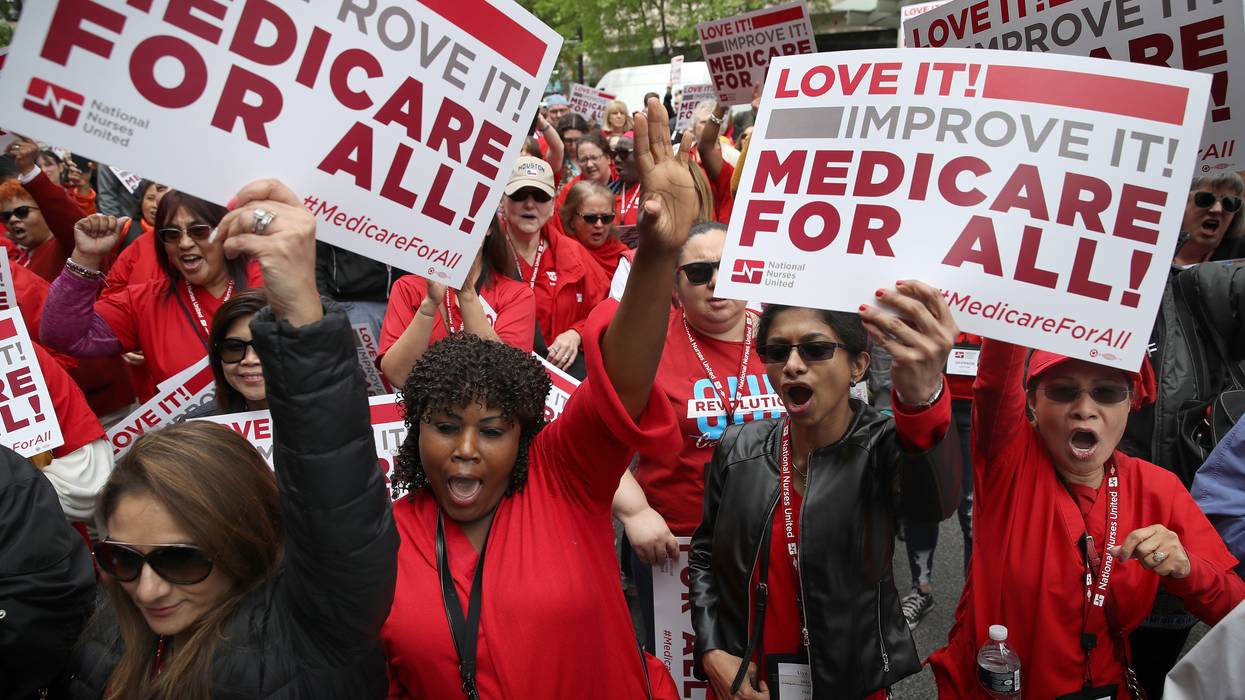
A survey taken last November by Data for Progress found that 65% of voters support expanding the Medicare system to everyone in the US, a proposal that would save an estimated $650 billion annually.
But as Rep. Pramila Jayapal (D-Wash.)—who has sponsored Medicare for All legislation in the House—noted on Wednesday, Republicans and establishment Democrats continue to claim the proposal is unaffordable.
"When we ask for Medicare for All it’s 'too expensive,' and we 'don’t have the money,'" said Jayapal. "When the president drags us into his own personal war, no expense is spared. Our priorities are backwards."
Warning that the Espionage Act has been used to "persecute and criminalize" dissenters, journalists, and whistleblowers numerous times since it was passed into law, US Rep. Rashida Tlaib on Thursday introduced the Daniel Ellsberg Press Freedom and Whistleblower Protection Act to "rein in" the 109-year-old law.
The proposal is named for the military analyst-turned-activist who disclosed decades of deception by the US government regarding Vietnam when he leaked the Pentagon Papers to the press in 1971—an act that led the government to charge Ellsberg with espionage, conspiracy, and other crimes before the case was thrown out over the Nixon administration's misconduct.
In the cases of Ellsberg, former National Security Agency contractor Edward Snowden, WikiLeaks founder Julian Assange, and other journalists and whistleblowers, "Espionage Act prosecutions have been used to silence dissent and undermine government transparency and are a clear violation of the First Amendment and the fundamental right to due process," said Tlaib (D-Mich.).
“Alerting the public to government wrongdoing is not a crime,” said the congresswoman. “The Espionage Act has been abused by administrations of both parties to target whistleblowers and journalists for sharing critically important information with the public. With whistleblowers, journalists, and civil liberties under significant attack and government decision-making shrouded in increasing secrecy, reining in the abuses of the Espionage Act could not be more urgent.”
Tlaib noted that in addition to past administrations using the Espionage Act to prosecute media sources and whistleblowers who alerted the public about mass surveillance, torture, drone assassinations, and war crimes in Iraq and Afghanistan, the FBI raided the home of a Washington Post reporter in January in connection to the prosecution of a government whistleblower.
The proposed legislation would limit the scope of the Espionage Act to foreign agents and government employees who have a legal duty to protect classified information—prohibiting the use of the law to prosecute publishers, journalists, or members of the public.
It would also increase due process standards and safeguards for whistleblowers who disclose government wrongdoing, war crimes, or abuses of power to the public. The legislation would create and affirmative public interest defense and require the government to prove that a whistleblower acted with the specific intent of harming the US or aiding a foreign power.
Under the Daniel Ellsberg Press Freedom and Whistleblower Protection Act, said Jenna Leventoff, senior policy counsel for the ACLU, "the government could no longer abuse [the Espionage Act] to silence those sharing information that is beneficial to the public."
“For too long the Espionage Act has been used to persecute and silence whistleblowers, journalists and publishers,” said Leventoff. “But journalism is not a crime—it is a First Amendment protected activity that protects our democracy by allowing the public to hold our nation’s leaders to account."
The Espionage Act was originally passed to crack down on those who spread information that could interfere with the war effort during World War I, and "from its inception," said Chip Gibbons, policy director at Defending Rights and Dissent, "the law has been used to stifle public debate and has become the go to weapon against whistleblowers and now journalists."
"Public servants who witness egregious crimes like torture, mass surveillance of Americans, or the killing of civilians, and seek to alert the American people about them are whistleblowers," said Gibbons. "Yet, using the Espionage Act the government prosecutes them as though they were spies. And with the government going further and prosecuting a journalist under the Espionage Act, the threat not just to press freedom, but to our very democracy, posed by this antiquated law is growing. Rep. Tlaib’s bill is desperately needed as it is well past time to bring the Espionage Act in line with the First Amendment.”
Tlaib noted that before his death in 2023, Ellsberg expressed public support for the reforms the congresswoman had proposed, when she introduced them as an amendment to the National Defense Authorization Act.
“For half a century, starting with my own prosecution, no whistleblower charged with violating the Espionage Act of 1917 has had, or could have, a fair trial," said Ellsberg in 2022. "These long-overdue amendments would remedy that injustice, protect the First Amendment freedom of the press, and encourage vitally needed truth-telling.”
The government has largely won its first case bringing material-support-for-terrorism charges against protesters alleged to belong to "antifa," which President Donald Trump designated as a domestic terror group in 2025 despite the fact that no such organized group exists and the president has no legal authority to designate organizations as domestic terror groups.
A federal jury in Fort Worth, Texas agreed on Friday to convict eight people of domestic terrorism because they wore all black to a protest outside Immigration and Customs Enforcement's (ICE) Prairieland Detention Facility in Alvarado, Texas on July 4, 2025, at which one of the protesters shot and wounded a police officer. Legal experts say the verdict could bolster attempts by the administration to stifle dissent.
"A case like this helps the government kind of see how far they can go in criminalizing constitutionally protected protests and also helps them kind of intimidate, increase the fear, hoping that folks in other cities then will think twice over protesting,” Suzanne Adely, interim president of the National Lawyers Guild, told The Associated Press.
The administration promised it would be the first such case of many.
"The US lost today with this verdict."
“Antifa is a domestic terrorist organization that has been allowed to flourish in Democrat-led cities—not under President Trump,” Attorney General Pam Bondi said in a statement Friday. “Today’s verdict on terrorism charges will not be the last as the Trump administration systematically dismantles Antifa and finally halts their violence on America’s streets.”
The trial revolved around a nighttime protest at which participants planned to set off fireworks in solidarity with the around 1,000 migrants detained inside the Prarieland ICE facility. Some participants brought guns, which is legal in Texas, as The Intercept reported.
Sam Levine explained in The Guardian what happened next:
Shortly after arriving at the facility, two or three of the protesters broke away from the larger group and began spray painting cars in the parking lot, a guard shack, slashed the tires on a government van, and broke a security camera. Two ICE detention guards came out and told the protesters to stop. A police officer arrived on the scene shortly after and drew his weapon at one of the people allegedly doing vandalism. One of the protesters was standing in the woods with an AR-15 and hit him in the shoulder. The officer would survive.
At first, the federal government charged those arrested after the event with "attempted murder of a police officer," according to NOTUS.
However, that changed after Trump's designation of antifa as a terror group in September and the release of National Security Presidential Memorandum 7 (NSPM-7), which directs federal law enforcement to target left-leaning groups and activities. The next month, the government's case expanded to include terrorism charges.
“This wouldn’t be a terrorism case if it weren’t for that memo,” one defense lawyer told NOTUS on background.
The prosecution argued that the fact that the protesters wore black clothes to the protest was enough to convict them of material support for terrorism.
“Providing your body as camouflage for others to do the enumerated acts is providing support,” Assistant US Attorney Shawn Smith said during closing arguments, as The Intercept reported on Thursday. “It’s impossible to tell who is doing what. That’s the point.”
The defense, meanwhile, warned the jury about the free speech implications of the charge.
“The government is asking you to put protesters in prison as terrorists. You are the only people who can stop that,” Blake Burns, an attorney for defendant Elizabeth Soto, said, according to The Guardian.
"When the villain is a made-up boogeyman then the target becomes 'anyone who disagrees with Trump'—and this is the result."
Ultimately, the jury decided to convict eight defendants of material support for terrorism as well as riot, conspiracy to use and carry an explosive, and use and carry of an explosive. However, they dismissed attempts by the state to argue that the protest constituted a pre-planned ambush and charge four people who had not shot at the police officer with attempted murder and discharging a firearm during a crime. Only Benjamin Song, the alleged shooter, was charged with one count of attempted murder and three counts of discharging a firearm.
The jury also convicted a ninth defendant, Daniel Rolando Sanchez Estrada, of conspiracy to conceal documents. Sanchez Estrada, who was not at the protest, had simply moved a box of zines out of his wife's home after she was arrested for the protest, according to The Intercept.
"The US lost today with this verdict,” Sanchez Estrada’s attorney, Christopher Weinbel, said, as AP reported.
Support the Prarieland Defendants said in a statement, "Everything about this trial from beginning to end has proven what we have said all along: This is a sham trial, built on political persecution and ideological attacks coming from the top."
However, the group commended the solidarity that had sprung up among the defendants and their allies and vowed to continue to support them.
"We have a long journey ahead of us to continue fighting these charges along with the state level charges," they said. "What happens here sets the tone for what’s to come. We are here and we won’t give up."
Outside observers warned about the implication for the right to protest under Trump.
"Remember all the people who dismissed the alarm over NSPM-7 because 'ANTIFA isn't even a real organization'? We told you that didn't matter. When the villain is a made-up boogeyman then the target becomes 'anyone who disagrees with Trump'—and this is the result," said Cory Archibald, the co-founder of Track AIPAC [American Israel Public Affairs Committee].
Content creator Austin MacNamara said: "The Prairieland trial was given almost zero media coverage because of the blatant lies by DHS [Department of Homeland Security] and Police. This verdict now sets a precedent for criminalization of dissent across the board. Noise demos, Black-Bloc, pamphlets/zines/red cards, all of this can be used to imprison you."
Academic Nathan Goodman wrote that convicting people of terrorism based on clothing was a "serious threat to the First Amendment."
The verdict gives new poignancy to what defendant Meagan Morris told NOTUS ahead of the jury's decision: “If we win, I think it shows that Trump’s mandate is not working, that the people understand that you can’t criminalize, you know, First and Second Amendment-protected activities. And I think if we lose, then… a lot of the country is OK with what’s going on. And it will be a much darker time, it’ll just signify a much increased crackdown on political opposition and free speech."
More than 800,000 Lebanese people who have been forced from their homes in southern Lebanon in the last two weeks have little hope of returning soon as the Israeli government on Monday announced its military had begun "limited and targeted ground operations" in and around the strategic southern town of Khiam, a stronghold of Hezbollah.
The ground attacks represent a significant expansion of the Israel Defense Forces' ground operations. On March 2, when Hezbollah fired rockets into Israel in retaliation for the US and Israel's killing of Iran's supreme leader, Ayatollah Ali Khamenei, Israel began sending troops into Lebanon to bolster the presence the IDF has had there in five areas since a 2024 ceasefire.
Until now, ground forces have conducted "limited incursions," Axios reported.
Israel has also launched airstrikes in Lebanon, killing at least 850 people—including 107 children and 66 women—since it was joined by the US late last month in abruptly ending diplomatic negotiations and attacking Iran.
The Times of Israel reported that the IDF carried out "massive airstrikes and artillery shelling 'to remove threats'" over the weekend before the 91st "Galilee" Regional Division began raiding the eastern section of southern Lebanon in attacks that the military said killed several Hezbollah operatives.
Israel conducted raids on towns including Burj Qalawiya, Sultyaniya, Chaqra, Qantara, and as-Sawana on Monday, according to Al Jazeera Arabic, with the military saying the 91st Division had "begun limited and targeted ground operations against key Hezbollah strongholds in southern Lebanon."
A major target of the ramped up ground attacks was Khiam, a Hezbollah stronghold that lies at a strategic junction of roads leading to the eastern and western sections of southern Lebanon.
"What Israel has been trying to do is really cut the supply lines and the difficult capabilities of Hezbollah, so it’s unable to bring in more weapons and fighters to areas south of the Litani River," reported Zeina Khodr of Al Jazeera.
Israeli Defense Minister Israel Katz said that due to what the IDF claimed will be "limited and targeted ground operations," close to a million people who have fled their homes in southern Lebanon "will not return to their homes south of the Litani River until the security of the residents of [northern Israel] is guaranteed.”
While claiming the operation in southern Lebanon will be "limited," Katz also said the operation is intended to resemble Israel's assault on Gaza, which has continued despite a ceasefire that was reached last October, has killed more than 75,000 Palestinians, and has been called a genocide by leading human rights groups and scholars.
Dozens of healthcare workers have been killed in Israeli strikes since the IDF began attacking Lebanon earlier this month; in Gaza, more than 1,500 doctors, nurses, and medics have been killed in October 2023. One attack that killed two paramedics this week in the southern village of Kfarsir was reportedly a "double-tap" strike in which first responders were killed when they arrived to help victims of an initial strike on a building.
The charity group Save the Children on Monday described children "clutching beloved pets and toys as they flee their homes in Lebanon due to the escalating conflict," and said nearly 300,000 children are among those who have been forcibly displaced.
More than 130,000 people are sheltering in overcrowded schools that have been repurposed as refugee shelters, said the group, and families have had to leave their homes without time to gather crucial documents, clothes, or medications.
“Many families were forced to flee in the middle of the night with nothing, and children miss their homes, their villages, their friends, and their schools," said Nora Ingdal, country director for Save the Children Lebanon. "I met a child who told me, ‘I'm not able to play here and I just want to go back to my village as soon as possible.’ One child I met clutched his blue toy car, as it was the only thing he had managed to bring from home."
"Hostilities must end and children must be protected at all costs," said Ingdal. "We know children are always the most impacted in any conflict, and the psychological impacts last long after any conflict ends."
The IDF is reportedly calling up 450,000 reservists to carry out the ground invasion, and the Israeli newspaper Yedioth Ahronoth reported that a senior Northern Command official told reservists in a briefing that the operation could continue "until Shavuot," a Jewish holiday falling between May 21-23.
"We will stay as long as necessary," the official said.
Lebanese security sources told Reuters Monday that the IDF had effectively taken control of Khiam and were advancing west toward the Litani River, which could cut off parts of southern Lebanon from the rest of the country.
Katz has also threatened to seize territory in the southern area in an effort to uproot Hezbollah.
Geopolitical analyst Shaiel Ben-Ephraim said Israel appears to be using "coercive diplomacy" and expressing a willingness to hold direct talks with Lebanon in the coming days.
"Israel is applying the Daheyia Doctrine, which uses overwhelming, disproportionate force against civilian infrastructure in areas controlled by Hezbollah to deter future attacks," said Ben-Ephraim. "However, they plan to use this increasingly against Lebanese infrastructure to coerce Lebanon into a deal."
"There is no clear exit strategy for this war. While in theory Israel is trying to coerce Lebanon into disarming Hezbollah, it is unlikely that can happen," he said.
US Sen. Chris Murphy (D-Conn.) emphasized that the expanded ground operation in Lebanon is one of several crises unfolding as a result of President Donald Trump's decision to launch attacks against Iran with Israel.
"A broader, regional war is breaking out," said Murphy. "Trump has no endgame. Iran and its proxies can create chaos indefinitely."
"All of this was totally foreseeable," he added. "Frankly, it’s why previous presidents weren’t so stupid to start a war like this. Trump has lost control of the war. His best course now is to cut his losses and end it. That’s the only way to prevent an even bigger disaster."
The California Democratic lawmaker slammed Jonathan Greenblatt as "a Trump apologist who attacked Obama's nuclear deal, defends Elon, and is basically a shill for the Trump administration and Netanyahu. Sad to see."
US Rep. Ro Khanna on Tuesday hit back at Anti-Defamation League CEO Jonathan Greenblatt after he accused the California Democrat of enabling antisemitism.
As reported by Jewish Insider, Greenblatt accused Khanna (D-Calif.) of using an antisemitic dog whistle when he blamed "neoconservatives" for President Donald Trump's decision to launch an unprovoked military strike against Iran.
Greenblatt also slammed Khanna for appearing on the podcast of Hasan Piker, a critic of Israel whom the ADL chief described as "one of the most virulent, outspoken antisemitic influencers in the world."
ADL CEO Jonathan Greenblatt tells 2026 Never is Now conference that it's "anti-Semitic" to blame Israel for the war on Iran that Israel started.
He accuses Sen. Chris Van Hollen of anti-Semitism for blaming "AIPAC" and slams Rep. Ro Khanna for blaming "neocons" and saying he's… pic.twitter.com/3MpTxFiSwE
— Chris Menahan 🇺🇸 (@infolibnews) March 17, 2026
In addition to going after Khanna, Greenblatt attacked Sen. Chris Van Hollen (D-Md.) for accusing the American Israel Public Affairs Committee (AIPAC) of being "un-American" during an address at a conference hosted by J Street, a liberal Zionist organization that in the past has clashed with AIPAC.
In a social media post, Khanna accused Greenblatt of being a partisan shill with a history of overlooking antisemitism from his political allies in the Republican Party.
"Facts don't matter to Greenblatt," Khanna wrote. "He is a Trump apologist who attacked [former President Barack] Obama's nuclear deal, defends Elon [Musk], and is basically a shill for the Trump administration and [Israeli Prime Minister Benjamin] Netanyahu. Sad to see. He has zero respect among any House Democrats anymore."
Shortly after this, Khanna responded to a social media post from AIPAC and suggested that the group merge with Greenblatt's ADL.
"Greenblatt you've sucked up enough to Trump you can probably get the merger approved in this administration," Khanna wrote.
Matt Duss, executive vice president at the Center for International Policy and former foreign policy adviser to Sen. Bernie Sanders (I-Vt.), took note of Khanna's defiant reaction to Greenblatt's attacks and argued it showed how much clout the ADL had lost in recent years under his leadership.
"There was a time when the head of the ADL saying this about two prominent Democrats would’ve mattered," he observed, "but Greenblatt has effectively marginalized himself with exactly this kind of reckless slander."
Drop Site News reporter Ryan Grim also argued that Greenblatt had made himself irrelevant by so aggressively hitting critics of Israel with charges of antisemitism.
"Has anyone been worse at his actual job than Jonathan Greenblatt?" he wrote. "If he wants to be an advocate for Likud in DC, he should just do that. Be direct. This thing where he weaponizes concerns about antisemitism to boost Likud is outrageous and also not working."
"American families don't need a report to tell them that the president has broken his campaign promise to slash energy costs."
Over two weeks into President Donald Trump and Israel's illegal war on Iran, which is driving up oil prices around the world, Democrats on the congressional Joint Economic Committee revealed Tuesday that the average US electric bill increased by $110, or 6.4%, last year.
The Democratic JEC staff compared monthly data from the federal Energy Information Administration for 2024, when Trump was campaigning to return to office against then-Democratic Vice President Kamala Harris, and 2025, when the Republican returned to power, having repeatedly promised to cut electric bills in half.
The JEC report highlights that last year's national average was "even higher than the increase the committee projected last November," plus "annual electricity costs were higher in 2025 in nearly every state, and were at least 10% higher in 12 states and DC."
The states with the highest bills were Connecticut and Hawaii, which each had an average of $2,490 for 2025. They were followed by Alabama at $2,230, Maryland at $2,220, Massachusetts at $2,190, Texas at $2,080, and Florida at $2,010.
In terms of the largest increases last year, the District of Columbia saw the biggest jump: a 23.5% rise from $1,360 to $1,680. New Jersey led all states with a 16.9% hike from $1,540 to $1,800, followed by Illinois at 15.9%, Pennsylvania at 12.1%, Kentucky at 11.8%, Maryland and Tennessee at 11.6%, New York at 11.4%, Ohio at 11.1%, and Missouri at 11%.
"American families don't need a report to tell them that the president has broken his campaign promise to slash energy costs; they already feel the impact of President Trump's actions every single day," said Sen. Maggie Hassan (D-NH), the panel's ranking member. "But this report is yet another indication that sky-high costs are continuing to rise—and are continuing to hurt American families."
Throughout last year, lawmakers and other experts warned of various policies expected to drive up utility bills, including the Republican budget package, or so-called One Big Beautiful Bill Act, which eliminated tax credits for solar and wind energy.
"Trump and Republicans are accelerating their self-inflicted energy crisis with continued project cancellations," the group Climate Power declared in a December report that blamed the administration for hurting "projects that would have produced enough electricity to power the equivalent of 13 million homes."
The Trump administration is also advocating for the construction of artificial intelligence data centers, despite warnings that the unregulated buildup of such facilities is causing local electricity costs to soar, plus threatening nearby communities and the global climate.
There's also US liquefied natural gas (LNG) exports, which are not only exacerbating the fossil fuel-driven climate emergency but also pushing up energy prices for Americans, as Public Citizen detailed in a December report. The watchdog noted that "1 in 6 Americans—21 million households—are behind on their energy bills," which "are rising at twice the rate of inflation."
"Energy Secretary Chris Wright and Interior Secretary Doug Burgum have acted as global gas salesmen, traveling to Europe to push exports and gut European methane regulations while attacking mainstream climate science," Tyson Slocum, report author and director of the Public Citizen's Energy Program, said at the time. "Meanwhile, Trump has done nothing to keep prices down at home."
The report preceded Big Oil-backed Trump launching a war on Iran without congressional authorization. While causing oil prices to skyrocket, his Operation Epic Fury is expected to boost the US LNG industry, with one expert projecting earlier this month that American companies could see up to $20 billion per month in windfall profits if the global market is deprived of Qatari gas until the summer.
"He’s at war in Iran without congressional authorization. He overthrew Venezuela by force. He threatened to invade a NATO ally. Now he wants to take Cuba and thinks he can do 'anything he wants' with it."
US President Donald Trump told reporters on Monday that he believes he will have "the honor of taking Cuba" and that he "can do anything" he wants with the island, as the nation of 11 million people faced a large-scale blackout and a humanitarian crisis intensified by the Trump administration's oil embargo.
"It's a beautiful island, great weather," Trump said of Cuba, whose economy has been strangled by decades of US economic warfare. "I do believe... I'll be having the honor of taking Cuba."
Asked to clarify what he meant by "taking" Cuba, Trump said: "Taking Cuba. I mean, whether I free it, take it—I think I can do anything I want with it, if you want to know the truth. A very weakened nation."
Watch:
Trump: Cuba, it's a beautiful island. Great weather. I will be having the honor of taking Cuba. Whether I free it, take it. I think I can do anything I want with it, if you want to know the truth pic.twitter.com/Po7J9tJMr2
— Acyn (@Acyn) March 16, 2026
"Dear god," responded David Adler, co-general coordinator of Progressive International. "Donald Trump is once again announcing his plans for a violent invasion of Cuba. We must stop him. To stand up for Cuba—against this malignant colonial mindset—is to stand up for all of humanity."
Trump's remarks came as Cuba faced an island-wide blackout caused by what the government called "complete disconnection" of the nation's electrical system. According to Cuban President Miguel Diaz-Canel, the country hasn't received an oil shipment in over three months due to the Trump administration's embargo, which began shortly after the US abducted Venezuelan President Nicolás Maduro in January and set its sights on the island as its next target.
"Cuba is ready to fall," Trump said hours after the kidnapping of Maduro.
The New York Times reported Monday that the Trump administration is seeking to remove Diaz-Canel from power in ongoing talks with the nation's government.
"In the view of some Trump administration officials, removing Cuba’s head of state would allow structural economic changes in the country that Mr. Díaz-Canel, whom the officials consider a hard-liner, is unlikely to support," the Times reported. "If the Cubans agree, it would result in the first major political shake-up arising from talks between the two countries since those began a few months ago."
Trump's latest threat to seize Cuba came as his administration continued to wage war on Iran, a deadly assault that was not authorized by the US Congress and is illegal under international law.
"He’s at war in Iran without congressional authorization. He overthrew Venezuela by force. He threatened to invade a NATO ally," US Rep. Mike Levin (D-Calif.) said Monday. "Now he wants to take Cuba and thinks he can do 'anything he wants' with it. Where the hell are my Republican colleagues?"
"They took the same oath I did. Every single one of them who stays silent owns this," Levin added. "A Congress that won’t stop a president who answers to no one isn’t a coequal branch. It’s an accomplice."
Last week, a trio of Senate Democrats introduced a war powers resolution aimed at preventing Trump from attacking Cuba, but the measure likely faces the same fate as previous resolutions on Venezuela and Iran in the Republican-controlled chamber.
"The United States is a full-blown rogue state under Donald Trump," Dylan Williams, vice president for government affairs at the Center for International Policy, wrote Monday.