
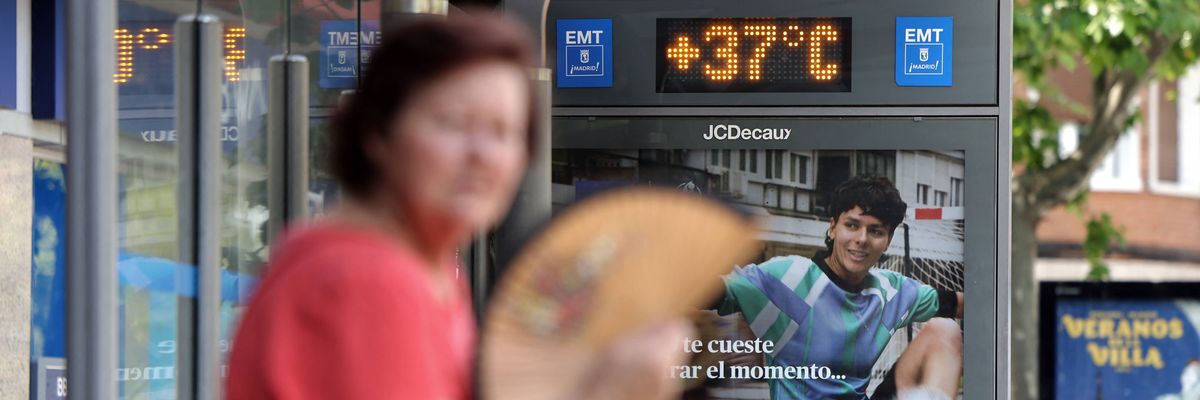
A woman cools herself off using a fan at a bus stop showing a temperature of 37°C—or 99°F—during a heatwave in Madrid, on July 1, 2025.
'A Wake-Up Call': Scientists Find 2025 Among Hottest Years on Record
"2025 was full of stark reminders of the urgent need to cut climate pollution, invest in clean energy, and tackle the climate crisis now."
Climate change driven by human burning of fossil fuels helped make 2025 one of the hottest years ever recorded, a scientific report published Monday affirmed, prompting renewed calls for urgent action to combat the worsening planetary emergency.
Researchers at World Weather Attribution (WWA) found that "although 2025 was slightly cooler than 2024 globally, it was still far hotter than almost any other year on record," with only two other recent years recording a higher average worldwide temperature.
For the first time, the three-year running average will end the year above the 1.5°C warming goal, relative to preindustrial levels, established a decade ago under the landmark Paris climate agreement.
"Global temperatures remained very high and significant harm from human-induced climate change is very real," the report continues. "It is not a future threat, but a present-day reality."
"Across the 22 extreme events we analyzed in depth, heatwaves, floods, storms, droughts, and wildfires claimed lives, destroyed communities, and wiped out crops," the researchers wrote. "Together, these events paint a stark picture of the escalating risks we face in a warming world."
The WWA researchers' findings tracked with the findings of United Nations experts and others that 2025 would be the third-hottest year on record.
According to the WWA study:
This year highlighted again, in stark terms, how unfairly the consequences of human-induced climate change are distributed, consistently hitting those who are already marginalized within their societies the hardest. But the inequity goes deeper: The scientific evidence base itself is uneven. Many of our studies in 2025 focused on heavy rainfall events in the Global South, and time and again we found that gaps in observational data and the reliance on climate models developed primarily for the Global North prevented us from drawing confident conclusions. This unequal foundation in climate science mirrors the broader injustices of the climate crisis.
The events of 2025 make it clear that while we urgently need to transition away from fossil fuels, we also must invest in adaptation measures. Many deaths and other impacts could be prevented with timely action. But events like Hurricane Melissa highlight the limits of preparedness and adaptation: When an intense storm strikes small islands such as Jamaica and other Caribbean nations, even relatively high levels of preparedness cannot prevent extreme losses and damage. This underscores that adaptation alone is not enough; rapid emission reductions remain essential to avoid the worst impacts of climate change.
“If we don’t stop burning fossil fuels very, very, quickly, very soon, it will be very hard to keep that goal” of 1.5°C, WWA co-founder Friederike Otto—who is also an Imperial College London climate scientist—told the Associated Press. “The science is increasingly clear.”
The WWA study's publication comes a month after this year's United Nations Climate Change Conference—or COP30—ended in Brazil with little meaningful progress toward a transition from fossil fuels.
Responding to the new study, Climate Action Campaign director Margie Alt said in a statement that "2025 was full of stark reminders of the urgent need to cut climate pollution, invest in clean energy, and tackle the climate crisis now."
"Today’s report is a wake-up call," Alt continued. "Unfortunately, [US President Donald] Trump and Republicans controlling Congress spent the past year making climate denial official US policy and undermining progress to stave off the worst of the climate crisis. Their reckless polluters-first agenda rolled back critical climate protections and attacked and undermined the very agencies responsible for helping Americans prepare for and recover from increasingly dangerous disasters."
"Across the country, people are standing up and demanding their leaders do better to protect our families from climate change and extreme weather," Alt added. "It's time those in power started listening.”
We are at a crossroads
This country and this world are at a monumental crossroads. In a few short weeks, US voters will have an opportunity to beat back the forces of fascism and confront the billionaires who are rigging the economy, our media system, and our democracy, making it increasingly impossible for ordinary people to get by. We’re not just talking about the election. We’re talking about what must be done once these fascist elements are vanquished from power. We need a bolder set of solutions than what either major party has so far been willing to offer and a working-class movement ready to fight like hell for it. Trump didn't emerge from nowhere. The conditions that fueled MAGA authoritarianism were created by decades of radical neoliberal economic policies and a corrupt political system dominated by corporate interests. They slashed taxes on the super-rich, promising that the benefits would trickle down. They said giveaways to the corporate titans would make life more affordable for the rest of us. It was all bullshit. And when a bitter, betrayed populace searches for someone to blame, right-wing demagogues have little trouble finding scapegoats. People know when they're being lied to, but you won't hear any of this from the corporate media. Only independent journalism—powered and funded by people who believe in building a better world—can deliver truly trustworthy daily news. Our Fall Campaign is underway, and we need your help. To power our newsroom through the rest of the year, we need to raise $125,000 by midnight on October 31. So if you share our vision, please contribute whatever you can to sustain our work. |
Climate change driven by human burning of fossil fuels helped make 2025 one of the hottest years ever recorded, a scientific report published Monday affirmed, prompting renewed calls for urgent action to combat the worsening planetary emergency.
Researchers at World Weather Attribution (WWA) found that "although 2025 was slightly cooler than 2024 globally, it was still far hotter than almost any other year on record," with only two other recent years recording a higher average worldwide temperature.
For the first time, the three-year running average will end the year above the 1.5°C warming goal, relative to preindustrial levels, established a decade ago under the landmark Paris climate agreement.
"Global temperatures remained very high and significant harm from human-induced climate change is very real," the report continues. "It is not a future threat, but a present-day reality."
"Across the 22 extreme events we analyzed in depth, heatwaves, floods, storms, droughts, and wildfires claimed lives, destroyed communities, and wiped out crops," the researchers wrote. "Together, these events paint a stark picture of the escalating risks we face in a warming world."
The WWA researchers' findings tracked with the findings of United Nations experts and others that 2025 would be the third-hottest year on record.
According to the WWA study:
This year highlighted again, in stark terms, how unfairly the consequences of human-induced climate change are distributed, consistently hitting those who are already marginalized within their societies the hardest. But the inequity goes deeper: The scientific evidence base itself is uneven. Many of our studies in 2025 focused on heavy rainfall events in the Global South, and time and again we found that gaps in observational data and the reliance on climate models developed primarily for the Global North prevented us from drawing confident conclusions. This unequal foundation in climate science mirrors the broader injustices of the climate crisis.
The events of 2025 make it clear that while we urgently need to transition away from fossil fuels, we also must invest in adaptation measures. Many deaths and other impacts could be prevented with timely action. But events like Hurricane Melissa highlight the limits of preparedness and adaptation: When an intense storm strikes small islands such as Jamaica and other Caribbean nations, even relatively high levels of preparedness cannot prevent extreme losses and damage. This underscores that adaptation alone is not enough; rapid emission reductions remain essential to avoid the worst impacts of climate change.
“If we don’t stop burning fossil fuels very, very, quickly, very soon, it will be very hard to keep that goal” of 1.5°C, WWA co-founder Friederike Otto—who is also an Imperial College London climate scientist—told the Associated Press. “The science is increasingly clear.”
The WWA study's publication comes a month after this year's United Nations Climate Change Conference—or COP30—ended in Brazil with little meaningful progress toward a transition from fossil fuels.
Responding to the new study, Climate Action Campaign director Margie Alt said in a statement that "2025 was full of stark reminders of the urgent need to cut climate pollution, invest in clean energy, and tackle the climate crisis now."
"Today’s report is a wake-up call," Alt continued. "Unfortunately, [US President Donald] Trump and Republicans controlling Congress spent the past year making climate denial official US policy and undermining progress to stave off the worst of the climate crisis. Their reckless polluters-first agenda rolled back critical climate protections and attacked and undermined the very agencies responsible for helping Americans prepare for and recover from increasingly dangerous disasters."
"Across the country, people are standing up and demanding their leaders do better to protect our families from climate change and extreme weather," Alt added. "It's time those in power started listening.”
- Trump’s Cabinet of Planet-Wreckers Are Destroying What They’ve Sworn to Protect ›
- States Should Step Up to Protect Their Workers and Economies From Extreme Heat ›
- 'Changes In the Heart of Winter': NOAA Report Documents Warmest Arctic Year on Record ›
- 3 Climate Priorities World Leaders Must Champion at the UN and Beyond ›
- Opinion | It's About to Get Even Hotter—Can We Learn From It? | Common Dreams ›
- Opinion | The Climate Crisis Is About to Usher in a World We Haven't Seen Before | Common Dreams ›