SUBSCRIBE TO OUR FREE NEWSLETTER
Daily news & progressive opinion—funded by the people, not the corporations—delivered straight to your inbox.
5
#000000
#FFFFFF
To donate by check, phone, or other method, see our More Ways to Give page.
Daily news & progressive opinion—funded by the people, not the corporations—delivered straight to your inbox.
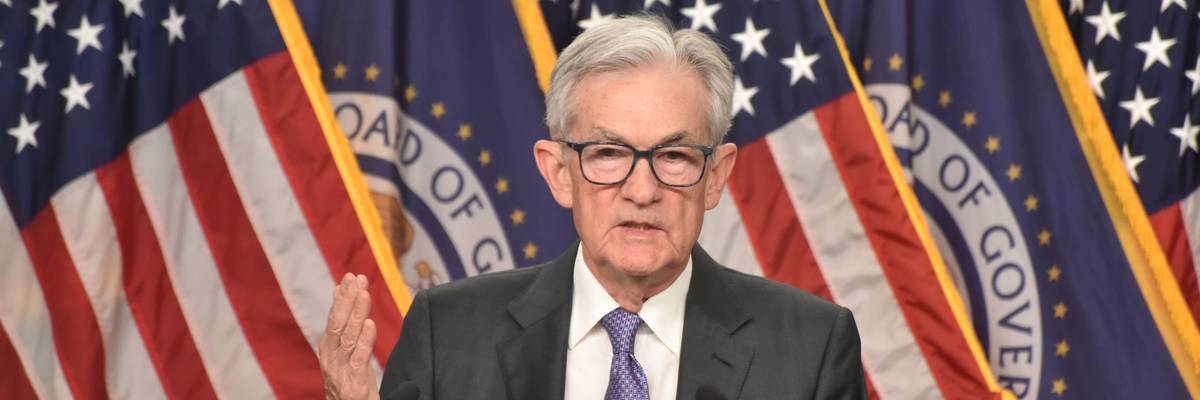
Federal Reserve Chair Jerome Powell speaks during a press conference following the Federal Open Markets Committee meeting on December 10, 2025 in Washington, DC.
"Working families are heading into the holidays feeling stretched, stressed, and far from jolly."
A leading economist and key congressional Democrat on Wednesday pointed to the Federal Reserve's benchmark interest rate cut as just the latest evidence of the havoc that President Donald Trump is wreaking on the economy.
The US central bank has a dual mandate to promote price stability and maximum employment. The Federal Open Market Committee may raise the benchmark rate to reduce inflation, or cut it to spur economic growth, including hiring. However, the FOMC is currently contending with a cooling job market and soaring costs.
After the FOMC's two-day monthly meeting, the divided committee announced a quarter-point reduction to 3.5-3.75%. It's the third time the panel has cut the federal funds rate in recent months after a pause during the early part of Trump's second term.
"Today's decision shows that the Trump economy is in a sorry state and that the Federal Reserve is concerned about a weakening job market," House Budget Committee Ranking Member Brendan Boyle (D-Pa.) said in a statement. "On top of a flailing job market, the president's tariffs—his national sales tax—continue to fuel inflation."
"To make matters worse, extreme Republican policies, including Trump's Big Ugly Law, are driving healthcare costs sharply higher," he continued, pointing to the budget package that the president signed in July. "I will keep fighting to lower costs and for an economy that works for every American."
Alex Jacquez, a former Obama administration official who is now chief of policy and advocacy at the Groundwork Collaborative, similarly said that "Trump's reckless handling of the economy has backed the Fed into a corner—stuck between rising costs and a weakening job market, it has no choice but to try and offer what little relief they can to consumers via rate cuts."
"But the Fed cannot undo the damage created by Trump's chaos economy," Jacquez added, "and working families are heading into the holidays feeling stretched, stressed, and far from jolly."
Thanks to the historically long federal government shutdown, the FOMC didn't have typical data—the consumer price index or jobs report—to inform Wednesday's decision. Instead, its new statement and projections "relied on 'available indicators,' which Fed officials have said include their own internal surveys, community contacts, and private data," Reuters reported.
"The most recent official data on unemployment and inflation is for September, and showed the unemployment rate rising to 4.4% from 4.3%, while the Fed's preferred measure of inflation also increased slightly to 2.8% from 2.7%," the news agency noted. "The Fed has a 2% inflation target, but the pace of price increases has risen steadily from 2.3% in April, a fact at least partly attributable to the pass-through of rising import taxes to consumers and a driving force behind the central bank's policy divide."
The lack of government data has also shifted journalists' attention to other sources, including the revelation from global payroll processing firm ADP that the US lost 32,000 jobs in November, as well as Gallup's finding last week that Americans' confidence in the economy has fallen by seven points over the past month and is now at its lowest level in over a year.
The Associated Press highlighted that the rate cut is "good news" for US job-seekers:
"Overall, we've seen a slowing demand for workers with employers not hiring the way they did a couple of years ago," said Cory Stahle, senior economist at the Indeed Hiring Lab. "By lowering the interest rate, you make it a little more financially reasonable for employers to hire additional people. Especially in some areas—like startups, where companies lean pretty heavily on borrowed money—that's the hope here."
Stahle acknowledged that it could take time for the rate cuts to filter down to employers and then to workers, but he said the signal of the reduction is also important.
"Beyond the size of the cut, it tells employers and job-seekers something about the Federal Reserve's priorities and focus. That they're concerned about the labor market and willing to step in and support the labor market. It's an assurance of the reserve's priorities."
The Federal Reserve is now projecting only one rate cut next year. During a Wednesday press conference, Fed Chair Jerome Powell pointed to the three cuts since September and said that "we are well positioned to wait to see how the economy evolves."
However, Powell is on his way out, with his term ending in May, and Trump signaled in a Tuesday interview with Politico that agreeing with immediate interest rate cuts is a litmus test for his next nominee to fill the role.
Trump—who embarked on a nationwide "affordability tour" this week after claiming last week that "the word 'affordability' is a Democrat scam"—also graded the US economy on his watch, giving it an A+++++.
US Sen. Bernie Sanders (I-Vt.) responded: "Really? 60% of Americans live paycheck to paycheck. 800,000 are homeless. Food prices are at record highs. Wages lag behind inflation. God help us when we have a B+++++ economy."
Dear Common Dreams reader, It’s been nearly 30 years since I co-founded Common Dreams with my late wife, Lina Newhouser. We had the radical notion that journalism should serve the public good, not corporate profits. It was clear to us from the outset what it would take to build such a project. No paid advertisements. No corporate sponsors. No millionaire publisher telling us what to think or do. Many people said we wouldn't last a year, but we proved those doubters wrong. Together with a tremendous team of journalists and dedicated staff, we built an independent media outlet free from the constraints of profits and corporate control. Our mission has always been simple: To inform. To inspire. To ignite change for the common good. Building Common Dreams was not easy. Our survival was never guaranteed. When you take on the most powerful forces—Wall Street greed, fossil fuel industry destruction, Big Tech lobbyists, and uber-rich oligarchs who have spent billions upon billions rigging the economy and democracy in their favor—the only bulwark you have is supporters who believe in your work. But here’s the urgent message from me today. It's never been this bad out there. And it's never been this hard to keep us going. At the very moment Common Dreams is most needed, the threats we face are intensifying. We need your support now more than ever. We don't accept corporate advertising and never will. We don't have a paywall because we don't think people should be blocked from critical news based on their ability to pay. Everything we do is funded by the donations of readers like you. When everyone does the little they can afford, we are strong. But if that support retreats or dries up, so do we. Will you donate now to make sure Common Dreams not only survives but thrives? —Craig Brown, Co-founder |
A leading economist and key congressional Democrat on Wednesday pointed to the Federal Reserve's benchmark interest rate cut as just the latest evidence of the havoc that President Donald Trump is wreaking on the economy.
The US central bank has a dual mandate to promote price stability and maximum employment. The Federal Open Market Committee may raise the benchmark rate to reduce inflation, or cut it to spur economic growth, including hiring. However, the FOMC is currently contending with a cooling job market and soaring costs.
After the FOMC's two-day monthly meeting, the divided committee announced a quarter-point reduction to 3.5-3.75%. It's the third time the panel has cut the federal funds rate in recent months after a pause during the early part of Trump's second term.
"Today's decision shows that the Trump economy is in a sorry state and that the Federal Reserve is concerned about a weakening job market," House Budget Committee Ranking Member Brendan Boyle (D-Pa.) said in a statement. "On top of a flailing job market, the president's tariffs—his national sales tax—continue to fuel inflation."
"To make matters worse, extreme Republican policies, including Trump's Big Ugly Law, are driving healthcare costs sharply higher," he continued, pointing to the budget package that the president signed in July. "I will keep fighting to lower costs and for an economy that works for every American."
Alex Jacquez, a former Obama administration official who is now chief of policy and advocacy at the Groundwork Collaborative, similarly said that "Trump's reckless handling of the economy has backed the Fed into a corner—stuck between rising costs and a weakening job market, it has no choice but to try and offer what little relief they can to consumers via rate cuts."
"But the Fed cannot undo the damage created by Trump's chaos economy," Jacquez added, "and working families are heading into the holidays feeling stretched, stressed, and far from jolly."
Thanks to the historically long federal government shutdown, the FOMC didn't have typical data—the consumer price index or jobs report—to inform Wednesday's decision. Instead, its new statement and projections "relied on 'available indicators,' which Fed officials have said include their own internal surveys, community contacts, and private data," Reuters reported.
"The most recent official data on unemployment and inflation is for September, and showed the unemployment rate rising to 4.4% from 4.3%, while the Fed's preferred measure of inflation also increased slightly to 2.8% from 2.7%," the news agency noted. "The Fed has a 2% inflation target, but the pace of price increases has risen steadily from 2.3% in April, a fact at least partly attributable to the pass-through of rising import taxes to consumers and a driving force behind the central bank's policy divide."
The lack of government data has also shifted journalists' attention to other sources, including the revelation from global payroll processing firm ADP that the US lost 32,000 jobs in November, as well as Gallup's finding last week that Americans' confidence in the economy has fallen by seven points over the past month and is now at its lowest level in over a year.
The Associated Press highlighted that the rate cut is "good news" for US job-seekers:
"Overall, we've seen a slowing demand for workers with employers not hiring the way they did a couple of years ago," said Cory Stahle, senior economist at the Indeed Hiring Lab. "By lowering the interest rate, you make it a little more financially reasonable for employers to hire additional people. Especially in some areas—like startups, where companies lean pretty heavily on borrowed money—that's the hope here."
Stahle acknowledged that it could take time for the rate cuts to filter down to employers and then to workers, but he said the signal of the reduction is also important.
"Beyond the size of the cut, it tells employers and job-seekers something about the Federal Reserve's priorities and focus. That they're concerned about the labor market and willing to step in and support the labor market. It's an assurance of the reserve's priorities."
The Federal Reserve is now projecting only one rate cut next year. During a Wednesday press conference, Fed Chair Jerome Powell pointed to the three cuts since September and said that "we are well positioned to wait to see how the economy evolves."
However, Powell is on his way out, with his term ending in May, and Trump signaled in a Tuesday interview with Politico that agreeing with immediate interest rate cuts is a litmus test for his next nominee to fill the role.
Trump—who embarked on a nationwide "affordability tour" this week after claiming last week that "the word 'affordability' is a Democrat scam"—also graded the US economy on his watch, giving it an A+++++.
US Sen. Bernie Sanders (I-Vt.) responded: "Really? 60% of Americans live paycheck to paycheck. 800,000 are homeless. Food prices are at record highs. Wages lag behind inflation. God help us when we have a B+++++ economy."
A leading economist and key congressional Democrat on Wednesday pointed to the Federal Reserve's benchmark interest rate cut as just the latest evidence of the havoc that President Donald Trump is wreaking on the economy.
The US central bank has a dual mandate to promote price stability and maximum employment. The Federal Open Market Committee may raise the benchmark rate to reduce inflation, or cut it to spur economic growth, including hiring. However, the FOMC is currently contending with a cooling job market and soaring costs.
After the FOMC's two-day monthly meeting, the divided committee announced a quarter-point reduction to 3.5-3.75%. It's the third time the panel has cut the federal funds rate in recent months after a pause during the early part of Trump's second term.
"Today's decision shows that the Trump economy is in a sorry state and that the Federal Reserve is concerned about a weakening job market," House Budget Committee Ranking Member Brendan Boyle (D-Pa.) said in a statement. "On top of a flailing job market, the president's tariffs—his national sales tax—continue to fuel inflation."
"To make matters worse, extreme Republican policies, including Trump's Big Ugly Law, are driving healthcare costs sharply higher," he continued, pointing to the budget package that the president signed in July. "I will keep fighting to lower costs and for an economy that works for every American."
Alex Jacquez, a former Obama administration official who is now chief of policy and advocacy at the Groundwork Collaborative, similarly said that "Trump's reckless handling of the economy has backed the Fed into a corner—stuck between rising costs and a weakening job market, it has no choice but to try and offer what little relief they can to consumers via rate cuts."
"But the Fed cannot undo the damage created by Trump's chaos economy," Jacquez added, "and working families are heading into the holidays feeling stretched, stressed, and far from jolly."
Thanks to the historically long federal government shutdown, the FOMC didn't have typical data—the consumer price index or jobs report—to inform Wednesday's decision. Instead, its new statement and projections "relied on 'available indicators,' which Fed officials have said include their own internal surveys, community contacts, and private data," Reuters reported.
"The most recent official data on unemployment and inflation is for September, and showed the unemployment rate rising to 4.4% from 4.3%, while the Fed's preferred measure of inflation also increased slightly to 2.8% from 2.7%," the news agency noted. "The Fed has a 2% inflation target, but the pace of price increases has risen steadily from 2.3% in April, a fact at least partly attributable to the pass-through of rising import taxes to consumers and a driving force behind the central bank's policy divide."
The lack of government data has also shifted journalists' attention to other sources, including the revelation from global payroll processing firm ADP that the US lost 32,000 jobs in November, as well as Gallup's finding last week that Americans' confidence in the economy has fallen by seven points over the past month and is now at its lowest level in over a year.
The Associated Press highlighted that the rate cut is "good news" for US job-seekers:
"Overall, we've seen a slowing demand for workers with employers not hiring the way they did a couple of years ago," said Cory Stahle, senior economist at the Indeed Hiring Lab. "By lowering the interest rate, you make it a little more financially reasonable for employers to hire additional people. Especially in some areas—like startups, where companies lean pretty heavily on borrowed money—that's the hope here."
Stahle acknowledged that it could take time for the rate cuts to filter down to employers and then to workers, but he said the signal of the reduction is also important.
"Beyond the size of the cut, it tells employers and job-seekers something about the Federal Reserve's priorities and focus. That they're concerned about the labor market and willing to step in and support the labor market. It's an assurance of the reserve's priorities."
The Federal Reserve is now projecting only one rate cut next year. During a Wednesday press conference, Fed Chair Jerome Powell pointed to the three cuts since September and said that "we are well positioned to wait to see how the economy evolves."
However, Powell is on his way out, with his term ending in May, and Trump signaled in a Tuesday interview with Politico that agreeing with immediate interest rate cuts is a litmus test for his next nominee to fill the role.
Trump—who embarked on a nationwide "affordability tour" this week after claiming last week that "the word 'affordability' is a Democrat scam"—also graded the US economy on his watch, giving it an A+++++.
US Sen. Bernie Sanders (I-Vt.) responded: "Really? 60% of Americans live paycheck to paycheck. 800,000 are homeless. Food prices are at record highs. Wages lag behind inflation. God help us when we have a B+++++ economy."