SUBSCRIBE TO OUR FREE NEWSLETTER
Daily news & progressive opinion—funded by the people, not the corporations—delivered straight to your inbox.
5
#000000
#FFFFFF
To donate by check, phone, or other method, see our More Ways to Give page.
Daily news & progressive opinion—funded by the people, not the corporations—delivered straight to your inbox.
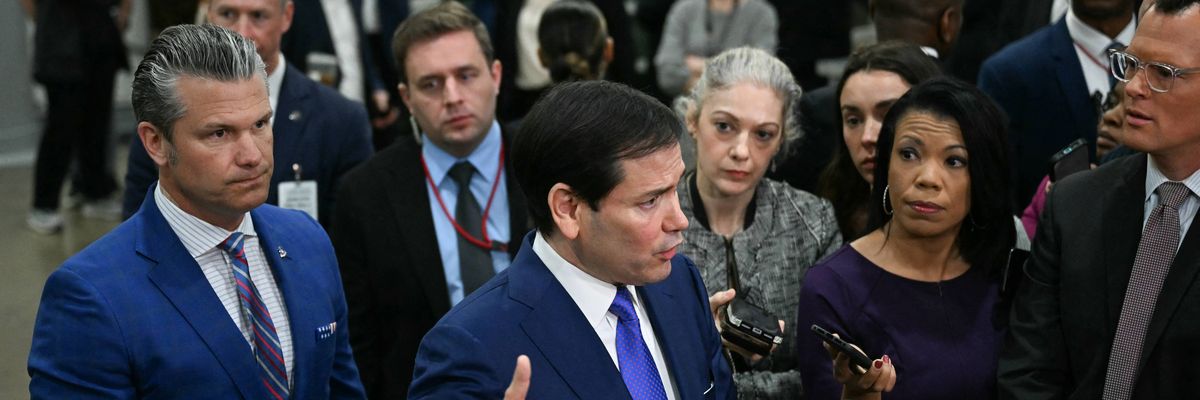
US Secretary of Defense Pete Hegseth and Secretary of State Marco Rubio speak to reporters after they briefed senators on the recent US military actions in Venezuela on Capitol Hill in Washington, DC on January 7, 2026.
"The Trump administration is blatantly colonialist, and proud of it."
On the heels of President Donald Trump’s threats to use military force to conquer Greenland, Secretary of State Marco Rubio suggested during a Wednesday press conference that US presidents reserve the right to do so not only in the Danish territory, but anywhere in the world.
The conference came shortly after Rubio and Defense Secretary Pete Hegseth briefed lawmakers about Trump's illegal operation to overthrow Venezuelan President Nicolás Maduro last weekend.
After Rubio laid out plans for the US to take control of 30 million to 50 million barrels of Venezuelan oil following a deal with its newly installed government, reporters attempted to ask Rubio to explain the administration's designs on Greenland.
On Tuesday, amid international outcry, the White House issued a statement that acquiring Greenland was a "national security priority" and that "utilizing the US military is always an option" to annex the Arctic island.
European leaders met on Wednesday to discuss a potential response if Trump were to launch a military operation to seize Greenland, which has been a territory of Denmark—now a NATO member—for over 300 years.
Rubio appeared sheepish about discussing Trump's saber-rattling. Asked by a reporter whether he'd take military intervention "off the table," he shrugged: "I'm not here to talk about Denmark or military intervention. I'll be meeting with them next week."
Rubio pivoted to discuss the president's interest in buying Greenland, which he has suggested since his first term in office. But reporters continued to press on what was meant by Trump's suggestion that the military may be used.
After continuing to stall—and, at one point, interrupting a reporter to tell him he'd "lost a lot of weight"—Rubio obliquely addressed the president's threats.
He said: "Guys, what I think the White House said yesterday is what I will tell you now, and I've always said: The president always retained the option—every president, not this president, every president—always retains the option... I'm not talking about Greenland, I'm talking about globally. If the president identifies a threat to the national security of the United States, every president retains the option to address it through military means."
"As a diplomat, which is what I am... we always prefer to settle it in different ways," Rubio continued. "That included in Venezuela. We tried repeatedly to reach an outcome here that did not involve having to go in and grab an indicted drug trafficker. Those were unsuccessful, unfortunately."
The United Nations Charter, which the US has signed, allows for the use of military force against other sovereign nations only in very narrow circumstances: in self-defense against an imminent attack, or when approved by the UN Security Council as necessary to prevent a threat to peace.
The Trump administration has attempted to stretch this definition to justify its overthrow of the Venezuelan government, claiming that supposed drug trafficking from Venezuela constitutes an imminent threat to the US. But Venezuela is not considered a large player in the global drug trade, and even if it were, drug trafficking has never been considered equivalent to an armed attack under international law.
Rubio did not clarify what "threat" Greenland supposedly poses to the United States. Earlier this week, Trump stated that the US "needs" the island because it is supposedly "covered with Russian and Chinese ships," which isn't true, but would not constitute an imminent threat to the US even if it were.
When a reporter then asked Trump what justification the US would have to take Greenland, he responded that “the [European Union] needs us to have it.” Several major EU members, in fact, issued a harsh condemnation of the idea on Tuesday.
International relations scholars agree with virtual unanimity that for the US to forcibly annex Greenland would not be a legitimate use of force. But Section 2(4) of the UN Charter also forbids the threat of military force as a tool of leverage in negotiations, which Trump may be using in a possible bid to buy Greenland.
"International law does not recognize title obtained through unlawful force," wrote Edmarverson A. Santos, a Dublin-based international law and policy researcher. "The prohibition extends beyond actual armed attack. Contemporary doctrine recognizes that serious threats of force, particularly when coupled with political or military pressure, can fall within the scope of Article 2(4)."
Since its attack on Venezuela, the Trump administration has threatened to use similar force to knock over the governments of several other countries as part of what he has described as a 21st-century revival of the colonial-era "Monroe Doctrine."
Trump issued threats to Mexico's President Claudia Sheinbaum and Colombian President Gustavo Petro. Rubio, meanwhile, said that if he were part of Cuba's socialist government, he'd "be concerned, at least a little bit."
On Tuesday, André Nollkaemper, a professor of public international law at the University of Amsterdam, warned that Trump's increasing belligerence toward Europe was the direct outcome of European leaders' meek response to his attack on Venezuela.
"The long-term impact of US intervention in Venezuela will not be decided in Caracas or Washington, but elsewhere," he wrote for the German academic site Verfassungsblog. "With intervention now framed as a standard policy instrument of the USA, it is the response of other states—including in Europe—that will determine whether the erosion of international law becomes normalized across regions."
"In deciding the course and content of its response, Europe might be tempted to assume that this new strategy is limited to Latin America, and that the United States should be given some room there," he continued. "That would, of course, be irresponsible; in terms of its implications for international law, and with regard to Mexico, Colombia, and Cuba—not to mention Greenland."
Dear Common Dreams reader, It’s been nearly 30 years since I co-founded Common Dreams with my late wife, Lina Newhouser. We had the radical notion that journalism should serve the public good, not corporate profits. It was clear to us from the outset what it would take to build such a project. No paid advertisements. No corporate sponsors. No millionaire publisher telling us what to think or do. Many people said we wouldn't last a year, but we proved those doubters wrong. Together with a tremendous team of journalists and dedicated staff, we built an independent media outlet free from the constraints of profits and corporate control. Our mission has always been simple: To inform. To inspire. To ignite change for the common good. Building Common Dreams was not easy. Our survival was never guaranteed. When you take on the most powerful forces—Wall Street greed, fossil fuel industry destruction, Big Tech lobbyists, and uber-rich oligarchs who have spent billions upon billions rigging the economy and democracy in their favor—the only bulwark you have is supporters who believe in your work. But here’s the urgent message from me today. It's never been this bad out there. And it's never been this hard to keep us going. At the very moment Common Dreams is most needed, the threats we face are intensifying. We need your support now more than ever. We don't accept corporate advertising and never will. We don't have a paywall because we don't think people should be blocked from critical news based on their ability to pay. Everything we do is funded by the donations of readers like you. When everyone does the little they can afford, we are strong. But if that support retreats or dries up, so do we. Will you donate now to make sure Common Dreams not only survives but thrives? —Craig Brown, Co-founder |
On the heels of President Donald Trump’s threats to use military force to conquer Greenland, Secretary of State Marco Rubio suggested during a Wednesday press conference that US presidents reserve the right to do so not only in the Danish territory, but anywhere in the world.
The conference came shortly after Rubio and Defense Secretary Pete Hegseth briefed lawmakers about Trump's illegal operation to overthrow Venezuelan President Nicolás Maduro last weekend.
After Rubio laid out plans for the US to take control of 30 million to 50 million barrels of Venezuelan oil following a deal with its newly installed government, reporters attempted to ask Rubio to explain the administration's designs on Greenland.
On Tuesday, amid international outcry, the White House issued a statement that acquiring Greenland was a "national security priority" and that "utilizing the US military is always an option" to annex the Arctic island.
European leaders met on Wednesday to discuss a potential response if Trump were to launch a military operation to seize Greenland, which has been a territory of Denmark—now a NATO member—for over 300 years.
Rubio appeared sheepish about discussing Trump's saber-rattling. Asked by a reporter whether he'd take military intervention "off the table," he shrugged: "I'm not here to talk about Denmark or military intervention. I'll be meeting with them next week."
Rubio pivoted to discuss the president's interest in buying Greenland, which he has suggested since his first term in office. But reporters continued to press on what was meant by Trump's suggestion that the military may be used.
After continuing to stall—and, at one point, interrupting a reporter to tell him he'd "lost a lot of weight"—Rubio obliquely addressed the president's threats.
He said: "Guys, what I think the White House said yesterday is what I will tell you now, and I've always said: The president always retained the option—every president, not this president, every president—always retains the option... I'm not talking about Greenland, I'm talking about globally. If the president identifies a threat to the national security of the United States, every president retains the option to address it through military means."
"As a diplomat, which is what I am... we always prefer to settle it in different ways," Rubio continued. "That included in Venezuela. We tried repeatedly to reach an outcome here that did not involve having to go in and grab an indicted drug trafficker. Those were unsuccessful, unfortunately."
The United Nations Charter, which the US has signed, allows for the use of military force against other sovereign nations only in very narrow circumstances: in self-defense against an imminent attack, or when approved by the UN Security Council as necessary to prevent a threat to peace.
The Trump administration has attempted to stretch this definition to justify its overthrow of the Venezuelan government, claiming that supposed drug trafficking from Venezuela constitutes an imminent threat to the US. But Venezuela is not considered a large player in the global drug trade, and even if it were, drug trafficking has never been considered equivalent to an armed attack under international law.
Rubio did not clarify what "threat" Greenland supposedly poses to the United States. Earlier this week, Trump stated that the US "needs" the island because it is supposedly "covered with Russian and Chinese ships," which isn't true, but would not constitute an imminent threat to the US even if it were.
When a reporter then asked Trump what justification the US would have to take Greenland, he responded that “the [European Union] needs us to have it.” Several major EU members, in fact, issued a harsh condemnation of the idea on Tuesday.
International relations scholars agree with virtual unanimity that for the US to forcibly annex Greenland would not be a legitimate use of force. But Section 2(4) of the UN Charter also forbids the threat of military force as a tool of leverage in negotiations, which Trump may be using in a possible bid to buy Greenland.
"International law does not recognize title obtained through unlawful force," wrote Edmarverson A. Santos, a Dublin-based international law and policy researcher. "The prohibition extends beyond actual armed attack. Contemporary doctrine recognizes that serious threats of force, particularly when coupled with political or military pressure, can fall within the scope of Article 2(4)."
Since its attack on Venezuela, the Trump administration has threatened to use similar force to knock over the governments of several other countries as part of what he has described as a 21st-century revival of the colonial-era "Monroe Doctrine."
Trump issued threats to Mexico's President Claudia Sheinbaum and Colombian President Gustavo Petro. Rubio, meanwhile, said that if he were part of Cuba's socialist government, he'd "be concerned, at least a little bit."
On Tuesday, André Nollkaemper, a professor of public international law at the University of Amsterdam, warned that Trump's increasing belligerence toward Europe was the direct outcome of European leaders' meek response to his attack on Venezuela.
"The long-term impact of US intervention in Venezuela will not be decided in Caracas or Washington, but elsewhere," he wrote for the German academic site Verfassungsblog. "With intervention now framed as a standard policy instrument of the USA, it is the response of other states—including in Europe—that will determine whether the erosion of international law becomes normalized across regions."
"In deciding the course and content of its response, Europe might be tempted to assume that this new strategy is limited to Latin America, and that the United States should be given some room there," he continued. "That would, of course, be irresponsible; in terms of its implications for international law, and with regard to Mexico, Colombia, and Cuba—not to mention Greenland."
On the heels of President Donald Trump’s threats to use military force to conquer Greenland, Secretary of State Marco Rubio suggested during a Wednesday press conference that US presidents reserve the right to do so not only in the Danish territory, but anywhere in the world.
The conference came shortly after Rubio and Defense Secretary Pete Hegseth briefed lawmakers about Trump's illegal operation to overthrow Venezuelan President Nicolás Maduro last weekend.
After Rubio laid out plans for the US to take control of 30 million to 50 million barrels of Venezuelan oil following a deal with its newly installed government, reporters attempted to ask Rubio to explain the administration's designs on Greenland.
On Tuesday, amid international outcry, the White House issued a statement that acquiring Greenland was a "national security priority" and that "utilizing the US military is always an option" to annex the Arctic island.
European leaders met on Wednesday to discuss a potential response if Trump were to launch a military operation to seize Greenland, which has been a territory of Denmark—now a NATO member—for over 300 years.
Rubio appeared sheepish about discussing Trump's saber-rattling. Asked by a reporter whether he'd take military intervention "off the table," he shrugged: "I'm not here to talk about Denmark or military intervention. I'll be meeting with them next week."
Rubio pivoted to discuss the president's interest in buying Greenland, which he has suggested since his first term in office. But reporters continued to press on what was meant by Trump's suggestion that the military may be used.
After continuing to stall—and, at one point, interrupting a reporter to tell him he'd "lost a lot of weight"—Rubio obliquely addressed the president's threats.
He said: "Guys, what I think the White House said yesterday is what I will tell you now, and I've always said: The president always retained the option—every president, not this president, every president—always retains the option... I'm not talking about Greenland, I'm talking about globally. If the president identifies a threat to the national security of the United States, every president retains the option to address it through military means."
"As a diplomat, which is what I am... we always prefer to settle it in different ways," Rubio continued. "That included in Venezuela. We tried repeatedly to reach an outcome here that did not involve having to go in and grab an indicted drug trafficker. Those were unsuccessful, unfortunately."
The United Nations Charter, which the US has signed, allows for the use of military force against other sovereign nations only in very narrow circumstances: in self-defense against an imminent attack, or when approved by the UN Security Council as necessary to prevent a threat to peace.
The Trump administration has attempted to stretch this definition to justify its overthrow of the Venezuelan government, claiming that supposed drug trafficking from Venezuela constitutes an imminent threat to the US. But Venezuela is not considered a large player in the global drug trade, and even if it were, drug trafficking has never been considered equivalent to an armed attack under international law.
Rubio did not clarify what "threat" Greenland supposedly poses to the United States. Earlier this week, Trump stated that the US "needs" the island because it is supposedly "covered with Russian and Chinese ships," which isn't true, but would not constitute an imminent threat to the US even if it were.
When a reporter then asked Trump what justification the US would have to take Greenland, he responded that “the [European Union] needs us to have it.” Several major EU members, in fact, issued a harsh condemnation of the idea on Tuesday.
International relations scholars agree with virtual unanimity that for the US to forcibly annex Greenland would not be a legitimate use of force. But Section 2(4) of the UN Charter also forbids the threat of military force as a tool of leverage in negotiations, which Trump may be using in a possible bid to buy Greenland.
"International law does not recognize title obtained through unlawful force," wrote Edmarverson A. Santos, a Dublin-based international law and policy researcher. "The prohibition extends beyond actual armed attack. Contemporary doctrine recognizes that serious threats of force, particularly when coupled with political or military pressure, can fall within the scope of Article 2(4)."
Since its attack on Venezuela, the Trump administration has threatened to use similar force to knock over the governments of several other countries as part of what he has described as a 21st-century revival of the colonial-era "Monroe Doctrine."
Trump issued threats to Mexico's President Claudia Sheinbaum and Colombian President Gustavo Petro. Rubio, meanwhile, said that if he were part of Cuba's socialist government, he'd "be concerned, at least a little bit."
On Tuesday, André Nollkaemper, a professor of public international law at the University of Amsterdam, warned that Trump's increasing belligerence toward Europe was the direct outcome of European leaders' meek response to his attack on Venezuela.
"The long-term impact of US intervention in Venezuela will not be decided in Caracas or Washington, but elsewhere," he wrote for the German academic site Verfassungsblog. "With intervention now framed as a standard policy instrument of the USA, it is the response of other states—including in Europe—that will determine whether the erosion of international law becomes normalized across regions."
"In deciding the course and content of its response, Europe might be tempted to assume that this new strategy is limited to Latin America, and that the United States should be given some room there," he continued. "That would, of course, be irresponsible; in terms of its implications for international law, and with regard to Mexico, Colombia, and Cuba—not to mention Greenland."