SUBSCRIBE TO OUR FREE NEWSLETTER
Daily news & progressive opinion—funded by the people, not the corporations—delivered straight to your inbox.
5
#000000
#FFFFFF
To donate by check, phone, or other method, see our More Ways to Give page.
The American Civil Liberties Union was founded in 1920 and is our nation's guardian of liberty. The ACLU works in the courts, legislatures and communities to defend and preserve the individual rights and liberties guaranteed to all people in this country by the Constitution and laws of the United States.
(212) 549-2666
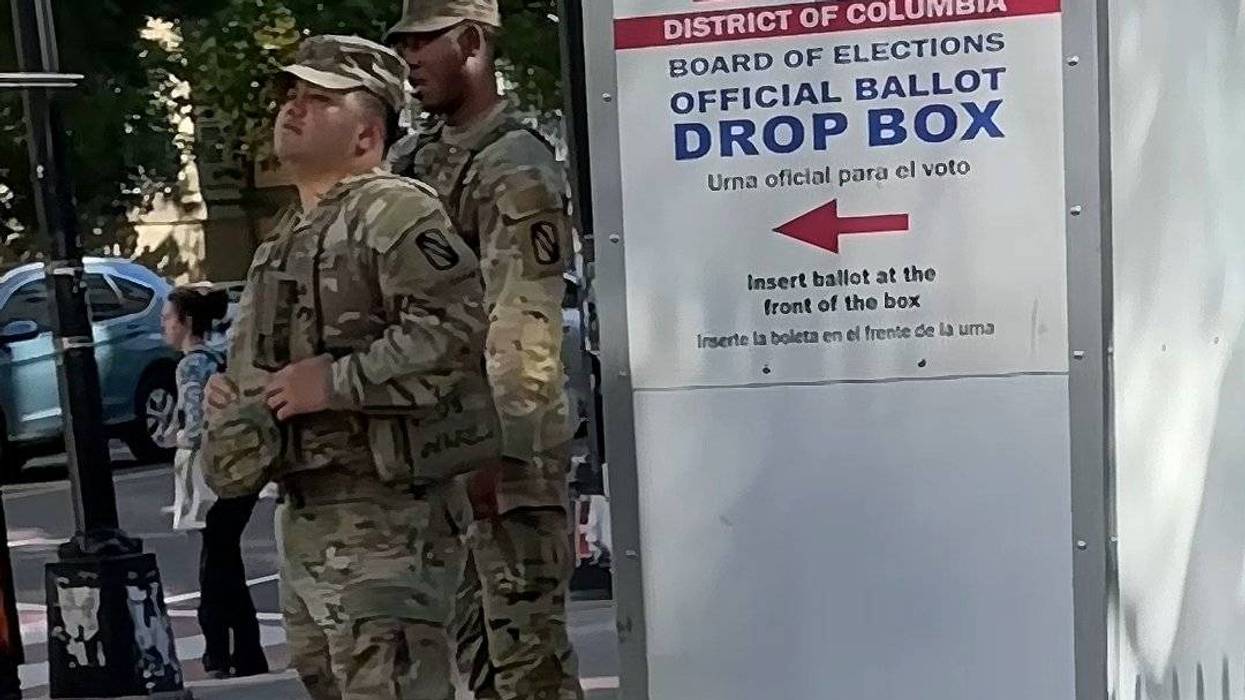
"I stood and watched for a few minutes before I watched this video," Randolph said. "They were there for at least a few minutes. I don't know for how much longer they'd been there before that."
He said that minutes after he began filming, the troops left, possibly because they saw him recording.
Federal law explicitly prohibits the presence of "any troops or armed men at any place where a general or special election is held" unless their presence is necessary to repel armed enemies of the United States.
Though the statute does not specifically mention ballot drop boxes, legal experts have argued that the phrase "any place" means it should apply not just to traditional polling places, but also ballot drop boxes, election offices, and ballot counting facilities.
While he said it was unclear why the troops were stationed at the ballot box, Randolph noted that it was "a giant white box with the word 'ballot' pretty hard to miss," adding that "they clearly, at best, have not been told to stay away."
A spokesperson for the DC Board of Elections confirmed to Common Dreams that it "has received complaints regarding National Guard personnel posted near a ballot drop box next to the Foggy Bottom-GWU Metro station."
"We are addressing the concerns with the National Guard directly and have requested that they impose limitations on the placement of National Guard service members near drop boxes and other voting locations in the District," she said.
Joint Task Force-District of Columbia, the military command overseeing National Guard operations in the capital, did not respond to a request for comment.
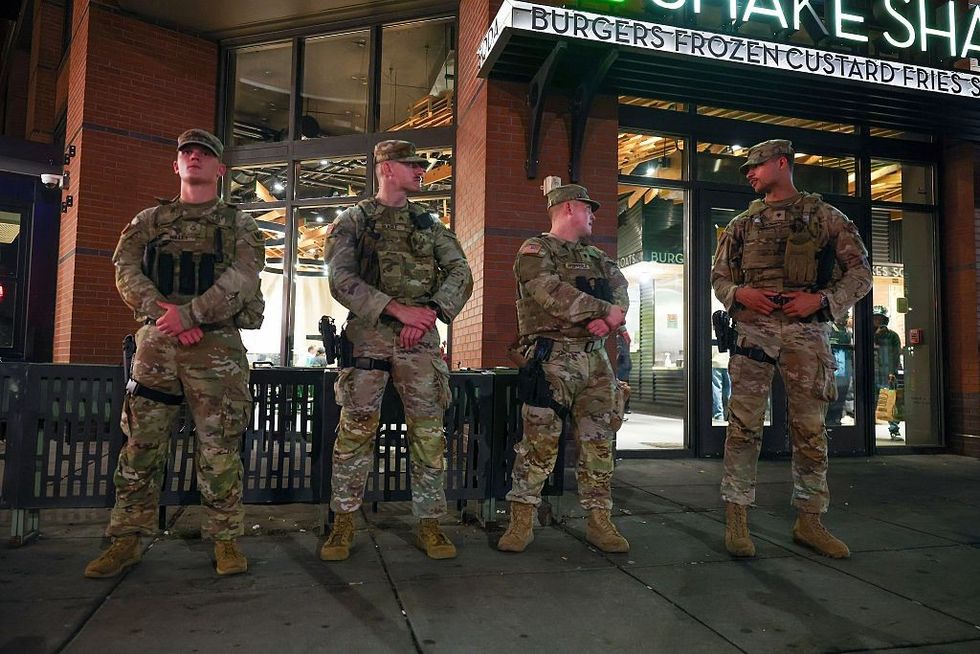 National Guard Members patrol 14th Street, working with Metro police on August 24, 2025, in Washington, DC. (Photo by Tasos Katopodis/Getty Images)
President Donald Trump deployed the National Guard to the streets of the nation's capital last summer. The troops have remained despite widespread public opposition and a federal judge's ruling that the deployment was unlawful, which an appeals court subsequently put on hold.
Asked about the possibility of deploying troops to polling places earlier this year, Trump did not rule it out. He has also lamented that he did not send National Guard troops to seize election materials while he tried to overturn his loss in the 2020 election.
Voting rights experts have warned about possible plans by Trump to use federal troops or agents—including US Immigration and Customs Enforcement (ICE) and the National Guard—to interfere with November's midterm elections. Though elections are administered by states under the Constitution, Trump has said that Republicans should "nationalize" voting.
Dan Herman and Devon Ombres, two national security and legal policy experts at the Center for American Progress, said that "there is little to no safe or democratic way for the military to be involved with the elections process."
"Voters may stay home if they fear military presence. Ballots may no longer be trusted if a machine’s chain of custody is broken. Military deployments elsewhere in a city might prevent voters from reaching their polling site in time," they wrote in a brief published Friday by Just Security.
The recording shared on Thursday is not the first instance of National Guard personnel seen gathered around ballot boxes in DC. In June, Rep. Eleanor Holmes Norton (D-DC), the nonvoting delegate from DC in the House of Representatives, demanded answers about another video in which a resident confronted several troops who were seen outside a drop box.
Asked whether they'd been told to stay away from the boxes, one of the Guard members responded, "No. Not at all."
"The fact that Guard personnel reportedly had not been instructed to avoid ballot drop boxes suggests a troubling lack of awareness by leadership of the impact these deployments are having on the district and its residents," Norton said.
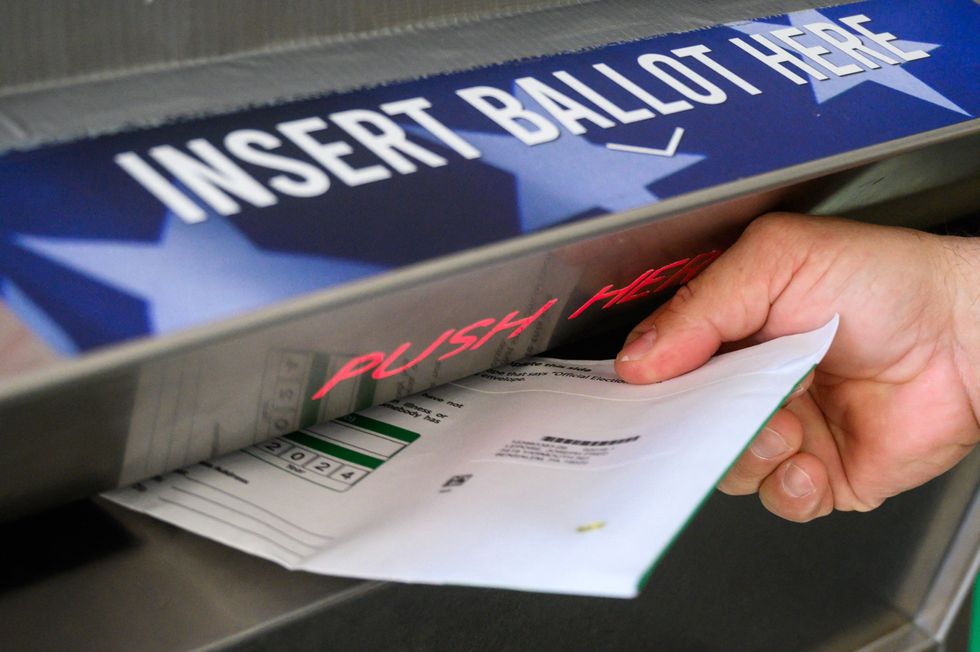 A voter uses a ballot drop box at the Bucks County Administration building voting on demand and ballot drop center in Doylestown, Pennsylvania on October 31, 2024. (Photo by Ed Jones/AFP via Getty Images)
With Republicans in Congress projected to take heavy losses in the midterms, proponents of his efforts to overturn his last election defeat have reportedly met with Trump in recent days, urging him to declare a "national emergency" that they claim would allow him to assert direct authority over the elections, an idea disputed by legal experts.
One plan that has reportedly circulated among election deniers has involved declaring the Insurrection Act, which they claim would allow Trump to flood polling locations with military and federal law enforcement.
While the Insurrection Act would permit some domestic law enforcement by the military, Herman and Ombres emphasized that it would not override the laws restricting troops from polling locations.
"Armed troops do not belong near ballot boxes," Monica Hopkins, executive director of the ACLU of the District of Columbia, told Common Dreams. "At minimum, troop presence at the ballot box creates the appearance of voter intimidation and risks discouraging DC residents from exercising our fundamental right to vote."
"The deployment of National Guard into the District without the consent of our local government is an affront to democracy here and around the nation," she said. "National Guard troops must go home."


Trump raged against Democratic Gov. Tim Walz, whom he described as an "incompetent thief who doesn't want to get involved," and seemed to suggest that if ordinary Minnesotans took matters into their own hands, they'd have the blessing of the federal government.
"The Somalians [sic] should not be allowed to get away with what they are doing," Trump said. "They view you as weak and stupid people. Fight back, Minnesota, fight back! If you need, the Federal Government will come to your rescue."
It's hardly the first time Trump has slurred Somali immigrants. He's previously referred to them as "garbage," "very low-IQ people," and "pirates," and said they should all be deported from the country.
But Trump’s comments on Thursday went a step further than that, leaving community members on edge about the possibility that they could instigate violent attacks by his supporters.
“President Trump is placing a target on the backs of Somali Americans," said Jaylani Hussein, the executive director of the Council on American-Islamic Relations in Minnesota, in a statement. "His words are not simply political rhetoric. They are a dangerous invitation to hatred and potentially violence."
"Minnesota has led the nation in attacks on mosques, including fire-bombings," he said. "We know firsthand what happens when hateful rhetoric turns into violence.”
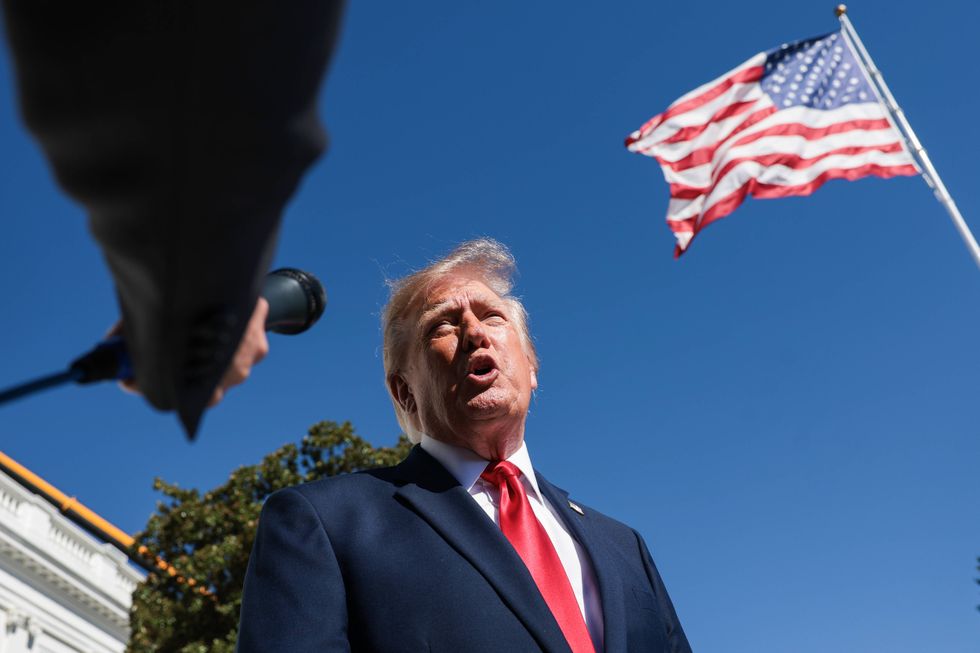 President Donald Trump speaks to reporters before boarding Marine One on the South Lawn of the White House on October 7, 2026 in Washington, DC. (Photo by Anna Moneymaker/Getty Images)
Faisa Ahmed, a Somali American political organizer and senior adviser to the reelection campaign of Minnesota Attorney General Keith Ellison, said unease ran deep in her home city of Minneapolis on Thursday night.
"Every Somali I know is walking through our own neighborhoods scared tonight," she said.
"The president just told Minnesotans to 'fight back' against Somalis by name," she added. "This is incitement, and everyone should call it that."
Though most of them are US citizens, Somalis were aggressively targeted when thousands of immigration agents descended on Minnesota during Trump's Operation Metro Surge earlier this year.
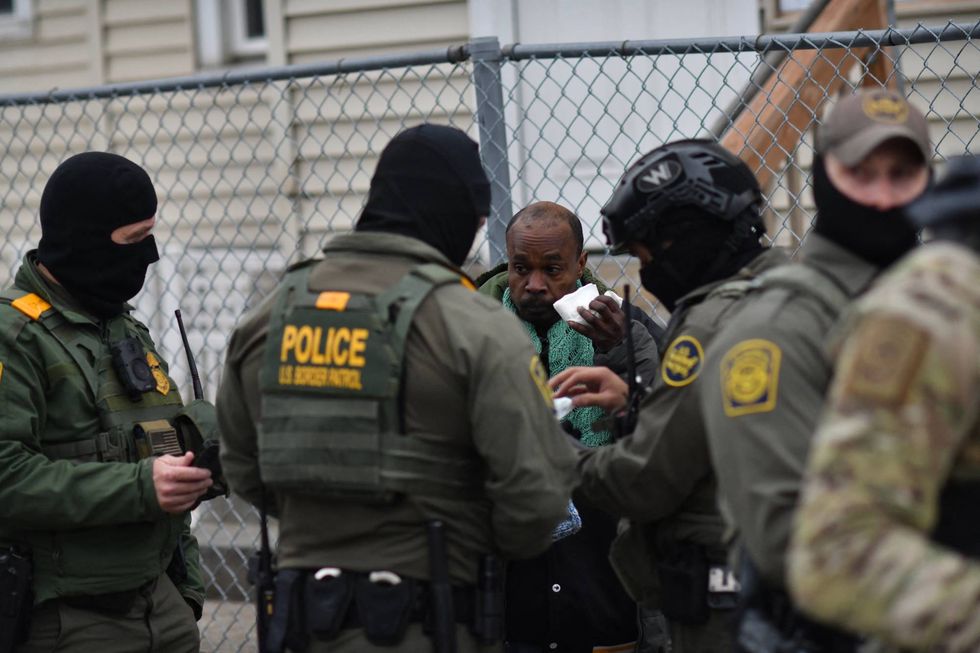 US Border Patrol agents detain an unidentified man of Somali descent in Minneapolis, Minnesota, on January 8, 2026. (Photo by Octavio Jones/AFP via Getty Images)
In numerous cases, Immigration and Customs Enforcement (ICE) and other federal agents were documented engaging in explicit racial profiling directed at Somali citizens—as well as other immigrants—many of whom were detained arbitrarily and attacked with physical violence.
Ellison, who has sued the administration for civil rights violations and pushed for agents to be investigated under state law, said he would not let this happen again.
"We've seen what Trump's government coming to the 'rescue' looks like," he wrote on social media Thursday. "It ended with two Minnesotans shot dead by federal agents, racial profiling, assaults, and the violation of our rights."
"Never again. If Trump tries, I'll drag him back to court," he said. "Somali Minnesotans are our neighbors. They are part of Minnesota. And the Minnesota I know and love is so much better than this bigotry."
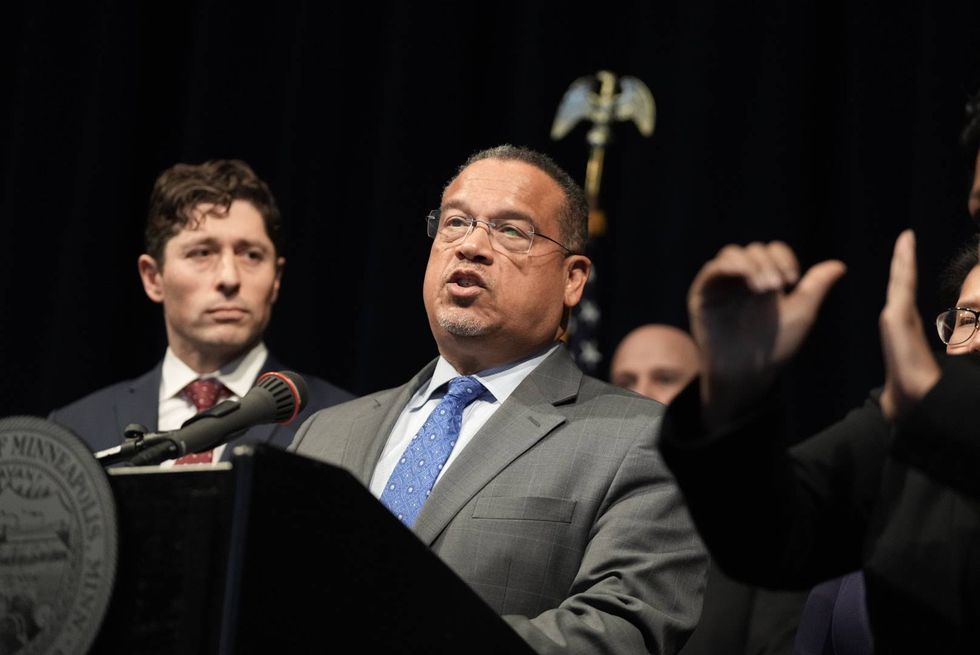 Minnesota Attorney General Keith Ellison, along with Minneapolis Mayor Jacob Frey, announced a lawsuit against the Trump administration's deployment of ICE agents to the Twin Cities during a press conference at Minneapolis City Hall on Monday, January 12, 2026. (Photo by Richard Tsong-Taatarii/The Minnesota Star Tribune via Getty Images)
With less than a month to go before the midterm elections, Minnesota Republicans have sought to harness bigotry against Somalis to rally support.
Democratic candidate Doug Chapin, who is trying to unseat Republican House Majority Whip Tom Emmer in Minnesota's 6th district, put it plainly during an event on Thursday night.
"I'll call it what it is," Chapin said. "The president is trying to foment a race war here in Minnesota."
But as the violent rhetoric has ramped back up, so have expressions of solidarity from community members who have called it out as a cynical political tactic.
"This is KGB-style fear-mongering before an election. Trump’s terrified he’s going to lose the House and Senate and get impeached," said Mike Norton, the former vice chair of the Democratic Farmer-Labor Party in Minneapolis.
"I love my Somali friends and neighbors. They make Minnesota a better place," Norton said. "If Trump tries to come for them, he needs to come through all of us."