SUBSCRIBE TO OUR FREE NEWSLETTER
Daily news & progressive opinion—funded by the people, not the corporations—delivered straight to your inbox.
5
#000000
#FFFFFF
To donate by check, phone, or other method, see our More Ways to Give page.
Daily news & progressive opinion—funded by the people, not the corporations—delivered straight to your inbox.
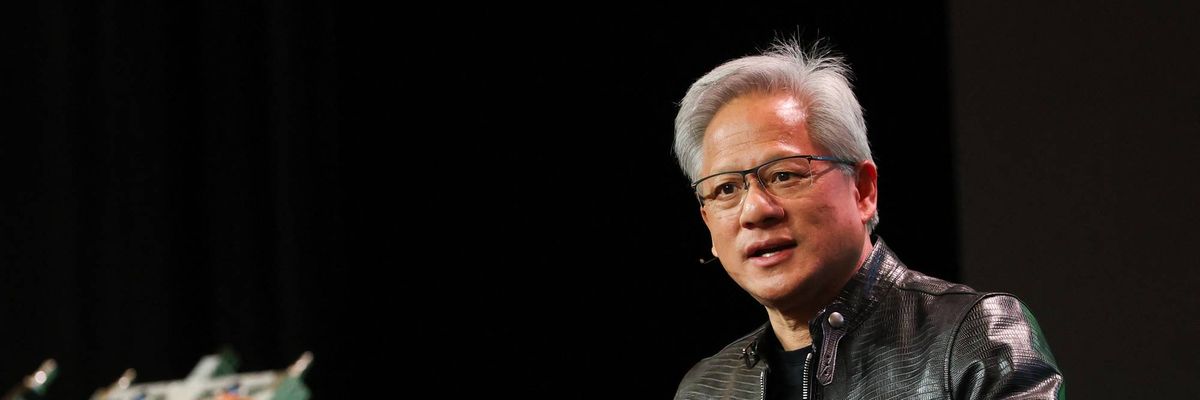
Nvidia founder and CEO Jensen Huang speaks during an event in Las Vegas, Nevada, on January 6, 2026.
If the proposed tax is enacted, Huang would face a roughly $8 billion tax bill—a tiny fraction of his $165 billion net worth.
Jensen Huang, CEO of the tech behemoth Nvidia and the eighth-richest man in the world, said Tuesday that he is "perfectly fine" with a grassroots push in California to impose a one-time wealth tax on the state's billionaire residents.
In an interview with Bloomberg, Huang said that "we chose to live in Silicon Valley, and whatever taxes, I guess, they would like to apply, so be it"—a nonchalant response that diverges from the hysteria expressed by other members of his class in response to the proposed ballot initiative.
"It never crossed my mind once," Huang said of the tax proposal.
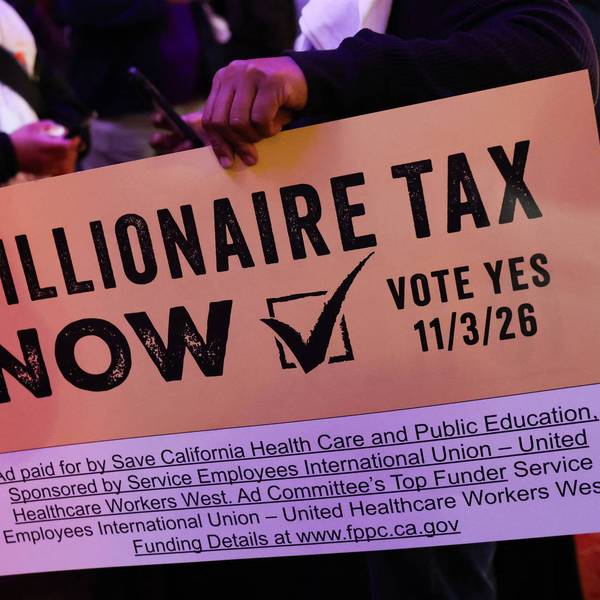
If the proposed 5% levy on billionaire wealth makes it onto the November ballot and California voters approve it, Huang would face an estimated $8 billion tax bill—a tiny slice of his $165 billion net worth. Those subject to the tax would have the option of paying the full amount owed all at once or over a period of five years.
"'Who cares' is absolutely the appropriate reaction," said Matt Bruenig, founder of the People's Policy Project, a left-wing think tank. "It means nothing to him. David Sacks types look like the biggest babies in the world."
Bruenig was referring to the White House cryptocurrency czar who left California for Texas at the end of 2025 in an apparent effort to avoid the possible billionaire tax, which would apply to anyone living in California as of January 1, 2026.
“As a response to socialism, Miami will replace NYC as the finance capital and Austin will replace SF as the tech capital,” Sacks declared in a social media post last week.
"Frontline caregivers are glad to hear that, much like the overwhelming majority of billionaires, Mr. Huang will not be uprooting his life or business to make an ideological point over a 1% per year fix to a problem that Congress created."
The proposed one-time tax on California's roughly 200 billionaires would raise an estimated $100 billion in revenue, funds that would be set aside for the state's healthcare system, food assistance, and education.
Organizers are pursuing the tax in direct response to unprecedented Medicaid cuts enacted by US President Donald Trump and the Republican-controlled Congress over the summer.
Suzanne Jimenez, chief of staff of Service Employees International Union-United Healthcare Workers West and the lead sponsor of the ballot initiative, welcomed Huang's response to the proposed tax in a statement late Tuesday.
"We agree with Jensen Huang that California has a tremendous talent pool of workers uniquely qualified to continue moving many industries forward, including within the tech sector and beyond," said Jimenez. "This initiative will ensure the $100 billion healthcare funding crisis created by [the Trump-GOP legislation] in July is fixed, so that all of those workers can access emergency rooms and vital healthcare in California."
"Frontline caregivers are glad to hear that, much like the overwhelming majority of billionaires, Mr. Huang will not be uprooting his life or business to make an ideological point over a 1% per year fix to a problem that Congress created last July—and that California will unite to solve this November," Jimenez added.
Dear Common Dreams reader, It’s been nearly 30 years since I co-founded Common Dreams with my late wife, Lina Newhouser. We had the radical notion that journalism should serve the public good, not corporate profits. It was clear to us from the outset what it would take to build such a project. No paid advertisements. No corporate sponsors. No millionaire publisher telling us what to think or do. Many people said we wouldn't last a year, but we proved those doubters wrong. Together with a tremendous team of journalists and dedicated staff, we built an independent media outlet free from the constraints of profits and corporate control. Our mission has always been simple: To inform. To inspire. To ignite change for the common good. Building Common Dreams was not easy. Our survival was never guaranteed. When you take on the most powerful forces—Wall Street greed, fossil fuel industry destruction, Big Tech lobbyists, and uber-rich oligarchs who have spent billions upon billions rigging the economy and democracy in their favor—the only bulwark you have is supporters who believe in your work. But here’s the urgent message from me today. It's never been this bad out there. And it's never been this hard to keep us going. At the very moment Common Dreams is most needed, the threats we face are intensifying. We need your support now more than ever. We don't accept corporate advertising and never will. We don't have a paywall because we don't think people should be blocked from critical news based on their ability to pay. Everything we do is funded by the donations of readers like you. When everyone does the little they can afford, we are strong. But if that support retreats or dries up, so do we. Will you donate now to make sure Common Dreams not only survives but thrives? —Craig Brown, Co-founder |
Jensen Huang, CEO of the tech behemoth Nvidia and the eighth-richest man in the world, said Tuesday that he is "perfectly fine" with a grassroots push in California to impose a one-time wealth tax on the state's billionaire residents.
In an interview with Bloomberg, Huang said that "we chose to live in Silicon Valley, and whatever taxes, I guess, they would like to apply, so be it"—a nonchalant response that diverges from the hysteria expressed by other members of his class in response to the proposed ballot initiative.
"It never crossed my mind once," Huang said of the tax proposal.
If the proposed 5% levy on billionaire wealth makes it onto the November ballot and California voters approve it, Huang would face an estimated $8 billion tax bill—a tiny slice of his $165 billion net worth. Those subject to the tax would have the option of paying the full amount owed all at once or over a period of five years.
"'Who cares' is absolutely the appropriate reaction," said Matt Bruenig, founder of the People's Policy Project, a left-wing think tank. "It means nothing to him. David Sacks types look like the biggest babies in the world."
Bruenig was referring to the White House cryptocurrency czar who left California for Texas at the end of 2025 in an apparent effort to avoid the possible billionaire tax, which would apply to anyone living in California as of January 1, 2026.
“As a response to socialism, Miami will replace NYC as the finance capital and Austin will replace SF as the tech capital,” Sacks declared in a social media post last week.
"Frontline caregivers are glad to hear that, much like the overwhelming majority of billionaires, Mr. Huang will not be uprooting his life or business to make an ideological point over a 1% per year fix to a problem that Congress created."
The proposed one-time tax on California's roughly 200 billionaires would raise an estimated $100 billion in revenue, funds that would be set aside for the state's healthcare system, food assistance, and education.
Organizers are pursuing the tax in direct response to unprecedented Medicaid cuts enacted by US President Donald Trump and the Republican-controlled Congress over the summer.
Suzanne Jimenez, chief of staff of Service Employees International Union-United Healthcare Workers West and the lead sponsor of the ballot initiative, welcomed Huang's response to the proposed tax in a statement late Tuesday.
"We agree with Jensen Huang that California has a tremendous talent pool of workers uniquely qualified to continue moving many industries forward, including within the tech sector and beyond," said Jimenez. "This initiative will ensure the $100 billion healthcare funding crisis created by [the Trump-GOP legislation] in July is fixed, so that all of those workers can access emergency rooms and vital healthcare in California."
"Frontline caregivers are glad to hear that, much like the overwhelming majority of billionaires, Mr. Huang will not be uprooting his life or business to make an ideological point over a 1% per year fix to a problem that Congress created last July—and that California will unite to solve this November," Jimenez added.
Jensen Huang, CEO of the tech behemoth Nvidia and the eighth-richest man in the world, said Tuesday that he is "perfectly fine" with a grassroots push in California to impose a one-time wealth tax on the state's billionaire residents.
In an interview with Bloomberg, Huang said that "we chose to live in Silicon Valley, and whatever taxes, I guess, they would like to apply, so be it"—a nonchalant response that diverges from the hysteria expressed by other members of his class in response to the proposed ballot initiative.
"It never crossed my mind once," Huang said of the tax proposal.
If the proposed 5% levy on billionaire wealth makes it onto the November ballot and California voters approve it, Huang would face an estimated $8 billion tax bill—a tiny slice of his $165 billion net worth. Those subject to the tax would have the option of paying the full amount owed all at once or over a period of five years.
"'Who cares' is absolutely the appropriate reaction," said Matt Bruenig, founder of the People's Policy Project, a left-wing think tank. "It means nothing to him. David Sacks types look like the biggest babies in the world."
Bruenig was referring to the White House cryptocurrency czar who left California for Texas at the end of 2025 in an apparent effort to avoid the possible billionaire tax, which would apply to anyone living in California as of January 1, 2026.
“As a response to socialism, Miami will replace NYC as the finance capital and Austin will replace SF as the tech capital,” Sacks declared in a social media post last week.
"Frontline caregivers are glad to hear that, much like the overwhelming majority of billionaires, Mr. Huang will not be uprooting his life or business to make an ideological point over a 1% per year fix to a problem that Congress created."
The proposed one-time tax on California's roughly 200 billionaires would raise an estimated $100 billion in revenue, funds that would be set aside for the state's healthcare system, food assistance, and education.
Organizers are pursuing the tax in direct response to unprecedented Medicaid cuts enacted by US President Donald Trump and the Republican-controlled Congress over the summer.
Suzanne Jimenez, chief of staff of Service Employees International Union-United Healthcare Workers West and the lead sponsor of the ballot initiative, welcomed Huang's response to the proposed tax in a statement late Tuesday.
"We agree with Jensen Huang that California has a tremendous talent pool of workers uniquely qualified to continue moving many industries forward, including within the tech sector and beyond," said Jimenez. "This initiative will ensure the $100 billion healthcare funding crisis created by [the Trump-GOP legislation] in July is fixed, so that all of those workers can access emergency rooms and vital healthcare in California."
"Frontline caregivers are glad to hear that, much like the overwhelming majority of billionaires, Mr. Huang will not be uprooting his life or business to make an ideological point over a 1% per year fix to a problem that Congress created last July—and that California will unite to solve this November," Jimenez added.