SUBSCRIBE TO OUR FREE NEWSLETTER
Daily news & progressive opinion—funded by the people, not the corporations—delivered straight to your inbox.
5
#000000
#FFFFFF
To donate by check, phone, or other method, see our More Ways to Give page.
Daily news & progressive opinion—funded by the people, not the corporations—delivered straight to your inbox.
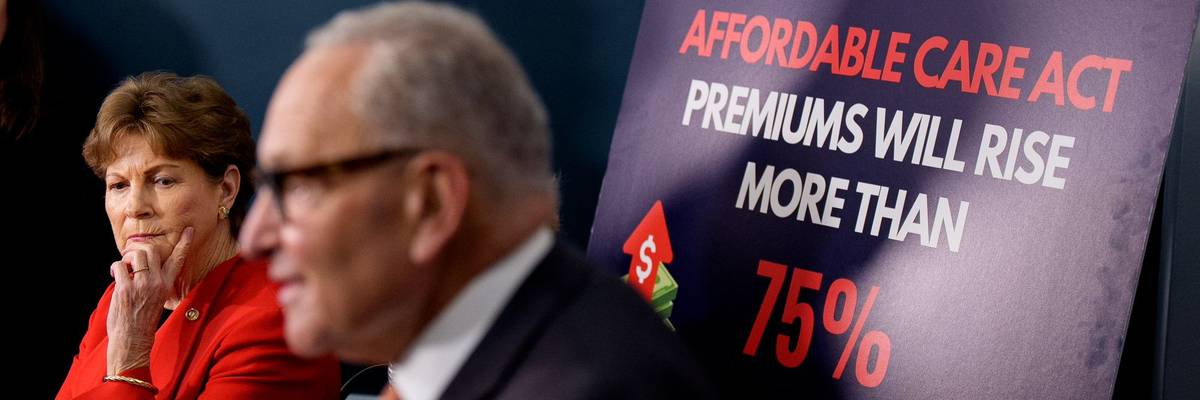
A poster reads "Affordable Care Act Premiums Will Rise More Than 75%" as Senate Minority Leader Chuck Schumer (D-NY) (2nd-L), accompanied by Sen. Jeanne Shaheen (D-NH) (L), speaks at a news conference to call on Republicans to pass Affordable Care Act tax breaks on Capitol Hill on September 16, 2025 in Washington, DC.
$30 billion of federal spending for ACA subsidies is a drop in the bucket of a $1 trillion defense budget.
With Congress overseeing the ending of the Affordable Care Act, or Obamacare, enhanced premium tax credit, or subsidies, for Americans, hiking premiums for them to buy private healthcare insurance, consider such economics and politics in the context of $1 trillion in defense spending. Why? Context matters, economically and politically.
Against this backdrop, ACA subsidies are 3% or three-hundredths, of $1 trillion. To be sure, $30 billion is real money to the average US citizen. But $30 billion of federal spending for ACA subsidies is a drop in the bucket of a $1 trillion defense budget.
This policy priority reflects a political economy that weakens the healthcare of an estimated 22 million Americans facing ACA premium hikes of 114%, on average, according to a Kaiser Family Foundation survey, and strengthens the profitability of military corporations such as Lockheed Martin, RTX Corporation, Northrop Grumman, Boeing, and General Dynamics. Such federal spending priorities are a kitchen table issue affecting people who vote blue, red, or independent, or are non-voters.
Here’s the bottom line. Healthcare insurance is a necessity, not a luxury.
Thus, about 10 days of annual defense spending equals the $30 billion of expired Obamacare subsidies. Welcome to politics and economics in capitalist America.
In 2026, with ACA tax credits expiring, Renee Rubin Ross, a mother who lives in California and covers her family of four with Obamacare, is facing a big price hike. How big? Try $2,700 more each month to maintain healthcare coverage. That’s $32,400 more per year for Ross to buy ACA coverage. Where will she and millions of Americans like her find the money to pay their healthcare bills?
The out-of-pocket costs for mom-and-pop shops are also spiking. Shaundell Newsome is the founder of Sumnu Marketing in Las Vegas and co-chair of Small Business for America's Future. “Refusing to extend the Affordable Care Act enhanced tax credits has abandoned us and added soaring healthcare costs to the economic crisis crushing Main Street this year,” he said in a statement. “We’re beyond disappointed that 5 million small business owners are now almost certain to see their premiums double.”
We return to the $1 trillion annual defense budget. That figure amounts to just over $2.7 billion of spending on defense every day of the year. Thus, about 10 days of annual defense spending equals the $30 billion of expired Obamacare subsidies. Welcome to politics and economics in capitalist America.
The US political economy reflects the money power of the top defense contractors to lobby Congress and the White House for a budget policy that drives increased military spending. There’s a bipartisan consensus, a blue and red marriage. You can’t blame only President Donald J. Trump. Visit opensecrets.org to see the proof of the spending parity in military contractors’ lobbying, a revealing blue and red party breakdown.
For the average US citizen, there is simply no equivalent force of politics and economics in their interests regarding health and warfare spending. Big money sways policy priorities, and the average US citizen is at a distinct disadvantage. That’s not a law of nature, just an indication of a disorganized American working class, politically speaking.
Healthcare spending is a constructive means of improving people’s living conditions. Think of regular check-ups, ranging in age from infants to seniors, who receive care from doctors and nurses. Think of mental health services, a crucial component of health and wellness, for those in need, from traumatized military veterans to sexual assault victims. There are also emergency room visits for accidents and unexpected medical situations such as strokes.
There are coalitions at the state level that do great work to improve funding for healthcare. One example is Health Access California. Its advocacy has in part resulted in lower-cost insulin via CalRX. This means $11 per pen for Californians.
Meanwhile, defense spending is a destructive force that worsens people’s lives at home and abroad. I close with a list, a partial one, of the foreign places where US armaments directly and by proxy lead to the loss of lives and limbs.
Just ask the relatives of Venezuelans maimed and murdered during the US early morning attack and kidnapping of the nation’s elected president and his wife recently. For that matter, ask the family members of the fishermen who lost their lives due to aerial strikes from US forces in the Caribbean over the past few months. Then there are families and friends of those injured and killed by US drone strikes in Somalia. US defense spending has been and remains despite a “ceasefire” a central part of Israel’s genocide of Palestinians in Gaza.
Meanwhile, there is talk in the US Senate about resuming the expired ACA enhanced tax credits. Shifting federal spending from a $1 trillion defense budget to funding Americans’ healthcare is in all likelihood not a part of this political talk given the corporate-dominant political economy of the country’s military-industrial complex and imperialist foreign policy.
A solution to this destructive situation is movement politics, popular mobilization, and organization of working people in their interests as a class force for peace and social justice, domestically and globally. A few groups that come to mind are CodePink, the Poor People’s Campaign, Public Citizen, and Repairers of the Breach.
Dear Common Dreams reader, It’s been nearly 30 years since I co-founded Common Dreams with my late wife, Lina Newhouser. We had the radical notion that journalism should serve the public good, not corporate profits. It was clear to us from the outset what it would take to build such a project. No paid advertisements. No corporate sponsors. No millionaire publisher telling us what to think or do. Many people said we wouldn't last a year, but we proved those doubters wrong. Together with a tremendous team of journalists and dedicated staff, we built an independent media outlet free from the constraints of profits and corporate control. Our mission has always been simple: To inform. To inspire. To ignite change for the common good. Building Common Dreams was not easy. Our survival was never guaranteed. When you take on the most powerful forces—Wall Street greed, fossil fuel industry destruction, Big Tech lobbyists, and uber-rich oligarchs who have spent billions upon billions rigging the economy and democracy in their favor—the only bulwark you have is supporters who believe in your work. But here’s the urgent message from me today. It's never been this bad out there. And it's never been this hard to keep us going. At the very moment Common Dreams is most needed, the threats we face are intensifying. We need your support now more than ever. We don't accept corporate advertising and never will. We don't have a paywall because we don't think people should be blocked from critical news based on their ability to pay. Everything we do is funded by the donations of readers like you. When everyone does the little they can afford, we are strong. But if that support retreats or dries up, so do we. Will you donate now to make sure Common Dreams not only survives but thrives? —Craig Brown, Co-founder |
With Congress overseeing the ending of the Affordable Care Act, or Obamacare, enhanced premium tax credit, or subsidies, for Americans, hiking premiums for them to buy private healthcare insurance, consider such economics and politics in the context of $1 trillion in defense spending. Why? Context matters, economically and politically.
Against this backdrop, ACA subsidies are 3% or three-hundredths, of $1 trillion. To be sure, $30 billion is real money to the average US citizen. But $30 billion of federal spending for ACA subsidies is a drop in the bucket of a $1 trillion defense budget.
This policy priority reflects a political economy that weakens the healthcare of an estimated 22 million Americans facing ACA premium hikes of 114%, on average, according to a Kaiser Family Foundation survey, and strengthens the profitability of military corporations such as Lockheed Martin, RTX Corporation, Northrop Grumman, Boeing, and General Dynamics. Such federal spending priorities are a kitchen table issue affecting people who vote blue, red, or independent, or are non-voters.
Here’s the bottom line. Healthcare insurance is a necessity, not a luxury.
Thus, about 10 days of annual defense spending equals the $30 billion of expired Obamacare subsidies. Welcome to politics and economics in capitalist America.
In 2026, with ACA tax credits expiring, Renee Rubin Ross, a mother who lives in California and covers her family of four with Obamacare, is facing a big price hike. How big? Try $2,700 more each month to maintain healthcare coverage. That’s $32,400 more per year for Ross to buy ACA coverage. Where will she and millions of Americans like her find the money to pay their healthcare bills?
The out-of-pocket costs for mom-and-pop shops are also spiking. Shaundell Newsome is the founder of Sumnu Marketing in Las Vegas and co-chair of Small Business for America's Future. “Refusing to extend the Affordable Care Act enhanced tax credits has abandoned us and added soaring healthcare costs to the economic crisis crushing Main Street this year,” he said in a statement. “We’re beyond disappointed that 5 million small business owners are now almost certain to see their premiums double.”
We return to the $1 trillion annual defense budget. That figure amounts to just over $2.7 billion of spending on defense every day of the year. Thus, about 10 days of annual defense spending equals the $30 billion of expired Obamacare subsidies. Welcome to politics and economics in capitalist America.
The US political economy reflects the money power of the top defense contractors to lobby Congress and the White House for a budget policy that drives increased military spending. There’s a bipartisan consensus, a blue and red marriage. You can’t blame only President Donald J. Trump. Visit opensecrets.org to see the proof of the spending parity in military contractors’ lobbying, a revealing blue and red party breakdown.
For the average US citizen, there is simply no equivalent force of politics and economics in their interests regarding health and warfare spending. Big money sways policy priorities, and the average US citizen is at a distinct disadvantage. That’s not a law of nature, just an indication of a disorganized American working class, politically speaking.
Healthcare spending is a constructive means of improving people’s living conditions. Think of regular check-ups, ranging in age from infants to seniors, who receive care from doctors and nurses. Think of mental health services, a crucial component of health and wellness, for those in need, from traumatized military veterans to sexual assault victims. There are also emergency room visits for accidents and unexpected medical situations such as strokes.
There are coalitions at the state level that do great work to improve funding for healthcare. One example is Health Access California. Its advocacy has in part resulted in lower-cost insulin via CalRX. This means $11 per pen for Californians.
Meanwhile, defense spending is a destructive force that worsens people’s lives at home and abroad. I close with a list, a partial one, of the foreign places where US armaments directly and by proxy lead to the loss of lives and limbs.
Just ask the relatives of Venezuelans maimed and murdered during the US early morning attack and kidnapping of the nation’s elected president and his wife recently. For that matter, ask the family members of the fishermen who lost their lives due to aerial strikes from US forces in the Caribbean over the past few months. Then there are families and friends of those injured and killed by US drone strikes in Somalia. US defense spending has been and remains despite a “ceasefire” a central part of Israel’s genocide of Palestinians in Gaza.
Meanwhile, there is talk in the US Senate about resuming the expired ACA enhanced tax credits. Shifting federal spending from a $1 trillion defense budget to funding Americans’ healthcare is in all likelihood not a part of this political talk given the corporate-dominant political economy of the country’s military-industrial complex and imperialist foreign policy.
A solution to this destructive situation is movement politics, popular mobilization, and organization of working people in their interests as a class force for peace and social justice, domestically and globally. A few groups that come to mind are CodePink, the Poor People’s Campaign, Public Citizen, and Repairers of the Breach.
With Congress overseeing the ending of the Affordable Care Act, or Obamacare, enhanced premium tax credit, or subsidies, for Americans, hiking premiums for them to buy private healthcare insurance, consider such economics and politics in the context of $1 trillion in defense spending. Why? Context matters, economically and politically.
Against this backdrop, ACA subsidies are 3% or three-hundredths, of $1 trillion. To be sure, $30 billion is real money to the average US citizen. But $30 billion of federal spending for ACA subsidies is a drop in the bucket of a $1 trillion defense budget.
This policy priority reflects a political economy that weakens the healthcare of an estimated 22 million Americans facing ACA premium hikes of 114%, on average, according to a Kaiser Family Foundation survey, and strengthens the profitability of military corporations such as Lockheed Martin, RTX Corporation, Northrop Grumman, Boeing, and General Dynamics. Such federal spending priorities are a kitchen table issue affecting people who vote blue, red, or independent, or are non-voters.
Here’s the bottom line. Healthcare insurance is a necessity, not a luxury.
Thus, about 10 days of annual defense spending equals the $30 billion of expired Obamacare subsidies. Welcome to politics and economics in capitalist America.
In 2026, with ACA tax credits expiring, Renee Rubin Ross, a mother who lives in California and covers her family of four with Obamacare, is facing a big price hike. How big? Try $2,700 more each month to maintain healthcare coverage. That’s $32,400 more per year for Ross to buy ACA coverage. Where will she and millions of Americans like her find the money to pay their healthcare bills?
The out-of-pocket costs for mom-and-pop shops are also spiking. Shaundell Newsome is the founder of Sumnu Marketing in Las Vegas and co-chair of Small Business for America's Future. “Refusing to extend the Affordable Care Act enhanced tax credits has abandoned us and added soaring healthcare costs to the economic crisis crushing Main Street this year,” he said in a statement. “We’re beyond disappointed that 5 million small business owners are now almost certain to see their premiums double.”
We return to the $1 trillion annual defense budget. That figure amounts to just over $2.7 billion of spending on defense every day of the year. Thus, about 10 days of annual defense spending equals the $30 billion of expired Obamacare subsidies. Welcome to politics and economics in capitalist America.
The US political economy reflects the money power of the top defense contractors to lobby Congress and the White House for a budget policy that drives increased military spending. There’s a bipartisan consensus, a blue and red marriage. You can’t blame only President Donald J. Trump. Visit opensecrets.org to see the proof of the spending parity in military contractors’ lobbying, a revealing blue and red party breakdown.
For the average US citizen, there is simply no equivalent force of politics and economics in their interests regarding health and warfare spending. Big money sways policy priorities, and the average US citizen is at a distinct disadvantage. That’s not a law of nature, just an indication of a disorganized American working class, politically speaking.
Healthcare spending is a constructive means of improving people’s living conditions. Think of regular check-ups, ranging in age from infants to seniors, who receive care from doctors and nurses. Think of mental health services, a crucial component of health and wellness, for those in need, from traumatized military veterans to sexual assault victims. There are also emergency room visits for accidents and unexpected medical situations such as strokes.
There are coalitions at the state level that do great work to improve funding for healthcare. One example is Health Access California. Its advocacy has in part resulted in lower-cost insulin via CalRX. This means $11 per pen for Californians.
Meanwhile, defense spending is a destructive force that worsens people’s lives at home and abroad. I close with a list, a partial one, of the foreign places where US armaments directly and by proxy lead to the loss of lives and limbs.
Just ask the relatives of Venezuelans maimed and murdered during the US early morning attack and kidnapping of the nation’s elected president and his wife recently. For that matter, ask the family members of the fishermen who lost their lives due to aerial strikes from US forces in the Caribbean over the past few months. Then there are families and friends of those injured and killed by US drone strikes in Somalia. US defense spending has been and remains despite a “ceasefire” a central part of Israel’s genocide of Palestinians in Gaza.
Meanwhile, there is talk in the US Senate about resuming the expired ACA enhanced tax credits. Shifting federal spending from a $1 trillion defense budget to funding Americans’ healthcare is in all likelihood not a part of this political talk given the corporate-dominant political economy of the country’s military-industrial complex and imperialist foreign policy.
A solution to this destructive situation is movement politics, popular mobilization, and organization of working people in their interests as a class force for peace and social justice, domestically and globally. A few groups that come to mind are CodePink, the Poor People’s Campaign, Public Citizen, and Repairers of the Breach.