SUBSCRIBE TO OUR FREE NEWSLETTER
Daily news & progressive opinion—funded by the people, not the corporations—delivered straight to your inbox.
5
#000000
#FFFFFF
To donate by check, phone, or other method, see our More Ways to Give page.
Daily news & progressive opinion—funded by the people, not the corporations—delivered straight to your inbox.
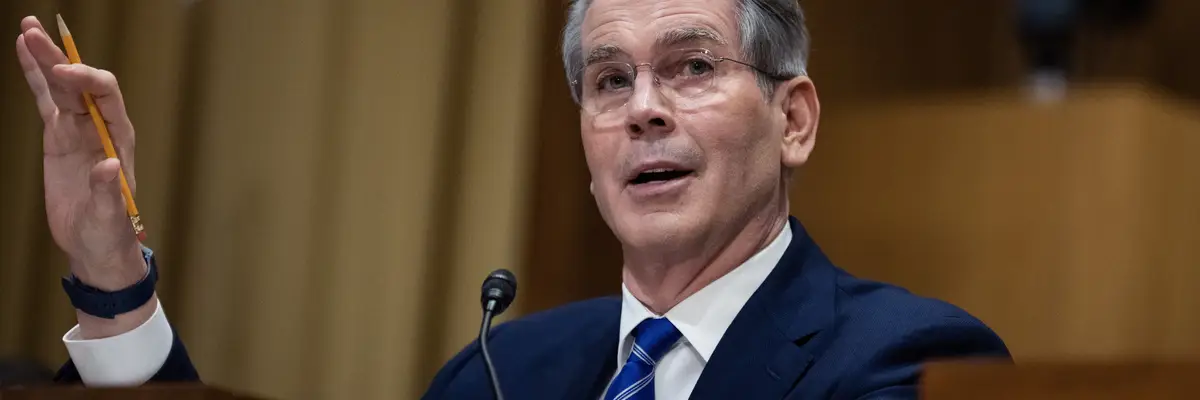
US Treasury Secretary Scott Bessent testifies during his Senate Finance Committee confirmation hearing in Dirksen building on Thursday, January 16, 2025.
“The Trump administration has chosen to prioritize maintaining rock-bottom taxes for big corporations to the detriment of ordinary Americans and our allies across the globe," said one critic.
The Organization of Economic Cooperation and Development is facing criticism for buckling under US demands when finalizing an update to the global minimum corporate tax agreement.
As reported by Reuters on Monday, the OECD agreed to amend a 2021 deal to enforce a 15% global minimum corporate tax to include "simplifications and carve-outs to align US minimum tax laws with global standards, accommodating earlier objections raised by the Trump administration."
Under the original framework, OECD members agreed to apply a 15% corporate tax on multinational corporations that book profits in jurisdictions that have lower tax rates.
President Donald Trump objected to this, however, and insisted that some US corporations be given exemptions that have subsequently been granted by OECD states.
US Treasury Secretary Scott Bessent said that the revised deal "represents a historic victory in preserving US sovereignty and protecting American workers and businesses from extraterritorial overreach," while noting that it allowed for US-headquartered firms to be subject only to US global minimum taxes.
Some critics, though, accused the OECD of letting the US get away with robbery.
Zorka Milin, policy director at the Financial Accountability and Corporate Transparency Coalition, warned that the deal "risks nearly a decade of global progress on corporate taxation" by allowing "the largest, most profitable American companies to keep parking profits in tax havens."
“The Trump administration has chosen to prioritize maintaining rock-bottom taxes for big corporations to the detriment of ordinary Americans and our allies across the globe," Milin added.
Alex Cobham, chief executive at Tax Justice Network, said other OECD members were only hurting themselves by caving to Trump's demands.
"By the Tax Justice Network’s assessment, France for example is already losing $14 billion a year to tax cheating US firms, Germany is losing $16 billion, and the UK is losing $9 billion," Cobham explained. "Today’s bending of the knee to Trump will cost countries billions more. But how much more? Tellingly, the OECD, which has delivered this shameful result, and OECD members have not put a number on the scale of tax losses that will result."
An analysis published last month by the Institute on Taxation and Economic Policy (ITEP) made the case that global minimum corporate taxes were needed to prevent US companies from sheltering vast profits by reporting them in nations that serve as offshore tax havens.
As an example, ITEP pointed to data showing that the profits US companies reported in notorious tax havens such as Barbados and the British Virgin Islands were more than 100% of those territories' gross domestic product, which the report noted "is obviously impossible."
ITEP went on to state that full implementation of this global minimum tax is "the best hope for blocking the types of tax avoidance that have weakened corporate income taxes all over the world" by making it "difficult for any single government (even one as powerful as the US) to ignore or weaken it."
Dear Common Dreams reader, It’s been nearly 30 years since I co-founded Common Dreams with my late wife, Lina Newhouser. We had the radical notion that journalism should serve the public good, not corporate profits. It was clear to us from the outset what it would take to build such a project. No paid advertisements. No corporate sponsors. No millionaire publisher telling us what to think or do. Many people said we wouldn't last a year, but we proved those doubters wrong. Together with a tremendous team of journalists and dedicated staff, we built an independent media outlet free from the constraints of profits and corporate control. Our mission has always been simple: To inform. To inspire. To ignite change for the common good. Building Common Dreams was not easy. Our survival was never guaranteed. When you take on the most powerful forces—Wall Street greed, fossil fuel industry destruction, Big Tech lobbyists, and uber-rich oligarchs who have spent billions upon billions rigging the economy and democracy in their favor—the only bulwark you have is supporters who believe in your work. But here’s the urgent message from me today. It's never been this bad out there. And it's never been this hard to keep us going. At the very moment Common Dreams is most needed, the threats we face are intensifying. We need your support now more than ever. We don't accept corporate advertising and never will. We don't have a paywall because we don't think people should be blocked from critical news based on their ability to pay. Everything we do is funded by the donations of readers like you. When everyone does the little they can afford, we are strong. But if that support retreats or dries up, so do we. Will you donate now to make sure Common Dreams not only survives but thrives? —Craig Brown, Co-founder |
The Organization of Economic Cooperation and Development is facing criticism for buckling under US demands when finalizing an update to the global minimum corporate tax agreement.
As reported by Reuters on Monday, the OECD agreed to amend a 2021 deal to enforce a 15% global minimum corporate tax to include "simplifications and carve-outs to align US minimum tax laws with global standards, accommodating earlier objections raised by the Trump administration."
Under the original framework, OECD members agreed to apply a 15% corporate tax on multinational corporations that book profits in jurisdictions that have lower tax rates.
President Donald Trump objected to this, however, and insisted that some US corporations be given exemptions that have subsequently been granted by OECD states.
US Treasury Secretary Scott Bessent said that the revised deal "represents a historic victory in preserving US sovereignty and protecting American workers and businesses from extraterritorial overreach," while noting that it allowed for US-headquartered firms to be subject only to US global minimum taxes.
Some critics, though, accused the OECD of letting the US get away with robbery.
Zorka Milin, policy director at the Financial Accountability and Corporate Transparency Coalition, warned that the deal "risks nearly a decade of global progress on corporate taxation" by allowing "the largest, most profitable American companies to keep parking profits in tax havens."
“The Trump administration has chosen to prioritize maintaining rock-bottom taxes for big corporations to the detriment of ordinary Americans and our allies across the globe," Milin added.
Alex Cobham, chief executive at Tax Justice Network, said other OECD members were only hurting themselves by caving to Trump's demands.
"By the Tax Justice Network’s assessment, France for example is already losing $14 billion a year to tax cheating US firms, Germany is losing $16 billion, and the UK is losing $9 billion," Cobham explained. "Today’s bending of the knee to Trump will cost countries billions more. But how much more? Tellingly, the OECD, which has delivered this shameful result, and OECD members have not put a number on the scale of tax losses that will result."
An analysis published last month by the Institute on Taxation and Economic Policy (ITEP) made the case that global minimum corporate taxes were needed to prevent US companies from sheltering vast profits by reporting them in nations that serve as offshore tax havens.
As an example, ITEP pointed to data showing that the profits US companies reported in notorious tax havens such as Barbados and the British Virgin Islands were more than 100% of those territories' gross domestic product, which the report noted "is obviously impossible."
ITEP went on to state that full implementation of this global minimum tax is "the best hope for blocking the types of tax avoidance that have weakened corporate income taxes all over the world" by making it "difficult for any single government (even one as powerful as the US) to ignore or weaken it."
The Organization of Economic Cooperation and Development is facing criticism for buckling under US demands when finalizing an update to the global minimum corporate tax agreement.
As reported by Reuters on Monday, the OECD agreed to amend a 2021 deal to enforce a 15% global minimum corporate tax to include "simplifications and carve-outs to align US minimum tax laws with global standards, accommodating earlier objections raised by the Trump administration."
Under the original framework, OECD members agreed to apply a 15% corporate tax on multinational corporations that book profits in jurisdictions that have lower tax rates.
President Donald Trump objected to this, however, and insisted that some US corporations be given exemptions that have subsequently been granted by OECD states.
US Treasury Secretary Scott Bessent said that the revised deal "represents a historic victory in preserving US sovereignty and protecting American workers and businesses from extraterritorial overreach," while noting that it allowed for US-headquartered firms to be subject only to US global minimum taxes.
Some critics, though, accused the OECD of letting the US get away with robbery.
Zorka Milin, policy director at the Financial Accountability and Corporate Transparency Coalition, warned that the deal "risks nearly a decade of global progress on corporate taxation" by allowing "the largest, most profitable American companies to keep parking profits in tax havens."
“The Trump administration has chosen to prioritize maintaining rock-bottom taxes for big corporations to the detriment of ordinary Americans and our allies across the globe," Milin added.
Alex Cobham, chief executive at Tax Justice Network, said other OECD members were only hurting themselves by caving to Trump's demands.
"By the Tax Justice Network’s assessment, France for example is already losing $14 billion a year to tax cheating US firms, Germany is losing $16 billion, and the UK is losing $9 billion," Cobham explained. "Today’s bending of the knee to Trump will cost countries billions more. But how much more? Tellingly, the OECD, which has delivered this shameful result, and OECD members have not put a number on the scale of tax losses that will result."
An analysis published last month by the Institute on Taxation and Economic Policy (ITEP) made the case that global minimum corporate taxes were needed to prevent US companies from sheltering vast profits by reporting them in nations that serve as offshore tax havens.
As an example, ITEP pointed to data showing that the profits US companies reported in notorious tax havens such as Barbados and the British Virgin Islands were more than 100% of those territories' gross domestic product, which the report noted "is obviously impossible."
ITEP went on to state that full implementation of this global minimum tax is "the best hope for blocking the types of tax avoidance that have weakened corporate income taxes all over the world" by making it "difficult for any single government (even one as powerful as the US) to ignore or weaken it."