SUBSCRIBE TO OUR FREE NEWSLETTER
Daily news & progressive opinion—funded by the people, not the corporations—delivered straight to your inbox.
5
#000000
#FFFFFF
To donate by check, phone, or other method, see our More Ways to Give page.
Daily news & progressive opinion—funded by the people, not the corporations—delivered straight to your inbox.

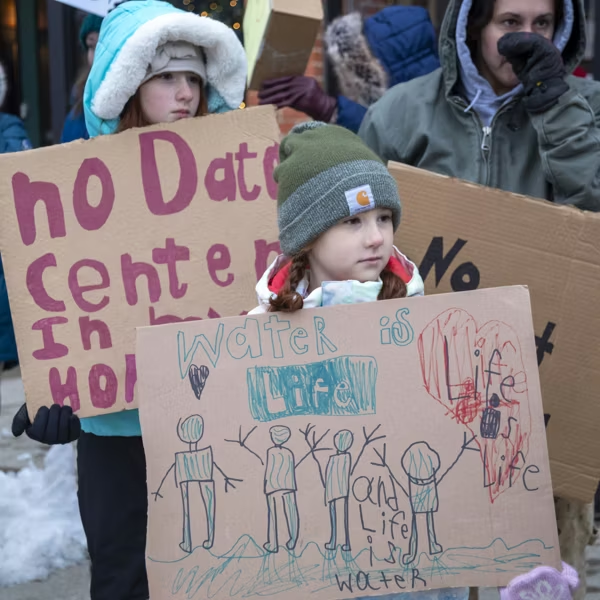
Residents in Saline, Michigan rally against the $7 billion Stargate data center planned on southeast Michigan farm land on December 1, 2025.
"No good comes of having an AI data center near you."
The massive energy needs of artificial intelligence data centers became a major political controversy in 2025, and new reporting suggests that it will grow even further in 2026.
CNBC reported on Thursday that data center projects have become political lightning rods among politicians ranging from Sen. Bernie Sanders (I-Vt.) on the left to Republican Florida Gov. Ron DeSantis on the right.
However, objections to data centers aren't just coming from politicians but from ordinary citizens who are worried about the impact such projects will have on their local environment and their utility bills.
CNBC noted that data centers' energy needs are so great that PJM Interconnection, the largest US grid operator that serves over 65 million people across 13 states, projects that it will be a full six gigawatts short of its reliability requirements in 2027.
Joe Bowring, president of independent market monitor Monitoring Analytics, told CNBC that he's never seen the grid under such projected strain.
"It’s at a crisis stage right now," Bowring said. "PJM has never been this short."
Rob Gramlich, president of power consulting firm Grid Strategies, told CNBC that he expects the debate over data centers to become even more intense this year once Americans start getting socked with even higher utility bills.
"I don't think we’ve seen the end of the political repercussions,” Gramlich said. “And with a lot more elections in 2026 than 2025, we’ll see a lot of implications. Every politician is going to be saying that they have the answer to affordability and their opponents’ policies would raise rates."
Concerns about data centers' impact on electric grids are rising in both red and blue states.
The Austin American-Statesman reported on Thursday that a new analysis written by the office of Austin City Manager TC Broadnax found that data centers have the potential to overwhelm the city's system given they are projected to need more power than can possibly be delivered with current infrastructure.
"The speed in which AI is trying to be deployed creates tremendous strain on the already tight resources in both design and construction," says the analysis, which noted that some proposed data centers are seeking more than five gigawatts, which is more than the peak load for the entire city.
In New York, local station News 10 reported last year that the New York Independent System Operator is estimating that the state's grid could be 1.6 gigawatts short of reliability requirements by 2030 thanks in large part to data centers.
Anger over proposed data centers has even spread to President Donald Trump's primary residential home of Palm Beach County, Florida, where local residents successfully postponed the construction of a proposed 200-acre data center complex.
According to public news station WLRN, locals opposed to the project cited "expected noise from cooling towers, servers, and diesel generators, along with heavy water use, pollution concerns, and higher utility costs" when petitioning Palm Beach County commissioners to scrap the proposal.
Corey Kanterman, a local opponent of the proposed data center, told WLRN that his goal is to shut the project down entirely.
"No good comes of having an AI data center near you," Kanterman said. "Put them in the location of least impact to the environment and people. This location is not it."
Dear Common Dreams reader, It’s been nearly 30 years since I co-founded Common Dreams with my late wife, Lina Newhouser. We had the radical notion that journalism should serve the public good, not corporate profits. It was clear to us from the outset what it would take to build such a project. No paid advertisements. No corporate sponsors. No millionaire publisher telling us what to think or do. Many people said we wouldn't last a year, but we proved those doubters wrong. Together with a tremendous team of journalists and dedicated staff, we built an independent media outlet free from the constraints of profits and corporate control. Our mission has always been simple: To inform. To inspire. To ignite change for the common good. Building Common Dreams was not easy. Our survival was never guaranteed. When you take on the most powerful forces—Wall Street greed, fossil fuel industry destruction, Big Tech lobbyists, and uber-rich oligarchs who have spent billions upon billions rigging the economy and democracy in their favor—the only bulwark you have is supporters who believe in your work. But here’s the urgent message from me today. It's never been this bad out there. And it's never been this hard to keep us going. At the very moment Common Dreams is most needed, the threats we face are intensifying. We need your support now more than ever. We don't accept corporate advertising and never will. We don't have a paywall because we don't think people should be blocked from critical news based on their ability to pay. Everything we do is funded by the donations of readers like you. When everyone does the little they can afford, we are strong. But if that support retreats or dries up, so do we. Will you donate now to make sure Common Dreams not only survives but thrives? —Craig Brown, Co-founder |
The massive energy needs of artificial intelligence data centers became a major political controversy in 2025, and new reporting suggests that it will grow even further in 2026.
CNBC reported on Thursday that data center projects have become political lightning rods among politicians ranging from Sen. Bernie Sanders (I-Vt.) on the left to Republican Florida Gov. Ron DeSantis on the right.
However, objections to data centers aren't just coming from politicians but from ordinary citizens who are worried about the impact such projects will have on their local environment and their utility bills.
CNBC noted that data centers' energy needs are so great that PJM Interconnection, the largest US grid operator that serves over 65 million people across 13 states, projects that it will be a full six gigawatts short of its reliability requirements in 2027.
Joe Bowring, president of independent market monitor Monitoring Analytics, told CNBC that he's never seen the grid under such projected strain.
"It’s at a crisis stage right now," Bowring said. "PJM has never been this short."
Rob Gramlich, president of power consulting firm Grid Strategies, told CNBC that he expects the debate over data centers to become even more intense this year once Americans start getting socked with even higher utility bills.
"I don't think we’ve seen the end of the political repercussions,” Gramlich said. “And with a lot more elections in 2026 than 2025, we’ll see a lot of implications. Every politician is going to be saying that they have the answer to affordability and their opponents’ policies would raise rates."
Concerns about data centers' impact on electric grids are rising in both red and blue states.
The Austin American-Statesman reported on Thursday that a new analysis written by the office of Austin City Manager TC Broadnax found that data centers have the potential to overwhelm the city's system given they are projected to need more power than can possibly be delivered with current infrastructure.
"The speed in which AI is trying to be deployed creates tremendous strain on the already tight resources in both design and construction," says the analysis, which noted that some proposed data centers are seeking more than five gigawatts, which is more than the peak load for the entire city.
In New York, local station News 10 reported last year that the New York Independent System Operator is estimating that the state's grid could be 1.6 gigawatts short of reliability requirements by 2030 thanks in large part to data centers.
Anger over proposed data centers has even spread to President Donald Trump's primary residential home of Palm Beach County, Florida, where local residents successfully postponed the construction of a proposed 200-acre data center complex.
According to public news station WLRN, locals opposed to the project cited "expected noise from cooling towers, servers, and diesel generators, along with heavy water use, pollution concerns, and higher utility costs" when petitioning Palm Beach County commissioners to scrap the proposal.
Corey Kanterman, a local opponent of the proposed data center, told WLRN that his goal is to shut the project down entirely.
"No good comes of having an AI data center near you," Kanterman said. "Put them in the location of least impact to the environment and people. This location is not it."
The massive energy needs of artificial intelligence data centers became a major political controversy in 2025, and new reporting suggests that it will grow even further in 2026.
CNBC reported on Thursday that data center projects have become political lightning rods among politicians ranging from Sen. Bernie Sanders (I-Vt.) on the left to Republican Florida Gov. Ron DeSantis on the right.
However, objections to data centers aren't just coming from politicians but from ordinary citizens who are worried about the impact such projects will have on their local environment and their utility bills.
CNBC noted that data centers' energy needs are so great that PJM Interconnection, the largest US grid operator that serves over 65 million people across 13 states, projects that it will be a full six gigawatts short of its reliability requirements in 2027.
Joe Bowring, president of independent market monitor Monitoring Analytics, told CNBC that he's never seen the grid under such projected strain.
"It’s at a crisis stage right now," Bowring said. "PJM has never been this short."
Rob Gramlich, president of power consulting firm Grid Strategies, told CNBC that he expects the debate over data centers to become even more intense this year once Americans start getting socked with even higher utility bills.
"I don't think we’ve seen the end of the political repercussions,” Gramlich said. “And with a lot more elections in 2026 than 2025, we’ll see a lot of implications. Every politician is going to be saying that they have the answer to affordability and their opponents’ policies would raise rates."
Concerns about data centers' impact on electric grids are rising in both red and blue states.
The Austin American-Statesman reported on Thursday that a new analysis written by the office of Austin City Manager TC Broadnax found that data centers have the potential to overwhelm the city's system given they are projected to need more power than can possibly be delivered with current infrastructure.
"The speed in which AI is trying to be deployed creates tremendous strain on the already tight resources in both design and construction," says the analysis, which noted that some proposed data centers are seeking more than five gigawatts, which is more than the peak load for the entire city.
In New York, local station News 10 reported last year that the New York Independent System Operator is estimating that the state's grid could be 1.6 gigawatts short of reliability requirements by 2030 thanks in large part to data centers.
Anger over proposed data centers has even spread to President Donald Trump's primary residential home of Palm Beach County, Florida, where local residents successfully postponed the construction of a proposed 200-acre data center complex.
According to public news station WLRN, locals opposed to the project cited "expected noise from cooling towers, servers, and diesel generators, along with heavy water use, pollution concerns, and higher utility costs" when petitioning Palm Beach County commissioners to scrap the proposal.
Corey Kanterman, a local opponent of the proposed data center, told WLRN that his goal is to shut the project down entirely.
"No good comes of having an AI data center near you," Kanterman said. "Put them in the location of least impact to the environment and people. This location is not it."