SUBSCRIBE TO OUR FREE NEWSLETTER
Daily news & progressive opinion—funded by the people, not the corporations—delivered straight to your inbox.
5
#000000
#FFFFFF
To donate by check, phone, or other method, see our More Ways to Give page.
Daily news & progressive opinion—funded by the people, not the corporations—delivered straight to your inbox.
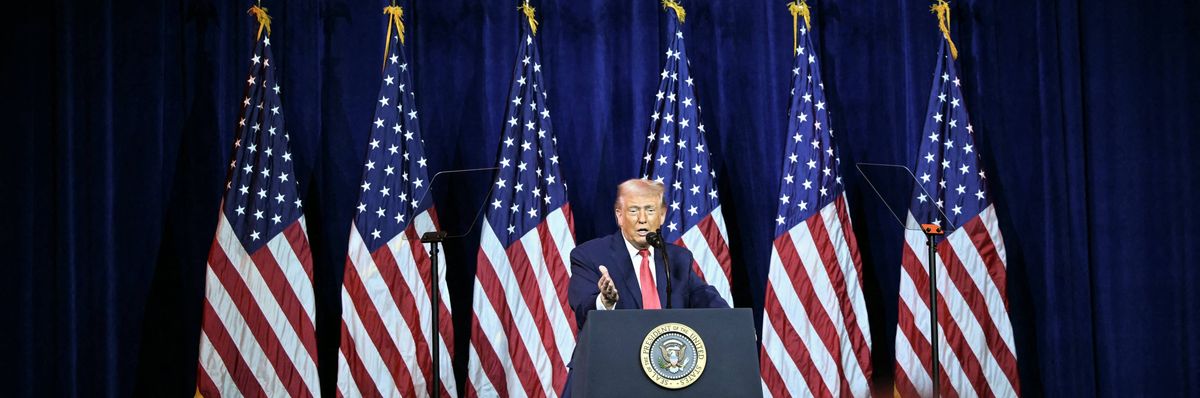
US President Donald Trump speaks during the House Republican Party member retreat at the Kennedy Center in Washington, DC, on January 6, 2026.
“This is the mind of a fascist,” said a former official of the first Trump administration.
As he uses the military to extort Venezuela and threatens to wage war against half a dozen other nations, President Donald Trump stated plainly this week that there are no restraints on his power to use force to dominate and subjugate any country on the planet besides his own will.
Asked by the New York Times whether there were any limits on his ability to use military force in his ambitions toward "American supremacy," and a return to 19th-century imperial conquest, he told the paper, which published excerpts from the interview Thursday: "Yeah, there is one thing. My own morality. My own mind. It’s the only thing that can stop me.”
Trump’s attack on Venezuela and kidnapping of President Nicolás Maduro last weekend, his floating of military force to annex Greenland this week, and his repeated threats to bomb Iran in recent days have all been described as blatant affronts to international law and what remains of the “rules-based” global order.
The president told the Times, “I don’t need international law. I’m not looking to hurt people.” He seemed to backpedal momentarily when pressed about whether his administration needed to follow international law, saying, "I do." But the Times reports that the president "made clear he would be the arbiter when such constraints applied to the United States."
“It depends what your definition of international law is,” Trump said.
If statements by other top officials are any guide, the administration's "definition" of international law is more akin to the law of the jungle than anything to do with treaties or UN Security Council resolutions.
In an interview earlier this week, senior adviser Stephen Miller, reportedly one of the architects of Trump's campaign of extrajudicial boat bombings in the Caribbean, laid out a view of the president's power that amounts to little more than "might makes right."
Speaking of Trump's supposed unquestioned right to use military force against Greenland and Venezuela, Miller told CNN anchor Jake Tapper: “The United States is using its military to secure our interests unapologetically in our hemisphere. We’re a superpower, and under President Trump, we are going to conduct ourselves as a superpower. It is absurd that we would allow a nation in our backyard to become the supplier of resources to our adversaries but not to us.”
Miller added that “the future of the free world depends on America to be able to assert ourselves and our interests without an apology.”
The United Nations Charter expressly forbids "the threat or use of force against the territorial integrity or political independence of any state."
Yet in recent days, Trump has also threatened to carry out strikes against Colombia and Mexico, while his secretary of state, Marco Rubio, suggested a similar operation to the one that deposed Maduro could soon be carried out against Cuba's socialist government, which US presidents have sought to topple for nearly seven decades.
In a Fox News interview on Thursday, Trump stated that the US would "start now hitting land" in Mexico as part of operations against drug cartels. The nation's president, Claudia Sheinbaum—who has overseen a dramatic fall in cartel violence since she took office in 2024—has said that such strikes would violate Mexico's status as an "independent and sovereign country."
To Kenneth Roth, the former executive director of Human Rights Watch, Trump’s assertion of limitless authority sounded like “the dangerous words of a would-be dictator.”
"Trump says he is constrained not by the law but only by his 'own morality,'" Roth said. "Since he values self-aggrandizement above all else, he is describing an unbridled presidency guided only by his ego and whims."
In recent days, the White House has sought to punish those who suggest that members of the US military should not follow illegal orders given by the president.
Earlier this week, Defense Secretary Pete Hegseth announced that he would seek to strip retirement pay from Sen. Mark Kelly (Ariz.), a retired Navy captain who last year spoke in a video reminding active duty soldiers that their foremost duty is to the law rather than the president. Trump has referred to these comments as "seditious behavior" and called for Kelly and other members of Congress who took part in the video to be executed.
The White House has repeatedly asserted that because Trump is the commander-in-chief of the military, any orders he gives are legal by definition.
For Miles Taylor, who served as chief of staff for the Department of Homeland Security during Trump's first term, the president's latest claim to hold unquestioned authority called to mind a warning from Gen. John Kelly, who also served in the first Trump White House as its chief of staff.
In the lead-up to the 2024 election, Kelly told The Atlantic that Trump fits the definition of "a fascist" and that the president would frequently complain that his generals were not more like “German generals,” who he said were “totally loyal” to Hitler.
"John Kelly was right," Turner said on Thursday. "This is the mind of a fascist."
While Trump's comments left her worried about a return to an "age of imperialism," Margaret Satterthwaite, the UN special rapporteur on the independence of judges and lawyers, said that the president's sense of impunity is unsurprising given the recent toothlessness of international law in dealing with the actions of rogue states, specifically Israel's genocide in Gaza.
“International law cannot stop states from doing terrible things if they’re committed to doing them,” Satterthwaite told Al Jazeera. “And I think that the world is aware of all of the atrocities that have happened in Gaza recently, and despite efforts by many states and certainly by the UN to stop those atrocities, they continued. But I think we’re worse off if we don’t insist on the international law that does exist. We’ll simply be going down a much worse kind of slippery slope.”
Dear Common Dreams reader, It’s been nearly 30 years since I co-founded Common Dreams with my late wife, Lina Newhouser. We had the radical notion that journalism should serve the public good, not corporate profits. It was clear to us from the outset what it would take to build such a project. No paid advertisements. No corporate sponsors. No millionaire publisher telling us what to think or do. Many people said we wouldn't last a year, but we proved those doubters wrong. Together with a tremendous team of journalists and dedicated staff, we built an independent media outlet free from the constraints of profits and corporate control. Our mission has always been simple: To inform. To inspire. To ignite change for the common good. Building Common Dreams was not easy. Our survival was never guaranteed. When you take on the most powerful forces—Wall Street greed, fossil fuel industry destruction, Big Tech lobbyists, and uber-rich oligarchs who have spent billions upon billions rigging the economy and democracy in their favor—the only bulwark you have is supporters who believe in your work. But here’s the urgent message from me today. It's never been this bad out there. And it's never been this hard to keep us going. At the very moment Common Dreams is most needed, the threats we face are intensifying. We need your support now more than ever. We don't accept corporate advertising and never will. We don't have a paywall because we don't think people should be blocked from critical news based on their ability to pay. Everything we do is funded by the donations of readers like you. When everyone does the little they can afford, we are strong. But if that support retreats or dries up, so do we. Will you donate now to make sure Common Dreams not only survives but thrives? —Craig Brown, Co-founder |
As he uses the military to extort Venezuela and threatens to wage war against half a dozen other nations, President Donald Trump stated plainly this week that there are no restraints on his power to use force to dominate and subjugate any country on the planet besides his own will.
Asked by the New York Times whether there were any limits on his ability to use military force in his ambitions toward "American supremacy," and a return to 19th-century imperial conquest, he told the paper, which published excerpts from the interview Thursday: "Yeah, there is one thing. My own morality. My own mind. It’s the only thing that can stop me.”
Trump’s attack on Venezuela and kidnapping of President Nicolás Maduro last weekend, his floating of military force to annex Greenland this week, and his repeated threats to bomb Iran in recent days have all been described as blatant affronts to international law and what remains of the “rules-based” global order.
The president told the Times, “I don’t need international law. I’m not looking to hurt people.” He seemed to backpedal momentarily when pressed about whether his administration needed to follow international law, saying, "I do." But the Times reports that the president "made clear he would be the arbiter when such constraints applied to the United States."
“It depends what your definition of international law is,” Trump said.
If statements by other top officials are any guide, the administration's "definition" of international law is more akin to the law of the jungle than anything to do with treaties or UN Security Council resolutions.
In an interview earlier this week, senior adviser Stephen Miller, reportedly one of the architects of Trump's campaign of extrajudicial boat bombings in the Caribbean, laid out a view of the president's power that amounts to little more than "might makes right."
Speaking of Trump's supposed unquestioned right to use military force against Greenland and Venezuela, Miller told CNN anchor Jake Tapper: “The United States is using its military to secure our interests unapologetically in our hemisphere. We’re a superpower, and under President Trump, we are going to conduct ourselves as a superpower. It is absurd that we would allow a nation in our backyard to become the supplier of resources to our adversaries but not to us.”
Miller added that “the future of the free world depends on America to be able to assert ourselves and our interests without an apology.”
The United Nations Charter expressly forbids "the threat or use of force against the territorial integrity or political independence of any state."
Yet in recent days, Trump has also threatened to carry out strikes against Colombia and Mexico, while his secretary of state, Marco Rubio, suggested a similar operation to the one that deposed Maduro could soon be carried out against Cuba's socialist government, which US presidents have sought to topple for nearly seven decades.
In a Fox News interview on Thursday, Trump stated that the US would "start now hitting land" in Mexico as part of operations against drug cartels. The nation's president, Claudia Sheinbaum—who has overseen a dramatic fall in cartel violence since she took office in 2024—has said that such strikes would violate Mexico's status as an "independent and sovereign country."
To Kenneth Roth, the former executive director of Human Rights Watch, Trump’s assertion of limitless authority sounded like “the dangerous words of a would-be dictator.”
"Trump says he is constrained not by the law but only by his 'own morality,'" Roth said. "Since he values self-aggrandizement above all else, he is describing an unbridled presidency guided only by his ego and whims."
In recent days, the White House has sought to punish those who suggest that members of the US military should not follow illegal orders given by the president.
Earlier this week, Defense Secretary Pete Hegseth announced that he would seek to strip retirement pay from Sen. Mark Kelly (Ariz.), a retired Navy captain who last year spoke in a video reminding active duty soldiers that their foremost duty is to the law rather than the president. Trump has referred to these comments as "seditious behavior" and called for Kelly and other members of Congress who took part in the video to be executed.
The White House has repeatedly asserted that because Trump is the commander-in-chief of the military, any orders he gives are legal by definition.
For Miles Taylor, who served as chief of staff for the Department of Homeland Security during Trump's first term, the president's latest claim to hold unquestioned authority called to mind a warning from Gen. John Kelly, who also served in the first Trump White House as its chief of staff.
In the lead-up to the 2024 election, Kelly told The Atlantic that Trump fits the definition of "a fascist" and that the president would frequently complain that his generals were not more like “German generals,” who he said were “totally loyal” to Hitler.
"John Kelly was right," Turner said on Thursday. "This is the mind of a fascist."
While Trump's comments left her worried about a return to an "age of imperialism," Margaret Satterthwaite, the UN special rapporteur on the independence of judges and lawyers, said that the president's sense of impunity is unsurprising given the recent toothlessness of international law in dealing with the actions of rogue states, specifically Israel's genocide in Gaza.
“International law cannot stop states from doing terrible things if they’re committed to doing them,” Satterthwaite told Al Jazeera. “And I think that the world is aware of all of the atrocities that have happened in Gaza recently, and despite efforts by many states and certainly by the UN to stop those atrocities, they continued. But I think we’re worse off if we don’t insist on the international law that does exist. We’ll simply be going down a much worse kind of slippery slope.”
As he uses the military to extort Venezuela and threatens to wage war against half a dozen other nations, President Donald Trump stated plainly this week that there are no restraints on his power to use force to dominate and subjugate any country on the planet besides his own will.
Asked by the New York Times whether there were any limits on his ability to use military force in his ambitions toward "American supremacy," and a return to 19th-century imperial conquest, he told the paper, which published excerpts from the interview Thursday: "Yeah, there is one thing. My own morality. My own mind. It’s the only thing that can stop me.”
Trump’s attack on Venezuela and kidnapping of President Nicolás Maduro last weekend, his floating of military force to annex Greenland this week, and his repeated threats to bomb Iran in recent days have all been described as blatant affronts to international law and what remains of the “rules-based” global order.
The president told the Times, “I don’t need international law. I’m not looking to hurt people.” He seemed to backpedal momentarily when pressed about whether his administration needed to follow international law, saying, "I do." But the Times reports that the president "made clear he would be the arbiter when such constraints applied to the United States."
“It depends what your definition of international law is,” Trump said.
If statements by other top officials are any guide, the administration's "definition" of international law is more akin to the law of the jungle than anything to do with treaties or UN Security Council resolutions.
In an interview earlier this week, senior adviser Stephen Miller, reportedly one of the architects of Trump's campaign of extrajudicial boat bombings in the Caribbean, laid out a view of the president's power that amounts to little more than "might makes right."
Speaking of Trump's supposed unquestioned right to use military force against Greenland and Venezuela, Miller told CNN anchor Jake Tapper: “The United States is using its military to secure our interests unapologetically in our hemisphere. We’re a superpower, and under President Trump, we are going to conduct ourselves as a superpower. It is absurd that we would allow a nation in our backyard to become the supplier of resources to our adversaries but not to us.”
Miller added that “the future of the free world depends on America to be able to assert ourselves and our interests without an apology.”
The United Nations Charter expressly forbids "the threat or use of force against the territorial integrity or political independence of any state."
Yet in recent days, Trump has also threatened to carry out strikes against Colombia and Mexico, while his secretary of state, Marco Rubio, suggested a similar operation to the one that deposed Maduro could soon be carried out against Cuba's socialist government, which US presidents have sought to topple for nearly seven decades.
In a Fox News interview on Thursday, Trump stated that the US would "start now hitting land" in Mexico as part of operations against drug cartels. The nation's president, Claudia Sheinbaum—who has overseen a dramatic fall in cartel violence since she took office in 2024—has said that such strikes would violate Mexico's status as an "independent and sovereign country."
To Kenneth Roth, the former executive director of Human Rights Watch, Trump’s assertion of limitless authority sounded like “the dangerous words of a would-be dictator.”
"Trump says he is constrained not by the law but only by his 'own morality,'" Roth said. "Since he values self-aggrandizement above all else, he is describing an unbridled presidency guided only by his ego and whims."
In recent days, the White House has sought to punish those who suggest that members of the US military should not follow illegal orders given by the president.
Earlier this week, Defense Secretary Pete Hegseth announced that he would seek to strip retirement pay from Sen. Mark Kelly (Ariz.), a retired Navy captain who last year spoke in a video reminding active duty soldiers that their foremost duty is to the law rather than the president. Trump has referred to these comments as "seditious behavior" and called for Kelly and other members of Congress who took part in the video to be executed.
The White House has repeatedly asserted that because Trump is the commander-in-chief of the military, any orders he gives are legal by definition.
For Miles Taylor, who served as chief of staff for the Department of Homeland Security during Trump's first term, the president's latest claim to hold unquestioned authority called to mind a warning from Gen. John Kelly, who also served in the first Trump White House as its chief of staff.
In the lead-up to the 2024 election, Kelly told The Atlantic that Trump fits the definition of "a fascist" and that the president would frequently complain that his generals were not more like “German generals,” who he said were “totally loyal” to Hitler.
"John Kelly was right," Turner said on Thursday. "This is the mind of a fascist."
While Trump's comments left her worried about a return to an "age of imperialism," Margaret Satterthwaite, the UN special rapporteur on the independence of judges and lawyers, said that the president's sense of impunity is unsurprising given the recent toothlessness of international law in dealing with the actions of rogue states, specifically Israel's genocide in Gaza.
“International law cannot stop states from doing terrible things if they’re committed to doing them,” Satterthwaite told Al Jazeera. “And I think that the world is aware of all of the atrocities that have happened in Gaza recently, and despite efforts by many states and certainly by the UN to stop those atrocities, they continued. But I think we’re worse off if we don’t insist on the international law that does exist. We’ll simply be going down a much worse kind of slippery slope.”