SUBSCRIBE TO OUR FREE NEWSLETTER
Daily news & progressive opinion—funded by the people, not the corporations—delivered straight to your inbox.
5
#000000
#FFFFFF
To donate by check, phone, or other method, see our More Ways to Give page.
Daily news & progressive opinion—funded by the people, not the corporations—delivered straight to your inbox.
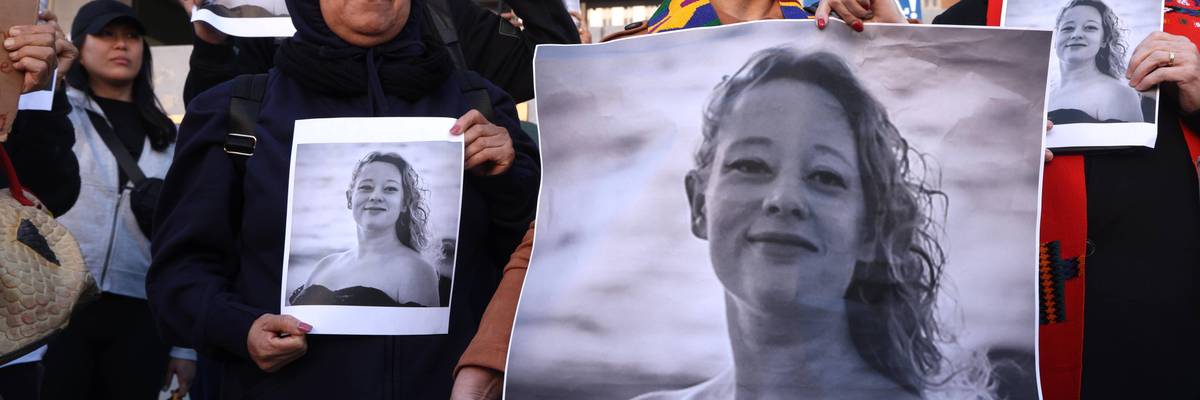
Ampara Rincon, second from right, her husband Pastor Carlos Rincon, right, and other protesters, hold photos of Renee Nicole Good, the day after her shooting death Wednesday by an ICE agent in Minneapolis, in front of the Federal Building in downtown Los Angeles on January 8, 2026.
At the heart of this test lie two irreconcilable viewpoints: those who align themselves with armed agents and the task of protecting America from the “enemy within,” and those who embrace compassion for others. Between those with the guns, and those with the whistles.
On January 7, Renee Nicole Good was murdered by Jonathan Ross, an “experienced” Immigration and Customs Enforcement agent with more than 10 years with the agency.
This tragic event was recorded from multiple angles. This includes a video recorded by Ross himself during the confrontation. If you ask me, these videos, alongside detailed frame-by-frame breakdowns produced by the media, clearly show that Good had no intention to hit Ross. She had no malice toward him. She literally says, “That’s fine, dude. I’m not mad at you.”
Ross was not in any danger. He didn’t need to shoot, let alone shoot three times. It was not self-defense. He murdered Good—or, as he saw her, a “fucking bitch.”
Yet, many conservatives saw things completely differently. At a press hearing on January 8, Vice President JD Vance remarked, "Everybody who has been repeating the lie that this was some innocent woman who was out for a drive in Minneapolis when a law enforcement officer shot at her, you should be ashamed of yourselves, every single one of you.” This viewpoint was shared by Republicans in Congress, like Rep. Buddy Carter (R-Ga.) and Rep. Dan Meuser (R-Pa.), conservative commentators like Jesse Watters and Steven Crowder, and, of course, the world’s most chronically online billionaire Elon Musk.
We have no obligation to follow unjust laws. Our duty, as those who believe in democracy and freedom, is to challenge authoritarianism and injustice anytime and anywhere.
It may be tempting to argue that these people are all simply lying. However, that response overlooks that it’s not just political commentators and politicians—across social media, people are seeing what Vance and others claim.
Here it is important to remember that perception is not neutral. The world we see is very much shaped by our beliefs, values, and our commitments. This doesn’t mean that everything is relative. For instance, it’s clear that Ross fired after he was no longer in the path of Good’s car. But, while some like Secretary of Homeland Security Kristi Noem are blatantly lying, others really are seeing something different here. The question then is: why? What is the basis for these discrepancies? And what does it tell us about where we’re at as a society?
The murder of Renee Nicole Good is a political Rorschach test. At the heart of this test lie two irreconcilable viewpoints: those who align themselves with armed agents and the task of protecting America from the “enemy within,” and those who embrace compassion for others and support their diverse communities. Between those with the guns, and those with the whistles. Between those who think that what happened to Good could never happen to them, and those who see in Good’s death their own vulnerability.
These opposing viewpoints reflect deep divides regarding how Americans think about defiance, vulnerability, and community.
For those who immediately see Good as “a domestic terrorist,” the issue is not about criminality. ICE agents are not police officers. They can only lawfully detain citizens under very narrow circumstances, such as if they interfere with an arrest or assault an agent. None of these conditions applied to Good. She was, by the Department of Homeland Security’s (DHS) own standards, outside the scope of their limited authority.
The issue is not about criminality, malice, or citizenship. It’s about defiance. This sentiment is captured in an op-ed written by the conservative New York Post Editorial Board. They place “full blame” for Good’s death on the Democrats for “cheering law-breaking protesters, calling for resistance to ICE as if it weren’t a duly constituted law enforcement agency.” They emphasize that, “anyone who doesn’t like how the law is enforced is free to work to elect different leaders, and to advocate for different laws. If you absolutely must object, then employ genuine, orderly civil disobedience and go peacefully off to jail afterward.”
For the board, those of us critical of ICE, DHS, and the Trump administration have two options: obey, or protest and go to jail. Though ideally, in their view, everyone should simply allow ICE agents to do their work unimpededly. As they write, “If the civilians had just left the law enforcers alone, Renee Nicole Good would still be alive.” Without explicitly saying so, the board blames Good for her death.
Central to this view are two key assumptions: first, “law-breaking protesters” are always in the wrong; and second, that legality alone makes law enforcement legitimate. The board is wrong on both fronts. We have no obligation to follow unjust laws. Our duty, as those who believe in democracy and freedom, is to challenge authoritarianism and injustice anytime and anywhere. The government is no exception.
We should also all be mindful that immigration enforcement officers have a long history of putting themselves in danger to justify violence. For instance, a 2013 review of US Border Patrol by the nonprofit Police Executive Research Forum found that agents “have intentionally and unnecessarily stepped in front of moving cars to justify using deadly force against vehicle occupants.”
This is a test about vulnerability. Dan McLaughlin, a fellow at the conservative National Review Institute, argues that Good “had to actively try to make herself a target for an ICE agent. That was her choice, not ICE’s.”
Many of Ross’ supporters see the situation similarly—ICE poses no immediate threat to citizens. If an ICE agent gives a citizen an order, they have no reason to refuse. They implicitly trust that ICE will respect their status as Americans. On this view, Good put herself in danger; she made herself vulnerable to police violence. Thus, she is at fault.
Yet, as has been widely reported, ICE have surveilled, approached, assaulted, arrested, and detained US citizens. For Muslims, people of color and immigrants alike, citizenship offers no protections. Some of us don’t have the privilege to forget about the ways in which we are different.
When I see video from that day, I see Good being murdered. I see a version of America that betrays its most cherished ideals. I see community resilience and the attempts by armed officers to silence it.
Even if an act of injustice does not directly impact us, that’s not a reason to do nothing. Yet this is precisely what some believe. Conservative commentator Matt Walsh, for instance, posts: “This lesbian agitator gave her life to protect Somali scammers who couldn’t give less of a shit about her. The most disgraceful and humiliating end a person could possibly meet.”
Walsh’s comment is both homophobic and racist. It also demonstrates something very true about the nature of bigotry. The homophobe is always a racist; the racist is always a sexist; the sexist is always a xenophobe. Bigotry is inherently irrational and irrationality knows no bounds. As a woman in a same-sex marriage, Good likely understood this. As a Christian, she acknowledged her duty to help others in need.
Finally, this is a test about belonging and community. For some, like Sen. Lindsey Graham (R-SC), ICE agents “are under unprecedented siege by radical leftist open border activists. This video […] shows you the danger our ICE agents are under.” But I would argue that it’s the exact opposite. American communities are under siege by federal agents empowered by an administration openly hostile to its own citizens.
When I see video from that day, I see Good being murdered. I see a version of America that betrays its most cherished ideals. I see community resilience and the attempts by armed officers to silence it.
But, in the aftermath, I see hope in the form of nationwide anti-ICE protests. I see a public that will not be gaslit by lies and falsehoods from those in power. I see that, despite the best efforts of the Trump administration, we haven’t yet lost what makes America great.
Dear Common Dreams reader, It’s been nearly 30 years since I co-founded Common Dreams with my late wife, Lina Newhouser. We had the radical notion that journalism should serve the public good, not corporate profits. It was clear to us from the outset what it would take to build such a project. No paid advertisements. No corporate sponsors. No millionaire publisher telling us what to think or do. Many people said we wouldn't last a year, but we proved those doubters wrong. Together with a tremendous team of journalists and dedicated staff, we built an independent media outlet free from the constraints of profits and corporate control. Our mission has always been simple: To inform. To inspire. To ignite change for the common good. Building Common Dreams was not easy. Our survival was never guaranteed. When you take on the most powerful forces—Wall Street greed, fossil fuel industry destruction, Big Tech lobbyists, and uber-rich oligarchs who have spent billions upon billions rigging the economy and democracy in their favor—the only bulwark you have is supporters who believe in your work. But here’s the urgent message from me today. It's never been this bad out there. And it's never been this hard to keep us going. At the very moment Common Dreams is most needed, the threats we face are intensifying. We need your support now more than ever. We don't accept corporate advertising and never will. We don't have a paywall because we don't think people should be blocked from critical news based on their ability to pay. Everything we do is funded by the donations of readers like you. When everyone does the little they can afford, we are strong. But if that support retreats or dries up, so do we. Will you donate now to make sure Common Dreams not only survives but thrives? —Craig Brown, Co-founder |
On January 7, Renee Nicole Good was murdered by Jonathan Ross, an “experienced” Immigration and Customs Enforcement agent with more than 10 years with the agency.
This tragic event was recorded from multiple angles. This includes a video recorded by Ross himself during the confrontation. If you ask me, these videos, alongside detailed frame-by-frame breakdowns produced by the media, clearly show that Good had no intention to hit Ross. She had no malice toward him. She literally says, “That’s fine, dude. I’m not mad at you.”
Ross was not in any danger. He didn’t need to shoot, let alone shoot three times. It was not self-defense. He murdered Good—or, as he saw her, a “fucking bitch.”
Yet, many conservatives saw things completely differently. At a press hearing on January 8, Vice President JD Vance remarked, "Everybody who has been repeating the lie that this was some innocent woman who was out for a drive in Minneapolis when a law enforcement officer shot at her, you should be ashamed of yourselves, every single one of you.” This viewpoint was shared by Republicans in Congress, like Rep. Buddy Carter (R-Ga.) and Rep. Dan Meuser (R-Pa.), conservative commentators like Jesse Watters and Steven Crowder, and, of course, the world’s most chronically online billionaire Elon Musk.
We have no obligation to follow unjust laws. Our duty, as those who believe in democracy and freedom, is to challenge authoritarianism and injustice anytime and anywhere.
It may be tempting to argue that these people are all simply lying. However, that response overlooks that it’s not just political commentators and politicians—across social media, people are seeing what Vance and others claim.
Here it is important to remember that perception is not neutral. The world we see is very much shaped by our beliefs, values, and our commitments. This doesn’t mean that everything is relative. For instance, it’s clear that Ross fired after he was no longer in the path of Good’s car. But, while some like Secretary of Homeland Security Kristi Noem are blatantly lying, others really are seeing something different here. The question then is: why? What is the basis for these discrepancies? And what does it tell us about where we’re at as a society?
The murder of Renee Nicole Good is a political Rorschach test. At the heart of this test lie two irreconcilable viewpoints: those who align themselves with armed agents and the task of protecting America from the “enemy within,” and those who embrace compassion for others and support their diverse communities. Between those with the guns, and those with the whistles. Between those who think that what happened to Good could never happen to them, and those who see in Good’s death their own vulnerability.
These opposing viewpoints reflect deep divides regarding how Americans think about defiance, vulnerability, and community.
For those who immediately see Good as “a domestic terrorist,” the issue is not about criminality. ICE agents are not police officers. They can only lawfully detain citizens under very narrow circumstances, such as if they interfere with an arrest or assault an agent. None of these conditions applied to Good. She was, by the Department of Homeland Security’s (DHS) own standards, outside the scope of their limited authority.
The issue is not about criminality, malice, or citizenship. It’s about defiance. This sentiment is captured in an op-ed written by the conservative New York Post Editorial Board. They place “full blame” for Good’s death on the Democrats for “cheering law-breaking protesters, calling for resistance to ICE as if it weren’t a duly constituted law enforcement agency.” They emphasize that, “anyone who doesn’t like how the law is enforced is free to work to elect different leaders, and to advocate for different laws. If you absolutely must object, then employ genuine, orderly civil disobedience and go peacefully off to jail afterward.”
For the board, those of us critical of ICE, DHS, and the Trump administration have two options: obey, or protest and go to jail. Though ideally, in their view, everyone should simply allow ICE agents to do their work unimpededly. As they write, “If the civilians had just left the law enforcers alone, Renee Nicole Good would still be alive.” Without explicitly saying so, the board blames Good for her death.
Central to this view are two key assumptions: first, “law-breaking protesters” are always in the wrong; and second, that legality alone makes law enforcement legitimate. The board is wrong on both fronts. We have no obligation to follow unjust laws. Our duty, as those who believe in democracy and freedom, is to challenge authoritarianism and injustice anytime and anywhere. The government is no exception.
We should also all be mindful that immigration enforcement officers have a long history of putting themselves in danger to justify violence. For instance, a 2013 review of US Border Patrol by the nonprofit Police Executive Research Forum found that agents “have intentionally and unnecessarily stepped in front of moving cars to justify using deadly force against vehicle occupants.”
This is a test about vulnerability. Dan McLaughlin, a fellow at the conservative National Review Institute, argues that Good “had to actively try to make herself a target for an ICE agent. That was her choice, not ICE’s.”
Many of Ross’ supporters see the situation similarly—ICE poses no immediate threat to citizens. If an ICE agent gives a citizen an order, they have no reason to refuse. They implicitly trust that ICE will respect their status as Americans. On this view, Good put herself in danger; she made herself vulnerable to police violence. Thus, she is at fault.
Yet, as has been widely reported, ICE have surveilled, approached, assaulted, arrested, and detained US citizens. For Muslims, people of color and immigrants alike, citizenship offers no protections. Some of us don’t have the privilege to forget about the ways in which we are different.
When I see video from that day, I see Good being murdered. I see a version of America that betrays its most cherished ideals. I see community resilience and the attempts by armed officers to silence it.
Even if an act of injustice does not directly impact us, that’s not a reason to do nothing. Yet this is precisely what some believe. Conservative commentator Matt Walsh, for instance, posts: “This lesbian agitator gave her life to protect Somali scammers who couldn’t give less of a shit about her. The most disgraceful and humiliating end a person could possibly meet.”
Walsh’s comment is both homophobic and racist. It also demonstrates something very true about the nature of bigotry. The homophobe is always a racist; the racist is always a sexist; the sexist is always a xenophobe. Bigotry is inherently irrational and irrationality knows no bounds. As a woman in a same-sex marriage, Good likely understood this. As a Christian, she acknowledged her duty to help others in need.
Finally, this is a test about belonging and community. For some, like Sen. Lindsey Graham (R-SC), ICE agents “are under unprecedented siege by radical leftist open border activists. This video […] shows you the danger our ICE agents are under.” But I would argue that it’s the exact opposite. American communities are under siege by federal agents empowered by an administration openly hostile to its own citizens.
When I see video from that day, I see Good being murdered. I see a version of America that betrays its most cherished ideals. I see community resilience and the attempts by armed officers to silence it.
But, in the aftermath, I see hope in the form of nationwide anti-ICE protests. I see a public that will not be gaslit by lies and falsehoods from those in power. I see that, despite the best efforts of the Trump administration, we haven’t yet lost what makes America great.
On January 7, Renee Nicole Good was murdered by Jonathan Ross, an “experienced” Immigration and Customs Enforcement agent with more than 10 years with the agency.
This tragic event was recorded from multiple angles. This includes a video recorded by Ross himself during the confrontation. If you ask me, these videos, alongside detailed frame-by-frame breakdowns produced by the media, clearly show that Good had no intention to hit Ross. She had no malice toward him. She literally says, “That’s fine, dude. I’m not mad at you.”
Ross was not in any danger. He didn’t need to shoot, let alone shoot three times. It was not self-defense. He murdered Good—or, as he saw her, a “fucking bitch.”
Yet, many conservatives saw things completely differently. At a press hearing on January 8, Vice President JD Vance remarked, "Everybody who has been repeating the lie that this was some innocent woman who was out for a drive in Minneapolis when a law enforcement officer shot at her, you should be ashamed of yourselves, every single one of you.” This viewpoint was shared by Republicans in Congress, like Rep. Buddy Carter (R-Ga.) and Rep. Dan Meuser (R-Pa.), conservative commentators like Jesse Watters and Steven Crowder, and, of course, the world’s most chronically online billionaire Elon Musk.
We have no obligation to follow unjust laws. Our duty, as those who believe in democracy and freedom, is to challenge authoritarianism and injustice anytime and anywhere.
It may be tempting to argue that these people are all simply lying. However, that response overlooks that it’s not just political commentators and politicians—across social media, people are seeing what Vance and others claim.
Here it is important to remember that perception is not neutral. The world we see is very much shaped by our beliefs, values, and our commitments. This doesn’t mean that everything is relative. For instance, it’s clear that Ross fired after he was no longer in the path of Good’s car. But, while some like Secretary of Homeland Security Kristi Noem are blatantly lying, others really are seeing something different here. The question then is: why? What is the basis for these discrepancies? And what does it tell us about where we’re at as a society?
The murder of Renee Nicole Good is a political Rorschach test. At the heart of this test lie two irreconcilable viewpoints: those who align themselves with armed agents and the task of protecting America from the “enemy within,” and those who embrace compassion for others and support their diverse communities. Between those with the guns, and those with the whistles. Between those who think that what happened to Good could never happen to them, and those who see in Good’s death their own vulnerability.
These opposing viewpoints reflect deep divides regarding how Americans think about defiance, vulnerability, and community.
For those who immediately see Good as “a domestic terrorist,” the issue is not about criminality. ICE agents are not police officers. They can only lawfully detain citizens under very narrow circumstances, such as if they interfere with an arrest or assault an agent. None of these conditions applied to Good. She was, by the Department of Homeland Security’s (DHS) own standards, outside the scope of their limited authority.
The issue is not about criminality, malice, or citizenship. It’s about defiance. This sentiment is captured in an op-ed written by the conservative New York Post Editorial Board. They place “full blame” for Good’s death on the Democrats for “cheering law-breaking protesters, calling for resistance to ICE as if it weren’t a duly constituted law enforcement agency.” They emphasize that, “anyone who doesn’t like how the law is enforced is free to work to elect different leaders, and to advocate for different laws. If you absolutely must object, then employ genuine, orderly civil disobedience and go peacefully off to jail afterward.”
For the board, those of us critical of ICE, DHS, and the Trump administration have two options: obey, or protest and go to jail. Though ideally, in their view, everyone should simply allow ICE agents to do their work unimpededly. As they write, “If the civilians had just left the law enforcers alone, Renee Nicole Good would still be alive.” Without explicitly saying so, the board blames Good for her death.
Central to this view are two key assumptions: first, “law-breaking protesters” are always in the wrong; and second, that legality alone makes law enforcement legitimate. The board is wrong on both fronts. We have no obligation to follow unjust laws. Our duty, as those who believe in democracy and freedom, is to challenge authoritarianism and injustice anytime and anywhere. The government is no exception.
We should also all be mindful that immigration enforcement officers have a long history of putting themselves in danger to justify violence. For instance, a 2013 review of US Border Patrol by the nonprofit Police Executive Research Forum found that agents “have intentionally and unnecessarily stepped in front of moving cars to justify using deadly force against vehicle occupants.”
This is a test about vulnerability. Dan McLaughlin, a fellow at the conservative National Review Institute, argues that Good “had to actively try to make herself a target for an ICE agent. That was her choice, not ICE’s.”
Many of Ross’ supporters see the situation similarly—ICE poses no immediate threat to citizens. If an ICE agent gives a citizen an order, they have no reason to refuse. They implicitly trust that ICE will respect their status as Americans. On this view, Good put herself in danger; she made herself vulnerable to police violence. Thus, she is at fault.
Yet, as has been widely reported, ICE have surveilled, approached, assaulted, arrested, and detained US citizens. For Muslims, people of color and immigrants alike, citizenship offers no protections. Some of us don’t have the privilege to forget about the ways in which we are different.
When I see video from that day, I see Good being murdered. I see a version of America that betrays its most cherished ideals. I see community resilience and the attempts by armed officers to silence it.
Even if an act of injustice does not directly impact us, that’s not a reason to do nothing. Yet this is precisely what some believe. Conservative commentator Matt Walsh, for instance, posts: “This lesbian agitator gave her life to protect Somali scammers who couldn’t give less of a shit about her. The most disgraceful and humiliating end a person could possibly meet.”
Walsh’s comment is both homophobic and racist. It also demonstrates something very true about the nature of bigotry. The homophobe is always a racist; the racist is always a sexist; the sexist is always a xenophobe. Bigotry is inherently irrational and irrationality knows no bounds. As a woman in a same-sex marriage, Good likely understood this. As a Christian, she acknowledged her duty to help others in need.
Finally, this is a test about belonging and community. For some, like Sen. Lindsey Graham (R-SC), ICE agents “are under unprecedented siege by radical leftist open border activists. This video […] shows you the danger our ICE agents are under.” But I would argue that it’s the exact opposite. American communities are under siege by federal agents empowered by an administration openly hostile to its own citizens.
When I see video from that day, I see Good being murdered. I see a version of America that betrays its most cherished ideals. I see community resilience and the attempts by armed officers to silence it.
But, in the aftermath, I see hope in the form of nationwide anti-ICE protests. I see a public that will not be gaslit by lies and falsehoods from those in power. I see that, despite the best efforts of the Trump administration, we haven’t yet lost what makes America great.