SUBSCRIBE TO OUR FREE NEWSLETTER
Daily news & progressive opinion—funded by the people, not the corporations—delivered straight to your inbox.
5
#000000
#FFFFFF
To donate by check, phone, or other method, see our More Ways to Give page.
Daily news & progressive opinion—funded by the people, not the corporations—delivered straight to your inbox.
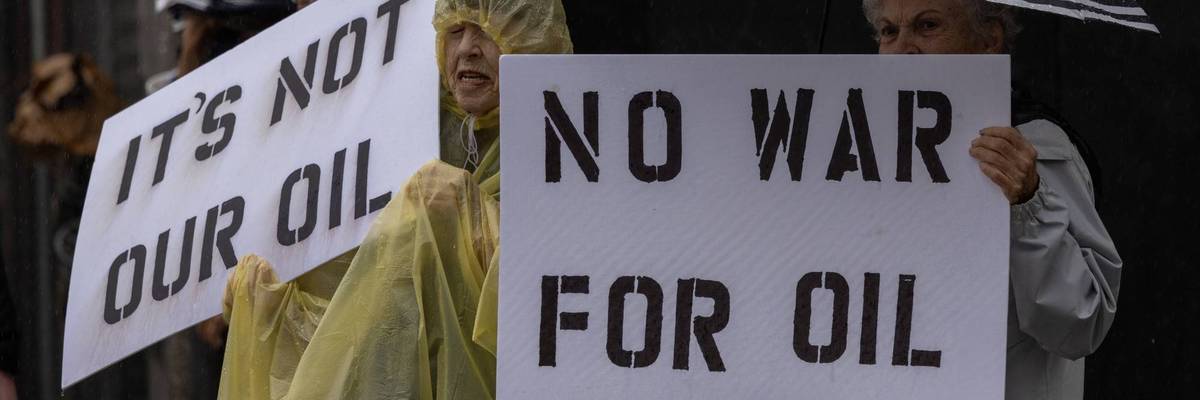
People participate in a “No War on Venezuela” protest on January 3, 2026 in Los Angeles, California.
"Today’s meeting is meant to ensure the future of Venezuela is being shaped in a way that maximizes Big Oil profits and Trump’s power."
US President Donald Trump is set to meet at the White House on Friday afternoon with executives from some of the world's largest fossil fuel companies to discuss the future of Venezuela's oil infrastructure, a gathering that critics said throws into stark relief the true aims of the administration's military assault on a sovereign nation and abduction of its president.
The meeting, scheduled for 2 pm ET, will come after Trump declared on social media early Friday that "at least 100 Billion Dollars will be invested by BIG OIL," an industry that donated heavily to the president's 2024 campaign and inaugural fund. Attendees of Friday's White House meeting will reportedly include the CEOs of Chevron, ExxonMobil, ConocoPhillips, Halliburton, and Shell.
Harold Hamm, the founder of Continental Resources and major Trump donor, is also expected to attend. Hamm organized the now-infamous 2024 event where Trump asked oil executives for $1 billion in campaign donations in exchange for industry-friendly policies.
“American fossil fuel companies who’ve bought access to the Trump administration stand to benefit most from Trump’s illegal acts of aggression in Venezuela," Allie Rosenbluth, US program manager at Oil Change International, said in a statement ahead of Friday's gathering.
"Today’s meeting is meant to ensure the future of Venezuela is being shaped in a way that maximizes Big Oil profits and Trump’s power," said Rosenbluth. "Trump’s aggression in Venezuela is leading us to a hotter, more polluted, and more dangerous world—all to enrich himself and his fossil fuel donors. Today’s meeting is proof of that. To protect our communities from climate disasters and more wars for oil, we need to reject extractive energy models and build democratic systems that prioritize community health and safety."
Despite Trump's lofty promises and suggestion of taxpayer reimbursement, major US oil companies have yet to make any concrete investment pledges related to Venezuela's oil infrastructure.
Earlier this week, US Energy Secretary Chris Wright said the Trump administration intends to manage Venezuela oil sales and revenue indefinitely. On Tuesday, Trump proclaimed that he himself would control the proceeds from the sale of Venezuelan oil.
While Venezuela's known oil reserves are the largest in the world, some leading oil executives have "privately expressed reservations about committing the kind of money it would take to meaningfully boost Venezuelan oil production," the New York Times reported Friday.
"Some oil companies have discussed the possibility of seeking some form of financial guarantee from the federal government before agreeing to establish or expand production in Venezuela," the Times added.
"Along with blocking further military action against Venezuela, Congress must act to ensure US taxpayers don’t subsidize Big Oil’s exploitation of Venezuela’s oil resources.”
The watchdog group Public Citizen noted in a report released Thursday that "Big Oil companies have a long history of demanding that taxpayers shoulder their risks, even when they choose to operate in politically volatile jurisdictions."
"They rake in billions in profit exploiting the natural resources from impoverished nations, then demand taxpayer compensation if those nations require them to clean up their pollution or if affected communities convince their governments to halt harmful projects," the group observed. "And so it seems likely that these companies are going to require their investments in Venezuela to have some sort of 'guarantees and conditions'—that’s the exact phrase [US Secretary of State] Marco Rubio used on 'Face the Nation' on Monday."
Robert Weissman, Public Citizen's co-president, said in a statement that "the Trump administration’s shocking actions to use force to exploit Venezuela’s oil resources echo the imperial arrogance of the United States after the invasion of Iraq and a century of military intervention in Central and South America."
"Along with blocking further military action against Venezuela," said Weissman, "Congress must act to ensure US taxpayers don’t subsidize Big Oil’s exploitation of Venezuela’s oil resources.”
This country and this world are at a monumental crossroads. US voters have an opportunity to beat back the forces of fascism and confront the billionaires who are rigging the economy, our media system, and our democracy, making it increasingly impossible for ordinary people to get by. We’re not just talking about the election. We’re talking about what must be done once these fascist elements are vanquished from power. We need a bolder set of solutions than what either major party has so far been willing to offer and a working-class movement ready to fight like hell for it. Trump didn't emerge from nowhere. The conditions that fueled MAGA authoritarianism were created by decades of radical neoliberal economic policies and a corrupt political system dominated by corporate interests. They slashed taxes on the super-rich, promising that the benefits would trickle down. They said giveaways to the corporate titans would make life more affordable for the rest of us. It was all bullshit. And when a bitter, betrayed populace searches for someone to blame, right-wing demagogues have little trouble finding scapegoats. People know when they're being lied to, but you won't hear any of this from the corporate media. Only independent journalism—powered and funded by people who believe in building a better world—can deliver truly trustworthy daily news. If you share our vision, please contribute whatever you can to sustain our work. |
US President Donald Trump is set to meet at the White House on Friday afternoon with executives from some of the world's largest fossil fuel companies to discuss the future of Venezuela's oil infrastructure, a gathering that critics said throws into stark relief the true aims of the administration's military assault on a sovereign nation and abduction of its president.
The meeting, scheduled for 2 pm ET, will come after Trump declared on social media early Friday that "at least 100 Billion Dollars will be invested by BIG OIL," an industry that donated heavily to the president's 2024 campaign and inaugural fund. Attendees of Friday's White House meeting will reportedly include the CEOs of Chevron, ExxonMobil, ConocoPhillips, Halliburton, and Shell.
Harold Hamm, the founder of Continental Resources and major Trump donor, is also expected to attend. Hamm organized the now-infamous 2024 event where Trump asked oil executives for $1 billion in campaign donations in exchange for industry-friendly policies.
“American fossil fuel companies who’ve bought access to the Trump administration stand to benefit most from Trump’s illegal acts of aggression in Venezuela," Allie Rosenbluth, US program manager at Oil Change International, said in a statement ahead of Friday's gathering.
"Today’s meeting is meant to ensure the future of Venezuela is being shaped in a way that maximizes Big Oil profits and Trump’s power," said Rosenbluth. "Trump’s aggression in Venezuela is leading us to a hotter, more polluted, and more dangerous world—all to enrich himself and his fossil fuel donors. Today’s meeting is proof of that. To protect our communities from climate disasters and more wars for oil, we need to reject extractive energy models and build democratic systems that prioritize community health and safety."
Despite Trump's lofty promises and suggestion of taxpayer reimbursement, major US oil companies have yet to make any concrete investment pledges related to Venezuela's oil infrastructure.
Earlier this week, US Energy Secretary Chris Wright said the Trump administration intends to manage Venezuela oil sales and revenue indefinitely. On Tuesday, Trump proclaimed that he himself would control the proceeds from the sale of Venezuelan oil.
While Venezuela's known oil reserves are the largest in the world, some leading oil executives have "privately expressed reservations about committing the kind of money it would take to meaningfully boost Venezuelan oil production," the New York Times reported Friday.
"Some oil companies have discussed the possibility of seeking some form of financial guarantee from the federal government before agreeing to establish or expand production in Venezuela," the Times added.
"Along with blocking further military action against Venezuela, Congress must act to ensure US taxpayers don’t subsidize Big Oil’s exploitation of Venezuela’s oil resources.”
The watchdog group Public Citizen noted in a report released Thursday that "Big Oil companies have a long history of demanding that taxpayers shoulder their risks, even when they choose to operate in politically volatile jurisdictions."
"They rake in billions in profit exploiting the natural resources from impoverished nations, then demand taxpayer compensation if those nations require them to clean up their pollution or if affected communities convince their governments to halt harmful projects," the group observed. "And so it seems likely that these companies are going to require their investments in Venezuela to have some sort of 'guarantees and conditions'—that’s the exact phrase [US Secretary of State] Marco Rubio used on 'Face the Nation' on Monday."
Robert Weissman, Public Citizen's co-president, said in a statement that "the Trump administration’s shocking actions to use force to exploit Venezuela’s oil resources echo the imperial arrogance of the United States after the invasion of Iraq and a century of military intervention in Central and South America."
"Along with blocking further military action against Venezuela," said Weissman, "Congress must act to ensure US taxpayers don’t subsidize Big Oil’s exploitation of Venezuela’s oil resources.”