

SUBSCRIBE TO OUR FREE NEWSLETTER
Daily news & progressive opinion—funded by the people, not the corporations—delivered straight to your inbox.
5
#000000
#FFFFFF
To donate by check, phone, or other method, see our More Ways to Give page.
Daily news & progressive opinion—funded by the people, not the corporations—delivered straight to your inbox.

The investor-state dispute settlement (ISDS) regime at the heart of the Trans-Pacific Partnership (TPP) that would newly empower thousands of multinational corporations to challenge U.S. policies before panels of three private lawyersto demand taxpayer compensation is the target of a letter sent to Congress today by leading pro-free trade U.S. economics and law professors calling on Congress to reject the TPP.
The White House has escalated its efforts to pass the TPP in the lame-duck session, with Cabinet secretaries who are promoting the TPP crossing paths with Democratic presidential and congressional candidates campaigning against the TPP.
Last year, several dozen legal scholars joined congressional Democrats in raising concerns about the ISDS regime and demanding that a final TPP deal exclude the parallel legal system for multinational corporations. President Barack Obama scorned the critics, declaring they were "making this stuff up." Today's letter, signed by more than 200 prominent academics, including Obama's Harvard Law School mentor Professor Larry Tribe, warns that the ISDS regime threatens the rule of law and undermines our nation's democratic institutions. The academics call on Congress to reject the pact because the final deal would greatly expand the ISDS regime.
U.S. Sen. Elizabeth Warren (D-Mass.) praised the letter: "Today's letter from top legal experts makes clear: ISDS undermines the American judicial system and tilts the playing field further in favor of big multinational corporations," Warren said. "This provision empowers companies to challenge laws and regulations they don't like, with friendly corporate lawyers instead of judges deciding their disputes. Congress should not approve a TPP agreement that includes ISDS."
Tribe, Nobel laureate Joseph Stiglitz, former California Supreme Court Justice Cruz Reynoso, and Columbia University Professor and UN Senior Adviser Jeffrey Sachs are among the signers, many of whom have supported past U.S. trade agreements. The letter spotlights the danger of the ISDS provisions, which was the same reason Democratic vice presidential nominee Tim Kaine cited for opposing the final TPP deal.
The U.S. has dodged ISDS liability to date because past treaties have covered only a limited number offoreign investors operating here. Research conducted by Public Citizen shows that the TPP, which includes Japan, Australia and other nations with more than 9,000 corporate subsidiaries in the United States, would double U.S. ISDS exposure. Nearly $3 billion in ISDS awards has been paid to corporations under U.S. treaties alone and claims worth more than $70 billion are pending.
Recent investigative reports by a Pulitzer-Prize-winning journalist and a new Columbia Global Reports book reveal how critics have understated the threats posed by the ISDS regime, which - if the TPP is approved - would empower thousands more multinational corporations to challenge U.S. federal, state and local laws, court decisions and government actions before panels of three private lawyers. Under ISDS, the panel of lawyers can award the companies unlimited taxpayer money, including for loss of expected future profits. The decisions cannot be appealed.
"In recent years, corporations have challenged a wide range of environmental, health and safety regulations, fiscal policies, bans on toxins, denials of permits including for toxic waste dumps, moratoria on extraction of natural resources, measures taken in response to financial crises, court decisions on issues ranging from the scope of intellectual property rights to the resolution of bankruptcy claims, policy decisions on privatizations of prisons and health care, and efforts to combat tax evasion, among others," the letter notes.
The experts lament that despite the Obama administration's claims to have addressed growing concerns about the ISDS system, "the final TPP text simply replicates nearly word-for-word many of the problematic provisions from past agreements, and indeed would vastly expand the U.S. government's potential liability under the ISDS system." They fear that the expansion of ISDS in the TPP and in ongoing negotiations with Europe "threatens to dilute constitutional protections, weaken the judicial branch and outsource our domestic legal system to a system of private arbitration that is isolated from essential checks and balances."
This letter adds to a rising chorus of opposition to ISDS from prominent members of Congress such as Warren; the National Conference of State Legislatures; pro-free trade think tanks such as the Cato Institute; and hundreds of labor, environmental, consumer and faith organizations.
View the letter and list of signers.
What the signers are saying:
Jeffrey Sachs, professor of economics, Columbia University:
"We need trade agreements that protect worker rights and the environment. ISDS gravely threatens environmental protection and worker rights, and the rule of law more generally, as evidenced by the current lawsuit by TransCanada suing the U.S. government for $15 billion over the cancellation of the climate-wrecking Keystone XL Pipeline."
Cruz Reynoso, former California Supreme Court Justice andprofessor of law emeritus, University of California, Davis:
"The right of foreign corporations and investors to challenge U.S. policies which allegedly violate investor rights is a frontal attack on our judicial system."
Alan Morrison, associate dean, George Washington Law School:
"The United States Constitution simply does not allow Congress to assign the duty to assess the legality under the TPP of federal and state laws to the unreviewable discretion of three private individuals, instead of to our federal court system with full-time and unconflicted judges."
Lisa Sachs, professor of law, director of Columbia Center on Sustainable Investment:
"A multilateral agreement presents an opportunity to promote the rule of law, strengthen domestic judicial systems and ensure the rights of all, including the most vulnerable, are equally advanced. ISDS in its current form undermines each of those objectives. The whole system needs a rethink to better balance all stakeholders' interests and rights."
Kevin Gallagher, professor of economics, Boston University:
"ISDS accentuates the regulatory risks that characterize the latest trade and investment pacts by granting foreign investors far greater rights over national democratic decision-making. Putting governments and their citizens back in charge of settling disputes is the first step toward the comprehensive reform that is needed."
Public Citizen is a nonprofit consumer advocacy organization that champions the public interest in the halls of power. We defend democracy, resist corporate power and work to ensure that government works for the people - not for big corporations. Founded in 1971, we now have 500,000 members and supporters throughout the country.
(202) 588-1000
"Machines selecting and engaging their target and taking a life—without human control and judgment. That is morally repugnant. It is politically unacceptable. And it must be banned by international law."
As the global artificial intelligence arms race accelerates and lethal autonomous weapons systems—better known as "killer robots"—go from the stuff of science fiction to battlefield reality, the head of the United Nations warned Monday that the world is running out of time to set international rules governing AI before the technology outpaces humanity's ability to control it.
"We may be the last generation able to set the terms on which humanity and machines coexist," UN Secretary-General António Guterres said in a social media post coinciding with his speech at the inaugural UN Global Dialogue on AI Governance in Geneva.
"If AI is to be powerful, it must be governed," he asserted. "If AI is to be trusted, those who build it must be accountable. If AI is to be global, it must be fair. And if AI is to serve the future, it must not consume the future. Let’s build a future of AI by humanity, with humanity, for all humanity."
"My main concern is with 'lethal autonomous weapon systems,'" Guterres stressed during his speech. "Let us call them what they are: killer robots."
"Machines selecting and engaging their target and taking a life—without human control and judgment," the UN chief added. "That is morally repugnant. It is politically unacceptable. And it must be banned by international law."
While scores of nations and civil society groups—chiefly, the Campaign to Stop Killer Robots—support a treaty banning lethal autonomous weapons systems, key military powers including the United States, Russia, and Israel have resisted negotiating a legally binding ban.
Proponents of killer robots argue that their development is inevitable, that they could reduce harm to noncombatants, and that they represent progress.
"It's a scary idea, but, I mean, that's the world we live in," Anduril Industries co-founder Palmer Luckey said of killer robots on CBS News' "60 Minutes" last year.
"I'd say it's a lot scarier, for example, to imagine a weapons system that doesn't have any level of intelligence at all," Luckey added. "It's not a question between smart weapons and no weapons. It's a question between smart weapons and dumb weapons."
However, recent real-world examples show how AI-powered warfare can actually multiply civilian harm. One Israeli intelligence source said that the Israel Defense Forces' use of AI systems like Habsora to automatically select airstrike targets at an exponentially faster rate than humans has transformed the IDF into a “mass assassination factory” in which the “emphasis is on quantity and not quality” of kills.
Combined with the use of massive 1,000- and 2,000-pound bombs and a policy empowering relatively junior IDF officers to order attacks on not only senior Hamas commanders but any fighter in the resistance group, regardless of civilian casualties, mass casualty events increased dramatically during Israel's ongoing genocidal war on Gaza, which has left more than 250,000 Palestinians dead, maimed, or missing.
In one AI-aided airstrike targeting a single senior Hamas commander, the IDF dropped multiple US-supplied 2,000-pound bombs, each of which can level an entire city block, on the Jabalia refugee camp in October 2023, killing at least 126 people, 68 of them children, and wounding 280 others. Hamas said four Israeli and three international hostages abducted on October 7, 2023 were also killed in the attack.
The Washington Post reported early during the illegal US-Israeli war of choice on Iran that the Pentagon has “leveraged the most advanced artificial intelligence it’s ever used in warfare," including Palantir’s Maven Smart System, which reportedly helped US commanders select 1,000 Iranian targets during the war’s first 24 hours alone. Among the civilian targets hit during that period was the Shajareh Tayyebeh girls’ elementary school in Minab. Iranian officials said the US attack massacred 156 people, at least 120 of them children, and wounded 95 others.
During his speech Monday, Guterres said "let us not wait for atrocity to act" on banning autonomous weapons systems, drawing criticism from social media users, including one account noting that Israeli forces "are quite LITERALLY using AI to commit genocide, and here you are still talking in IFs."
While acknowledging AI's enormous potential, Guterres warned about other dangers of deploying the technology without effective governance. The UN chief highlighted threats to democracy and children, as well as the risk of increasing inequality due to the concentration of power, economic disruption, and mass unemployment.
"Innovation needs guardrails," he said. "The technologies we trust most—in aviation, in medicine, in nuclear energy, and beyond—earned that trust because we acted to hold their makers to account."
Guterres also noted that, amid a worsening climate emergency, AI data centers now consume more electricity than most countries.
“By 2030, they could use more electricity than all but five nations—and enough water to meet the needs of all 1.3 billion people in sub-Saharan Africa for an entire year," he said.
Other speakers at the forum sounded the alarm on even greater risks posed by the unchecked development of AI.
"Highly concerning tests have... shown that frontier AI models are capable of deceiving humans, to understand when they are being tested," Yoshua Bengio, co-chair of the UN's Independent International Scientific Panel on AI, said.
"It sounds like science fiction, but it's a real possibility, and it could change the world in ways that we don't understand yet, and it could change the power dynamics of our planet in ways that require our attention," he added.
As with thermonuclear weapons during the Cold War, experts, including some of the pioneers of AI technology, have increasingly warned that a poorly governed race toward artificial general intelligence—a hypothetical advanced AI that can understand, learn, and apply knowledge of any subject as well as or better than a typical human—could pose an existential threat to humanity.
"AI is too consequential to be shaped by a few," said Amandeep Singh Gill, the UN special envoy for digital and emerging technologies. "We need a conversation that is global, inclusive, and grounded in evidence."

State Sen. Mallory McMorrow dropped out of the race on Sunday after having positioned herself as a "moderate" choice.
With state lawmaker Mallory McMorrow having suspended her US Senate campaign, progressives on Monday were looking ahead to the final weeks of a primary race in which Michigan Democrats have a clear choice to make about who should run in the general election as the party hopes to wrest control of the chamber from Republicans: a candidate backed by the pro-Israel lobby or one who has focused his campaign largely on the broadly popular Medicare for All proposal.
US Rep. Rashida Tlaib (D-Mich.) said in a video for the grassroots advocacy group Our Revolution that "the contrast could not be clearer" ahead of the August 4 primary as voters decide between Rep. Haley Stevens, who is backed by Senate Majority Leader Chuck Schumer (D-NY), and former Detroit health official Abdul El-Sayed, who's been endorsed by progressive leaders including Sen. Bernie Sanders (I-Vt.) and Rep. Alexandria Ocasio-Cortez (D-NY).
With early voting already underway in parts of Michigan, said Tlaib, voters are choosing between "a people-powered movement versus the establishment pick."
"Abdul is on the ballot right now to be our next US senator, the only candidate that is unapologetic in supporting Medicare for All," said Tlaib, urging supporters to canvass for the progressive candidate, who has also spoken out against military funding for Israel and abolishing US Immigration and Customs Enforcement.
"All of us know the importance of direct human contact. That's how we get elected, especially someone like Dr. Abdul El-Sayed, who is unbought and doesn't take corporate [political action committee] money," she said.
Our Revolution emphasized that with McMorrow out of the race, "the numbers show this is winnable."
As El-Sayed has faced Stevens and McMorrow in the three-way race in recent months, the progressive candidate has surged in several polls following his opponents' attacks on his campaigning with vocal anti-Israel critic and streamer Hasan Piker and as he has remained focused on what he says are his top three priorities: "money out of politics, money in your pocket, and Medicare for All."
The most recent polling, from Quantus Insights, showed El-Sayed with 41% support compared with Stevens' 36% and McMorrow's 8%. Other surveys, like one from Tulchin Research for the pro-El-Sayed Fighting for Michigan PAC, found the candidate up 19 points over Stevens, with McMorrow in a distant third place.
A poll by a super PAC that supports El-Sayed also asked voters ahead of McMorrow's suspension of her campaign how they would vote if El-Sayed and Stevens were the only two candidates, and found the progressive up 54-34.
El-Sayed has argued during the campaign that Stevens' support from the American Israel Public Affairs Committee (AIPAC) as well as for-profit health insurance companies is emblematic of a corrupt political system that's been worsened in recent years by the US Supreme Court Citizens United ruling.
As Common Dreams reported in May, AIPAC has appealed to its direct donors to send contributions of Stevens during the campaign, as well as spending $10 million to boost the candidate.
“I’m the only candidate today who didn’t ask AIPAC for their support," said El-Sayed at a debate in May. "I don’t think that our taxpayer dollars which we pay every April ought to be going to bomb children, to fund bombs and tanks for other countries, when we got kids who can’t afford basic things in our own.”
Before suspending her campaign, McMorrow cast herself as a candidate who could be seen as a midway point between Stevens' establishment connections and El-Sayed's demands for bold changes to the US political system and the Democratic Party's priorities.
But Lever News founder David Sirota pointed to McMorrow's dismissive comments about Medicare for All as evidence that she was far out of step with voters.
She claimed in an interview and a debate that public support for a government-run universal healthcare program "isn't there yet," despite the fact that the proposal was backed by 78% of Democratic voters and 65% of overall voters in one recent poll.
New York Times politics reporter Reid Epstein also pointed to McMorrow's decision to join in a weekslong smear campaign against El-Sayed, over his appearances with Piker, as a move that "backfired quickly."
"Her remarks helped burnish Dr. El-Sayed's claim that he was the lone progressive candidate in the race and the one most willing to criticize American funding of the Israeli military," wrote Epstein.
While Stevens supporters have suggested she's likely to appeal to more Michigan Democratic voters, recent public polling regarding AIPAC and Israel tells a different story following Israel's US-backed assault on Gaza, which has been called a genocide by top Holocaust scholars and human rights groups.
Last October, nearly half of Democrats in competitive primary districts said they "could never" vote for a candidate backed by AIPAC, and another survey in March showed a double-digit decline in support for Israel among US voters.
One campaigner for El-Sayed said Monday that interactions with voters have suggested Stevens' AIPAC ties are seen as a liability, even among people who haven't yet heard of her opponent in the primary.
Following McMorrow's announcement that she was suspending her campaign, El-Sayed thanked the state senator and said the race has been and remains a fight against "a politics that rigs the system against too many of us."
"The same party insiders she had the courage to challenge have been bullying anyone who opposes their chosen candidate," said El-Sayed. "After spending $30 million to drown Sen. McMorrow and me out, they're now spending even more to attack me. It's everything we stand against."
"I welcome her supporters to our movement to stand up against money in politics, to put money back in pockets, and pass Medicare for All," said El-Sayed. "We cannot allow the establishment to decide our nominee for us."
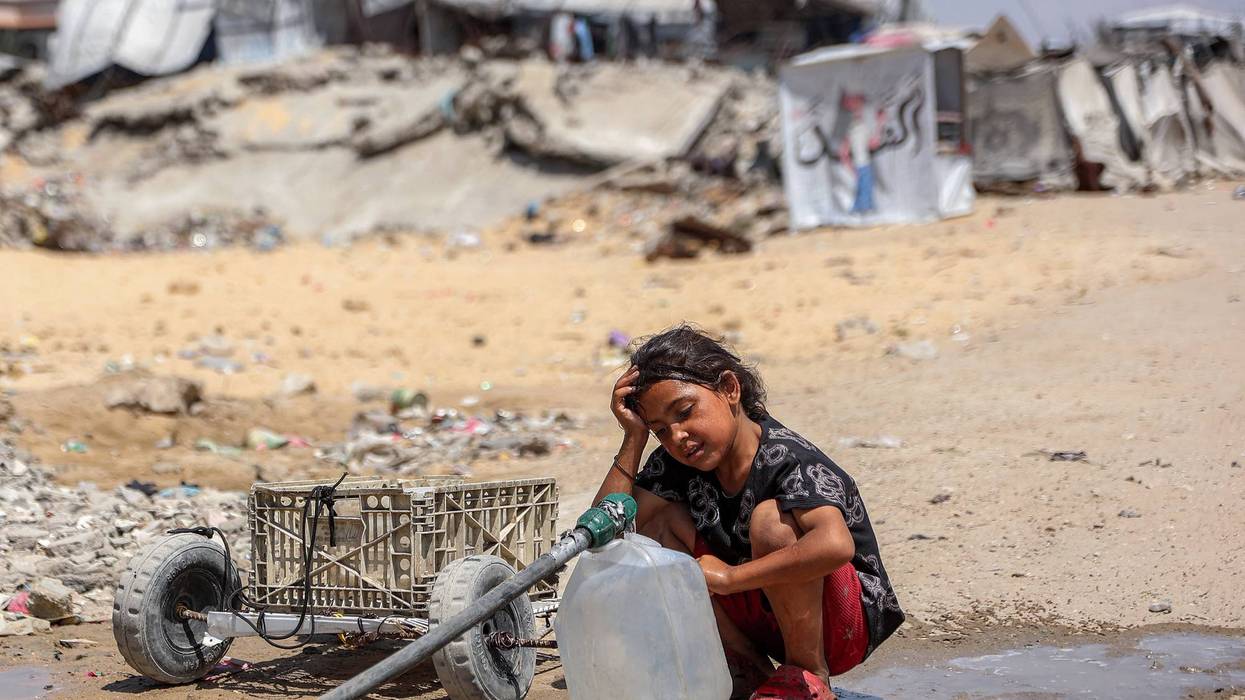
"This station was one of the most important remaining sources of clean water in Gaza City," said an activist who has used it to supply desperate families.
As Gaza is gripped by a water crisis, Israel has reportedly attacked a facility that provided safe drinking water to thousands of families in Gaza City.
Tamer Nahed, a journalist and activist with the recently created humanitarian group Sake For Gaza, reported via social media on Monday that his group had been forced to suspend its efforts to provide clean water to some of Gaza's most dangerous areas after the facility they partnered with was "directly struck, resulting in the deaths of several people and injuries to others working there."
Middle East Eye reported on Monday that the attack, east of Gaza City, "struck a gathering of displaced people in front of a water refilling station" and killed two people as Israel shelled the city early on Monday.
The Palestinian outlet Al-Quds said the attack "directly targeted civilians as they stood in front of a water filling station" in the Al-Samar area, and was "part of a series of attacks launched by the occupation forces against civilian gatherings and vital facilities in the besieged areas of the Gaza Strip, exacerbating the already deteriorating humanitarian crisis."
Under international law, deliberately attacking civilian facilities or those that are essential for survival, like water facilities, is considered a war crime.
Israel has destroyed or damaged nearly 90% of water and sanitation infrastructure in Gaza, according to Doctors Without Borders (MSF), which says the military has used water as a "weapon" in its genocidal war against Gaza.
The group has documented the military firing upon clearly marked trucks and destroying boreholes and desalination plants relied on by thousands of residents. The group has also documented attacks on civilians accessing clean water.
A late-May report from the UN Children's Fund (UNICEF) found that around 82% of families in Gaza remain water insecure, and up to 70% are unable to collect even six liters of water per person each day. A person needs between 50 and 100 liters of water per day to meet their most basic needs, according to the World Health Organization.
Monday's attack came less than an hour after Nahed announced that the group's 11th truck had "reached one of Gaza’s most dangerous areas, carrying 5,000 liters of fresh drinking water."
The group had been attempting to send one truck per day to families living in tent cities, many of whom have been forced to rely on groundwater and contaminated water in order to survive, leading to serious illness.
Nahed said he and his team "truly risked our lives to reach this place, as it is located very close to military deployment areas, and the road was extremely dangerous at every moment."
He called the attack on the water supply facility "very heartbreaking news" and said as a result, "we have been forced to suspend our water distribution project until further notice."
"This station was one of the most important remaining sources of clean water in Gaza City and served as a lifeline for thousands of families, especially after most other water stations had stopped operating," he said. "We are deeply saddened by the loss of life and by the suspension of a project that was providing clean drinking water to people enduring these extremely difficult conditions."
Monday's attacks were some of the latest of Israel's near-daily strikes despite October's ceasefire agreement. Israel has expanded its control over the Gaza Strip in recent months, with Prime Minister Benjamin Netanyahu saying last week that the military “will not withdraw from the territory" as the agreement requires.
He added on Sunday that unless Hamas fully disarms, there also would be "no reconstruction in Gaza without dismantling and demilitarizing the strip."
Netanyahu described the occupation zone as a "new Gaza envelope inside of Gaza," a term that could refer to permanent occupation or annexation, as the term "Gaza envelope" refers to the communities inside Israeli territory near the Gaza border.
Other ministers in Israel's far-right government, including Finance Minister Bezalel Smotrich, have called for Israel to complete the "conquest" of Gaza and move Israeli settlers to replace the Palestinian population.
A recent proposal by the "Board of Peace," led by US President Donald Trump, conditioned the entry of basic humanitarian supplies, including shelter-building material, reconstruction aid, and other life essentials, on the total disarmament of Palestinian militant groups.
Last week, the United Nations Office for the Coordination of Humanitarian Affairs (OCHA) warned that “the continued expansion of areas under Israeli control in Gaza since the ceasefire agreement in October 2025 is intensifying risks to civilians and further constraining humanitarian efforts."
“Humanitarian access remains severely constrained due to restrictions on movement, which results in delays or pauses in lifesaving activities,” the statement said. “Some partners have had to scale down or temporarily suspend lifesaving activities, particularly following the killing of service providers in those areas. This has affected up to thousands of families in the vicinity.”